It’s hard to believe, but the Russian “justice” system has just outdone itself.
Oleg Orlov
Here’s a headline from AP News dated December 14, 2023:
“Court voids fine given to Russian activist for criticizing war . . .” Gee, that’s sounds great, so far.
“ . . . and sends case back to prosecutors.” Oh, no! Why would they do that?
Let’s look at what happened to get Mr. Orlov in front of the court in the first place. To begin with, this pleasant-looking, grandfatherly gentleman is co-chairman of the Nobel Peace Prize-winning human rights group Memorial. But he was charged and convicted of publicly discrediting the Russian military when he posted an article on Facebook criticizing the invasion of Ukraine.
Oh, that’s not good. In fact, that’s now a serious criminal offense in Russia; one simply does not criticize the military, the government, or any member thereof. Not if one values one’s freedom, one doesn’t.
Anyway, Mr. Orlov must have thought he’d gotten off easy when a lower court simply fined him 150,000 rubles — the equivalent of about $1,500 — instead of a lengthy prison term such as others have received for similar infractions. But that’s still a lot of money, so Mr. Orlov and his attorneys appealed the sentence. And that was when they found out — and here’s where the WOW! factor comes in — that the prosecution had also appealed it, demanding that the fine be set aside and the sentence be changed to three years in prison. Their reason? The prosecutors said that investigators “failed to take into account Orlov’s motive.” [Dasha Litvinova, AP News, Dec. 14, 2023.] Thus, while the conviction would stand, the severity of the punishment was considered insufficient.
Now, I personally have never heard of a prosecutor appealing a conviction . . . much less overruling a judge. But I’m an American, and we have legal protections against things like double jeopardy. In the Russian judicial system . . . well, not so much.
A Defendant’s Place In the Courtroom
The Moscow City Court unsurprisingly sided with the prosecution and remanded the case — not to the lower court, but to the prosecutors! — “for revision,” thus nullifying the earlier verdict and canceling the fine. Mr. Orlov is quoted as having said in court:
“In my view, the authorities are afraid. So afraid of the free will of the people that they destroyed the institution of elections, that they prohibited holding any kind of demonstrations for various bogus reasons, so much so that they imprison people over words.” [Quoted by AP News from independent Russian news site Mediazona.]
Mr. Orlov is said to have brought a bag of personal belongings with him to court in case he was jailed immediately. Because that’s what you do in Vladimir Putin’s Russia.
The report ends there. I assume there will be a second trial for Mr. Orlov, the outcome of which is pretty much a foregone conclusion. I’m sure he’ll have that bag with him then, too.
It’s Christmas week — in fact, it’s the month of happy holidays — and the news headlines have been so grim (earthquake in China, volcano eruption in Iceland, floods up and down the U.S. east coast, you name it), that I’ve had to go searching for something cheerful to write about. And I can’t find it. Russia is still trying to destroy and capture Ukraine; Israel and Hamas are still trying to destroy each other; and Donald Trump is still trying to convince the world he’s presidential material.
Iceland Volcano, 12/18/23
So in desperation I’ve turned to CNN’s “Style” and “Entertainment” sections. And even there I found a few items about people who have sadly passed away just before ushering in 2024, some films that have bombed, and one woman whose intestines nearly exploded (but happily, she’s recovering nicely).
I did manage to pick out a few headlines that sounded interesting, so I thought I’d toss them at you for your reactions. Maybe they’ll induce a chuckle or two out of someone.
First, from CNN Style, December 18th:
1) The Meaning Behind Pantone’s Color of the Year 2024. I’ve been holding my breath all year for this unveiling, as I’m sure you have. And at last, here it is: it’s “Peach Fuzz” — a soft color, chosen because “it conjures peace and serenity.” And Heaven knows, we all need a little of that. So everyone run out and buy some clothes in pale peach, and redecorate at least one room in a dreamy pastel color brought back from the 1960s. And be prepared to do it all over again next year, in a color that will undoubtedly conjure chaos and mayhem.
Pantone’s Color for 2024
2) Italian Designers Are Using Fruit Peel To Make Furniture. I didn’t even bother to read this one. I’m all for recycling, but this just conjured an image of my pet otter nibbling at the furniture . . . while I’m sitting on it.
3) A Space For Humans and Pigeons To Share Is Among the Highlights of Dubai Design Week. Okay, this one requires explanation. First, it’s not a residence; it’s a shade shelter, inspired by “the historical significance of pigeon towers in the Arabian Peninsula, where buildings that often featured beautiful arches and detailed engravings were built to protect pigeons during harsh weather and collect their feces for use as fertilizer, as well as showcasing the wealth of the tower’s owner. [The new design] features pigeon nests at the top of the oblong structure, while three arched entrances at the bottom welcome human visitors. The sections for humans and pigeons are separated, and bird feces collected from the top section will be used as fertilizer for plants in Dubai’s Design District.” Well, that’s a relief! But I once had two pigeons take shelter for the winter in a corner of my balcony where I had stored my outdoor furniture under a tarp. When I found them in the spring, they were decidedly dead, frozen solid, and their poop — also frozen — was scooped up, by me, to become garbage, not fertilizer. I want nothing more to do with pigeons, thank you.
One for adults, one for children?
4) People Are Making Furniture Out of Cardboard. Furniture seems to be a big item this year. But seriously, haven’t homeless people been doing this for eons? I think they should be given credit — and a share of the profits — for having started the trend.
5) A Guitar Maker Finds Music in Mushrooms. Didn’t read this one either; methinks this fellow has mistaken the magic mushrooms of his happy hippy days for musical mushrooms in his golden years. Peace out, friend.
6) Gen-Z Is Already Worried About Looking Old. Well, welcome to my world, you spoiled little brats. I’ve got a news flash for you: It doesn’t make a damn bit of difference how much healthy food you eat, how much you exercise, or how much plastic surgery you have. You’re going to get old eventually, unless you die young. Take your pick.
Laugh now, kids. Your time will come.
*. *. *
I’m sorry to say, I found even less inspiration in the Entertainment section, but here are a couple of items of some minor interest:
1) Eddie Murphy Is Back As Axel Foley In Beverly Hills Cop 4. No disrespect, Eddie, but aren’t you and the rest of the regular cast a little slower than you were 30 years ago, when No. 3 was released? Though if Indiana Jones can keep going, I guess Axel Foley can too. Good luck to you.
2) Taylor Swift and Her Dad Cheer On Travis Kelce At Chiefs Game. Let’s move on . . . there’s nothing new here. I just included it because no column on entertainment would be complete without you-know-who.
One More Pic For the Swifties
3) Why Cher Says She Doesn’t Want To Be In the Rock & Roll Hall of Fame. Honestly, I don’t care one way or the other. But here she is . . .
Uhhh . . .
*. *. *
Well, I tried; I can’t help it if the good news isn’t all that great. It’s still better than the daily gloom-and-doom . . . but not much.
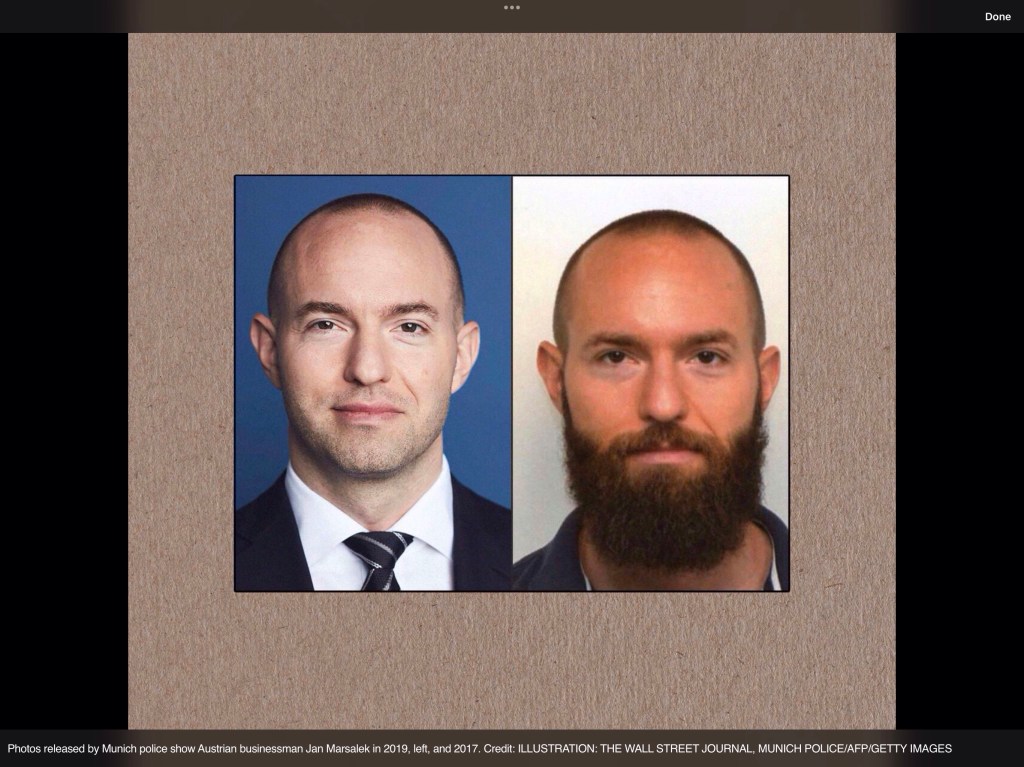
I have no idea how many satchels or suitcases it would take to hold $1.9 billion; but I’m reasonably certain that Austrian businessman Jan Marsalek, former Chief Operating Officer of now-defunct payment processing company Wirecard, didn’t literally try to run off with that kind of dough in hand. What he is accused of doing is stealing — and redistributing in a most unorthodox manner — hundreds of millions of dollars from his company’s investors, and then vanishing.
Jan Marsalek, in 2019 (left) and 2017, [from the Wall street Journal/Munich Police/AFP/Getty Images]
Being able to embezzle that kind of money without being detected is, to me, mind-boggling in itself. But that’s not what really blows my mind about Mr. Marsalek’s tale. It’s the back-story that I find most fascinating. Because, you see, “Western intelligence and security officials now say they have reached the unsettling conclusion that Marsalek had likely been a Russian agent for nearly a decade.” [Bojan Pancevski and Max Colchester, Wall Street Journal, Dec. 15, 2023.] That is decidedly one very sneaky fellow.
For further details on Mr. Marsalek’s background, as well as the formation and rise of Wirecard to incredible heights, I suggest you read the WSJ article. My focus is on Marsalek’s transition from COO of a company that claimed to have processed $140 billion of transactions a year to being “[o]ne of the most wanted men in the world.” [WSJ, Dec. 15, 2023.]
According to former associates, Marsalek was “obsessed with the . . . world of espionage,” even implying to them that “he had connections with intelligence officers.” He is said to have kept a statuette of Vladimir Putin on his desk. And now, British prosecutors say that between 2020 and 2023, “Marsalek ran a ring of five U.K. based Bulgarians who are alleged to have spied for Russia, directing them to gather information on people with the aim of helping the Kremlin abduct them.” He was the go-between who enabled the Russian intelligence services to avoid direct contact with the Bulgarian agents. [WSJ, Dec. 15, 2023.]
The Faceless One
So what happened to Mr. Marsalek after 2020 when he and the $1.9 billion were no longer to be found, and Wirecard had declared insolvency? It seems he traveled by air to none other than Russia’s ally, Belarus, and was driven from there to Moscow, where he was given a Russian passport under a false name. He is believed to be spending considerable time in Dubai, where he has worked with “a retired Russian intelligence officer based there who has been acquiring weapons for Moscow.” The government of the United Arab Emirates has not responded to requests for comment. [WSJ, Dec. 15, 2023.]
I could go on quoting from the Wall Street Journal article, but that would be pointless. Again, I invite you to read the whole convoluted story for yourselves — you will be gobsmacked, as the British are fond of saying, at the nerve . . . the chutzpah . . . the out-and-out balls of this man, who is now wanted in multiple countries for the most outlandish criminal acts imaginable, committed under various names and using different passports.
It does not appear that Marsalek is solely responsible for the entire $1.9 billion missing from Wirecard. In fact, Wirecard’s CEO, Markus Braun, has been charged with fraud and other crimes, and is currently being tried; he of course denies the charges and has pled not guilty.
Markus Braun
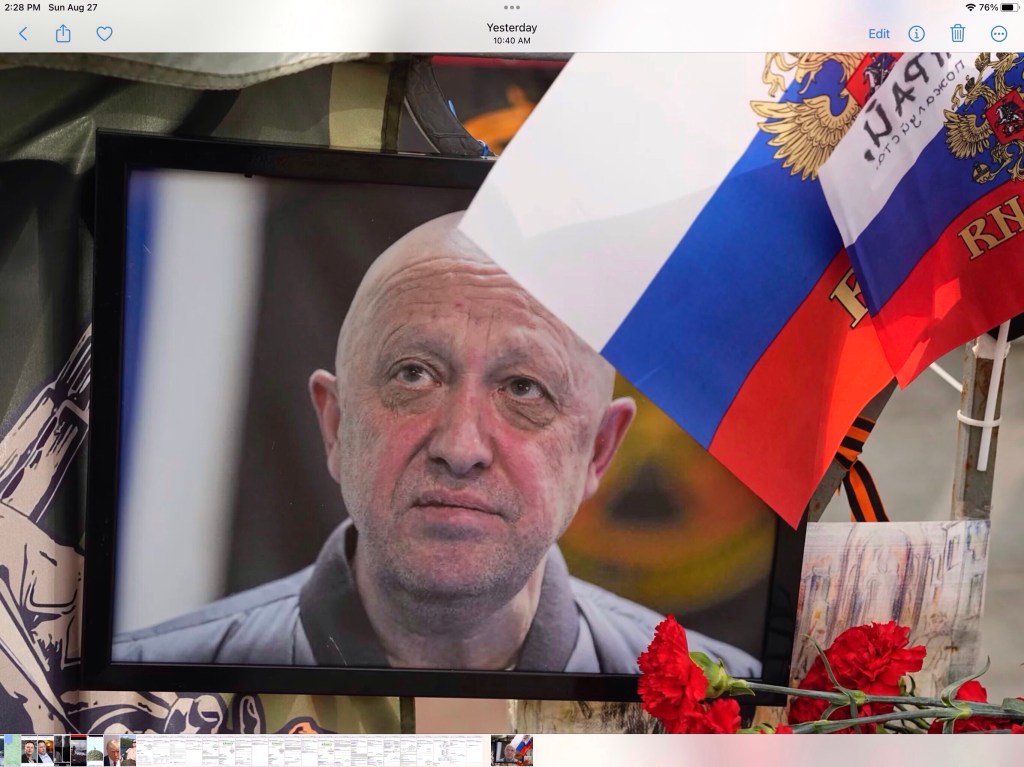
But what did Marsalek do with the funds he did manage to siphon from the company? Well, besides the whole Bulgarian affair, he is accused — while still running Wirecard — of having funneled money for Russia’s GRU and SVR intelligence agencies to their agents in conflict zones in the Middle East and Africa . . . possibly including to the notorious, and now deceased, Yevgeny Prigozhin and his still active band of merry mercenaries.
Yevgeny Prigozhin
The Russian government, of course, denies any relationship between its intelligence services and Marsalek, and calls allegations of any such connection “politicization.” Well, now, there’s a surprise!
*. *. *
My big takeaway from this whole messy tale is not so much the disastrous end of what was once a hugely profitable multinational company. I’m much more concerned with the behind-the-scenes involvement of the COO of that company with — and financial assistance to — Russia and its spy organizations, both official and unofficial, domestic and foreign.
During the Cold War, we all heard stories of Americans and others in sensitive positions spying for Russia and other adversaries — people such as Aldrich Ames (CIA), Robert Hanssen (FBI), Edward Lee Howard (CIA), et al. But the ones who are caught are just the tip of the iceberg. How many others, like Jan Marsalek (Austrian), have continued operating below the surface even to the present time, providing vital information and hands-on assistance to a country that is openly attempting to reclaim, one by one, the countries of the former Soviet Bloc? We’ll never know for sure.
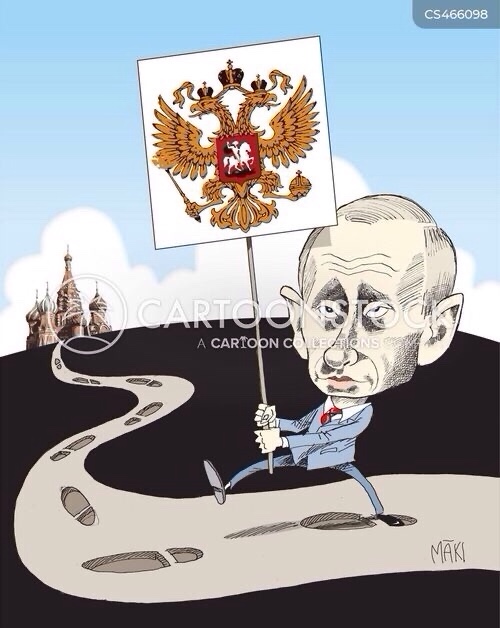
Rebuilding the Russian Empire
What we do know — and must never close our eyes to — is that virtually every recent conflict in, and every incursion into, any country in Eastern Europe, the Middle East, Africa, and even Latin America eventually seems to trace its roots back to, or have some connection with, the Moscow Kremlin.
Am I being paranoid?
Only if I’m wrong.
Marsalek’s story may read like a parody of a James Bond movie; but the ending is not pre-ordained as the films are, and its entertainment value is zero. It is, in fact, the stuff of my nightmares.
As of this date, the whereabouts of Alexei Navalny are still a mystery. Russian judges have halted seven hearings “until [Navalny’s] whereabouts [is] established,” his lawyers said. [Andrew Roth, The Guardian, Dec. 18, 2023.]
Alexei Navalny, June 22, 2023
He has not contacted his attorneys in nearly two weeks. Ironically, a hearing that failed to take place as scheduled last Friday was to be held on the subject of violations of Navalny’s human rights while in detention. Prison authorities say only that he is no longer at that penal colony in the Vladimir region, and is not at any of the nearly 200 pre-trial detention centers that have been contacted. And the Kremlin has “neither the intention nor the ability to track the fate of prisoners,” according to spokesman Dmitry Peskov. The United Nations has said his absence amounts to a “forced disappearance.”
Melekhovo IK-6 Penal Colony, Vladimir Region, Russia
The cancellation of the judicial hearings today is just the latest indication that something dire has happened to Navalny — that, as his lawyers fear, he “could be muzzled or even killed as Vladimir Putin has announced plans to extend his rule for a fifth presidential term.” At the very least, he may have been transferred into a “special regime” colony, in which case he could be held incommunicado for years under Russian law. [The Guardian, Dec. 18, 2023.]
Earlier this month, Navalny was hospitalized after collapsing due to poor sanitation and nutrition at the Melekhovo IK-6 prison where he had been held and from which he has since disappeared. His appearance, as shown in a photograph (above) taken in June of this year, is pale, gaunt and sickly as compared to the Alexei Navalny we remember from less than three years ago — even after having survived the poisoning that nearly killed him.
Alexei Navalny is Putin’s most viable opponent in the presidential election scheduled on March 15-17, 2024. If he dies while in the custody of the Russian prison system, Vladimir Putin will, as always, shrug it off as being the fault of some low-level prison officials. But the world — and the Russian people to whom Navalny is a hero — all know better. Alexei Navalny’s fate is in the hands of none other than Vladimir Putin himself; and allowing the worst to happen to Navalny could prove to be the biggest mistake of Putin’s career.
Washington, first week of March 1994: Things were not going well. With word out that Shvets’ book was about to be released, the press was expected to engage in one of its usual feeding frenzies, and I knew I had to take preemptive action; I couldn’t let my Russian contacts find out about my involvement from a news release. So I went to see Natalya at the Embassy. She was expecting to hear about the conference in Malta; what she heard instead appeared to send her into shock.
Natalya Semenikhina was an exceptional woman: smart, efficient, attractive, with a natural charm and warmth that made her perfect for her position in the Cultural Section of the Embassy. And she had been extremely helpful to me in working toward the creation of my U.S. training program and establishment of a business school in Moscow. I genuinely liked and respected her, and had enjoyed working with her. And now I had to try to salvage our relationship — and all of my hard work and dreams — without betraying the two people to whom I owed a professional responsibility . . . whether they deserved it or not.
She and I sat facing one another over tea in one of the Embassy’s formal meeting rooms, talking first about Malta, the people I had met there, the business opportunities, etc. Then I said I had something else to discuss with her . . . something quite serious. And as I related the story of my meeting the year before with Aksilenko in Moscow, his revelation as to his friend’s tell-all book, their subsequent “relocation” to the United States, and the imminent publication of the book, her face paled and her expression turned to one of total horror. Although I stressed the strictly commercial nature of my relationship with them, I could see clearly that she knew exactly who they were and what was at stake. And, for the first time in all the months I had known her, she was speechless.
Finally composing herself, she said that this was completely outside her purview, and that she would have to discuss it with someone else. At that point, I’m not sure she even knew whom to go to, but she did know she couldn’t deal with it alone. She said she would call me to set up another meeting, and I left the Embassy with a sinking feeling that my work in Russia was about to come to an end. My one hope might be to cut short my working relationship with Aksilenko and Shvets, and perhaps even to forfeit my financial interest in the book. I would have to give that some thought while I waited to hear from her, but I wasn’t optimistic — you can’t unring a bell.
She called the very next day and asked me to come to the Embassy on the day after that. Her voice left no doubt that she was under serious stress. As concerned as I was for my own situation, I also felt regret that it had become necessary for her to be involved — she had had nothing to do with any of it.
The next morning I arrived at the Embassy to be greeted by a very somber Natalya. There was no tea service in the meeting room that day — a bad sign from the normally hospitable Russians. Her speech was hesitant, and had obviously been carefully rehearsed. All of the public rooms in the Embassy were assumed to be bugged, probably even wired with cameras; so I was sure she was being careful to say everything she’d been instructed to say, and nothing more. I, on the other hand, had no idea of what to expect. For me, this was going to be like amateur night at the Improv.
Natalya told me she would normally have arranged for me to meet with a Mr. Lysenko — the name was unfamiliar to me — but that he had returned to Moscow just a few days earlier. So she had talked with someone else in his department, and that person had suggested that I should prepare and submit to them — now check this out — a written statement detailing the history of my relationship with Aksilenko and Shvets, from beginning to end, leaving nothing out: everything I knew about them, everything they had ever told me, everything about the contents of the book, my business arrangement with them, and where they were and what they were doing now. Then, and only then, could my own situation be reevaluated and given careful consideration.
Momentary silence . . . deep breath . . . then . . .
“You’re kidding . . . right??!!!”
Okay, so I didn’t actually laugh. But oh, how I wanted to! Did they really believe for one moment that I would even consider delivering to the government of any country — let alone an adversarial one — any information that could conceivably be used against American interests? Did they think I was personally low enough to sell out another human being (or two)? Or that I was stupid enough not to realize that anything I might give them would go directly to the Russian Foreign Ministry as well as KGB Headquarters, and could potentially reach all the way to the Kremlin itself? And did they also believe I was weak enough or greedy enough to simply break down and submit to their transparent attempt at coercion?
Actually . . . yes, I suppose that is what they thought. Well, then . . . they clearly had no idea of what kind of person they were dealing with!
Of course, I kept all those thoughts to myself, and somehow managed to remain calm. I briefly considered keeping them hanging for a couple of days by telling Natalya I’d think it over and get back to her. But no . . . there was nothing to think over, and I wanted them to know that. So what I did say was that — for better or worse — Aksilenko and Shvets were my clients in a publishing venture, and that it would be professionally unethical and personally reprehensible (my exact words) for me to betray them in the manner her people were suggesting. Bottom line: a flat-out “Nyet!”
As I spoke, Natalya almost seemed physically to deflate. She had failed, and she looked worried, even frightened. Then she stood up, whispered something that sounded vaguely apologetic . . . and I was politely shown the door.
*. *. *
Walking down 16th Street away from the Embassy, I knew that I, too, had failed in my efforts to guide some of Russia’s middle class into the approaching 21st Century. But they would manage without me and my business school; the Russian people always did, somehow. In a different sense, though, I knew I had succeeded. I had stood my ground, refused to be intimidated, and had managed to preserve my principles of honor and decency. I was, in human terms, the clear winner.
“Ta-da!!”
When I reported all of this to Eric later that day, he told me that the man I was supposed to have met — Aleksandr Lysenko — was well known to the FBI: he had been the rezident, or chief of station, at the Russian Embassy for several months. In other words, the top KGB agent in Washington. He had been expelled from the U.S. just days earlier for his role in running the CIA turncoat Aldrich Ames. The fact that I was intended to have met with a person of Lysenko’s rank clearly indicated how seriously the Russians were treating this whole situation. On the one hand, I was obviously relieved that a meeting with him had been averted; but on the other hand, I thought it might have been an interesting experience . . . in a rather perverse way. But that’s one more thing I’ll never know.
Aldrich Ames and Aleksandr Lysenko — two men I didn’t know, and had never even heard of before they made the news just a few days earlier — had somehow, indirectly, invaded my life and changed it forever. Unbelievable!
*. *. *
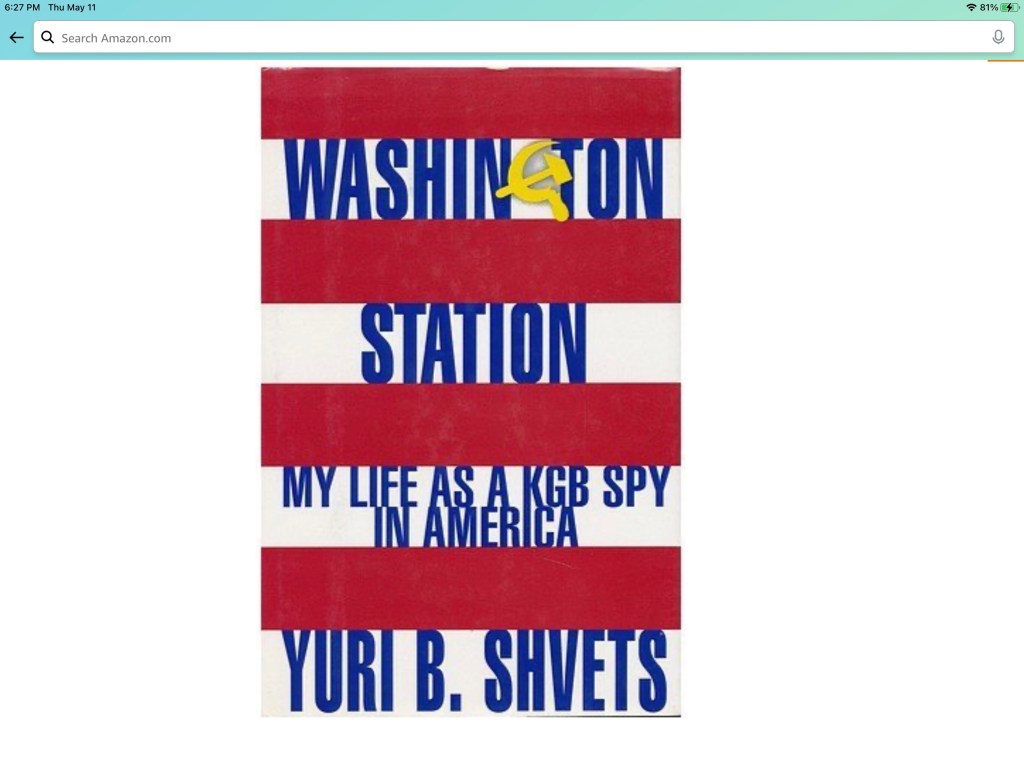
In April of 1994, Shvets’ book, Washington Station, was finally released.
The Root of the Trouble
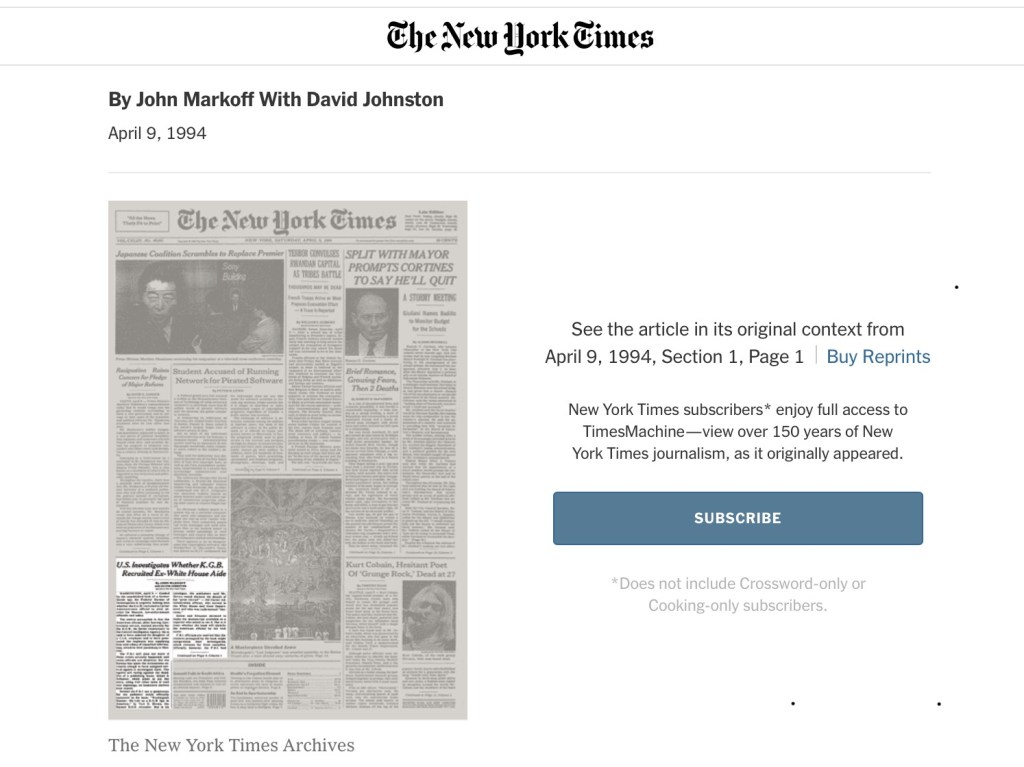
On April 9th, an article by John Markoff and David Johnston appeared in the New York Times about the book, about Yuri Shvets himself, and about my role — not entirely accurately presented — in having brought Shvets and his colleague, Valentin Aksilenko, to the United States the previous year. But the article didn’t stop there. It went on to suggest a possible connection between the arrival of the two men in the U.S. for ten days in April-May of 1993 and the opening of the FBI’s official case against Aldrich Ames on May 12th, just one week after their departure on May 5th.
And as I read that article, a comic-strip lightbulb lit up over my head. It all began to make sense, in a totally convoluted, nonsensical way. All of the attention from the FBI at home and the KGB and Militia in Moscow; the “watchers” and “Good Samaritans” repeatedly showing up during my travels; the ease with which the two former KGB spies had gotten back into the U.S. — it hadn’t been my imagination at all.
No . . . I was just a person who had been in the right place at the wrong time — not really involved, but ultimately the one who had been used to tie the various strings together. Metaphorically speaking, I had become a pawn in someone else’s political chess game, and now, at the end of that game . . . well, now I was simply collateral damage.
You just can’t make this stuff up!
*. *. *
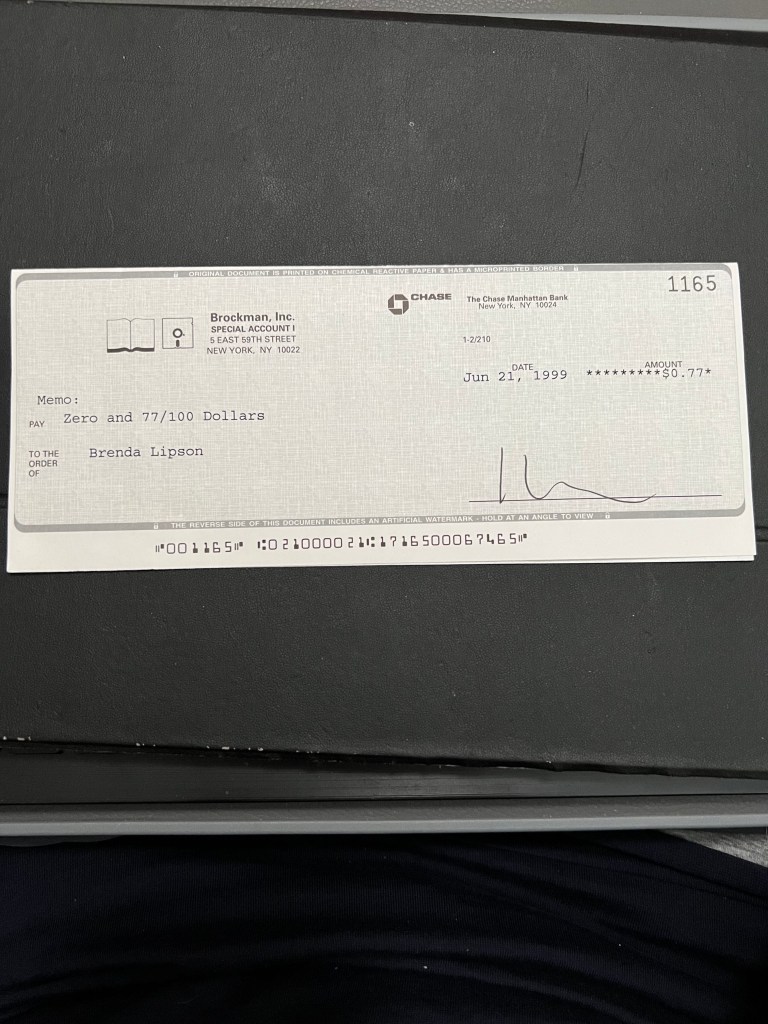
There’s more — lots more — that I really don’t need to go into here. But there is an interesting footnote. Because of the brouhaha surrounding Aldrich Ames’ arrest and eventual conviction and sentencing on charges of espionage, Yuri Shvets’ book could not have hit the stands at a worse time. It was totally overshadowed by the bigger story. The first — and only — printing was smaller than originally planned, and didn’t do well. It was withdrawn from the bookstore shelves before most of the world even knew it was there. Other than my small percentage of their advance payment, my only royalty check arrived in the mail a full five years later, in June of 1999, in the amount of . . . drumroll, please. . . seventy-seven cents ($0.77). As I stood by the wall of mailboxes in the lobby of my apartment building and opened the unexpected envelope from Brockman, Inc., I burst out laughing — so hard, and so loudly, that several passing neighbors thought I’d lost my marbles. I managed to choke out “I’m okay,” and continued laughing all the way to the elevator, up to the third floor, and down the long hallway to my apartment.
I still have that check, and it still tickles me to look at it.
Don’t spend it all at once!
*. *. *
So how does it all end? Am I going to leave you hanging after dragging you around Europe with me for half a year, wondering why I’ve bothered writing all of this stuff? No . . . of course I wouldn’t do that to my loyal readers. So, see you next time for the grand finale.
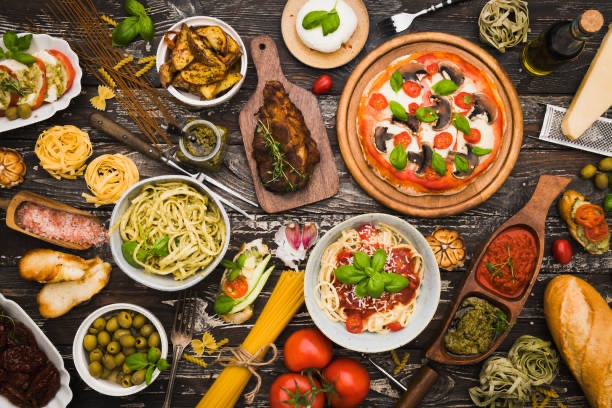
February 25, 1994: Homeward bound once more, and happily not on Aeroflot this time. But because my original booking had been through Rome, returning the same way turned out to be the least expensive route, even though there was no connecting flight and it meant an overnight stay in Rome. I had reserved a room at a small hotel near the airport and arrived around 11:00 p.m., well after the hotel’s dining room had shut down for the night. But one of the benefits of a boutique hotel is the personal attention they are able to pay to their guests, and this one was no exception. The concierge found a person still in the kitchen who was able to prepare some of the food that hadn’t been served at dinner, and delivered my light meal to me personally. It was delicious, and with a glass of Chianti to wash it down, I was able to sleep like a baby.
Italian Snack
I awoke early the next morning — Saturday the 26th — in order to catch the hotel’s shuttle bus to the airport. As I was dressing, I again tuned in to CNN, this time to learn that there had been yet another shooting incident in Hebron, a Palestinian city in the West Bank of Israel. Would they never stop?!! I wondered. It was an ongoing tragedy; but as an American who lived geographically far removed from the problems of the Middle East, and this being years before acts of foreign terrorism reached our shores, I never thought of the effect it might have here in Italy. That is, until I got to the airport . . .
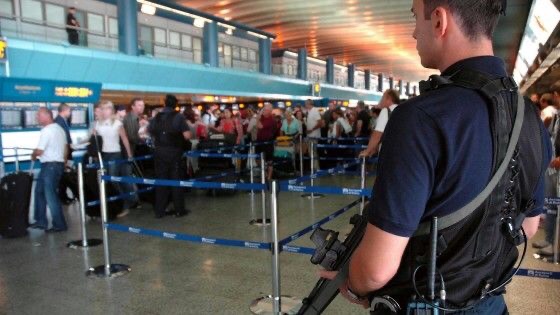
The lines in the terminal appeared endless. They snaked around the inside of the building to every airline counter, including mine. The police and military presences were heavy and heavily armed, many accompanied by their canine partners. This was Europe, where they had suffered their fair share of terrorist attacks; and I had forgotten that when things heated up in the Middle East, the response here was immediate . . . and impressive. So I found my line and waited as the security officer worked her way toward me.
Airport Security – Rome, Italy
When she finally reached me, she began by asking the usual questions: “What was the purpose of your visit to Rome, and how long were you here?”
Answer: “Overnight, just transiting.”
Logical next question: “Transiting from where to where?”
Oh-oh. My answer — “Moscow to Washington” — was clearly going to set off some alarms. And did it ever! Her next questions concerned the purpose of my visit to Moscow, where I had stayed and for how long, whether my luggage had ever been out of my sight, whether anyone else might have had access to it . . . And when I answered truthfully that I had stayed in an apartment and that yes, others had been alone with my bags for a while, she very apologetically said she would have to perform a search of my luggage. I responded that it was no problem, as long as I didn’t miss my flight, which she assured me would not happen.
And I said a silent prayer of thanks that I had had the good sense not to take Shvets’ $3,000, and even more so his son’s passport, from his mother. This was exactly the sort of thing I had been afraid of, although I certainly could not have known there would be an overnight Middle East problem. But there are many possible reasons for a baggage search — even a simple random check — and it was almost as though Mama Shvets had been hoping for that when she loudly insisted that I could hide the passport under my clothing. The things I thought about her and her precious son in those moments do not bear repeating, but I’m sure they’re not difficult to imagine.
Not My Finest Moment
In any event, the search was quick and respectful. Security officers are trained to read people’s reactions and body language, and I suppose she could sense that I wasn’t hiding anything. When she finished, she even took me up to the head of the line to be checked in, as a sort of apology for the inconvenience. The plane was boarded on time, and off we went.
I had a seat mate this time: an American woman, 40-ish, well-dressed, professional-appearing — someone I thought I might enjoy chatting with. But she was as silent as the American man on last summer’s Aeroflot flight. My usual get-acquainted questions — was this your first visit to Italy? business or vacation? what line of work are you in? — met with non-responsive, monosyllabic answers. She clearly did not feel like talking. I didn’t want to be intrusive, so I resigned myself to a long, quiet flight ahead and settled in with the book I had brought, thinking she might be more willing to talk a bit later. She wasn’t. We landed at Dulles on time, and she walked away without a word. So much for the friendly skies.
The next day, all hell broke loose.
Well . . . maybe not this bad.
First, there was Yuri Shvets to deal with. He was anxious to receive whatever his mother had sent back for him. The FedEx envelope with the passport was already en route (and actually arrived a couple of days later); but when he saw that I had brought only a letter and no money, and that most of his gifts for her had not made it into my luggage in the first place, he was livid . . . which was nothing compared to what I was feeling. I told him in minute detail of his mother’s performance and how irresponsibly, and even recklessly, she had behaved. His excuse was, again, that she was just a “simple Russian woman,” to which I replied, “Bull shit! She’s the mother of a KGB Major. Don’t tell me she doesn’t know how to behave in public.” I also let him know what had happened at the Rome airport. The conversation deteriorated from there, and I stopped just short of accusing him of trying to set me up — only because I had no proof. And because I was alone in my apartment with a very angry man. He finally took the bag and the letter and left, slamming the door behind him. I never saw or spoke to him again.
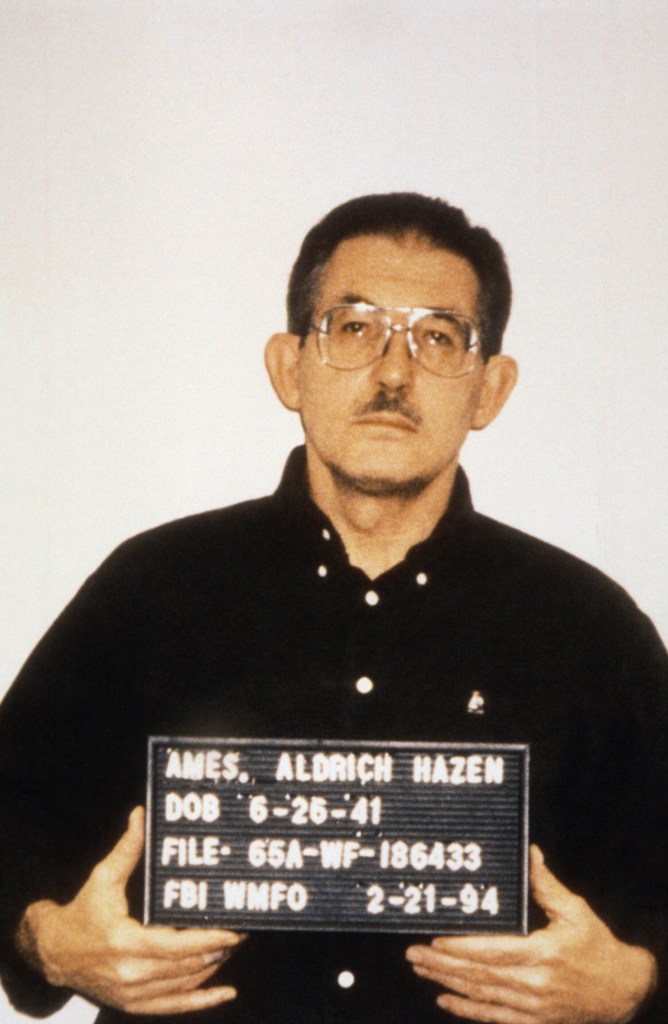
I called Eric on Monday to let him know I was safely back, and we made plans to get together in a day or so. In the meantime, I had caught up on the national and local news, which turned out to be full of the story of the CIA agent who had been caught spying for the KGB: Aldrich Ames, the man I had first heard of on CNN in Moscow. Folks there had shrugged it off as just another remnant of the Cold War; but here at home it was a big deal. Still, it had nothing to do with me.
Well, at least not directly, it didn’t. But as I read the details of his arrest, and the FBI’s actions in the days leading up to it, I realized that the coincidence in timing between that activity and my pending travel to Moscow was more than a little interesting. It was reported that Ames had been part of a CIA team scheduled for an official visit to Moscow, due to leave Washington on February 22nd — the very middle of the time I was also to be in Moscow — and that his arrest had been set for the 21st in order to forestall his leaving the country. But again I wondered: so what? I hadn’t even known the man existed.
Aldrich Ames
And I had my own problems. Shvets’ book was soon to be released, and John Brockman was talking about pre-release publicity. My name was tied to both Shvets and Aksilenko, and I knew it was time to do damage control with Natalya at the Russian Embassy. This was not going to be pleasant . . .
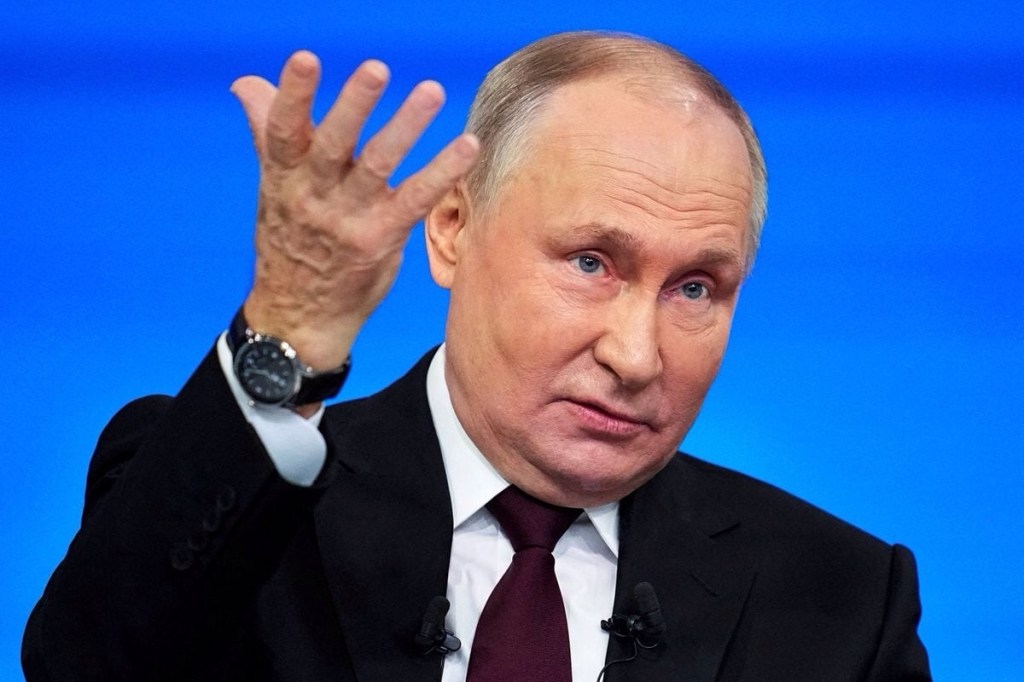
Putin’s annual press conference in a nutshell: The “special military operation” in Ukraine will continue until we have attained our goals; the prisoner swap will take place when our demands are met; and the appropriate government officials will fix the price of eggs “in the near future.” How enlightening! How hopeful for the coming year!
What a load of crap!
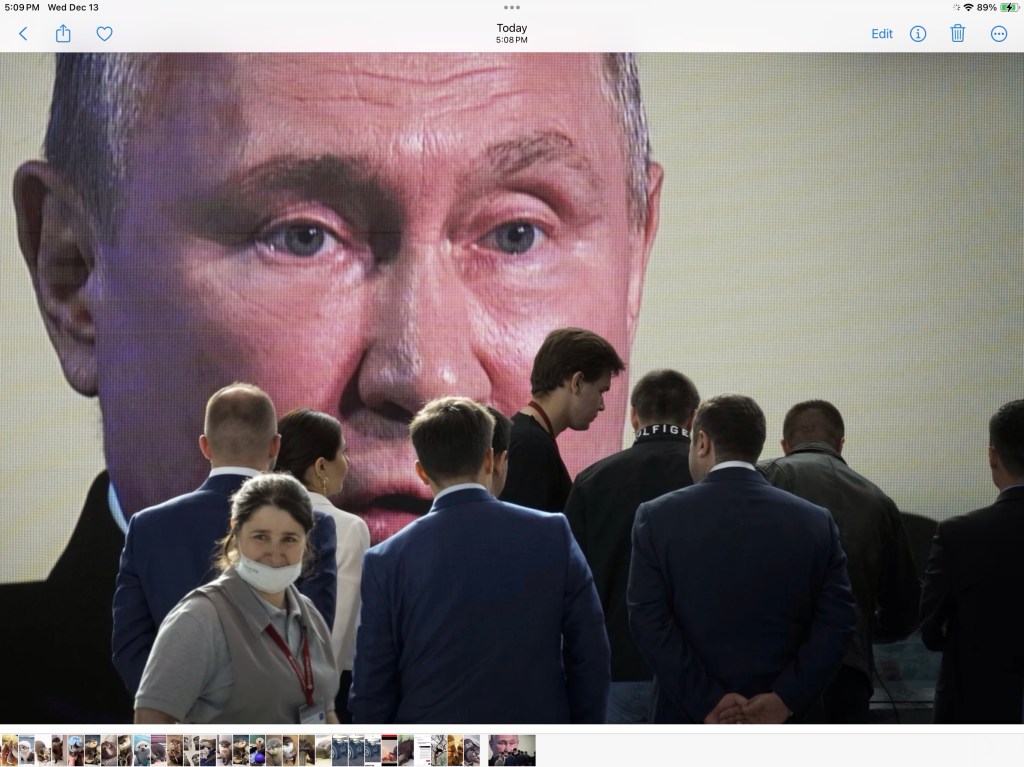
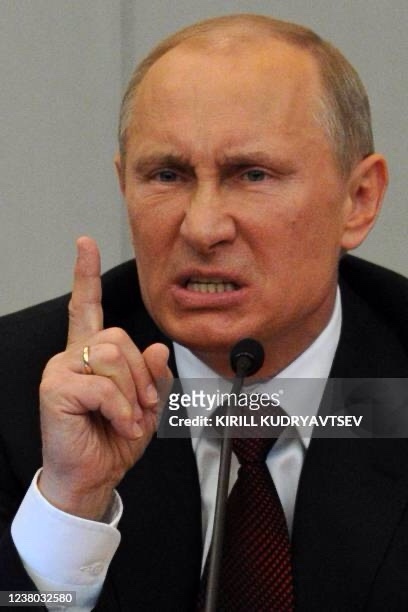
Would you buy a used car from this man?
For anyone who follows the news from Russia, there is nothing new here. The commander-in-chief of Russia’s seemingly inexhaustible troops continues to exude complete confidence in his country’s ultimate victory — despite refusing to acknowledge that he’s talking about an actual “war.” And with the passage of time, as Western support for Ukraine sadly diminishes, his confidence grows. He now says that there is no need for a second mobilization of reserve troops, due to “a steady influx of volunteers.” [AP News, Dec. 14, 2023.] Well, maybe . . . we shall see. In the meantime, Ukraine’s future hangs by a thread.
*. *. *
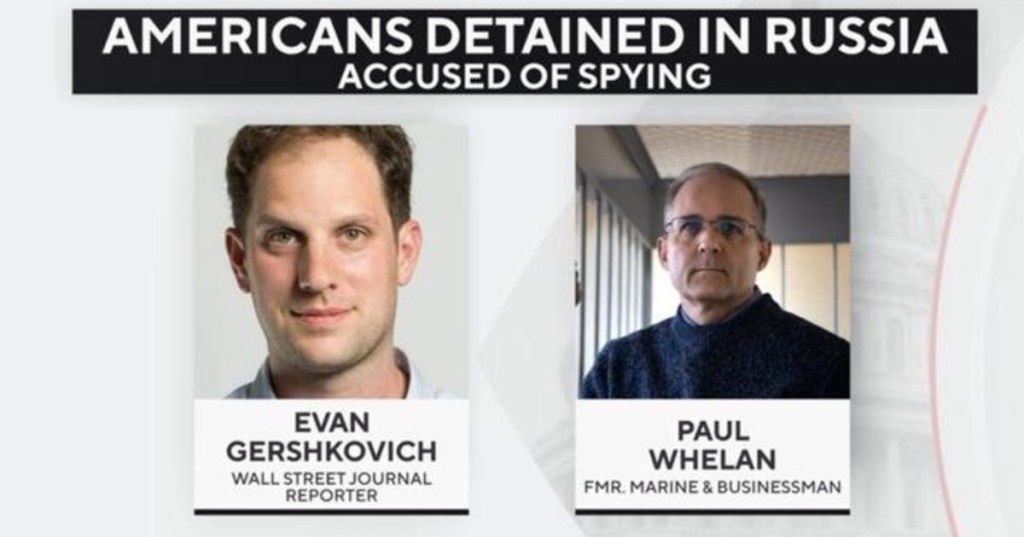
Putin was also asked by a New York Times reporter about the possibility of a prisoner swap for Americans Evan Gershkovich (a Wall Street Journal reporter) and Paul Whelan (a U.S. Marine veteran), both being held on trumped-up charges of spying. His answer: “We want to reach an agreement, and these agreements must be mutually acceptable and must suit both parties.” Stating that talks with the U.S. have been ongoing, he added: “It is not simple, I will not go into details now, but in general, it seems to me that we speak a language that is understandable to each other. I hope we will find a solution. But, I repeat, the American side must hear us and make an appropriate decision, one that suits the Russian side.”
Once again, Vladimir Putin is both the irresistible force and the immovable object . . . the rock and the hard place. He holds the prisoners; he knows how badly we want them back; and he is calling the shots. John Kirby, the White House national security spokesperson, said that discussions were ongoing, but that “There was . . . [a serious proposal] put forward and they rebuffed it.”
Surprise, surprise, surprise!
And in the meantime, the futures of Evan Gershkovich and Paul Whelan also remain hanging by a thread.
The Hostages
*. *. *
Finally, after the usual bluff and bluster, came the entertainment feature of this year’s program: the questions from ordinary Russian citizens. One of the stars of today’s show was a pensioner, an elderly lady named Irina Akopova who is shown seated at her kitchen table, speaking to Putin by video link (obviously pre-arranged). She complains that prices for eggs, chicken breasts and wings have skyrocketed. “Vladimir Vladimirovich, take pity on pensioners! We don’t get millions in our pensions. Sort this out – we have no one to turn to. I’m very grateful to you, I’m counting on you to help.” [Reuters, Dec. 14, 2023.]
“Counting on you to help.”
And the response of dear Vladimir Vladimirovich? Simply: “I apologize for this, but this is a failure of the government’s work . . . I promise that the situation will be corrected in the near future.”
Wow! How sympathetic! How heartfelt! How helpful!
Or in the words — or word — of my beloved grandmother: “Oy!”
But greater satisfaction was given to a group of young boys in the Russian-annexed territory of Crimea, who complained about the rundown state of their sports hall. A response from TV anchor Pavel Zarubin (who was apparently participating in the program) indicated that volunteers from that territory had called in and promised to renovate their arena. Terrific! Poor Mrs. Akopova can’t afford eggs, but we can fix a sports venue immediately. You know, that actually makes sense, in a perverse way — the first issue involves a nationwide increase in prices as high as 40%, whereas the second merely calls for some local “volunteers” with hammers and nails (and a big trash truck).
*. *. *
So how does this people-to-person marathon come about each year? It obviously is not a spontaneous exchange. To begin with, Putin speaks . . . and speaks . . . and speaks. On and on he drones, ad infinitum. I counted 209 paragraphs (even grouping together some of the shortest ones) from the transcript offered on the Kremlin’s own website. No, I did not read the whole thing; my tolerance for bullshit is not that great.
For those on the scene who managed to stay awake to that point, there followed the question-and-answer session. The journalists this year were hand-picked and carefully screened. And as for the citizen call-ins, I have no idea how they were chosen from the many applicants; but from the two examples above, I am quite certain that any attempt at improvisation would have been cut off by “technical difficulties.” The questions, though sincere, were pre-selected and carefully worded, and the answers obviously scripted. All very efficient.
But the desired effect has been obtained: the benevolent master has shown his concern for his serfs. All is well throughout the land.
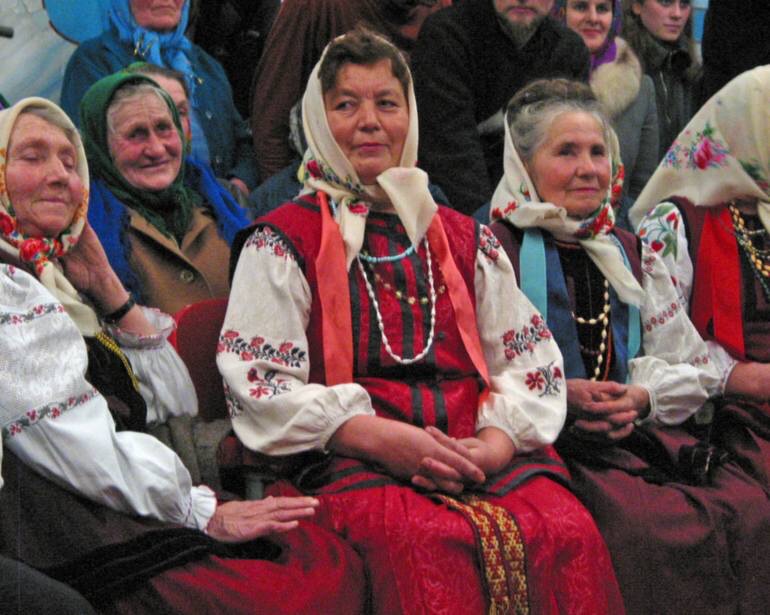
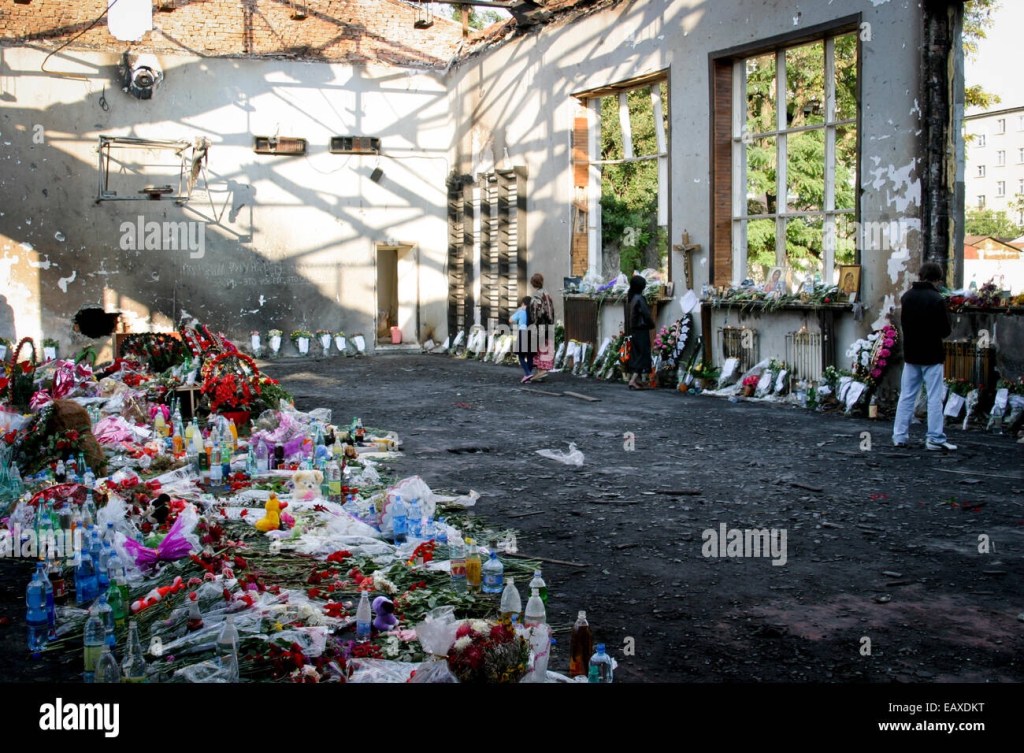
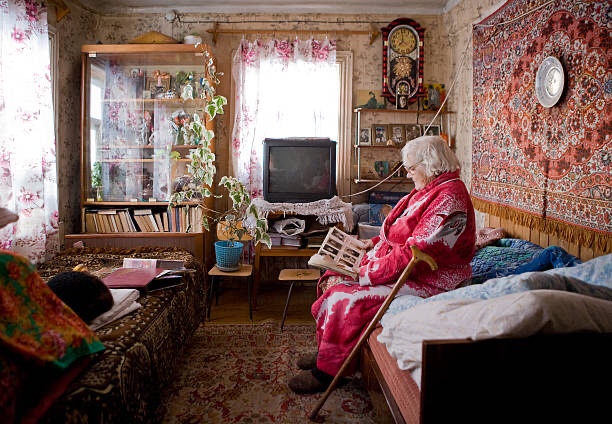
A Rural Russian VillageA Russian PensionerPeople lined up at a supermarket ATM in Moscow to withdraw dollarsfollowing devaluation of the ruble
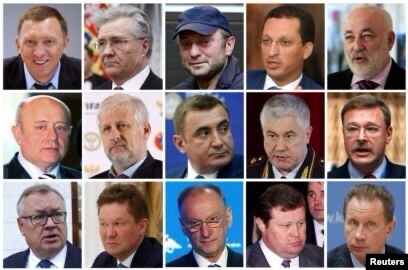
Not in Russia, anyway. If you’re an oligarch with a direct line to the Kremlin, your privileged lifestyle is in imminent danger of being snatched away. Your wealth may — may — be safe, but your political and personal influence . . . not so much.
The Faces of Influence
The history of the Russian “oligarchs” is fairly well-known. Back in the 1990s, following the collapse of the Soviet Union and the introduction of Mikhail Gorbachev’s policy of perestroika (restructuring), a slew of state industries were privatized and put up for grabs by anyone with the money, the smarts, and the right connections to claim as their own at a tiny fraction of their actual value. And those formerly failing industries were modernized and upgraded, and began to thrive. Fortunes were made in banking, manufacturing, oil production, communications, and so on. And the people who made those fortunes became the cadre of oligarchs who, along with their wealth, gained a certain political influence with Gorbachev, and later with Boris Yeltsin . . . and into the 21st Century, with Vladimir Putin.
Except that Putin’s tolerance was limited. In July of 2000, he summoned 21 of Russia’s top oligarchs and business leaders and advised them that he wouldn’t reverse the privatization of their assets . . . provided they pledged their loyalty to him and agreed not to meddle in politics. He has been quoted as follows:
“I want to draw your attention to the fact that you built this state yourself, to a great degree through the political or semi-political structures under your control. So there is no point in blaming the reflection in the mirror. So let us get down to the point and be open and do what is necessary to do to make our relationship in this field civilized and transparent.”
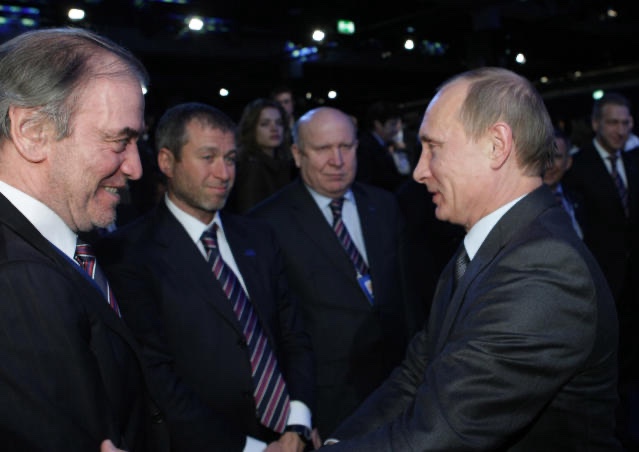
The Face of Power
Needless to say, they got the message, and things seemed to have been running fairly smoothly ever since. They had access, they had input, they had a measure of influence . . . and they had their money.
But . . . Yes, always that damned Russian “but” . . .
But time passed, as time does, and along came February of 2022, when Putin decided to pursue his “special military operation” . . . Oh, hell, let’s call it what it is: his invasion of Ukraine. A few hours after sending in the first of his troops, he held a meeting in the Kremlin with top industrialists and business leaders, and told them flat out that he had had no choice but to invade. Their input had not been required.
And thus the dynamic of the Kremlin-oligarch relationship shifted dramatically. They realized the war would have an unwelcome effect on their fortunes, but they had to accept it. They knew who wielded absolute power. For the most part, they have again kept quiet and adjusted to the new reality. A few, of course, listened to their consciences, spoke up, and fled the country, notably banking and brewing executive Oleg Tinkov, who called the war’s supporters “morons,” left Russia, and renounced his citizenship. But most were not that courageous.
Fleeing Russia
*. *. *
One of the effects of Putin’s war against Ukraine has been the flight from Russia of many of the largest foreign companies — McDonald’s, 3M, CITI, Lego, and a thousand or so more — leaving behind the physical foundations for the establishment of new Russian companies. And the Russian government has taken on the task of reallocating those abandoned assets.
One would think that the most-favored oligarchs would be the natural recipients of this largesse; but alas, that does not appear to be the case. While Putin is said to value loyalty above all else, that loyalty runs in one direction — to him, not from him. And he has seen an opportunity to expand this program of reallocation. As reported by Jim Heintz of Associated Press, Dec. 6, 2023:
“But . . . analysts suggest that loyalty had not been enough for Putin and that he wants to create a new cadre of hugely wealthy figures who are beholden to him by distributing the assets that the state has seized from foreign companies exiting Russia and through invalidating the privatizations from the 1990s. [Emphasis is mine.]
”Analyst Nikolai Petrov of Britain’s Royal Institute of International Affairs wrote that Russia is engaged in deprivatization ‘intended to redistribute wealth to a new generation of less-powerful individuals and shore up the president’s own position.’
”A new group of quasi-owner state oligarchs is being created, with wealth and control redistributed from the ‘old nobles’ to the new, he said.”
The Face of Deception
More significant — and more frightening — than his treatment of his current group of loyal sycophants is Putin’s undisguised intention to “deprivatize” and redistribute what has for some thirty years been privately-held and privately-run industrial and commercial property. Just like that! A snap of the fingers, and the state once again owns everything. Welcome home, Messrs. Lenin and Stalin and all the rest up to and including Konstantin Chernenko. Everything will soon be just as you left it.
*. *. *
I have no great love for the oligarchs; for the most part, they got their starts through questionable, even purely illegal, means. But they did then manage to build something out of nothing, and — much like the American “robber barons” of the late 19th and early 20th Centuries — contributed tremendously to the industrial and economic growth of their country. And so my hope for them is that they survive this royal screwing, get the hell out of Dodge, and use whatever assets they’ve managed to hide in foreign lands to start fresh. Preferably legally, this time.
As for Vladimir Putin . . . you, sir, have once again proven yourself the Grand Poobah of Nastiness. But name-calling doesn’t faze you; sanctions don’t stop you; even the condemnation of the entire free world rolls off of you like water off a shark. How does one deal with a ruthless, pathologically narcissistic individual who is absolutely convinced of his own infallibility and immortality? Quite simply, one doesn’t.
Seriously, what new hell has he been thrown into now? Because he’s missing from Melekhovo penal colony, where he has been imprisoned since being found guilty of “founding and funding an extremist organization” — charges that he unequivocally denies.
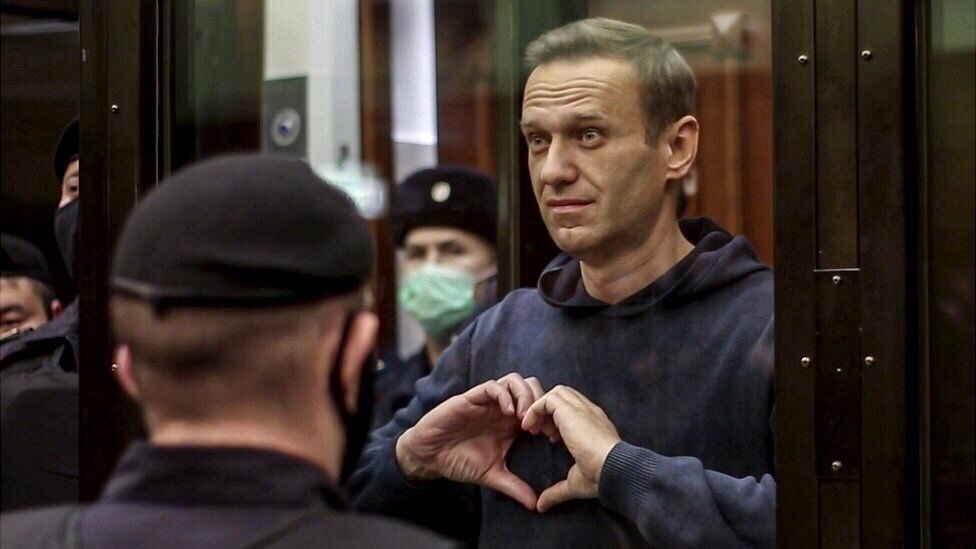
Alexei Navalny, In Prison
His associate, Kira Yarmysh, said on Monday that there had been no news of him for six days, and that he had been absent from several recent court appearances, which he has in the past attended by video link. Prison authorities blamed the absences on technical problems at the colony. She further said that lawyers waiting for news outside Melekhovo, 235 km (145 miles) east of Moscow, and another nearby colony, had been told that he was not registered in either place.[Robert Greenall, BBC News, Dec. 11, 2023.]
Alexei Navalny has been a thorn in Vladimir Putin’s side for many years now. A staunch political reformer, he has gained a huge following throughout Russia, and has proven himself to be a viable competitor to Putin. For this reason alone, he had to be silenced. But he survived an attempt on his life when he was poisoned with the Russian nerve agent Novichok in August of 2020. Because of the worldwide publicity, he was permitted to seek treatment in Germany, where the poisonous substance was identified, and where he was brought back to reasonably good health.
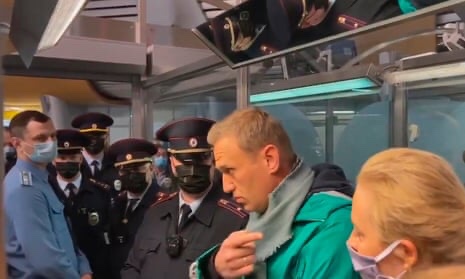
And then he made the decision that would change the rest of his life: he returned to his homeland, where he was arrested immediately upon arrival at Moscow’s Sheremetyevo Airport. He has been in one prison or another ever since. But where is he now? And why has this happened at this particular time?
Arrest at Sheremetyevo Airport
Well, think about it. On Friday, December 8th, Vladimir Putin officially announced that he will be running for his fifth term as President of the Russian Federation — not a surprise, but an official announcement that had inexplicably been postponed and kept secret for many weeks. And no sooner was that announcement made than Alexei Navalny disappeared from sight.
According to Navalny’s aide, Leonid Volkov, this was “0% coincidence and 100% direct manual political control from the Kremlin. It’s not a secret for Putin who his main opponent is in these ‘elections.’ and he wants to make it so that Navalny’s voice is not heard. So each one of us must become the voice of Navalny.” [Robert Greenall, BBC News, Dec. 11, 2023.]
Intelligent, personable, courageous, attractive, honest, sincere . . . all of these qualities have made Navalny the one Russian opposition leader who has been able to gather the large numbers of people throughout Russia needed to form a viable opposition. Over more than a decade he has drawn tens of millions of online viewers to his video investigations into corruption in the Russian government. He is, to state it mildly, a serious threat to the Putin regime.
“Navalny Must Go!”
And as such, he must be dealt with. His health has been failing in recent months. Will he now suddenly “decline” and die “while receiving the best medical care” in a prison hospital? Or will that be too extreme even for Putin, in light of Navalny’s great popularity? Could that even be the spark that might finally light the tinder of an already nascent people’s revolution? Might it be best just to keep him locked away, out of reach of even his legal team, in a maximum-security penal colony, perhaps in far Eastern Siberia? It’s a decision that can only be made by Vladimir Putin himself; and I would imagine it’s keeping him awake at night.
*. *. *
This is, as they say, a breaking and continuing story. Be assured that I will be following it closely . . . meanwhile sending my hopes and prayers to Alexei Navalny, his family, and his legion of friends and supporters for a best-case outcome.
UPDATE: Today (December 12th), U.S. National Security spokesman John Kirby commented on the disappearance of Alexei Navalny as follows: “He should never have been jailed in the first place, and we’re going to work with our embassy in Moscow to see how much more we can find out.” [CNN’s 5 Things, Dec. 12, 2023.]
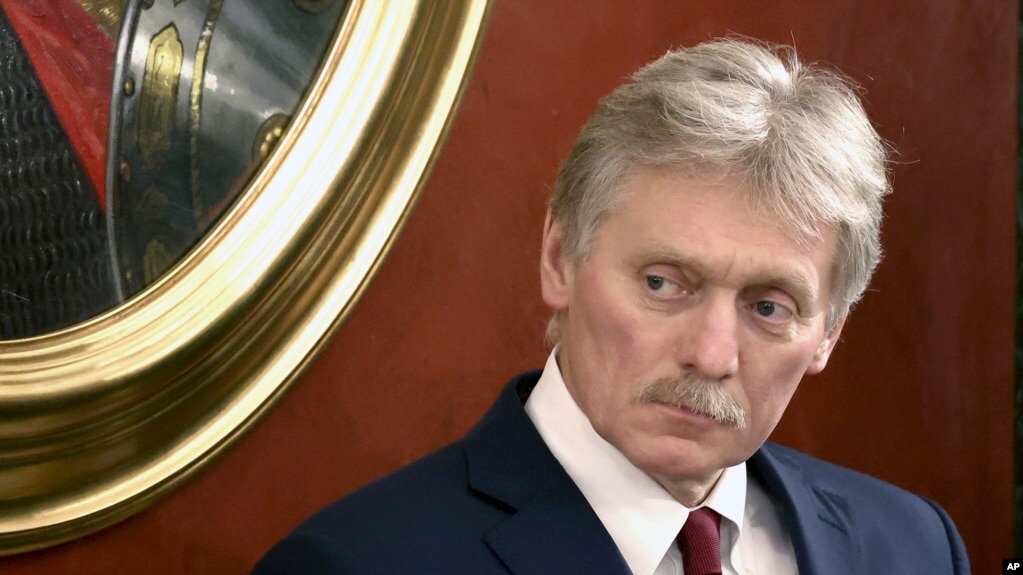
Presidential spokesman (and chief propagandist) Dmitry Peskov has claimed that the Kremlin does not know where Navalny is currently being held, and that they have no intention of looking into the matter. He called U.S. expressions of concern over Navalny’s disappearance “unacceptable.” He told reporters:
“Here we are talking about one prisoner who, according to the law, was found guilty and is serving his sentence, and here we consider any intervention by anyone, including the United States of America, unacceptable and impossible.” [Patrick Reevell, ABC News, Dec. 12, 2023.]
Dmitry Peskov
I don’t know how much good it will do — considering the obduracy and total lack of transparency of the Russian government — but I am pleased to know that at least we are trying, and that Alexei Navalny is not being forgotten. He is not a U.S. citizen; but his opposition to the increasingly totalitarian nature of Vladimir Putin’s regime is of vital importance to the Russian people and to the entire free world. We must not fail Navalny or any of the other political prisoners being held unjustly in Russian penal colonies.
I ask myself: How many human rights violations can one country be allowed to get away with? And the number just keeps growing.
“They” say that if you treat a cold, it will go away in just seven days; but if you don’t treat it, it will hang around for a full week. Or vice-versa. That’s about as clever as the groundhog mystique — we know it’s exactly six weeks from February 2nd to the first day of spring (March 21st) whether that cute but not-very-bright little marmot sees his shadow or not.
Punxsutawney Phil
But in either case — to treat or not to treat — “they” (whoever the hell “they” are) are full of it. I am now on day ten, with no sign of this current plague ever going anywhere. I’ve kept sort of a diary of the past ten days, simply because I haven’t had the energy or the desire to do anything other than sit here in my comfy chair with my iPad on my lap. And of course, being the compulsive sharer that I am, it was inevitable that I would share it with you.
No, no! Don’t run away! It’s really rather interesting, and may perhaps serve to prepare you for the winter cold you’ll probably have before Punxsutawney Phil shows up again.
Day One – Saturday: Oh-oh! Woke up this morning with a scratchy, burning throat. Never a good sign. Feeling a little off, but not terrible. Maybe I just slept with my mouth open. Christmas tree going up today, something nice to distract me.
Day Two – Sunday: Damn! Throat feels worse, and there’s a definite post-nasal drip making an appearance. Time for the Mary Poppins treatment, slightly modified: a spoonful of honey, instead of sugar. It really helps the scratchiness, and it tastes yummy. Let’s see . . . ooh, orange blossom. No wonder. A cup of tea would be good too, and some extra Vitamin C.
Day Three – Monday: Crap! Feeling really rotten now. Woke up coughing up a lung from the g**damned drip. Hope it’s not the flu. [Pause to take temperature.] Nope — a nice cool 97.9, so that’s good. Should get dressed, but I’d rather just hang out in my jammies today. Not going anywhere anyway. Called the dentist about my 4:00 p.m. appointment, and they told me not to come — understandable, but the lady sounded like I was Typhoid Mary or something. Rescheduled for next Monday; should be fine by then.
Day Four – Tuesday: Oohhhhhhh! I can’t breathe through my nose anymore. Where are my saline nose drops? Did have somebody pick up some DayQuil, which helps a little but the label says I can’t overdo it without risking damage to my liver from the Acetaminophen, or whatever it is. Why is the treatment always more dangerous than the condition? Crap!
Day Five – Wednesday: Shit! Shit! Shit! Shit! Shit! I really need to get out of these jammies and get washed — it’s . . . what? Three days now? Okay, as soon as I can get up. First, let’s see what’s on TV. [Pause] Not much. Maybe I’ll just check Facebook. [Long pause] Oops . . . fell asleep there. If DayQuil does that to me, can you imagine what NyQuil would do?
Day Six – Thursday: Feeling better in clean jammies, but had a coughing fit today and think I pulled something on my left side. It hurts to cough and to move certain ways. Not as bad as the time I tore cartilage in my rib cage, though, so no worries. Just one more thing to deal with. Think I’ll get some soup now . . . Hey, I never noticed that before. Is it something crawling on the carpet, or am I seeing spots? . . . Oh, okay — it’s a piece of outside dirt the dog brought in. Can’t bend down without falling over — get it later. First night of Chanukah tonight; remember to light the menorah.
Day Seven – Friday: Still coughing, still dripping (post-nasally). Working on second bottle of DayQuil; bye-bye, liver. Also about to finish second big box of Kleenex. All that stuff is so freakin’ expensive! Still no fever, so that’s some good news anyway; glad I had my flu shot last month. Just noticed how much dust there is on the ceiling fan. Well, that’s something to do when I can stand up again; or get someone else to do it. Yeah, that’s a better idea. Or just don’t look up at the ceiling. Time for more soup now.
Jewish Penicillin
Day Eight – Saturday: F*ck! F*ck! F*ck! Saturday again. I told you they lied about that seven-day cold thing. Still choking on phlegm, hacking up gobs of the stuff, blowing yellow crap through my nostrils, and peeing every 20 minutes from all the liquids I keep chugging. My nose looks like freakin’ Rudolph from all the blowing. Not a f*cking pretty picture, but who gives a shit at this point? I guess I’ll be missing the neighborhood party tonight; and I even bought an ugly Christmas sweater for it. But who wants Typhoid Mary at their party, right? And I sure don’t want to be the one everybody blames when anybody in the neighborhood gets sick between now and Easter. Crap!
Day Nine – Sunday: Same as every other day. Seriously hooked on honey now. I wonder how many calories it has . . . don’t really care. Running out of curse words in English, too lazy to look them up in other languages. Cancelled dental appointment tomorrow too. Don’t care about that anymore either. F*ck it!
Seriously don’t care.
Day Ten – Monday: Slept till almost 2:00 p.m. Still feel like crap, still a lot of nose-blowing, but just a little less coughing. Maybe there’s actually a light at the end of this G*d-awful tunnel? Fifth night of Hanukkah (however you choose to spell it). We’ll see what tomorrow brings.
Maybe . . .
No time to think about that now, though . . . got to pee again.