Not in Russia, anyway. If you’re an oligarch with a direct line to the Kremlin, your privileged lifestyle is in imminent danger of being snatched away. Your wealth may — may — be safe, but your political and personal influence . . . not so much.
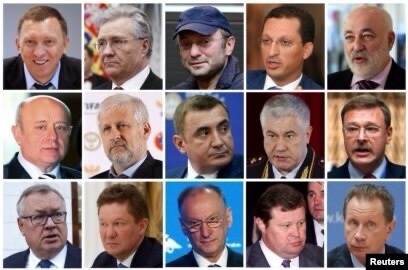
The history of the Russian “oligarchs” is fairly well-known. Back in the 1990s, following the collapse of the Soviet Union and the introduction of Mikhail Gorbachev’s policy of perestroika (restructuring), a slew of state industries were privatized and put up for grabs by anyone with the money, the smarts, and the right connections to claim as their own at a tiny fraction of their actual value. And those formerly failing industries were modernized and upgraded, and began to thrive. Fortunes were made in banking, manufacturing, oil production, communications, and so on. And the people who made those fortunes became the cadre of oligarchs who, along with their wealth, gained a certain political influence with Gorbachev, and later with Boris Yeltsin . . . and into the 21st Century, with Vladimir Putin.
Except that Putin’s tolerance was limited. In July of 2000, he summoned 21 of Russia’s top oligarchs and business leaders and advised them that he wouldn’t reverse the privatization of their assets . . . provided they pledged their loyalty to him and agreed not to meddle in politics. He has been quoted as follows:
“I want to draw your attention to the fact that you built this state yourself, to a great degree through the political or semi-political structures under your control. So there is no point in blaming the reflection in the mirror. So let us get down to the point and be open and do what is necessary to do to make our relationship in this field civilized and transparent.”
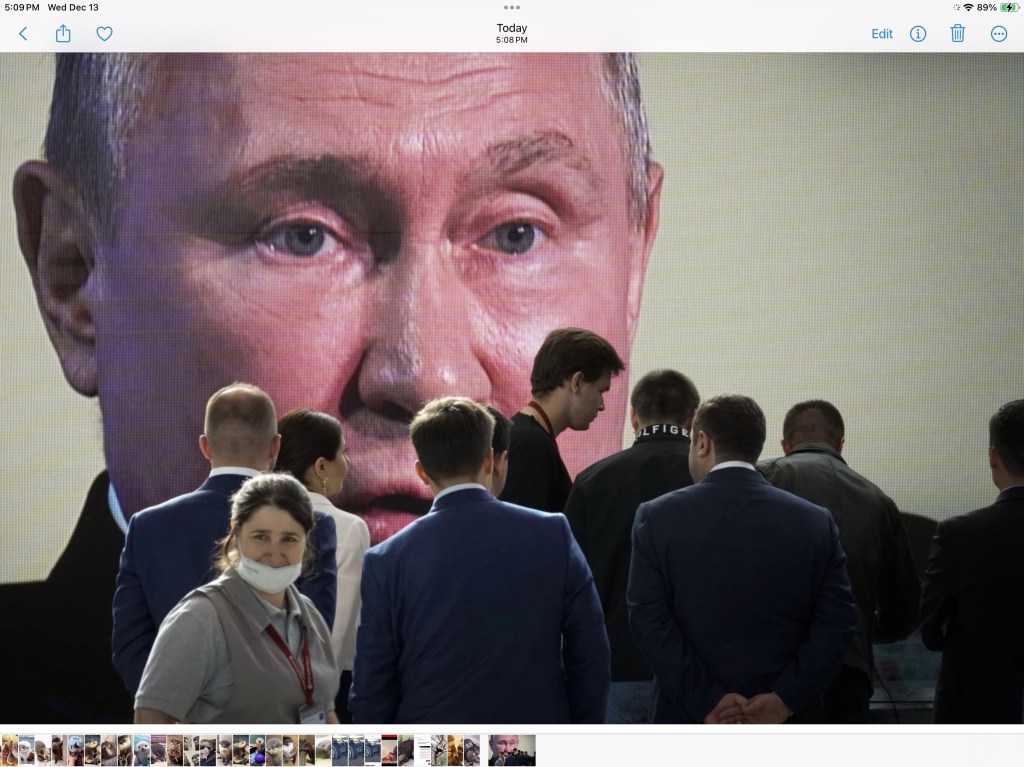
Needless to say, they got the message, and things seemed to have been running fairly smoothly ever since. They had access, they had input, they had a measure of influence . . . and they had their money.
But . . . Yes, always that damned Russian “but” . . .
But time passed, as time does, and along came February of 2022, when Putin decided to pursue his “special military operation” . . . Oh, hell, let’s call it what it is: his invasion of Ukraine. A few hours after sending in the first of his troops, he held a meeting in the Kremlin with top industrialists and business leaders, and told them flat out that he had had no choice but to invade. Their input had not been required.
And thus the dynamic of the Kremlin-oligarch relationship shifted dramatically. They realized the war would have an unwelcome effect on their fortunes, but they had to accept it. They knew who wielded absolute power. For the most part, they have again kept quiet and adjusted to the new reality. A few, of course, listened to their consciences, spoke up, and fled the country, notably banking and brewing executive Oleg Tinkov, who called the war’s supporters “morons,” left Russia, and renounced his citizenship. But most were not that courageous.
*. *. *
One of the effects of Putin’s war against Ukraine has been the flight from Russia of many of the largest foreign companies — McDonald’s, 3M, CITI, Lego, and a thousand or so more — leaving behind the physical foundations for the establishment of new Russian companies. And the Russian government has taken on the task of reallocating those abandoned assets.
One would think that the most-favored oligarchs would be the natural recipients of this largesse; but alas, that does not appear to be the case. While Putin is said to value loyalty above all else, that loyalty runs in one direction — to him, not from him. And he has seen an opportunity to expand this program of reallocation. As reported by Jim Heintz of Associated Press, Dec. 6, 2023:
“But . . . analysts suggest that loyalty had not been enough for Putin and that he wants to create a new cadre of hugely wealthy figures who are beholden to him by distributing the assets that the state has seized from foreign companies exiting Russia and through invalidating the privatizations from the 1990s. [Emphasis is mine.]
”Analyst Nikolai Petrov of Britain’s Royal Institute of International Affairs wrote that Russia is engaged in deprivatization ‘intended to redistribute wealth to a new generation of less-powerful individuals and shore up the president’s own position.’
”A new group of quasi-owner state oligarchs is being created, with wealth and control redistributed from the ‘old nobles’ to the new, he said.”
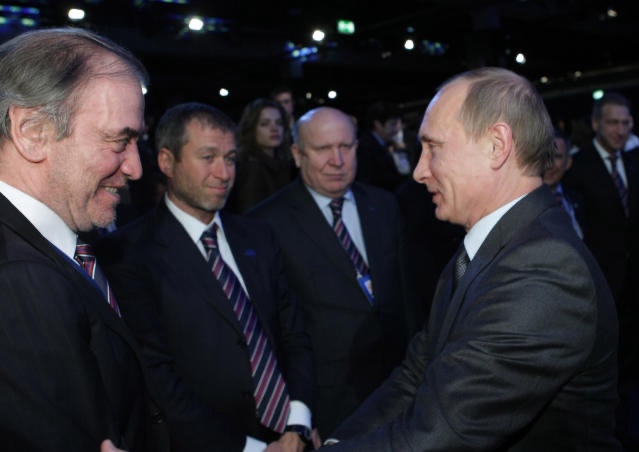
More significant — and more frightening — than his treatment of his current group of loyal sycophants is Putin’s undisguised intention to “deprivatize” and redistribute what has for some thirty years been privately-held and privately-run industrial and commercial property. Just like that! A snap of the fingers, and the state once again owns everything. Welcome home, Messrs. Lenin and Stalin and all the rest up to and including Konstantin Chernenko. Everything will soon be just as you left it.
*. *. *
I have no great love for the oligarchs; for the most part, they got their starts through questionable, even purely illegal, means. But they did then manage to build something out of nothing, and — much like the American “robber barons” of the late 19th and early 20th Centuries — contributed tremendously to the industrial and economic growth of their country. And so my hope for them is that they survive this royal screwing, get the hell out of Dodge, and use whatever assets they’ve managed to hide in foreign lands to start fresh. Preferably legally, this time.
As for Vladimir Putin . . . you, sir, have once again proven yourself the Grand Poobah of Nastiness. But name-calling doesn’t faze you; sanctions don’t stop you; even the condemnation of the entire free world rolls off of you like water off a shark. How does one deal with a ruthless, pathologically narcissistic individual who is absolutely convinced of his own infallibility and immortality? Quite simply, one doesn’t.
One just leaves that to the Fates to handle.
Just sayin’ . . .
Brendochka
12/14/23
 The Blog About Everything … and Sometimes Nothing