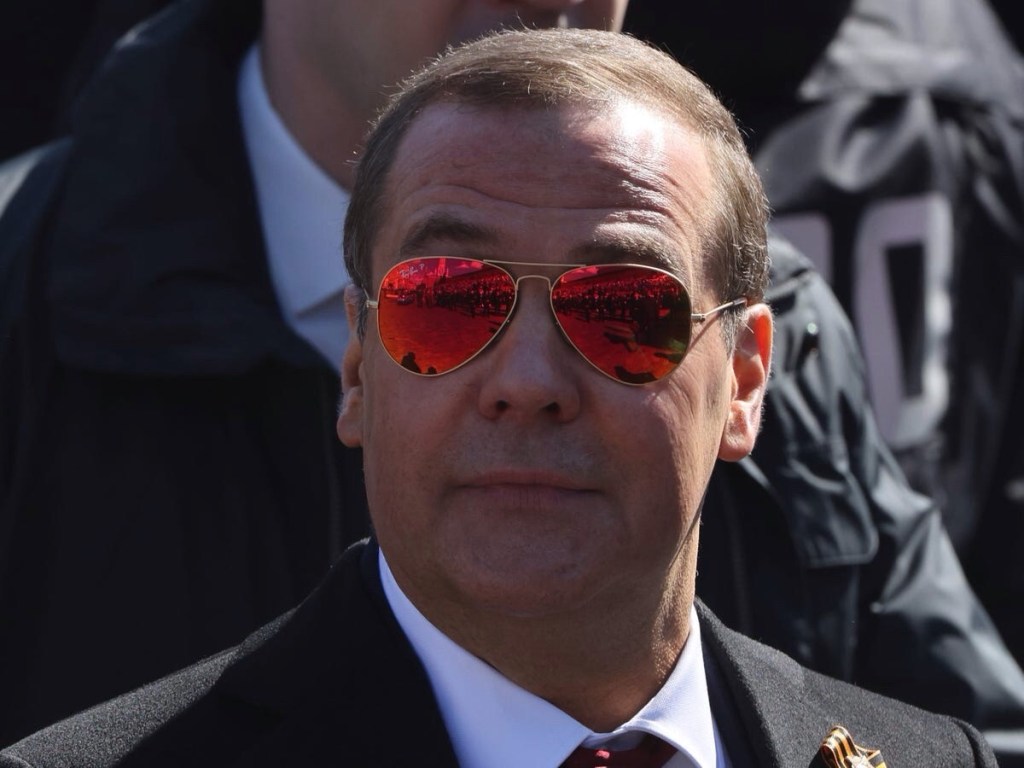
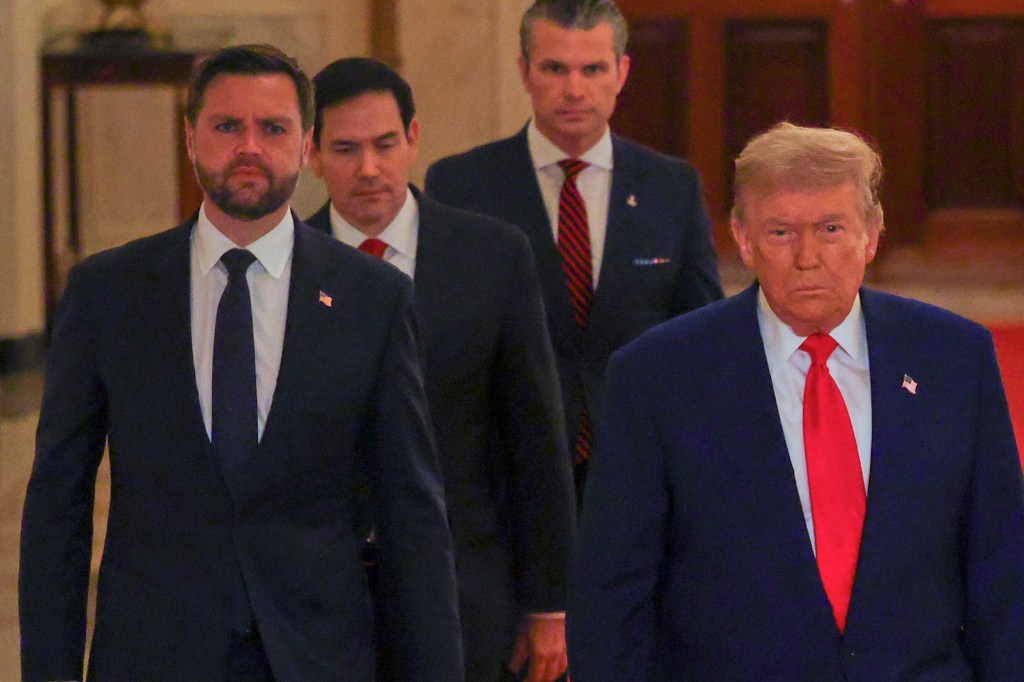
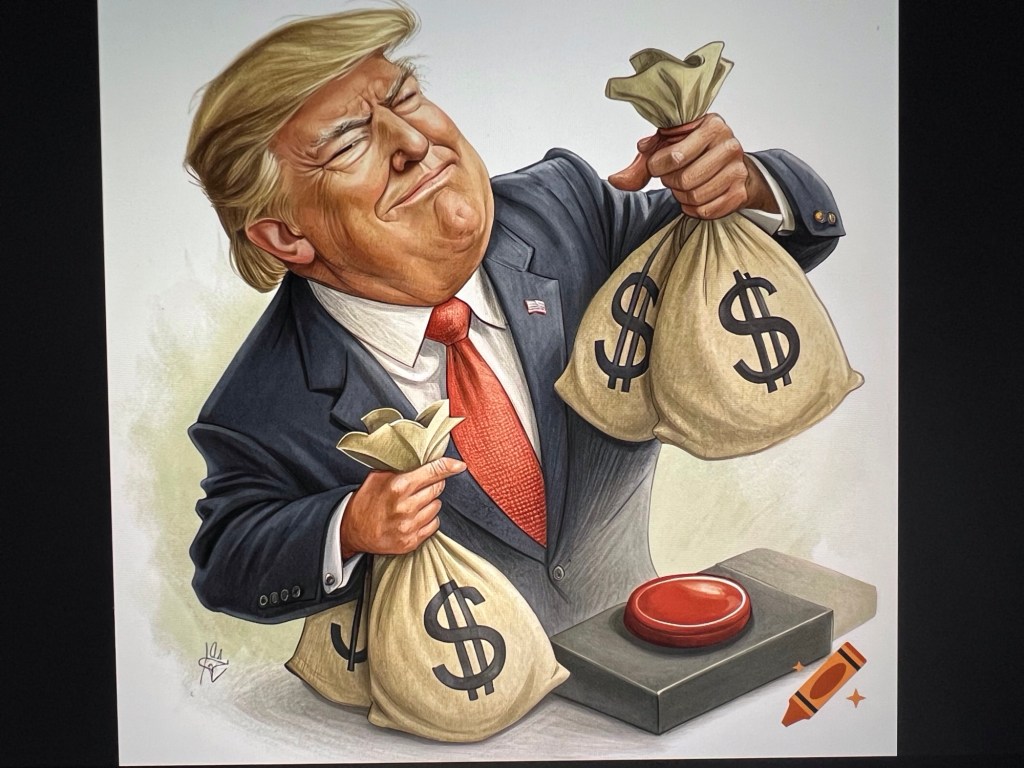
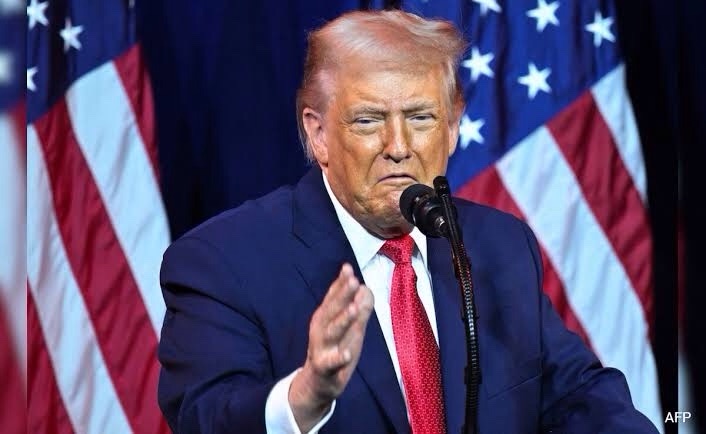
It doesn’t surprise me in he least that Dmitry Medvedev — former one-term President of Russia (2008-2012), current Deputy Chairman of the Russian Security Council, and super-scary nuke-happy whack job to end all whack jobs — would urge Donald Trump to instruct his “military chief” (presumably Pete Hegseth) and CIA director (John Ratcliffe) to “deal with” Ukrainian President Volodymyr Zelensky.
Nor was it unusual for Medvedev to state that the “method, place and way do not matter.” [Ukraine News, October 25, 2026.]
He is, after all, well known for his tendency to issue statements that, if acted upon, would almost surely lead to the nuclear destruction of our planet. Luckily, no one seems to have taken him seriously . . . yet.
Dmitry Medvedev
But what is even more frightening is that this latest exhortation, framed in language that leaves it wide open to interpretation, is addressed personally to a man in obvious mental decline, who has the power to do almost anything, is already “dealing with” Zelensky by withdrawing support and siding with the enemy, has proven himself vulnerable to suggestion from whatever person he listened to last, and would do anything to please Medvedev’s boss, Vladimir Putin.
The language used — “method, place and way do not matter” — does not sound like a suggestion to undertake diplomatic discussions, offer fatherly advice, or even resort to threats of ending all U.S. aid.
It sounds like the language of a mob boss ordering a hit.
We already know what Trump and his henchmen are capable of: blasting fishing boats out of international waters, kidnapping the president of Venezuela, starting a war with Iran . . . even sending his armed, masked goon squad to attack, arrest, and sometimes to kill innocent Americans in our own cities. In his addled view, what is one more life, if taking it would end the war in favor of his good friend in the Kremlin?
To suggest that Medvedev should be gagged and removed from any position of authority or influence in Russia would be both obvious and futile. But what can and must be done is to keep that kind of talk away from Donald Trump.
He already has far too many madmen whispering sweet nothings in his ear.
That was my day today . . . and I didn’t know I still had it in me to get through it all without even breathing hard.
I have been enlisted, at least temporarily, as the official daytime sitter for my daughter’s adorable Goldendoodle, Daisy. And that involves two “walkies” — around 11:00 a.m. and 3:00 p.m. — and a fair bit of cuddle time in between.
The Irresistible Miss Daisy
She’s a lovely dog, and I’m happy to be able to spend time with her. But, while I definitely need the exercise, I’m no longer young and agile, and walking a dog while steering my rollator up and down our hilly neighborhood is something of a challenge. But it’s like physical therapy or a dental checkup: you do it because it’s good for you.
Today, however, I also had to squeeze in a routine doctor’s appointment. It was just an annual checkup, but it was with a new cardiologist, so it took a bit longer than usual. (If anyone’s interested, it went well, I aced my EKG, and was told I’m probably good for another year. Thank you for your applause.)
But then I had to rush home, change my shoes, and head out with Miss Daisy for our second stroll of the day. And to my surprise and delight, I found that it’s already getting easier. No heavy breathing, no stopping to rest, and I was almost sorry when we arrived back at home.
So who’s helping whom in this arrangement? In all honesty, I think I’m getting as much benefit from it as my daughter and Daisy . . . but don’t tell them. I may need a return favor someday.
Yes, the man in the Oval Office with the chronic case of verbal diarrhea let loose with some more choice bons mots this weekend. It was difficult to narrow them down, but I’ve finally settled on two.
First, at a rally in Georgia (a very “red” state), he let his followers know just how unimportant they are to him by saying that, while oil prices are indeed “temporarily high,” it’s worth it to him and his billionaire friends because:
“The United States oil and gas business is making hundreds of billions of dollars. I don’t give a damn, I’m going to say it — we’re making a freaking fortune.”
[Source: Business Insider, October 25, 2026]
You heard him, MAGA people. He doesn’t give a damn.
*. *. *
Then he turned his attention to one of our finest allies, and incidentally one of the happiest countries in the world: Norway. During what was supposed to be a campaign rally in Michigan, he turned (for probably the 1,000th time) to the subject of the Nobel Peace Prize that he didn’t win again this year, despite (according to him) his having settled eight wars.
Again ignoring the fact that it is the Nobel Committee, and not the Norwegian government, that awards the prizes each year, he declared:
“ . . . so I’m not in love with Norway. Frankly, Norway sucks. Norway has become a shithouse country, actually. I don’t want anybody from Norway. I don’t want anything to do with Norway.”
[Source: Newsweek, October 25, 2026]
Well, that’s just lovely. So mature. So diplomatic. So presidential. So . . . well . . . so totally Trump.
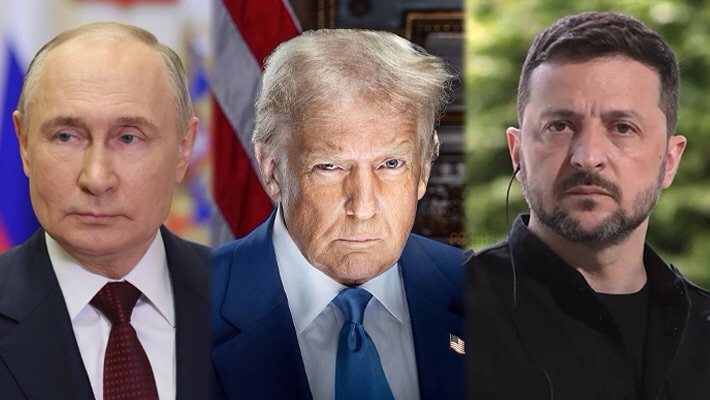
This time it is not, as you may think, the threesome of Putin, Zelensky and Trump — although there is talk of a possible tripartite meeting in the near future to re-start negotiations in the hope of finding a means to end Russia’s war against Ukraine.
But I wouldn’t pin too much hope on the mere fact that Putin has signaled his “willingness” to engage in talks. As it turns out, according to his foreign policy advisor Yuri Ushakov, the first step in that direction would merely be exploratory, involving teams of delegates rather than the leaders themselves, and designed to set out their respective positions — but not to formulate any definitive agreements.
So, since all of the Kremlin mouthpieces — from Vladimir Putin himself to Foreign Minister Sergey Lavrov to Press Secretary Dmitry Peskov and everyone in between — continue to stress that nothing less than total capitulation on Ukraine’s part will satisfy them; and since Ukrainian President Volodymyr Zelensky is determined not to surrender his beloved country to the marauding Russian hordes; any meeting in the near future will, once again, likely turn out to be much ado about nothing.
But what I am concerned about today is the possibility of a different three-way meeting being talked about in conjunction with the upcoming Asia-Pacific Economic Cooperation (APEC) summit scheduled to be held in Shenzhen, China, in mid-November.
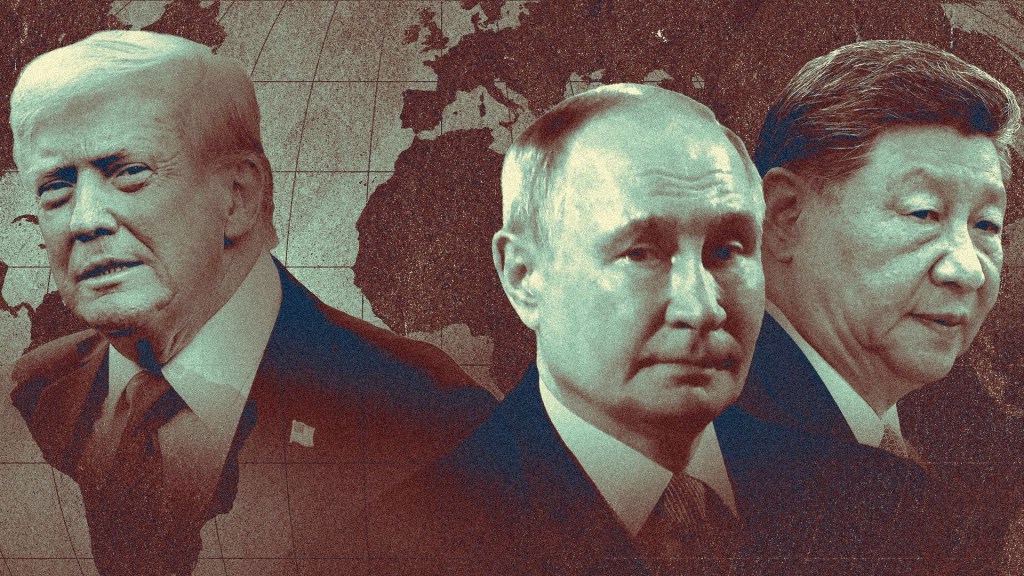
According to the same Yuri Ushakov, preparations are already underway for a meeting on the sidelines of the summit among China’s Xi Jinping, Vladimir Putin, and — to round out the triumvirate of autocrats — our very own Donald Trump.
Shortly after Putin’s most recent meeting with U.S. special envoy Steve Witkoff in St. Petersburg, Ushakov announced:
“Our Chinese friends, who are hosting the APEC summit, will deal or rather are already dealing with its [the trilateral meeting’s] preparation. And if circumstances are favourable, they, our Chinese friends, will of course include this meeting in the programme of events in Shenzhen.” [Ukrainska Pravda, October 21, 2026, citing European Pravda and Russian news agency Interfax.]
According to Ushakov, this is still tentative and awaiting confirmation from all parties; and neither has there been any indication of what sort of agenda is under consideration. It could be anything . . . and that is what is so worrisome. When those three — who, for some reason, call to my mind the Sith Triumvirate from Star Wars — put their heads together, you can be certain they’re not swapping recipes for pelmeni or moo shu pork.
The Sith Triumvirate
But it’s a little early to fret about something that is still three weeks away, and may never even take place. Between now and then, Im sure we’ll have plenty of other issues to occupy us: a midterm election, a couple of wars, the state of the French school system, and the cost of food and fuel, to name just a few.
In the meantime, I’ll simply try to keep on breathing, enjoying the lovely fall weather (my favorite season), and keeping in touch with my readers.
Earlier this week I had the great pleasure of announcing the release of two of our American hostages: Robert Gilman and Stephen Hubbard. (See my posts of October 21.)
Robert Gilman
Stephen Hubbard
But let us not lose sight of all those remaining in Putin’s prisons, including Americans David Barnes, Gordon Black, Michael Leake, Eugene Spector, and Robert Woodland Romanov.
Yes, I know that’s just five, not ten. But from a statement issued by the U.S. State Department about these two releases, I learned of five additional detainees who were previously unknown to me. They are:
Daniel Schneider Chuck Zimmerman Andre Khachaturian Aleksandr Antonov Olga Jezler
Daniel Schneider, a Maryland resident was married to a Russian woman. In 2023, his wife returned to Russia, illegally taking their young son with her following a court battle in Maryland. Daniel traveled to Russia to attempt to get his son back, but was arrested and charged with kidnapping. Sentenced to six years, he remains in prison in Kaliningrad, a small Russian exclave bordering Poland and Lithuania.
Daniel Schneider
*. *. *
Chuck Zimmerman, 58, a master electrician and U.S. Navy veteran from Virginia, was sailing in international waters on the Black Sea in June of 2025, when he was intercepted by a Russian naval vessel. When he voluntarily surrendered a firearm he kept for his personal safety, he was forced to sail to the Russian port of Sochi, where he was charged with arms smuggling. He has been sentenced to five years in prison.
Chuck Zimmerman
*. *. *
Andre Khachaturian, a dual citizen of Armenia and the U.S., was arrested in 2021 during a layover in Moscow en route to Armenia to visit his wife’s family. He was carrying a licensed, secured firearm in his checked luggage in accordance with the guidance he had received from Russia’s Aeroflot Airline. While in the airport in Moscow, he had to access his luggage to retrieve some medication, and a Russian official saw the firearm. Despite being fully compliant with Russian law, he was arrested and charged, ultimately being sentenced to eight years in prison for “improper registration” of the firearm.
Andre Khachaturian
*. *. *
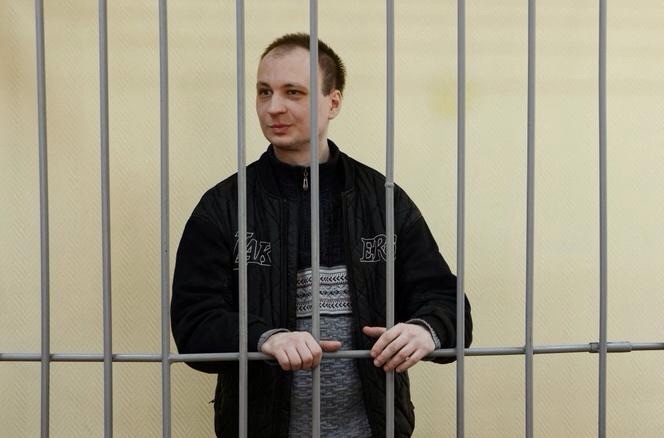
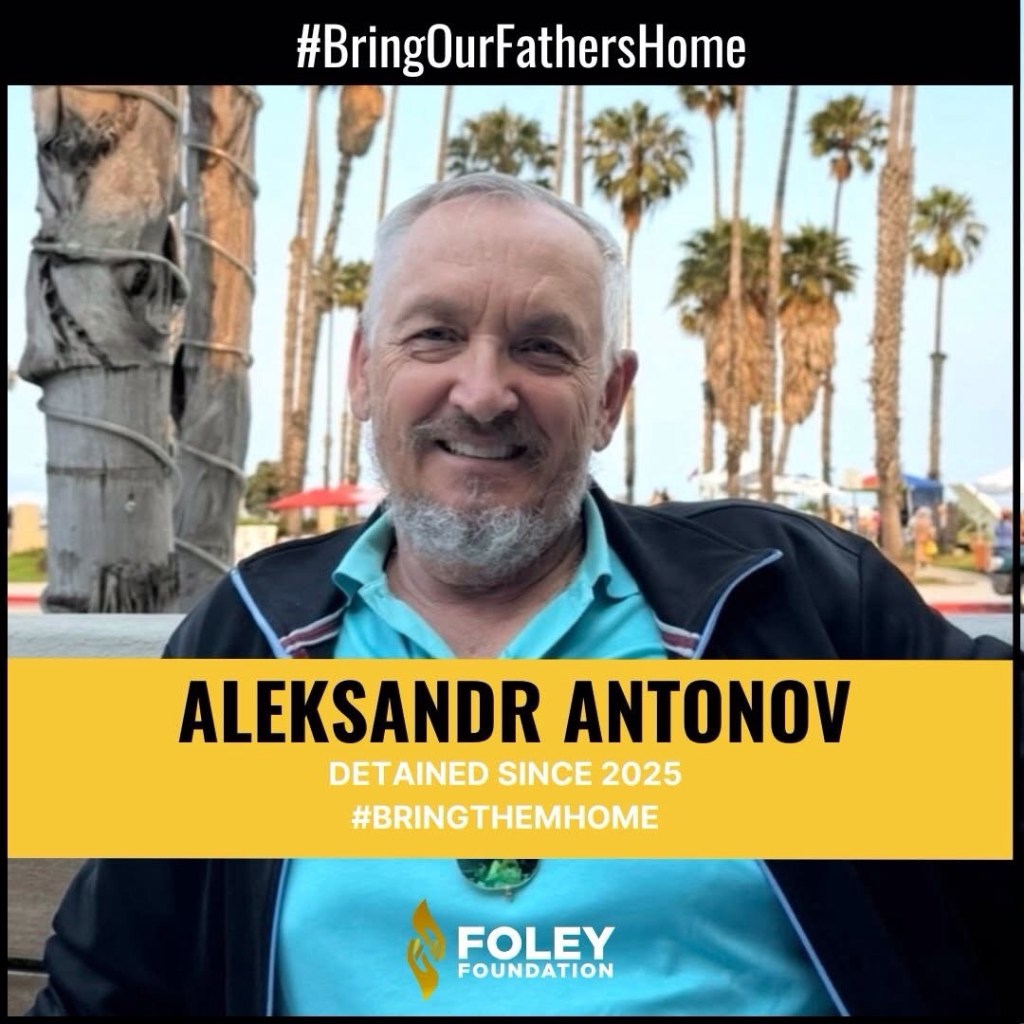
Aleksandr Antonov is a 66-yea-old citizen of Russia, the United States and Ukraine who had formerly lived in Crimea. In March of 2025, following a visit to his former Crimean home, by then occupied by Russian invaders, he was leaving Russia to cross into Estonia when he was detained at passport control. On the basis of his social media history between 2022 and 2024, when he had expressed his support for Ukraine, he was charged with inciting terrorism and extremism under the Russian Criminal Code and sentenced to six years in a Russian prison colony.
Aleksandr Antonov
*. *. *
Olga Jezler, a legal permanent resident of the United States who was born in Russia, had traveled back to Moscow in June of 2022 to help care for her sister, who was undergoing treatment for breast cancer. She had brought with her some CBD capsules for her sister, which are legal in Russia and which she openly declared, as she had done on previous visits. But this time — after being allowed to leave the airport and spending three days in Moscow — she was arrested and charged with drug trafficking, earning her a ten-year sentence in a prison colony.
Olga Jezler
Five more cases of entrapment of guiltless American citizens, arrested for no other reason than to be warehoused as collateral until they can be exchanged for some future favors. Innocent human beings, treated as so much merchandise.
When will it end?
*. *. *
And, as always on Sunday, here is the list of those hostages still being held in Putin’s prisons. Sadly, though we were able to delete two names, the addition of five more has lengthened the list once again.
But the good news is that we now have word that negotiations for their release are ongoing . . . and we’ll take all the hope we can get.
Prisoners of War:
The 20,000+ Kidnapped Ukrainian Children The People of Ukraine The 6,000 Starving Citizens of Oleshky
Immigrant Detainees in Russia:
Migrants from the Central Asian nations of Kazakhstan, Kyrgyzstan, Tajikistan, Turkmenistan and Uzbekistan
Endangered Exiles:
Pavel “Pasha” Talankin Mikita Losik Yulia Navalnaya Oleg Orlov Countless Journalists and Other Dissidents
Political Prisoners:
In Afghanistan:
Mahmoud Habibi (Afghan-American) Paul Overby (American, missing since 2018)
Andrei Chapiuk Uladzimir Labkovich Andrzej Poczobut Marfa Rabkova Valiantsin Stafanovic Yuras Zyankovich
In Georgia:
Mzia Amaglobeli
In Russia:
The “Crimea 8”: – Oleg Antipov – Artyom Azatyan – Georgy Azatyan – Aleksandr Bylin – Roman Solomko – Artur Terchanyan – Dmitry Tyazhelykh – Vladimir Zloba
James Scott Rhys Anderson (British) Aleksandr Andreyev Aleksandr Antonov (Russian/Ukrainian/American) David Barnes (American) Yevgenia Berkovich Gordon Black (American) Hayden Davies (British) Yury Dmitriyev Anastasia Dyudyaeva Antonina Favorskaya Konstantin Gabov Robert Gilman (American) Stephen James Hubbard (American) Olga Jezler (Russian/American) Sergey Karelin Andre Khachaturian (Armenian/American) Timur Kishukov Vadim Kobzev Darya Kozyreva Artyom Kriger Aleksandr Kynev Michael Travis Leake (American) Aleksei Liptser Svitlana Loi (in Ukraine) Mikhail Loshchinin “Madame Z” (in Ukraine) Grigory Melkonyants Dmitry Morozov Boris Nadezhdin Nika Novak Svetlana Petriichuk Leonid Pshenychnov (in Russian-occupied Crimea) Ilya Remeslo Nadezhda Rossinskaya (a.k.a. Nadin Geisler) Lev Schlossberg Daniel Schneider Sofiane Sehili (French) Igor Sergunin Dmitry Shatresov Robert Shonov Grigory Skvortsov Eugene Spector (American) Joseph Tater (American, disappeared) Karina Tsurkan Arseniy Turbinin (age 18) Laurent Vinatier Robert Romanov Woodland (American) Chuck Zimmerman
You have not been, and will not be, forgotten. Stay strong.
Last night at sundown, I lit the ninth memorial candle for my sister Merna.
Merna, with Emily and Nate
It’s hard to believe that nine years have passed since she died. My only sibling, my best friend, and my confidante, she is still so sorely missed. How many times have I reached for the phone to call her! But I know she’s waiting for me, wondering what’s taking me so long. (She always hated it when people were late.)
In the hope that she can hear me, I’d like to send her this message:
“Dear Merny (her nickname):
“Be patient, rest well, and be glad you don’t have to witness what’s happened to this world while you’ve been gone. Say hello to everyone for me; I’ll be along in due time.
“Love you and miss you. And I’m sorry I never said it often enough when I could have.
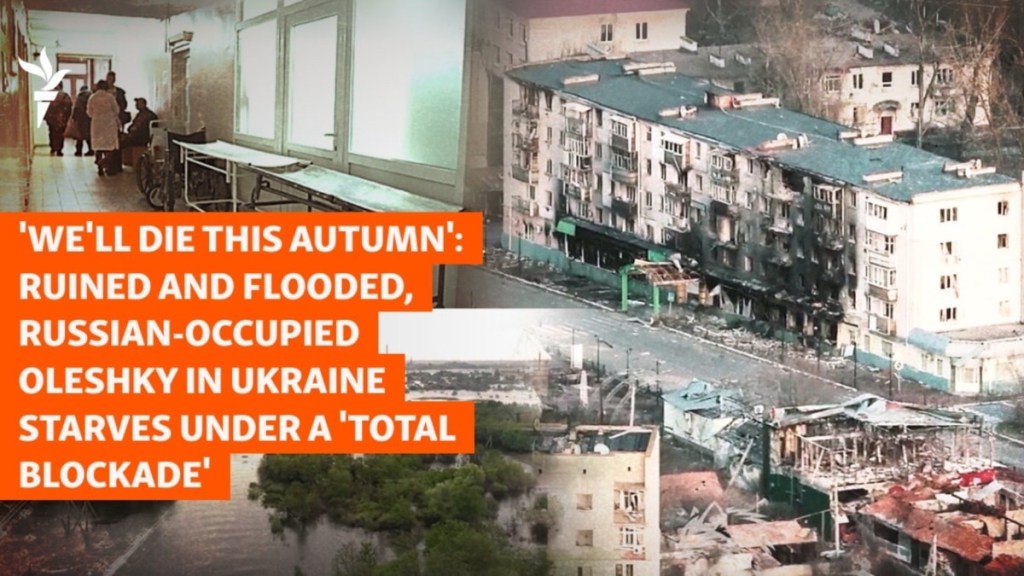
There are between 2,000 and 6,000 people — depending on whether you include the outlying areas — remaining in the besieged city of Oleshky in the Kherson region of Ukraine. Occupied by Russian forces, they are unable to leave, and all normal routes for the delivery of humanitarian aid are blockaded. For weeks, Ukraine has been making air-drop deliveries of food and medical supplies, but even those have been subject to attack by Russian armaments . . . as have the aid stations set up to distribute the supplies.
In short, the remaining occupants of Oleshky are starving to death. And without heat or proper shelter, those who don’t starve will likely freeze in the oncoming winter if help doesn’t reach them in time. It is tragically reminiscent of the 872-day siege of Leningrad by Nazi Germany during World War II.
But today there is new hope. On October 16th, while recovering from major surgery, Pope Leo XIV initiated talks with the Kremlin, requesting an immediate ceasefire in order to allow delivery of aid and evacuation of those who wish to leave Oleshky. And on October 19th, the Pope spoke directly with Vladimir Putin to press the matter.
Yesterday, just four days after that conversation, the Kremlin announced its agreement to a temporary lifting of the siege of Oleshky to enable life-saving aid to be brought in to the survivors and an evacuation corridor to be established. The rescue operation, the details of which have been under discussion between the Vatican and the Kremlin, is scheduled to begin during the coming week.
If all goes well, it will be a bright light in the ongoing darkness of Russia’s never-ending war of attrition against Ukraine, and a cause for celebration.
If all goes well.
Yet it seems that even a great humanitarian gesture cannot exist without political overtones.
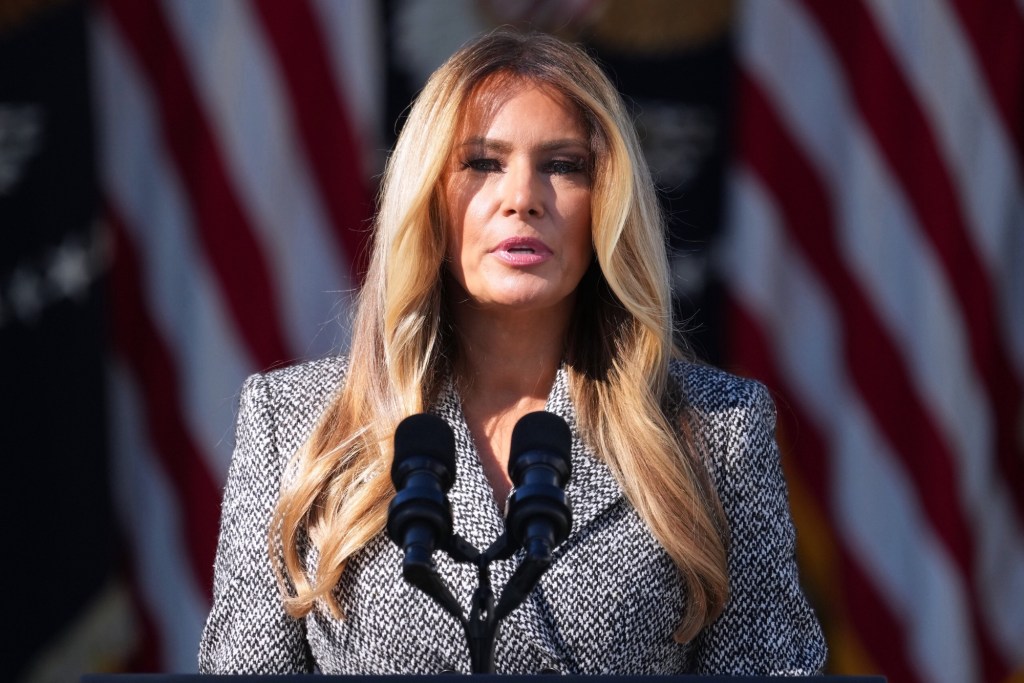
Late yesterday, it was announced that Melania Trump, who had reportedly been involved in international initiatives concerning child welfare, was being credited with having brokered the Oleshky ceasefire agreement. According to the White House, while working on those separate matters, she had learned of the plight of Oleshky and “initiated talks about Oleshky after learning about the situation at one of her events during the U.N. General Assembly session in September.” [Ben Finley and Seung Min Kim, Associated Press, October 23, 2026.]
The statement added that “She and a representative worked directly with Russian and Ukrainian leadership to define the terms of the ceasefire.” [Id.]
Melania Trump
Maybe so, maybe not. It would be nice to learn that the enigmatic, mostly absent, do-nothing, titular first lady of the United States actually has taken an active interest in something meaningful during her tenure in Washington. But the fact is that nothing was accomplished until the Pope intervened; and having Melania step into the limelight at the last moment diminishes his contribution and only serves to accentuate the Trump administration’s insatiable lust for glory.
If she was indeed involved in the attempt to rescue the people of Oleshky, then she deserves credit for that. But to claim that she “brokered” the agreement would seem to be a gross exaggeration . . . and more than a little tacky.
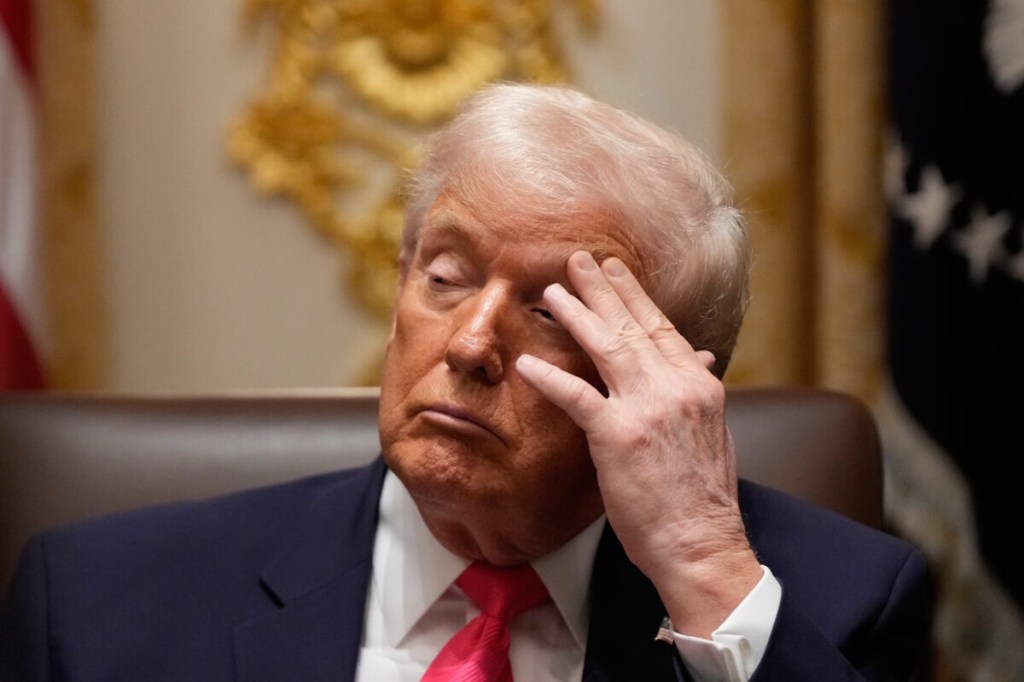
I don’t know what to make of this one from Donald Trump; in fact, much of the world is trying to figure out what he meant when he posted this on social media yesterday:
“A healthy person has a thousand dreams. A sick person has only one (to get better)! President DONALD J. TRUMP”
Was he talking about himself, or someone else? Had he just awakened from a bad dream? Was he trying his hand at philosophizing?
We’ll probably never know. But it is terribly disturbing.
Without delving into amateur analysis, I can only say that it sounds like the mental meandering of a person in deep despair and/or confusion. And when that person is the president of the United States, it cannot be ignored.
We all know he’s not well. But just how sick is he?
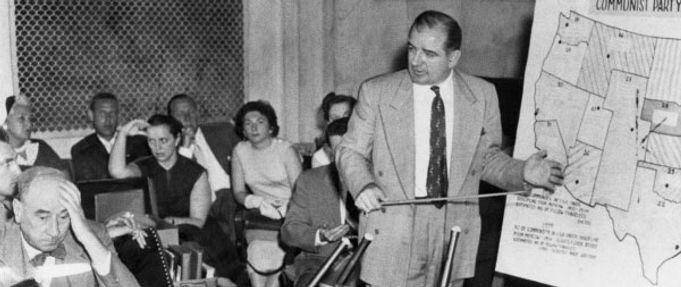
For some time now, the Republican party has been maligning Democrats — and anyone who favors government programs designed to make life better for average citizens — by accusing them of being “Socialists.”
At the same time, there is a growing number of Democrats who are identifying themselves as either Democratic Socialists or Social Democrats . . . which has been enough to send the Republican masses into a frenzy, threatening to plunge the nation into a replay of the “Red Scare” of the 1950s.
McCarthy Hearings – C. 1950s
For those people, it is just a short step from what they think of as “Socialism” to full-blown Communism. But they couldn’t be more wrong; and their error is the natural result of their lack of understanding of the different types of Socialism.
When someone like Bernie Sanders or Alexandria Ocasio-Cortez speaks about social programs, they are not trying to sell the sort of Marxist philosophy that Vladimir Lenin used to jump-start his transition to Communism and the creation of the oppressive Soviet state. That was very real, and completely disastrous; and it is what today’s right wing extremists are trying to frighten us with.
But in point of fact, it is that very sort of autocracy that the Republicans themselves are attempting to establish under Donald Trump’s leadership: ownership of everything by the elite few, and total control over every aspect of the lives of the downtrodden, impoverished proletariat.
However, there is the other side of so-called “Socialism,” which already exists in a number of free, social-democratic nations throughout the world . . . countries like Finland, which, not coincidentally, is ranked as “the happiest country in the world.”
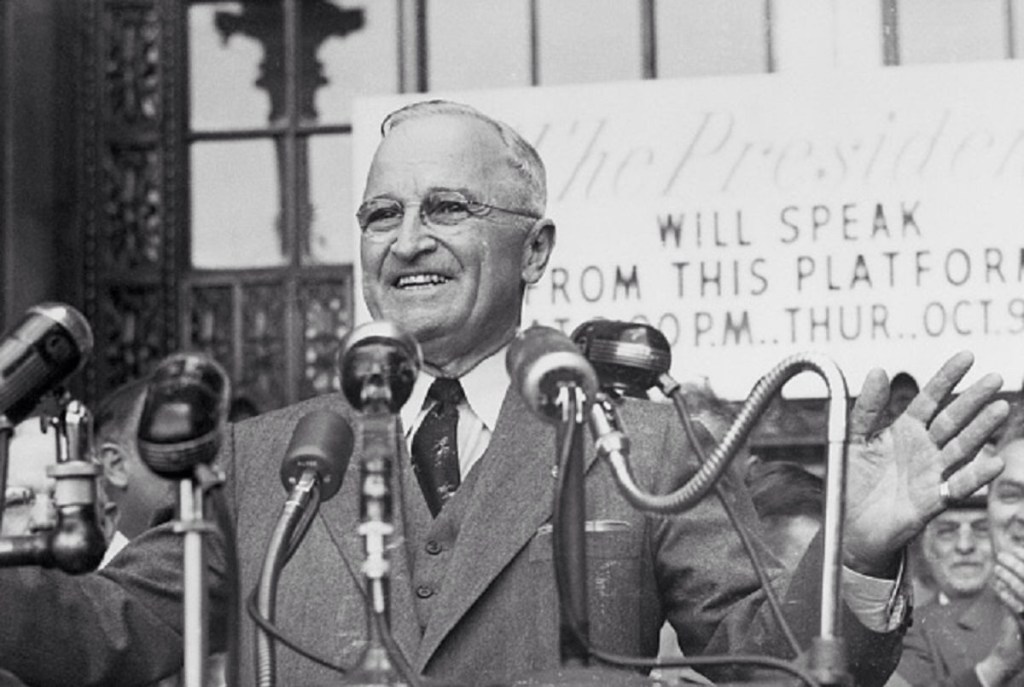
And rather than embark on a long, boring explanation, I will let the words of the late President Harry S. Truman speak for me:
“Socialism is a scare word they have hurled at every advance the people have made in the last 20 years.
“Socialism is what they called public power. Socialism is what they call social security.
“Socialism is what they called farm price supports.
“Socialism is what they called bank deposit insurance.
“Socialismm is what they called the growth of free and independent labor organizations.
“Socialism is their name for almost anything that helps all the people.
“When the Republican candidate inscribes the slogan ‘Down With Socialism’ on the banner of his ‘great crusade,’ that is really not what he means at all.
“What he really means is, ‘Down with Progress — down with Franklin Roosevelt’s New Deal,’ and ‘down with Harry Truman’s Fair Deal.’ That’s all he means.”
– Harry S Truman’s remarks in Syracuse, New York, October 10, 1952. [Source: Harry S. Truman Library & Museum.]
President Harry S Truman
That was 74 years ago, and his words ring as true today as they did then.
As my pal Will Shakespeare asked, “What’s in a name?” Well, for some people, apparently quite a lot. It’s difficult to educate the uneducated if they don’t want to learn. So maybe it would be simpler and more productive for today’s “Socialists” to adopt a new name for themselves and eliminate the issue altogether.