That was how much time I had on Tuesday morning to hope that the surprise visit of CIA Director John Ratcliffe to Moscow might actually result in a measure of good news: possibly the promise of serious ceasefire negotiations, or an imminent prisoner swap.

But no . . . it was not to be. Because that same afternoon, word was received that the Kremlin had issued a threat of “attacks from ‘unknown sources’” against UK factories for having provided long-range drones being used by Ukraine in its recent counter-attacks on Russian territory. And I had to face the harsh truth: that Ratcliffe’s trip was more likely a sign of deepening tensions and an attempt to forestall any such aggression on Putin’s part against a NATO nation.
That Kremlin comment arrived on the heels of an earlier statement that had been issued by the Russian Embassy in London:
“The United Kingdom is acting as an accomplice and co-perpetrator of the bloody crimes and terrorist attacks committed by Ukrainian neo-Nazis. London’s actions will inevitably carry consequences for which it will have to answer . . . The deeper its involvement in the conflict and the greater its support of Kiev’s [sic] terrorist machinery, the higher the price it will pay.” [Owen Matthews, Independent, August 20, 2026.]
[Ed.Note: Look who’s calling whom terrorists ... again.]

And yesterday it was revealed that the purpose of Ratcliffe’s trip was indeed to warn Russia against attacking NATO. According to the Wall Street Journal, U.S. officials are concerned that Putin’s mounting difficulties in Ukraine and at home could push him to take action — anything from a cyberattack to an actual land incursion — and possibly against a Baltic nation. [Lara Seligman, Alexander Ward and Josh Dawsey, Wall Street Journal, August 26, 2026.]
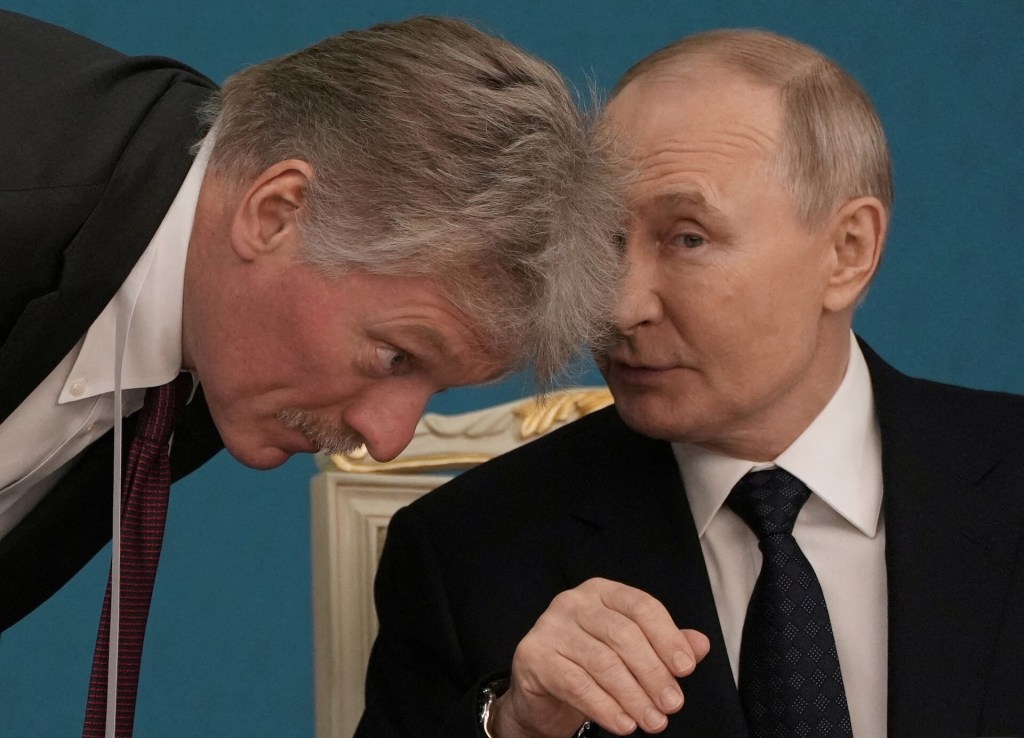
Kremlin spokesman Dmitry Peskov — having a day earlier denied even knowing about Ratcliffe’s plane landing at Moscow’s Vnukovo Airport — finally conceded that both the plane and its passenger were indeed there, saying:
“All I can tell you is that there have been contacts via the security services. These contacts often continue even during the most difficult periods in bilateral relations. Our president, incidentally, has spoken about this.
“However, it is still too early to say to what extent this will, overall, help to steer our bilateral relations out of the profound crisis in which they currently find themselves.” [Arpan Rai and James C. Reynolds, Independent, August 27, 2026 04:14 BST.]
Peskov added that Ratcliffe had met with intelligence officials, but not with Putin himself — though Putin was, of course, being briefed on the matter.
The White House has not been forthcoming with further information, though Donald Trump told radio host Glenn Beck on Wednesday that Ratcliffe’s trip was “semi-routine,” and that, as far as the war in Ukraine is concerned, “Something may come out of it. We’re working very hard to get that war ended and frankly they both want to see it ended at this point.” [WSJ, op.cit.]
I can’t even imagine how Trump defines “semi-routine.” But in my experience, there is nothing routine — “semi” or otherwise — about a CIA Director secretly hopping on a military flying fortress to pay a sudden, rushed visit to meet with his counterparts in Moscow . . . and particularly in a time of “profound crisis,” as Dmitry Peskov so bluntly described the situation.
*. *. *
From what little we do know, this is an interesting development, to say the least. I can hardly wait to see what the rest of the week has in store for us.

Just sayin’ . . .
Brendochka
8/27/26

