When the Soviet Union (USSR) imploded in 1991, each of its 15 republics became independent nations. In an effort to maintain solidarity in matters of economic, political and military affairs, three of the former republics — Russia, Ukraine, and Belorussia (renamed Belarus) — formed the Commonwealth of Independent States (CIS), to be joined by nine others, excluding only the Baltic states of Latvia, Lithuania and Estonia. Subsequently, Ukraine and Georgia both withdrew from the CIS, leaving the current membership of ten former Soviet republics: Russia, Belarus, Moldova, Armenia, Azerbaijan, Kazakhstan, Kirghizstan, Tajikistan, Turkmenistan, and Uzbekistan.
The world has seen many changes in the 35 years since the dissolution of the USSR. Not surprisingly, those changes have given birth to a number of new alliances and a whole new set of acronyms for us to memorize.
Remembering the names is actually the easy part; what is becoming difficult is distinguishing among them, as they sometimes include some of the same members and offer the same or similar mission statements . . . leading one to question whether they may actually be operating at cross-purposes.
For example, there is BRICS — so named for its founding members: Brazil, Russia, India, China, and South Africa. It was the brainchild of Vladimir Putin, founded in 2006 as BRIC (becoming BRICS with the later addition of South Africa), and since having added Egypt, Ethiopia, Indonesia, Iran, Saudi Arabia and the United Arab Emirates as full members. In addition, there are numerous “partner” members, as well as pending applicants for membership. It has held an annual summit each year since 2009.
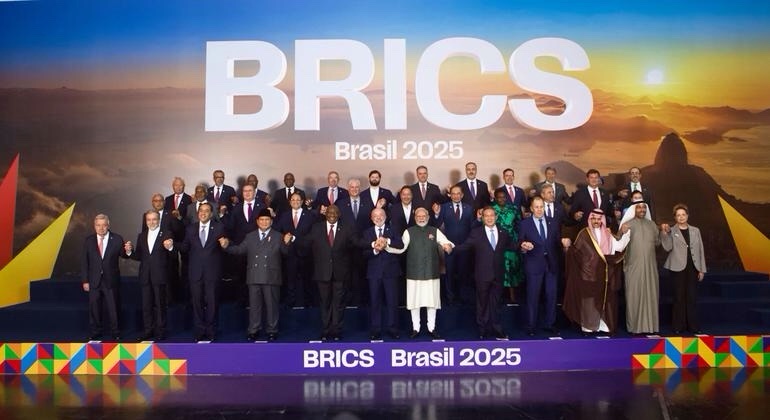
BRICS is, thus far, the most formidable of the new groups, bluntly stating that its principal purpose is to surpass and replace the Western alliances as the dominant political and economic forces of the 21st century.
*. *. *
On August 10th, I reported on a new alliance, known as the Mecca Joint Defense Agreement, among Saudi Arabia, Pakistan, and Türkiye. Although it hasn’t officially adopted an acronym, I think of it as “SPAT,” since “MJDA” is unpronounceable in most languages (though admittedly I do not speak Arabic, Urdu, or Turkish).
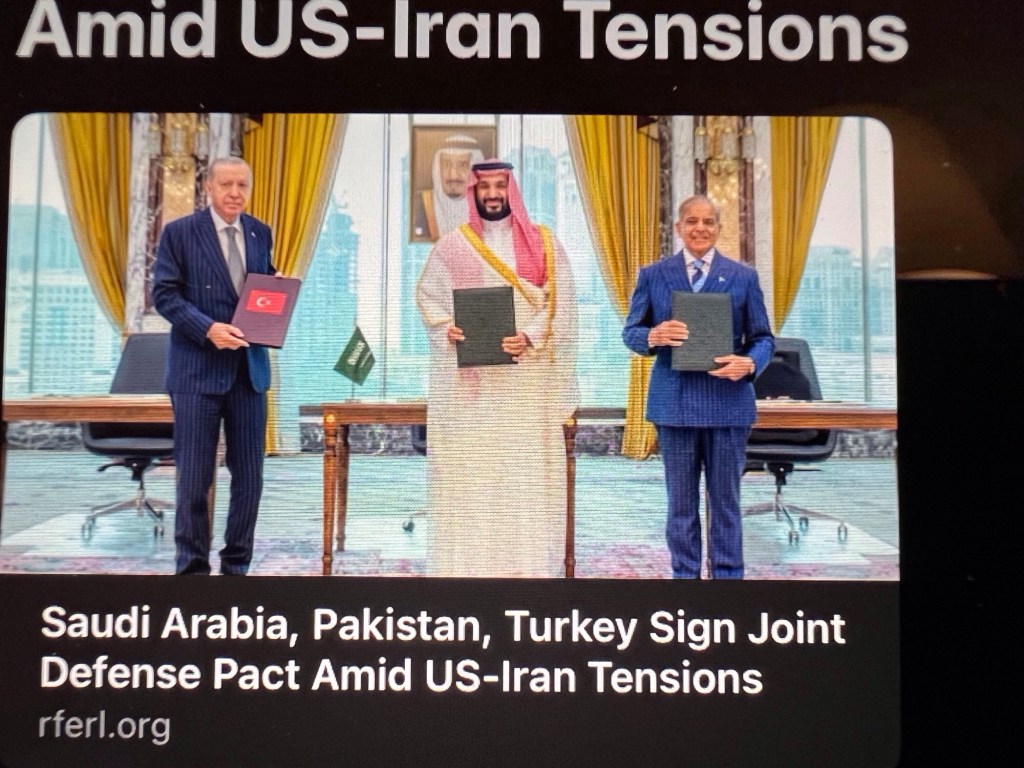
SPAT may never expand to an organization the size of BRICS. But it is of particular interest because of the presence of NATO member Türkiye, and its NATO-like declaration that “any armed attack against any one of the three states shall be regarded as an attack against them all.” [David Khattak, RFE/RL, August 7, 2026.]
In the midst of an increasingly precarious situation in the Middle East, it is understandable that surrounding regions are finding it necessary to increase their defensive capabilities. But conditions can change in an instant, so we shall have to see where this one goes.
*. *. *
But wait . . . there’s more. Yesterday’s news brought word of a growing cooperative effort among the world’s four dominant autocracies — China, Russia, Iran, and North Korea — that is already being unofficially referred to as “CRINK.”
While not yet a formal alliance, they have responded to increasing Western pressure and sanctions by “drawing on one another’s resources, military capabilities, and geopolitical leverage to withstand Western pressure.” [Alex Raufoglu, RFE/RL, August 12, 2026.]
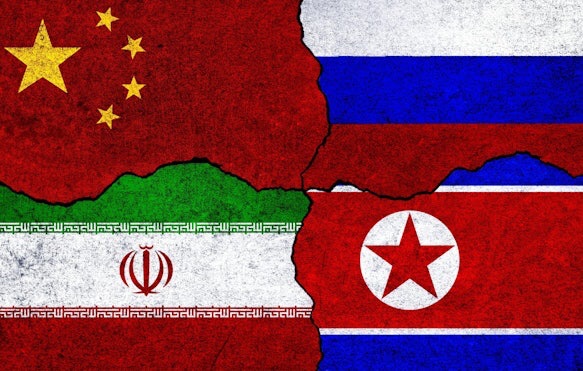
In this instance, it is the inclusion of isolationist North Korea — which has increasingly been involving itself in Russia’s war against Ukraine — that is of particular interest. And in Washington and elsewhere, there is concern over the extent to which such a formidable alliance might shift the existing international balance of power.
*. *. *
Of course, on the other side of the political fence, there is the “Coalition of the Willing” — the bloc of 35 European nations, being led by France and the UK, that has been so instrumental in aiding Ukraine’s defense against Russian aggression since the invasion of February 24, 2022. I hesitate to assign it an acronym, as it would almost certainly have to be “COW” — which, while inoffensive enough, sounds a bit playful for such a serious undertaking. (The alternative — naming it after the two lead countries of France and the UK — is tempting, though probably not a good idea in the context of international diplomacy.)
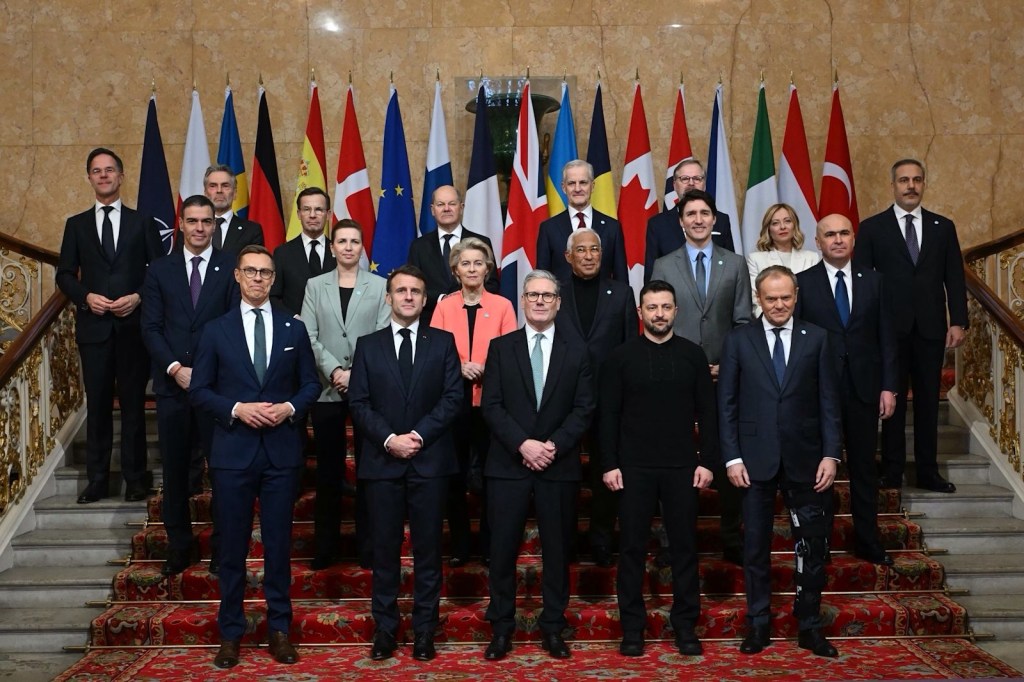
But the Coalition is certainly a welcome counterpoint to the growing number of back-room alliances being created in an increasingly anxiety-ridden world. Together with the UN, NATO, the EU, and others, they bring us hope for the survival of a freer and more peaceful planet.
Just sayin’ . . .
Brendochka
8/13/26

