Today is the 1,544th anniversary of the founding of Kiev (as it was known then). Although the exact date is the subject of ongoing debate, it has come to be accepted as the year 482 A.D., and is celebrated on May 31st.
Fifth Century Kiev
(Just as a matter of interest, the city of Moscow was not founded until 1147 A.D. — nearly 700 years later. So all of the talk about Ukraine historically “belonging” to Russia is . . . well . . . so much talk.)
Today, even in the midst of war, the spirit of the people of Kyiv shines through the pain and the misery, as expressed in a post that I found on Facebook today. It reads in part:
“This is a city that is truly impossible not to love. A city of chestnut trees and golden domes, bustling streets, morning traffic jams, and evening walks along the Dnipro River. A city where every street has its own story and every district its own character.
“ . . . Kyiv is its people. It is the rescuers who are first to arrive after strikes, the soldiers defending its skies, the doctors, volunteers, utility workers, teachers, public transport drivers, and everyone who works every day to keep the capital alive.
“Kyiv is a city of resilience and a city of hope. Happy Kyiv Day — to the city that inspires, fights, and wins!”
But, as I’ve said before, Vladimir Putin and his crew of Kremlin comics are often at their funniest when they’re being serious.
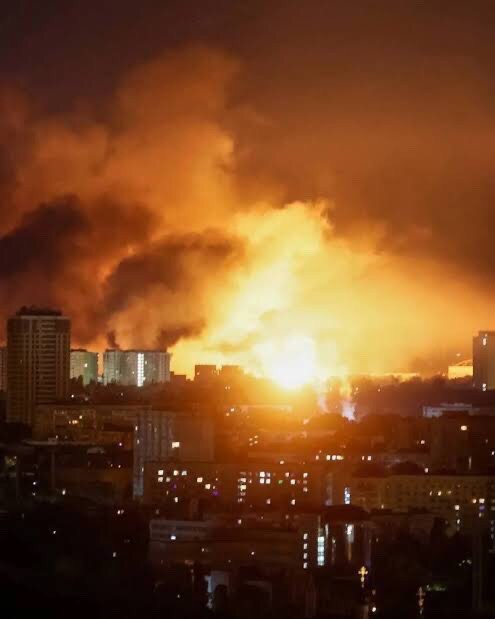
On Thursday, May 28th, a drone — in the midst of a massive Russian multi-drone attack on the Ukrainian city of Izmail — crossed the border into Romania, striking an apartment building in Galati, seriously wounding two Romanian civilians.
NATO and the EU immediately denounced Russia’s “reckless behavior,” while Romanian President Nicusor Dan expelled the Russian Consul General and shut down the consulate in the nearby city of Constanta.
But instead of attempting to defuse the potentially volatile situation by apologizing for what might conceivably have been an accident, Putin went on record the next day as saying it was too early to determine whether the offending drone was actually Russian. Speaking to reporters at a news conference in Astana, Kazakhstan, he said:
“Who in Romania says that this is a Russian drone? No one can say what the origin of this or that drone is until an examination has been carried out.” [Reuters, May 29, 2026.]
Claiming that Ukrainian drones had previously been spotted in Poland, Finland, and the Baltic countries, he attempted to deflect blame by adding:
“The first reaction was exactly the same as it is now in Romania: The Russians are coming. Then, after a short time, it turned out that it had nothing to do with Russian drones.” [Id.]
Well, maybe . . . except for a little matter of geography.
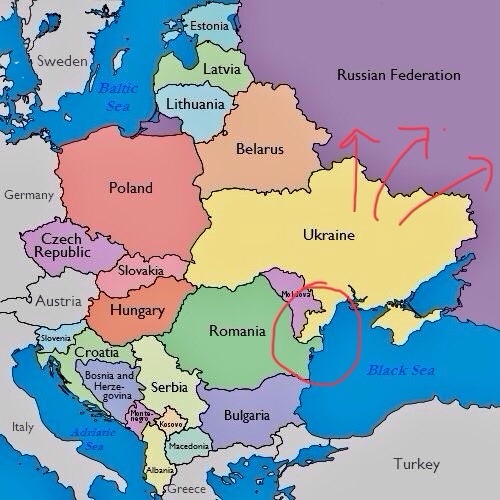
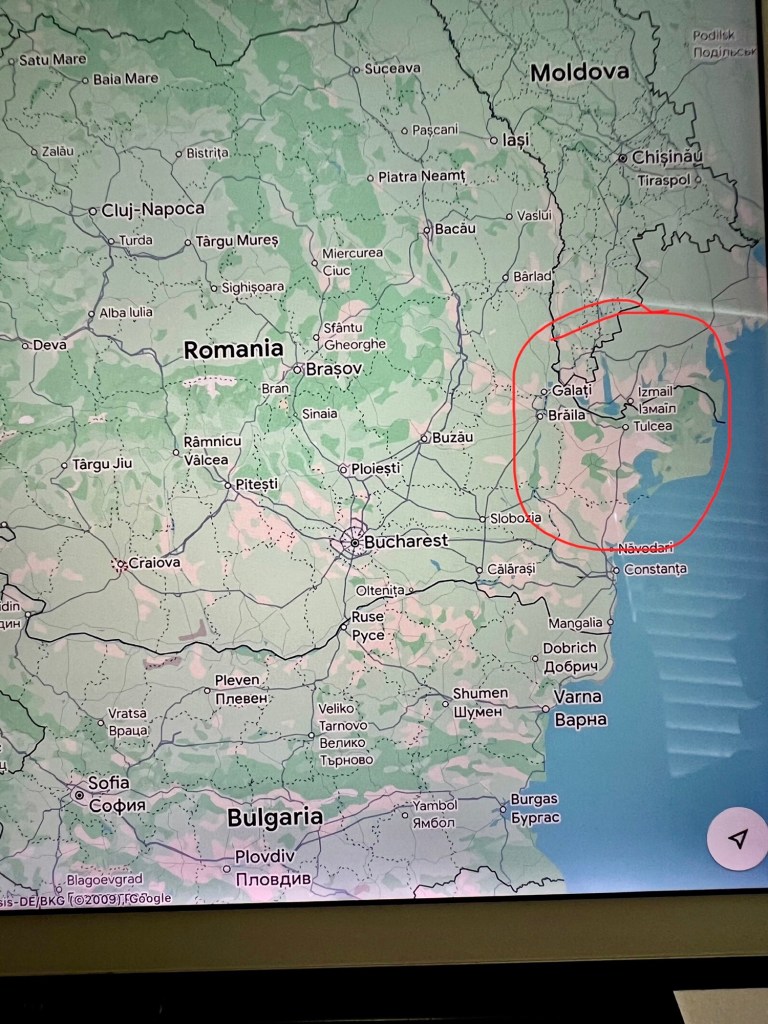
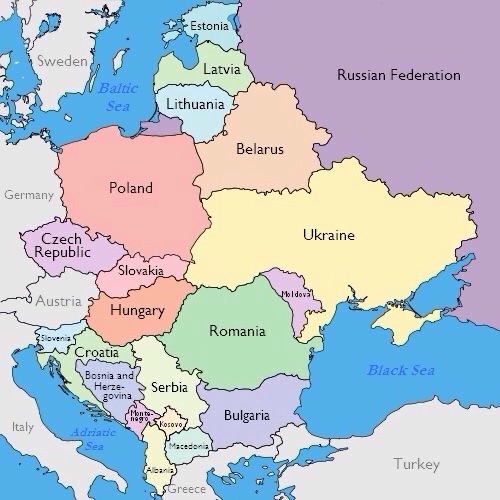
I am the farthest thing from a military expert, but even I can see the fallacy in Putin’s so-called logic. Let’s look at the map of the region.
Eastern Europe
The area in which the missile strike occurred is circled in red, in that little space where Ukraine and Romania share a short border, next to Moldova. Galati, Romania, is located just across the Danube River from Izmail, Ukraine. So why would Ukrainian forces, who were busy repelling an attack from Russia, be firing drones toward Romania in the opposite direction? Unless they were colossally stupid — which they most assuredly are not — their anti-drone munitions would be aimed generally in the directions shown by the arrows: north/northeast.
Am I right?
Now, I realize that the Russian Federation and the Soviet Union have had a long-standing tradition of refusing to accept responsibility for anything, preferring instead to find the nearest scapegoat when things go wrong. But it seems that after so many years of dissembling they’ve run out of plausible excuses.
So why can’t Vlad — just once, to see how it feels — put on his big-boy pants, and admit that someone in his army goofed? And if that’s too painful, he can always find a general or two to take the heat.
There is nothing more dangerous than an animal — even one of the human variety — that is cornered and out of options. And with his war against Ukraine in its fifth year, his economy bottoming out, NATO and the European Union standing up to him, and his own people catching onto the fact that he is something less than superhuman, Vladimir Putin is showing distinct signs of exactly that kind of desperation.
He has also been struggling to maintain a measure of control over a number of former Soviet republics. The Baltic states — Latvia, Lithuania and Estonia — are fiercely independent, having gained membership in both NATO and the EU in 2004. Strategically-located Moldova has more recently become a candidate for EU membership. And now Armenia — long considered to be under Russian security protection — has begun turning Westward, deepening its ties with Europe and the U.S. while noticeably reducing its dependence on Moscow . . . the final straw apparently having been Russia’s failure to assist Armenia in maintaining its control in the Nagorno-Karabakh region.
So, Putin being Putin, he has been issuing threats that he may not actually be in a position to carry out. In a statement glaringly reminiscent of his rhetoric prior to the 2022 invasion of Ukraine, he recently warned Armenia’s Prime Minister Nikol Pashinyan that they could face a “Ukrainian scenario” if they continued to pursue stronger ties with Europe, and spoke of a potential split:
“In my opinion, it would be right, both in relation to the population, the citizens of Armenia, and in relation to us, as the main economic partner, to decide as early as possible, for example, by holding a referendum. Accordingly, we would draw the appropriate conclusions and follow the path of a soft, intelligent and mutually beneficial divorce.”
– Vladimir Putin, May 10, 2026 Press Briefing
And we all know what a Putin-esque “Ukrainian scenario” looks like.
Not all of the hostages are in Russia. The prisons and penal colonies in other former Soviet republics and Russia-friendly countries — such as Belarus, Azerbaijan and Georgia — are also full of political prisoners: dissidents, oppositionists, journalists, and others who have spoken out against their repressive regimes.
In June of 2025, seven such individuals were convicted in a court in Baku, Azerbaijan, on various spurious charges and sentenced to lengthy prison terms. Their names have been on my list of hostages since that time; I dubbed them the “Azerbaijan Seven.”
The “Azerbaijan Seven”
One of them — economist, civil society advocate, and RFE/RL contributor Farid Mehralizade (far left above), had been abducted on the street on May 30, 2024, denied counsel, and charged with “illegal entrepreneurship, money laundering, tax evasion, and document forgery.” Despite a total lack of evidence, he was convicted at the 2025 trial and sentenced to nine years in prison, where he remains today. [RFE/RL, May 30, 2026.]
After two years in detention, Mehralizada has spoken out on his life in prison, as reported yesterday by RadiioFreeEurope/RadioLiberty. His account is not filled with tales of horror, anguish and depression, but instead focuses on the social, economic, and practical aspects of life behind bars . . . and is well worth taking the time to read.
A young man — just 31 years old, with a wife and a daughter born a few months after his arrest — his words reflect his loneliness, but lack any expression of bitterness or anger. His report is both enlightening and inspiring, indicative of a man who is determined to survive this miscarriage of justice in order to be reunited with his family. We can only hope for the success of the efforts underway for his early release.
RFE/RL Photo
*. *. *
And for the thousands of other political prisoners of Putin and his tyrannical allies, another week in prison has passed. Once again, here is the full list of those hostages known to me, which is still only a fraction of the total:
Prisoners of War:
The 20,000+ Kidnapped Ukrainian Children The People of Ukraine
Immigrant Detainees in Russia:
Migrants from the Central Asian nations of Kazakhstan, Kyrgyzstan, Tajikistan, Turkmenistan and Uzbekistan
Endangered Exiles:
Pavel “Pasha” Talankin Mikita Losik Yulia Navalnaya Oleg Orlov Countless Journalists and Other Dissidents
Political Prisoners:
In Afghanistan:
Mahmoud Habibi (Afghan-American) Paul Overby (American, missing since 2018)
Andrei Chapiuk Uladzimir Labkovich Andrzej Poczobut Marfa Rabkova Valiantsin Stafanovic Yuras Zyankovich
In Georgia:
Mzia Amaglobeli
In Russia:
The “Crimea 8”: Oleg Antipov Artyom Azatyan Georgy Azatyan Aleksandr Bylin Roman Solomko Artur Terchanyan Dmitry Tyazhelykh Vladimir Zloba
James Scott Rhys Anderson (British) Aleksandr Andreyev David Barnes (American) Yevgenia Berkovich Gordon Black (American) Hayden Davies (British) Yury Dmitriyev Anastasia Dyudyaeva Antonina Favorskaya Konstantin Gabov Robert Gilman (American) Stephen James Hubbard (American) Sergey Karelin Timur Kishukov Vadim Kobzev Darya Kozyreva Artyom Kriger Michael Travis Leake (American) Aleksei Liptser Grigory Melkonyants Nika Novak Svetlana Petriichuk Leonid Pshenychnov (in Russian-occupied Crimea) Nadezhda Rossinskaya (a.k.a. Nadin Geisler) Lev Schlossberg Sofiane Sehili (French) Igor Sergunin Dmitry Shatresov Robert Shonov Grigory Skvortsov Eugene Spector (American) Joseph Tater (American, disappeared) Karina Tsurkan Laurent Vinatier Robert Romanov Woodland (American)
I’ll never understand why bad things have to happen to good people. But on the flip-side, I like to think that karma will eventually catch up with those who deserve it — the murderers, abusers, tyrants, and yes, even the vampires (if they do exist) — who are completely without conscience and live only for their own twisted pleasures.
I included vampires here because of a quote from Anne Rice, the late American author best known for her Vampire Chronicles, in which Lestat, reflecting on his own ill-conceived life choices, addresses himself:
“Oh Lestat, you deserved everything that’s ever happened to you. You better not die. You might actually go to hell.”
– Anne Rice, “The Vampire Lestat (The Vampire Chronicles, #2)”
Anne Rice (1941 – 2021)
I could name any number of people living today who might give that thought some serious consideration. But you already know who they are, don’t you?
When we were kids, that was our sing-song way of taunting a sore loser, or someone who had just been called out for intentionally misbehaving.
Stop whining, you big baby!
And when that little brat grows up to be nothing more than a bigger version of him (or her) self, those of us who actually did become adults — having learned a bit of restraint along the way — might prefer instead to offer a bit of useful advice, such as . . .
“If you can’t face up to the punishment, maybe you should think about not committing the crime in the first place, you f***ing idiot!”
“Why are they picking on me?”
I’m sure you’ve figured out that I’m talking about the ruling handed down yesterday by U.S. District Judge Casey Cooper, directing that Donald Trump’s renaming and closing of the Kennedy Center be reversed. In his 94-page opinion, Judge Cooper concluded that the law establishing the Center:
“ . . . makes crystal clear that the Center is to be named for President Kennedy, and it cannot bear any other formal name or public memorial based on the Board’s unilateral say-so. Congress gave the Kennedy Center its name, and only Congress can change it.” [Devan Cole and Betsy Klein, CNN, May 29, 2026.]
Word has it that the White House staff was subsequently treated to a typical Trumpian meltdown . . .
. . . following which he spent some time actually doing his job, entering the White House Situation Room to make his “final determination” on the situation in Iran. We can only hope that he stayed focused long enough to get through that meeting.
He then turned his attention back to what was of greatest importance to him: Judge Cooper’s ruling. In a 578-word statement on Truth Social, he attacked the judge for having been nominated to the federal bench by Barack Obama. He noted that Judge Cooper had ruled that his (Trump’s) handpicked board members, who “unanimously voted to add the name ‘TRUMP’ onto the former Kennedy Center, making it The Trump Kennedy Center, did not have the right to do such an addition, and the name, ‘TRUMP,’ must be removed.” [Robert Mackey, Maham Javaid, Lucy Campbell and Tom Ambrose, The Guardian, May 29, 2026.]
And — after a great deal more ranting and raving — he ended with a “you-can’t-fire-me-because-I-quit” type of statement, saying that he has “no interest” in the Kennedy Center, and that:
“ . . . we are going to be working with Congress to transfer this failing Institution back to them. I have instructed the Department of Commerce to make all necessary arrangements with Congress to allow a full and complete transfer of this Institution, giving them the responsibility for its Operation, Maintenance, and Management.” [Id.]
But despite Trump’s professed lack of interest, Judge Cooper’s ruling is likely to be appealed. The Kennedy Center’s vice president for public relations, Roma Daravi, also issued a statement, stating that they “are confident that on appeal the court will uphold the board’s will to recognize President Trump’s historic contributions to our nation’s cultural center.” [Id.]
Still, what else would one expect from a board comprised of loyal sycophants anxious to maintain their positions?
*. *. *
Things haven’t been going well for Trump lately. His ill-conceived (and illegal) “excursion” into Iran is dragging on; he flew to China to meet with Xi Jinping, only to leave empty-handed; numerous courts are ruling against his vindictive attempts to retaliate against people who tell the truth about him; his $1.77 billion slush fund is in limbo, as are his “Arc de Trump,” his proposed $250 bill with his face on it, and the proposed taxpayer funding for his precious ballroom/bunker. Even members of his own party are beginning to vote against him in Congress. It can’t be much longer before the six conservative Supreme Court justices wake up to the fact that he can’t fire them, and that perhaps it’s time they started thinking of their own legacies.
Then maybe — just maybe — once Todd Blanche and Kash Patel have been dispensed with, the Department of Justice will resume doing its job, tear up Trump’s enemies list, and begin prosecuting the real criminals.
And when that day comes, we will know that it all started with a few honest and brave judges like Casey Cooper.
A few hours ago, I posted an article about Russia’s most recent incursion into NATO territory, when an overnight attack against Izmail, southwestern Ukraine, resulted in a drone striking an apartment building in Galati, southeastern Romania. Referring to Vladimir Putin’s continuing violations of international law, I wondered:
“So how long will it be before he is held to account?”
Proximity of Izmail, Ukraine, to Galati, Romania
Well, it didn’t take long for Romania to take diplomatic action.While NATO accused Russia of reckless behavior and promised to defend its allied territory, Romanian President Nicusor Dan went a giant step further and announced the expulsion of Andrei Kosilin, the Russian Consul General in the nearby city of Constanta, and shut down the consulate.
Romanian President Nicusor Dan
From the looks of it, it’s not much of a consulate. And its closure is not as impactful as shutting down the embassy in Bucharest would be.
Russian Consulate General – Constanta, Romania
But it’s a start — and it has not gone unnoticed in Moscow. Russian Foreign Ministry spokesperson Maria Zakharova was quick in saying that:
“ . . . retaliatory measures in connection with the declaration of the Russian consul general as persona non grata and the closure of the consulate general will not be long in coming.” [Meduza, May 29, 2026.]
Zakharova did not indicate whether they were considering diplomatic retaliation or — hopefully not — a military response. But it is clear from her words that the Kremlin is not happy.
The war in Ukraine has predictably spilled across borders in the tightly-packed Eastern and Central European region, creating security nightmares for numerous countries from Romania and Moldova to the Baltics. The International Criminal Court (ICC) has an outstanding warrant against Putin and other high Russian officials for war crimes committed in Ukraine. But Russia is not a member of the ICC, and there has been no practical effect on Putin other than to restrict his travel to or through certain ICC member countries.
Further isolating Russia diplomatically might be more meaningful, if enough countries were to follow Romania’s lead. A number of them have already closed their borders with Russia and its ally Belarus, cancelled direct flights, and issued punishing sanctions.
But Putin still has sufficient allies throughout the world to keep his regime afloat . . . for now. What will it take for them to realize that his ability to help them is waning, while his need for their assistance is increasing?
How long would their loyalty last if he were finally shown to be the liability that he truly is?
It keeps happening: Russian drones — ostensibly aimed at Ukrainian targets — continue to stray across borders into NATO/EU territory, causing human casualties and damage to civilian infrastructure.
This time it was Romania . . . again. Russian drones have breached that country’s airspace 28 times, and last night another one hit an apartment building in Galati, exploding and wounding two people. The strike occurred as a massive attack was underway in the Ukrainian city of Izmail, a large Ukrainian port just across the border formed by the Danube River. [Kathleen Magramo, CNN, May 28, 2026.]
Galati is located in the far southeastern region of Romani, abutting both Ukraine and Moldova. And Moldova — while not yet a member of either NATO or the EU, but on track for EU membership in an effort to remain outside of Russia’s grasp — is equally endangered.
Also at risk are NATO/EU members Poland, Slovakia and Hungary, all of whom share borders with western Ukraine. Polish airspace has already been invaded numerous times by Russian drones, and that entire region of Eastern Europe is on increased, constant alert.
Yet Vladimir Putin claims that it is his country that is in danger from Western “aggression,” as he continues to pound Ukraine into rubble, while also veering — accidentally or otherwise — into territories that pose no threat whatsoever to him.
Is Russia’s drone technology so poor that they keep wandering outside of their intended target range? Or are these in fact intentional warning shots across NATO’s bow? Practically speaking, it hardly matters. Either way, Putin’s actions are in clear violation of international law.
So how long will it be before he is held to account?
Welsh poet and writer Dylan Thomas famously penned these immortal words when contemplating the inevitable death of his father:
“Do not go gentle into that good night. Rage, rage against the dying of the light.”
And it appears that Vladimir Putin has taken that advice very seriously — to the tune of some $26 billion to finance his longevity initiative, known as “New Health Preservation Technologies.”
Bathing in Ice-Cold Water, With the Blessing of the Church – c. 2018
It was announced last month by the Russian government that scientists are working on the development of a gene-therapy treatment that would slow cellular aging. According to Deputy Science Minister Denis Sekirinsky, the drug “represents one of the most promising avenues in the fight against aging.” [Bojan Pancevski, The Wall Street Journal , May 28, 2026.]
But that’s just one facet of Putin’s quest for immortality. They are also working to create human organs in a laboratory for transplantation, focusing on two key technologies: bioprinting, or 3D printing of living tissue; and xenotransplantation, or growing human organs inside mini-pigs, which are a breed of animals genetically compatible to humans.
Russian scientists already claim to have bioprinted human cartilage tissue and a mouse thyroid gland, and have projected a target date of 2030 for achieving human organ transplantation. According to the Kremlin press service:
“In the Russian Federation, work is under way on a whole range of scientific programs in this field. These projects are supported by the state, and many scientific and research institutions are taking part in them.” [Id.]
Putin’s longevity program is being spearheaded by his daughter Maria Vorontsova, an endocrinologist, along with physicist Mikhail Kovalchuk, head of the Soviet-era nuclear research center known as the Kurchatov Institute.
Maria Vorontsova and Mikhail Kovalchuk
Kovalchuk — whose brother Yuri is a banker and media investor close to Putin — says that science will soon allow humans to repair and replace body parts indefinitely:
“It is difficult to discuss immortality, but the ability to repair man will undoubtedly increase.” [Id.]
This initiative is not new; it was started by Putin in 2024, but has received little or no publicity. Nor has there been any meaningful peer-reviewed research reported in major international journals. According to Russian scientist Aleksandr Ostrovsky:
“If there are no publications there are no real results, and their statements should probably be taken as aspirations, not to say dreams. It’s impossible to do science in isolation. They are probably telling Putin what he wants to hear to secure funding.” [Id.]
When Pigs Fly
Vladimir Putin is not the only billionaire fascinated with the idea of living forever; his obsession is shared by the likes of Jeff Bezos, Sam Altman and Peter Thiel, among others. But unlike those who may be motivated by a simple desire never to be parted from their money, Putin is known to be a man who lives in constant fear.
He is said to be a germophobe; pictures of him surfaced during the COVID pandemic, seated at ridiculously long conference tables far removed from other people. He moves constantly from residence to residence, office to office, to keep his whereabouts hidden from his perceived enemies. And he has recently been known to spend considerable time hiding out in secret bunkers because of the Ukrainian military’s expanding drone and missile attacks on Moscow.
An Excess of Caution
While fear of death — particularly a violent death — is not unusual, Putin’s condition seems extreme, even pathological. And I can’t help wondering whether, as he grows older and life becomes more hazardous, he has perhaps begun thinking about the possibility that there will be a Judgment Day in which he will finally be required to account for his actions on this earthly plane. And that’s enough to drive anyone to distraction.
Thinking about my own misdeeds throughout life is disturbing enough. I sure as hell wouldn’t want to have to answer for his.
Yesterday was not one of my better days. It was just a sinus headache on top of a restless night’s sleep; but it was enough to interfere with my plans for the day, and my overall mood — especially after perusing the daily ration of depressing world news.
But I didn’t want to give in to it for another day, so I turned to a wise man for inspiration, and found this last night:
“There is a saying in Tibetan, ‘Tragedy should be utilized as a source of strength.’ No matter what sort of difficulties, how painful experience is, if we lose our hope, that’s our real disaster.”
– Dalai Lama XIV
The 14th Dalai Lama
So, here’s to holding out hope for a better day today.





















 The Blog About Everything … and Sometimes Nothing