In my earlier post today, I wrote that Vladimir Putin’s popularity with the people of Russia is suffering and their support for his seemingly endless war against Ukraine is “waning.” That may actually have been something of an understatement.
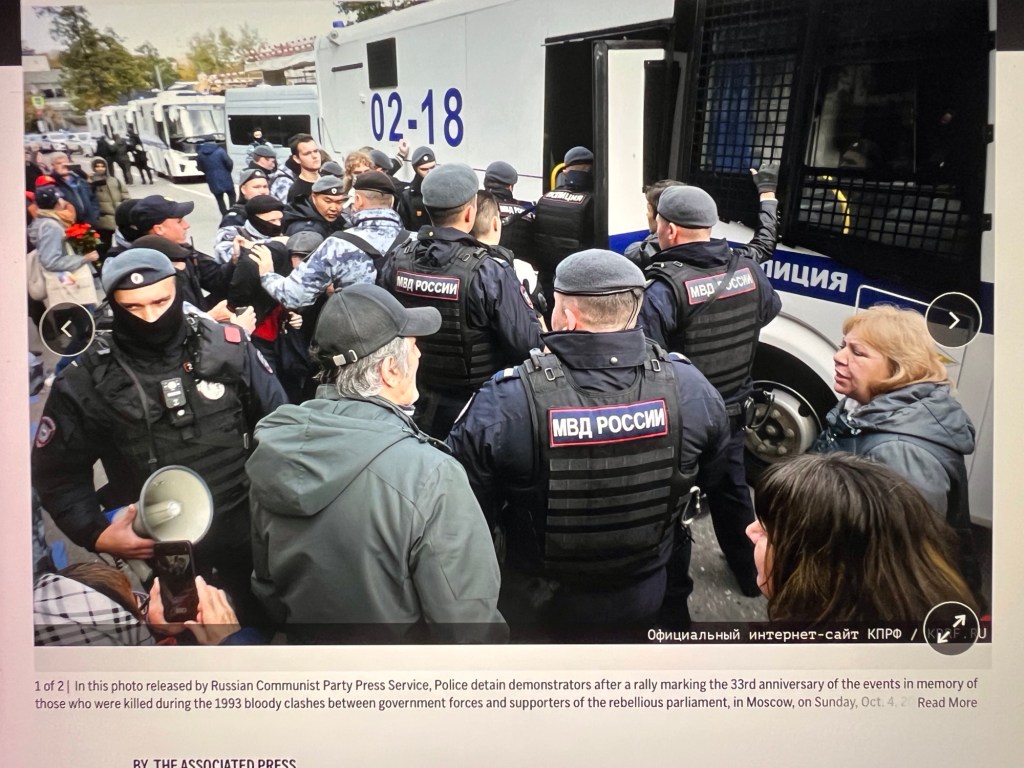
As it turns out, I seem to have miscalculated the level of dissatisfaction of the Russian populace. Because over the weekend, the Kremlin-friendly Communist Party of the Russian Federation (KPRF) organized a rally, joined by some 6,000 demonstrators including members of the liberal, anti-war Yabloko Party . . . the opposition party that was denied authorization to run in the recent Parliamentary elections.
Moscow – October 4, 2026(AP Photo)
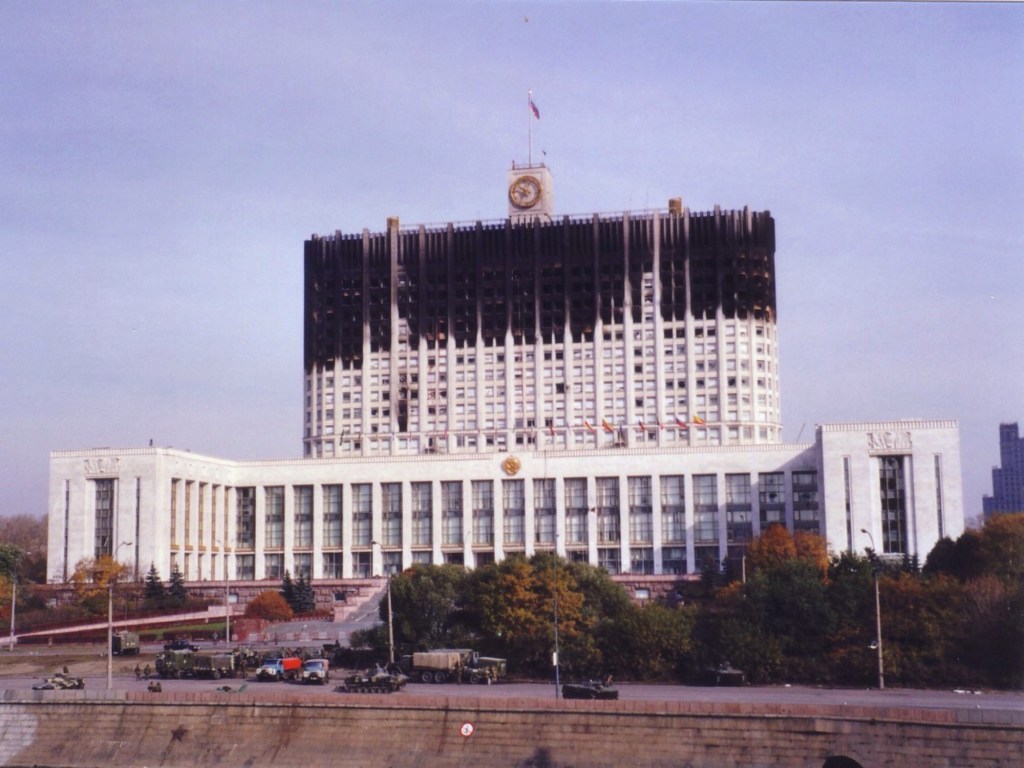
The bipartisan rally was being held to commemorate the 33rd anniversary of the 1993 constitutional crisis that ended in the shelling of the Parliament, on the orders of then-president Boris Yeltsin, to quell the resistance to his reforms being staged by a cadre of Soviet-era hard-liners. Known as the “Black October” uprising, it resulted in the deaths of 147 people and hundreds of injuries.
Russian Parliament Building – Moscow, October 1993
At this week’s rally, everything was fine until near the end. According to the Pravda news service, as some of Sunday’s demonstrators began chanting “Freedom for political prisoners,” “For fair elections,” and “Down with the Tsar,” police charged in and arrested some 60 people, of whom 26 were reportedly from the Communist Party, and another 30 from Yabloko. [Harry Thompson, Daily Beast,October 5, 2026.]
The Associated Press has reported that the KPRF says it is working to obtain the release of those arrested. [Id.]
Such demonstrations of opposition are rare in Russia, and are invariably met with police action. This has been especially true since the loss of the popular dissident Aleksei Navalny, and the increase in arrests of journalists and others who dare to speak out against Putin or his war.
So what prompted this one? Is it a one-off, or the start of a larger movement? Will it fizzle out, or build momentum to present a serious challenge to Putin’s iron-fisted rule?
Obviously, I don’t have the answers. I don’t think Putin will be going anywhere soon, or that a full-blown revolution in Russia is imminent. But, as history is so fond of proving, anything is possible.
It is incomprehensible; it is unspeakable; it defies all reason . . . even for Donald Trump.
Speaking at a campaign rally in Nebraska yesterday, he said this about the cost of the war in Iran:
“It’s a small price to pay for keeping the world safe, keeping the country safe. They can take out a city, let ‘em take out Los Angeles, let ‘em take out San Diego. This is a very small price to pay.” [Iris Kwok, et al., Los Angeles Times, October 5, 2026.]
And his audience of MAGA maniacs cheered.
Congress must put a stop to this madness NOW. There are legal, constitutional remedies available. No more excuses, no more “party loyalty.” The country simply will not survive another two years with this lunatic in charge.
As the 1954 Johnny Mercer classic told us, that’s when “something’s gotta give.”
On Saturday, October 3rd, Vladimir Putin — assuming the ones to “give” would be the foreign diplomats who have kept their embassies in Ukraine open despite the increased attacks by Russia’s forces — issued a direct warning for them to leave or risk losing their lives.
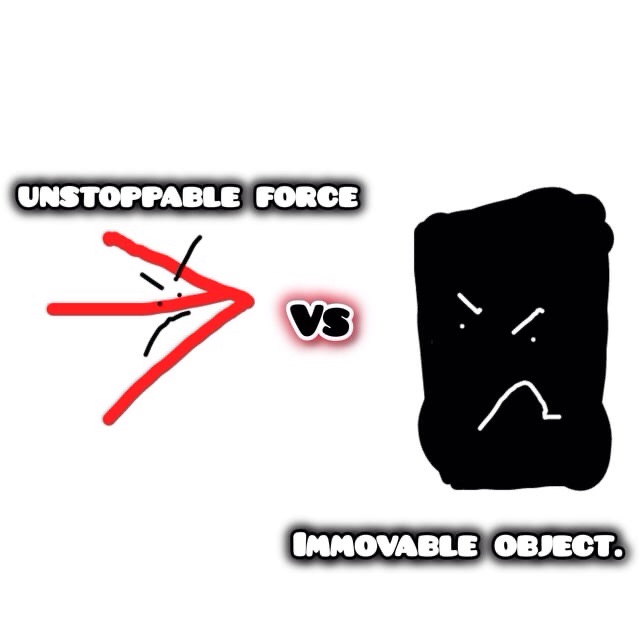
He undoubtedly expected to see a mass exodus; instead, he received responses from some immovable sources:
> From Poland: It has no intention of changing how its Embassy operates in Kyiv.
> From Estonia: Its Embassy remains in Kyiv, and its support of Ukraine remains firm.
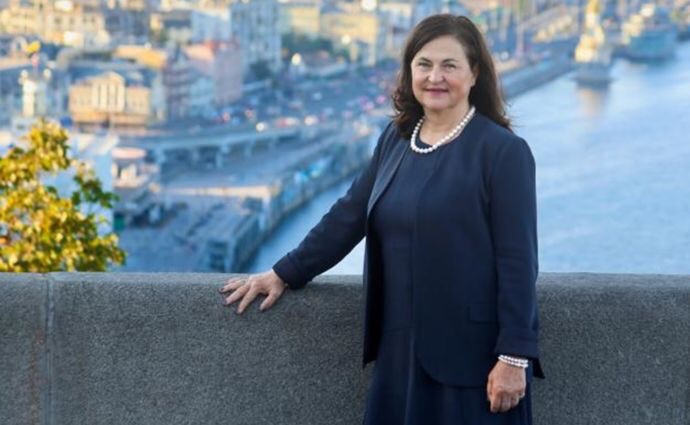
> And from the EU’s Ambassador to Ukraine, Katarina Mathernova: “The responsibility for russian [sic] attacks belongs to russia [sic]. Moscow wants to scare Europe into reducing its support for Ukraine. That will not happen.” [Yuri Zoria, Euromaidan, October 4, 2026.]
EU Ambassador Katarina Mathernova
Putin’s threats, and his hybrid assaults on NATO/EU territory, have thus far only served to strengthen the resolve and the defenses of the nations of Europe. Now he has sunk to the level of personally threatening the lives of their government officials as he escalates his attacks on Kyiv.
But his bluff is being called.
Nearly five years of war have, rather than causing the people of Ukraine to cower and surrender, only reinforced their determination to defend their country for as long as it takes to defeat Putin. Similarly, the people of Europe — having fought and survived two world wars — are standing firm in the defense of Ukraine and of their own sovereign nations.
Conversely, however, Putin’s prolonged war has begun to affect his own people, and their support for his “special military operation” is noticeably waning. He is now facing the once unimaginable possibility of a dual loss: on the battlefield in Ukraine, and in the political arena at home.
There’s no telling what twists and turns are ahead, or how long it may take to reach a final resolution; but right now, my money is on the immovable objects of Europe.
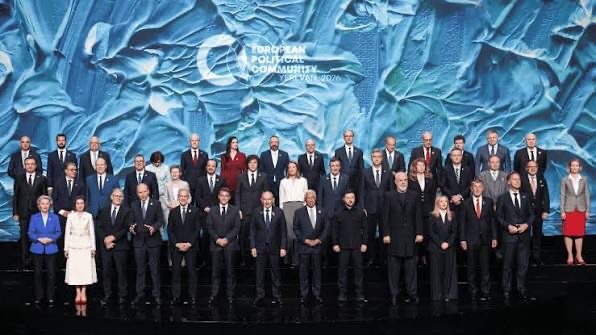
European Political Community Summit – Yerevan, Armenia – May 4, 2026
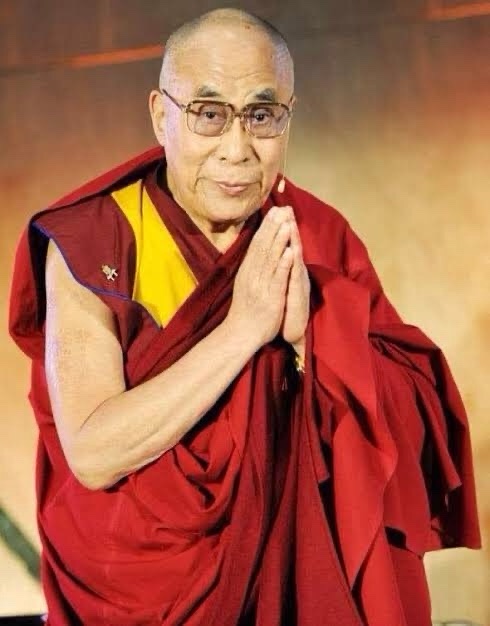
On this date in 1989, Dalai Lama XIV was awarded the Nobel Peace Prize. At 91 years of age, he continues to grace us with his pearls of wisdom and prayers for peace, such as:
“Our prime purpose in this life is to help others. And if you can’t help them, at least don’t hurt them.”
”Love and compassion are necessities, not luxuries. Without them, humanity cannot survive.”
“World peace must develop from inner peace. Peace is not just mere absence of violence. Peace is, I think, the manifestation of human compassion.”
Dalai Lama XIV (1935 – present)
*. *. *
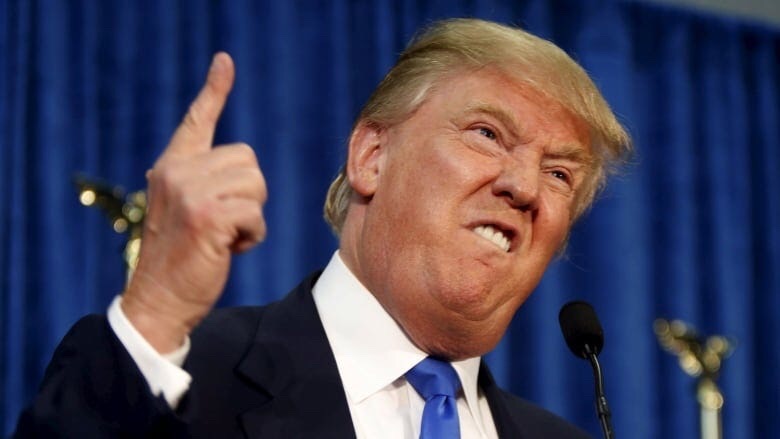
And currently, another man actively lobbies for ahis own Nobel Peace Prize, offering as justification such unforgettable utterances as:
“And when you’re a star . . . you can do anything . . . grab ‘em by the p*ssy . . . you can do anything.” (Private conversation about women, 2005)
“I have black guys counting my money . . . I hate it. The only people I want counting my money are short guys that wear yamulkes all day.” (USA Today, May 20, 1991)
”They’re not humans. They’re animals.” (On undocumented immigrants, 2024)
“A whole civilization will die tonight, never to be brought back again.” (About bombing Iran, Truth Social post, April 7, 2026.)
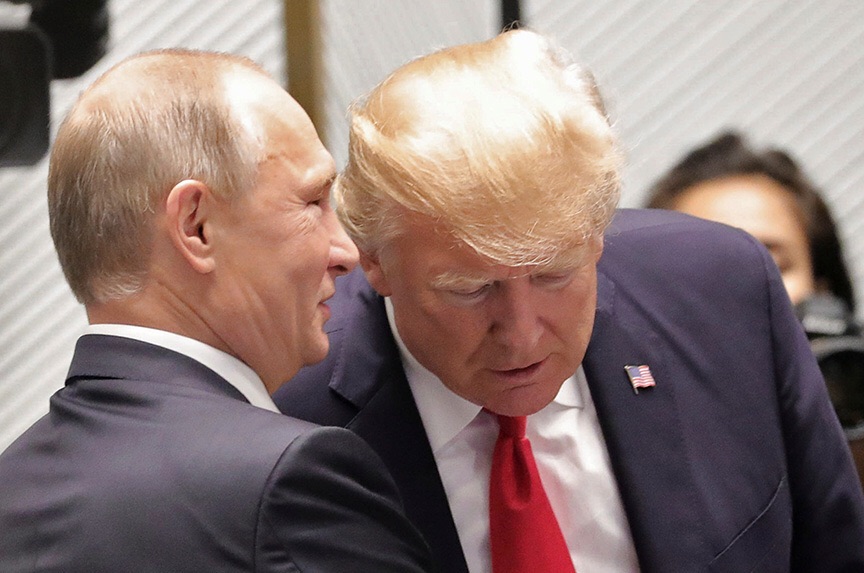
Have you ever wondered what these two actually discuss on the rare occasions when they meet face-to-face?
This can’t be good . . .
Of course, you have. The very fact that we are given so little information following their get-togethers is all that’s needed to pique our curiosity.
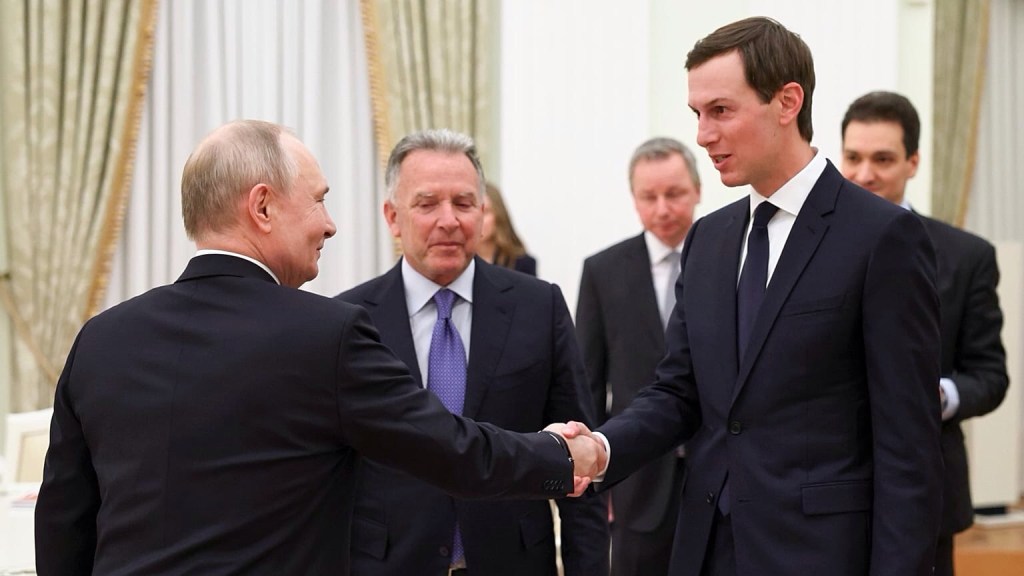
The same holds true for the “negotiations” that have taken place in Moscow between Vladimir Putin’s team and the American vaudeville act of Witkoff and Kushner. They travel, they meet, they slam down somevodka and caviar, they fly home . . . and all we get are assurances that the meetings were “productive” and included a discussion of a possible trilateral meeting in the near future.
Whoop-dee-do!
“Anyone know what really took place?”
But now, The New York Times, citing “people familiar with the meeting,” reports that, when Steve Witkoff and Jared Kushner met with Putin on September 5th of this year, Putin raised the possibility of a multi-billion-dollar oil deal that would benefit Middle Eastern business executives who happen to have ties to both Witkoff and Kushner. [Disha Mishra, Reuters, October 3, 2026.]
According to the NYT report, the deal would involve a widespread network of oil fields, refineries and gas stations around the world, owned by the Russian energy giant Lukoil. And while the transaction is — at least technically — contingent on approval from the U.S. government as well as the Kremlin, it is hard to imagine that either would disapprove . . . at least as long as Trump can push it through Congress while he still has a subservient Republican majority.
On Putin’s part, he reportedly said the proposal would be a way to show the Russian people — who are less than thrilled with the way the war is going — that they can still do business with the United States.
Well, as long as Donnie can help save his friend Vlad’s skin, and pull in an extra few billion dollars in the bargain, then I’m as happy as a raccoon in a garbage can.
I have to wonder, though: Did Witkoff, Kushner and Putin even get around to discussing actually trying to end the war in Ukraine?
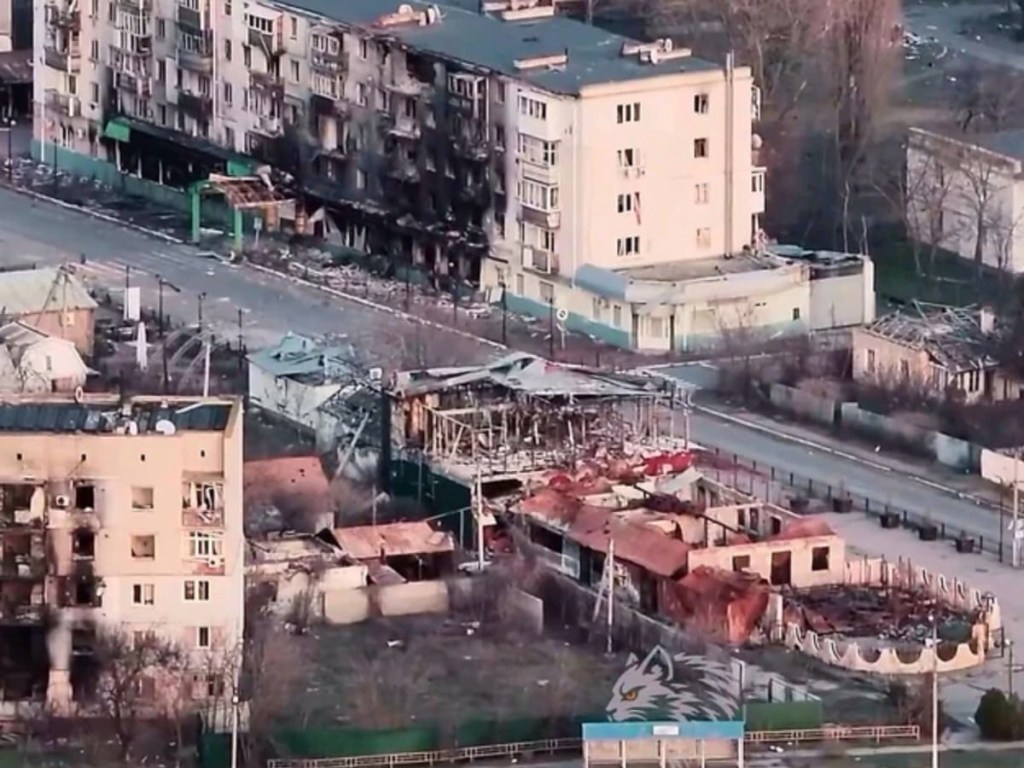
Oleshky is not a person; it is a city of about 6,000 people (of the original 24,000) in the Russian-occupied Kherson region of Ukraine, consisting of the men, women and children who have been unable to leave since the 2022 invasion and are now trapped by the occupying forces with little or no access to food, water, electricity, or medical care.
A Residential Neighborhood in Oleshky, Ukraine
Last week I added The 6,000 Starving Citizens of Oleshky to my list of known hostages under Vladimir Putin’s barbaric regime. And the situation has only become more dire since then. One citizen wrote to the city’s relocated Ukrainian administration that, with just one remaining beetroot, five potatoes, an onion, a zucchini, a tomato, and a little barley:
“We are preparing our last borshch. We eat once a day. We’ll die this autumn for sure. I’m dying already, weakening with each day.” [Mykyta Peretiatko and RFE/RL’s Ukrainian Service, October 3, 2026.]
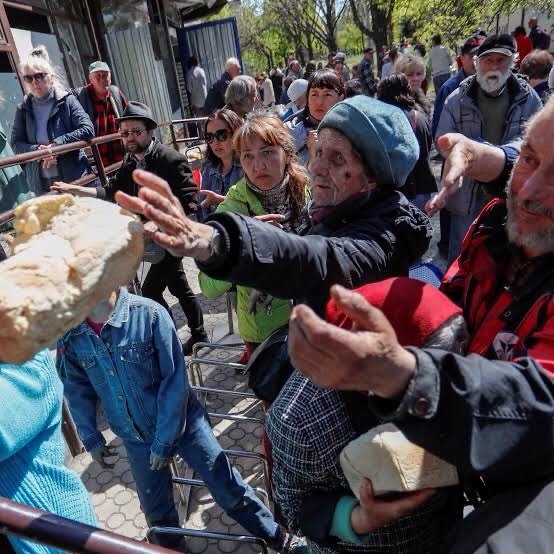
Ukrainian forces have sent heavy-lift drones to deliver food and other supplies to the city. But Russia regularly shoots down as many of the drones as possible, and further targets the people directly as they gather at distribution sites in hopes of receiving aid.
Queuing for Bread in Oleshkky
The Ukrainian civic organization Humanity has reportedly rescued more than 7,000 people from Russian-occupied areas. But for those remaining in Oleshky, with their “homes destroyed, property wiped out,” documents lost, and little chance of obtaining legal status in Russia, they are trapped by the Russian blockade and literally starving to death. According to a spokesperson for Humanity:
“The hunger has reached such a scale that, in the best-case scenario, a person can eat a clear soup and a few spoons of some kind of porridge in a day. If they have any left. They have been left completely without food, without medicine, without access to medical assistance, without fire engines, and, of course, without money.” [Id.]
She added that the residents with whom she spoke expect their food supplies to run out in October. That’s this month.
There are no adjectives adequate to describe the hell that Vladimir Putin has created for the innocent people of Ukraine. And even harder to tolerate is the realization that, while the indescribable suffering he has created drags on, he and Donald Trump have been in discussions to further enrich themselves, their friends and relatives with an oil deal . . .
But that is a topic for my next post. Please stay tuned.
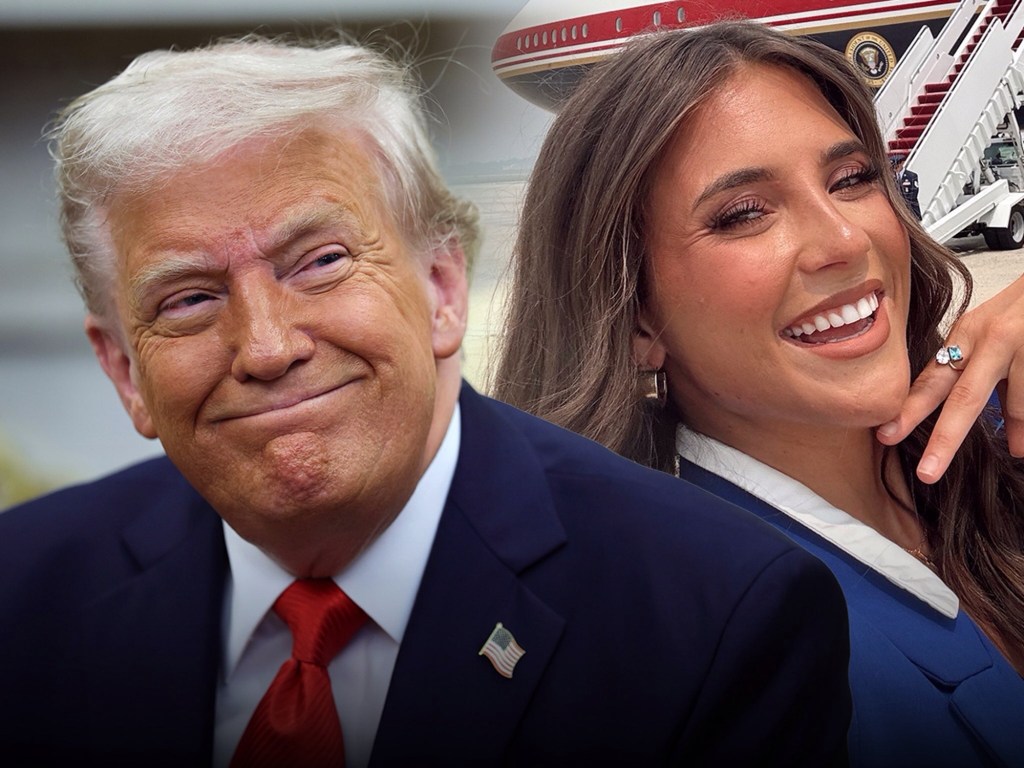
Her name — improbable as it may seem — is Beni Rae Harmony. She is 24 years old; earned a Bachelor of Science degree in political science and government just three years ago from the University of Illinois Springfield; worked while in college for Turning Point USA; and interned for U.S. Representatives Paul Gosar and Matt Gaetz. She also did a stint as a lifestyle host for WICS-TV in her native Springfield, Illinois, until she made the mistake of offering an on-air tribute to Charlie Kirk following his assassination, resulting in her “resignation.”
She then wound up as White House correspondent for the right-wing Real America’s Voice — a streaming, cable and satellite TV channel based in Centennial, Colorado.
And she is what Donald Trump would describe as beautiful — although, of course, he’s not supposed to say that.
Beni Rae Harmony
Political correctness aside, however, it is fairly safe to assume this particular 24-year-old — with minimal (really minimal) journalistic experience — probably didn’t manage to land a job this month as an assistant White House Press Secretary solely on the basis of her resume. She certainly does meet the most basic, superficial White House standards; and we can only assume she has also signed the requisite loyalty oath.
The big question is how this hybrid of Kristi Noem and Karoline Leavitt is going to deal with Mrs. Trump — not to mention the ever-present, printer-toting, Saran-Wrap-clingy Natalie Harp. I hope the rest of the White House crew have their flak jackets handy.
Trouble Ahead?
Trump may be old, decrepit, and senile . . . but his libido is apparently still alive and kicking.
In describing the arrest of Russian political scientist Aleksandr Kynev for having publicly revealed evidence of fraud in the recent parliamentary elections, economist and author Vladislav Inozemtsev — who now lives outside Russia — said that Kynev’s arrest “comes as [a] surprise, of course, but to some degree it was to be expected.” Writing on Facebook, he added that:
“Terror directed not so much at the opposition per se, but at active citizens who are aware of the rights enshrined in the constitution — specifically voting rights in this case — has become the regime’s primary activity for the foreseeable future.”
– Source: Steve Gutterman, RFE/RL, October 2, 2026.
Vladislav Inozemtsev
That’s business as usual in Vladimir Putin’s Russia. But as I read Inozemtsev’s words, I found myself thinking he might as easily have been speaking about another country, whose upcoming interim Congressional elections are in jeopardy of being disrupted — perhaps not by arrests and beatings — but by more devious means of tampering, lies, and intimidation.
And it makes me physically ill each time I recognize yet another parallel between the authoritarianism of centuries of Tsarism, Communism, and Putinism in Russia, and the much more recent direction in which the United States is being led by Donald Trump and his administration.
But ignoring the truth is not an option, as history has proven far too often. So I ask you: what are we going to do to stop it?
Following the Parliamentary elections held on September 18-20, noted Russian political scientist Aleksandr Kynev posted on social media serious allegations of fraud in the elections in which the Putin-aligned United Russia party had, to no one’s surprise, been awarded a record-high majority of 349 of the State Duma’s 450 seats. The only serious opposition, the liberal Yabloko party, had earlier been declared ineligible to run.
On September 22nd, Kynev also said in a social media post on Telegram that United Russia had only won 20 to 30% of the votes cast in a Moscow suburb, and not the much higher percentage officially reported.
Aleksandr Kynev
Three days later, Kynev was arrested; and three days after that, an unnamed medical source in the prison system told the media outlet Slovo Zashchite that Kynev had been severely beaten while in custody, resulting in fractures of both shinbones.
As of October 2nd, he was being held in custody, reportedly in the hospital at Moscow’s Matrosskaya Tishina prison, on fabricated charges of attempting to sell a large quantity of narcotics — charges that could carry a sentence of up to 20 years in prison. It was, of course, an obvious ploy to cover the real, politically-motivated reason for his arrest.
In an interview with RFE/RL’s Russian Service, political analyst Dmitry Oreshkin said:
“While he tried to observe the proprieties, he also strove to respect the integrity of the numbers. He had the courage to point out that the actual election results contradicted the picture painted by the authorities. And for that, they broke his legs. That is the whole point of this ritual: Sit there and bow down, or better yet, keep your head down — otherwise we’ll rip it off.” [Steve Gutterman, RFE/RL, October 2, 2026.]
Kynev had earlier investigated and reported on Russian election fraud during his time as department head of the now-defunct independent vote-monitoring organization Golos. For that, he was designated a “foreign agent” by the government in February. But while others in similar circumstances have chosen to leave the country, he refused to do so.
Thus, according to economist and author Vladislav Inozemtsev, who now lives outside Russia, Kynev’s arrest “comes as [a] surprise, of course, but to some degree it was to be expected.” [Id.] Writing on Facebook, he continued:
“Terror directed not so much at the opposition per se, but at active citizens who are aware of the rights enshrined in the constitution — specifically voting rights in this case — has become the regime’s primary activity for the foreseeable future.” [Id.]
Vladislav Inozemtsev
And Tatyana Stanovaya, a senior fellow at the Carnegie Russia Eurasia Center, wrote on Telegram:
“The case of Kynev marks a new milestone in the unfolding saga of the security services acting on their own initiative.” [Id.]
Tatyana Stanovaya
Clearly, drugs had nothing to do with Aleksandr Kynev’s arrest; he had simply become a thorn in Putin’s side. Thus we add his name to our list of known political hostages in Russia.
There is no way of knowing how long he will be “detained” before being formally charged and tried, or whether we will receive follow-up reports of his physical condition in the interim. Hopefully, we will hear more from the human rights organizations who work to track these cases under increasingly difficult conditions.
*. *. *
And, this being Sunday, here again is the list of Putin’s hostages known to me. Sadly, it hasn’t gotten any shorter since last week.
Prisoners of War:
The 20,000+ Kidnapped Ukrainian Children The People of Ukraine The 6,000 Starving Citizens of Oleshky
Immigrant Detainees in Russia:
Migrants from the Central Asian nations of Kazakhstan, Kyrgyzstan, Tajikistan, Turkmenistan and Uzbekistan
Endangered Exiles:
Pavel “Pasha” Talankin Mikita Losik Yulia Navalnaya Oleg Orlov Countless Journalists and Other Dissidents
Political Prisoners:
In Afghanistan:
Mahmoud Habibi (Afghan-American) Paul Overby (American, missing since 2018)
Andrei Chapiuk Uladzimir Labkovich Andrzej Poczobut Marfa Rabkova Valiantsin Stafanovic Yuras Zyankovich
In Georgia:
Mzia Amaglobeli
In Russia:
The “Crimea 8”: – Oleg Antipov – Artyom Azatyan – Georgy Azatyan – Aleksandr Bylin – Roman Solomko – Artur Terchanyan – Dmitry Tyazhelykh – Vladimir Zloba
James Scott Rhys Anderson (British) Aleksandr Andreyev David Barnes (American) Yevgenia Berkovich Gordon Black (American) Hayden Davies (British) Yury Dmitriyev Anastasia Dyudyaeva Antonina Favorskaya Konstantin Gabov Robert Gilman (American) Stephen James Hubbard (American) Sergey Karelin Timur Kishukov Vadim Kobzev Darya Kozyreva Artyom Kriger Michael Travis Leake (American) Aleksei Liptser Svitlana Loi (in Ukraine) Mikhail Loshchinin “Madame Z” (in Ukraine) Grigory Melkonyants Boris Nadezhdin Nika Novak Svetlana Petriichuk Leonid Pshenychnov (in Russian-occupied Crimea) Ilya Remeslo Nadezhda Rossinskaya (a.k.a. Nadin Geisler) Lev Schlossberg Sofiane Sehili (French) Igor Sergunin Dmitry Shatresov Robert Shonov Grigory Skvortsov Eugene Spector (American) Joseph Tater (American, disappeared) Karina Tsurkan Arseniy Turbinin (age 18) Laurent Vinatier Robert Romanov Woodland (American)
You have not been, and will not be, forgotten. Stay strong.
As Donald Trump prepares to defy Congress and break the law yet again — this time by sending the heavy equipment to begin construction of his ludicrous “triumphal arch” at the gateway to Arlington National Cemetery — dozens of activists gathered at Memorial Circle during Thursday morning’s rush hour to protest.
Protesters at Memorial Circle in Washington – October 1, 2026
The speakers and other protesters included veterans, retirees, and lawmakers, some calling the proposed structure a “sacrilege” and an “obscenity.”
One such speaker was U.S. Senator (D.-Ill.) and Army veteran Tammy Duckworth, who lost both legs and some mobility in her right arm in 2004 when — while serving as a U.S. Army helicopter pilot in the Iraq War — her Black Hawk was hit by a rocket-propelled grenade fired by Iraqi insurgents.
She didn’t pull her punches when expressing her opposition to the arch:
“I am pissed that the five-time draft dodging coward of a commander-in-chief sitting over there in the White House dares to dishonor the men and women of this country who have put on her collars and sacrificed and served and now lay at rest in the hallowed grounds of Arlington National Cemetery.”
[Source: Rachel Treisman, NPR, October 2, 2026.]
Senator Tammy Duckworth
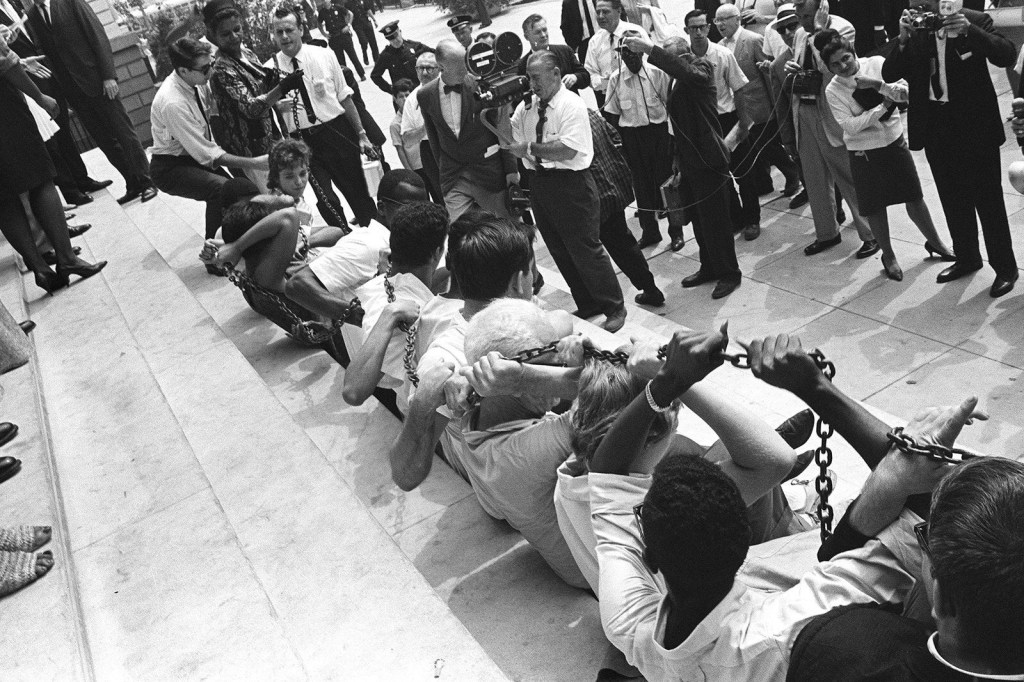
The veterans, determined to protect the sanctity of the cemetery where many of them will themselves be interred one day, also vowed to block the construction by forming a line of people seated in rocking chairs, reminiscent of the peaceful sit-ins of the mid-20th century.
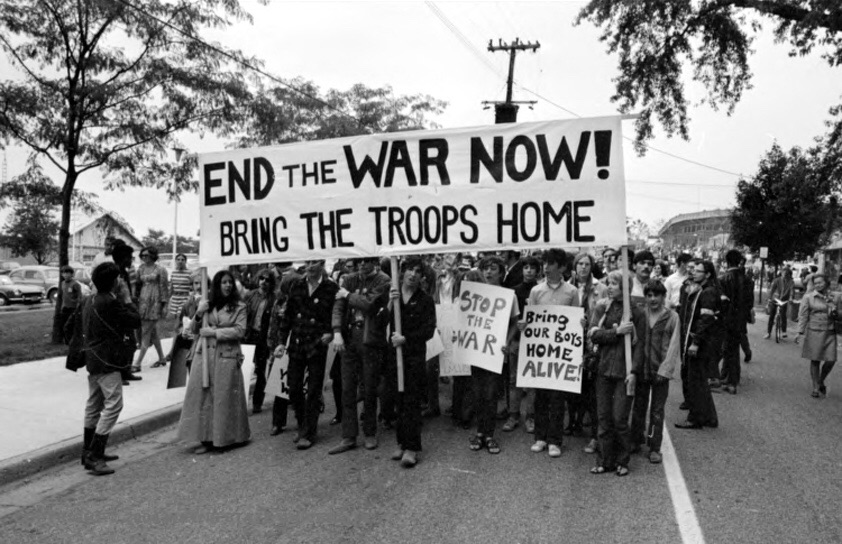
I’m old enough to remember those days, and the much-needed social changes that were spurred by the non-violent activists. I’ve been waiting, and hoping, for a resurrection of that spirit to finally restore a sense of order, respect, and basic decency to what was — and will be again — the greatest democracy the world has yet known.
1960s Anti-Vietnam War Protest
1960s Civil Rights Sit-In
We the people are not helpless; we have a strong collective voice. We can protest, and we can VOTE to defeat the tyrants who hope to subjugate us.