When I should have been drifting off to sleep this early a.m., this was running through my mind:
Vladimir Putin has been receiving missiles, drones, and God-only-knows-what-else from China, Iran, and God-only-knows-where-else, which he has of course been using in his “special military operation” against Ukraine . . . which, by the way, he started on February 24, 2022.
Meanwhile, he says that if the United States gives Ukraine the okay to use U.S.-made long-range missiles to strike inside Russia, then whatever happens — in fact, the whole megillah — will have been America’s fault.
But isn’t that kinda like Nazi Germany blaming Britain for the Blitz?
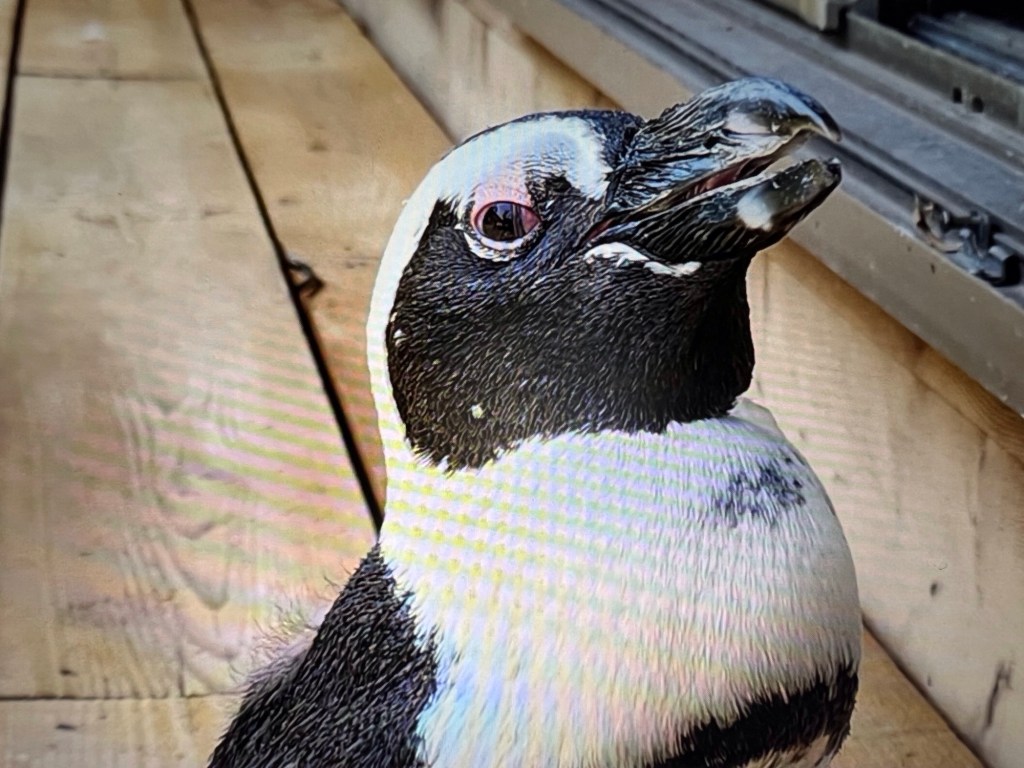
Well, the six-year-old female runaway African penguin in Japan, of course. Did you doubt it?
“Pen”
Her name is Pen, and the folks at the Gekidan Penters traveling zoo on Japan’s Himakajima Island thought they had lost her when she escaped from her enclosure and swam out into open waters, where she had never gone before.
Her keeper, Ryosuke Imai, said that her escape had left him wracked with worry and guilt. An African penguin can usually swim up to 25 miles a day, but their muscle mass decreases when they’re kept in captivity as Pen had been. “The chances of her surviving in the wild were very low,” Imai said. [Nodoka Katsura and Lex Harvey, CNN, September 12, 2024.]
But then the region was hit by typhoon Shanshan, with high winds and torrential rain that killed at least six people, displaced millions, knocked out power, and disrupted air travel. But with no fishing boats able to operate in the area, Pen was free of obstacles; and the rainfall provided her with a source of hydration and cooling. She also managed to find food — likely fish or crab — along the way, as evidenced by her “substantial droppings” when she was found after two weeks . . . just eight miles from the beach where she first went missing, and ten minutes from her home facility. [Id.]
Way to go, Pen! The world needs happy endings like yours.
*. *. *
People tend to take up unusual causes — unusual for them, at least. Mine, for some reason I can’t explain, seems to be marine animals. First there was Laverna, the surfboard-stealing otter off the coast of Monterey, California.
Laverna
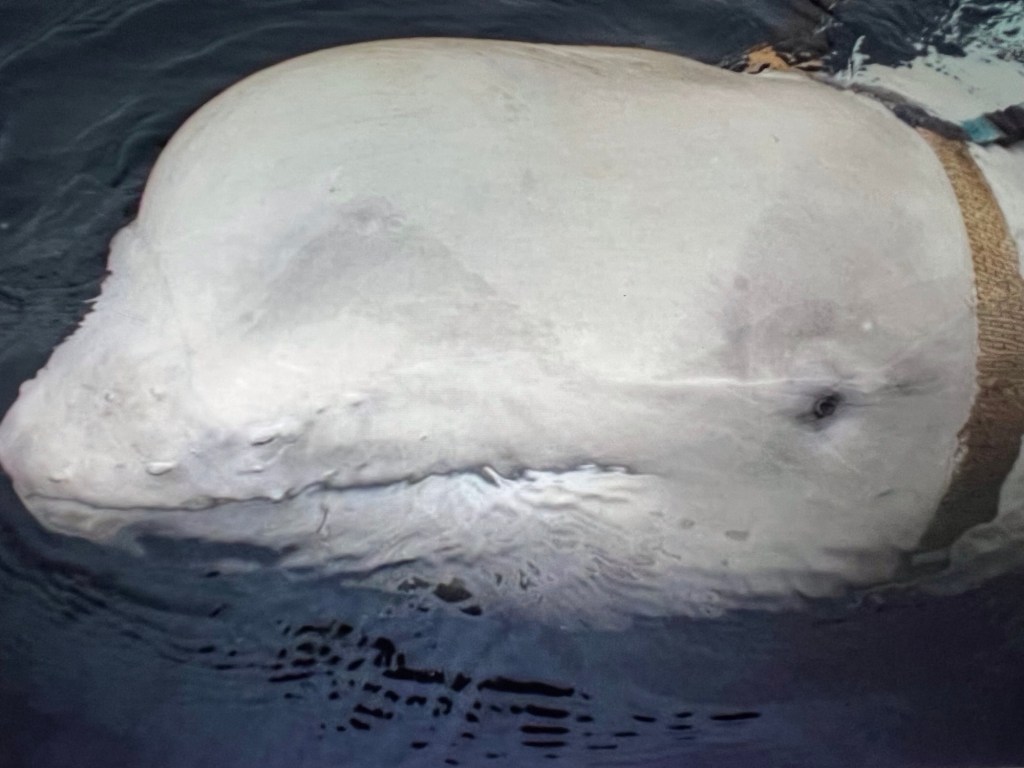
Next came the sadder story of Hvaldimir, the Russian spy whale who defected to Norway five years ago, but met with an unfortunate accident at sea earlier this month.
Hvaldimir
And then it was Pen, who I am pleased to say is alive and well in her Japanese home, happily snuggled up with Mr. Imai, probably dreaming about her big adventure at sea.
Marie Antoinette is famously (but erroneously) credited with having said, when told that the French people couldn’t afford bread: “Then let them eat cake.”
Marie Antoinette: A Woman In Denial
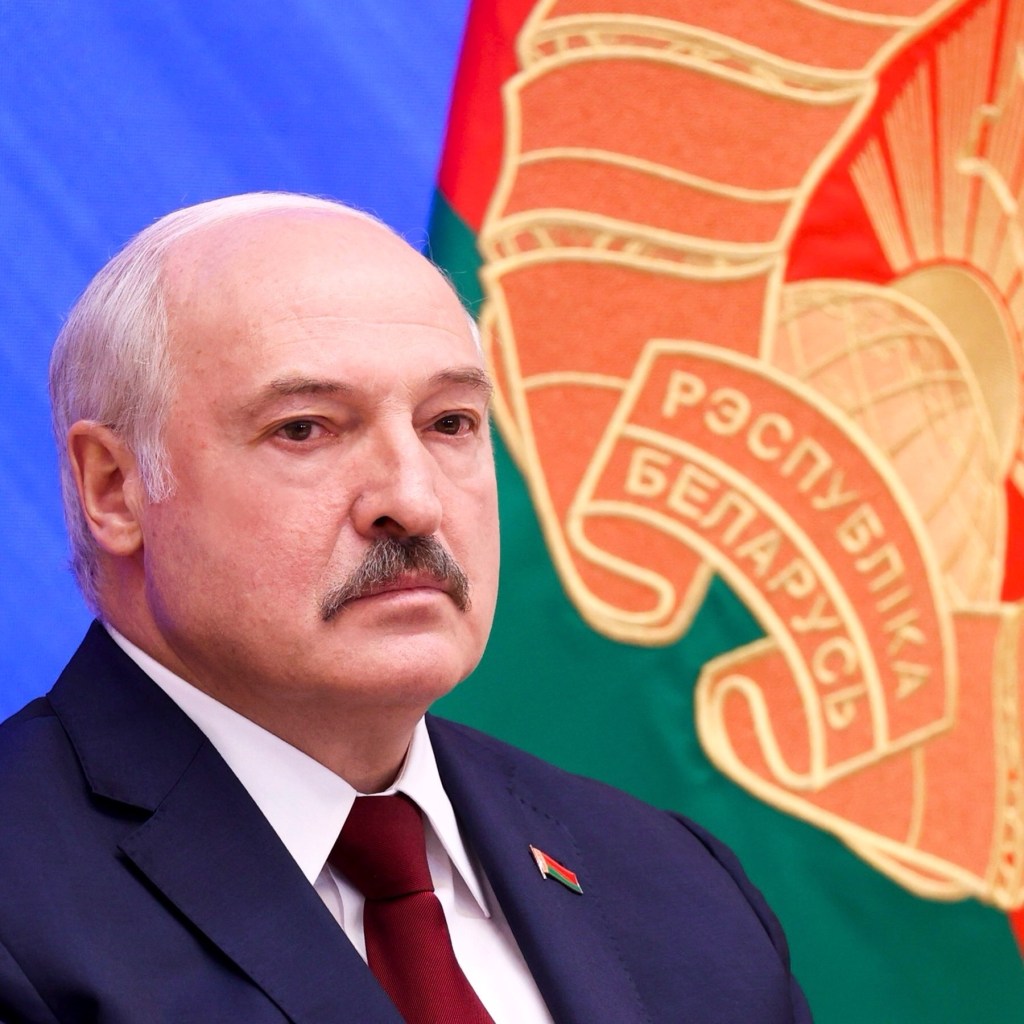
Aleksandr Lukashenko, President of Belarus, has figured out a way to carry that to an even greater extreme: Let them not eat at all.
Aksana Khinevich: “What is illegal if a person helps someone?”
Aksana’s son, Anatol, is an IT specialist who was sentenced to 2-1/2 years in prison for participating in the 2020 anti-government protests in Belarus. Aksana had herself and a disabled mother to support, on a salary of 300 rubles ($92) a month as a caregiver. So she was forced to accept help in the form of food donations through a U.S. online non-profit — INeedHelpBY — that uses a Telegram bot to match donors with people in Belarus “whose ‘active political position’ cost them their job or other income or led to ‘a large fine,’ time in custody, or other restrictions on their freedom.” [RadioFreeEurope/RadioLiberty, March 26, 2024.]
According to Belarusian authorities, this amounts to carrying out “extremist activities” by way of using “foreign donations” from an organization that has been declared an extremist organization.
INeedHelpBY: An “Extremist” Organization
And now scores — possibly hundreds — of needy Belarusians have faced prosecution simply for accepting a two-week supply of food from individuals registered with INeedHelpBY. These people, when convicted, have been sentenced to detention, confiscation of the donated goods, and fines equal to the value of the donations — usually hundreds, even thousands of dollars that they do not have. [Id.]
One retired man who had received groceries was found to have “threatened to harm state and public interests.” He was ordered to pay the state the assessed value of the groceries plus a fine equal to $184, and to surrender his laptop and (non-working) cell phone.
A woman caring for a small child was ordered to pay a fine of $300, plus the assessed value of the groceries — $5,550.
These people — deemed as national security threats — are also placed under travel restrictions. Some remain in pretrial detention, suspected of abetting “extremist activities.” [Id.]
All because they, or a family member, spoke out against the repressive regime of Aleksandr Lukashenko. And because they accepted humanitarian assistance from a foreign organization.
Aleksandr Lukashenko
It appears that Lukashenko has found the perfect deterrent to those who would dare to oppose him: If you’re not afraid of prison, then we’ll just go after your family as well, and starve them to death.
That was justice in the former Soviet Union . . . and it seems to be working for Belarus today.
This one is too good to pass up. Taylor Swift — a very smart lady, by all indications — finally decided this week to go public with her presidential candidate preference in the upcoming election (Kamala Harris, in case you hadn’t heard), and set forth her very well-thought-out reasons. No problem.
But she made one mistake: she signed off as a “childless cat lady,” sardonically referencing the Republican vice-presidential nominee’s — what’s his name again? — slam at Vice President Harris.
Lovely Taylor Swift, and Creepy Elon Musk: the Oddest Couple Ever
And who should pick up on that but . . . no, not JD Vance himself (oh, yeah, right — that’s his name!) . . . but none other than the ever-weird Elon Musk, who seemingly must do or say something every single day in order to keep his name in the news.
Now, as he is a die-hard supporter of the Trumpster, and by extension Trump’s running mate Vance as well, it’s not surprising that Musk would step in with a comment. But holy shit! Did he have to . . . how could he even . . . I mean, what the hell??!!! Has his brain completely ceased functioning?!!
As you no doubt have heard by now, he responded by saying:
“Fine Taylor … you win … I will give you a child and guard your cats with my life.”
Eeeeeewwwwwwww!!!!!!!
Of course, it was meant as a joke (at least, I hope and pray it was). But the inappropriateness of it — the downright creepiness — is doubly deranged coming from an avowed natalist who just spawns babies left and right with multiple women, names the poor children something strange and unpronounceable, and then abandons them to be raised by their mothers.
Sorry, Elon (or Leon, or whatever Donald Trump is calling you this week) . . . but your genes just aren’t that desirable. The world does not need a baker’s dozen of mini-Musks.
Shortly before turning in last night, I took my usual stroll through the late headlines and was jolted awake by the following:
“Russian Jails Recommend Foreigners Apply For Transfers Home After Hostage-Taking Incidents.” [RadioFreeEurope/RadioLiberty, September 10, 2024.]
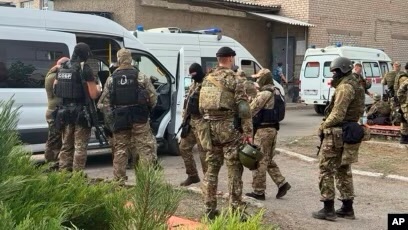
Soldiers Near Correctional Colony No. 19 at Surovikino, Volgograd Region – August 23, 2024
Thinking I might have drifted off to sleep and dreamt it, I took a drink of something non-alcoholic, rubbed my eyes, and read it again. And no, I had not been dreaming; that is indeed what the headline said, accompanied by the above picture.
Citing an article of the same date by IStories— an online publication with which I was not familiar — the RFE/RL article stated:
“Foreign nationals serving terms in Russian prisons have been asked to write requests to serve the remainder of their terms in their homeland following two recent hostage-taking crises at Russian penitentiaries, IStories said on September 10.” [Id.]
IStories cited sources “close to” a correctional colony, as well as rights defender Ivan Astashin and lawyer Yevgeny Smirnov, who had stated the reason for this action was to prevent further hostage-taking situations such as the ones that had recently occurred in prisons in Rostov-on-Don and in the Volgograd penal colony No. 19.
According to IStories’ sources, one Belarusian, three Kyrgyz, one Polish, and two U.S. citizens (unnamed in the article) are currently awaiting transfers to their home countries.
And my reaction to this startling news was . . .
Out of the blue, the Russian government is now supposedly letting foreigners — who for years have been held as hostages of the Kremlin for future trade — go home in order to prevent further internal problems in the Russian prison system. Just like that, no strings attached. And we’re supposed to believe it?
I’m sorry, but I cannot.
I have too many questions. First, who are these “sources” cited by IStories? How reliable are they? What are the conditions of the prisoners’ releases? And exactly who are these supposed Belarusian, Kyrgyz, Polish and U.S. citizens? What did they have to do, other than fill out a request form, in order to be granted reprieve? And exactly what do the forms say?
Further, if they are actually sent home to “serve the remainder of their terms in their homeland,” what guarantee is there that they would be required to do so upon returning home? Since they’re most likely political prisoners, and not actual criminals, odds are they would be welcomed home as heroes.
No . . . the whole thing smells fishy — perhaps some sort of public relations stunt.
I did do a little checking into the background of IStories (“Important Stories,” as translated from the Russian), which evolved from the independent Russian Novaya Gazeta in 2020 as the result of Kremlin pressure on all of the then-independent media. The office of their website is located in Latvia, and they have conducted investigations into such diverse matters as the poor quality of Russian COVID-19 tests, the persecution of Alexei Navalny, oil spill disasters in Russia, the Pandora Papers, and even Vladimir Putin’s daughter Katerina Tikhonova and her husband.
So I am not questioning their authenticity. But, again, I have to wonder about their sources, and the reliability of the information being fed to those sources.
In my experience, when something sounds too good to be true, it usually is.
American General William Tecumseh Sherman is credited with having said it first, in an address to military school graduates sometime after the end of the U.S. Civil War (1861-65). And he was an expert on the subject, as the man whose troops had burned a gigantic swath through the State of Georgia from Atlanta to Savannah.
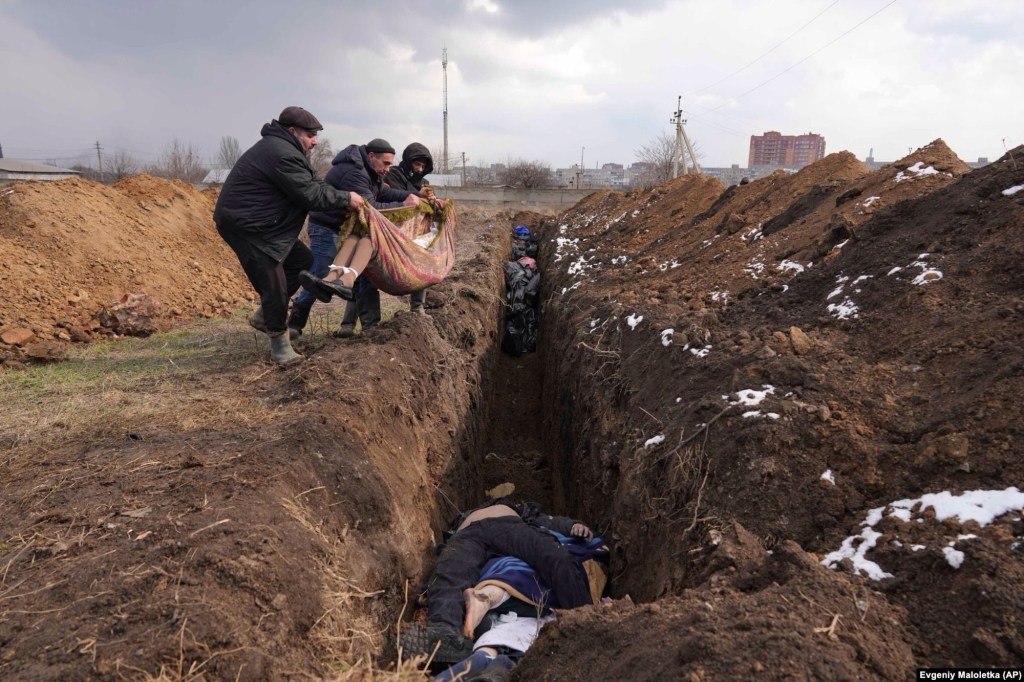
Today, 21st-Century weaponry being what it is, the hell of war has only gotten bigger and more devastatingly destructive.
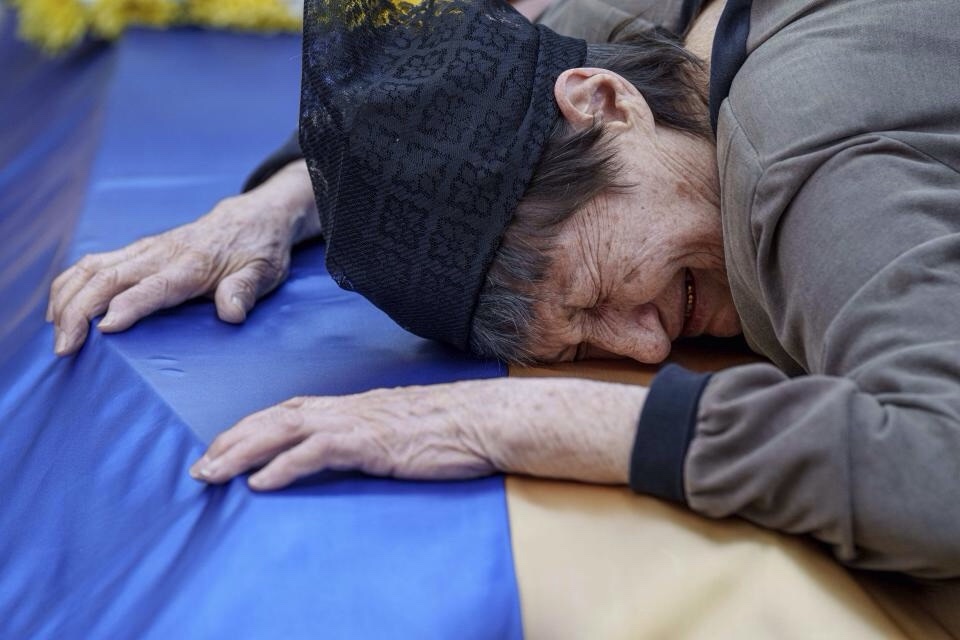
Ask anyone in Ukraine.
A Grieving Mother in Ukraine
As always, there are thousands upon thousands of innocent victims — civilians who are caught between two warring factions and become what is blithely referred to as “collateral damage.”
But there is another sort of collateral damage to be considered these days: the populations of neighboring countries, accidentally (or otherwise) the unlucky recipients of bits and pieces of weaponry that can’t read a map and don’t know where a border marks the end of one country and the beginning of another.
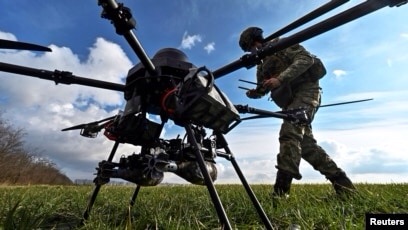
Drones, for example, are “smart” weapons; but they’re not infallible. And on Sunday, Romania and Latvia — both members of NATO — reported incursions into their territories by Russian drones.
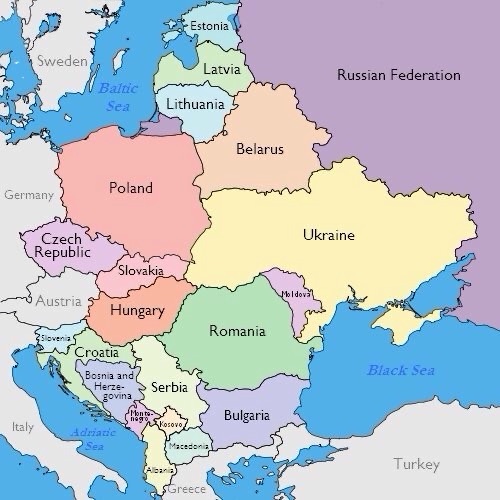
Eastern Europe
In Romania, it was reported by the Ministry of National Defense that a Russian drone had entered its territory early on Sunday as Moscow was engaged in a strike against “civilian targets and port infrastructure” across the Danube River in Ukraine. An investigation was underway as to the actual “impact zone” in an area — fortunately uninhabited — along the Romania-Ukraine border.
Luckily, there were no immediate reports of casualties or damage. But the government in Bucharest deployed F-16 warplanes to monitor its airspace, and issued alerts to the residents of two eastern regions. [Stephen McGrath and Jari Tanner, Associated Press, September 8, 2024.]
And this isn’t the first such incident. Romania has confirmed drone fragments on its territory on several occasions since Russia’s invasion of Ukraine in February 2022.
In this most recent instance, I was able to use the words “fortunately” and “luckily.” But, what if . . .? Just a few degrees in any direction, and human lives might have been lost, residential buildings and critical infrastructure damaged or destroyed . . . in a NATO country. Then what?
World War III?
NATO’s outgoing Deputy Secretary-General — who also happens to be a former top diplomat of Romania — condemned Russia’s violation of his country’s airspace:
“While we have no information indicating an intentional attack by Russia against Allies, these acts are irresponsible and potentially dangerous.” [Id.]
To say the least . . .
*. *. *
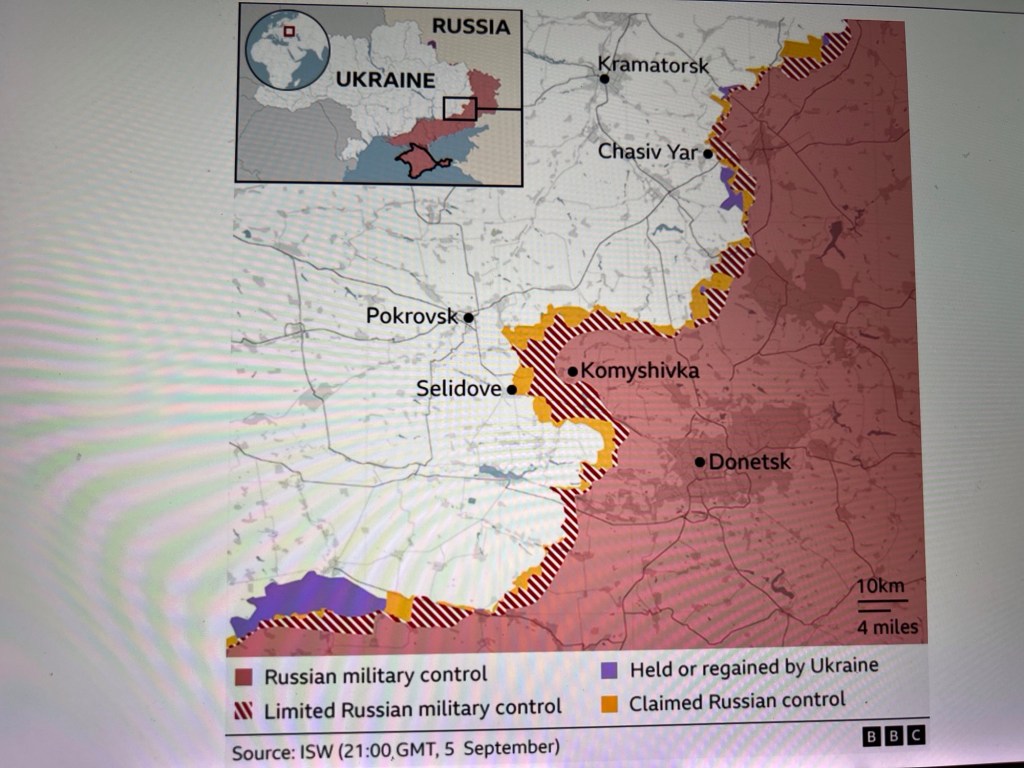
Looking at the above map, it’s easy to see how a drone or a missile might travel a little farther than intended and stray across the border into Romania. But what about Latvia? It doesn’t share a border with Ukraine.
It does, however, abut Russia’s good friend Belarus, as well as Russia itself. But a drone coming from either of those countries with a target somewhere in Ukraine would have to be pretty far off-course to end up in Latvian air space. Yet that’s apparently what happened.
The crash site has been identified, and an investigation is underway. But Latvian Defense Minister Andris Spruds has thus far downplayed the incident, saying:
“I can confirm that there are no victims here and also no property is infringed in any way. Of course, it is a serious incident, as it is once again a reminder of what kind of neighboring countries we live next to.” [Id.]
I could tell you what kind of neighbors they are . . . but it’s not necessary. Everyone already knows.
*. *. *
And in Ukraine, Foreign Minister Andrii Sybiha said that the incursions were “a reminder (that) the aggressive actions of the Russian Federation go beyond Ukraine’s borders.” [Id.]
It could happen to anyone, anywhere, at any time. But it has already been announced in the UK offices of “Big Four” accounting firm PricewaterhouseCoopers (PwC), to become effective January 1st. At that time, PwC will begin tracking where its employees in the UK are working.
Happy New Year, folks!
That’s right — they will be using “location data“ to verify where their employees are at any given time, presumably during working hours.
And it’s all because of the Covid-19 pandemic, which gave rise to work-at-home, which then — even after the worst of Covid was said to be behind us — morphed into a hybrid work schedule that has become so popular in many places around the world.
But even the best of intentions can have unexpected negative results. And now some employers are having trouble getting their people back into the office; it seems that folks enjoy working at home in their pajamas, and not having to commute in heavy traffic and all sorts of weather.
But employers have found — and I can’t imagine why they should be surprised — that some people cheat. Or simply don’t work as industriously or conscientiously outside a business environment or without supervision.
In addition, PwC-UK — who now insist that employees spend at least three days a week, or 60% of their time, in the office or with clients — have said:
“Our business thrives on strong relationships — and those are almost always more easily built and sustained face-to-face . . . By being physically together, we can offer our clients a differentiated experience and create the positive learning and coaching environment that is key to our success.” [Lianne Kolirin, CNN, September 6, 2024.]
Further, PwC said, the move is intended to “adjust” the firm’s existing hybrid working approach in order to place “more emphasis on in-person working”:
“We all benefit from the positive impact of a hybrid approach, but the previous guidance of at least two to three days a week was open to interpretation. This update aims to provide clarity around where and how we expect everyone to work.“ [Id.]
They do assure employees that individual working location data will be shared with them on a monthly basis, “to ensure that the new policy is being fairly and consistently applied across our business.” [Id.]
And in a recent online press release, the managing partner of PwC-UK stressed the importance of face-to-face working, while at the same time continuing to offer the flexibility of hybrid working.
Well, that’s all fine and dandy. Personally, before I retired, I preferred working in the office, where the entire atmosphere — the availability of resources, equipment setup, interaction with other human beings — was more conducive to actually getting the job done, and offered a change of scenery and a certain amount of socialization that you just don’t get at home in your jammies. (In all honesty, though, I really hated the morning and evening commutes.)
But where does the tracking stop? Of course, it’s supposed to end at the close of the normal workday — say, for example, 5:30 p.m. And hopefully, at PwC that is exactly what will happen. But where is the guarantee of that? You know this idea is going to spread. What is to stop some not-so-scrupulous employer from failing to turn off the tracker at closing time . . . perhaps in the guise of assuring that their employees aren’t spending personal time in unacceptable — perhaps even illegal — pursuits that might impact negatively on the business? Is that a legitimate excuse for spying on people?
And will the tracking technology be connected solely to the employer’s hardware being used at the employees’ homes, to be deactivated at that 5:30 closing time? Will the employees be able to shut it down? Or will the companies also be geolocating their employees through the individuals’ cell phone GPS software? Will people have to start turning off their personal phones in order to maintain any sense of privacy?
*. *. *
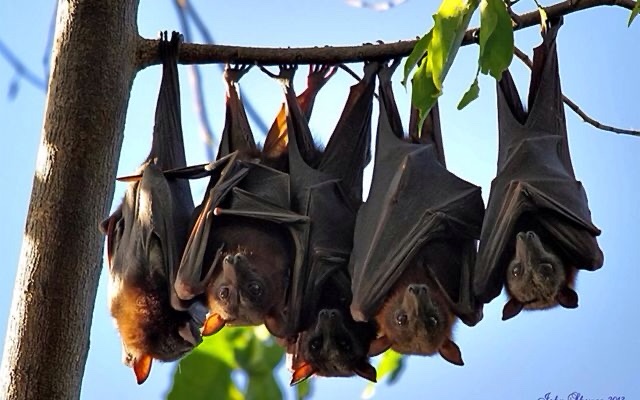
Before I can decide how I feel about this development, I need to know more about how it will work. In the meantime, maybe I’ll just go back to blaming those bats in China for starting the whole Covid thing again.
Maria, age 69, and her two kittens sit on a bus waiting to leave the city she has lived and worked in for 30 years, because the shelling and bombing and missile strikes are now too close for comfort. Her city — Pokrovsk, Ukraine — had a population of 48,000 people just two months ago; today, half of them have already left. [Abdujalil Abdurasulov, BBC News, September 9, 2024.]
Relatively few people in other parts of the world have heard of Pokrovsk. But to Ukraine, it is a key transportation hub that is depended upon as one of the main supply routes in the area. If Pokrovsk were to fall to the Russians, it would effectively mean the loss of nearly the entire Donetsk region — which has been a key goal of the Kremlin from day one of the February 24, 2022, invasion.
This is what President Volodymyr Zelensky and his troops hoped to prevent when they launched an offensive into the Kursk region of Russia. Their intent was to force the Russian military to divert offensive troops to the defense of Kursk in sufficient numbers for Ukraine to be better able to defend its remaining territory in the Donbas region.
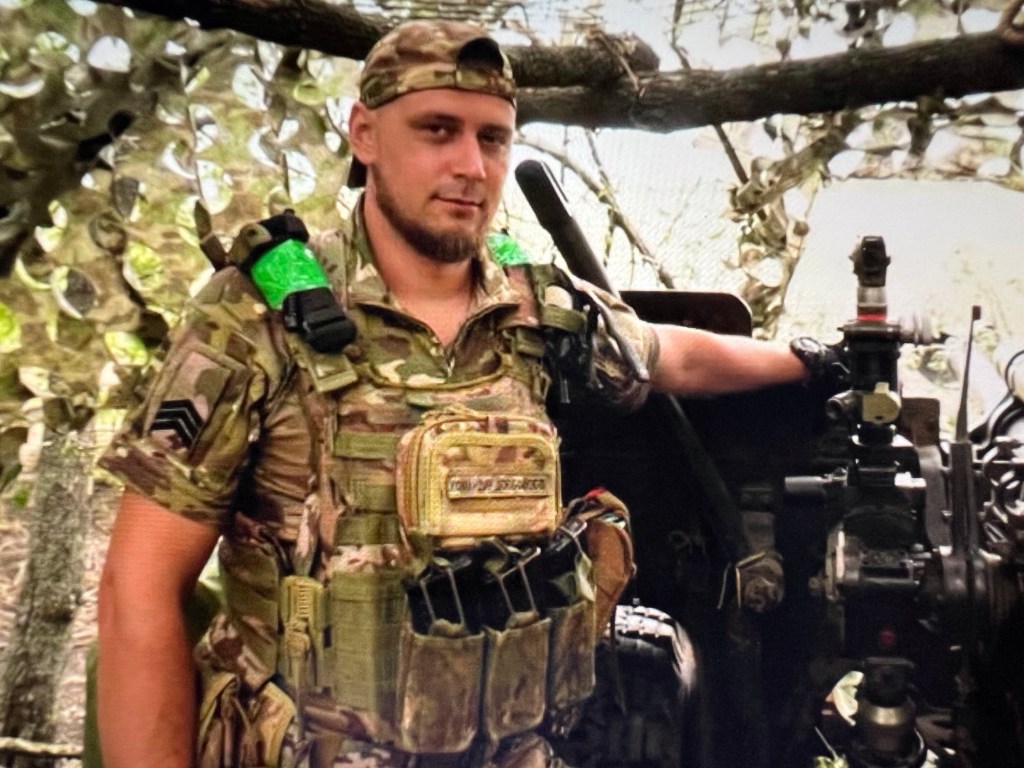
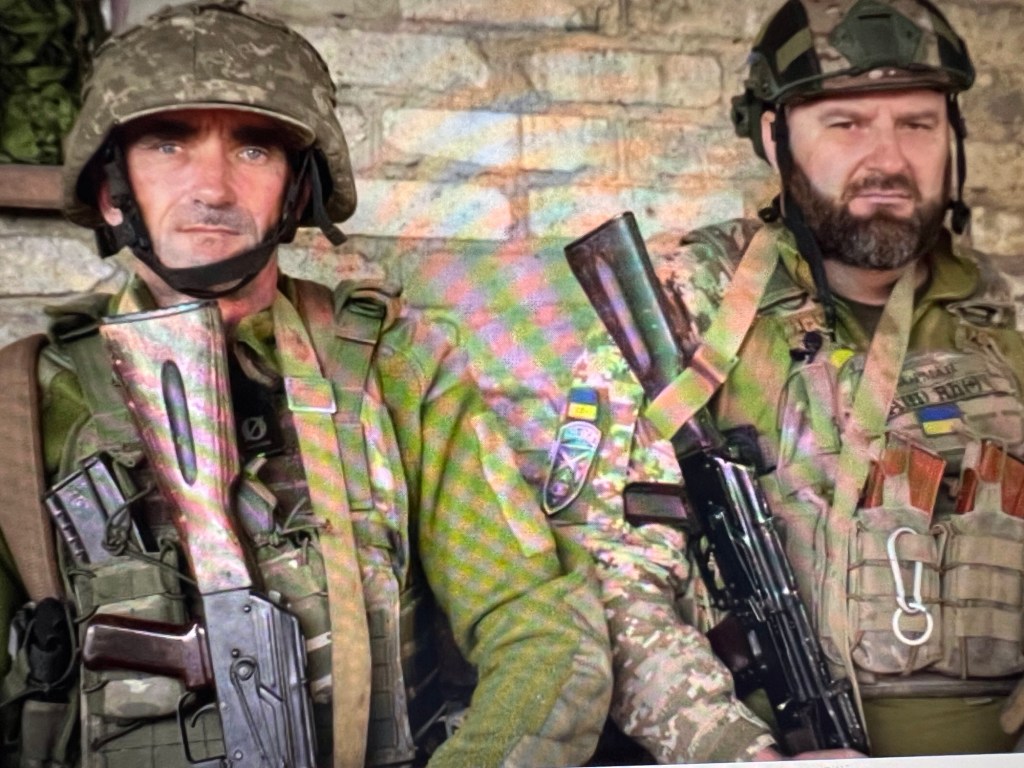
Defending Pokrovsk
But one thing Russia has in seemingly endless numbers is people — human bodies to throw into the front lines, wave after wave of them, conscripted from Chechnya, from friendly foreign countries, from mercenary groups like Wagner (now called the Africa Corps), and even from their own Russian prisons. Human cannon fodder. According to Pokrovsk’s military administration, the ratio of fighting forces in that area is ten-to-one in Russia’s favor. [Id.]
And they have the equipment and the weaponry, much of it also supplied by friendly countries including China and Iran . . . while they continue to protest Ukraine’s use of American and other Western armaments.
On Sunday, Russia claimed to have taken control of the village of Novohrodivka, just 10 kilometers (about 6.2 miles) from Pokrovsk. One unconfirmed report says that Ukrainian forces have retreated from there. [Id.]
Pokrovsk, Ukraine
*. *. *
And so, Maria sits on the bus with her two precious kittens, waiting to be taken to the next phase of her life . . . wherever and whatever that may be. Hopefully, she will be safer there.
For once, there is some good news to report — although it’s not exactly happy news, because Hvaldimir is indeed still dead. But the big, beautiful beluga whale did not expire as the result of man’s inhumanity to a fellow mammal; he was instead the victim of the sort of hazard that faces all sea creatures: a floating object.
Hvaldimir – 2019
A police autopsy — or necropsy, if you will — has concluded that “human activity” did not cause Hvaldimir’s death. What they did find was that a stick had become lodged in his mouth, and that what were initially thought by some to be bullet holes were just some “completely superficial” injuries. [Tom McArthur, BBC News, September 9, 2024.]
So, whether he was a Russian-trained spy whale who decided to “come in from the cold” and retire in the free world, or just a big bleached ball of blubber with a poor sense of direction, his last years were spent as a sort of folk hero to a lot of good people in Norway.
Once again . . . hvil i fred (R.I.P.), Hvaldimir; and know that you are missed.