Author Archives: brendochka39

Unknown's avatar

About brendochka39

Having a wonderful time reminiscing about all my past travel (and other) adventures. Hope you’ll share them with me in my blog, “All Roads Led to Russia.”

Ch. 11 – Golden Prague – Part I (Re-Posted 11/21/23)

We’ll be back to Moscow (1992) in a couple of days; but first a detour to Prague, in what was then still Czechoslovakia, where I spent the summer of 1991 — working, sightseeing, partying, walking, eating, and having the time of my life in one of the most beautiful, historic, and quirky cities in the world.

*. *. *

In 1991, I was working in the Washington office of the Squire Sanders law firm, and feeling bored with my life in general, when a bit of manna from Heaven fell into my lap. Two of the partners — one from the home office in Cleveland — were discussing the firm’s foreign offices. I said, half jokingly, that if there was any thought being given to opening an office in Moscow, I’d like to volunteer. The Cleveland partner said there was not, but that they had a new branch in Prague in need of someone who could organize the office and help to train the Czech staff. He asked if I would be interested, and — assuming he was also kidding — I laughingly replied that I could be packed and ready in an hour.

Never assume anything.

A few short weeks later, I found myself, and my six pieces of seriously overweight luggage, on a plane to the historic capital of Czechoslovakia, where I knew absolutely no one. I also did not know the Czech language, but I had studied Russian, and since they’re both Slavic languages, I figured it couldn’t be that hard, right? This was going to be great!
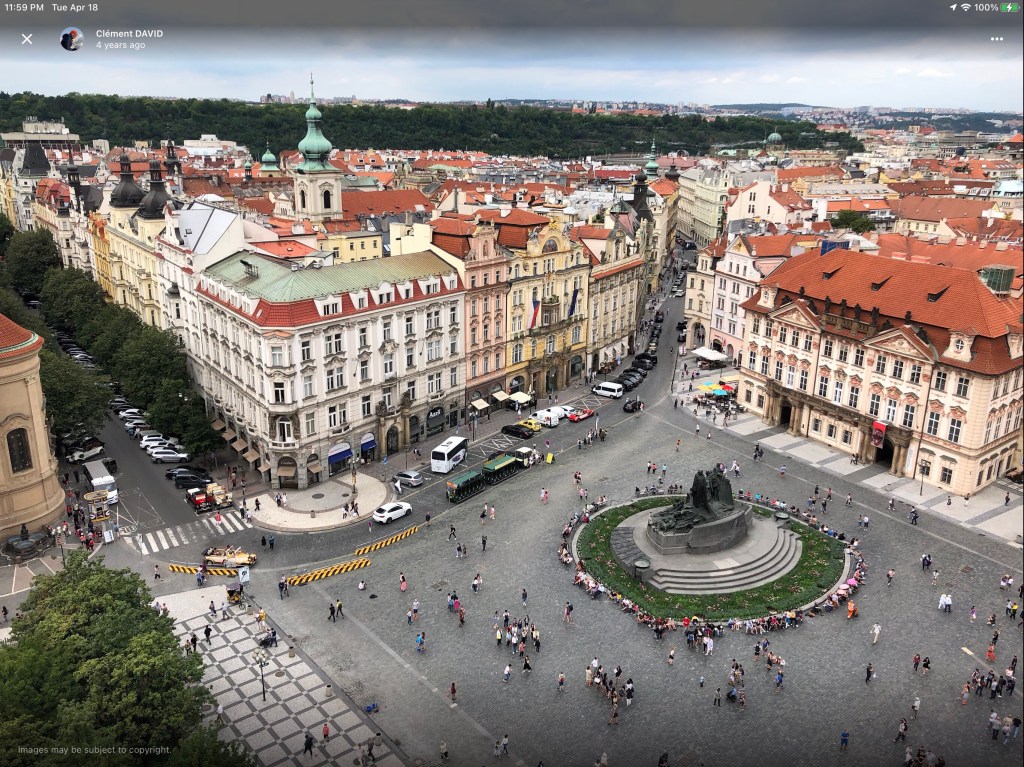
Old Town Square, Prague

When my overnight flight landed at Prague, I found a very pleasant-looking young man named Rudy holding a sign with my name, and I met my first friend in my new home. On the ride from the airport, I discovered why Prague is called the Golden City: the name refers to the golden spires of its abundance of churches, the estimated number ranging anywhere from 100 to 1,000, depending on which travel guide you’re reading. Rudy drove me first to the apartment the firm had rented for me, about a kilometer from the office; dropped off my luggage; and then headed straight for the office along a very direct route that would clearly be an easy walk for me the next morning, and every day after that for the next three months.

I could not have arrived in Prague at a better time. It was May of yet another “Prague Spring.” But this time it was not about an anti-communist revolt as it had been when the Soviet Union invaded in 1968; it was, conversely, all about celebrating the departure of the last of the occupying Soviet troops that very week. Independence had at last returned to Czechoslovakia, and to the rest of Eastern Europe, after the fall of the Berlin Wall a year and a half earlier; and Prague had not stopped partying since.

My apartment was on the second floor of a generic Soviet-style building near the foot of a ridiculously steep hill. The hallway light operated on a timer and had to be switched on each time I entered the building or left my apartment, if I didn’t want to be groping around in the dark. The apartment itself had a fairly large bedroom, and a small living room, where there was a wardrobe with a man’s clothes still hanging in it. (I never did find out who they belonged to, and no one ever came to claim them.) There was also a tiny bathroom where the hot water ran reddish-brown for several minutes before clearing enough for a quick shower. A sit-down bath was out of the question. The kitchen contained a working refrigerator, stovetop and sink; but I never learned to use the oven, which showed temperatures in centigrade, or the Russian-made microwave, which I was sure would zap me with some sort of deadly rays if I dared try.
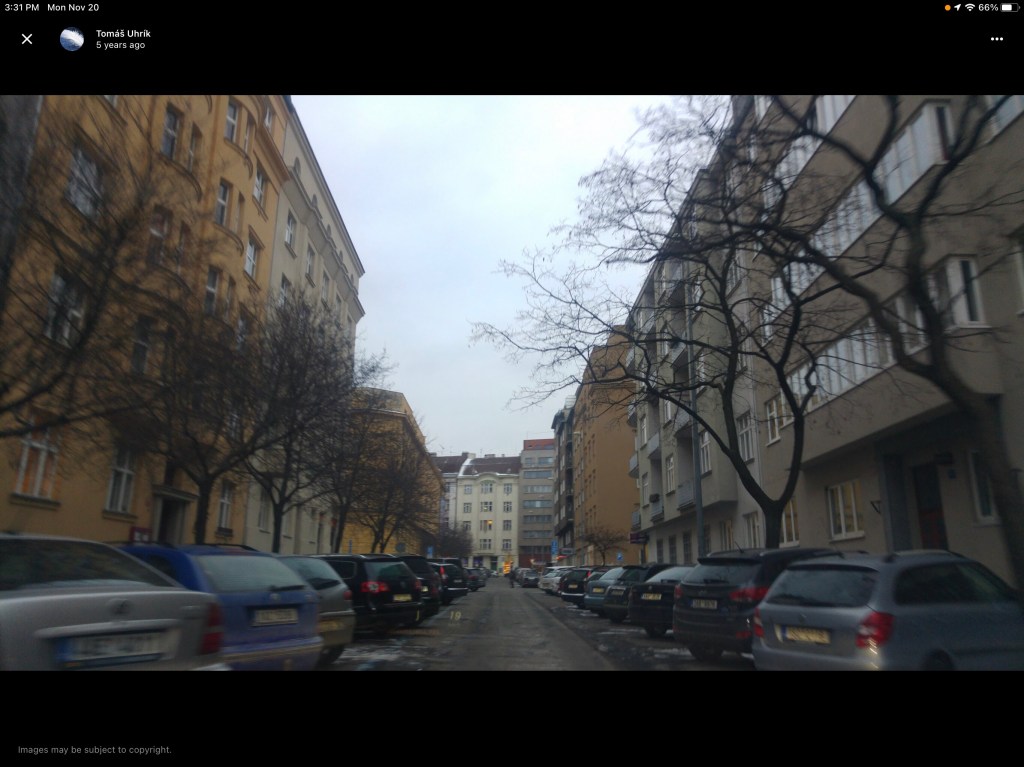
My Old Neighborhood in Prague

But none of that mattered, as I only slept, showered and changed clothes there. The rest of my time was spent at the office, followed by dinner every evening with one or more of my co-workers at any of the many outstanding restaurants the city had to offer, and sightseeing all weekend, every weekend. I quickly got into the habit of stopping on my way to work in the morning at a bakery near my apartment for fresh bread and pastries to share with all of my new colleagues, and Rudy brought in our daily supply of deli meats and cheeses for lunch.

On my first walk to work, I also discovered that I had seemingly been transported to Dorothy’s Emerald City. At the top of my hill was a store with a large sign that appeared from a distance to read “OZ.” Of course, my curiosity led me directly to it, and as I came closer, I found that those letters were — not the end of the yellow brick road — but the initials of the words “ovoshchi” and “zelenina.” Optimistically thinking that there must be a measure of similarity between the two Slavic languages, I tried to use my limited Russian skills to translate. In Russian, “ovoshchi” means vegetables, so that one was easy — or so I thought. But “zelenina” was a bit of a puzzle. I reasoned that it had to come from the root word for “green,” which in Russian is “zelyoni.” So, OZ seemed to stand for vegetables and . . . what? green things? — which obviously made no sense whatsoever. OZ was a produce store, all right, but it turned out that a Russian vegetable translated to a Czech fruit, and the “green things” were the veggies. My first foray into this new language was a complete bust, and it never did get much better. But I arrived at work that morning with a bag full of delicious fruit and green things.

The next day I got to the office to find that there was great excitement among all the employees, who included the aforementioned Rudy (our driver and jack-of-all-trades); another young man named Roman (our second driver and office courier); three very attractive, blonde young ladies all named Jana; Beata, who was a multi-lingual American paralegal of Czech birth; and a Czech-American attorney named Milan. It seemed that Rudy — a man of many talents, as it turned out — had scored a handful of tickets for a concert coming up the following weekend at the local football — soccer, to us Americans — stadium to celebrate the Russian exodus. The performer was none other than Paul Simon, of Simon & Garfunkel fame; and there was a ticket for me. And I’d only had to travel 4,300 miles to get there!

“Like a bridge over troubled water . . .”

As if that weren’t enough, when we arrived at the packed stadium on Saturday evening, we discovered that an even greater star was in attendance: President Vaclav Havel, the hero of the newly freed, democratic Czechoslovakia. We were able to see him from our seats, and the excitement was palpable throughout the crowd. Welcome to Prague, Brenda. This was just the first week, and I had spent it with an American music icon, the President of Czechoslovakia, and a whole bunch of welcoming strangers, most of whose females seemed to be named Jana.

Vaclav Havel, Hero of the Velvet Revolution

But Paul Simon wasn’t the only act in town. It happened that 1991 also marked the bicentennial anniversary of the death of one Wolfgang Amadeus Mozart, and throughout Europe his genius was being celebrated ad nauseum, all summer long. And I couldn’t get enough of it. Dragging various people along with me, I must have gone to a half dozen concerts. My favorites were held in a small theater on the banks of the Vltava River, and were called — if I remember correctly — “Mostly Mozart.” To the beautifully performed melodies and lyrics of the operatic arias (in the originally written languages), satirical plays were presented by the singers onstage that were absolutely hilarious; and somehow, the interplay of comedy and Mozart’s masterpieces just worked. “Wolfie” may have been turning over in his grave, but I loved it . . . and so, apparently, did the rest of Prague.

*. *. *

As for any spoken language barrier, I soon learned that everyone in the country had been required to study Russian during the Soviet occupation, but that most Czechs refused to speak it any longer, for obvious reasons. Along with their other freedoms, they were thrilled to have their native language back. But when I rode in a taxi or shopped in a local store, the conversation would usually go something like this:

Me (in Czech): “Dobry den” (“Good day”). Then, in English: “Do you speak English?”

Them (in German): “No. Do you speak German?” (It seemed they’d forgiven the Germans for the long-ago Nazi occupation, but the Russians . . . not so much.)

Me: “Nein.” (One of the dozen or so words I know in German, two of the others being Schweinehund and Dummkopf. You see how my mind works?)

Me (continuing, this time in Russian): “Maybe you speak Russian?”

Them (in Czech, and suddenly stiffening as though someone had shoved a pole up their butt): “No! No Russian!”

Me (still in Russian, and very apologetically): “Sorry. I’m American, and I only speak English and a little Russian. Can you understand me?”

Them (still in Czech, but now visibly relaxing): “Oh, American! Good! Welcome! Yes, I understand a little Russian.”

Problem solved. They would continue to speak in Czech, very slowly and with a lot of gestures; and I would respond in Russian, the same way. And somehow, we managed to communicate. Through the weeks, as I picked up some words and phrases in Czech, I would use a mixture of the two languages. Every cab driver in Prague came to know me and where I lived and worked — there weren’t a lot of American expats in Prague at the time, and a redheaded American woman who spoke to them in Russian was memorable. Being a good tipper didn’t hurt either.

*. *. *

Personal note: I hate beer. In my opinion, it’s bitter, it’s bloating, it smells bad, and it leaves a bad aftertaste. (I feel the same way about coffee, except for the bloating part). If that makes me weird, so be it. But the folks in Prague weren’t ready to accept that, and kept trying to convince me that their renowned Czech beer, Pilsner, was different and so much better. So one evening, when we were all out partying after work (not an unusual occurrence), I agreed to take a sip from Jana’s (it doesn’t matter which Jana’s) glass — and almost did a vaudeville-style spit-take. I’m sorry, but beer is beer, and I can’t tell a good brewski from a bad one. And I said so, as gently as possible. But I don’t think they ever forgave me for that.

“Sorry, it’s . . . beer.”

I did, however, discover a local drink that I loved, and still keep in my freezer to this day, right next to the Stolichnaya vodka. It’s called Becherovka, and is a clear, herbal, after-dinner liqueur, to which I was introduced one evening at dinner when I happened to mention that my feet were killing me from all the sight-seeing along the cobblestoned streets of Prague. On their promise that it would relieve my pain, I tried a shot before dinner. And a second. It was uniquely refreshing, and couldn’t possibly do any harm — after all, it was herbal, wasn’t it? Well, after those two shots, and another one after dinner, absolutely nothing hurt. In fact, although I swore I was not the least bit lightheaded, I couldn’t feel my feet at all. Luckily, I wasn’t doing the driving. So who needs opioids — or even ibuprofen — when you’ve got Becherovka? I do limit myself these days to one or two small shots, but it’s still my pain-killer of choice. (BTW, it can be ordered online, if you’re interested, and over 21.)

Herbal Pain Killer

Then there was the night I met the Dobermans. No, not the nice Jewish couple next door; these two were from upstairs. When I got out of the taxi in front of my building after dinner one evening, there was a small group of men standing nearby, just talking and enjoying the mild summer air. One of them called out to me, but he was speaking Czech and I couldn’t understand him. Thinking they were just being neighborly, I gave them a friendly wave as I opened the door to my building . . . and was confronted in the dark hallway by two humongous, solid black, barking, drooling, straining-at-the-leash Doberman Pinschers, ears up and tails down, obviously looking for someone to kill. Someone like me. Startled out of my wits, I let loose with a primal scream . . . the dogs’ owner screamed in response . . . the dogs barked louder . . . and all the while the men on the street were roaring with laughter. That was what they had been trying to tell me: look out for the dogs, who had just come back from their evening walkies. And when my neighbor and I finally stopped screaming, we joined the others in laughing at ourselves. The dogs — who lived directly above me — turned out to be sweethearts, once they got to know me, and their owner was also quite friendly; though I would have preferred to meet them some other way — any other way.
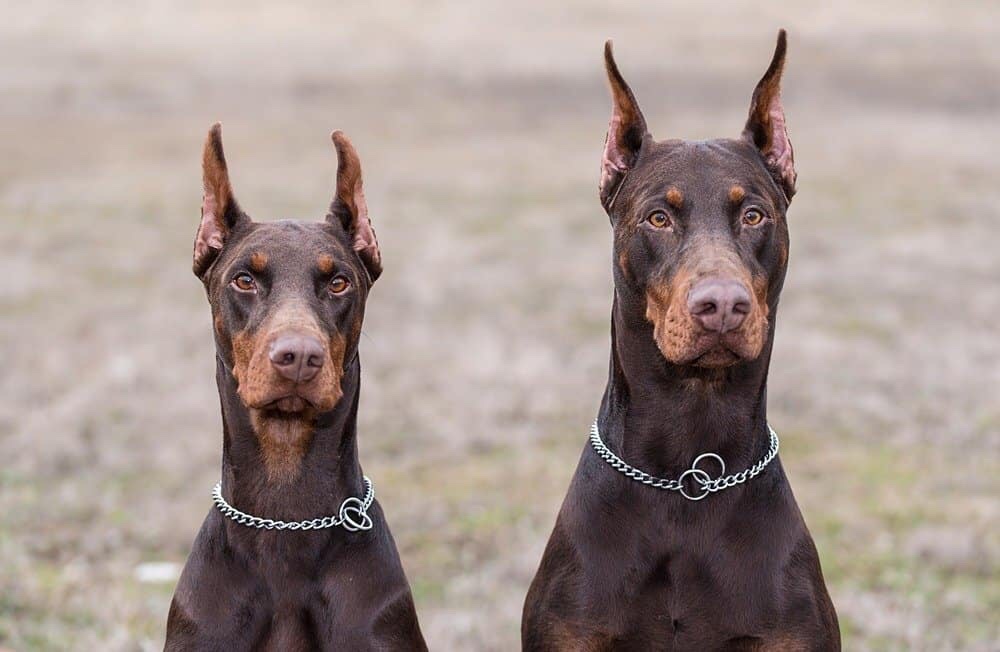
Howdy, Neighbors

Dogs are treasured as pets in Europe, just as they are here. And that included the dog belonging to the Czech Foreign Minister.

We had an American attorney working with us — a bright but spoiled young woman from a well-to-do family, who never quite adapted to the easy-breezy way of life in Prague. Our law firm had been retained by the new Czech government to advise and assist in formulating a new constitution and legal framework, and she — we’ll call her Valerie — had been assigned a desk at the Foreign Ministry where she worked pretty much full-time. As a convenience, she brought her lunch to work every day and kept it in the Ministry’s refrigerator, as did many others.

Now, I have to insert here that Valerie was, shall we say, less than popular with the Ministry staff. She had way too much Attitude. On the day in question, the Foreign Minister was leaving town on government business, and had brought along his beloved dog — a terrier, I believe — to hand over to a friend who was going to care for the pooch during his master’s absence. The Minister parked in his usual spot in front of the building, opened the driver’s-side car door, and before he could turn around, his dog ran out into the street — and directly into the path of an oncoming vehicle. The poor baby was killed instantly as his owner watched, helpless.

Needless to say, the Minister was devastated, but was unable to cancel or postpone his official trip at the last moment. So he had to make some hasty arrangement for his dog until a funeral could be planned for the following week. And this being Prague, the solution turned out to be . . . well . . . unique.

When Valerie arrived for work a little later that morning, no one took the trouble to warn her that anything was amiss. She went directly to the kitchen to put her lunch into the refrigerator, and had one item that needed to be kept frozen. So she opened the freezer door . . . and let out a SHRIEK that must have been heard in Belgium. Because in the freezer — staring sightlessly out at her, arms and legs akimbo, a silvery frost already forming on his fur and his little black nose and protruding pink tongue — was the Minister’s dog. The Minister’s dead dog. Sad . . . stiff . . . broken . . . bloody . . . undeniably, irretrievably dead doggie . . . without so much as a blanket or a newspaper to cover his sorrowful condition. And the shrieking continued, while all around her, Valerie’s co-workers were laughing their asses off. Not at the dog, of course, but at her. They really didn’t like her.

NOT the Minister’s Dog, Just a Cool Facsimile

You will be relieved to know, incidentally, that that unfortunate, cryogenically-preserved canine received what was reportedly a lovely burial the following week in the Minister’s home town, alongside all of his previous pets. I assume he was thawed first. The dog, not the Minister. Requiescat in pace — R.I.P., little pup.

Prague seemed intent on getting back at Valerie for not being happy there. Sometime during the summer, we suffered a city-wide power failure for nearly an entire day. As the locals were fond of saying, “Oh, well . . . that’s Prague.” While the rest of us enjoyed a lunch at a nearby restaurant, consisting of cold cuts and fresh vegetables, with potatoes cooked slowly over a huge collection of candles (Czech ingenuity at its finest), Valerie was stuck in the elevator at the Ministry. Stranded alone in the car, she again displayed her usual aplomb in times of crisis: she screamed, pounded the elevator door, screamed some more, repeatedly pushed the buttons to all the floors . . . and continued to scream for someone to get her the %#*#& out of there. When stressed, it seemed her upper-class upbringing went directly down the drain. She was, of course, ultimately rescued. But no one was in the least surprised — or in the least saddened — when she finally was granted a transfer back to the States.

*. *. *

Valerie may have considered Prague to be a living theatre of the absurd; but to me it was an endless tapestry of humanity at its best, and life as it is meant to be lived: freely, joyously, and always hopefully.

There is so much more to tell about that summer in Prague — water shut-offs, Gypsies, German tourists, rotisserie chickens, a Catholic priest, Chanukah candles, and more — so I’ll have to make this a two-part chapter. See you next time for the rest of the story.

TTFN,
Brendochka
2/23/23 (re-posted 11/21/23)
Ch. 5 – The Chernobyl Effect (Re-Posted 11/20/23)
On April 26, 1986, Armageddon was visited upon the unsuspecting people of Pripyat, Ukraine, when a nuclear reactor at Chernobyl failed and rained deadly radiation, not only upon the local citizens, but throughout a substantial portion of Eastern and Western Europe as well.

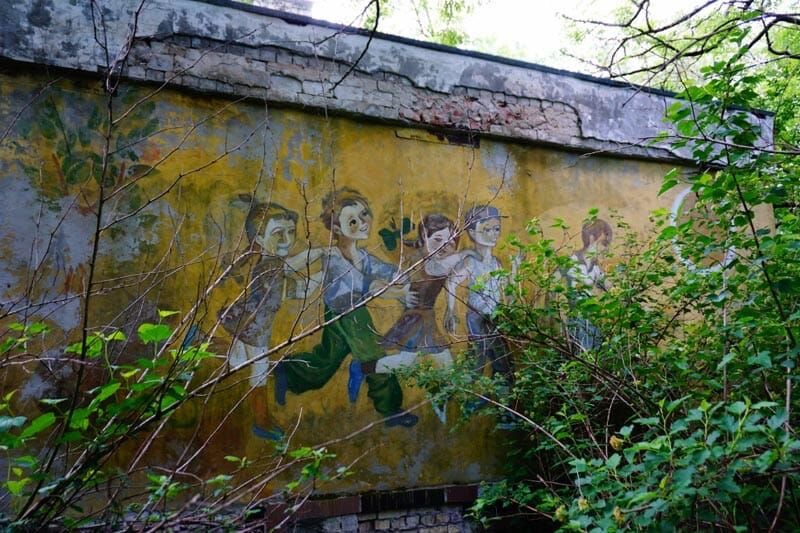
Pripyat School, Today

In August of 1988, nearly 2-1/2 years after that disaster, my friend Gisela and I were on a tour of the Soviet Union that was supposed to have included a visit to Kyiv, the beautiful and historic capital of Ukraine. But we had been notified that, for unexplained reasons, that part of the tour had been cancelled and we were instead going to enjoy a few days in the resort city of Sochi on the Black Sea coast. We didn’t need anyone to tell us why we were going to miss seeing the Great Gate of Kyiv, the stirring monument at Babi Yar, and the Cathedral of Saint Sophia. We knew it was the lingering radiation, and that its effect was still being felt, even 95 miles from Pripyat. (I did get to Kyiv five years later, but that is a tale for another chapter.)

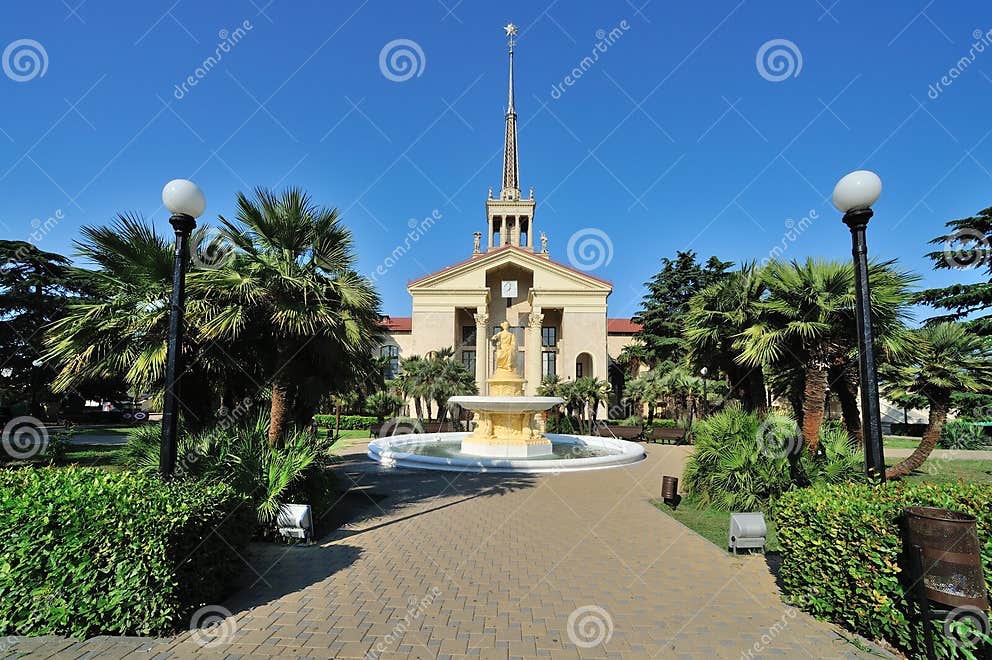
So, from Tbilisi, Georgia, Aeroflot Airline transported us the short distance to Sochi in about an hour, depositing us in a subtropical paradise that seemed totally alien in a land better known for its frozen tundras and birch forests. On the bus ride from the airport to our hotel — the Zhemchuzhina (translation: “Pearl”) — we were astonished to see palm trees, tropical flowers galore, and wide streets lined with beautiful white and pastel-colored buildings.

Sochi: The Warmer Side of Russia

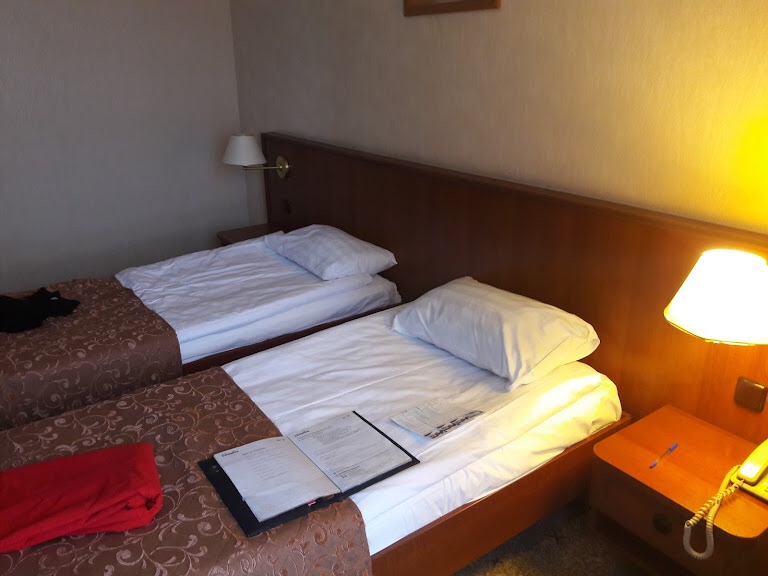
Unfortunately, the Pearl Hotel failed to live up to its name. As with the Cosmos Hotel in Moscow, it was no gem; it looked fine on the outside, but this Pearl’s nacre was only skin-deep. There was a spacious but simple lobby, elevators that mostly worked, and the usual dezhurnaya — sort of a hall monitor — watching out for us (or actually, just watching us) on each floor. And our room contained the expected twin beds (with sheets starched and ironed to a board-like stiffness), a dresser, and a small desk and chair. We found one electrical outlet, located next to the desk at baseboard level, so that when we washed our hair, we had to sit on the floor to use our dryers.

But it was the bathroom that kept us laughing for our entire stay. First was the paper strip affixed across the toilet seat each day, on which was printed a single word in Russian: Disinfected. That was nice, but something we take pretty much for granted in the U.S. — we don’t really need a sign. Still, clean is good.

And then there was the shower. The head and faucet were, quite logically, attached to the wall in an area surrounded on three sides by tile. The fourth side, though, was wide open — no door, no curtain, no tub, no surround of any kind. Not even a lip to keep the water inside. The floor drain in the middle of the shower area didn’t quite keep up with the normal flow of water, so when the shower was running, the entire bathroom — did I fail to mention that it sloped slightly downhill from the shower? — flooded and threatened to flow out to the bedroom, in which event the single electrical outlet on the baseboard would have been in danger of electrocuting anyone unfortunate enough to be sitting on the floor with their hair dryer plugged in. We quickly figured out how to shower with just a trickle of water in as few minutes as possible. And even so, I’m sure the hotel maids were puzzled and less than amused when we kept ordering more towels each day to try to stanch the overflow and returning them sopping wet.

But when on vacation, one does not typically spend a lot of time in the hotel room. Beautiful Sochi awaited.

One of our memorable afternoons was spent at the beach. Now, you readers should please rid yourselves of any mental images you may have of a stretch of beautiful, white sand as far as the eye can see. There was no sand; there were rocks, stretching into infinity. And they weren’t trucked in and spread there for effect; that was the natural “groundscape” (if there is such a word, and if there isn’t, there should be) of that part of the Black Sea shore. The local people, walking barefoot across that unforgiving surface, must have had feet made of rawhide. We Americans unabashedly donned our flip-flops, and I even wore mine into the water, much to Tamara’s amusement.

Rocky Beach at Sochi

And by the way, the name of the Black Sea was not just pulled out of thin air. No Caribbean blue waves for this beach. The water is very still where it meets the shore, and actually is black, or dark gray. There are many theories as to the reason for this anomaly, none of which is particularly appetizing, but we were assured that it was quite safe. However, it was some distance out to where the water was deep enough to actually swim, so we were pretty much restricted to wading in any event, and thus safe from encountering anything gross or treacherous.

Or were we? . . . [Cue “Jaws” music.]

No, there were no sharks, at least not that close to shore. But at one point, I saw Tamara reach into the water and pick something up in her hand. Thinking she had found some sort of treasure, I waded over to see what it was, and was alarmed to note that she was holding a live jellyfish. I shouted something like, “What are you doing? You’re going to get stung!” which made her laugh. She explained that these were not stinging jellyfish, and pointed out that I was already wading in a large gathering of them. “Ewwww.” She was right. But after an initial freak-out, and upon being dared by Tamara, I tentatively reached into the water and scooped up one of the little critters. How did it feel? How do you think it felt? It was viscous, glutinous and muculent (per my online thesaurus) — or, in plain English, slick, slimy and slippery. Back into the water it went, and out of the water I went. Enough of the Black Sea for me, thank you.

By the way, does anyone know the correct name for a group of jellyfish? A school? A herd? A flock? Not that it matters, but being naturally curious, I Googled it, and it turns out to be — drumroll, please — a “smack.” A smack of jellyfish. Not in a million years would I have guessed that one.

But enough of the vocabulary lesson — let’s get back to Sochi.

After dinner and a musical performance that night, we saw from the window of our room — which looked out across the sea — some strange searchlights sweeping back and forth across the water. Asking about it the next day, we were told, very quietly, that it was shore patrol on the lookout for drug runners from Turkey. Even Paradise had its seamy side.

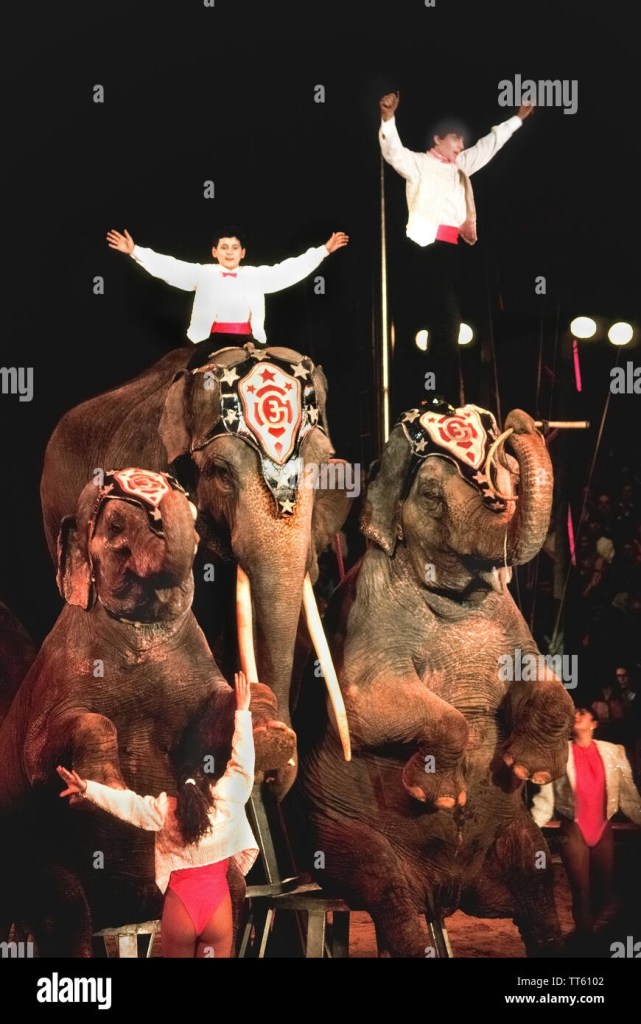
The next day, it was off to the Moscow Circus, which happened to be on tour in Sochi that week. The wonder of it shone from the faces of the scores of children in the audience, who undoubtedly had few such diversions to look forward to from day to day. I even learned from one child seated next to me — a beautiful little girl with two gigantic pink bows in her hair — that the Russian word for elephant is slon — which I assure you has not come up in conversation in any context since then, but for some reason has stuck in my mind. Right up there with zhemchuzhina. And, now also, a smack of jellyfish. Travel, as they say, is certainly broadening.

*. *. *

Walking back from our bus along the flower-lined path to our hotel one beautiful summer evening, we American tourists were mixed in among a number of locals apparently out for an evening of dining and dancing at the hotel restaurant and bar. Staggering toward us was an obviously drunk-out-of-his-mind Russian man, weaving and bobbing along the path and headed straight (or not so straight) at us. He stopped directly in front of me, trying to focus on my face, and smelling like a 1920s bootlegger. As the crowd of onlookers watched with amusement, I tried sidestepping to the left; he went to his right. I went right, he went left. And so on, about five or six times. Finally I bluffed, went the opposite of the way he expected, and he was able to stagger on his merry way. As he passed, I blurted out, in Russian, “Pyanniy durak” — “Drunken fool.” And every Russian person within earshot cracked up to hear a foreigner reacting like a local. I was beginning to feel very much at home in this enormous, strange, and varied land.

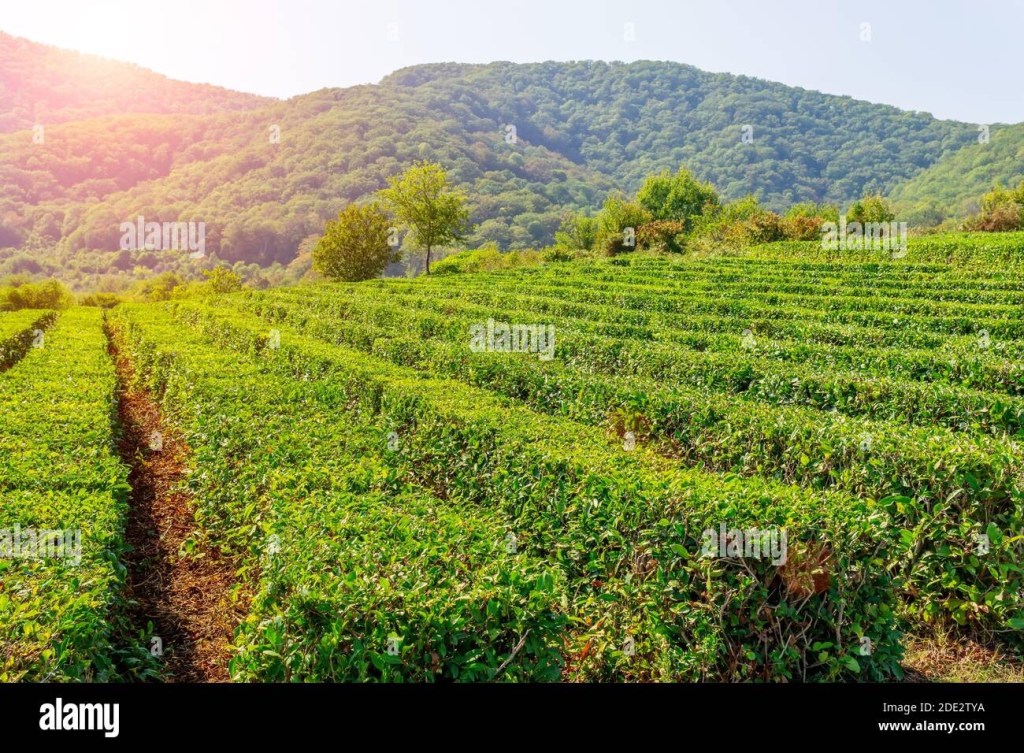
We also spent a glorious, but very long, day traveling by bus to a tea plantation near Krasnodar, where we were treated to a delicious lunch followed by an assortment of desserts and — of course — a selection of exquisite teas brewed from freshly-harvested leaves. The inside of the picturesque teahouse was strewn with dozens of antique samovars, any one of which I would gladly have purchased except for two things: first, they were not for sale, and more importantly, as antiques they could not be taken out of the country without a mess of paperwork, and even that didn’t guarantee success. Oh, and a third factor: I couldn’t have afforded one in any event. So I contented myself with a few packages of tea to carry home.

At Krasnodar we were once again educated in yet another new means of dealing with a most basic aspect of life: the bathroom. There were separate outbuildings for men and women, just a short walk from the teahouse. The exterior of the ladies’ facility looked very nice, and the interior was clean and well-kept — or perhaps I should say well-swept, as there was really nothing to “keep.” Nary a toilet, nor a sink, nor any sort of fixture to be found. Just a couple of deep holes dug into the dirt floor of the single large room. Here was a perfect example of the physical advantages that men have over women: they can pee anywhere. But as a woman wearing slacks (and, presumably, underwear), how does one stand over a hole to go without wetting her clothes — short of completely undressing, that is, since there was nowhere to lay the clothes down other than the dirt floor?

Krasnodar Tea Plantation

As it turned out, the answer was simple but awkward: by removing one leg from the garments and holding them off to the side. Then you plant one foot firmly on each side of the makeshift urinal, and squat. But not too low, of course. And Heaven help you if you have balance problems, as there was no rail or solid object of any kind to hold onto. This also is where those little packs of Kleenex came in handy again, as there was no toilet paper to be seen, either. I wondered momentarily, as I dropped the used tissues into the bottomless pit, whether they were biodegradable, but didn’t linger long on the thought.

All of this actually made the hotel’s bathroom look downright luxurious. But after drinking several cups of tea, and with another long bus ride ahead of us, we got through it relatively unscathed because we had no choice — though it would have been much simpler if I’d had a third hand to hold the Kleenex pack.

At the end of that fun-packed but exhausting day, and after another long bus ride back to Sochi, the whole group was ready for dinner and some much-needed shuteye. I don’t know about the others, but I slept the sleep of the innocent that night.

Then Tamara vanished.

We awoke on our final day in Sochi to find that we now had a young lady named Masha to accompany us on the last leg of our journey. No explanation, no answers to our questions . . . nothing. Just “Hi, I’m Masha, your new Intourist guide.” Even Lisa, our American guide, was unable to learn what had happened. Everything in the Soviet Union seemed to operate on a need-to-know basis, and apparently no one needed to know. Anything. Ever.

(Note: Lest the reader be concerned about Tamara’s fate, never fear — she showed up in my life again a couple of years later, at my apartment in Virginia, after calling and inviting herself to stay for a few days. As my beloved grandmother would have said — and often did — “Oy, vay!” I must remember to include the story of that visit in a later episode.)

*. *. *

[NOTE: This is a good place to break, if you so choose. The second part is a little shorter.]

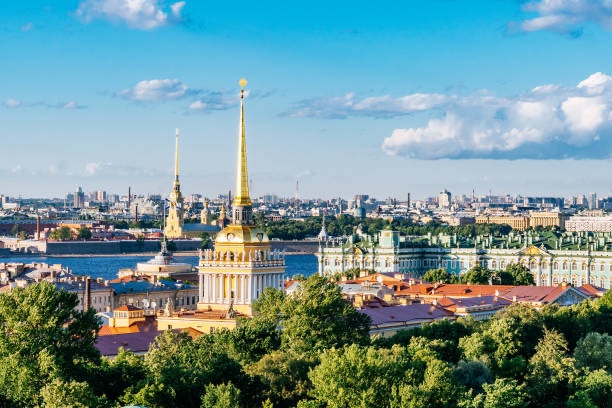
And so we were off once more, this time on a somewhat longer flight to Leningrad — since renamed St. Petersburg, the earlier Soviet name having been consigned to the dustbin of history following the collapse of the Soviet Union, right along with all tributes to the tyrant after whom it was named. Of course, Peter the Great — after whom the city was renamed — was no sweetheart either, but we’re not here for a history lesson . . .

Leningrad (St. Petersburg)

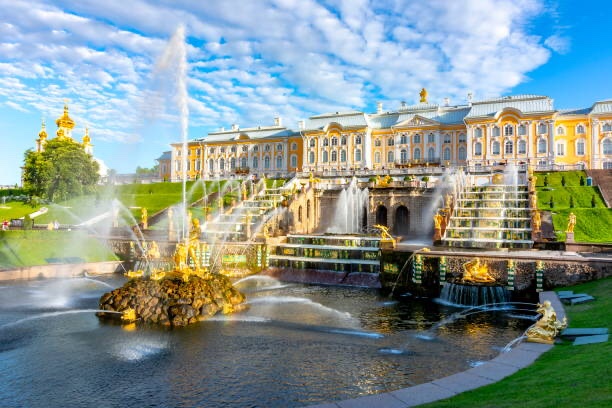
It was late August when we arrived in the city on the Baltic that had once been the Imperial capital of Russia. Often referred to as the Venice of the North, it is a city built on 42 islands threaded throughout with canals and rivers, deservedly boasting of magnificent palaces, broad avenues, manicured parks, decorative bridges, domed cathedrals, the Kirov (now Mariinskiy) Theatre . . . and frequent flooding. We toured the Winter Palace (a.k.a. the Hermitage), the Admiralty, a lesser palace or two, St. Isaac’s Cathedral, and rode on a hydrofoil across a stretch of the Gulf of Finland to Petrodvoryets — the incredible Summer Palace of the Tsars. One night, after dinner, we returned to our hotel, the Pribaltiskaya, in an outlying part of the city around 10:00 p.m., thinking it couldn’t be past 8:00 because it wasn’t yet fully dark. But we had arrived in late summer, in time to witness the end of the famous White Nights — which, while certainly fascinating, also turned out to be quite disorienting.

Petrodvoryets – Summer Palace of the Tsars

Gisela and I had one errand to run in Leningrad: a visit to Galina, a woman we didn’t know, but who was a childhood family friend of a young attorney from my firm. Vladimir had been born to a Jewish family originally from Ukraine who, long before his birth, changed their last name to something non-Jewish and managed to find their way to Leningrad to escape the Nazi invasion of their homeland. Smart move, except that they then had to endure the 900-day siege of their new home. But with their adopted name, they survived, thrived, and eventually emigrated to the United States, where young Vladimir, by then a college graduate, was able to attend law school and join Walter Surrey’s firm. He had given me a small gift to bring to Galina, and she invited us to dinner at her apartment. Once again, we missed our evening activity with the group, but it was well worth it.

Leaving our hotel, we were directed by a concierge to a specific taxi, which we had requested earlier in the day. This was a nicer car than most of the taxis — cleaner, and with a tape player and a wide selection of American music tapes most likely bought on the black market, like everything else of any value in those days. But the driver was too friendly and asked too many questions. I had a strange feeling about him, so instead of giving him the exact address, I told him to take us to the intersection near Galina’s building that I had found on a map. He hesitated, asked if I was sure about that, and then finally acceded when I insisted. When we got to the corner, paid him and left the cab, he just sat there and didn’t drive away, but watched to see which way we would go. So we dawdled, fiddling with a purse or the package for Galina, adjusting our jackets and tying an imaginary shoelace, until he finally drove off. Was he being protective, or just nosy? There was no way to know, but it felt decidedly strange.

We had no problem finding Galina’s building. But locating her apartment was a whole new experience. As Vladimir had cautioned me, we found ourselves in a pitch-dark entry, and had to grope for a light switch. The lights were on a timer to conserve electricity, and we hurried up the steps to the second floor before it went dark again. Reaching for the rickety handrail, I immediately recoiled. It was slimy and stank of years — or more like seven decades — of neglect, as did the rest of the building. It was obvious that the common areas had never, ever been cleaned. We couldn’t wait to see what Galina’s communal apartment looked like.

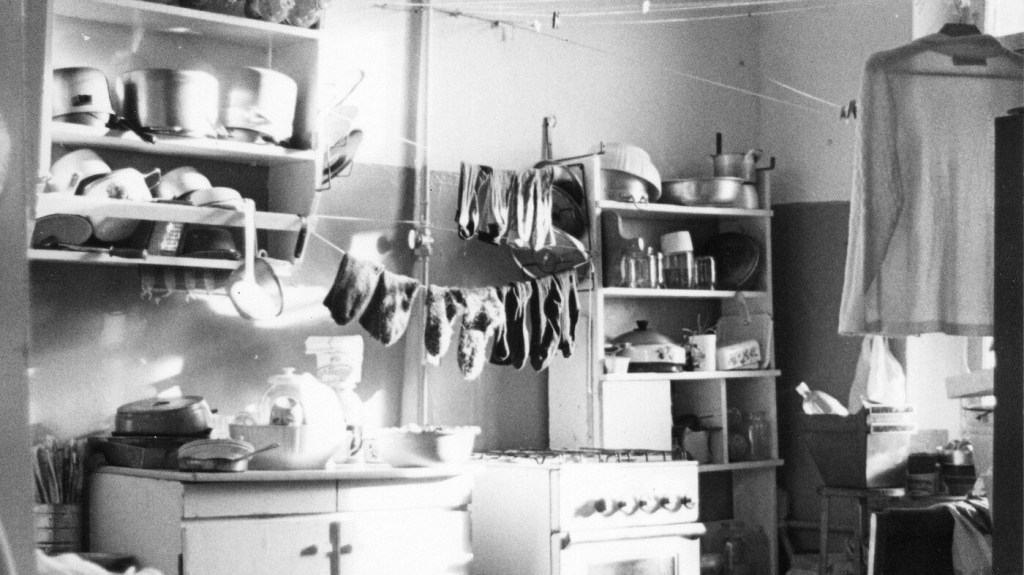
History note: Communal apartments in the Soviet Union dated back to the early Bolshevik days, following the 1917 Revolution. Each family had its own living and sleeping space, but kitchens and bathrooms were shared with other families, usually total strangers (but not strangers for long). Use your imagination — or better yet, don’t.

Gracious Living, Soviet Style

Galina turned out to be a lovely, bright, charming woman who spoke little or no English but had studied German, so Gisela was able to act as interpreter when our Russian language skills failed us. Using a combination of three languages, we got along famously. The apartment — the living area, at least — was poor but immaculate. We glimpsed the tiny communal kitchen, from which, by some miraculous feat of legerdemain, Galina had managed to turn out an exquisite meal. When she skipped over the bathroom on our tour, we took the hint and decided it would be wise to avoid it completely. In any event, the typical Russian “bathroom” consists of a toilet in one room and small bathtub or shower in an adjoining room, with the kitchen sink serving a dual purpose. The Russians are very big on “washing up” before a meal, and after the handrail incident I wasn’t about to argue, but we were glad to use the kitchen sink.

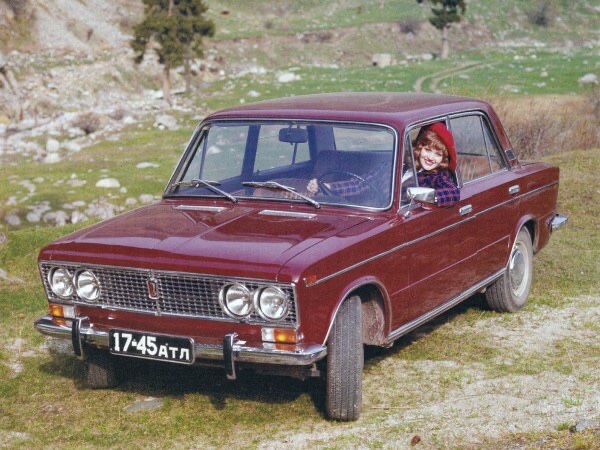
After dinner and more talk of life in America vs. Russia, Galina said that she had a gift for us to please carry back to Vladimir, but that she could only pick it up the next day. She asked if we could meet her in the afternoon at St. Isaac’s Cathedral, and we agreed. When we left around 10:00 p.m., carefully avoiding the offending handrail, she turned the hallway light on for us. Then we had to try to find a taxi in a residential neighborhood — no easy feat, since there were no taxi stands and no way to simply call for one. It was late, and the streets in that part of the city were nearly devoid of traffic. We stood on the same corner that we knew from our earlier drop-off, and after a few minutes, a plain car pulled over and the window was rolled down by a woman driver. At that time in Russia, most families could only afford one vehicle (if any), and that one was usually monopolized by the husband, so seeing a woman driver was strange in itself. But when she offered to go far out of her way to drive us to the Pribaltiskaya on the outskirts of the city, and said she would not accept payment, we were suspicious. Yet, with no taxis in sight, we saw no option and finally agreed to accept her offer.

Four Wheels and a Chassis

The woman was an excellent driver, well dressed, and — from what little she said — apparently well-educated, but didn’t talk about herself, not even her name. Nor did she ask many questions of us, which was odd, considering that she had just picked up two female American tourists on a dark street corner in a residential neighborhood in Leningrad at 10:00 at night — certainly not an everyday occurrence. She should at least have been curious about what we were doing there. Instead, she simply drove us directly to the hotel, said a quick goodbye, again refused an offer of gas money, and left without so much as a wave of the hand. Like a Russian Lone Ranger, she was there exactly when we needed her, then rode off into the night — just not on a white horse. The question was: Who was she, and why was she also there at that hour? (I know, that’s two questions, again with no answers.)

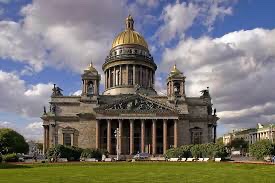
The next day, we met Galina at St. Isaac’s as agreed, on the landing outside the main entrance, at the top of the tall outdoor stone staircase. Her gift for Vladimir consisted of two small paintings by his favorite Russian artist, unframed and in a plastic shopping bag. As we talked for a few minutes, I noticed a man standing at the far end of the veranda, smoking and trying to be nonchalant but clearly watching our little trio. He never approached us, and did not follow Gisela and me (as far as we knew) when we headed off toward Nevsky Prospekt for a bit of shopping; so I chose to believe that he was just stationed there for “security” purposes. Maybe so, maybe not.

St. Isaac’s Cathedral, Leningrad (St. Petersburg)

Even here in Leningrad, far from Moscow, we seemed to be of some interest. But to whom? And why? Was this just common practice with American tourists? Or because we sometimes ventured out on our own, without our group and Tamara or Masha? Or because of Viktor Akimov and Georgi Karpov again? I’ll never know. It was like being in a bad spy movie, and we were enjoying it — or maybe just imagining it — like a couple of big kids.

Despite our little escapades, we survived our tour of the USSR, which was now drawing to a close. We hated to leave, but had no option: when your visa expires and your tour group goes home, you’d better be with them. But there was one last bit of rather sadistic fun. One of our group — a woman whose entitled attitude had not endeared her to the rest of us — had inadvisedly decided to purchase one of those outrageously expensive samovars, not at the tea house, of course, but at an antique shop in Sochi. She knew she couldn’t sneak it out in her luggage, so she very openly, and wisely, declared it at Customs. Seeing that it was a genuine antique, the Customs agent told her, in no uncertain terms, Nyet!!!! Despite the papers the antique dealer had given her, this was not allowed, and her treasure was confiscated. Several of us had tried to warn her, but she wouldn’t listen. I don’t know what she paid for it, but she might as well have flushed the money down a disinfected toilet. She just couldn’t understand why she hadn’t been able to bully the Customs agent into letting her have her own way — the sort of American tourist who gives all American tourists a bad name — or why she didn’t receive a lot of sympathy from her fellow travelers.

Homeward Bound

And finally, we were aboard our PanAm flight home. After lunch in the airport during our stopover in Helsinki, Finland, and a much-needed nap on the plane, we arrived safely at JFK’s international terminal in the late afternoon, jet-lagged and suffering from reverse culture shock. But that one excursion to a foreign land had been enough to infect me with an incurable case of travel fever. It would be a year and a half before my next overseas trip, but when the opportunity arose, I was more than ready. In the meantime, life at home was anything but dull.

See you next time, when I chronicle my return to “civilization.” Enjoy your weekend, and be well.

Brendochka
1-19-23 (re-posted 11/20/23)
11/19/23: Our Very Own Tyrant

[NOTE: The following is not a statement of my political views. I am neither Democrat nor Republican; neither liberal nor conservative; neither left-leaning nor right-leaning. I believe in moderation in all things (or nearly all things, chocolate and kindness to others excepted). This is simply a commentary on one individual who scares the hell out of me, and a statement of the reasons I feel as I do. I know there are those of you out there who will disagree with me, some perhaps vehemently. That is your absolute right — it’s what our First Amendment is all about — and I respect that. But be aware that I will not be responding to comments, pro or con. I do not engage in pissing contests. If you still want to read on, I invite you to do so, and I thank you.
- Brendochka]

*. *. *

I rarely dabble in U.S. politics, at least not publicly. But an article by CNN’s Stephen Collinson on November 14, 2023, had such disturbing domestic and international implications, I simply could not ignore it.

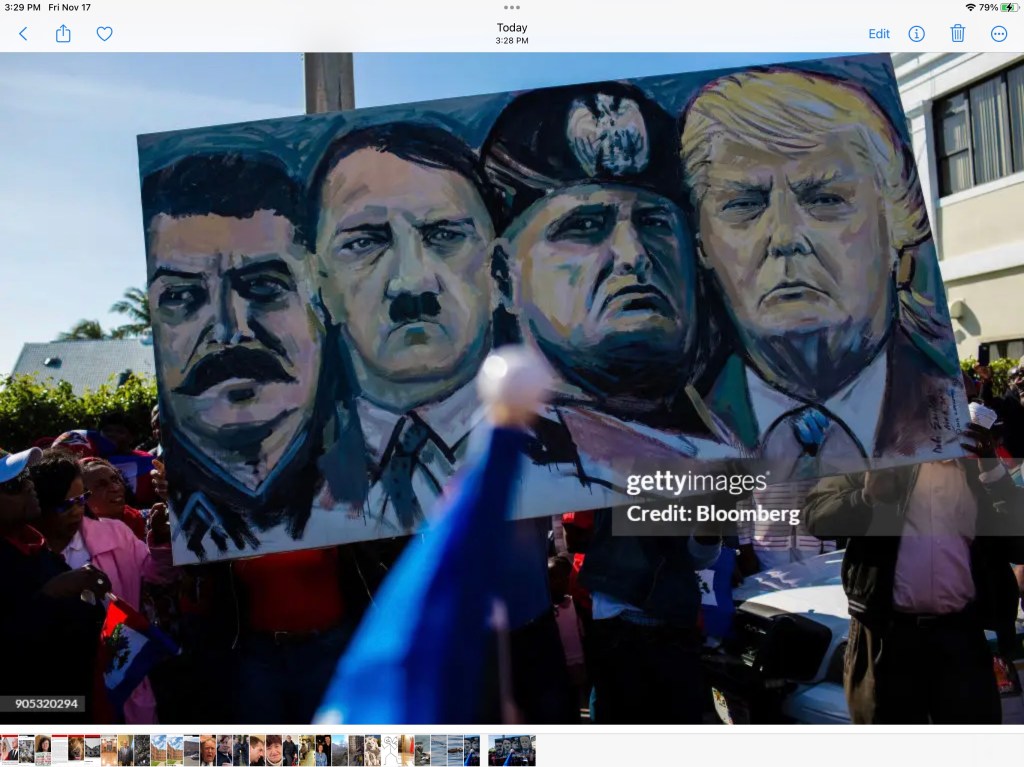
Tyrants From Recent History: Stalin, Hitler, Mussolini, and . . . oh, shit!

I don’t know the history of the poster shown above (which I found online), but it perfectly depicts my thoughts and fears concerning the current U.S. presidential campaign.

In a perfect world, the blond guy on the right would not be in that lineup. He’s not a deceased European dictator; we all know the atrocities committed during the early to mid-20th Century by Josef Stalin, Adolph Hitler, and Benito Mussolini, and surely he’s not in that category. No, Donald Trump is an American, a former President of the United States, a would-be second-term President, and not a mass murderer. By all rights, he should never appear in a picture with those other three.

But . . .

But he is also an American who is currently defending 91 charges within four criminal cases in the U.S. Courts. Ninety-one charges that, if he were to be found guilty of all of them, could bring him combined maximum sentences of up to 712 years in prison, or so I have read. Not even Methuselah could still run a campaign after that much hard time!

But wait . . . there’s more. Donald Trump idolizes strongmen; Vladimir Putin comes immediately to mind. We’ve all known about that little bromance for some time now. And Trump believed when he was in the White House — and still believes, despite having been proven wrong time after time — that as President he possessed, and would again possess if he were to be re-elected, absolute power. He still operates under the illusion — or delusion — that he would be above the authority of all laws, including the U.S. Constitution, the U.S. Department of Justice, rulings of the U.S. Supreme Court . . . and probably God Himself. Because he is Donald Trump. And in his parallel universe, Donald Trump reigns supreme.

Cover of Time Magazine, June 18, 2018

And he doesn’t hesitate to say so . . . loudly, clearly, and repeatedly. And he does so in a rhetoric that daily becomes more and more frightening to those of us Americans who value our hard-won freedoms. On Saturday, November 11th — Veterans Day — he spoke at a rally in the small town of Claremont, New Hampshire, where he offered up the following promise to his potential constituents:

“We will root out the communists, Marxists, fascists and the radical left thugs that live like vermin within the confines of our country.”

“Root out”?!! . . . “Thugs”?!! . . . “Vermin”??!!! . . . From which of Hitler’s speeches did he plagiarize that sentence? And he went on, further warning that “the real threat is not from the radical right. The real threat is from the radical left, and it’s growing every day.” Personally, I feel threatened by the “radical” anything, but apparently he’s okay with the ones from his side.

Vermin? Or just thugs? No, it’s just the Radical Right at the U.S. Capitol on January 6, 2022

With wars continuing to rage in Ukraine and the Middle East, and with Russia and China joining forces to establish a “new world order” of their own imagining, Trump — rather than focusing on unity at home — instead chose to push his favorite theme: divisiveness. In his words, “The threat from outside forces is far less sinister, dangerous and grave than the threat from within.” He sounds as though he’ll be satisfied with nothing less than another all-out civil war. Way to go, Donnie — that’ll sure solve all our troubles!

I don’t mean to minimize our internal problems; we do have plenty, and they do need to be dealt with. He’s right about that. But not his way. He would have us forget Russia; forget China; forget North Korea; forget Hamas and Hezbollah and Iran and . . . oh, what the hell — let’s just forget them all. And while we’re at it, let’s drop out of NATO, thus ridding ourselves of the need ever again to worry about our allies, because we wouldn’t freakin’ have any allies left! He would have us believe we just need to focus on getting rid of the liberal left — and anyone who opposes Donald Trump’s beliefs — in our own country, and all will be well, forever and ever, amen. The triumph of 21st-Century American isolationism: The Gospel According to Trump.

*. *. *

Donald Trump has also continued to zero in on “outsiders” and immigrants as juicy targets for his proposed feast of vengeance and — well, let’s just call it what it is — ethnic cleansing. He told the right-leaning National Pulse website that undocumented immigrants are “poisoning the blood of our country. It’s so bad, and people are coming in with disease.” Another idea borrowed right out of Der Fuhrer’s playbook . . . remember that episode called “the Holocaust”?

I seem to recall Trump’s similar statement, either during his 2016 campaign or early in his presidency, to the effect that the “Mexicans” (his all-inclusive term for Latin American immigrants entering the U.S. across our southwestern borders) were “. . . bringing drugs. They’re bringing crime. They’re rapists. And some, I assume, are good people.” Wow . . . how magnanimous of him!

*. *. *

Luckily for my nervous system, Mr. Collinson’s article goes on to point out the differences between the world of the 1930s and ‘40s and the world of today, as well as the protections existing in our U.S. legal system that would hold Donald Trump in check if he were to be elected to a second term. But imagine, if you can, the cost in terms of time and money, and the inattention to domestic and world affairs that would result from our need to be focused constantly on his every spoken and tweeted word.

(Off the subject for just a moment: can we still “tweet” when “Twitter” is gone? Don’t we have to “X-pel” or something? Just a thought.)

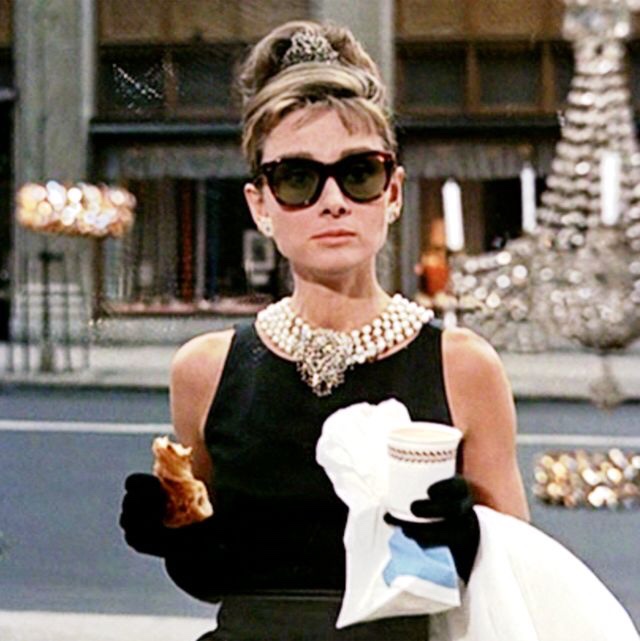
But back on topic: Another four years of that sort of nightmare scenario would, I fear, do us in, individually and as a nation. And what would the domino effect be like throughout the rest of the world? To paraphrase the irrepressible Holly Golightly in Breakfast at Tiffany’s, I can only say . . .

“Quelle nightmare!”

Just sayin’ . . .

Brendochka
11/19/23

[Again, credit and thanks to Stephen Collinson of CNN, for his article of Nov. 14, 2023, which saved me the time and trouble of searching elsewhere for the Trump quotations.]

Ch. 4 – If It’s Tuesday, This Must Be Georgia (Re-Posted 11/18/23)
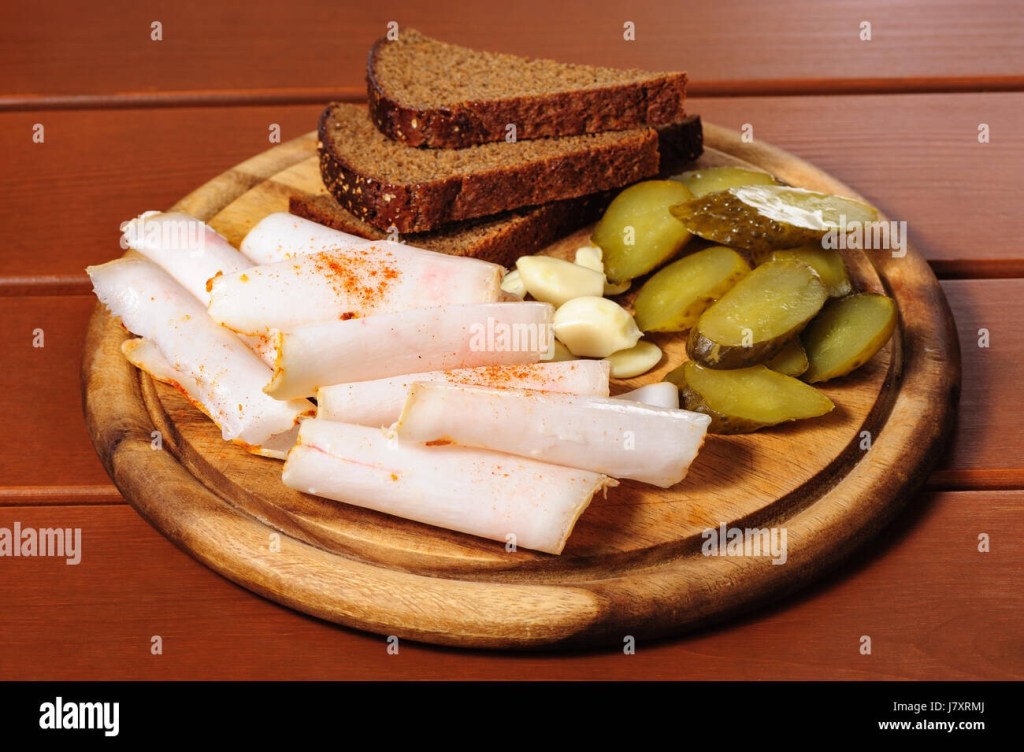
Having survived our first day in Moscow, Gisela and I joined Tamara and our group of adventurers in the lobby and experienced a typical Russian breakfast in the hotel dining room. Not bacon, eggs and toast; not cereal and fruit; not even a bagel with cream cheese. We were proudly served Russian black bread (deliciously reminiscent of my grandfather’s from my childhood), sliced cheese, some sort of thinly-sliced salted meat, a plate of tomatoes and fresh herbs, and a choice of coffee or tea. It was certainly . . . well, as my mother used to say when she didn’t care for something but didn’t want to hurt another person’s feelings . . . different.

Not Your Bacon-and-Eggs Breakfast

As the others took off toward the exit to begin their first tour, Gisela went back to our room to wait for me while I headed to the coffee shop to meet with Georgi Karpov. She and I had agreed that we would stick together throughout the two-week trip, and had also arranged to take advantage of this morning away from Tamara’s eagle eye to visit the American Embassy. The husband of one of our former classmates was stationed there, and had suggested that we drop by to register our presence in the country, “just in case” — hardly a comforting thought — so that was our plan for the remainder of the morning.

Shortly before 9:00, I settled at a table facing the door, ordered a cup of tea, and waited for an unknown man who would appear unsure of whom he was supposed to be meeting. He arrived precisely on time, but had no difficulty identifying me. I was the only woman sitting by herself, and I was fairly certain that Viktor had given him some sort of description.

Georgi headed right to my table, introduced himself, shook my hand (rather weakly, I noted), and sat opposite me, ordering a cup of tea. He was totally unremarkable: medium height, medium build, graying hair, unmemorable face. He was “Mr. Cellophane” — the invisible man. He spoke excellent English, and we talked a bit about my job and about Viktor, how he and I had become acquainted at my law office in Washington, and what a shame it was that he was on holiday and not in Moscow to greet me. I told him about the shavers and our client’s hopes for future sales in Russia. And then we ran out of conversation.

A little hesitantly, Georgi inquired whether there was anything else he could do for me during my stay in Moscow, and pointedly offered: “Do you need to buy some rubles? I can help you.”

“Let me help you, my dear . . . heh, heh, heh.”

Whoa! Warning bells began chiming in my head. Walter had wisely cautioned me about all sorts of things to look out for, and this was near the top of the list. In 1988 it was, even under Gorbachev’s more relaxed reign, still illegal for Russian citizens simply to possess hard currency, much less to trade rubles for dollars, pounds, francs, etc. Either I was talking to the most stupid individual in Moscow, or the most dishonest; or — worst-case scenario — it was an outright provocation, designed to establish whether I might be a naive, and thus vulnerable, American. I looked him straight in the eyes . . . and lied my ass off.

“Thank you so much, but I’ve already purchased rubles at the bank here in the hotel.”

I had done no such thing. But there was a bank in the hotel, and I was going to buy rubles that morning, so it was almost the truth. The important thing was, he bought it. He appeared disappointed, but he also seemed to have run out of excuses to hang around. Standing and shaking my hand again — still rather limply — he said his farewells and retreated with the two shavers, but without any of my dollars. I paid for the tea with the few rubles I had acquired at the airport the previous day — he had made no pretense at reaching for the check — and headed for my room to reconnect with Gisela.

And the fun had only just begun. Exiting the hotel — remembering to stop first at the cashier’s window to load up on more rubles — we found what appeared to be a taxi stand outside. There was also a bus stop nearby, with a little old man standing there, obviously waiting for a bus. On the far side of the expansive, semicircular driveway was a parked vehicle with a suspicious-looking, younger man leaning against the driver’s-side door. But there were no taxis at the moment, so we settled in to wait. After a few minutes, the guy across the way stood up straight and began sauntering toward us. He was respectably dressed in casual slacks and sport shirt, but projected a distinctly cocky attitude. Walking up to us, he asked — in English — “You need taxi? Where you going?”

His car was not a taxi, but I thought it best not to be rude right out of the starting gate, so I said, in Russian, “American Embassy. How much?”

“Fifty.”

“Rubles?”

Nyet. Dollars.”

Oh, crap! What was it with these people and their dollars? So I forgot about politeness and said, “No, that’s too much. And dollars are illegal. And, by the way, your car is not a taxi.”

He continued to insist that he was a taxi driver and that it was legal for him to charge dollars, so I decided it was time to end the conversation. I recalled a wonderfully obscene Russian expression that I had learned for just such an occasion, that translates to “[Do something unspeakable] to your mother,” and I let ‘er rip, in Russian. Obviously more than a little surprised at the expletive coming from the mouth of a respectable-looking American woman, he finally shrugged and slunk his way back to his non-taxi.

Meanwhile, the little old man by the bus stop had silently been taking in the entire exchange. He now took a few steps to my side, slapped me repeatedly on the shoulder, and said, “Molodyets. Nyet dollari. Molodyets!” (“Good for you. No dollars. Good for you!”) As with the handsome young man at passport control in the airport the day before, I seemed to have made this gentleman’s day as well. Obviously, it didn’t take much to amuse these good Russian people, and I was happy to be their entertainment committee.
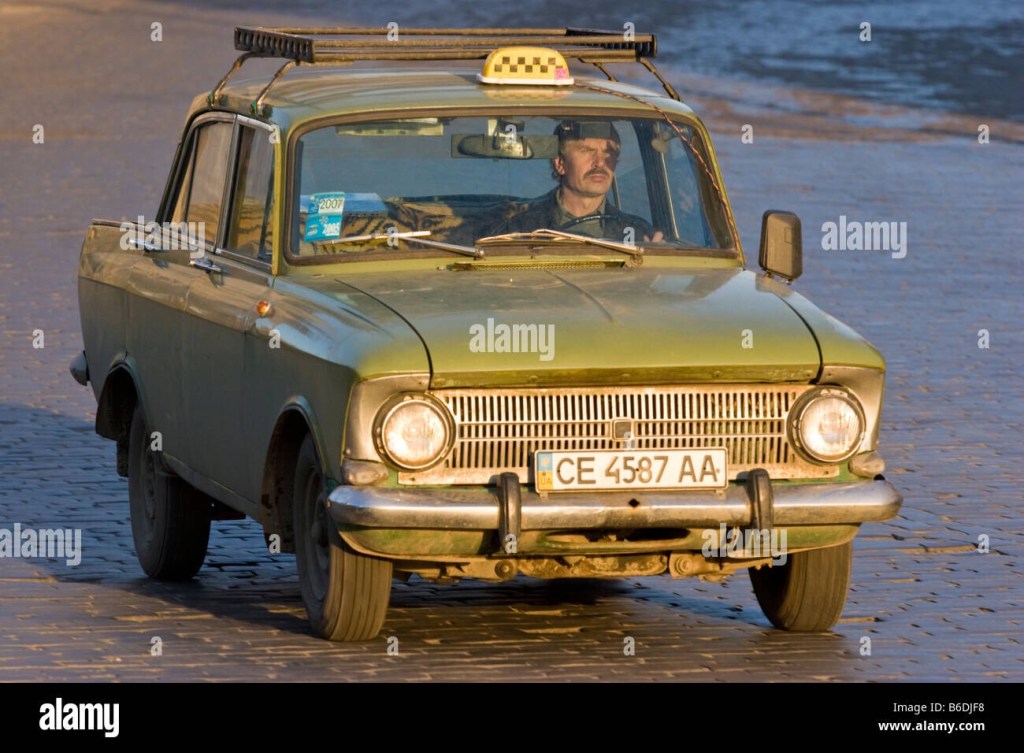
It Wasn’t Uber . . . But It Got Us To the Embassy

Just then, a legitimate taxi arrived and took us — for far less than the ruble equivalent of fifty dollars — to the Embassy, where the line of locals hoping to obtain visas to visit the U.S. was a good half block long. But as U.S. citizens, we went to a different entrance. After passing inspection by the Marine guards, we met with our friend’s husband, left copies of the front pages of our passports and our itinerary, and managed to grab another taxi back to the hotel in time for lunch and the afternoon tour. Tamara was clearly relieved to see us, and I could only imagine what flack she must have caught for letting us out of her sight for the entire morning. And frankly, that thought made my day. She was already not my favorite person, and we offered no explanation or insight into where we had been or what we had been doing for the past four hours, which of course she was dying to know in order to report back to her bosses.

After a few more fascinating but thankfully less eventful days in Moscow — which included the usual tours of the Kremlin and Red Square, an evening at the ballet in the Kremlin Theatre, and dinners in neighborhood restaurants with wonderful food and folk musicians — it was onto an Aeroflot plane (a bone-chilling experience in itself) and off to the Soviet Socialist Republic — today the sovereign nation — of Georgia and its historic capital, Tbilisi. (The “T” is silent. I don’t know why.)

*. *. *

This was a whole different world. The climate was milder, the older architecture vaguely Middle Eastern, and the people quite handsome and freer in their attitudes and lifestyles. A lot freer. Our hotel was in the center of town on a street called the Shata Rustaveli, very conveniently located within walking distance of shops, restaurants, and a Metro station. Our tours included a visit to a centuries-old monastery; a performance by a troupe of fearsome male Georgian dancers whose kneecaps surely were destined to be shattered by age 30; and a terrifying bus trip into the wildly beautiful Caucasus Mountains, to the ancient capital of Mtsxeta. (That is not a misspelling; don’t even try pronouncing it.) The ride was terrifying because of the condition of the steep, narrow, winding mountain road, and the glee with which the driver alternately hugged the edge of the cliff and took aim directly at every pothole, in a bus obviously lacking any sort of shock absorber, not to mention seat belts. But we concentrated on the magnificent scenery, and — not for the first or last time — survived the seemingly unsurvivable.

Mtsxeta, Georgia

We also had some free time in Tbilisi, during which Gisela and I, along with some other of our new American friends, took in a few local sights on our own, including a Metro ride to a vast outdoor market. The foods were fresh and wonderful, though the sight of newly-slaughtered piglets hanging unrefrigerated in the hot August midday was a bit disconcerting. And I drew quite a crowd of local ladies when I took a small pack of Kleenex from my purse and extracted one to blow my nose. I didn’t know how to explain in Russian what they were, so I said something like “papers for the nose, then you throw them away,” accompanied by some very exaggerated gestures. They were awestruck, and I finally gave the pack to the nearest woman, who thanked me as though she’d just hit the lottery.

That evening, we were treated to a delicious dinner in a Georgian restaurant where Tamara read the limited menu to us and took our orders. She then invited Gisela and me (obviously teacher’s pets, despite the fact that the affection was not mutual) to join her in a back room with the mafioso-looking owner of the establishment, where she placed the order for all our dinners and haggled over the cost, which was then tallied by the owner on a centuries-old abacus. In 1988, Georgia was still stuck way, way, wa-y-y-y back in the past. Sort of a Caucasian Brigadoon. Frankly, that was a large part of its charm.

After dinner, we returned to the hotel, and Gisela and I took a stroll down the street, stopping at a small sweetshop for some ice cream to top off our decadently caloric dinner. On the way back, we passed an alleyway where we saw a neon sign about halfway down, written in both Georgian (totally unintelligible) and Russian. I was trying to read the sign without actually entering the alley, when a man came up behind us and gestured toward it, clearly suggesting that we might want to accompany him there. Oh, goody — a date for the evening. Do you suppose he has a friend?

But seriously, the internal alarm bells were clanging again. Having read about the human trafficking problems in that part of the world, both Gisela and I started backing away, saying in unison, “Nyet! Nyet! Thanks anyway,” and hightailed it up the street to our hotel, where we joined the groups of people enjoying the summer evening in the plaza out front. For some reason, we hadn’t quite been able to see ourselves as some Caucasus warlord’s arm candy. Go figure.

Then things really got lively. A car that had been passing rather quickly on the street suddenly hit the curb, blew a tire, and came careening toward the fountain in the plaza, where we and a whole lot of other people were standing. It hit the fountain’s concrete surround and came to a stop, mercifully without running anyone down. A young woman in the front passenger seat jumped out with a package in one hand, ran back to the street, and hopped into a second vehicle that was stopped there and appeared to have been following the first car.

How do you say “busted” in Georgian?

In the meantime, the driver of the damaged car was still behind the wheel, trying unsuccessfully to disengage his vehicle from the fountain, when several uniformed police officers appeared out of nowhere like a bunch of Keystone Kops and surrounded his car. But these guys were no silent movie comedians; they were on a serious mission. One of the officers had a German shepherd on a leash, who began sniffing the vehicle and apparently gave the signal to the officer that something was amiss. While they were searching the car, obviously for drugs, the young woman had returned to the scene of the crime — without the package — and was trying to blend into the crowd, nonchalantly pretending that she had just arrived. But a good citizen — or snitch, depending on your point of view — pointed her out to the police, and she too was taken into custody. When I looked toward the street again, the second car was gone, leaving the young woman and her companion to face the consequences.

The whole thing probably took no more than ten minutes. The damaged car was hauled off, the police disappeared back into their dark corners, and the spectators returned to enjoying the night air. It may as well have been a scene from a play; it was obviously not considered newsworthy as far as the locals were concerned. Life went on as usual.

*. *. *

Of course, we also had with us for the entire two-week journey an American tour guide: a young woman named Lisa, who was blonde and blue-eyed, quite pretty, and not too bright, and seemed content to remain in the background and allow Tamara to run things. The day after the drug bust, she tried to convince me to accompany her, at the invitation of a Georgian man she had just met in the hotel lobby, to a Thursday night service at the local synagogue.

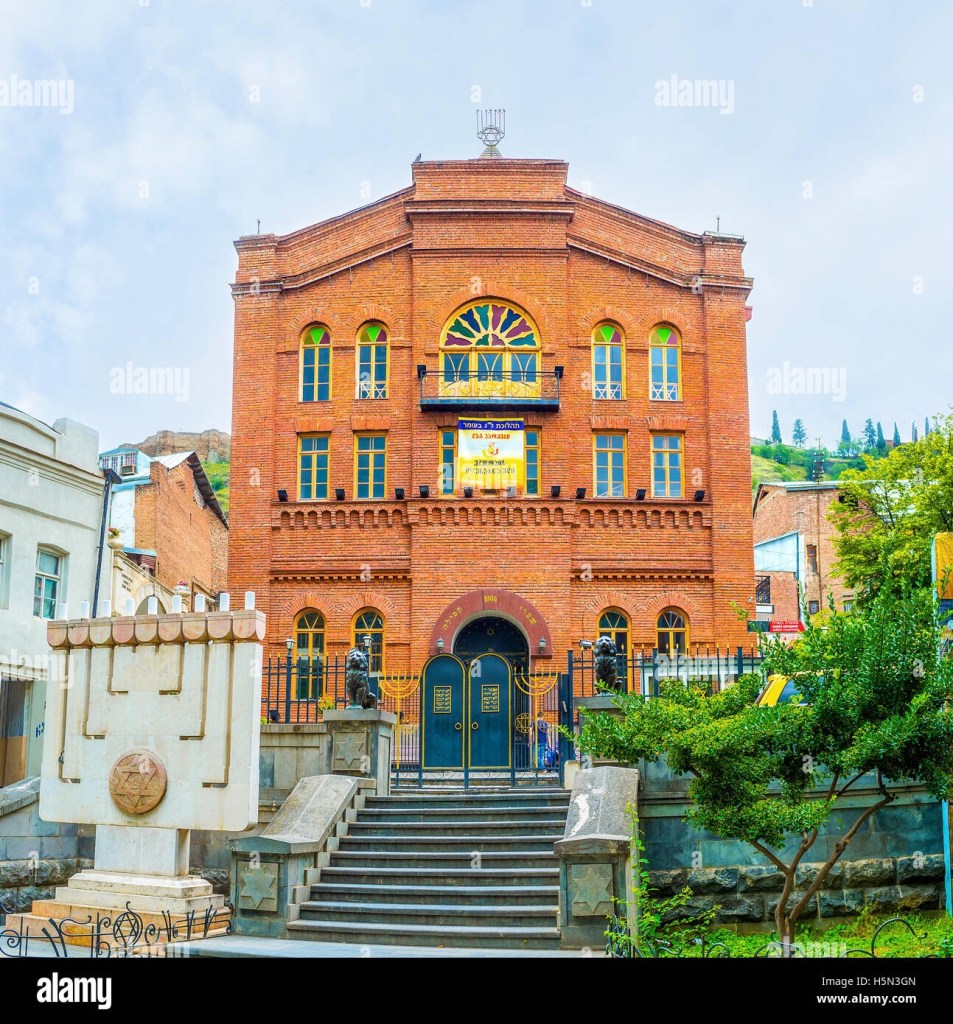
Tbilisi, Georgia Synagogue

Now, please tell me what is wrong with this picture: A strange man, in a strange and dangerous land, who somehow knew she was Jewish, inviting her to a service in a synagogue on a Thursday night?!! I explained the facts of life to her, emphasizing the parts about the trafficking of fair-haired foreign women in Georgia, and how no synagogue anywhere in the world holds services on other than Friday nights and Saturdays, and told her that if she even thought about going, I would tie her to her bed until it was time to leave the city. I must have been really convincing, because she believed me. That girl seriously needed to rethink her career choice.

Anyway, that was Tbilisi, my kind of town: never a dull moment. But all good things must end, and soon we were on our way, courtesy of Aeroflot again, to our next stop.

*. *. *.

Once again, I’ve gone on longer than intended. I’ll finish our tour of the Soviet Union next week, first in Sochi, a semi-tropical paradise on the shores of the Black Sea, followed by much more European Leningrad on the Baltic in the waning days of the White Nights.

TTFN,
Brendochka
1/12/23 (re-posted 11/18/23)

11/16/23: Russia’s 6th Air Force Army commander found dead under suspicious circumstances

Apropos of today’s earlier post: We may never have the answer to this one, but add it to the growing list of “suspicious” deaths. They’re dropping like flies over there.

*. *. *

“Lieutenant General Vladimir Sviridov, former commander of the 6th Air Force and Air Defense Forces Army of the Russian Federation, has been found dead in his home in the Stavropol Krai. Source: Latvia-based Russian media outlet Meduza, citing Baza Telegram channel; Kremlin-aligned news agency RIA Novosti and Kommersant media Details: A source of RIA Novosti says that the body of a woman was found next to Sviridov, her identity is being determined.”
— Read on news.yahoo.com/russias-6th-air-force-army-130553067.html

11/16/23: Bringing Back Stalin

I cannot imagine a more horrifying headline. But that is what’s happening today in Russia: Josef Stalin is back.

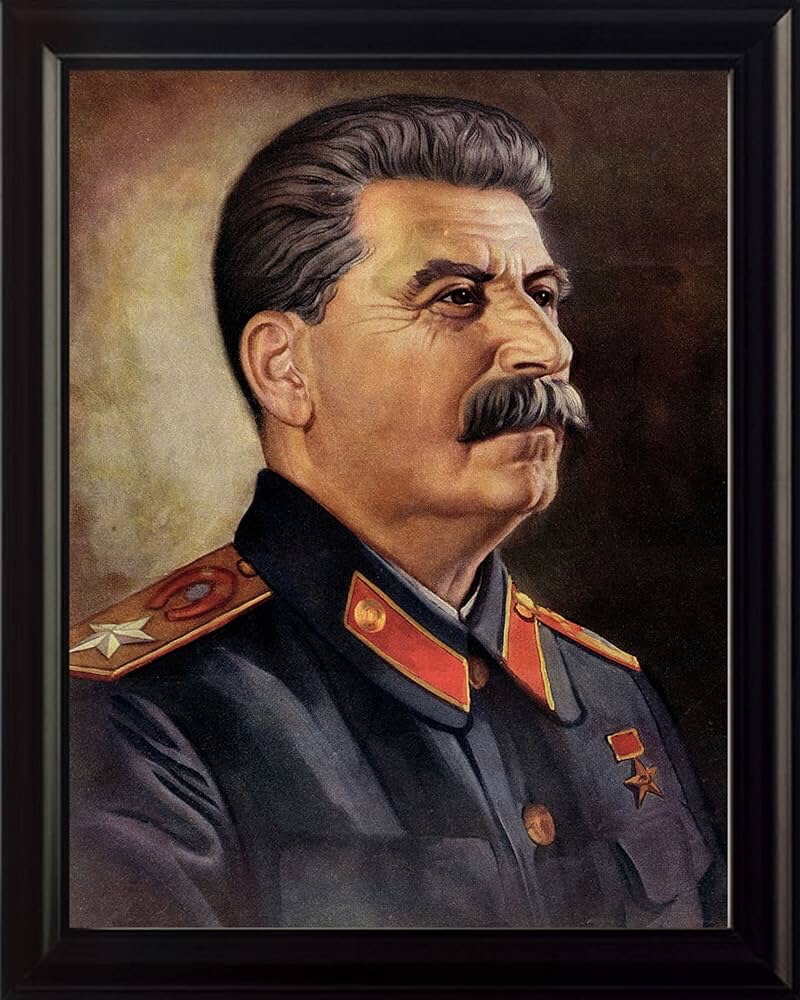
Iosif Vissarionovich Djugashvili (a.k.a. Josef Stalin)

Stalin. “Man of Steel.” The chosen name of the tough little Georgian with the shrunken arm who would come to terrorize, not only his own vast country, but the rest of the world as well, for some 29 years. A tyrant, a sadist, a mass murderer, whose own death in 1953 was a relief to the entire world.

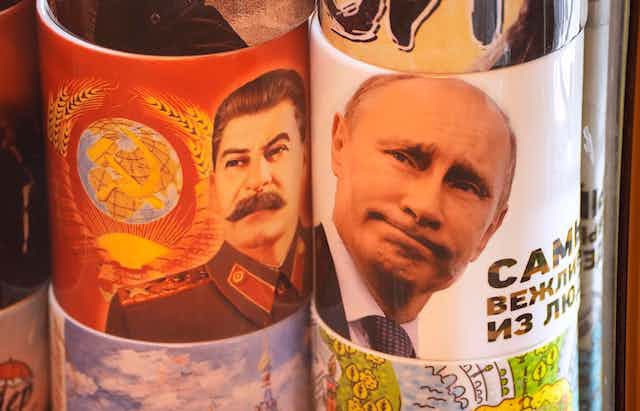
Yet he is still revered by many in Russia as the man who saw them through a world war, fought off the Nazi onslaught, and maintained order and prosperity in their beloved, beleaguered, bedraggled motherland. And, though dead these 70 long years, he is staging a comeback — but not without help, of course. (He is, after all, dead.) Rather, his comeback is taking place with a gigantic push from a man born just months before Stalin’s demise: Vladimir Putin, who — had he been born six months later — might well have been assumed to be the reincarnation of the little Georgian.

Two men, from different locations but similarly poor backgrounds; both small in stature (Stalin a bit larger), but both with gigantic egos born of deeply ingrained inferiority complexes; both fighters, determined to prove to the world that they were more than just what showed on the outside. And on the inside . . . each the personification of evil.

And now, the one currently in charge — Putin — is not only emulating his long-gone hero; he is actually succeeding in restoring Russia’s nostalgia for the “good old days” of order, security, and . . . what? Let’s see now . . . oh, yes . . . fear. Fear of everything. Of saying the wrong thing. Of someone reporting you for saying the wrong thing. Of that banging on the door in the middle of the night. Of the mock trial, the inevitable conviction, and the endless train ride to the endless term in the GULAG.

[Note: GULAG is an acronym for Main Administration of Prison Camps: Glavnoye Upravleniye Lagerei.]

It’s all coming back now, except (so far) the GULAGs. For now they’re just using regular prisons. But consider this:

— Alexei Navalny and Vladimir Kara-Murza, guilty of nothing more than speaking out against the current regime, a right held dear in the free world, but no longer permitted in Russia . . . rotting in prison on false charges of corruption and parole violation (Navalny) and spreading “false information” about the Russian military (Kara-Murza).

— Boris Nemtsov, Aleksandr Litvinenko, Anna Politkovskaya, and numerous others . . . dead, for the same or similar reasons.

— Countless business, industrial, and government leaders suddenly falling out of windows or suffering “heart attacks”. . . dead, for the same or similar reasons.

— Yevgeny Prigozhin, founder and head of the Wagner Group of mercenaries and close friend and confidant of Putin, along with several high-ranking members of the Wagner Group, suddenly falling out of the sky in an airplane . . . obviously dead, for protesting the military’s handling of the war in Ukraine.

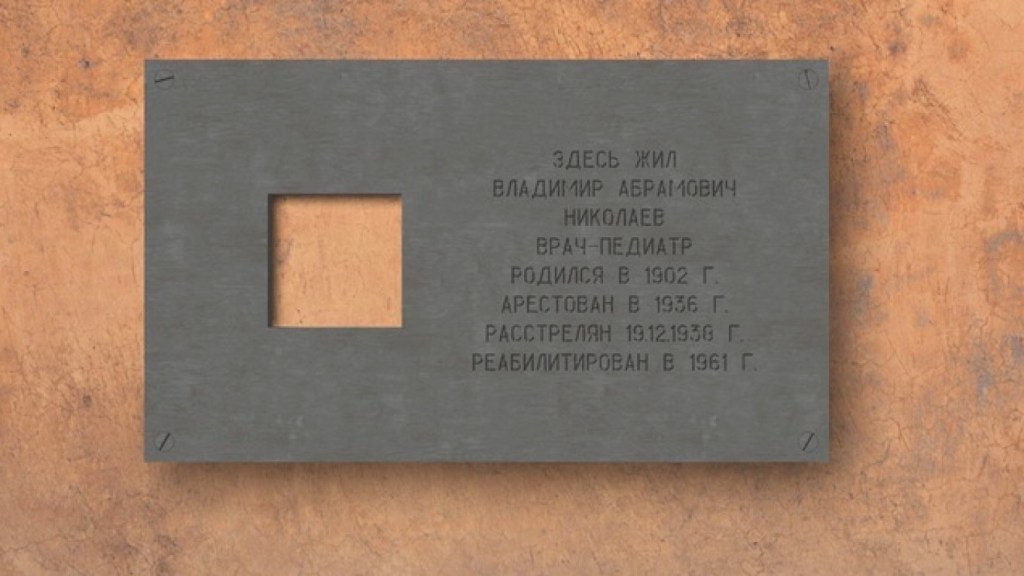
And then there’s this. Over the past decade, memorial plaques — about 700 or more — have been put up in Russia and elsewhere to commemorate the final residences of the victims of Stalin’s purges in the 1930s. But according to the plaque project known as Posledniy Adres (“last address”), dozens of the plaques have disappeared throughout Russia. And the disappearances are not being investigated by police, despite the growing numbers. Oksana Matievskaya of Posledniy Adres has said: “The memory of the Soviet terror challenges the concept of the state always being right and is, therefore, inconvenient for the Russian authorities. Especially following the invasion of Ukraine.” [As reported by Sandro Gvindadze, BBC Monitoring, Nov. 13, 2023.] In other words, criticizing the former Soviet state is now as verboten as criticizing Vladimir Putin and the current regime.

Memorial Plaque to Vladimir Nikolaev, Doctor of Pediatrics,
Executed Dec. 19, 1938

In addition, no fewer than 18 monuments to victims of repression, as well as foreign soldiers who fought in World War II — most of them Polish nationals — have been reported stolen or vandalized just in the past year and a half. Recently, in the city of Vladimir, a brick memorial to a prominent Polish priest was torn down and destroyed. And a concrete cross in the Komi Republic, memorializing Polish prisoners, was demolished; police blamed “bad weather” for that one, and refused to undertake criminal proceedings.

Hundreds of thousands of those Poles were executed, and nearly two million deported to GULAG camps in Siberia and Kazakhstan, after 1939. The noted civil rights group Memorial “believes the damage [to the monuments] was ordered or carried out by authorities because Moscow wants the Soviet Union to be perceived as a powerhouse rather than an oppressive state. The authorities try to erase the memory of the crimes of that empire to cover up or justify the crimes of this one.” [Alexandra Polivanova, Memorial, as reported by BBC Monitoring, Nov. 13, 2023.]

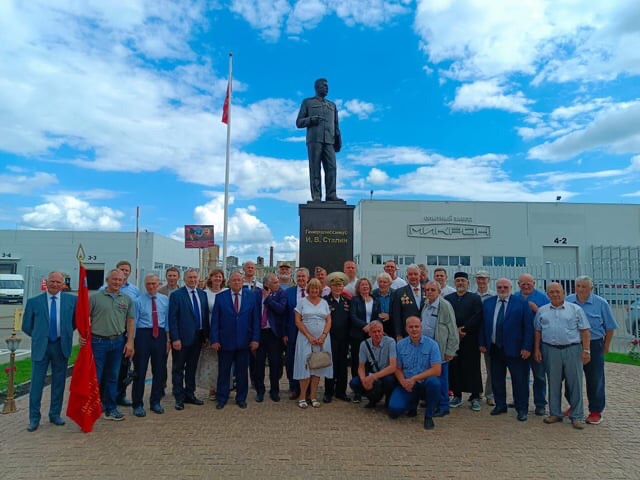
Recent polling has suggested that 63% of Russians now have a “favourable attitude” toward Stalin. And there are 110 Stalin statues still standing — 95 erected during Vladimir Putin’s rule, at least four of them since the invasion of Ukraine. One such, in the town of Velikiye Luki, is cast in bronze and stands eight meters (just over 26 feet) high. Go big or go home, I guess. And to cap off the occasion of the dedication, a Russian Orthodox priest scattered holy water over the base of the monument, intoning “Christ is risen!” — as the dozens of onlookers responded, in accordance with orthodox tradition, “Risen, indeed.”

Christ? I thought it was Stalin!

Dedication of Stalin Statue at Velikiye Luki – Aug. 2023

*. *. *

So what is behind this sudden “rehabilitation” of one of the world’s foremost monsters? Why, Vladimir Putin, of course. None of this would have been allowed if he hadn’t been behind it, or at least in favor of it. He needs the example of the strength and power of the Soviet state, even as far back as the 1930s, to legitimize his own similar actions today . . . particularly, of course, his invasion of Ukraine. He has stated that, to him, the greatest tragedy of the 20th Century was the collapse of the Soviet Union. And he has set about rectifying that “tragedy,” not merely by instituting and enforcing new and ever more repressive laws, but now also engaging in the same sort of mind-control tactics so familiar to those of us who remember the days of Josef Stalin and Adolf Hitler.

And, not content with controlling his own country, he seeks to bring back into the fold former republics of the Soviet Union, beginning with Belarus (with the all-too-willing consent of its leader, Aleksandr Lukashenko), and Ukraine (by brute force — a war of attrition that he ingenuously calls a “special military operation”). And who knows who’s next?

Are we to sit by and watch this happen again, once more ignoring the signs as the world did until Hitler and Stalin marched into Poland in 1939? Or until Japan bombed the hell out of Pearl Harbor in 1941? Have we forgotten that little disturbance known as World War II?

Pearl Harbor, Hawaii, USA – Dec. 7, 1941

Please tell me we’re not that stupid.

Just sayin’ . . .

Brendochka
11/16/23

11/14/23: Laverna (a.k.a. Otter #841) Is Safe and Sound . . . and There’s More Good News!

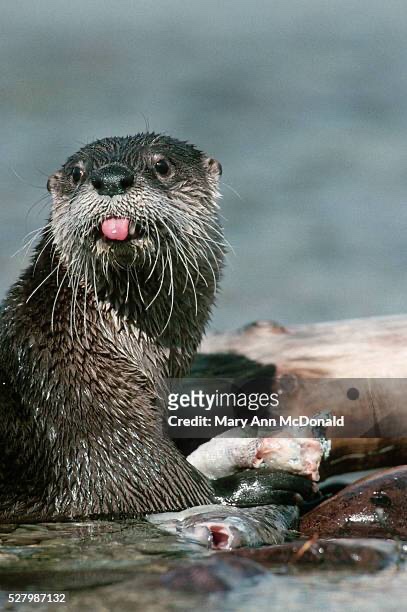
Exciting news! Remember Laverna, the mischievous surfboard-stealing otter from Monterey, California’s coastal area? The one the authorities have been trying to capture and re-home because she’s been annoying the human surfers who have . . . let’s be honest . . . been impinging on what is rightly her home, not theirs? The same one who has been evading them for months now, and who has the following comment for those humans:

“Pffttt!”

There’s been no word of her for a while, and I’ve been worried about her. Well, at last there’s been news . . . and great news at that. Laverna was spotted recently, and with her was her brand-new pup! That’s right — Laverna is a Mom. And the so-called experts who thought she was just an incorrigible little thief now admit that her behavior was simply the natural instinct of an expectant mammalian mama protecting her baby’s habitat. In other words, she was hormonal.

Now, we women have fought tirelessly against those males who persist in blaming everything we say or do on our hormonal “problems.” But in this case, it turns out to be true . . . and the result for Laverna and her little one couldn’t be more favorable: they will not be re-homed, and will be able to live peacefully in Monterey Bay for as long as they like. Justice has prevailed.

Now I look forward to details about the little pup. Male or female? Does it have a name yet, other than just a number? Any readers have suggestions? I’m thinking about “Justice” (it’s shorter than “Retribution”). I’d love to hear your ideas.

It’s a happy day at Blog HQ . . . “Justice” has indeed been served.

Just sayin’ . . .

Brendochka
11/14/23

Ch. 3 – Welcome to Moscow, Mrs. Gorbachev (Re-posted 11/14/23)

For those of you who may have missed them — and to keep you from forgetting me — I’ve decided to re-post some of my earlier episodes, particularly those involving my overseas adventures. So here for your reading pleasure (I hope) is my first trip — as a not-so-average American tourist — to Russia. Enjoy.

In 1984, I enrolled in an evening course at the local community college. My children were grown, and I found myself luxuriating in some quiet time in the evenings and on weekends. Watching what passed for TV entertainment was not an exciting option, and I’m simply not an artsy-craftsy person (no talent); so I decided on the next most logical thing to fill my free time: the study of a second language. Why not?

Pick A Language . . . Any Language

Actually, at the time, I was envious of some of my co-workers who were bilingual or multilingual. When I thought about studying a foreign tongue, I recalled high school French class, where I had learned the grammar and vocabulary but exhibited what any self-respecting Parisian would consider a truly insulting accent. So that’s when I came up with the obvious next choice: Russian. “Why obvious?” you ask? Well, it was a genetic thing. All four of my grandparents had emigrated in the early 1900s from what is now Ukraine but was then part of the greater Russian Empire, and their entry documents to the United States listed their nationalities as Russian. So I have always identified as a second-generation American of Russian descent, until recently; now I proudly introduce myself as a second-generation American of Ukrainian descent, for obvious reasons. But something about Russia stays with me: her history, her culture . . . even her interminable misery.

Our class, which met twice a week, started out with about 27 students. By the end of the first semester, we were down to a close-knit, hardcore group of 12 survivors. Some called us masochists, but we didn’t agree. Together with our amazing teacher — a delightful lady from Moscow named Ekaterina, who was now a citizen of the U.S. — we had a wonderful time exploring the intricacies of an impossible language, and delving into Russian history, literature, and politics on the side. One day, when Ekaterina learned of my Russian/Ukrainian ancestry, she shook a finger at me and exclaimed, “Aha! It’s in your blood” — thereby consigning me to a lifetime obsession with all things Slavic.

Still Rolling . . .

After three years, one of my classmate friends, a German woman named Gisela, and I decided it was time to get a first-hand look at the mysterious place we had been studying for so long. In 1987, we began planning and putting aside money for our trip, and in August of 1988, we were off. Which is just what our families and friends thought we were when we told them where we had chosen to take our big (and my first) overseas vacation. We didn’t care. We signed up with a tour leaving in mid-August, packed some clothes, walking shoes, and every over-the-counter medication we could think of, and headed into the unknown.

But first . . .

Oh, yes, first there was my boss Walter Surrey’s reaction. When I told him of my plans, his initial thought was, “Well, what am I going to do for two weeks?” Then, sensing a business opportunity, he remembered Viktor Akimov. And he also remembered a client who had been trying to sell his company’s product, an electric men’s shaver, in various parts of the world including Russia. And here was I, the perfect middleman. So, contrary to Russian law restricting foreigners’ business activities under tourist visas, two electric shavers also went into my luggage as “gifts” for Walter’s old friend Viktor.

We sent a telex — high-tech in those times — to Viktor, advising him of my impending arrival and itinerary. We did not hear back from him before my departure date, but I had his phone number with me, and instructions to ditch the shavers before coming home if I was unable to find him.

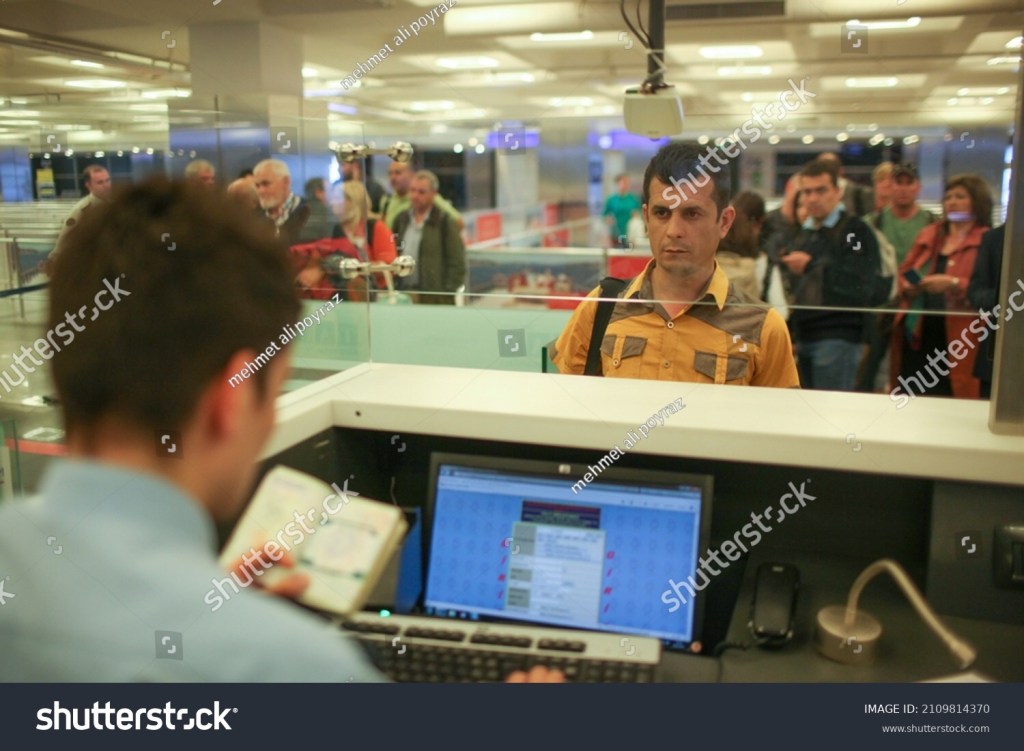
After an exhausting trip from DC to New York and overnight from New York to Moscow (an eight-hour time difference), we arrived at Sheremetyevo Airport looking like a bunch of . . . well . . . just what we were: bedraggled American tourists. We were greeted by Tamara, our official Intourist guide (one of a slew of government-controlled organizations directly answerable to the KGB), claimed our luggage, and headed for Passport Control. There were two lines open, and I was steered to one that was manned by a tall, blond, handsome young man with an appropriately stern facial expression. I put my passport, open to the front page, in the little tray at the base of the bullet-proof glass window. He picked it up, checked the visa, looked at the picture, looked at me, looked at the picture, looked at me, looked at . . . oh, well, you get the idea. Then he asked, in his best, heavily-accented English, “This your photo?” At the time, I was a 40-something, reasonably decent-looking redhead, not easily disguised, so yes, it was obviously my photo. I replied, in my best, American-accented Russian, “Yes, that is I.” Ekaterina was a stickler for grammar.

Tall-blond-and-handsome began again: looked at the passport, looked at me, looked at the passport, etc., and finally asked: “You sure this your photo?”

Enough, already. The impatient, impetuous, and somewhat impish American in me burst forth, and I smiled, this time answering in English: “Well, it’s not Raisa Gorbachev.”

Oh, my God! This was the hockey puck fiasco all over again (see last week’s episode), but worse — I was now on their turf. I began to wonder what the inside of a Russian prison looked like and what the usual sentence was for being an American smart-ass.

But miraculously, “Sourpuss” broke rank and actually smiled. Barely managing to stifle an audible laugh, he stamped my passport and waved me through, and I knew I had made his day. Welcome to Moscow, Mrs. Gorbachev — or whoever you are.

Cosmos Hotel, Moscow

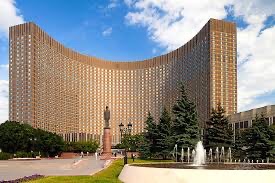
After a long and thorough clearance procedure through Customs, we were finally in a bus on our way to the impressively large Cosmos Hotel, nowhere near the center of Moscow but still within the city limits. The outside was fairly nice; the interior, not so much. Face it: it was shabby, without the chic. Our luggage made it off the bus and into the lobby, and when everyone else had claimed their two bags, there remained . . . nothing. An empty cart. My bags were nowhere to be seen.

“TAMARA!!!”

Poor Tamara. Missing luggage was the last thing she needed to deal with. Muttering a very Russian “Oy,” she set to work earning her pay. She consulted someone at the front desk, who shrugged and said something unintelligible while waving a hand in the direction of a staircase. Tamara told me that I had to go — by myself, since she couldn’t leave the rest of the group — downstairs to “Lost and Found.” In the basement. Of an enormous Russian hotel. In Moscow. Alone. Even Gisela wasn’t allowed to come with me.

With our exhausted and puzzled group waiting anxiously in the lobby, I steered my shaky legs down the steps to a large, dimly-lighted, unfurnished and unoccupied room. I called out — “Hello?” — and waited. After a few seconds, I called out again, louder. Hello?!! Finally, a man emerged from behind a closed door, and I told him I was looking for my two suitcases. Showing him my baggage claim check, and carefully spelling my name, I waited while he went back through the same doorway. About 12 hours later — all right, it was just a couple of minutes, but it felt . . . you know — he returned, miraculously with my actual bags, which seemed no worse for the wear. I resisted hugging him, but did say thank you about 100 times, and struggled back up the steps, shlepping my bags behind me. My fellow travelers heaved a collective sigh of relief when I returned in one piece, and we all headed for our assigned rooms. But as Tamara handed Gisela’s and my room keys to us, I swear she looked at me strangely. Or was I simply coming down with early symptoms of Soviet paranoia? I didn’t have any pills for that.

Gracious Living at the Cosmos Hotel

By now, we had been in Russia for several hours, between the lengthy airport processing, the bus ride, and the mystery of the disappearing suitcases, and it was nearly time for lunch with our group in the hotel dining room. There was just enough time to take our things to our room. Gisela and I reached our floor and introduced ourselves to the dezhurnaya — the female concierge (a.k.a. watchdog) on every floor — entered our room, set our bags down, began to look around . . . and the phone rang. “What the hell . . . ?”

Well, when a phone rings, you answer it — right? So I did, and a man whose voice I didn’t recognize asked for me by name. He introduced himself as Georgi Karpov (not his real name), a colleague of Viktor Akimov, who he said was on holiday and had asked him to get in touch with me as requested in Walter’s telex. All of that made sense, but what was totally spooky was the timing of his call, as though he had known precisely when we reached our room. Maybe it really was coincidence. Or that pesky paranoia.

In any event, we arranged to meet in the hotel’s coffee shop the next morning at 9:00, right after the group’s scheduled 8:00 breakfast. And then I had to tell Tamara that Gisela and I wouldn’t be joining the group on their first tour the following day because I had an early meeting with an official from the Foreign Ministry, after which we had an appointment at the American Embassy. Way to blend into the crowd, Brenda. Predictably, Tamara was less than amused, but had no recourse. I knew that she was, however, required to report any anomalies to her superiors, who in turn reported directly to the scary folks at KGB headquarters. First day, and I’m already on their radar. Oh boy!

After a quick lunch in the hotel dining room, we were herded back onto our bus for a driving tour of some of the city’s highlights — no stops, but views of the outside of the Kremlin, the entrance to Red Square, the front of the Bolshoi Theatre, and the like. The real tours were to start the next day. Then dinner in a rather nice restaurant, back to the hotel, and up to bed. As we unpacked our bags, Gisela and I staged the first of what were to become our nightly chats for the benefit of the hidden microphones in the room; found that the shower actually dispensed hot water; and slept rather soundly, all things considered. So far, so good.

Bolshoi Theatre, Moscow

* *. *

This tale is getting a bit long for a single post, so I will leave you here until next time, when I will expand on Mr. Karpov and his attempted provocation; the “gypsy” (unregistered) cab driver and his attempted provocation; a near-kidnapping (us) and an actual drug bust (not us) in Tbilisi, Georgia; and perhaps a few other improbable but absolutely true tales from the pages of my journals. See you then.

Brendochka
1/5/23 (Reposted 11/14/23)

11/13/23: Yeah, yeah . . . I’m Back Already.

Can’t help it . . . reading (and commenting on) the news is a hard habit to break, and I didn’t say I was going cold turkey.

This is just a quick pat on the back to one of my favorite people in the whole world: Ukrainian President Volodymyr Zelensky, who was heard on Friday to tell Russia, in effect:

“You cut our power, we kneecap your biggest economic driver [oil and gas infrastructure].” [Ben Lefebvre, Politico, Nov. 10, 2023.]

“Ta-da!”

Go, Volodya! No bullies in your schoolyard.

*. *. *

My apologies . . . I know that’s no way to address a President, but you are my hero, sir.

Just sayin’ . . .

Brendochka
11/13/23

11/11/23: Wrapping It Up

All good things must come to an end. How many times during our lives do we hear that? Unfortunately, it’s true. And today marks another end: the end of my daily blog. It is with a heavy heart that I tell you — my very few readers — that I am giving it a rest . . . at least partially.

No, it is not due to illness. But it seems that publishing every day may have been overdoing it. Even reading Shakespeare — okay, especially reading Shakespeare! — can get tiresome after awhile, and I regret to say that my readership has dropped off to almost nothing on many days.

I’ve kept going for the sheer pleasure of writing — I really love doing it. But these little presentations take time and effort. Before my fingers ever touch the keyboard, there’s reading (mostly of the daily news), background research, thought, analysis . . . and only then, searching for my own words. It’s a joyous process, and I shall miss it, and I suspect that I shall direct it elsewhere before long.

But writing for oneself is a lonely undertaking. Maybe I’ve chosen the wrong subject matters; or perhaps a blog just isn’t the right venue. Anyway, it’s time to cut back. But . . .

Yes, there is always a “but.” But I will probably be popping up once or twice a week, as inspiration strikes. And all those old blog posts are still there for the reading. So it’s not goodbye . . . just “see ya.”

. . . for now.

Much love,
Brendochka
11/11/23