On August 23, 1939, German Chancellor Adolph Hitler hastily dispatched his foreign minister, Joachim von Ribbentrop, to Moscow to meet with his Soviet counterpart, Vyacheslav Molotov, bearing written authorization to sign into effect a ten-year non-aggression pact stating, among other things, that the two countries would “desist from any act of violence, any aggressive action and any attack on each other, either individually or jointly with other powers,” for the next ten years. [“This Day in History,” History.com, August 23, 2026.]
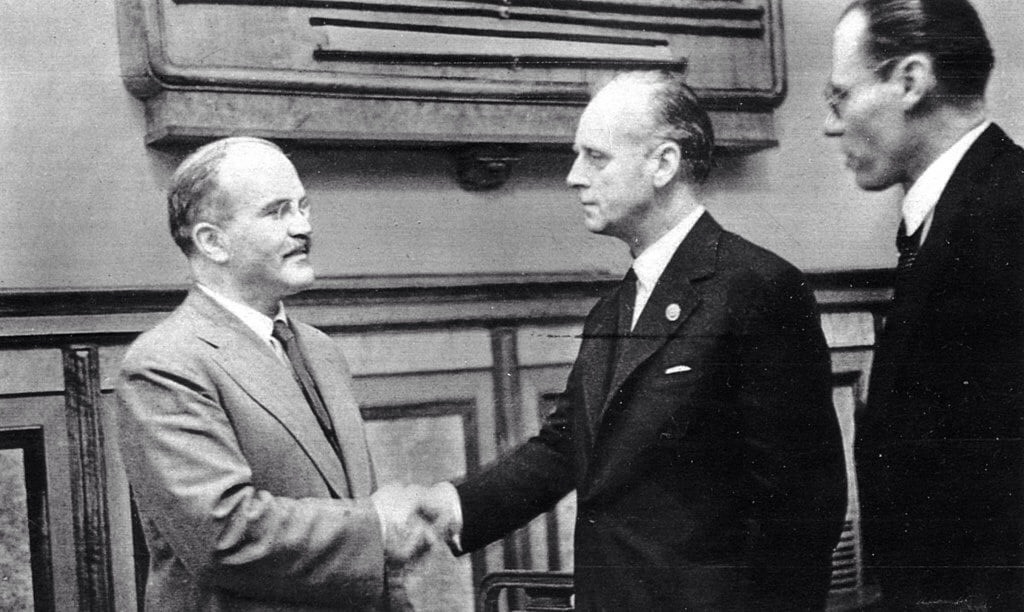
Hitler had urgently pressed Stalin to put aside their years of political hostility in order to enable his planned invasion of Poland without the threat of Soviet interference. Stalin, on his part, found the peace deal attractive because his country was already engaged in battle on its eastern front with Japan, and was fighting that conflict with an army depleted of commanders as a result of Stalin’s own purges of 1937-38.
So the treaty was signed, with Stalin personally assuring Ribbentrop that “The Soviet Government take the new pact very seriously,” and that he could guarantee on his “word of honor that the Soviet Union would not betray its partner.” [Id.]
The Supreme Soviet unanimously ratified the pact on August 31st; and just hours later, Hitler realized his dream when his armies attacked Poland, marking the start of World War II.
When Ribbentrop phoned Hitler at his Bavarian mountain retreat following the signing, Hitler’s delighted response was: “That will hit like a bombshell.” [Christopher Klein, “European History,” August 22, 2014.]
British Prime Minister Winston Churchill agreed, but from a different standpoint. He later wrote about that day that: “The sinister news broke upon the world like an explosion.” [Id.]
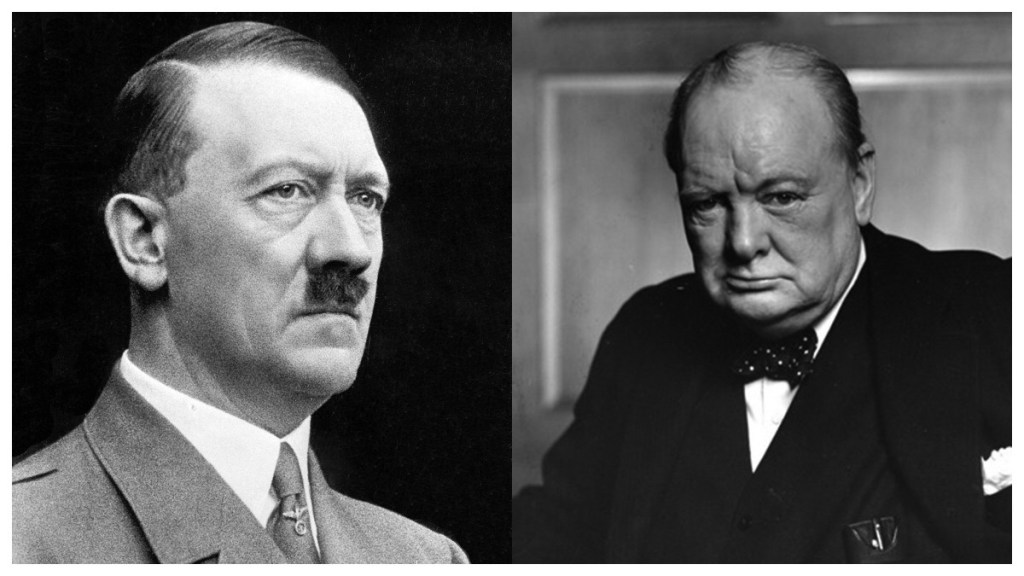
But ten years is a long time in a world where things change quickly, and often without notice. On June 22, 1941 — less than two years after the signing of the Molotov-Ribbentrop Pact — Hitler unilaterally broke the agreement by launching Operation Barbarossa: three parallel offensives, consisting of 19 panzer divisions, 3,000 tanks, 2,500 aircraft, and 7,000 artillery pieces, across a 1,000-mile border into the Soviet Union.
Pact? What pact?
Each man — the fascist Hitler and the communist Stalin — knew that the other could not be trusted. Yet they entered into an agreement on the basis of the need of the day, choosing immediate expediency over long-term probability.
That agreement wasn’t worth the price of the paper it was written on — nor is any agreement backed by the word of a tyrannical, autocratic, self-serving, greedy, egomaniacal, power-mad, amoral, malignant narcissist.
That never changes.

Just sayin’ . . .
Brendochka
8/23/26

