A spelling bee, that is, and specifically the annual Scripps National Spelling Bee that was concluded last week when 14-year-old Shrey Parikh correctly tackled words like . . .
“Cywyddau” . . . “Taurokathapsia” . . . “Natchitoches” . . . and finally, “Bromocriptine.”
(I capitalized all of them to be on the safe side, because I have no idea what any of them mean or whether they may be proper nouns.)
And that is precisely my point.

Who the hell does know, or care? Honestly . . . when will anyone other than, say, a devotee of the works of the late Welsh poet Dylan Thomas, ever have any use for a word like “cywyddau” (plural of “cywydd”), which (I looked it up) refers to “a highly structured traditional Welsh verse form . . . best known for being written in 7-syllable rhyming couplets that use cynghanedd — an intricate system of internal rhyme, alliteration, and consonant matching.” [Definition from Wikipedia AI Overview.]
See what I mean? Even Dylan Thomas himself probably didn’t know or care about cywyddau; he was too busy pleading with his father to “not go gentle into that good night” to be concerned with seven-syllable rhyming couplets or intricate systems of consonant matching.
I don’t mean to throw cold water on the accomplishments of young Shrey and the other spelling champs. They’re obviously bright kids, committed to learning and doing more with their lives than playing video games 24/7. They are to be admired and congratulated, as are their parents for encouraging them.
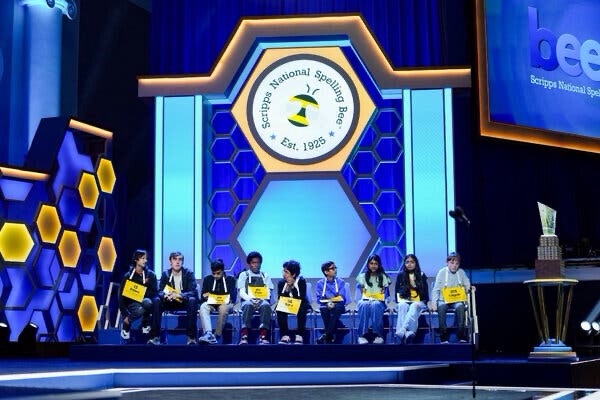
But what has happened to the Scripps National Spelling Bee in the decades since I became my school’s champion speller by correctly spelling “conscientious”? Yes, we were encouraged to study word lists; but they were useful words that added to our expanding vocabularies, with a few obscure ones thrown in for fun. And at the same time, we were being taught in our regular daily classes to sound out words, learn their definitions, and discern the most logical spelling. We didn’t simply swallow a volume of Webster’s Unabridged, and then spit it out, one word at a time, on command.

Why are we cluttering these children’s minds with words they are never likely to encounter again in their lifetimes? (And by the way, since this is a U.S. competition, when did they start throwing in bits from other languages that are not a part of the English lexicon?)
I don’t advocate “dumbing down” the contest — just keeping it real. And of course, a certain amount of memorization does factor into a well-rounded education. For example, I can still rattle off my multiplication tables, the names of the major bones of the body, and a few of Shakespeare’s most famous soliloquies. But none of those things ever played a part in my career advancement . . . although nothing livens up a dull party like a recitation of Marc Antony’s oration at Julius Caesar’s funeral.

Seriously, there is so much more for kids to learn these days, in the same number of school years, than when I was their age — more decades of history, and certainly more science and technology. Let’s not overwhelm them with the useless stuff, and maybe we can leave them a little time for . . . what was that old-fashioned word again? . . . oh, right:
F-u-n.

Just sayin’ . . .
Brendochka
6/1/26

