Category Archives: Uncategorized

12/31/24: Even in Ukraine, There’s No Business Like Show Business


To close out what has been, to say the least, a difficult year, I am pleased to bring you a bit of cheer from a most unexpected place: the war zone of Ukraine.

Welcome to the Ivan Franko Drama Theater of Kyiv.


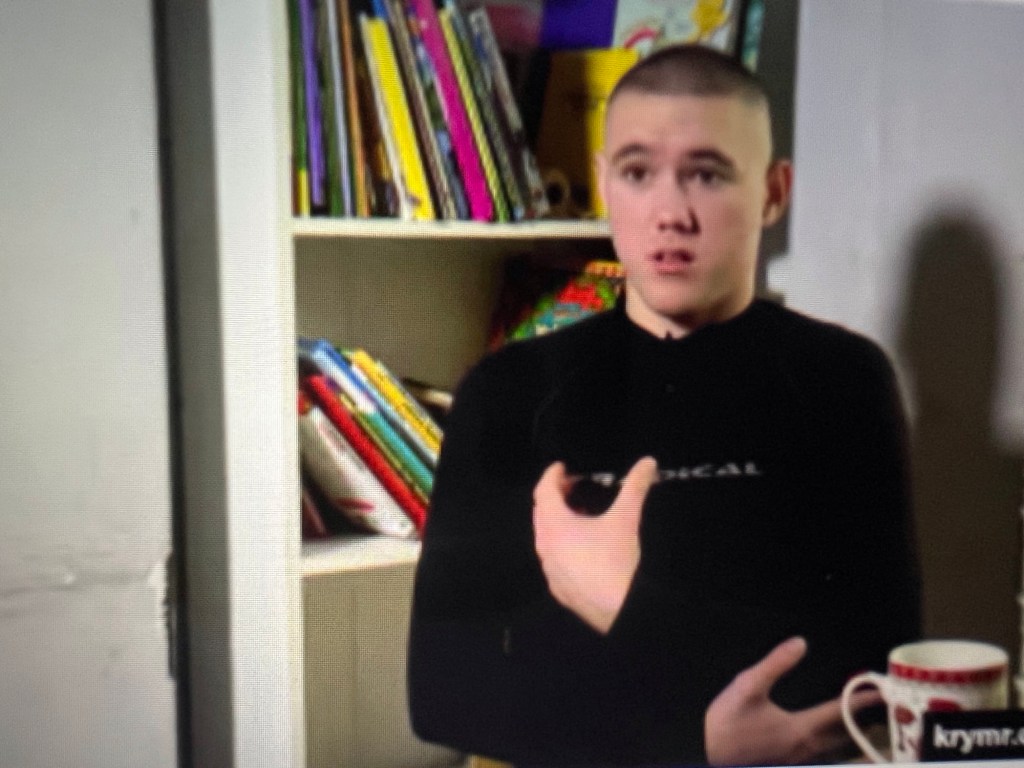
And say hello to its current director, Yevhen Nyshchuk . . . who, after serving a year at the front following the Russian invasion in 2022, was able to return to his career in the theater along with other former actors.

Yevhen Nyshchuk

Since its reopening six months after the start of the war, the Ivan Franko Drama Theater has staged more than 1,500 performances, attended by more than half a million patrons. Most, if not all, of their plays and concerts have sold out in minutes. [Svitlana Vlasova, CNN, December 29, 2024.]

One devoted theatergoer, Olha Mesheryakova, expects to attend at least a dozen performances in the coming year . . . despite not knowing what the coming year will actually bring to the lives of the Ukrainian people. She explains that the theater offers a sense of hope:

“This creates a certain expectation, gives a kind of structure, great support at a time when the world around me has gone crazy, and I know exactly what I’m going to do on December 23, for example, because I bought tickets in the summer. Honestly, it gives me hope and faith in the future. It’s some kind of magic.” [Id.]

And if a performance is interrupted by air raid sirens, as they frequently are . . . well, then the audience and the performers leave the theater and take shelter at the nearest metro station. If all is clear within an hour, the performance resumes; if not, the show continues on another day.

It reminds me of stories I’ve read of the London Blitz during World War II: stories of unimaginable courage and resilience in the face of interminable misery and fear.

Sheltering During the Blitz – London, World War II

*. *. *

And it’s not just the theaters that are going strong. The number of bookstores in Ukraine has actually increased since the start of the war from around 200 to nearly 500 today. The largest, Sens, opened on Kyiv’s main street while the war raged. It is crowded at all times of the day, and says that it had more than half a million customers this year. They also have events planned for months in advance. [Id.]

Sens Bookstore, Kyiv

The store’s founder, Oleksiy Erinchak, explains the rationale behind his opening of a business in the midst of a war:

“[A] book is the most convenient way to spend time during the war when it is impossible to predict anything. Many people have switched to the Ukrainian language [from Russian]. They are trying to understand what it means to be Ukrainian. And books make it much easier to do that.

“Maybe it’s just war, or stress, and a person just hides under the covers, under the bed, opens a book and travels to other worlds to get away from it all. Or not traveling to other worlds, but delving deeper to understand why did this happen in our lifetime? And books actually have many answers, and you can feel them, understand them, and feel better.

“Local culture always flourishes during wartime … If people are bringing money to the Ukrainian bookstore, it means that we need to invest this money further in Ukrainian books, in Ukrainian culture. We need to build this foundation in our book and cultural sphere as strongly as possible and build a semantic shield around it, a dome so that it would be much more difficult for others to break in and influence the minds of Ukrainians.”

Oleksiy Erinchak

*. *. *

And for those who may find the emphasis on culture a bit frivolous or inappropriate during wartime, Yegor Firsov — a chief sergeant who has been fighting in Ukraine’s defense against Russia since 2022 — has an answer, even as he and others are living in what he describes as “real hell”:

“When it comes to women and children, I and my brothers-in-arms, and everyone, supports it. Because people are distracted from stress and in such difficult times they want to experience something genuine, and bookshops and theaters are about the real thing, about life.” [Id.]

On occasional leave from the fighting, Sergeant Firsov sometimes manages to come to Kyiv. And when he does, he also goes to concerts:

“Culture is a part of our lives, it is both about war and partly about leisure, because even we, military men, need mental healing, need to be distracted, to be resilient.” [Id.]

*. *. *

All of this goes a long way toward explaining how the people of Ukraine — while vastly outnumbered and out-armed — have held out against the Russian war machine for nearly three years, without losing faith or certainty in their survival as a free and sovereign nation.

And that nobility of spirit is what Vladimir Putin has not been able to crack . . . and likely never will.

Ukrainian President Volodymyr Zelensky

Just sayin’ . . .

Brendochka
12/31/24

12/30/24: The Russian Empire Is History; The USSR Is the Future


Or so it was said on this date in 1922, five years after the Bolshevik Revolution of 1917, when a confederation of Russia, Belorussia, Ukraine and the Transcaucasian Federation* entered into a treaty officially establishing the Union of Soviet Socialist Republics — or the more easily pronounceable Soviet Union — and rendered the Russian Empire extinct.

[* Later, in 1936, to be divided into the three Soviet Republics of Georgia, Armenia and Azerbaijan.]
Karl Marx, Friedrich Engels, Vladimir Lenin, Josef Stalin

During those five post-revolutionary years, Vladimir Lenin’s Bolshevik Party had fought (and won) a civil war and established a tightly-controlled, socialist form of government, making Russia the first country in the world to be based on Marxist socialism. The country was ruled by the Communist Party and its Politburo; all industry was owned and operated by the state; and all agricultural land was divided into state-run collective farms.

Over the following years, the USSR expanded to include Moldavia (now Moldova), the three Baltic states of Latvia, Lithuania and Estonia, and the five Central Asian republics of Kazakhstan, Uzbekistan, Kyrgyzstan, Tajikistan and Turkmenistan: a total of 15 Soviet Socialist Republics controlled by the government located in Russia.
And the rest, as they say . . .

«Glory to the Great Stalin, Creator of the USSR Constitution»

*. *. *

And just 69 years later, on Christmas day of 1991, it all fell apart, when Boris Yeltsin took the reins of power from Mikhail Gorbachev, and the Soviet “hammer-and-sickle” flag was lowered and the tri-color flag of the Russian Federation raised over the Moscow Kremlin.

What celebrations there were then! What joy! What optimism! What a decade of wild, unbridled galloping toward democracy, capitalism, Western-style freedom was to follow.

What a pipe dream!


Because you can’t tear down one structure and expect another to immediately pop up in its place. You have to have a plan, and the tools and materials for a new structure. And none of those things existed in Yeltsin’s Russia. So what they did have, for eight crazy years, was chaos.

Then along came Vladimir Putin to “fix” things.

And the rest . . . well, you know.

“Big Brother” Putin

Today, after a quarter of a century in power, Putin has indeed “fixed” things. He has stabilized Russia’s economic, industrial, military, agricultural, and social structures . . . if, by “stabilized,” you mean “taken total control of.” Today’s Russia has become a carbon copy of Lenin’s USSR: an expansionist, militaristic, oppressive, closed society with a government ruled by one evil, shifty-eyed, megalomaniacal little tyrant determined to rule the world.

He is, in effect, the 21st Century’s Lenin . . . history repeating itself, but with technology and weaponry never imagined 100 years ago.


The world moves much more quickly now than it did a century ago. What lies ahead for Russia in the next decade — or, for that matter, in the next days — cannot possibly be predicted. We can only hope for something better than what it has today.

Just sayin’ . . .

Brendochka
12/30/24

12/30/24: Sliding Into Home Plate


This has been a long — and, I’m sorry to say, often depressing — year. It feels as though we’ve gone into extra innings, circling the bases a couple of hundred times, struggling to survive wars, natural disasters, terror attacks, collapsing governments, plane crashes, mass shootings, rampant inflation, more wars, and the loss of far too many good people.

Well, that’s more than enough. We’re finally rounding third base and heading for home: the start of a new year in less than two days. We’re supposed to be looking ahead with optimism and good cheer. After all, simply by reason of the fact that we’re still here, sliding into home plate . . . well, haven’t we already won the game?

Bringin’ It Home

Then why all the doom and gloom everywhere? Because it makes news . . . that’s why. These days, if it’s not bad, it’s simply not news. Even my blog has become mostly a commentary on the DOD — “Disaster of the Day” — which means that it too is depressing, by default.

So, as 2024 comes screeching to a halt, I shall — contrary to my earlier promise to myself — make a single New Year’s resolution for 2025: I resolve to dedicate at least one posting per week to something wholly and completely — maybe even nauseatingly — pleasant, cheerful, and most likely apropos of nothing.

No, I’m not giving up on venting my thoughts and feelings about all the chaos on our screwed-up planet. The world isn’t going to change, after all; and I do still need an outlet. But I will hereafter be on a dedicated search for bits and pieces of happiness as well, even if they’re sometimes meaningless or silly. And if I can’t find anything, I’ll just make something up. A limerick, perhaps.

“There once was a girl from Nantucket . . .”

Silly Enough For You?

In the meantime, happy Penultimate Day of 2024, everyone.

Just sayin’ . . .

Brendochka
12/30/24

12/29/24: Methinks I Didst Speak Too Soon


Mea culpa.

I should know better than to take anything Vladimir Putin says at face value. Yesterday, when it was reported that he had “apologized” to Azerbaijani President Aliyev for the crash of one of that country’s airliners in Kazakhstan, I thought it was a far better approach than Soviet leader Yuri Andropov’s response to the downing of Korean Air Flight 007 had been in 1983 — which at that time was, of course, to deny, deny, deny.


I did, however, qualify my reaction by indicating that Putin’s “apology” sounded more like a sympathy call, as he had not actually accepted responsibility for the tragedy, despite mounting evidence that the plane may have been shot down — whether knowingly or accidentally — by Russian forces stationed in the area.

Still, I should have waited a bit longer, because I had not yet seen a report of the comments made by the Kremlin’s official voice of authority, spokesman Dmitry Peskov, in a conference call with reporters. When asked about calls from Azerbaijani lawmaker Rasim Musabeyov for an apology, our old friend Peskov had this to say:

“This aviation incident is under investigation and until the conclusions are made as a result of the investigation, we do not consider ourselves entitled to give any assessments and will not do so. At the same time, we have our aviation authorities who can do this and information can only come from them. We do not consider ourselves entitled to comment on this.” [Nathan Hodge, CNN, December 27, 2024.]

“Vlad” and “Dima

Thus, Peskov has offered nothing new. Instead, he is sticking to the old, reliable tactic of talking while saying absolutely nothing — which, in Kremlin-speak, is tantamount to a denial . . . or at the very least, a delaying tactic to allow time to come up with an alternative story.

Well, at least they haven’t resorted to the old Soviet standby: “That is an internal matter” — usually followed by someone leaving the room in a huff. Not yet, anyway.

But it’s still early days.

Just sayin’ . . .

Brendochka
12/29/24

12/29/24: A Happy Instance of History Not Repeating Itself


It’s not at all a happy instance, of course: this week’s destruction of an Azerbaijan Airlines passenger plane over Kazakhstan, killing 38 of the passengers and crew.


As expected, immediately following the tragedy, there was speculation as to the possibility of the plane having been struck by a missile — and, because of the location, likely at the hands of Russian forces in the area. As evidence mounted that this might indeed have occurred, the Putin government went into defensive mode, cautioning against promoting “hypotheses” as to the cause of the crash.

But they didn’t flatly deny it. And yesterday brought a headline that both shocked and delighted me:

“Putin Apologizes, Tells Azerbaijan Russian Air Defenses Were Activated When Jet Crashed”
[RFE/RL’s Russian Service, December 28, 2024]

The report said that “Russian President Vladimir Putin has apologized over the crash of an Azerbaijan Airlines passenger plane this week, the Kremlin said, amid growing evidence that the jet was hit by a Russian air-defense missile in the Chechnya region before it went down in Kazakhstan, killing 38 of the 67 people on board. In a phone call with Azerbaijani President Ilham Aliyev, Putin said Russian air defenses were repelling an alleged Ukrainian drone attack on Chechnya’s capital, Grozny, when the plane was trying to land at the airport there, a Kremlin statement said.” [Id.]

It went on to state that Putin had “conveyed his apologies in connection with the fact that the tragic incident occurred in Russian airspace” — while still not acknowledging that it was indeed a Russian missile strike that had caused the crash. [Id.]

Flight Path of Azerbaijan Airlines Plane

Well, all right . . . that’s almost an apology. It actually sounds, from the reports available, more like an expression of sympathy. But it’s a huge step in the right direction as compared to the aftermath of another crash, some 41 years ago, that was quite personal to me . . .

*. *. *

1983: Korean Airlines flight shot down by Soviet Union.

I was in the office when the call came from the Dean of Columbia University Law School, telling me that John Oldham had been on that Korean Air Flight 007 to Seoul, en route to China for his summer of study and teaching.

All I could say was, “No! Not the one the Soviets shot down!”

Tragically, yes.


John was an amazing young man — smart, hard-working, decent, with a bright future. Just having graduated from law school, he was scheduled to join our firm; but first he had been offered an internship in Beijing for a year of study, with a side job of teaching English. He had been scheduled to leave a day earlier, but had changed his reservations in order to accommodate a friend who needed help with something. That was John.

And now he was gone.

It fell to me to tell everyone — but first of all, Walter. That was my immediate boss, Walter Surrey — a prominent international attorney and senior partner of a firm with clients doing business throughout the world, including China and the Soviet Union. But he was at a dental appointment that morning, so I had to tell him by phone, before he might hear it somewhere else.

When I called him at the dentist’s office and broke the news, he said nothing for a moment. Then: “Call Tregub. I want him in my office at noon. No excuses.” And he hung up.

Valeriy Tregub was our commercial contact in the Soviet Embassy. When I reached him by phone, there were none of the usual niceties. I told him bluntly, “One of our people was on that plane. Walter wants to see you here at noon.” And he didn’t argue.

When Tregub arrived, he looked as though he’d already been through hell; and his meeting with Walter didn’t help. I learned later from Walter that he had told Tregub what he thought his government should do: accept responsibility for a terrible, accidental tragedy, and offer restitution. But of course, that never happened. Instead, the Soviet government under Yuri Andropov closed ranks, denied involvement in the incident, and slammed shut the Iron Curtain.

Yuri Andropov

And to this day, there has been no justice for the 269 passengers and crew members on that flight . . . John Oldham included. He would have been around 65 now, perhaps a father and grandfather, and probably looking forward to retirement from a highly successful career. But it never happened.

And 41 years later, it still hurts — for me, and for the families and friends of the other 268 people aboard that flight. Nothing could have brought those victims back to life; but an apology — or even a simple acknowledgment of responsibility — would have gone a long way toward mitigating the anger.

*. *. *

So perhaps now, in a world some four decades older and (hopefully) wiser, Vladimir Putin will take yet another step toward doing the right thing, admit that his people made a tragic mistake, and offer restitution — not simply to improve his image, but because it is the right thing to do.


Just sayin’ . . ..

Brendochka
12/29/24

12/29/24: Putin’s Hostages: Bring Them Home, Week 51


What a wonderful gift it would be for the New Year, if we were able to bring home the remaining political prisoners from Vladimir Putin’s penal colonies: those people who never should have been there in the first place, who have done nothing more heinous than speak the truth about the Putin regime or about the war in Ukraine in particular, but who missed out on the prisoner swap in August of this year.


It saddens me beyond words to have to end this year, and face the beginning of yet another year, by once more listing their names in my small effort to ensure they are not forgotten. But here they are again:

David Barnes
Gordon Black
Marc Fogle
Robert Gilman
Stephen James Hubbard
Ksenia Karelina
Andrey Kuznechyk (in Belarus)
Michael Travis Leake
Ihar Losik (in Belarus)
Daniel Martindale
Farid Mehralizada (in Azerbaijan)
Robert Shonov
Eugene Spector
Laurent Vinatier
Robert Romanov Woodland
Vladislav Yesypenko (in Crimea)

I wish each and every one of them — and all those whose names are not known to me — continued courage, hope, and a one-way ticket home in the year to come.

Godspeed.


Just sayin’ . . .

Brendochka
12/29/24

12/28/24: If You Took Away All the Computers …

What would happen? It’s simple:

The old folks would reclaim the world, and send the last two generations back to school.


Because without the calculators, they couldn’t do basic arithmetic, let alone this thing called “Common Core” math.

Without a GPS, they couldn’t find their way to the nearest emergency room or sushi restaurant.

And without Google, they’d have to learn to use a card index in a building called “a Library” — if they could even find their way to the Library without a GPS.


They’d have to learn to speak to people face-to-face, because there would be no email or texting. They’d also have to learn to use a telephone attached to a wall in a building or a phone booth. But first they’d have to look up the number in a big, heavy phone book.

And they’d have to go into a bunch of different stores to shop, because there would be no Amazon. (Sorry, Jeff Bezos.)

They’d have to start wearing a watch to know what time it is . . . which, of course, would necessitate learning to read an analog clock.


Typing would be on an actual typewriter, using all eight fingers, with the right thumb reserved for the space bar. By the way, let me introduce you to carbon paper, typewriter erasers, and something called White-Out, which smells odd but won’t really get you high.

And while we’re designing the curriculum for this re-education program, let’s teach the young folks how to write in cursive, just for the fun of it.

Travel would be more interesting, too. Flying would require calls to various airlines for flight times and fares, and a visit to the airline office to pick up your paper tickets. For a road trip, you might want to call the AAA (American Automobile Association) for a TripTik, to map out your routes and make your hotel reservations.


Want to watch a movie? We’re not going back to the Stone Age, so you could still do this at home . . . but only at the scheduled time on one of the dozen or so TV channels. Or you could buy a VCR and a whole library of VHS tapes of your favorite flicks.

Because there wouldn’t be anything “on demand.” Life would be slower — but would that really be such a bad thing?

Sure, we’d miss all of our tech “stuff” if it were taken away from us now. But for those of us who grew up without it, that slower life was somehow easier, and quieter, and more friendly. And sometimes I miss it. It might be nice to reconnect to the human side of life.


But on the other hand, you wouldn’t have been reading my blog back in those low-tech days, because the concept of a “blog” didn’t exist yet. So maybe . . . just maybe . . . our tech stuff isn’t all bad.

The jury is still out on AI, though. That shit really scares me.


Just sayin’ . . .

Brendochka
12/28/24

12/28/24: Happy New Year, America! (I Think)


Christmas is a time for families and friends, and often total strangers, to come together in harmony and peace. It’s a time for messages of love and good wishes for the coming year.


And this year, it was a time for America to receive the biggest, bestest gift imaginable for the coming year: three additions to the family, whose names are:

Canada,
Panama Canal,
and
Greenland

Yes, those would be strange names for a trio of newborns . . . if we were talking about people. (Though not any stranger than some of Elon Musk’s offspring, but let’s not belabor that subject.)

We are, however, talking about geographical entities. And the incoming American Alienator-In-Chief has decided that the United States needs all three in order to secure our . . . well, I’m not sure exactly what we’re supposed to be securing. But he says we need them, so it must be true.

Accordingly, Canadian Prime Minister Trudeau will hereinafter be known as Governor Trudeau of the State of Canada; the Chinese (who may or may not be in Panama at all) will no longer have control (which they may or may not actually have at all) of the Canal; and the people of Greenland will have to forget their Greenlandic and Danish languages and begin working on their English.

And someone will be busily trying to figure out how to arrange 53 stars on a flag. Good luck with that . . . 53 isn’t divisible by anything.


Wait! I’ve got it! Three rows of 11 and two rows of 10 . . . a total of 53 really, really small stars.

* * * * * * * * * * *
* * * * * * * * * *
* * * * * * * * * * *
* * * * * * * * * *
* * * * * * * * * * *

Okay, that’ll work. Now, if we can only get the people of Canada, Panama and Denmark to agree . . .


Just sayin’ . . .

Brendochka
12/28/24

12/27/24: The Feenstras Receive An Award

It’s been just under a year since the Feenstra family — Arend, Anneesa, and eight of their nine children — left Canada to settle on their new farm in Russia. And what a year it has been!

Receiving the “Year of the Family” Award

After a rocky start, they did somehow manage to overcome a series of bureaucratic obstacles and are now settling into their forever home near Nizhny Novgorod. Without any knowledge of Russian laws and regulations, or even a smattering of the Russian language, they have acquired a nice piece of farmland on which they themselves have built a large house (still a work in progress, but habitable) and outbuildings; found the resources for installation of plumbing and electrical work; and set themselves up with all the equipment they could ever hope for, including farm machinery, a family-size van, and laptop computers for the children’s home schooling.

They also — in a land where all social media are being blocked — enjoy Facebook and other accounts, as well as an almost daily YouTube broadcast on which Arend regularly extols the advantages of life in Russia as opposed to the difficulties they left behind in Canada.

And further, he has established himself as an outstanding proselytizer for the Russian government — encouraging conservative families such as his to join them in their adopted Nirvana and leave behind the evils of the liberal, “woke” way of life in the West.

Which, of course, explains all of the perks. The Feenstras have been required to sell their souls in order to save their souls.


*. *. *

But they’re supposed to believe it’s all been worth it, because now they have received an award (and a bouquet of flowers) from their new President, handed to them personally by the Governor of Nizhny Novgorod at the conclusion of Vladimir Putin’s “Year of the Family.”

It was the culmination of a year of Putin’s propagation-pushing propaganda — a massive drive to stop the population decline of the past several years. I suppose when you’ve lost a few hundred thousand young men in your illegal war against Ukraine, you do become somewhat desperate to find means of replacing them. So you begin a campaign to “encourage” young couples to begin having more and more children, and you try to glamorize the joys of life in a large family.

And then you have a contest, and you offer rewards and a moment of glory to the outstanding families of the year across the country. In the Nizhny Novgorod region, the families were brought together in a large, grandly-decorated hall where they were treated to a buffet luncheon; a ballet performance created specially to depict the glory of love, marriage and multiple children; and, finally, a moment onstage with the Governor to have your picture taken as you receive an expression of gratitude from your country.


In Nizhny Novgorod, there were numerous families with children ranging in number from 2 to 14. But the Feenstras appeared to be the only non-Russians, and they were clearly lost as to what was going on. The ceremonies were conducted in Russian, and were unintelligible to them for the most part. The baby fell asleep on Anneesa’s shoulder. They were not able — because of the language difficulty — to mingle with the other families during the luncheon or following the ceremony. But they did have their moment of glory.

From the YouTube video, it appeared that they were the last family to be called forward, and the Governor said a few extra words to Arend, praising him for bringing his family to Russia and encouraging him, in turn, to encourage others to follow. And they received an enthusiastic round of applause as they left the stage.


Well done, Feenstras.

As they left the building for the drive back to the farm, Arend had a few words to say to the cameraman who always seems to be with them. He said it was a “very cool experience, like nothing I would ever have experienced in Canada,” and that he and his family were “absolutely honored to be included, [as] they didn’t have to do that.”


*. *. *

Meanwhile, back in Moscow, Vladimir Putin has extended his greetings to the participants, organizers and guests at a ceremony labeled “Year of the Family: Continuing on the path to the future — with love along the way.” His message included one final bit of hype to cap off his year-long campaign:

“Today, the National Centre RUSSIA welcomes the forum’s participants, including families with multiple children, entire labour dynasties, winners of the national contests Family of the Year and Our Family, and families of veterans from the special military operation* across various regions of the country. These are individuals who, through their life experiences, profoundly appreciate the immense, lasting value of home, as well as the foundations and traditions passed down through generations. It is within the family circle that a child’s personality and worldview are significantly shaped, and where enduring moral values such as care for others, devotion to one’s children and parents, love for the Fatherland, and a sense of connection to its destiny are instilled.

[* Known to the rest of the world as the war in Ukraine.]

“I would like to highlight that enhancing the demographic situation, supporting birth rates and multi-child parenting, and improving the welfare of Russian families constitute our primary national objectives. Over the past year, considerable efforts have been made to fortify the family’s social standing and high status. This vital and necessary work to preserve and nurture family foundations, as well as the culture of. motherhood and fatherhood, must continue, with particular attention given to families with many children.


After all, a large, harmonious family serves as a formidable pillar for the country, society, and the individual.

“I wish you success, health, and all the best. And, of course, I would like to take this opportunity to extend my New Year wishes to you all!”


[From “Greetings to participants of the Year of the Family annual review ceremony,” en.kremlin.ru.]


*. *. *

Kudos to the person(s) who wrote that speech for him. I’m reasonably certain their words will be of great comfort to the Feenstra children throughout all the years of their lives in the land their parents chose for them.

Just sayin’ . . .

Brendochka
12/27/24