Three days ago, Radio Free Europe / Radio Liberty (RFE/RL) announced that:
“European lawmakers have approved a resolution that calls for the ‘immediate and unconditional release’ of all political prisoners held in Russia, including journalists Alsu Kurmasheva and Evan Gershkovich.
“The resolution was part of a joint motion in the European Parliament on April 25, condemning Russia’s ‘undemocratic’ presidential election last month and their ‘illegitimate extension’ to territories inside Ukraine that Moscow has illegally annexed.” [RFE/RL, April 25, 2024.]
“Aha!” I impulsively exclaimed. And then I reminded myself that this resolution of the legislative body of the European Union (EU) is just that: a resolution of condemnation. Russia is not a member of the EU. What can the EU do? Arrest the country? Throw Vladimir Putin into prison? Hardly.
What they can do, of course, is issue further, ever more onerous sanctions in an attempt to make life miserable for Putin and his cronies. That’s fine. But massive sanctions have already been piled one on top of another, and despite the financial hardships, Putin continues to find support from countries willing to ignore the sanctions: China, India, Iran. And his tyrannical reign marches steadfastly on.
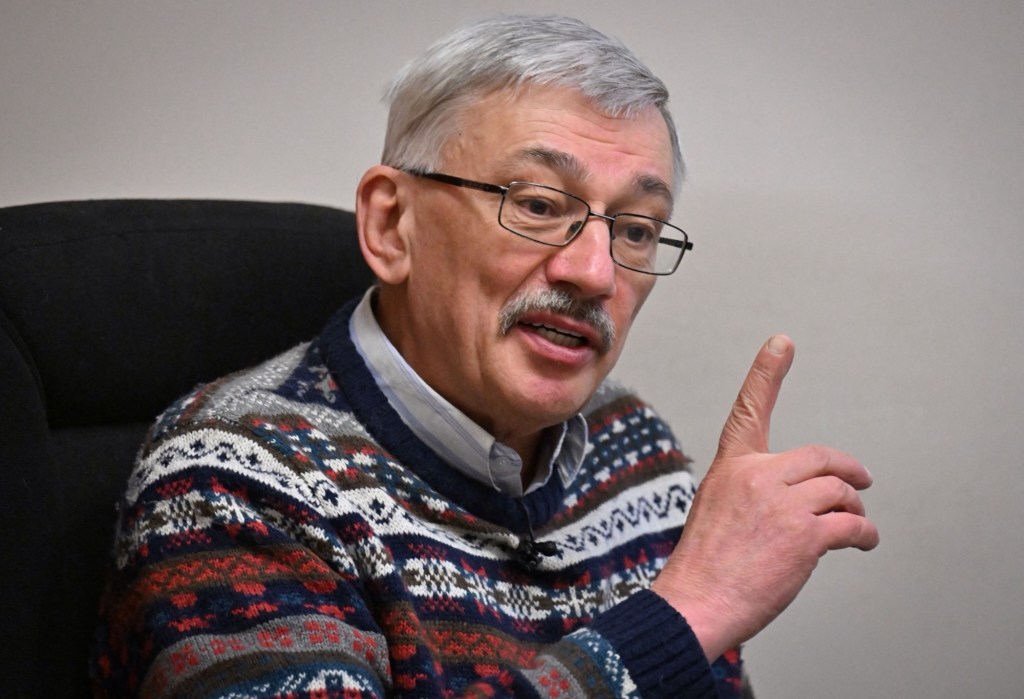
But perhaps — just perhaps — the continued international pressure on Putin will finally have some effect. The resolution calls for “the immediate and unconditional release and compensation of all political prisoners .. . . unjustly imprisoned journalists, including Alsu Kurmasheva and Evan Gershkovich, and their families, for the restoration of freedom of expression and association in Russia and for increased international scrutiny and monitoring of human rights abuses in Russia.” [RFE/RL, id.] It also specifically names, among others, Vladimir Kara-Murza, Oleg Orlov, Ksenia Fadeyeva, and Ilya Yashin — names already sadly familiar to us as included in my weekly list.
There likely isn’t a snowball’s chance in hell of any freedoms or human rights being restored to the people of Russia as long as Vladimir Putin sits in the Kremlin. But if any — even a single one — of the hostages obtains a quick release, then the resolution can be deemed a success. And if the EU and other institutions and governments continue to apply pressure, then maybe . . .
Sunday again, and we have updates on three of our HOSTAGES, plus a new one to add. Not a good week.
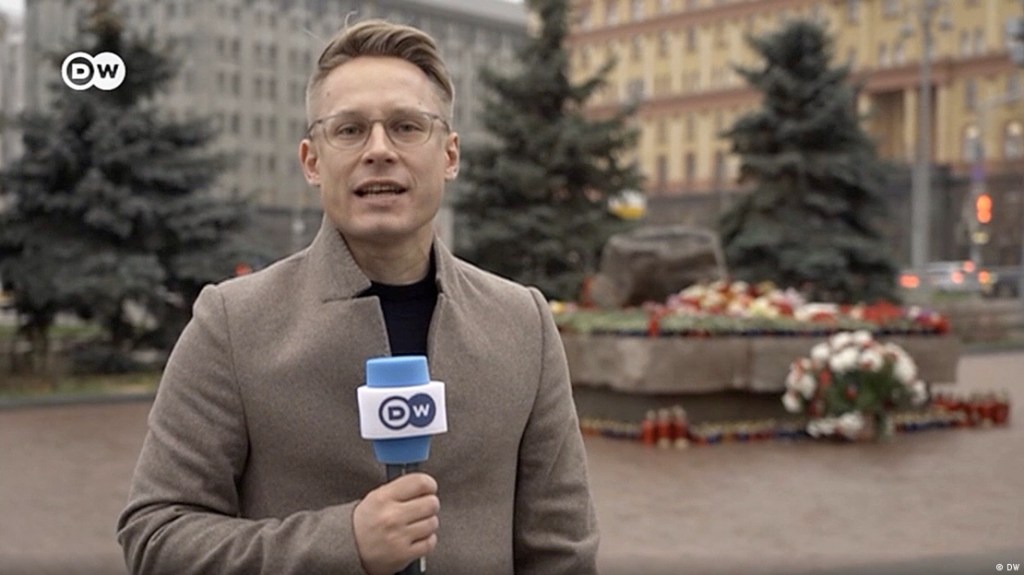
Let’s start with the new kid on the block: Konstantin Gabov, identified by the Russian authorities as a Moscow journalist for the Reuters news agency, who has previously worked for Russian broadcasters Moskva 24 and MIR. On Saturday, April 27th, he was detained by Moscow police and accused of participating in “preparing photo and video material” for the late Alexei Navalny’s YouTube channel, “Navalny LIVE.” As is well known, Navalny had been designated a “foreign agent” and was serving a combined 30-year sentence in a Siberian penal colony when he died under suspicious circumstances on February 16th of this year.
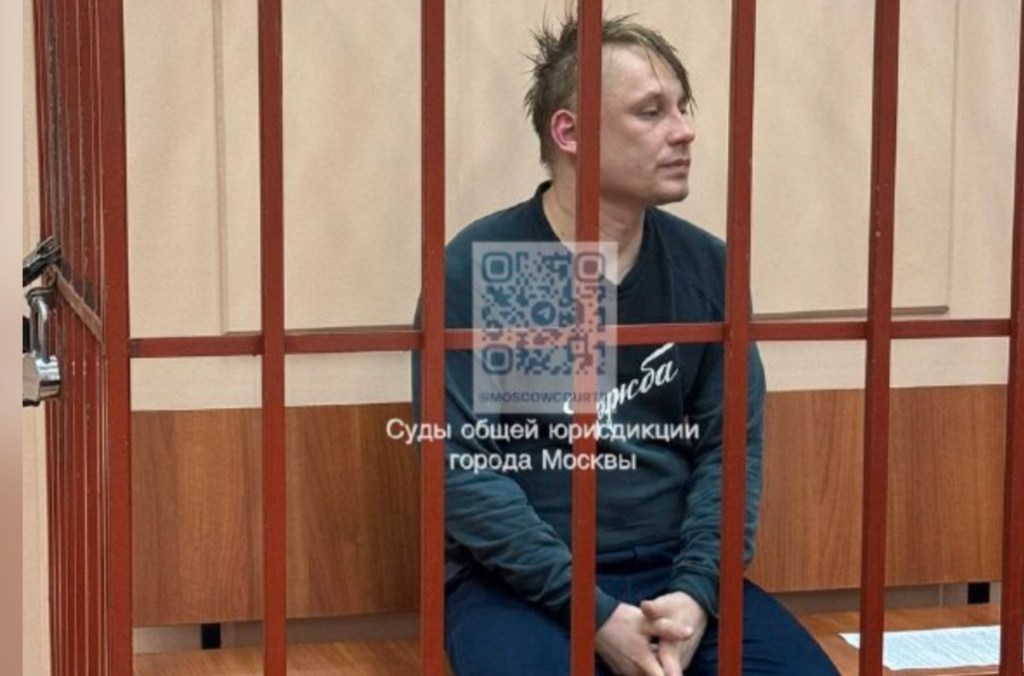
Konstantin Gabov, Before . . .. . . and After Arrest (Photos from DW, April 27, 2024)
Gabov is one of the lucky ones, so far: his initial pretrial detention is to be served under house arrest, rather than in prison. The April 27th statement from the press office of the Basmanny District Court reads in part:
“Gabov participated in the preparations of photo and video materials for publication on the NavalnyLIVE YouTube channel. The court ruled to place him in custody for the term of two months, i.e. until June 27, 2024.” NavalnyLIVE was referred to in the statement as an “extremist community”; the penalty for participation in such an organization can bring a sentence of imprisonment for two to six years. [The Insider, April 27, 2024.]
Having been associated in any way with Navalny has proven hazardous to one’s health in Russia, and has precipitated the exodus of members of his team to other, safer European locations . . . although even that is no guarantee of protection. In March of this year, one of Navalny’s team, Leonid Volkov, was attacked and brutally beaten with a hammer by assailants in front of his home-in-exile in Lithuania. Luckily, he survived. Arrests have been made in Poland of two suspects, but their message has been clearly received: no one is 100% safe from Moscow’s vengeance.
*. *. *
Gabov is not the only former associate of Navalny to make it onto our HOSTAGE list. Antonina Favorskaya, a photographer who covered Navalny’s trials for independent Russian news outlet SOTAvision, is already included (see below). She was initially accused of “disobeying a police officer” and detained for ten days in March, supposedly to be charged or released by March 27th. But that did not happen; instead, in a closed-door hearing in a Moscow court, she was ordered to be held for two additional months until May 28th “pending investigation on charges of allegedly participating in an extremist group.” [Committee to Protect Journalists (CPJ), March 29, 2024.] And so it begins.
*. *. *
Our other updates today are as follows:
Robert Woodland Romanov: At his scheduled court appearance on April 25th, this dual Russian-American citizen’s case was adjourned until mid-May — a typical delaying tactic designed, not to give both sides an opportunity to prepare their legal arguments, but simply to wear down the defendant, both mentally and physically.
Evan Gershkovich: The American Wall Street Journal reporter, arrested over a year ago, had his appeal against his continued detention rejected. No surprise there; Russian courts rarely, if ever, reverse themselves or each other.
Vladimir Kara-Murza: The most urgent of our HOSTAGE cases, dual Russian-British citizen Kara-Murza has been in failing health for some time. And this week it was reported that:
“As he languishes in solitary confinement in a Siberian penal colony, his doctors warn that he will not survive another year without proper medical treatment, which Vladimir Putin’s regime is denying as part of a slow-moving, torturous assassination.
”Now, Mr. Kara-Murza is slated for yet another arbitrary transfer nearly 3,000 kilometres back to Moscow for a sham hearing. In his current medical condition, the multiweek transfer is a form of torture that could kill him. And even if it doesn’t, there is a risk of enforced disappearance and outright murder.” [Brandon Silver, Irwin Cotler and Bill Browder, The Globe and Mail, April 24, 2024.]
*. *. *
I keep asking myself: How many ghosts does Vladimir Putin need hanging over his head before he calls a halt to the murder and mayhem of his regime? And how long will the people of Russia allow it to continue?
Just sayin’ . . .
Brendochka 4/28/24
*. *. *.
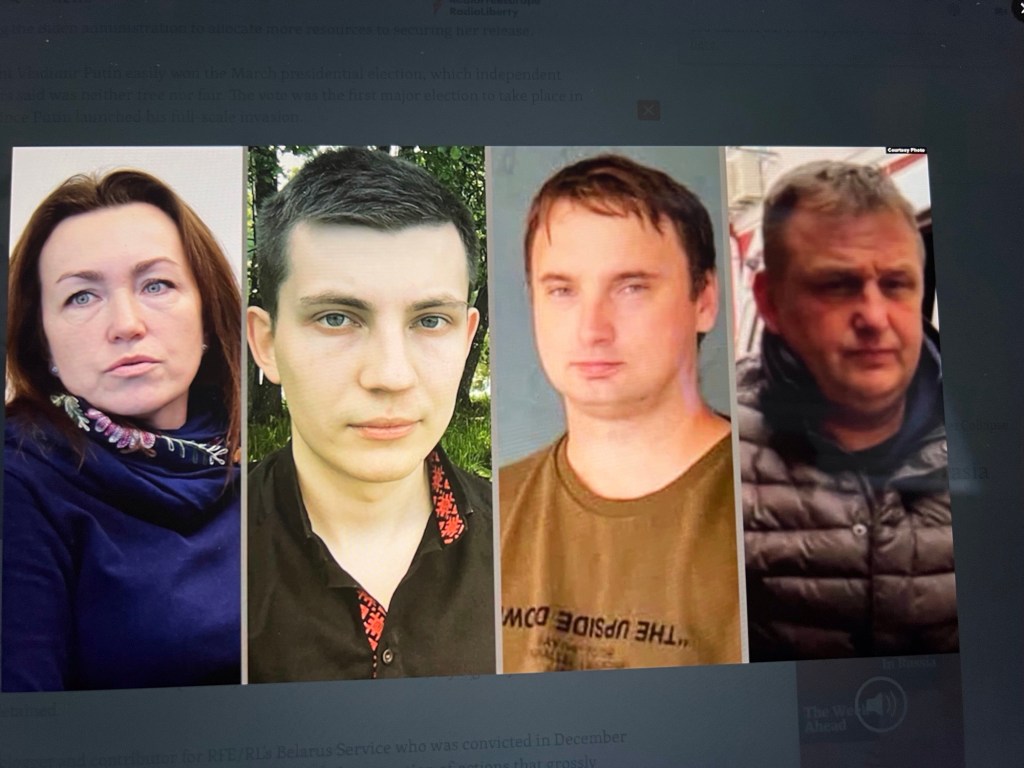
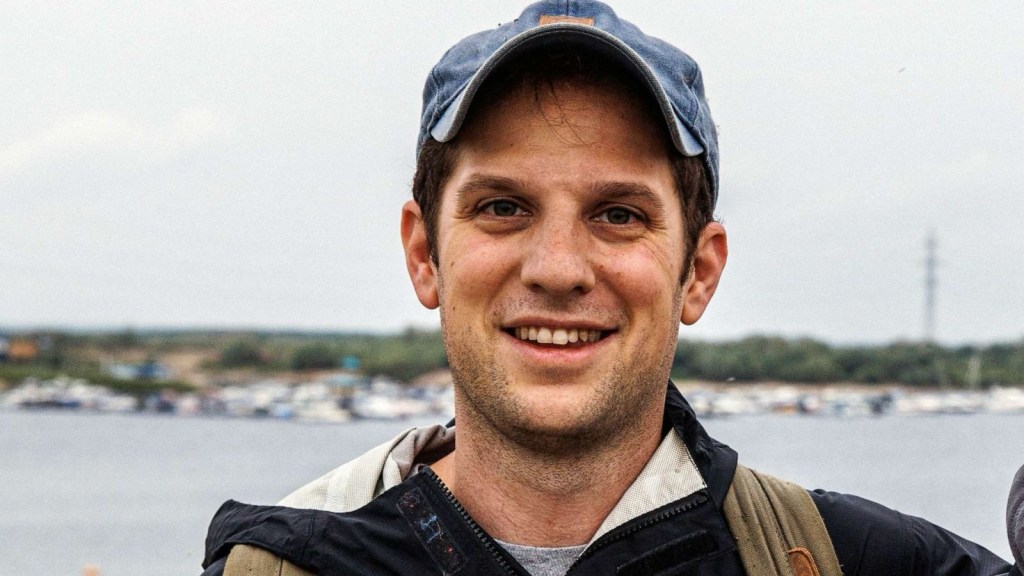
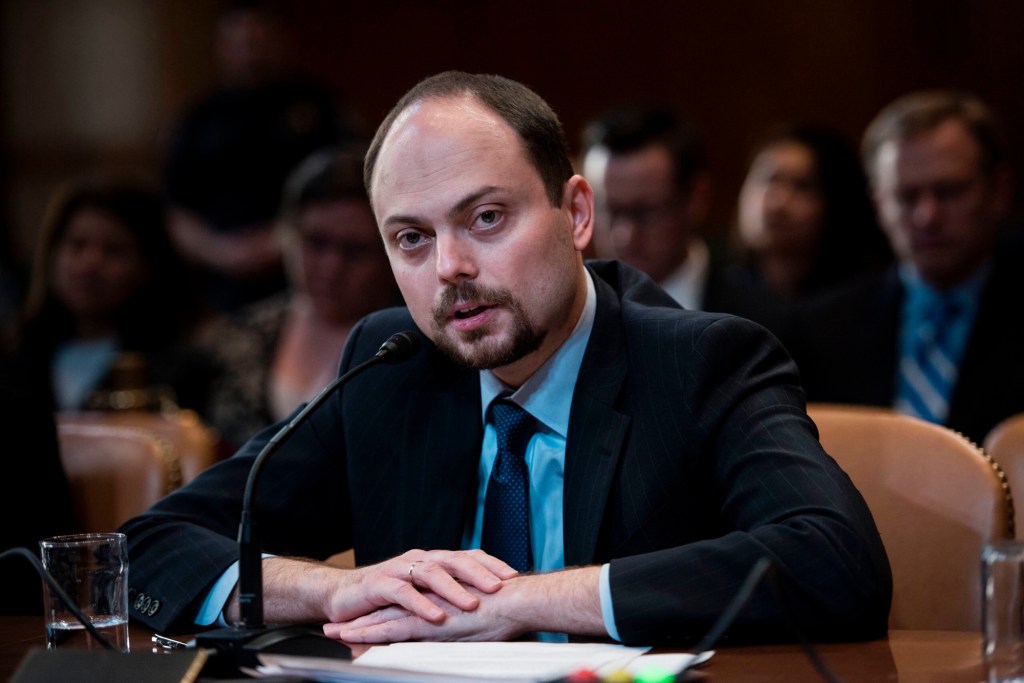
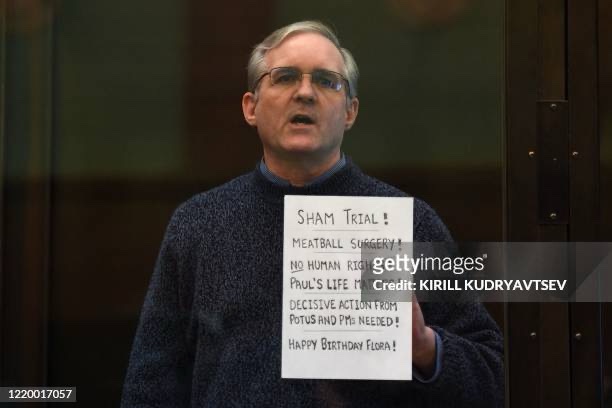
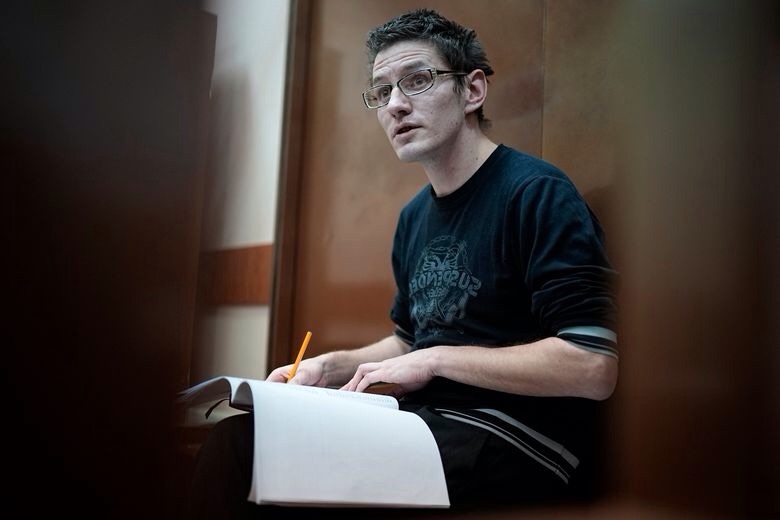
So, once again I beg you, please do not forget them; their families and friends haven’t. And here, one more time, are their pictures as a weekly reminder that they are real, and truly suffering. In no particular order, they are:
On April 18th, I wrote about Russell Bentley, more-or-less of a loser from Texas who decided about ten years ago to make a radical change in his life by enlisting in the Russian army, where he was assigned to serve in the Russian-occupied region of Donetsk, Ukraine. He became a Russian citizen, married a Russian woman — Lyudmila — and, as a “combat veteran,” next reinvented himself as a journalist for the Kremlin-controlled media. As such, he spread propaganda about the alleged Nazi regime in Ukraine, and lived the life of a good little Putinist. The Russians didn’t care — or perhaps didn’t know — about his past drug conviction; he had successfully put that life behind him.
Russell and Lyudmila Bentley’s Wedding
That is, until earlier this month, when Lyudmila reported — about a week after the fact — that her husband had been “brutally detained” and taken hostage by Russian troops on April 8th. Why? Well, they told her it was because he was accused of being a CIA mole operating in their midst for the past decade.
But where was Russell? At that point, no one knew . . . or, at least no one was admitting that they did. He was eventually reported by local officials, and by the battalion with which he had fought, as being dead. Oddly, this was confirmed — though without details — by editor-in-chief of Kremlin-controlled RT News, Margarita Simonyan . . . the same TV reporter who, as I mentioned in another, unrelated post on April 24th, is inexplicably fond of U.S. Congresswoman Marjorie Taylor Greene. So you may give her word as much credence as you think it’s worth.
Margarita Simonyan (Facebook Photo)
Unconfirmed reports have been circulating among Russian military bloggers to the effect that Bentley “suffered a gruesome death at the hands of Russian troops who mistook him for a spy.” [Allison Quinn, Daily Beast, April 24, 2024.] And his wife, who says she has not yet seen his remains or had any proof at all of his death, stated on Telegram:
“I know that his remains have been seen. But then I’m told that there are no remains. How is that?” But, assuming the worst, she has gone directly to the top of the hierarchy in her appeal for help in retrieving “what’s left of his body”: to Vladimir Putin himself. Because, in her words:
“Everyone knows that as soon as you appeal directly to Vladimir Vladimirovich Putin, then all problems get solved. That’s why I want to appeal to the president of the Russian Federation with a request to provide maximum assistance to find my husband, either alive, if it’s possible, or to give me his remains so that I can bury him. . . . It’s more than hell. I beg you please, help.” [Daily Beast, id.]
Lyudmila Bentley: Video on Telegram
Well, of course . . . that should do it. Your esteemed president didn’t have time to get involved in Alexei Navalny’s disappearance, but he will surely drop everything to help you find what’s left of your turncoat Texan. Good luck with that, Lyuda.
Seriously, I do sympathize with her. Life in Russia — and especially in the military — is not easy under the best of circumstances. As far as I can tell, this poor lady has done nothing wrong, other than marrying Russell Bentley. And now she lives with the delusion that the great Vladimir Vladimirovich Putin will put forth the effort to help her find Russell or his remains. It is truly a sad story, and I can’t imagine what will become of her. But I wish her well.
*. *. *
As for Russell Bentley himself, only questions remain. Foremost, of course, is the issue of his whereabouts and his condition: is he dead or alive, and in what location? Is he really dead? And if so, why was he killed? Was he horribly mutilated as rumors suggest? Would his remains even be identifiable? Was it all a big, blundering, stupid mistake; or was he actually a CIA spy, successfully remaining undetected for ten long years? Of course, we’ll never know the answer to that last question. And finally, if he’s still alive and hiding out (or being hidden) somewhere . . . why? And again, in what condition?
As usual when dealing with the Russian government, we are left with nothing but questions. And, as so frequently happens, I’m not sure we really want the answers in the puzzling case of Russell Bentley.
Although for Lyudmila Bentley, knowing would surely be better than a lifetime of wondering.
No, it wasn’t Camelot. Though I did think, just for a few seconds, that perhaps . . . but no, it was incredibly foolish of me . . . stupid, even, to believe, or just to hope, that my words might have had some influence, some effect on the President of the Russian Federation. He doesn’t even know I exist (fortunately). But what a coincidence!
Yeah, very funny, Vlad . . . very funny.
Let me explain. Just five days ago, on April 21st, I posted an article on my blog and on Facebook about the former Mrs. Putin and her current husband as to their legal troubles in France, where they now reside. It seems there is an ongoing investigation by the French government into some money laundering activity, in connection with which some of the couple’s properties — a villa in the south of France and an apartment in Paris — have been seized. And for some unknown reason, this little legal dust-up has upset folks at the Kremlin in Moscow . . . most particularly the lady’s ex-husband. Perhaps he was concerned that he might somehow become the recipient of some of the fallout from the investigation. In any event, President Putin’s Principal Puppet — Kremlin spokesman Dmitry Peskov, who never fails to amuse — had this to say on his boss’ behalf:
“Any encroachment on private property is illegal from the onset. The French authorities are undermining the foundations of their legal system. We have said it many times.”
And my immediate reaction was:
“Oh, God! I can’t stop!”
And now, just as I’ve managed to cease ROFLMAO, along comes a news item concerning a “reminder” from the self-same Vladimir Putin to Russia’s prosecutors that “seizing assets and turning them over to state ownership is only justified in cases where failing to act might jeopardise Russia’s national security.” [Reuters, April 25, 2024.]
You can no doubt understand how, in a sudden blaze of conceit, I might have considered the possibility . . . Well, anyway, I’m sure a lot of people (besides myself) were aware of the incredible irony in that statement, coming as it did from the man behind — not only the seizure of numerous successful commercial and industrial enterprises in his own country that were privatized in a huge sell-out after the fall of the Soviet Union just over 30 years ago — but also huge swaths of Ukrainian territory since Russia’s invasion, now in its third year.
What’s that old adage about “people who live in glass houses . . .”?
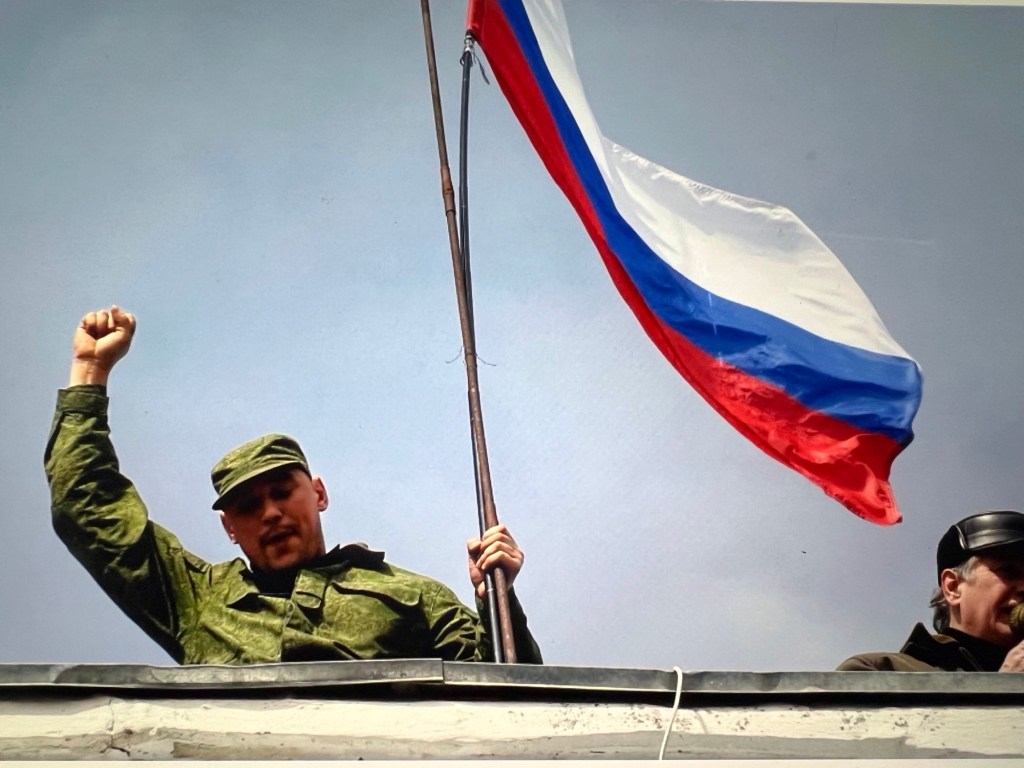
Russian Flag Being Raised Over Crimea’s Navy Headquarters
*. *. *
So now, having dissed the French government for taking a couple of properties as collateral in a criminal investigation, Putin had to cover his yagoditsy (buttocks) and work on his public image, since — according to a statement by prosecutor General Igor Krasnov last month — “More than 1 trillion roubles’ ($10.9 billion) worth of strategic enterprises and assets were transferred to state ownership by Russian courts last year.” [Reuters, id.]
Oops!
There may also have been recent grumblings amongst the business elite, because at a Moscow business forum — the Congress of the Russian Union of Industrialists and Entrepreneurs — Putin addressed the attendees as follows:
“I would like to stress: we are not talking about a privatisation review, but about cases when the actions or inaction by the owners of enterprises and property complexes cause direct harm to the country’s security and national interests.
“The seizure of business is justified only in the situation I have just described.
“Claims against current owners of assets are inappropriate, especially for those who work successfully, solve social issues and help ensure national security.” [Reuters, id.]
In other words: Behave, and you shall continue to prosper.
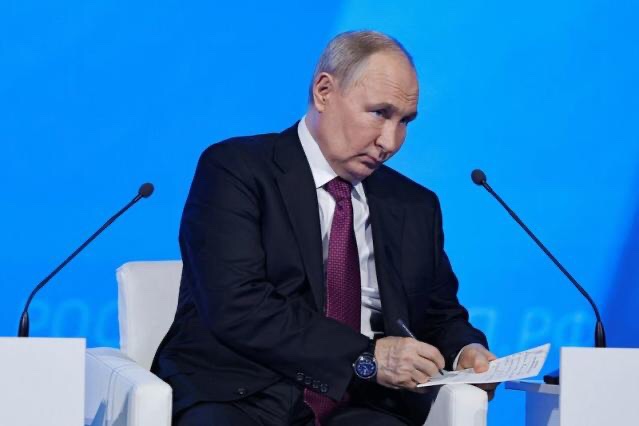
Addressing the Russian Union of Industrialists and Entrepreneurs
Way to go, Vlad. But you forgot to mention a couple of things, such as what constitutes “harm to the country’s security and national interests,” and who makes that determination in each case. (Actually, we already know that second part, don’t we?) Or what a business owner must do to “help ensure national security.”
The Reuters report also noted that the Russian Ministry of Finance “has listed about 30 companies in which the state may reduce its shareholding, while keeping a controlling stake, as it seeks to foster more domestic private investment and bolster budget revenues.” [Emphasis is mine.]
Yeah, there’s always that bottom line to consider, too.
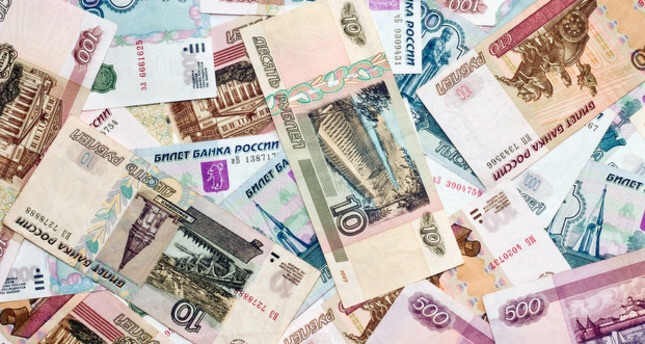
The Almighty Ruble
*. *. *
I find it interesting to see the Russian President — any Russian President — worrying about his public image. In a country that has always been ruled from the top by an iron-fisted autocrat, it has never seemed necessary before. And Putin has just been reelected (surprise!) for another six-year term. So why now? What is he afraid of? Is the memory of Yevgeny Prigozhin’s attempted revolt — though unsuccessful — still too vivid? Does the continuing public worship of the late dissident Alexei Navalny invade his dreams at night? Are there rumors of a latent putsch running through the Kremlin’s hallways? Or is he simply trying some new tactic, hoping to convince the world that he is — while still the strong man of Russia — a more reasonable man . . . perhaps even the potential leader of his envisioned new world order?
Who knows? But it’s fascinating to watch, and listen . . . and wait for tomorrow’s news from Moscow.
My day is totally complete. I didn’t have to search for a topic for today’s blog; this one, like, jumped right off the page and smacked me across my smiling face:
“Kim Kardashian clears up whether she blow dries her jewelry and other rumors.” [Lisa Respers France,CNN, April 23, 2024.]
Oh! My! God! Can you, like, believe it??!!!
I mean, like, Kim actually told such great stuff to Jimmy Kimmel, right there on his show! Stuff like — OMG! — when she was “like seven and eight years old,” she lived next door to Madonna, and would walk her dog after school in exchange for the jewelry she didn’t wear anymore. Madonna’s jewelry — not, like, the dog’s. Jeez!
Wow, she sure started that entrepreneur stuff early. No wonder she’s so rich.
Anyway, one time Madonna gave her, like, a shoe box with a bunch of neon bracelets, and when she wore them to school, “Everyone was like, ‘Oh my God I love your bracelets.’ And we were like, ‘Thanks. Madonna gave them to us.’”
Those were her exact words! How totally awesome is that?!!
Neon Bracelets, C.1980s
And then — I can’t believe it — she told Jimmy Kimmel how she blow dries her jewelry and anything with a zipper before she puts them on because she can’t stand being freezing cold, so she, like, warms all the metal stuff first. Isn’t she the smartest?!!
Oh, and wait — I haven’t told you the best part yet. She, like, washes her feet every night before bed. But she didn’t, like, mention the rest of her body. I wonder when she washes all that? And how does she, like, reach that awesome backside . . . ?
Awesome
Anyway — and this is totally awesome — she sleeps with her eyes partially open!
Partially? How does she do that? I mean, I tried, and they always, like, closed the rest of the way by themselves when I fell asleep. She’s, like, a genius, man! A creepy, awesome, freakin’ genius!
Freaky . . . But Cool
I am so, like, stoked now. My day — no, my whole life! — is complete. I just had to share this with all my FB BFFs. I’m going to go wash my feet now, jump into bed, and try that half-closed eye thing again. I’ll let you know if it works this time.
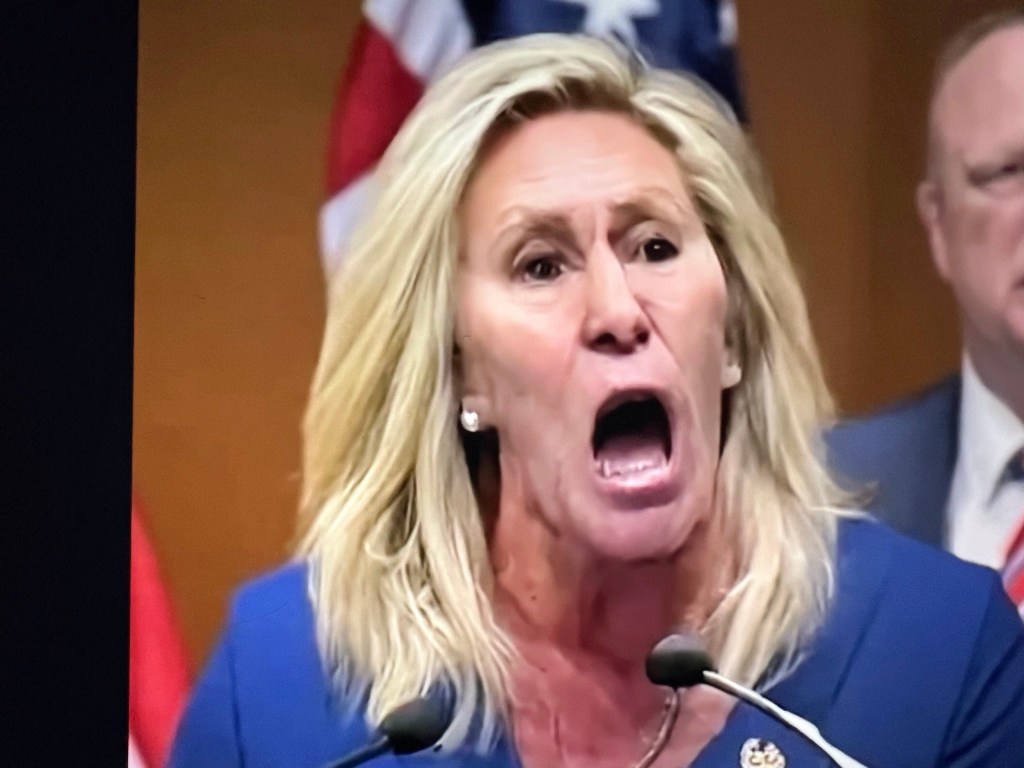
Wow — that came out sounding like a eulogy. Maybe it was a Freudian slip. Because actually, I wish we could say a final farewell . . . to her so-called career as a U.S. Congresswoman, and her bully pulpit . . . before she drags too many people with her on the downslide into the soul-sucking sludge of her ranting, raving, Putin-loving anti-Americanism.
Now ask me what I really think of her.
*. *. *
Most people today aren’t old enough to remember “Tokyo Rose.” She was not a single individual, but a group of English-speaking Japanese women broadcasting anti-American propaganda during World War II for the purpose of demoralizing American and allied troops and their families. Happily, it didn’t work. But those were the days before the internet and social media. And, in comparison to the quantity and quality of the trash to which we are subjected today, those 1940s broadcasts were simplistic and amateurish.
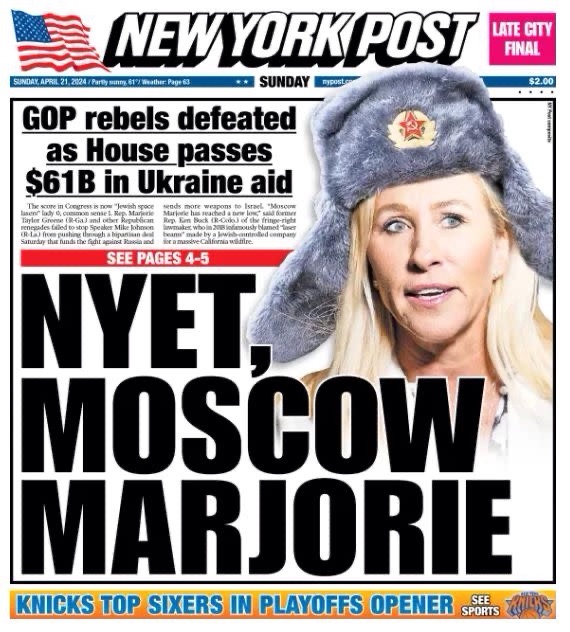
But where Greene is concerned, I am not laughing. Although the New York Post — hardly a worthy example of exemplary journalism on a normal day — did provide me with the best guffaw I’ve had in a while when they cobbled together this image:
But a lot of people, including her own Republican colleagues in Congress, are seriously worried about her sanity. She has threatened to oust House Speaker Mike Johnson (R-La.) due to his amazing work in the passage of a bill that provides desperately-needed aid to Ukraine in its war against Russia. (The Speaker finally does something really right, and this is what he gets for it — proving once again that no good deed goes unpunished.) She spouts falsehoods about so-called Nazism in Ukraine — echoing the official Kremlin excuse for their “special military operation” — and continually passes along false “information” on subjects ranging from U.S. border issues to aid for Israel. She is fueled by anger and hatred, and refuses to let the truth stand in the way of her daily screeds.
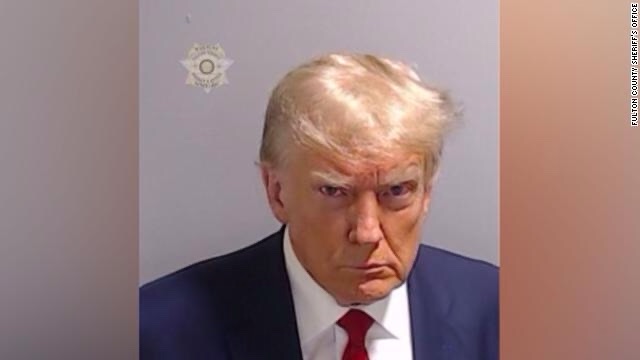
She is the female Donald Trump.
He says . . .She says . . .
And Vladimir Putin simply adores her. Well, why shouldn’t he? She’s out there proselytizing for him, free of charge. Former Representative Ken Buck (R-Colo), referring to her by her new moniker, recently said, “Moscow Marjorie is focused now on this Ukraine issue, getting her talking points from the Kremlin and making sure that she is popular and gets a lot of coverage.” [Lee Moran, Huffpost, April 22, 2024.]
And Moscow’s media mouthpieces couldn’t agree more. In an expected tirade against the House of Representatives’ passage of the bill authorizing further aid to Ukraine, the man known as “Russia’s No. 1 propagandist,” Vladimir Solovyov, took to the airwaves to declare that “a war with NATO is unavoidable.” He went on to castigate Joe Biden for “destroying” Trump, and Speaker Johnson for “betraying” the Republican party. “This is all you need to know about American politics. They’re traitors!” [Julia Davis, Center for European Policy Analysis (CEPA), April 22, 2024.]
Following Solovyov’s rant, Margarita Simonyan, head of Kremlin-controlled news outlet RT and a frequent guest on Solovyov’s program, had her turn. She spoke about Greene in what she considered to be the most glowing terms: “Greene is a real beauty. She is a blond who wears white coats with a fur collar. She’s demonstrably heterosexual.” [Fact-checked by Snopes.] She also referred to her as one of the few “normal people” in America.
“Blond, Fur-Bearing, Hetero . . . Normal,” Says Russia
Well, there you go! The gospel according to one of Putin’s Puppets, whoseexpertise in all things American seems to have been gained while once having worked as a waitress in Maine. [CEPA, id.]
*. *. *
I make light of this, but at the same time I’m seriously worried . . . worried that this is the best we can come up with when electing our country’s legislators. Not to mention the likely slate for the upcoming presidential election. We are in serious trouble, people.
Now I’m waiting to hear what my favorite Russian funnyman, Dmitry Peskov, has to say about us next. That should cheer me up . . . he always does.
“Beijing sees foreign threats ‘everywhere’ as powerful spy agency takes center stage.” [Nectar Gan, CNN’s Meanwhile In China, April 22, 2024.]
China Propaganda: “They are everywhere.”
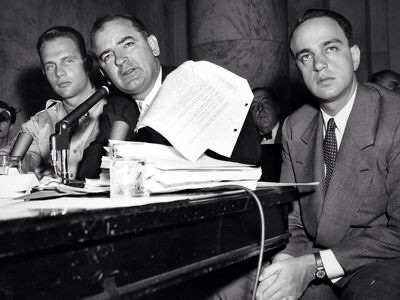
Thus read a CNN headline on Monday, immediately carrying me back to my school days in the early 1950s, when I spent hours one summer, glued to the black-and-white television set in my aunt’s living room, watching Senator Joseph McCarthy shouting, gesturing, and ruining the lives of mostly innocent Americans whom he — usually for specious reasons dreamt up in his twisted mind — suspected of being Communists or “Com-Simps”: Communist sympathizers.
Joseph McCarthy (center)
Those were the days of the Red Scare, when McCarthy and his cronies appointed themselves a posse tasked with rooting out every Commie and Com-Simp in the country — and especially those in prominent positions. Government employees, movie stars, musicians, academics: all were vulnerable, and many were blacklisted, their careers and their private lives decimated. We were expected to believe there was a Communist spy in every closet, behind every tree, and under every bed. Those were crazy, suspicious, frightening times.
“You’ll never know where they are.”
And now — in a somewhat different form and with a different goal — those days have come to the People’s Republic of China.
Of course, they’re not looking for Communists. They are the Communists. No, they’re looking for spies from “the West” — the U.S., all the other NATO countries, and our allies. We’re the bad guys now. And, according to China’s President Xi Jinping, we are everywhere: under the beds and behind the trees. Hiding. Lurking. Listening. Watching. It’s a massive infestation, and we must be rooted out and exterminated, like the cockroaches we really are.
Or so says President Xi. And he must know, because he is our honorable President.
Oh, sorry . . . wrong picture.
President of China, Xi Jinping
That’s better.
What has happened under China’s ultra-authoritarian leadership is that the formerly super-secret Ministry of State Security (MSS) has itself come out of the closet and embarked on a publicity campaign of such paranoid phantasmagoria as to be worthy of a George Orwell novel. I have not seen it personally, so I must resort to quoting from CNN’s description of a three-minute video released in tandem with National Security Education Day:
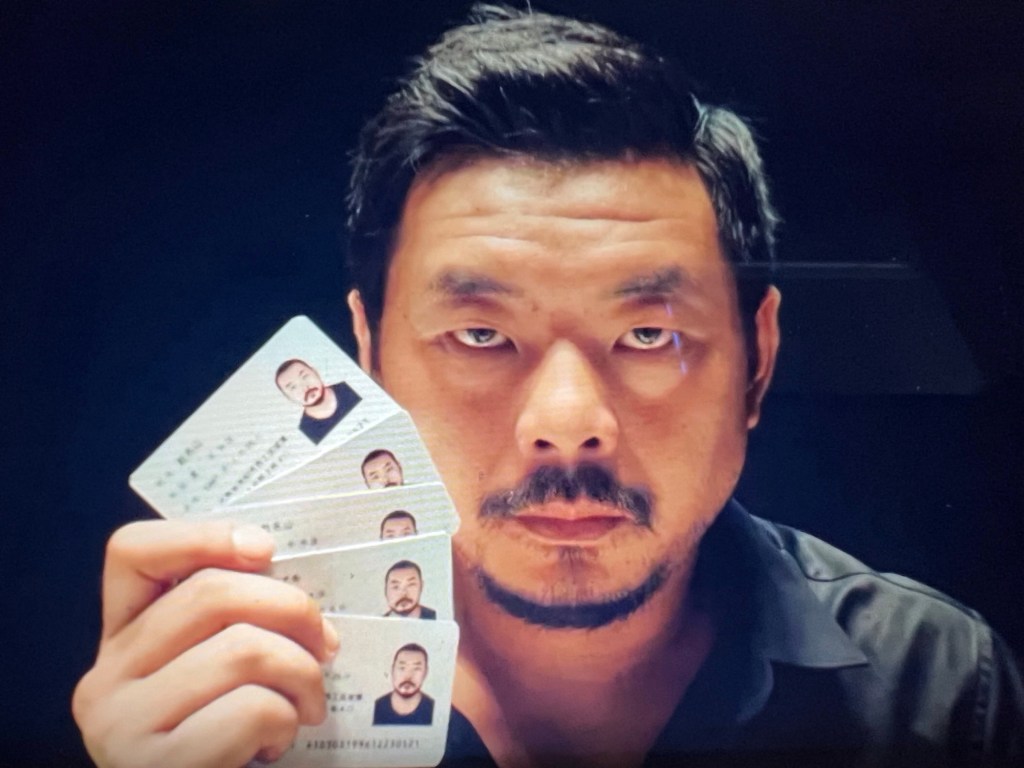
“As ominous music plays, a broad-faced, beady-eyed man disguises himself as a street fashion photographer, a lab technician, a businessman and a food delivery driver — he even sets up an online honey trap — to glean sensitive state secrets in various places and industries.
‘In the sea of people, you may have never noticed him. His identity is changeable and his whereabouts are hard to find,’ a narrator says. ‘They are everywhere, cunning . . . and sneaky, and they may be right here in our lives.’
Eventually, Chinese police catch the spy in a dramatic ambush after state security authorities receive multiple tip-offs from the public.
‘They can disguise as anyone. But among the crowds you and I together are protecting national security,’ the narrator concludes. ‘We 1.4 billion people are 1.4 billion lines of defense.’” [CNN’s Meanwhile in China, April 22, 2024.]
Wow! Looking forward to catching that on YouTube.
“You’ll never know who they are.”
And apparently China’s cities have been plastered with posters and slogans “on sidewalks, subway trains, campuses and billboards,” as well as on social media and even in comic strips. That’s right, folks — get the little kiddies looking under the bed too! Why should they miss out on the fun?
*. *. *
One of the worst-kept secrets in the world has always been that everyone spies on everyone else. Of course we spy on the Chinese! Aren’t they doing it to us? The same is true of the Russians, the Iranians, the North Koreans . . . it’s endemic. And it’s “the world’s second oldest profession,” going back to biblical times. (If you have to ask what the oldest profession is, I suggest you contact Siri.)
Seriously, though . . . so what? Why are they suddenly making such a big deal of it — enlisting every one of their 1.4 billion citizens to report on one another? Has Xi Jinping really become that paranoid? Is he trying to take further control of his own people by turning them against one another? Looking for an excuse to take some action against the West? Maybe he’s just trying to keep pace with his BFF, Vladimir Putin. Or is there some other, even more devious purpose bubbling in the cauldron of his psyche?
I have no idea; but I, for one, can’t wait to find out.
I was bingeing the other day — not on chocolates, but on reruns of my favorite British TV series, Midsomer Murders — when I saw again the episode wherein Tom Barnaby’s aunt is in short-term post-surgical rehab at a senior nursing home where several of the regular residents have died under mysterious circumstances. Well, Tom Barnaby being the local DCI (Detective Chief Inspector), naturally there had to be deaths to investigate.
But it was the living characters that interested me, and the depiction of the sad emptiness of their daily lives, even though it was quite a lovely nursing home. And what one still-vibrant gentleman resident said to a young visitor struck me as particularly poignant. I don’t recall his words verbatim, but in essence he said that when you’re old, you become invisible. When you’re young you have presence: you’re tall or short, handsome or ugly, perhaps smart, funny, sexy, etc. You’re interesting. But when you’re old, you become extraneous. You’re excluded from everything; you are no longer relevant. People look right past you as though you’re not even there. For all intents and purposes, you are invisible . . . or so said the elderly gentleman.
I see her. Do you?
And it occurred to me — from my own experience and observations — that he was right. Absolutely, completely, tragically right. Oh, not in the eyes of my own generation of friends . . . the few who are left alive. (I seem to be the one designated to survive all the others.) But to the younger ones, the people who have inherited the responsibility of running the world that my generation created (for which, please forgive us, by the way). At social events, or dining out with a group — if they’re mostly younger people, they’re so engaged with one another, they forget you’re there. They’re not being intentionally disrespectful; it’s just that you’ve become irrelevant.
I wonder: Is this a typically American thing? Or is it true in other countries as well? I know there are societies that revere their elders — Asian nations, for example. Why do we think we only need to make sure the old folks are “taken care of”? Don’t they realize we miss our social lives? Or that painting pottery in some senior center isn’t enough to satisfy our intellectual needs? Or even that we still have intellectual needs?
Now, I do know that I’m not actually some amorphous bit of ectoplasm floating in the air; I have a body (tired as it may be), and substance. People don’t bump into me in the market; I’ve never been run over on the street or in a parking lot. I am visible, in the corporeal sense. It’s just that younger people don’t seem to care.
Ectoplasms Я Us
But I have things to say. I have experience. I’ve had a long, interesting life. I keep up with the world news, politics, show biz gossip. I know who Volodymyr Zelensky, and Elon Musk, and Taylor Swift are. I have opinions, viewpoints based on all those years of experience. I even have a sense of humor. I have a blog, for Heaven’s sake!
And the same is true of most of my contemporaries . . . the ones who haven’t gone around the bend, at any rate. I can understand if the 20-somethings, who think they possess all the wisdom of the world (and are they in for some surprises!), believe we seniors have become obsolete. But those of you in your 50s, 60s . . . even your 30s and 40s . . . well, you should know better.
And one day you will.
Because your day is coming, kids . . . sooner than you think. I’m glad I won’t be around to see your reactions when you realize that you, too, have faded from sight.
Because by then it will be too late to make amends.
Sunday again, with yet another new addition to the list: Robert Woodland Romanov, the Russian-American dual citizen about whom I wrote at length just two days ago. Arrested on charges of drug trafficking, his case awaits resolution; but as his American citizenship renders him likely to become another of the pawns on Putin’s chess board, he has been added to our list.
Robert Woodland Romanov, Russian-American: Prisoner, Moscow
*. *. *
And once again, the remainder of the list continues sadly unchanged. Please do not forget them; their families and friends haven’t. And here are their pictures as a weekly reminder that they are real, and truly suffering. In no particular order, they are:
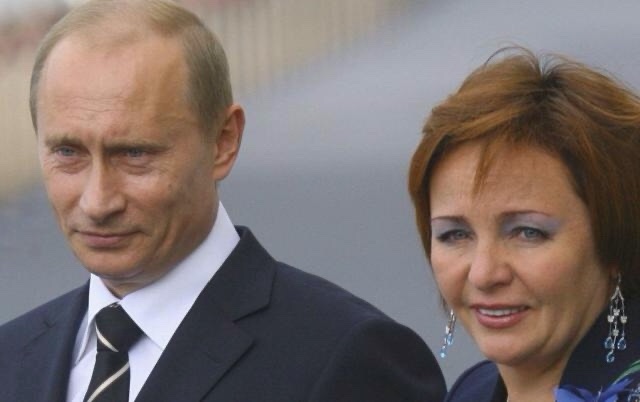
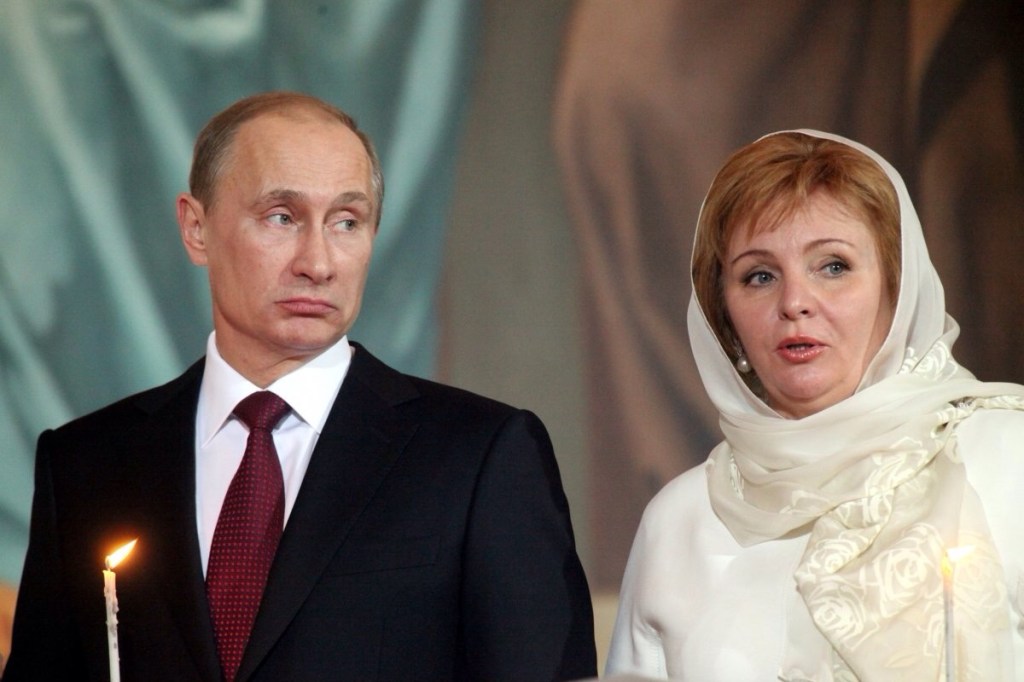
Yes, that would be the former Mrs. Vladimir Putin, once the First Lady of the Russian Federation. We know she escaped . . . sorry, was divorced from . . . Vlad the (21st Century) Impaler. And we know what he’s been doing for the past eleven years since they split. But how has Lyudmila made out since leaving the home and hearth (if you can describe the Kremlin in such idyllic terms) of the man with whom she shared her life for thirty years?
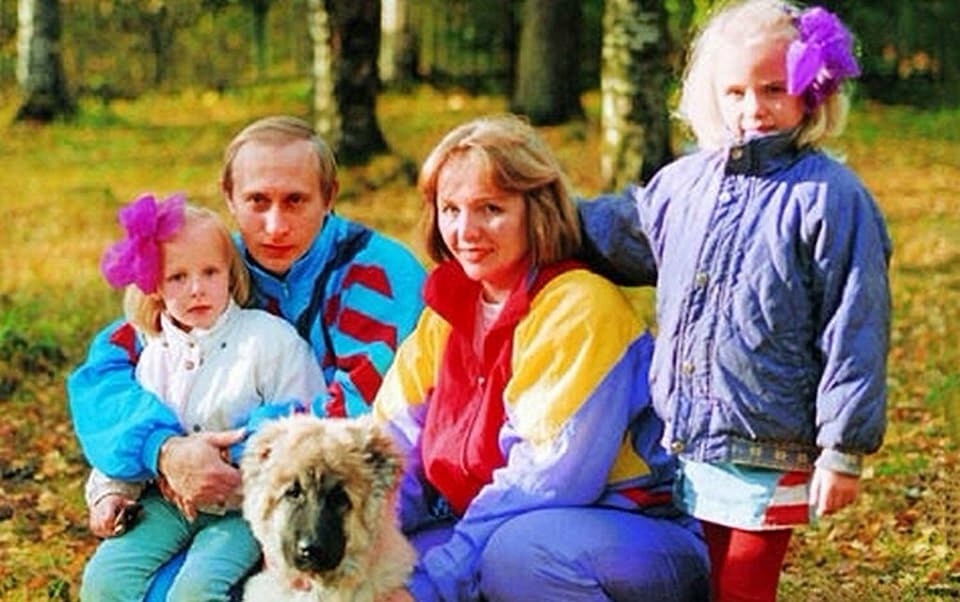
The Day She Said “Da”Happy Young FamilyPhoto Op: The Presidential YearsThen It All Went Pear-Shaped
*. *. *
Well, as it turned out, her luck seemed to change for the better. Or at least as much as we can tell from outside observations.
We will probably never know what finally caused the breakup of their long marriage, or what the terms of the divorce settlement might have been. That’s really no one’s business anyway (though I have to admit to being as curious as the next outsider). Thanks to the magic of the internet, though, we do have some information on events since the Putins announced the termination of their marriage, “based on a mutual decision,” on June 6, 2013.
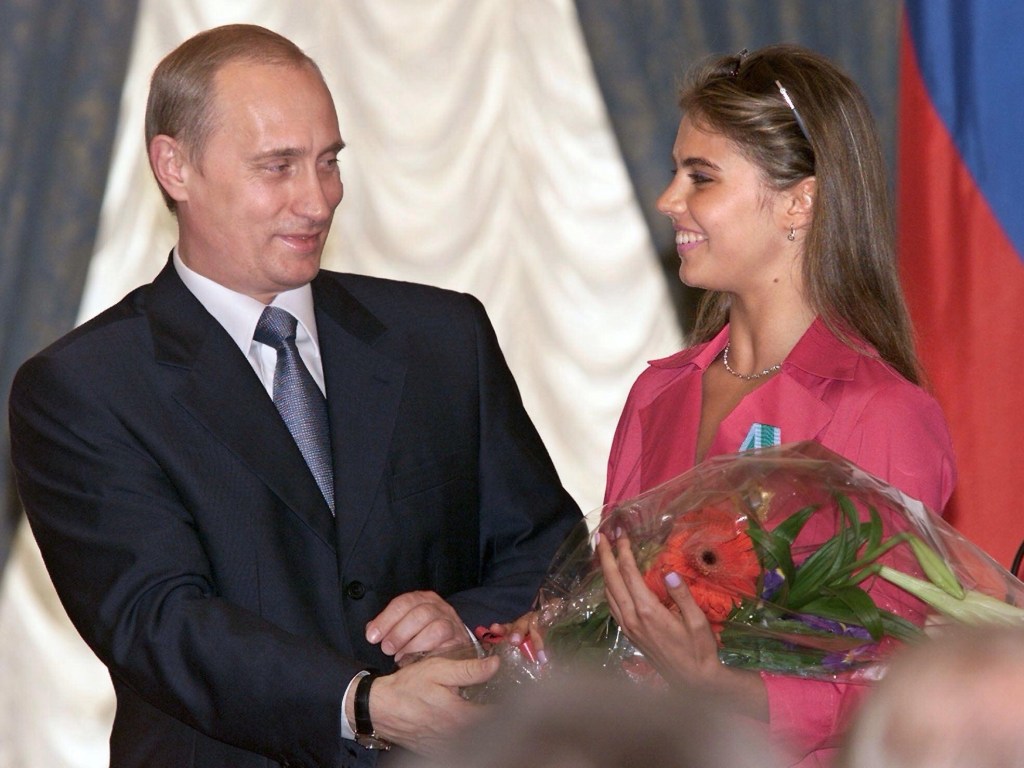
First, Vlad was seen in public — a lot — with a former gymnast by the name of Alina Kabayevna . . . a beautiful example of “arm candy” some 30 years his junior. And everyone thought, “Wow! What a stud he is!” Or maybe only his envious male colleagues thought that. In any event, he was the President, and in Putin’s Russia you don’t criticize the President, so he got away with it with a minimum of snarky (public) remarks.
Alina Kabayevna, as a young gymnast
The Beginning of a Romance
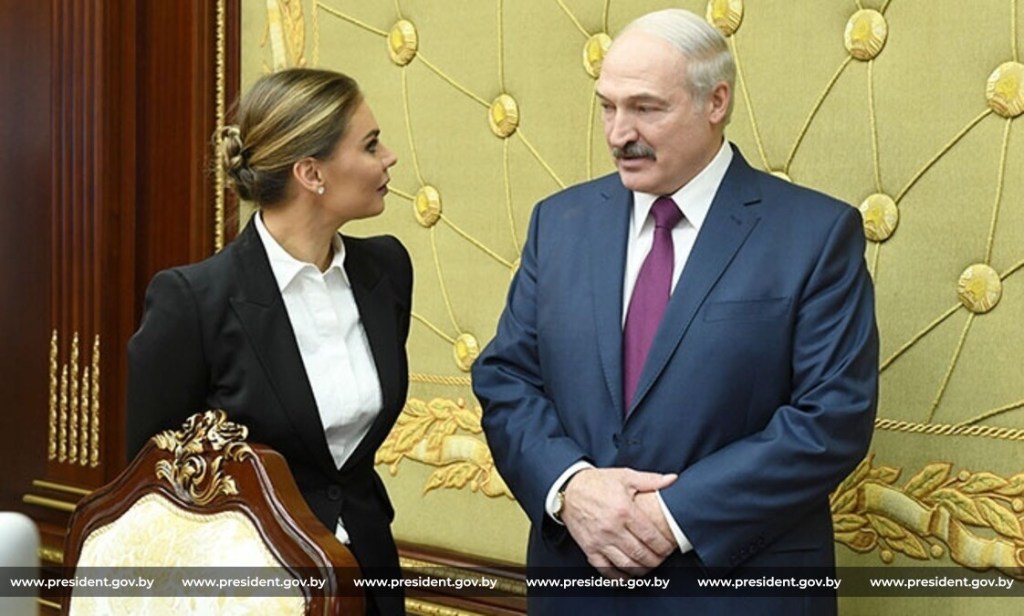
Kabayevna, reinvented as a politician, with Aleksandr Lukashenko, President of Belarus
*. *. *
I don’t know if there is an equivalent saying in Russia, but in the U.S. we say, “What’s sauce for the goose is sauce for the gander.” Reverse that, and you have the former Mrs. Putin (or Putina, in the Russian style) leaving married life behind and diving headfirst into a new life as — not a goose — but what we call a “Cougar.” And somewhere along the way, she met Artur Sergeyevich Ocheretny, some 20 years her junior, who very soon became known as Lyudmila’s “boy toy.”
Well, that’s only fair, don’t you think? If Alina is arm candy, then certainly Artur is the boy toy. There’s no gender discrimination here.
Lyudmila’s “Boy Toy”The Entrepreneur and the First Lady
And in 2015, just two years after the Putins’ divorce, Artur (then 37) and Lyudmila (then 57) became Mr. and Mrs. Artur Ocheretny. In 2017, it was reported that they had moved to Biarritz in the south of France. Definitely an upgrade!
But who is this man who just seems to have appeared out of the blue? His biography is brief. He is a high school graduate (1995) from Lyubertsy, a town within the Moscow Oblast (Region). After high school, he founded an office equipment repair company. And at some point, he is said to have run a seafood business. From 2003-2008, he became director of something called the Art Show Center, a company that organized various types of events for United Russia, Gazprom, and others. It’s unclear what happened to his earlier entrepreneurial efforts, but it was in connection with these latter event-organizing activities that he was able to meet representatives of the “Russian elite” . . . including Lyudmila Putina. And since their marriage, they are said to have built up a multi-million-dollar portfolio of real estate and other holdings.
Not bad for a high school graduate from a town best known for its “Russian Mafia” criminal gang in the 1980s and ‘90s.
But life isn’t all peaches and cream for this exceptional couple. They are currently in the headlines because the French authorities have seized — as part of an investigation into money laundering — a palatial villa in the French southwestern coastal town of Anglet reportedly owned by a real estate company controlled by . . . anyone care to guess? . . . none other than Artur Ocheretny. A second property — a Paris apartment allegedly owned by Lyudmila Ocheretnaya — was also seized in December.
The Villa
*. *. *
Whether Mr. Ocheretny turns out to be a true entrepreneur, or merely an opportunist who married his way to success, remains to be seen. But while all of this is really just fodder for the gossip columns, there is one footnote that I find absolutely hysterical. It involves that ever-amusing Kremlin spokesman, Dmitry Peskov, who always manages to crack me up when he is at his most serious.
Dmitry Peskov: The Russian Robin Williams
It seems that the Kremlin — i.e., Vladimir Putin — has taken something of an interest in this matter. No reason has been given as far as I know, although several fascinating possibilities have occurred to me. But never mind about that. What Mr. Peskov has said is as follows:
“Any encroachment on private property is illegal from the onset. The French authorities are undermining the foundations of their legal system. We have said it many times.” [James Crisp, The Telegraph, April 18, 2024.]
Well . . .
“Oh, God! I can’t stop!”
What’s that saying about the pot and the kettle? Here we have the “pot” — the mouthpiece for Vladimir Putin — calling out the “kettle” — the French government — for its seizure of private property in a criminal investigation as being illegal! The Kremlin . . . the very same people who have, if I’m not mistaken, seized about 27% of Ukraine’s private property! And they’re serious! Omigod!! My stomach really hurts now! I’m sorry . . . I can’t go on . . . I’m about to wet myself.
Oh, those crazy Russians . . . they get me every time.
































 The Blog About Everything … and Sometimes Nothing