Having a wonderful time reminiscing about all my past travel (and other) adventures. Hope you’ll share them with me in my blog, “All Roads Led to Russia.”
One summer, many years ago, I decided to take an evening course in Russian literature at the local community college. The course centered specifically on the works of Fyodor Dostoyevsky; and over some eight or nine weeks, I read (in English) and critiqued Crime and Punishment, The Brothers Karamazov, and The Idiot.
Luckily, I had not made any other major plans for that summer.
Fyodor Dostoyevsky (1821-81)
Russia’s political history is brutal, which is in large part responsible for the depth and angst of her cultural output . . . throughout the ages, so many of the world’s immortals have been at their most creative during periods of abject misery, and none more so than the Russian writers, composers and painters. One would be hard put to find another people who have suffered longer, more deeply, or more consistently.
Dostoyevsky was uniquely insightful with regard to the innate depravity of the human race. He lived in cruel times, and offered no excuse for the baseness of so many of his contemporaries, as in this quotation from my favorite of his works:
“People talk sometimes about the ‘bestial’ cruelty of man, but that is a great injustice and insult to beasts; a beast can never be so cruel as a man, so artfully, so artistically cruel.”
Last week brought an exchange of 314 prisoners — 157 Ukrainians and an equal number of Russians — as the result of the latest round of peace talks between Moscow and Kyiv at Abu Dhabi. They were prisoners of war, and not political hostages. Nevertheless, they are all — Ukrainians and Russians alike — victims of an unjust war perpetrated by Vladimir Putin’s tyrannical regime, and we celebrate their return to the care of their families.
Returning Home – February 5, 2026
*. *. *
The names of the returnees are not readily available; but there are indications that some civilians were among those exchanged. This leads me to wonder whether they included a group that I call “The Crimea 8” — a mix of Russian, Ukrainian and Armenian citizens who were involved, possibly innocently, in the delivery of explosives in October of 2022 that detonated while crossing the Russian-built Crimean Bridge connecting the Russian mainland with Ukraine’s Crimean Peninsula across the Kerch Strait.
Crimean Bridge – October 8, 2022
The explosives were hidden in a shipment of rolls of plastic film inside the delivery truck. Despite the fact that they were non-combatants and insisted they had no knowledge of the contents of the shipment, the men were tried in a Russian military court in Rostov, charged with carrying out a terrorist attack and illegal arms trafficking, and treated as prisoners of war.
Their names are Artyom and Georgy Azatyan, Oleg Antipov, Aleksandr Bylin, Vladimir Zloba, Dmitry Tyazhelykh, Roman Solomko, and Artur Terchanyan, and they have been on my list of hostages since their arrest. If anyone has information as to whether they were among those released — either this month or in previous exchanges — I would very much like to know.
Trial of the “Crimea 8”
*. *. *
In the meantime, they remain among the ranks of political hostages to be remembered on yet another Sunday:
Victims of Greed:
The President, First Lady, and citizens of Venezuela
Europeans Under Threat:
The Nation and the People of Greenland The people of NATO and EU member states
Prisoners of War:
The 19,500 Kidnapped Ukrainian Children The People of Ukraine
Immigrant Detainees in Russia:
Migrants from the Central Asian nations of Kazakhstan, Kyrgyzstan, Tajikistan, Turkmenistan and Uzbekistan
Endangered Exiles:
Mikita Losik Yulia Navalnaya Countless Journalists and Other Dissidents
Andrei Chapiuk Uladzimir Labkovich Andrzej Poczobut Marfa Rabkova Valiantsin Stafanovic Yuras Zyankovich
In Georgia:
Mzia Amaglobeli
In Russia:
The “Crimea 8”: — Oleg Antipov — Artyom Azatyan — Georgy Azatyan — Aleksandr Bylin — Roman Solomko — Artur Terchanyan — Dmitry Tyazhelykh — Vladimir Zloba
James Scott Rhys Anderson (British) David Barnes (American) Gordon Black (American) Hayden Davies (British) Antonina Favorskaya Konstantin Gabov Robert Gilman (American) Stephen James Hubbard (American) Sergey Karelin Timur Kishukov Vadim Kobzev Darya Kozyreva Artyom Kriger Michael Travis Leake (American) Aleksei Liptser Grigory Melkonyants Nika Novak Leonid Pshenychnov (in Russian-occupied Crimea) Nadezhda Rossinskaya (a.k.a. Nadin Geisler) Sofiane Sehili (French) Igor Sergunin Dmitry Shatresov Robert Shonov Grigory Skvortsov Eugene Spector (American) Joseph Tater (American, disappeared) Laurent Vinatier Robert Romanov Woodland (American)
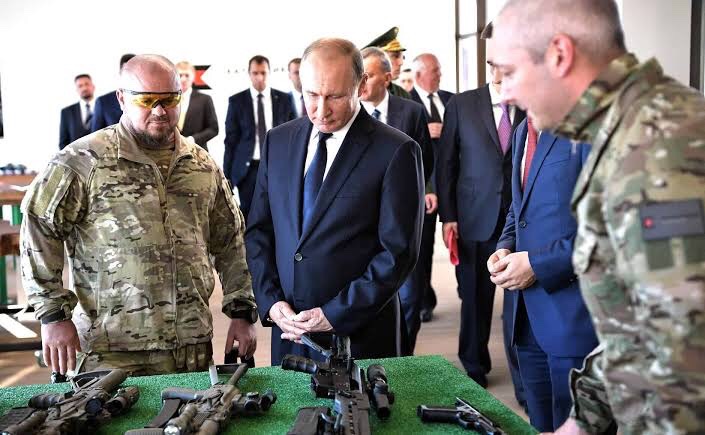
He has to be the best damn sheriff that ever sat in the saddle.
“Sheriff” Putin (Photo credit: The Atlantic)
On Friday, February 6th, Russian Lieutenant General Vladimir Alekseyev was shot and seriously wounded by an anonymous assailant inside his apartment building in the outskirts of Moscow. The attacker fled; Alekseyev was transported to a hospital, where he is said to have undergone surgery and regained consciousness, though his condition is being kept secret.
One day later — today, Saturday, February 7th — it was announced by Russian publication Kommersant that a suspect and an alleged accomplice had been detained for questioning, with a pretrial court hearing scheduled for tomorrow, February 8th. The charges are attempted murder and illegal arms trafficking.
Despite the absence of an official confirmation by Russian government officials, two Telegram news channels — Mash and Baza — have said the shooter is “being transported from Dubai.” [RFE/RL, February 7, 2026.]
Considering the roughly 24-hour window between the time of the shooting and the alleged arrest of suspects, this announcement raises more questions than it answers. And the reference to Dubai is just plain puzzling.
Who are the suspects? (Foreign Minister Sergei Lavrov has blamed Ukraine for the attack, but without verification.) How were they identified and located so quickly? Were they actually in Dubai, and if so, how did they manage to get there . . . and again, how were they found and apprehended in such a short time?
Either this is an example of the most efficient police work known to mankind, or it’s another classic case of Kremlin coverup. And if the latter . . . well, the obvious question becomes: Why?
We need a break from all of the angst . . . at least, I know I do. So I’m going to try to focus part of my time on the sheer apolitical joy of watching the world’s best young athletes as they go for the gold on behalf of their home countries.
Opening Ceremony – 2026 Winter Olympics
And though I am, of course, rooting for my home teams . . .
“USA! USA! USA!”
. . . I also want to give a huge shout-out to the Ukrainians who, under the most difficult conditions imaginable, have somehow managed to continue training and preparing for this event. Their spirit is indeed indomitable, and I wish them the best of luck.
“Slava Ukraini“
Here’s to two weeks of spirited competition, peace, and brotherhood.
I’ve quoted these words of Shakespeare before. But in light of the recent revelations concerning the possible Russian involvement in the Epstein files, I felt it appropriate to bring them back today:
“And thus I clothe my naked villainy / With odd old ends stol’n out of holy writ; / And seem a saint, when most I play the devil.”
– William Shakespeare, Richard III, Act I, Scene 3
William Shakespeare (1564-1616)
Somehow, the Bard always manages to nail it, doesn’t he?
Was he trolling for beautiful young Russian girls? Looking for financial opportunities in the vast Russian market? Might he have been a dupe for some duplicitous scheme of Vladimir Putin’s intelligence services?
Or is there some other, equally weird explanation for the fact that Russia was mentioned at least 5,876 times, and Putin’s name some 1,055 times, in the latest Epstein file dump from the U.S. Department of Justice?
“Comrade” Epstein?
One person who wants answers to those questions is Poland’s Prime Minister Donald Tusk. Announcing on Tuesday that his country will launch an investigation into possible links between Epstein and Russian intelligence, and specifically with regard to any impact the scandal may have on Poland, Tusk said:
“More and more leads, more and more information, and more and more commentary in the global press all relate to the suspicion that this unprecedented paedophilia scandal was co-organised by Russian intelligence services. I don’t need to tell you how serious the increasingly likely possibility that Russian intelligence services co-organised this operation is for the security of the Polish state. This can only mean that they also possess compromising materials against many leaders still active today.” [Reuters, February 3, 2026.]
Polish Prime Minister Donald Tusk
There was no immediate reply from the Russian Foreign Ministry in Moscow or the Russian Embassy in Warsaw to a written request for comment. But in December, Foreign Ministry spokeswoman Maria Zakharova had already commented on the Epstein files, which she described as indicative of the hypocrisy of Western elites:
“Here, as I understood, were all the Western ‘lecturers on life’ who looked down on Russia and who lectured us about ‘democracy and human rights’ in interesting poses with equally interesting leisure partners.” [Id.]
*. *. *
Donald Tusk is not the only European leader to express concern about possible Russian involvement with Epstein. French and British intelligence agencies are likewise trying to establish whether this might have been what one called “the world’s largest honeytrap operation”: how many people Epstein may have dragged into his Tenth Circle of Hell, for whose benefit (his own, or Russia’s), for what purpose, and how the material may have been used or intended to be used. [Ben Macintyre, The Times, February 6, 2026.]
According to The Times’ Ben MacIntyre, the entire operation bears the unmistakable “fingerprints” of Russian kompromat — the collection and/or invention of compromising material for the explicit purposes of blackmail, coercion, political leverage . . . and sometimes the total destruction of the targeted individual’s personal and professional life. As Macintyre accurately points out, “kompromat need not be genuine to be effective.” [Id.]
Epstein is said to have visited Russia multiple times, and tried to arrange a meeting with Putin — though it is unclear whether he succeeded. He arranged Russian visas for others, and claimed to have links to members of the Russian elite, including Foreign Minister Sergei Lavrov and former Russian Ambassador to the United Nations Vitaly Churkin. [Id.]
Mysteriously, two days before his suicide, Epstein left the bulk of his fortune to a 36-year-old Belarusian dentist. And it has now been learned that, following his sex trafficking conviction, he hired publicist Maria Drokova (now known as Masha Bucher) — a former press secretary of the Kremlin youth group known as Nashi (“Ours”) — to help restore his public image. With Epstein’s help, Bucher went on to become a successful Silicon Valley venture capitalist, and in turn was able to introduce Epstein to at least nine startups-up founders. [Id.]
Maria Drokova, a.k.a. Masha Bucher
There is more — much more. But, in addition to the horrific physical and psychological suffering of the legion of Epstein’s victims, and the damage to the reputations of prominent people who may, or may not, be guilty of the actions set out in the millions of pages thus far produced, we now have to consider the possibility that some or all of it could be the product of Russian kompromat.
And that opens the door to the likelihood that at least a portion of it has been manufactured or exaggerated.
As The Times’ Macintyre points out:
“[In Stalin’s time] some of the evidence was fabricated: planted drugs, doctored images, forged financial records. But Stalin’s blackmailers found that by far the most effective kompromat was genuine, photographic, sexual in nature and collected long before it might be needed. That is precisely what Epstein appears to have done.” [Id.]
There is no proof as yet that Epstein was a willing Russian agent. But we see just how easily government and business leaders can become victims of the most insidious conspiracies, making it that much more difficult to separate fact from fiction.
And, as Macintyre said:
“No one will be enjoying those revelations more than Putin, the Kremlin’s king of kompromat. Checkmate.” [Id.]
I find it particularly interesting to note that the leaders of such countries as Poland, France and the U.K. are willing — indeed, anxious — to unearth the truth . . . while the man in the Oval Office spends 25 hours a day trying to bury it.
Assassinations are nothing new in Russia. And since the start of Russia’s war of attrition against Ukraine, the numbers have increased, with Ukraine taking responsibility for some, but not all, of them.
In just over a year since December of 2024, three Lieutenant Generals have been targeted and killed in or around Moscow alone:
> December 2024: Lt. Gen. Igor Kirillov, chief of the military’s Nuclear, Biological and Chemical Protection Forces, by a car bomb hidden on an electric scooter outside his apartment building;
> April 2025: Lt. Gen. Yaroslav Moskalik, deputy head of the Main Operational Department of the General Staff, by an explosive device placed in his parked car; and
> December 2025: Lt. Gen. Fanil Sarvarov, head of the Operational Training Directorate of the Russian Armed Forces’ General Staff, also by a car bomb.
And today the target of a shooting outside of a high-rise apartment building northwest of Moscow’s city center was Lieutenant General Vladimir Alekseyev, deputy head of Russia’s military intelligence agency known as the GRU.
Vladimir Alekseyev
At last report, Alekseyev was alive, fighting for his life in a Moscow hospital, after being shot several times by an unknown assailant who fled the scene.
The attack occurred while Alekseyev’s boss, Admiral Igor Kostyukov, was out of the country, heading the Russian delegation to the peace negotiations taking place in Abu Dhabi, UAE.
Igor Kosktyukov
Russian Foreign Minister Sergei Lavrov, in televised comments, accused Ukraine of a “terrorist act [designed to] disrupt the negotiation process.” Ukrainian officials have not yet commented.
Meanwhile, Kremlin spokesman Dmitry Peskov reported that the shooting is being investigated, saying:
“The special services are doing their job. We wish the general a speedy recovery. We hope that will be the case.” [CBS News, February 6, 2026.]
And Svetlana Petrenko, spokeswoman for Russia’s Investigative Committee, added:
“Investigative actions and operational search measures are being carried out to identify the person or persons involved in committing the aforementioned crime.” [Id.]
*. *. *
But was this indeed a targeted assassination by Ukrainian forces in retaliation for four years of bombardment by Russia? Perhaps . . . though they have not claimed credit for it. And a shooting by a lone assailant seems out of line with their usual, more sophisticated, covert methods.
So, if not Ukraine, then who might have been responsible? Let’s look at Alekseyev’s background.
As First Deputy Chief of the GRU since 2011, he has been under Western sanctions because of alleged cyberattacks, and for his role in the poisoning of former Russian spy Sergei Skripal in the U.K. in 2018. While Skripal and his daughter survived, an innocent bystander died as a result of accidental exposure to the deadly Novichok agent. [Id.]
Sergei Skripal
Alekseyev led Russia’s intelligence operations in Syria on behalf of former leader Bashar al-Assad.
And, when the head of the paramilitary Wagner Group, Yevgeny Prigozhin, attempted a mutiny against the Kremlin in 2023, it was Alekseyev who was assigned to head the negotiation that ultimately put down the revolt. It should be noted that, just months after the event, Prigozhin and several of his top lieutenants were killed in a mysterious mid-air plane explosion.
Yevgeny Prigozhin
So it can be assumed that Vladimir Alekseyev has made more than one enemy over the course of his career — not the least of whom might well be someone within the Putin administration itself. At this point, unless Ukrainian officials do claim responsibility, it’s probably best not to rush to judgment . . . no matter what Sergei Lavrov says.
Surprisingly, this has nothing to do with politics . . . although I could certainly go off on that subject as well. But not today.
Rather, this is about information . Like the good citizens of Russia, I have recently found myself with access to fewer and fewer reliable news sources. Oh, they’re out there, all right; I just can’t get to them.
Several years ago, I moved from the Washington, D.C. area, where everything was at my fingertips, to the quiet countryside in the southeastern U.S. It’s peaceful and relaxing here; but it’s also a bit of a schlep to many of the conveniences I had always taken for granted. There’s always a trade-off in life.
And our area does not receive cable TV. There is satellite service, but quite frankly, it sucks: a few drops of rain, or a good breeze, and it’s “bye-bye, TV reception.“ So I gave that up, and went with something called Fire TV, which gives me lots of movies and old sitcoms, plus a couple of network news stations that honestly don’t offer the most in-depth coverage.
Fortunately, there is the internet. And on the internet, there are news services from every corner of the world: CNN, BBC, RFE/RL, Al Jazeera, MSNBC, the Washington Post,New York Times, Wall Street Journal, the Kyiv Independent . . . even the Moscow Times and TASS from Russia. And more.
I don’t have time to read all of them, so I’ve relied on a chosen few that I found to be the most dependable and least biased, which worked well . . . until, one by one, they began requiring paid subscriptions for online access to their full stories. And there’s the rub.
Now, I get it; I do. The print publications — the Times, the Journal, the Post, et al. — are businesses whose subscriptions have no doubt decreased as more and more people have come to rely on the internet. But why are the TV broadcasters, whose programming is included under their customers’ cable or satellite contracts, also starting to charge for internet access — which logically should be covered by our internet service fees?
I am a news junkie. I am also an older, retired woman with a limited income; I can’t justify the cost of a half dozen subscriptions in addition to what I already pay for internet service (not to mention that Fire TV).
We are living in a time when it is increasingly important to be well-informed by reliable, impartial news sources, so as not to be taken in by all of the misinformation, disinformation, and AI garbage coming at us from every direction. If the legitimate, mainstream media were to become inaccessible, we would be truly lost.
Yesterday was a comparatively good day, news-wise.
On the war front, 314 prisoners of war — 157 Ukrainians and an equal number of Russians — were exchanged and returned home to their families.
And in the United States, Congress passed a bipartisan bill approving $200 million in security assistance for the Baltic states of Estonia, Latvia and Lithuania in the face of perceived threats of aggression from Russia.
So it was a day to celebrate, as Buddha would have advised:
“Let us rise up and be thankful, for if we didn’t learn a lot at least we learned a little, and if we didn’t learn a little, at least we didn’t get sick, and if we got sick, at least we didn’t die; so, let us all be thankful.”
In a world where life seems to grow more difficult with each passing day, it helps to focus on the good stuff, and to be thankful that — at least today — we didn’t die.
Can it be? Is the U.S. Congress finally waking from its year-long sleep? Have the members begun looking at the facts of life and stopped listening to the hyperbole and outright lies emanating from high-ranking members of the administration? Have they at last taken a closer look at the state of our country’s foreign relations? Or have they merely become aware of the approach of the mid-term elections, when many of their jobs will be at risk of being snatched from them?
Whatever the reason, in a near-miracle of bipartisan action, Congress has just approved — as part of the Fiscal Year 2026 Defense Appropriations Act passed this week — $200 million in security assistance for the Baltic states of Latvia, Lithuania and Estonia, signaling continued U.S. backing under the Baltic Security Initiative . . . and this despite Pentagon attempts to defund the program.
Dawn Breaks Over the U.S. Capitol Building
Republican Congressman Don Bacon — a retired Air Force Brigadier General and co-chair of the House Baltic Caucus, said:
“This is great for deterrence for our Baltic allies. Congress is committed to a strong NATO alliance, and we know that extra emphasis is needed in regard to the Baltics. Most in Congress are committed to NATO and know we need friends to counter China, Russia and Iran. We cannot do it alone. America alone is America weaker.” [Alex Raufoglu, RFE/RL, February 5, 2026.]
Representative Don Bacon (R-Nebraska)
Referencing the recent repeated intrusions by Russian drones and aircraft into Estonian and other NATO airspace, Bacon noted that the outcome of the war in Ukraine will directly affect the Baltic states and other neighboring countries, adding:
“If Ukraine falls, we should know with certainty that Moldova will be next” . . . most likely to be followed by the Baltics and Georgia.
“We should not be neutral,” he continued. “We should stand on the side of freedom . . . and against a dictator thug.” [Id.]
Although the Defense Appropriations Act passed the House by a slim 217-214 margin, it cleared the Senate with a much more impressive 71-29 vote, and was promptly signed into law by Donald Trump . . . proving that, when push comes to shove, our lawmakers can work together toward a worthwhile goal.