Author Archives: brendochka39

Unknown's avatar

About brendochka39

Having a wonderful time reminiscing about all my past travel (and other) adventures. Hope you’ll share them with me in my blog, “All Roads Led to Russia.”

Ch. 5 – The Chernobyl Effect

On April 26, 1986, Armageddon was visited upon the unsuspecting people of Pripyat, Ukraine, when a nuclear reactor at Chernobyl failed and rained deadly radiation, not only upon the local citizens, but throughout a substantial portion of Eastern and Western Europe as well.
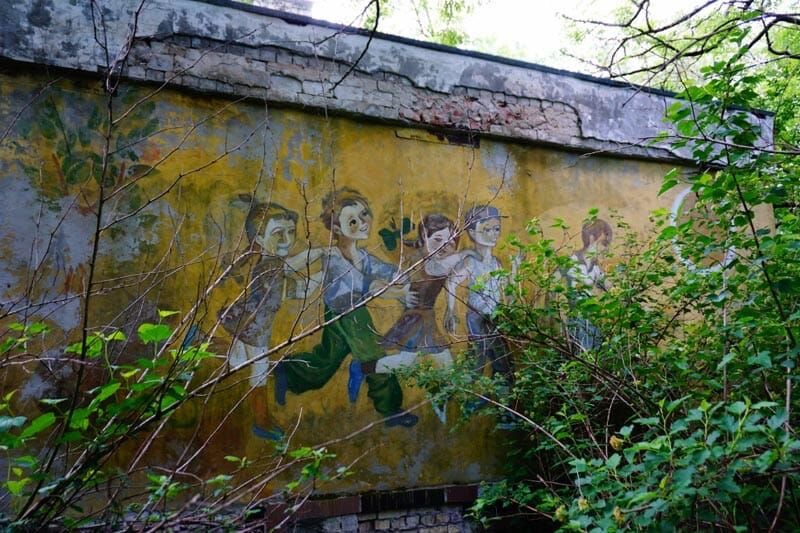
Pripyat School, Today

In August of 1988, nearly 2-1/2 years after that disaster, my friend Gisela and I were on a tour of the Soviet Union that was supposed to have included a visit to Kyiv, the beautiful and historic capital of Ukraine. But we had been notified that, for unexplained reasons, that part of the tour had been cancelled and we were instead going to enjoy a few days in the resort city of Sochi on the Black Sea coast. We didn’t need anyone to tell us why we were going to miss seeing the Great Gate of Kyiv, the stirring monument at Babi Yar, and the Cathedral of Saint Sophia. We knew it was the lingering radiation, and that its effect was still being felt, even 95 miles from Pripyat. (I did get to Kyiv five years later, but that is a tale for another chapter.)

So, from Tbilisi, Georgia, Aeroflot Airline transported us the short distance to Sochi in about an hour, depositing us in a subtropical paradise that seemed totally alien in a land better known for its frozen tundras and birch forests. On the bus ride from the airport to our hotel — the Zhemchuzhina (translation: “Pearl”) — we were astonished to see palm trees, tropical flowers galore, and wide streets lined with beautiful white and pastel-colored buildings.

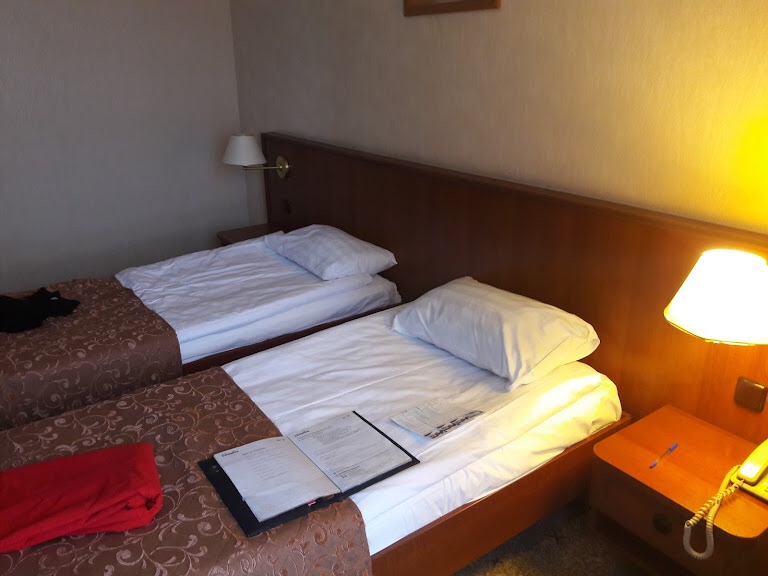
Unfortunately, the Pearl Hotel failed to live up to its name. As with the Cosmos Hotel in Moscow, it was no gem; it looked fine on the outside, but this Pearl’s nacre was only skin-deep. There was a spacious but simple lobby, elevators that mostly worked, and the usual dezhurnaya — sort of a hall monitor — watching out for us (or actually, just watching us) on each floor. And our room contained the expected twin beds (with sheets starched and ironed to a board-like stiffness), a dresser, and a small desk and chair. We found one electrical outlet, located next to the desk at baseboard level, so that when we washed our hair, we had to sit on the floor to use our dryers.

But it was the bathroom that kept us laughing for our entire stay. First was the paper strip affixed across the toilet seat each day, on which was printed a single word in Russian: Disinfected. That was nice, but something we take pretty much for granted in the U.S. — we don’t really need a sign. Still, clean is good.

And then there was the shower. The head and faucet were, quite logically, attached to the wall in an area surrounded on three sides by tile. The fourth side, though, was wide open — no door, no curtain, no tub, no surround of any kind. Not even a lip to keep the water inside. The floor drain in the middle of the shower area didn’t quite keep up with the normal flow of water, so when the shower was running, the entire bathroom — did I fail to mention that it sloped slightly downhill from the shower? — flooded and threatened to flow out to the bedroom, in which event the single electrical outlet on the baseboard would have been in danger of electrocuting anyone unfortunate enough to be sitting on the floor with their hair dryer plugged in. We quickly figured out how to shower with just a trickle of water in as few minutes as possible. And even so, I’m sure the hotel maids were puzzled and less than amused when we kept ordering more towels each day to try to stanch the overflow and returning them sopping wet.

But when on vacation, one does not typically spend a lot of time in the hotel room. Beautiful Sochi awaited.

One of our memorable afternoons was spent at the beach. Now, you readers should please rid yourselves of any mental images you may have of a stretch of beautiful, white sand as far as the eye can see. There was no sand; there were rocks, stretching into infinity. And they weren’t trucked in and spread there for effect; that was the natural “groundscape” (if there is such a word, and if there isn’t, there should be) of that part of the Black Sea shore. The local people, walking barefoot across that unforgiving surface, must have had feet made of rawhide. We Americans unabashedly donned our flip-flops, and I even wore mine into the water, much to Tamara’s amusement.

Rocky Beach at Sochi

And by the way, the name of the Black Sea was not just pulled out of thin air. No Caribbean blue waves for this beach. The water is very still where it meets the shore, and actually is black, or dark gray. There are many theories as to the reason for this anomaly, none of which is particularly appetizing, but we were assured that it was quite safe. However, it was some distance out to where the water was deep enough to actually swim, so we were pretty much restricted to wading in any event, and thus safe from encountering anything gross or treacherous.

Or were we? . . . [Cue “Jaws” music.]

No, there were no sharks, at least not that close to shore. But at one point, I saw Tamara reach into the water and pick something up in her hand. Thinking she had found some sort of treasure, I waded over to see what it was, and was alarmed to note that she was holding a live jellyfish. I shouted something like, “What are you doing? You’re going to get stung!” which made her laugh. She explained that these were not stinging jellyfish, and pointed out that I was already wading in a large gathering of them. “Ewwww.” She was right. But after an initial freak-out, and upon being dared by Tamara, I tentatively reached into the water and scooped up one of the little critters. How did it feel? How do you think it felt? It was viscous, glutinous and muculent (per my online thesaurus) — or, in plain English, slick, slimy and slippery. Back into the water it went, and out of the water I went. Enough of the Black Sea for me, thank you.

By the way, does anyone know the correct name for a group of jellyfish? A school? A herd? A flock? Not that it matters, but being naturally curious, I Googled it, and it turns out to be — drumroll, please — a “smack.” A smack of jellyfish. Not in a million years would I have guessed that one.

But enough of the vocabulary lesson — let’s get back to Sochi.

After dinner and a musical performance that night, we saw from the window of our room — which looked out across the sea — some strange searchlights sweeping back and forth across the water. Asking about it the next day, we were told, very quietly, that it was shore patrol on the lookout for drug runners from Turkey. Even Paradise had its seamy side.

The next day, it was off to the Moscow Circus, which happened to be on tour in Sochi that week. The wonder of it shone from the faces of the scores of children in the audience, who undoubtedly had few such diversions to look forward to from day to day. I even learned from one child seated next to me — a beautiful little girl with two gigantic pink bows in her hair — that the Russian word for elephant is slon — which I assure you has not come up in conversation in any context since then, but for some reason has stuck in my mind. Right up there with zhemchuzhina. And, now also, a smack of jellyfish. Travel, as they say, is certainly broadening.

Walking back from our bus along the flower-lined path to our hotel one beautiful summer evening, we American tourists were mixed in among a number of locals apparently out for an evening of dining and dancing at the hotel restaurant and bar. Staggering toward us was an obviously drunk-out-of-his-mind Russian man, weaving and bobbing along the path and headed straight (or not so straight) at us. He stopped directly in front of me, trying to focus on my face, and smelling like a 1920s bootlegger. As the crowd of onlookers watched with amusement, I tried sidestepping to the left; he went to his right. I went right, he went left. And so on, about five or six times. Finally I bluffed, went the opposite of the way he expected, and he was able to stagger on his merry way. As he passed, I blurted out, in Russian, “Pyanniy durak” — “Drunken fool.” And every Russian person within earshot cracked up to hear a foreigner reacting like a local. I was beginning to feel very much at home in this enormous, strange, and varied land.

We also spent a glorious, but very long, day traveling by bus to a tea plantation near Krasnodar, where we were treated to a delicious lunch followed by an assortment of desserts and — of course — a selection of exquisite teas brewed from freshly-harvested leaves. The inside of the picturesque teahouse was strewn with dozens of antique samovars, any one of which I would gladly have purchased except for two things: first, they were not for sale, and more importantly, as antiques they could not be taken out of the country without a mess of paperwork, and even that didn’t guarantee success. Oh, and a third factor: I couldn’t have afforded one in any event. So I contented myself with a few packages of tea to carry home.

At Krasnodar we were once again educated in yet another new means of dealing with a most basic aspect of life: the bathroom. There were separate outbuildings for men and women, just a short walk from the teahouse. The exterior of the ladies’ facility looked very nice, and the interior was clean and well-kept — or perhaps I should say well-swept, as there was really nothing to “keep.” Nary a toilet, nor a sink, nor any sort of fixture to be found. Just a couple of deep holes dug into the dirt floor of the single large room. Here was a perfect example of the physical advantages that men have over women: they can pee anywhere. But as a woman wearing slacks (and, presumably, underwear), how does one stand over a hole to go without wetting her clothes — short of completely undressing, that is, since there was nowhere to lay the clothes down other than the dirt floor?
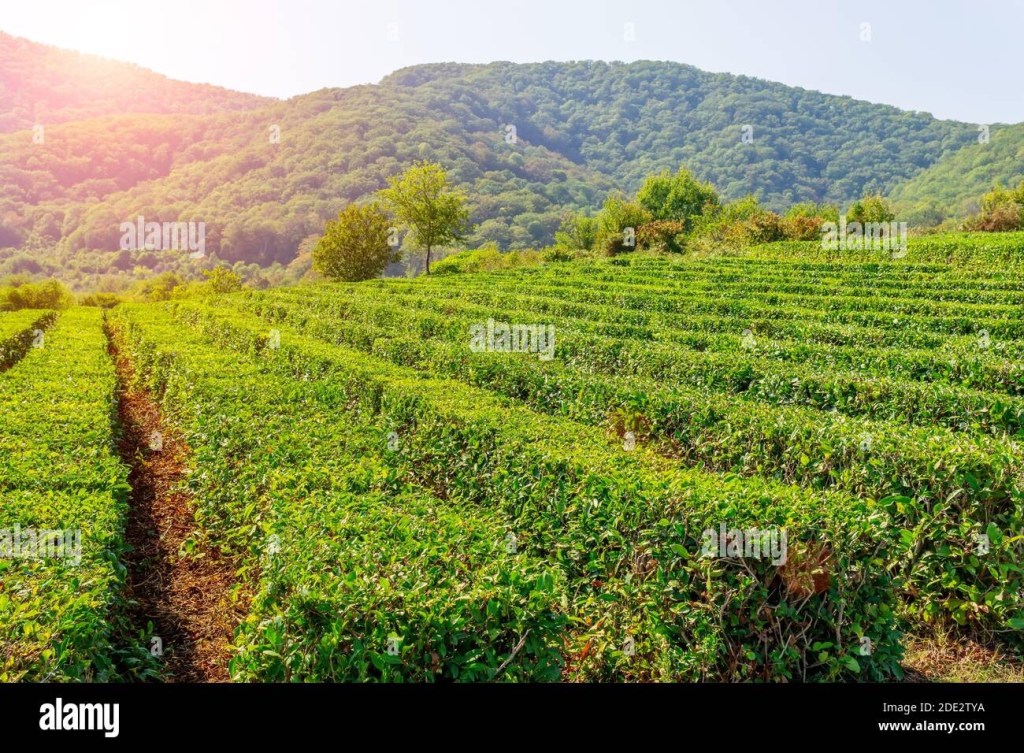
Krasnodar Tea Plantation

As it turned out, the answer was simple but awkward: by removing one leg from the garments and holding them off to the side. Then you plant one foot firmly on each side of the makeshift urinal, and squat. But not too low, of course. And Heaven help you if you have balance problems, as there was no rail or solid object of any kind to hold onto. This also is where those little packs of Kleenex came in handy again, as there was no toilet paper to be seen, either. I wondered momentarily, as I dropped the used tissues into the bottomless pit, whether they were biodegradable, but didn’t linger long on the thought.

All of this actually made the hotel’s bathroom look downright luxurious. But after drinking several cups of tea, and with another long bus ride ahead of us, we got through it relatively unscathed because we had no choice — though it would have been much simpler if I’d had a third hand to hold the Kleenex pack.

At the end of that fun-packed but exhausting day, and after another long bus ride back to Sochi, the whole group was ready for dinner and some much-needed shuteye. I don’t know about the others, but I slept the sleep of the innocent that night.

Then Tamara vanished.

We awoke on our final day in Sochi to find that we now had a young lady named Masha to accompany us on the last leg of our journey. No explanation, no answers to our questions . . . nothing. Just “Hi, I’m Masha, your new Intourist guide.” Even Lisa, our American guide, was unable to learn what had happened. Everything in the Soviet Union seemed to operate on a need-to-know basis, and apparently no one needed to know. Anything. Ever.

(Note: Lest the reader be concerned about Tamara’s fate, never fear — she showed up in my life again a couple of years later, at my apartment in Virginia, after calling and inviting herself to stay for a few days. As my beloved grandmother would have said — and often did — “Oy, vay!” I must remember to include the story of that visit in a later episode.)

And so we were off once more, this time on a somewhat longer flight to Leningrad — since renamed St. Petersburg, the earlier Soviet name having been consigned to the dustbin of history following the collapse of the Soviet Union, right along with all tributes to the tyrant after whom it was named. Of course, Peter the Great — after whom the city was renamed — was no sweetheart either, but we’re not here for a history lesson . . .

It was late August when we arrived in the city on the Baltic that had once been the Imperial capital of Russia. Often referred to as the Venice of the North, it is a city built on 42 islands threaded throughout with canals and rivers, deservedly boasting of magnificent palaces, broad avenues, manicured parks, decorative bridges, domed cathedrals, the Kirov (now Mariinskiy) Theatre . . . and frequent flooding. We toured the Winter Palace (a.k.a. the Hermitage), the Admiralty, a lesser palace or two, St. Isaac’s Cathedral, and rode on a hydrofoil across a stretch of the Gulf of Finland to Petrodvoryets — the incredible Summer Palace of the Tsars. One night, after dinner, we returned to our hotel, the Pribaltiskaya, in an outlying part of the city around 10:00 p.m., thinking it couldn’t be past 8:00 because it wasn’t yet fully dark. But we had arrived in late summer, in time to witness the end of the famous White Nights — which, while certainly fascinating, also turned out to be quite disorienting.
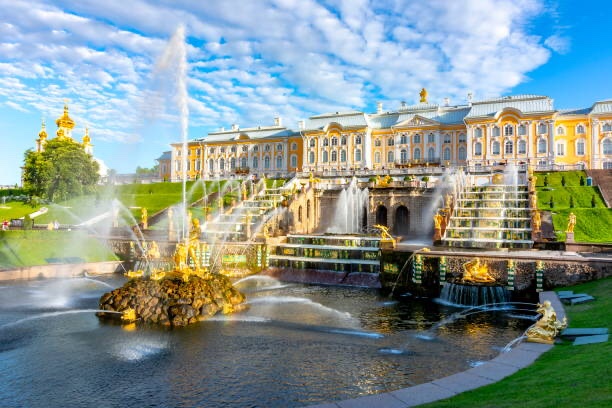
Petrodvoryets – Summer Palace of the Tsars

Gisela and I had one errand to run in Leningrad: a visit to Galina, a woman we didn’t know, but who was a childhood family friend of a young attorney from my firm. Vladimir had been born to a Jewish family originally from Ukraine who, long before his birth, changed their last name to something non-Jewish and managed to find their way to Leningrad to escape the Nazi invasion of their homeland. Smart move, except that they then had to endure the 900-day siege of their new home. But with their adopted name, they survived, thrived, and eventually emigrated to the United States, where young Vladimir, by then a college graduate, was able to attend law school and join Walter Surrey’s firm. He had given me a small gift to bring to Galina, and she invited us to dinner at her apartment. Once again, we missed our evening activity with the group, but it was well worth it.

Leaving our hotel, we were directed by a concierge to a specific taxi, which we had requested earlier in the day. This was a nicer car than most of the taxis — cleaner, and with a tape player and a wide selection of American music tapes most likely bought on the black market, like everything else of any value in those days. But the driver was too friendly and asked too many questions. I had a strange feeling about him, so instead of giving him the exact address, I told him to take us to the intersection near Galina’s building that I had found on a map. He hesitated, asked if I was sure about that, and then finally acceded when I insisted. When we got to the corner, paid him and left the cab, he just sat there and didn’t drive away, but watched to see which way we would go. So we dawdled, fiddling with a purse or the package for Galina, adjusting our jackets and tying an imaginary shoelace, until he finally drove off. Was he being protective, or just nosy? There was no way to know, but it felt decidedly strange.

We had no problem finding Galina’s building. But locating her apartment was a whole new experience. As Vladimir had cautioned me, we found ourselves in a pitch-dark entry, and had to grope for a light switch. The lights were on a timer to conserve electricity, and we hurried up the steps to the second floor before it went dark again. Reaching for the rickety handrail, I immediately recoiled. It was slimy and stank of years — or more like seven decades — of neglect, as did the rest of the building. It was obvious that the common areas had never, ever been cleaned. We couldn’t wait to see what Galina’s communal apartment looked like.

History note: Communal apartments in the Soviet Union dated back to the early Bolshevik days, following the 1917 Revolution. Each family had its own living and sleeping space, but kitchens and bathrooms were shared with other families, usually total strangers (but not strangers for long). Use your imagination — or better yet, don’t.
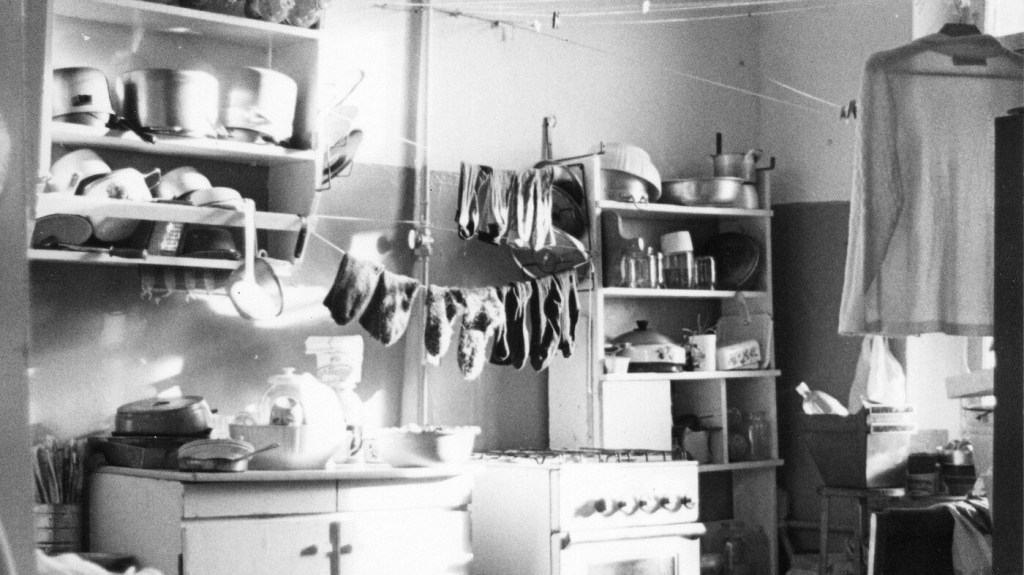
Gracious Living, Soviet Style

Galina turned out to be a lovely, bright, charming woman who spoke little or no English but had studied German, so Gisela was able to act as interpreter when our Russian language skills failed us. Using a combination of three languages, we got along famously. The apartment — the living area, at least — was poor but immaculate. We glimpsed the tiny communal kitchen, from which, by some miraculous feat of legerdemain, Galina had managed to turn out an exquisite meal. When she skipped over the bathroom on our tour, we took the hint and decided it would be wise to avoid it completely. In any event, the typical Russian “bathroom” consists of a toilet in one room and small bathtub or shower in an adjoining room, with the kitchen sink serving a dual purpose. The Russians are very big on “washing up” before a meal, and after the handrail incident I wasn’t about to argue, but we were glad to use the kitchen sink.

After dinner and more talk of life in America vs. Russia, Galina said that she had a gift for us to please carry back to Vladimir, but that she could only pick it up the next day. She asked if we could meet her in the afternoon at St. Isaac’s Cathedral, and we agreed. When we left around 10:00 p.m., carefully avoiding the offending handrail, she turned the hallway light on for us. Then we had to try to find a taxi in a residential neighborhood — no easy feat, since there were no taxi stands and no way to simply call for one. It was late, and the streets in that part of the city were nearly devoid of traffic. We stood on the same corner that we knew from our earlier drop-off, and after a few minutes, a plain car pulled over and the window was rolled down by a woman driver. At that time in Russia, most families could only afford one vehicle (if any), and that one was usually monopolized by the husband, so seeing a woman driver was strange in itself. But when she offered to go far out of her way to drive us to the Pribaltiskaya on the outskirts of the city, and said she would not accept payment, we were suspicious. Yet, with no taxis in sight, we saw no option and finally agreed to accept her offer.
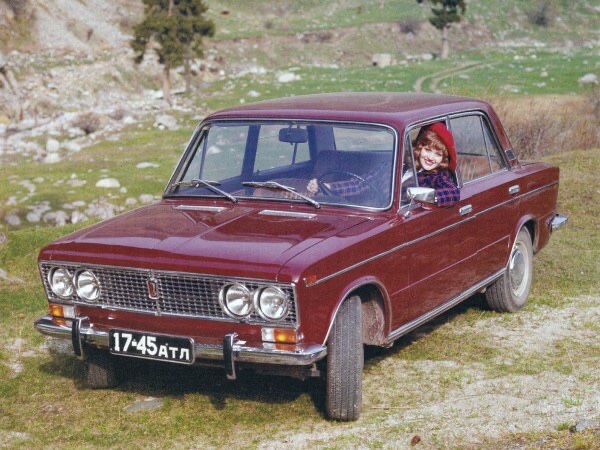
Four Wheels and a Chassis

The woman was an excellent driver, well dressed, and — from what little she said — apparently well-educated, but didn’t talk about herself, not even her name. Nor did she ask many questions of us, which was odd, considering that she had just picked up two female American tourists on a dark street corner in a residential neighborhood in Leningrad at 10:00 at night — certainly not an everyday occurrence. She should at least have been curious about what we were doing there. Instead, she simply drove us directly to the hotel, said a quick goodbye, again refused an offer of gas money, and left without so much as a wave of the hand. Like a Russian Lone Ranger, she was there exactly when we needed her, then rode off into the night — just not on a white horse. The question was: Who was she, and why was she also there at that hour? (I know, that’s two questions, again with no answers.)

The next day, we met Galina at St. Isaac’s as agreed, on the landing outside the main entrance, at the top of the tall outdoor stone staircase. Her gift for Vladimir consisted of two small paintings by his favorite Russian artist, unframed and in a plastic shopping bag. As we talked for a few minutes, I noticed a man standing at the far end of the veranda, smoking and trying to be nonchalant but clearly watching our little trio. He never approached us, and did not follow Gisela and me (as far as we knew) when we headed off toward Nevsky Prospekt for a bit of shopping; so I chose to believe that he was just stationed there for “security” purposes. Maybe so, maybe not.
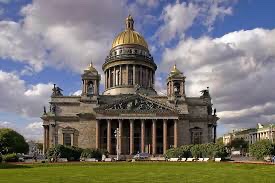
St. Isaac’s Cathedral, Leningrad (St. Petersburg)

Even here in Leningrad, far from Moscow, we seemed to be of some interest. But to whom? And why? Was this just common practice with American tourists? Or because we sometimes ventured out on our own, without our group and Tamara or Masha? Or because of Viktor Akimov and Georgi Karpov again? I’ll never know. It was like being in a bad spy movie, and we were enjoying it — or maybe just imagining it — like a couple of big kids.

Despite our little escapades, we survived our tour of the USSR, which was now drawing to a close. We hated to leave, but had no option: when your visa expires and your tour group goes home, you’d better be with them. But there was one last bit of rather sadistic fun. One of our group — a woman whose entitled attitude had not endeared her to the rest of us — had inadvisedly decided to purchase one of those outrageously expensive samovars, not at the tea house, of course, but at an antique shop in Sochi. She knew she couldn’t sneak it out in her luggage, so she very openly, and wisely, declared it at Customs. Seeing that it was a genuine antique, the Customs agent told her, in no uncertain terms, Nyet!!!! Despite the papers the antique dealer had given her, this was not allowed, and her treasure was confiscated. Several of us had tried to warn her, but she wouldn’t listen. I don’t know what she paid for it, but she might as well have flushed the money down a disinfected toilet. She just couldn’t understand why she hadn’t been able to bully the Customs agent into letting her have her own way — the sort of American tourist who gives all American tourists a bad name — or why she didn’t receive a lot of sympathy from her fellow travelers.
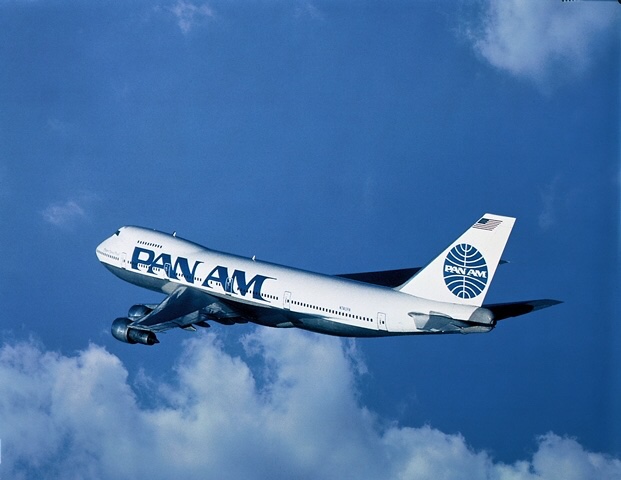
Homeward Bound

And finally, we were aboard our PanAm flight home. After lunch in the airport during our stopover in Helsinki, Finland, and a much-needed nap on the plane, we arrived safely at JFK’s international terminal in the late afternoon, jet-lagged and suffering from reverse culture shock. But that one excursion to a foreign land had been enough to infect me with an incurable case of travel fever. It would be a year and a half before my next overseas trip, but when the opportunity arose, I was more than ready. In the meantime, life at home was anything but dull.

See you next time, when I chronicle my return to “civilization.” Enjoy your weekend, and be well.

Brendochka
1-19-23 (re-posted 11/___/23)

Ch. 4 – If It’s Tuesday, This Must Be Georgia

Having survived our first day in Moscow, Gisela and I joined Tamara and our group of adventurers in the lobby and experienced a typical Russian breakfast in the hotel dining room. Not bacon, eggs and toast; not cereal and fruit; not even a bagel with cream cheese. We were proudly served Russian black bread (deliciously reminiscent of my grandfather’s from my childhood), sliced cheese, some sort of thinly-sliced salted meat, a plate of tomatoes and fresh herbs, and a choice of coffee or tea. It was certainly . . . well, as my mother used to say when she didn’t care for something but didn’t want to hurt another person’s feelings . . . different.

As the others took off toward the exit to begin their first tour, Gisela went back to our room to wait for me while I headed to the coffee shop to meet with Georgi Karpov. She and I had agreed that we would stick together throughout the two-week trip, and had also arranged to take advantage of this morning away from Tamara’s eagle eye to visit the American Embassy. The husband of one of our former classmates was stationed there, and had suggested that we drop by to register our presence in the country, “just in case” — hardly a comforting thought — so that was our plan for the remainder of the morning.

Shortly before 9:00, I settled at a table facing the door, ordered a cup of tea, and waited for an unknown man who would appear unsure of whom he was supposed to be meeting. He arrived precisely on time, but had no difficulty identifying me. I was the only woman sitting by herself, and I was fairly certain that Viktor had given him some sort of description.

Georgi headed right to my table, introduced himself, shook my hand (rather weakly, I noted), and sat opposite me, ordering a cup of tea. He was totally unremarkable: medium height, medium build, graying hair, unmemorable face. He was “Mr. Cellophane” — the invisible man. He spoke excellent English, and we talked a bit about my job and about Viktor, how he and I had become acquainted at my law office in Washington, and what a shame it was that he was on holiday and not in Moscow to greet me. I told him about the shavers and our client’s hopes for future sales in Russia. And then we ran out of conversation.

A little hesitantly, Georgi inquired whether there was anything else he could do for me during my stay in Moscow, and pointedly offered: “Do you need to buy some rubles? I can help you.”

Whoa! Warning bells began chiming in my head. Walter had wisely cautioned me about all sorts of things to look out for, and this was near the top of the list. In 1988 it was, even under Gorbachev’s more relaxed reign, still illegal for Russian citizens simply to possess hard currency, much less to trade rubles for dollars, pounds, francs, etc. Either I was talking to the most stupid individual in Moscow, or the most dishonest; or — worst-case scenario — it was an outright provocation, designed to establish whether I might be a naive, and thus vulnerable, American. I looked him straight in the eyes . . . and lied my ass off.

“Thank you so much, but I’ve already purchased rubles at the bank here in the hotel.”

I had done no such thing. But there was a bank in the hotel, and I was going to buy rubles that morning, so it was almost the truth. The important thing was, he bought it. He appeared disappointed, but he also seemed to have run out of excuses to hang around. Standing and shaking my hand again — still rather limply — he said his farewells and retreated with the two shavers, but without any of my dollars. I paid for the tea with the few rubles I had acquired at the airport the previous day — he made no pretense at reaching for the check — and headed for my room to reconnect with Gisela.

And the fun had only just begun. Exiting the hotel — remembering to stop first at the cashier’s window to load up on more rubles — we found what appeared to be a taxi stand outside. There was also a bus stop nearby, with a little old man standing there, obviously waiting for a bus. On the far side of the expansive, semicircular driveway was a parked vehicle with a suspicious-looking, younger man leaning against the driver’s-side door. But there were no taxis at the moment, so we settled in to wait. After a few minutes, the guy across the way stood up straight and began sauntering toward us. He was respectably dressed in casual slacks and sport shirt, but projected a distinctly cocky attitude. Walking up to us, he asked — in English — “You need taxi? Where you going?”

His car was not a taxi, but I thought it best not to be rude right out of the starting gate, so I said, in Russian, “American Embassy. How much?”

“Fifty.”

“Rubles?”

Nyet. Dollars.”

Oh, crap! What was it with these people and their dollars? So I forgot about politeness and said, “No, that’s too much. And dollars are illegal. And, by the way, your car is not a taxi.”

He continued to insist that he was a taxi driver and that it was legal for him to charge dollars, so I decided it was time to end the conversation. I recalled a wonderfully obscene Russian expression that I had learned for just such an occasion, that translates to “[Do something unspeakable] to your mother,” and I let ‘er rip, in Russian. Obviously more than a little surprised at the expletive coming from the mouth of a respectable-looking American woman, he finally shrugged and slunk his way back to his non-taxi.

Meanwhile, the little old man by the bus stop had silently been taking in the entire exchange. He now took a few steps to my side, slapped me repeatedly on the shoulder, and said, “Molodyets. Nyet dollari. Molodyets!” (“Good for you. No dollars. Good for you!”) As with the handsome young man at passport control in the airport the day before, I seemed to have made this gentleman’s day as well. Obviously, it didn’t take much to amuse these good Russian people, and I was happy to oblige.

Just then, a legitimate taxi arrived and took us — for far less than the ruble equivalent of fifty dollars — to the Embassy, where the line of locals hoping to obtain visas to visit the U.S. was a good half block long. But as U.S. citizens, we went to a different entrance. After passing inspection by the Marine guards, we met with our friend’s husband, left copies of the front pages of our passports and our itinerary, and managed to grab another taxi back to the hotel in time for lunch and the afternoon tour. Tamara was clearly relieved to see us, and I could only imagine what flack she must have caught for letting us out of her sight for the entire morning. And frankly, that thought made my day. She was already not my favorite person, and we offered no explanation or insight into where we had been or what we had been doing for the past four hours, which of course she was dying to know in order to report back to her bosses.

After a few more fascinating but thankfully less eventful days in Moscow, which included the usual tours of the Kremlin and Red Square, an evening at the ballet in the Kremlin Theatre, and dinners in neighborhood restaurants with wonderful food and folk musicians, it was onto an Aeroflot plane (a bone-chilling experience in itself) and off to the Soviet Socialist Republic — today the sovereign nation — of Georgia and its historic capital, Tbilisi. (The “T” is silent. I don’t know why.)

This was a whole different world. The climate was milder, the older architecture vaguely Middle Eastern, and the people quite handsome and freer in their attitudes and lifestyles. A lot freer. Our hotel was in the center of town on a street called the Shata Rustaveli, very conveniently located within walking distance of shops, restaurants, and a Metro station. Our tours included a visit to a centuries-old monastery; a performance by a troupe of fearsome male Georgian dancers whose kneecaps surely were destined to be shattered by age 30; and a terrifying bus trip into the wildly beautiful Caucasus Mountains, to the ancient capital of Mtsxeta. (That is not a misspelling; don’t even try pronouncing it.) The ride was terrifying because of the condition of the steep, narrow, winding mountain road, and the glee with which the driver alternately hugged the edge of the cliff and took aim directly at every pothole, in a bus obviously lacking any sort of shock absorber, not to mention seat belts. But we concentrated on the magnificent scenery, and — not for the first or last time — survived the seemingly unsurvivable.

Mtsxeta, Georgia

We also had some free time in Tbilisi, during which Gisela and I, along with some other of our new American friends, took in a few local sights on our own, including a Metro ride to a vast outdoor market. The foods were fresh and wonderful, though the sight of newly-slaughtered piglets hanging unrefrigerated in the hot August midday was a bit disconcerting. And I drew quite a crowd of local ladies when I took a small pack of Kleenex from my purse and extracted one to blow my nose. I didn’t know how to explain in Russian what they were, so I said something like “papers for the nose, then you throw them away,” accompanied by some very exaggerated gestures. They were awestruck, and I finally gave the pack to the nearest woman, who thanked me as though she’d just hit the lottery.

That evening, we were treated to a delicious dinner in a Georgian restaurant where Tamara read the limited menu to us and took our orders. She then invited Gisela and me (obviously teacher’s pets, despite the fact that the affection was not mutual) to join her in a back room with the mafioso-looking owner of the establishment, where she placed the order for all our dinners and haggled over the cost, which was then tallied by the owner on a centuries-old abacus. In 1988, Georgia was still stuck way, way, wa-y-y-y back in the past. Sort of a Caucasian Brigadoon. Frankly, that was a large part of its charm.

After dinner, we returned to the hotel, and Gisela and I took a stroll down the street, stopping at a small sweetshop for some ice cream to top off our decadently caloric dinner. On the way back, we passed an alleyway where we saw a neon sign about halfway down, written in both Georgian (totally unintelligible) and Russian. I was trying to read the sign without actually entering the alley, when a man came up behind us and gestured toward it, clearly suggesting that we might want to accompany him there. Oh, goody — a date for the evening. Do you suppose he has a friend?

But seriously, the internal alarm bells were clanging again. Having read about the human trafficking problems in that part of the world, both Gisela and I started backing away, saying in unison, “Nyet! Nyet! Thanks anyway,” and hightailed it up the street to our hotel, where we joined the groups of people enjoying the summer evening in the plaza out front. For some reason, we hadn’t quite been able to see ourselves as some Caucasian warlord’s arm candy. Go figure.

Then things really got lively. A car that had been passing rather quickly on the street suddenly hit the curb, blew a tire, and came careening toward the fountain in the plaza, where we and a whole lot of other people were standing. It hit the fountain’s concrete surround and came to a stop, mercifully without running anyone down. A young woman in the front passenger seat jumped out with a package in one hand, ran back to the street, and hopped into a second vehicle that was stopped there and appeared to have been following the first car.

In the meantime, the driver of the damaged car was still behind the wheel, trying unsuccessfully to disengage his vehicle from the fountain, when several uniformed police officers appeared out of nowhere like a bunch of Keystone Kops and surrounded his car. But these guys were no silent movie comedians; they were on a serious mission. One of the officers had a German shepherd on a leash, who began sniffing the vehicle and apparently gave the signal to the officer that something was amiss. While they were searching the car, obviously for drugs, the young woman had returned to the scene of the crime — without the package — and was trying to blend into the crowd, nonchalantly pretending that she had just arrived. But a good citizen — or snitch, depending on your point of view — pointed her out to the police, and she too was taken into custody. When I looked toward the street again, the second car was gone, leaving the young woman and her companion to face the consequences.

The whole thing probably took no more than ten minutes. The damaged car was hauled off, the police disappeared back into their dark corners, and the spectators returned to enjoying the night air. It may as well have been a scene from a play, as it was obviously not considered newsworthy as far as the locals were concerned. Life went on as usual.

Of course, we also had with us for the entire two-week journey an American tour guide: a young woman named Lisa, who was blonde and blue-eyed, quite pretty, and not too bright, and seemed content to remain in the background and allow Tamara to run things. The day after the drug bust, she tried to convince me to accompany her, at the invitation of a Georgian man she had just met in the hotel lobby, to a Thursday night service at the local synagogue. Now, please tell me what is wrong with this picture: A strange man, in a strange and dangerous land, who somehow knew she was Jewish, inviting her to a service in a synagogue on a Thursday night?!! I explained the facts of life to her, emphasizing the parts about the trafficking of fair-haired foreign women in Georgia, and how no synagogue anywhere in the world holds services on other than Friday nights and Saturdays, and told her that if she even thought about going, I would tie her to her bed until it was time to leave the city. I must have been really convincing, because she believed me. That girl seriously needed to rethink her career choice.

Anyway, that was Tbilisi, my kind of town: never a dull moment. But all good things must end, and soon we were on our way, courtesy of Aeroflot again, to our next stop. (Or, as I’d heard it called, Aeroflop. Very reassuring.)

*. *. *.

Once again, I’ve gone on longer than intended. I’ll finish our tour of the Soviet Union next week, first in Sochi, a semi-tropical paradise on the shores of the Black Sea, followed by much more European Leningrad on the Baltic in the waning days of the White Nights.

TTFN,
Brendochka
1/12/23

Ch. 3 – Welcome to Moscow, Mrs. Gorbachev

In 1984, I enrolled in an evening course at the local community college. My children were grown, and I found myself luxuriating in some quiet time in the evenings and on weekends. Watching what passed for TV entertainment was not an exciting option, and I’m simply not an artsy-craftsy person (no talent); so I decided on the next most logical thing to fill my free time: the study of a second language. Why not?

Actually, at the time, I was envious of some of my co-workers who were bilingual or multilingual. When I thought about studying a foreign tongue, I recalled high school French class, where I had learned the grammar and vocabulary but exhibited what any self-respecting Parisian would consider a truly insulting accent. So that’s when I came up with the obvious next choice: Russian. “Why obvious?” you ask? Well, it was a genetic thing. All four of my grandparents had emigrated in the early 1900s from what is now Ukraine but was then part of the greater Russian Empire, and their entry documents to the United States listed their nationalities as Russian. So I have always identified as a second-generation American of Russian descent, until recently; now I proudly introduce myself as a second-generation American of Ukrainian descent, for obvious reasons. But something about Russia stays with me: her history, her culture . . . even her interminable misery.

Our class, which met twice a week, started out with about 27 students. By the end of the first semester, we were down to a close-knit, hardcore group of 12 survivors. Some called us masochists, but we didn’t agree. Together with our amazing teacher — a delightful lady from Moscow named Ekaterina, who was now a citizen of the U.S. — we had a wonderful time exploring the intricacies of an impossible language, and delving into Russian history, literature, and politics on the side. One day, when Ekaterina learned of my Russian/Ukrainian ancestry, she shook a finger at me and exclaimed, “Aha! It’s in your blood” — thereby consigning me to a lifetime obsession with all things Slavic.

After three years, one of my classmate friends, a German woman named Gisela, and I decided it was time to get a first-hand look at the mysterious place we had been studying for so long. In 1987, we began planning and putting aside money for our trip, and in August of 1988, we were off. Which is just what our families and friends thought we were when we told them where we had chosen to take our big (and my first) overseas vacation. We didn’t care. We signed up with a tour leaving in mid-August, packed some clothes, walking shoes, and every over-the-counter medication we could think of, and headed into the unknown.

But first . . .

Oh, yes, first there was my boss Walter Surrey’s reaction. When I told him of my plans, his initial thought was, “Well, what am I going to do for two weeks?” Then, sensing a business opportunity, he remembered Viktor Akimov. And he also remembered a client who had been trying to sell his company’s product, an electric men’s shaver, in various parts of the world including Russia. And here was I, the perfect middleman. So, contrary to Russian law restricting foreigners’ business activities under tourist visas, two electric shavers also went into my luggage as “gifts” for Walter’s old friend Viktor.

We sent a telex — high-tech in those times — to Viktor, advising him of my impending arrival and itinerary. We did not hear back from him before my departure date, but I had his phone number with me, and instructions to ditch the shavers before coming home if I was unable to find him.

After an exhausting trip from DC to New York and overnight from New York to Moscow (an eight-hour time difference), we arrived at Sheremetyevo Airport looking like a bunch of . . . well . . . just what we were: bedraggled American tourists. We were greeted by Tamara, our official Intourist guide (one of a slew of government-controlled organizations directly answerable to the KGB), claimed our luggage, and headed for Passport Control. There were two lines open, and I was steered to one that was manned by a tall, blond, handsome young man with an appropriately stern facial expression. I put my passport, open to the front page, in the little tray at the base of the bullet-proof glass window. He picked it up, checked the visa, looked at the picture, looked at me, looked at the picture, looked at me, looked at . . . oh, well, you get the idea. Then he asked, in his best, heavily-accented English, “This your photo?” At the time, I was a 40-something, reasonably decent-looking redhead, not easily disguised, so yes, it was obviously my photo. I replied, in my best, American-accented Russian, “Yes, that is I.” Ekaterina was a stickler for grammar.

Tall-blond-and-handsome began again: looked at the passport, looked at me, looked at the passport, etc., and finally asked: “You sure this your photo?”

Enough, already. The impatient, impetuous, and somewhat impish American in me burst forth, and I smiled, this time answering in English: “Well, it’s not Raisa Gorbachev.”

Oh, my God! This was the hockey puck fiasco all over again (see last week’s episode), but worse — I was now on their turf. I began to wonder what the inside of a Russian prison looked like and what the usual sentence was for being an American smart-ass.

But miraculously, “Sourpuss” broke rank and actually smiled. Barely managing to stifle an audible laugh, he stamped my passport and waved me through, and I knew I had made his day. Welcome to Moscow, Mrs. Gorbachev — or whoever you are.

After a long and thorough clearance procedure through Customs, we were finally in a bus on our way to the impressively large Cosmos Hotel, nowhere near the center of Moscow but still within the city limits. The outside was fairly nice; the interior, not so much. Face it: it was shabby, without the chic. Our luggage made it off the bus and into the lobby, and when everyone else had claimed their two bags, there remained . . . nothing. An empty cart. My bags were nowhere to be seen.

“TAMARA!!!”

Poor Tamara. Missing luggage was the last thing she needed to deal with. Muttering a very Russian “Oy,” she set to work earning her pay. She consulted someone at the front desk, who shrugged and said something unintelligible while waving a hand in the direction of a staircase. Tamara told me that I had to go — by myself, since she couldn’t leave the rest of the group — downstairs to “Lost and Found.” In the basement. Of an enormous Russian hotel. In Moscow. Alone. Even Gisela wasn’t allowed to come with me.

With our exhausted and puzzled group waiting anxiously in the lobby, I steered my shaky legs down the steps to a large, dimly-lighted, unfurnished and unoccupied room. I called out — “Hello?” — and waited. After a few seconds, I called out again, louder. Hello?!! Finally, a man emerged from behind a closed door, and I told him I was looking for my two suitcases. Showing him my baggage claim check, and carefully spelling my name, I waited while he went back through the same doorway. About 12 hours later — all right, it was just a couple of minutes, but it felt . . . you know — he returned, miraculously with my actual bags, which seemed no worse for the wear. I resisted hugging him, but did say thank you about 100 times, and struggled back up the steps, shlepping my bags behind me. My fellow travelers heaved a collective sigh of relief when I returned in one piece, and we all headed for our assigned rooms. But as Tamara handed Gisela’s and my room keys to us, I swear she looked at me strangely. Or was I simply coming down with early symptoms of Soviet paranoia? I didn’t have any pills for that.

Gracious Living at the Cosmos Hotel

By now, we had been in Russia for several hours, between the lengthy airport processing, the bus ride, and the mystery of the disappearing suitcases, and it was nearly time for lunch with our group in the hotel dining room. There was just enough time to take our things to our room. Gisela and I reached our floor and introduced ourselves to the dezhurnaya — the female concierge (a.k.a. watchdog) on every floor — entered our room, set our bags down, began to look around . . . and the phone rang. “What the hell . . . ?”

Well, when a phone rings, you answer it — right? So I did, and a man whose voice I didn’t recognize asked for me by name. He introduced himself as Georgi Karpov (not his real name), a colleague of Viktor Akimov, who he said was on holiday and had asked him to get in touch with me as requested in Walter’s telex. All of that made sense, but what was totally spooky was the timing of his call, as though he had known precisely when we reached our room. Maybe it really was coincidence. Or that pesky paranoia.

In any event, we arranged to meet in the hotel’s coffee shop the next morning at 9:00, right after the group’s scheduled 8:00 breakfast. And then I had to tell Tamara that Gisela and I wouldn’t be joining the group on their first tour the following day because I had an early meeting with an official from the Foreign Ministry, after which we had an appointment at the American Embassy. Way to blend into the crowd, Brenda. Predictably, Tamara was less than amused, but had no recourse. I knew that she was, however, required to report any anomalies to her superiors, who in turn reported directly to the scary folks at KGB headquarters. First day, and I’m already on their radar. Oh boy!

After a quick lunch in the hotel dining room, we were herded back onto our bus for a driving tour of some of the city’s highlights — no stops, but views of the outside of the Kremlin, the entrance to Red Square, the front of the Bolshoi Theatre, and the like. The real tours were to start the next day. Then dinner in a rather nice restaurant, back to the hotel, and up to bed. As we unpacked our bags, Gisela and I staged the first of what were to become our nightly chats for the benefit of the hidden microphones in the room; found that the shower actually dispensed hot water; and slept rather soundly, all things considered. So far, so good.

* *. *

This tale is getting a bit long for a single post, so I will leave you here until next week, when I will expand on Mr. Karpov and his attempted provocation; the “gypsy” (unregistered) cab driver and his attempted provocation; a near-kidnapping (us) and an actual drug bust (not us) in Tbilisi, Georgia; and perhaps a few other improbable but absolutely true tales from the pages of my journals. See you then.

Brendochka
1/5/23

Ch. 2 – My First Commie

Whew! Christmas has come and gone, and we stand once more on the cusp of a new year. I hope everyone made it through the snowy, blowy holiday without too much difficulty, and that we can all ease into 2023 in good spirits — and I don’t just mean a hot toddy . . . though that’s not a bad place to start.

Now, to pick up where I left off last week . . .

If you think hard enough, you’re likely to recall one moment in your life when an event, a chance encounter or a decision changed the entire course of your future. In my case, it was taking a job I wasn’t even sure was right for me (or vice-versa). In fact, none of my most memorable adventures would have taken place were it not for that job and one extraordinary individual: the late Walter Sterling Surrey. So it’s only fitting that I begin this week’s post with a bit about him.

Walter was short, rather homely, and totally unremarkable — until he began to speak. That’s when the force of his personality, his brilliant mind, and his Puckish humor made themselves known, but without ego or pretension. It was that force that convinced me to accept the job offer and give international law a try.

Walter was a prominent Washington attorney with an expansive international transactional practice and clients doing business in such scary places as China, the Soviet Union and Iran. Before that, he had been in the OSS (precursor to the CIA) during World War II; joined the U.S. Department of Justice after the war; then moved to the State Department, where he became the chief legal draftsman of both the Marshall Plan and the NATO Treaty. Later, he worked with Richard Nixon and Henry Kissinger to reopen relations with “Red” China. Not a bad resume.

What I loved most about Walter, though, were his totally irreverent sense of humor and his genuine concern for people. It’s the down-to-earth side of him I’ll be sharing with you from time to time, beginning now.

But first, a brief personal note: I am a night person. I hate early mornings. They’re way up there on my “things-to-avoid-at-all-costs” list, right next to cleaning the toilet and scooping dog poop with nothing but an inverted plastic baggie between my naked hand and the steaming pile of poop. Oh, and cilantro, which to me tastes like soap.

However, like most of the rest of the world, I spent the greater part of my life conforming to someone else’s idea of a “normal” workday: up with the *#&#*$*! alarm clock; fighting the morning rush-hour traffic in all sorts of weather; fighting the mid-afternoon energy slump; fighting the evening rush-hour traffic in the same lousy weather; and — after all of the fighting was over for the day — falling asleep on the couch around 9 p.m. in the middle of a TV rerun that had been dreadful the first, second and third times around so why was I watching it again with a half-eaten Chinese takeout dinner congealing in its container on the tray table by my side?

It was different, though, for the ten years I worked with Walter, at a time when the practice of law was first and foremost about service to the client, and not just the almighty dollar. I was happily up before the sun, out of the house by 7:15 (a.m.!), in the office by 8, breakfast and lunch at my desk, no time for a mid-afternoon energy crash, on the go at Mach speed until 6:30 or later, having side-stepped the worst of both rush hours, and still raring to go for the next day.

God, how I loved that job!!

Most of Walter’s early mornings in the office were devoted to getting his thoughts organized for the day. But occasionally there would be a pre-office-hours visitor who preferred not to be seen by the dozens of people arriving for work around 9:00. One such was Viktor Akimov (not his real name). I hadn’t been working with Walter for more than a few weeks when he said to me one day that he needed to meet with this man from the Soviet Embassy, and that it had to be an early a.m. appointment. This was in 1979 — remember the Cold War? — and I believe my response was the same as anyone else’s would have been:

“Did you say SOVIET Embassy????”

Yes, that was indeed what he had said. He explained that, because there existed at the time no private industry in the USSR, all business had to be conducted with the appropriate government ministries in Moscow — light industry, heavy industry, oil and gas, agriculture, and so on — and that a contact in the Embassy was essential to making the necessary introductions. Viktor Akimov was that contact.

Old Soviet Embassy, Washington
(Now Russian Ambassador’s Residence)

So, with some trepidation, I consulted the first of the two gigantic Rolodexes on my desk. Again, remember that this was 1979, way before the advent of electronic contact lists, or much of anything else electronic. In fact, we were still typing on IBM Selectric typewriters, which, as you older readers may recall, did not have an “Undo” key.

Anyway, I found Mr. Akimov’s business card identifying him as a diplomat in the Economic Affairs Section at the Soviet Embassy in Washington. Nervously, as though he might somehow be watching me through the phone lines, I dialed his number. He answered his phone just as I was thinking, “Oh damn, now what do I say?” As it turned out, though, his English was excellent, his manner was cordial, and we confirmed an appointment for the following morning. That night, I anxiously anticipated the next day when I would finally see what a real Soviet official looked like.

I’m not sure what I was expecting. Probably a thug with a bad haircut, ill-fitting cheap suit, and hideous vinyl shoes. But that was not at all what I saw when I walked to the reception area to greet the man I had already labelled in my mind as My First Commie. He was attractive, well-dressed, and quite charming — just your average businessman type. He clearly had to be a spy, right?

Right, indeed — as confirmed two days later, when I received a call from Mike (also not his real name), an FBI agent seeking one of those early a.m. meetings with Walter. Putting Mike on hold, I ran into Walter’s office and whispered, rather dramatically, “FBI. Are you in trouble?” He smiled, shook his head, and replied, “Oh, yeah — I forgot to tell you to expect him.” The next day, Mike showed up to meet with Walter behind closed doors. It didn’t take much for me to figure out that we were dealing with the KGB. This was going to be one hell of a job!

And for ten years it was, until we lost Walter in 1989. But much more about him in later episodes.

As for Viktor Akimov, he and I developed a pleasant rapport over time and I found that — contrary to my initial mental image of a typical Soviet official — he had a sense of humor. I first discovered this when he happened to have an appointment with Walter on the day following the 1980 Winter Olympics hockey match at Lake Placid where, in what was later dubbed the “Miracle on Ice,” the American team whipped the Soviet team’s collective ass by a score of 4-3. As I escorted him from the reception area to Walter’s office, I politely asked Viktor whether I might get anything for him: “Coffee? Tea? Hockey puck?”

[Pregnant pause . . . ]

Holy Mother of God! Had I really just said that?!!

Yes, I really had. And no, despite my worst fears, I did not lose my job. Nor, apparently, did I do any damage to U.S.-Soviet relations, which already were — as they are today — pretty much in the crapper. In fact, Viktor laughed. Walter laughed, too, when I later confessed my faux pas. Life went on; it was, after all, not the end of the world. On the contrary, for me it was just the beginning.

* * *

I hope you’ll join me after the New Year’s celebrations have died down, for a trip in 1988 to what was then still the USSR, and my introduction to the bizarre world of spies, lies and “misplaced” luggage. See you next year, and until then, stay safe and warm.

B
12/29/22

Ch. 1 – This Is Me

I once climbed a mountain in Czechoslovakia.

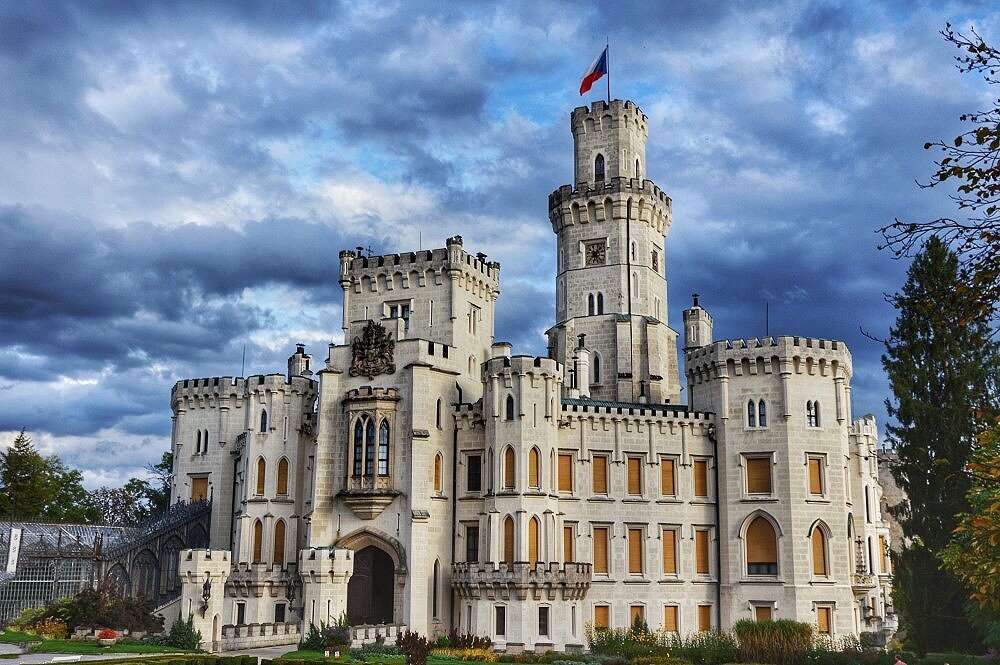
Well, it was part of a mountain, anyway — more of a long, steep incline, really, to an historic castle inexplicably named Hluboka, which is Czech for “deep.” I’ve never understood why they chose to call it “deep” rather than “high” or “tall” — but no one consulted me about the name.

Hluboka Castle
Czech Republic

In Moscow, I spent countless hours strolling through the Kremlin, Red Square, Novodevichy Monastery, the Sparrow Hills, and numerous historic cemeteries. Moscow has no mountains, but it does have an over-abundance of cemeteries.

In Alaska, I took the easy way up the mountainside on the White Pass Railway; squeezed into a tiny float plane to glide over the incredibly beautiful, endless glaciers; and ate salmon roasted over an open fire in a clearing by a forest full of bears.

I also climbed the cobblestone steps numerous times to Hradcany, or Castle Hill, in Prague. Actually, what appears architecturally to be a castle on that hill turns out to be St. Vitus Cathedral, while the Presidential Palace nearby is a lovely but far more modest edifice. Very confusing — but that’s Prague for you.

In London, I dodged the advances of an amorous Russian Foreign Ministry official; in Budapest, I took a boat ride up the Danube to an artists’ village called Szentendre; I witnessed a drug bust in front of our hotel in Tbilisi, Georgia; played with a jellyfish in the Black Sea at Sochi; in Kiev, I visited a hospital for child victims of the Chernobyl nuclear disaster.

And in Helsinki, Copenhagen, Tallinn and Berlin, I racked up uncounted thousands of steps as a tourist, unfortunately without a pedometer to log them for me.

I’ve been nearly mugged in St. Petersburg (Russia, not Florida), ridden in the King’s Elevator in the Royal Palace at Stockholm, and been driven to Sheremetyevo Airport by the KGB as I left Moscow.

All of my grand adventures took place in the late 1980s, throughout the ‘90s, and into the early 2000s, until the years started to catch up with my bones. Now on the far side of 80, I no longer have the mobility or the energy to climb the cobblestone steps to Hradcany, or fold my legs into a little float plane. But I am forever grateful to have done all of those things when I was able, and to still have the joy of remembering the adventures and the people who lived them with me.

But having something of value — even of intrinsic value, like a happy memory — is not much good if you can’t share it. And since my family and old friends have heard the stories many times over and are sick to death of them, I’ve decided it’s time to make some new friends, and hopefully to amuse you with tales, in no particular order, of the places I’ve been, the people I’ve known, and the close calls I’ve had, and to show how all of my earlier experiences ultimately led me — innocently skipping like Dorothy along the yellow brick road — to Russia. Life can be endlessly amusing, if you overlook the bad stuff and hold on to the good.

I invite you to join me for Chapter 2, when I will introduce you to the person who most influenced the second half of my life (thus far), and how he in turn introduced me, at the height of the Cold War, to My First Commie.

In the meantime, Happy Holidays to all, and to all a good night, from Brendochka.