Having a wonderful time reminiscing about all my past travel (and other) adventures. Hope you’ll share them with me in my blog, “All Roads Led to Russia.”
I don’t know whether this picture is of Yun Chuan or Xin Bao, but it really doesn’t matter. They are the newest couple in residence at the San Diego Zoo in California . . . and the first pair of giant pandas to be sent to us from China in 21 years.
I do know that since the days of the first pair to arrive at the National Zoo in Washington, D.C. in 1972 — Ling Ling and Hsing Hsing — the indescribably adorable pandas have been a symbol of successful diplomatic relations between the United States and the People’s Republic of China.
Just look at that face! Wouldn’t it melt the stoniest of hearts? Who cares if they’re Chinese, American, or Martian? All they ask is a comfortable place to sleep, a couple of toys to play with, their daily ration of 40 pounds of bamboo to munch on . . . and to be treated kindly.
I always knew it, but at last, there is proof. I really am smarter than the average bear.
I recently ran across an article titled “Why ‘doing nothing, intentionally’ is good for us: The rise of the slow living movement.” [Holly Williams, BBC, August 8, 2024.]
Well, hell’s bells . . . I knew that years ago. It’s called “retirement,” people.
Happy Older People
But then I read the entire article, and that’s not at all what the author was talking about. It seems the woman about whom she was writing — an author, podcaster and entrepreneur named Emma Gannon — decided to battle the burnout resulting from her frenetic lifestyle by experiencing “a year of nothing.” As she put it, “No work, no emails, no career progression, no striving or achieving or being productive.”
Right . . . retirement. But younger. And it’s expensive. How many people can afford to do that, or have family circumstances that would allow them to just drop out for a year?
Elon Musk (as if you didn’t know)
Okay, maybe this guy. But you know perfectly well that’s never going to happen. Because he thrives on the stress of overwork.
Luckily for Ms. Gannon, though — who was truly in need of a long stretch of serious R&R — she was able to manage it.
But what the Millennials have discovered (or think they originated) is something called #SlowLiving (with six million hits on Instagram). And the GenZ folks have come up with”quiet quitting” and “lazy girl jobs,” where they do the minimum at work to preserve their energy for the more “meaningful” parts of life, such as hobbies, relationships, or self-care. [BBC, id.]
Well, I hate to tell you this, but I’ve worked all my life with a wide variety of people, and quite a few of them fit that “lazy girl” description long before it even had a name. It turns out, they were just plain lazy — goof-offs who made life harder for those of us with a good, old-fashioned work ethic, and who then had to carry their load along with our own. And by the way, a couple of those slackers managed to get themselves fired, so it’s probably not a terrific idea.
“Hey, come on, guys!”
But there are always two sides to a situation. In this age of cut-backs for the purpose of minimizing expenses and maximizing profit for the upper echelon (oh, sorry, was I not supposed to bring that up?) . . . well, anyway, in today’s work environment, many employers are making do with fewer employees and requiring them to pick up the slack and produce the same amount of work as the larger pool of workers did.
And that’s a big part of the reason for the meltdowns and the slowdowns and the general job dissatisfaction. People are simply burning out. I saw it myself in the last couple of years before I retired; and according to friends from my last job who are still there, it’s only gotten worse.
*. *. *
So let’s say you’re one of the lucky ones who can take a year off, not have to declare bankruptcy during that time, and still have a job to come back to when you’re fully rested. What are you going to do with all that extra time?
Well, yes, I suppose that’s one possibility. But realistically . . .
Your options depend on a number of factors: what your interests are, what your financial limitations are, and even where you live.
The first thing that comes to a lot of people’s minds is travel. Personally, that’s always been my favorite. But restful? Not these days. Have you been through an airport lately? Or squeezed into a coach seat on a plane? Or tried to deal with the entitled passenger who insists you change seats with her because she and her boyfriend were too stupid to book seats together?
But it might be worth the hassle if you’re going to one of those amazing spas . . .
That could work. Expensive, though, and wouldn’t last for the entire year. So for the other 50 weeks . . .
How about doing some of that volunteer work you’ve never had time for? But that can be stressful too — and she did say “no achieving or being productive.”
Okay, you could write that book . . . Nope. Requires typing and it’s productive and possibly an achievement. Not allowed.
Catch up with old friends. Sorry, no emails. Maybe phone calls, except that all of those friends are at work.
Cooking classes? Too much like work — all that peeling, slicing, dicing, chopping, blending, and cleaning up afterwards. Also, you’d be sticking to a class schedule, and that’s stressful.
There’s always time for social activity, though: going to the theater, checking out the newest restaurants in town, getting hot-stone massages, going shopping . . . But aren’t we on a no-income-for-a-year budget? And who’s going to go with you? All of your friends are . . . I hate to repeat myself . . . working.
*. *. *
Get my drift? Unless you’re seriously, clinically stressed out — I mean, physically and/or emotionally hanging by a thread, in which case you definitely need to get help — then maybe Ms. Gannon’s extreme cure isn’t for you.
And if you need confirmation, just ask me. I have nothing but time on my hands, and I will testify — hand-on-the-bible swear — that it’s not all it’s cracked up to be. And I’m not restricted from using a computer or being productive. But I miss the good old days — well, except for the commuting in traffic and having to get up at the crack of dawn — when I felt as though I might actually be accomplishing something worthwhile. And enjoying the company of co-workers. And going out to lunch. And receiving a paycheck twice a month.
Probably not that much, but still . . .
So maybe the answer isn’t a year off, or a work slowdown. Maybe you could just start planning a lovely, restful, two-week vacation. Or book a massage once a month. Hire someone to clean your condo for you. Score tickets to a great play or concert.
Or have you ever thought of looking for a new job? That could work.
Ten days ago, sixteen of Putin’s political prisoners were released from various prisons and penal colonies in Russia . . . traded for eight Russian criminals being held in several European countries and the United States. The world celebrated, and the sixteen people who had done nothing more than voice their opposition to Vladimir Putin’s repressive regime are now re-starting their lives. The road ahead may not be an easy one, but they are free to take whatever direction they may choose. And I have no doubt we will continue to hear from them as they carry on the fight against Putin’s tyrannical dictatorship.
Three who continue the fight: Kara-Murza, Pivovarov and Yashin
But eight Americans — and hundreds of Russian dissidents — remain locked up in Russia. So we continue to remember them each week, and will do so until each and every one has been returned home.
But one in particular, Ksenia Karelina, a dual U.S.-Russian citizen, was not included in the exchange because her case had not yet come up for trial. Russian regulations require that sentence be pronounced before a prisoner can be eligible for a possible “swap,” and she missed the deadline by just a week.
A resident of Los Angeles, Karelina was visiting family in Yekaterinburg, Russia, in February of this year, when she was arrested and charged with having donated $51.80 — while in the United States — to a charity that offered assistance to Ukrainian war victims. Her trial began on August 8th, at which time the prosecutor asked that she be sentenced to 15 years in prison for “treason.” A guilty verdict is a certainty; only the sentence remains in question.
Ksenia Karelina – “Hostage of the Week”
*. *. *
Marc Fogel, a schoolteacher from Pennsylvania, was arrested in August of 2021 for possession of 0.6 ounce of legally-prescribed (in the U.S.) medical marijuana. In June of 2022 he was sentenced to 14 years in prison.
Marc Fogel
*. *. *
Robert Romanov Woodland, a dual US-Russian citizen, was teaching English in Russia when he was arrested in January of 2024 for allegedly attempting to sell drugs. In July, he was sentenced to 12-1/2 years in a maximum security prison.
Robert Romanov Woodland
*. *. *
U.S. Army Staff Sergeant Gordon Black was stationed in South Korea when he fell into a Russian “honey trap.” He was on his way back to his home in Texas, on two weeks’ leave, when he was lured to Vladivostok by the Russian girlfriend he had met in Korea. He was arrested in May of 2024 on charges of alleged larceny and murder threat, and sentenced the following month to a prison term of three years and nine months.
Staff Sergeant Gordon Black
*. *. *
Robert Gilman, already in jail in Russia serving a 4-1/2-year sentence (later reduced to 3-1/2 years on appeal) for kicking a police officer in 2022, found himself facing added charges in 2023 of punching prison staff in the head, and later also attacking a criminal investigator and another prison guard.
Robert Gilman
*. *. *
David Barnes, an American citizen and resident of Texas, was arrested in January of 2022 while visiting his children, who had been taken to Russia from Texas by his Russian wife. He was charged and sentenced in the fall of that year to 21 years in prison for child abuse (allegedly occurring while in Texas), on his wife’s accusation. I really wish I knew more of this story!
David Barnes
*. *. *
Eugene Spector, a dual US-Russian citizen already serving a four-year sentence handed down in June of 2021 on a bribery conviction, received additional charges of suspicion of espionage in August of 2023. No other details have been found, as the evidence is labelled “classified.”
Eugene Spector
*. *. *
Michael Travis Leake, a rock musician and former paratrooper, was sentenced in July of this year to 13 years in prison on drug charges — specifically, suspicion of selling mephedrone, and organizing a drug trafficking business “involving young people.”
Michael Travis Leake
*. *. *
Are any of these prisoners actually guilty of the charges leveled against them? I don’t know. But I do know that the recent timing of a number of the arrests, and the speed with which they were brought to trial, is a clear indication of Russia’s intentional roundup of American citizens to be used as (what I call) Putin’s Pawns.
What they are, quite simply, are HOSTAGES. And they will not — MUST not — be forgotten. Let’s shorten this list to zero.
Science is a wonderful thing. It can tell us how far away Pluto is (not the Disney dog — the planet that isn’t a planet anymore, but maybe it is, or not, because no one seems to be sure). And it can tell us what’s going on in the insides of our bodies (though it can’t fix everything just yet). And it can allow us to create artificial entities that look and act just like real people (except that the hands are always too big, too small, or just in the wrong place).
And now — wonder of wonders, miracle of miracles! — science has proven that J.R.R. Tolkien knew something the rest of the world didn’t: He knew that Hobbits were real.
Living Proof
Of course, the folks at New Line Cinema were sure of it all along, or they wouldn’t have produced the movie series that made all of their investors incredibly wealthy. But the world was still full of unbelievers; and to all of you, I say . . .
Pffftt!!
So how has science come to verify what has long been consigned to the category of science fiction? Perseverance, that’s how. By not giving up on a mystery dating back to a discovery made in 2003, when archaeologists found a teeny-tiny human skull on the Indonesian island of Flores.
They found other small bones as well, and at first assumed they were all those of a child from ancient times. But there were teeth, and the molars were those of an adult. A very small adult.
And voila! They realized they were looking at “a newfound kind of human who lived 60,000 years ago: Homo floresiensis.” [Ashley Strickland, CNN Science, August 10, 2024.]
An Adult Humerus (Upper Arm)
Okay . . . I will freely admit that science was my worst subject in school. Therefore, I will not be attempting to explain how the scientists were able to identify these bones, or how they figured out how old they were . . . or, indeed, how they knew they weren’t just the bones of a “normal” person suffering from dwarfism. All of that is beyond me.
But I am convinced it is proof of Hobbits. And if they investigate that island very, very thoroughly, I would be willing to bet they will find this . . .
Hobbit Hill
. . . or a reasonable facsimile.
And they can argue all they want to about studies, and tests, and methodologies, or whatever. As far as I’m concerned, they can take their test tubes and microscopes and computers, and put them where the sun don’t shine.
Because in today’s world of global warming, and wars, and artificial intelligence — and even at my advanced age — I still prefer to believe in the fantasy.
Thank you, Hurricane/Tropical Storm Debby, for all you have left behind: the flooded roads and buildings, weakened dams, broken pavements, sinkholes, disrupted lives and businesses . . .
And the overabundance — unrequested and unwanted — of mushrooms and army worms. The former are sprouting all over our back yard like . . . well . . . like toadstools.
‘Shrooms by the hundreds
And the latter are everywhere, devouring the nourishment that had turned our lawns green — for a while. And now they’re brown. The lawns, that is. And the army worms too, I guess.
Army Worms: Not your ordinary caterpillar
Oh, and don’t forget these guys.
Them Ol’ Cottonmouths Back Home
They’re showing up everywhere on people’s properties, and they’re scary as hell because some of them, like the cottonmouths, are venomous. We have children and pets. We don’t need snakes. This is not the Garden of Eden!
Wasn’t once enough?!!
So please, Mr. Sun, keep shining. Bring back the nice, hot weather that will dry out our soggy lawns and gardens, send the snakes back into their snake holes, and fry the army worms to a delightful crisp. As for the mushrooms, I guess we’ll just have to keep hacking away at them.
At least until the next big rain event. This is, after all, the southern swampland.
The following was re-posted yesterday by Russian journalist Aleksei Venediktov:
A real-life horror story
It is the true story of an incident involving an 87-year-old man on a bus in the center of Moscow. I have chosen to attach the article in its entirety in order to present the full story in all of its horror. The English translation is not the best, but it is clear enough to be understood. Please take a few moments to read it in its entirety.
And this is the victim of the story: Dmitry Pavlovich Grinchia — a kindly, peaceable old gentleman, minding his own business, who happened to express an opinion in a public place about Vladimir Putin’s bloodthirsty mercenaries, the Wagner Group, and had the misfortune to be overheard by the wrong people. He survived, but given the extent of his injuries and his age, he will never be the same.
What makes a comic book — no, not even a whole comic book, but just the cover art — worth $7.5 million dollars? That’s right — $7,500,000 U.S. dollars. And specifically this:
First appearance of Marvel hero Deadpool
At least, that’s what Heritage Auctions is estimating it could bring at its upcoming auction.
Now, I am not a comic book aficionado. I haven’t read one since I was about nine years old. They were pretty simplistic back then — Superman, Wonder Woman, Archie — and we loved them. We couldn’t wait for the next issue of each one; we’d read them a few times, and then they went into the stack for the paper drive. That was during World War II, and we collected everything for the war drives. After the war, we simply threw them away.
Really . . . who had space to save everything? And why would you? It was just paper. And later, when I had children of my own, who would have thought to save the Barbies, the GI Joes, the Hot Wheels, those hideous Cabbage Patch dolls, or the even uglier Trolls that belonged under a bridge? And save the boxes? How could you do that? You bought them for your kids to play with, not to stash on a shelf in case they might someday be worth something. That would have been ridiculous.
Troll Dolls: So ugly, they’re almost cute
But some people did, and still do. They collect everything. And when it becomes overwhelming, those people are called hoarders. They’ve even become the subject of a really depressing TV series. But somewhere in some of those hoards there could be an item or two worth some real money. I mean . . . millions!
But how do you know? And where do you draw the line on collecting? I’ve never been that lucky. I collect books, because I love them. And music CDs, because I love music. They’ll never be worth more than the original price. I did collect the U.S. State coin series, and they’re estimated at a bit more than face value; but they’ll never make me rich. I have a few items — a signed, numbered lithograph by a now-dead artist, for example — that could net me a few thousand dollars. But $7.5 million?
Ha!!!
“Lotsa luck!”
So, okay. So I’m not that lucky . . . or, apparently, that smart. But I go back to my original question: Why? Why is something like a comic book cover worth that kind of money to a collector? Who decides those things? And are they really a good long-term investment, or could they one day become just more junk? I watch Antiques Roadshow, you know; I’ve seen how some items can depreciate.
So with my luck, or lack of it, I’ll stick to proven winners, like gold. That is, if I can ever afford to buy it.
At 71, the Russian human rights activist found himself in prison in February of this year, sentenced to 2-1/2 years for writing an article opposing the war in Ukraine — something that would never have happened in the pre-Putin days.
Like most Russians, Orlov had high hopes for his country following the dissolution of the Soviet Union in 1991 and the passage of democratic reforms. But the euphoria of that decade was not to last far into the new millennium. With the accession to the presidency of Vladimir Putin in 2000, it all began a rapid downhill slide back to the days of suffocating repression, onerous new laws against dissent, and totalitarian enforcement. And Orlov’s words were used against him.
Arrested . . . Tried . . . Sentenced
He didn’t know, of course, that he was being warehoused as another pawn in a highly secretive political operation that was to culminate in an historic prisoner exchange between Russia and seven Western countries in the near future.
But less than six months later, he was unexpectedly moved from his jail cell in central Russia. He expected the worst: a transfer to a penal colony. But that didn’t happen. First he was told to write a clemency request addressed to Putin, which he flatly refused to do. Then he was driven in a van to an airport in Samara and flown to Moscow with a number of other people.
In Moscow, he was placed in the notorious Lefortovo Prison, where he was kept in isolation for three days — not even allowed access to his lawyer. Orlov feared that the authorities were simply building another, more serious case against him. Although he knew he had committed no crime, he said, “They would find [one] without a problem. The repressive machine . . . has been put in motion and it runs on its own. The machine works to sustain itself and can only intensify the repressions, make them harsher.” [Dasha Litvinova, Associated Press, August 9, 2024.]
Finally, however, he was given a document saying that he had been “pardoned,” and put onto another plane, this time with other dissidents who had likewise been freed. Miraculously, they were flown to Germany, where they were greeted by Chancellor Olaf Scholz.
German Chancellor Olaf Scholz, welcoming newly freed Russian political prisoners
A happy ending? Well, yes and no. The unjustly imprisoned dissidents were free; but they were also homeless. They had not been allowed to remain in their homeland, but had been shipped off to Germany without their consent. What the future holds for each of them is as yet unknown.
Orlov — co-founder of the Nobel Peace Prize-winning rights group Memorial — has vowed to continue his work with the group. He says there are things that can be done, even from outside of Russia, such as maintaining the database of political prisoners and coordinating assistance to them. And as long as there are still political prisoners — estimated by Memorial at more than 760, and as many as 1,300 according to another rights group, OVD-Info — the work must continue.
Because, as Orlov says, the horrors will only be stopped when Putin’s “repressive, terrorist regime” ceases to exist. [AP, id.]
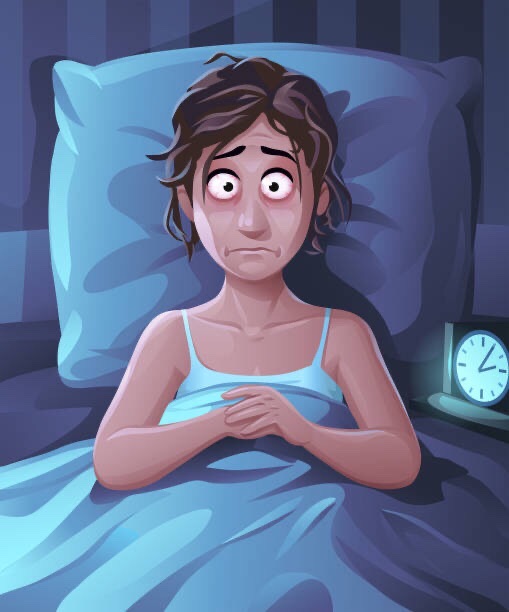
Have you ever gotten up in the morning, looked in the mirror, and realized that this is how you felt?
Or this . . .?
I know exactly what you mean. One of the first things I do each morning is check the headlines of the day’s news. And you know it’s mostly bad news. Frequently about this guy:
Or this one . . .
Or him:
And that makes you feel kind of like this . . .
Or this . . .
Or simply this . . .
But sometimes a story will make you feel as though the whole world is out to get you, and you begin having wild, paranoid delusions, as though this . . .
Or this . . .
Or, God forbid, this . . .
. . . is watching you.
Well, if that happens, you naturally want to find a solution to the problem.
Perhaps there’s a potion:
Or you might just hide under the covers, like this smart fellow . . .
But you don’t, because you know . . .
So you think about standing up and fighting, like Tiananmen Square “Tank Man”:
Yeah . . . right. Like you’re gonna stop a tank.
Well, then, how about giving this to the world . . .
Oops — wrong fingers, Betty. But you’ve got the right idea.
And they can just kiss your . . .
But actually, what you probably need is simply this:
No, no, not that! This:
A little TLC, and a lot more sleep. That’s my prescription . . . and maybe then it won’t feel like such a bad world after all.
As expected, the downstream effect continues. I never really focused before on how close that twisted river is, or the little creek that flows from it toward our neighborhood. We’re fine, but some of the folks nearer the river haven’t been as lucky.
On the other hand, all of this water has brought the snakes up for air, including some venomous ones. Eeww!
“Them old cottonmouths back home“
But that’s life in the swamp: colorful, picturesque, and very much alive.