Maybe . . . just maybe . . . we’re a little more civilized than we were 170 years ago. Or, more likely, we’re just more underhanded in the way we take our revenge on our perceived enemies.
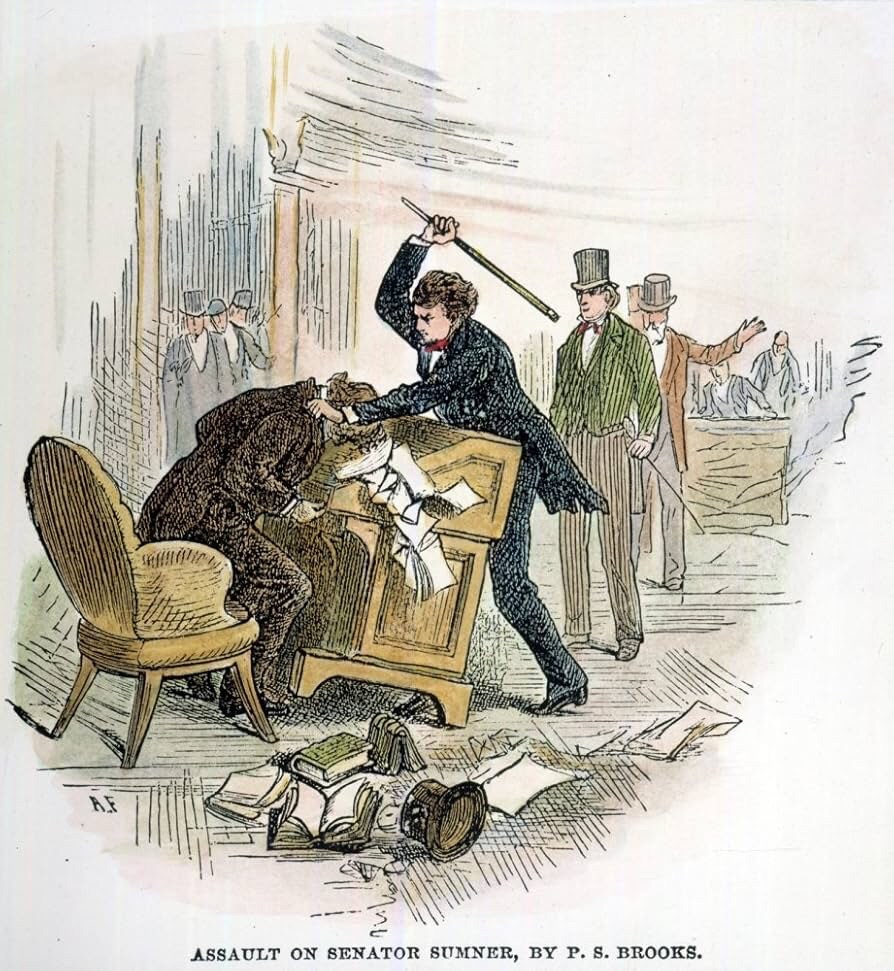
Case in point: the caning of a Northern U.S.. Senator by a Southern U.S. Congressman over the most controversial issue of the day: slavery.
In 1856, slavery had already been banned in the Northern United States for more than 30 years. But the passage of the Kansas-Nebraska Act of 1854 had granted the new territories of Kansas and Nebraska the right to decide the slavery issue by vote, nullifying the Missouri Compromise of 1820.
Northerners were incensed; violence broke out in the Kansas Territory; and by 1856, the U.S. Congress had become embroiled in the issue. On May 19th, Massachusetts abolitionist Senator Charles Sumner began a two-day filibuster, raging against the “crime against Kansas,” and naming three of his colleagues, including pro-slavery South Carolina Senator Andrew P. Butler. [“This Day In History,” History.com, May 22, 2026.]
On May 22nd, Butler, then elderly and ill, was absent from the proceedings. But his cousin, Representative Preston Brooks of South Carolina — a man with a history of violence — decided it was his duty to defend his relative’s honor. Walking with a cane as the result of injuries incurred in an 1840 duel over a different political issue, Brooks entered the Senate chamber and attacked Sumner with his cane, trapping him behind his desk which was bolted to the floor. It was only due to the intervention of other legislators that Sumner escaped with his life. [Id.]
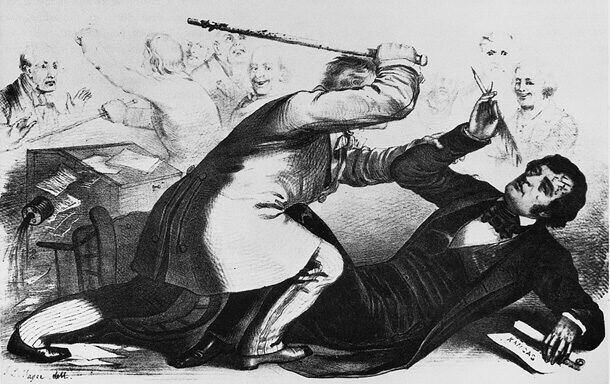
But he suffered severe head injuries from the bludgeoning by the heavy, metal-topped cane, and was forced to vacate his Senate seat for three years in order to recuperate. His seat remained empty during his absence, his Massachusetts colleagues refusing to replace him and choosing instead to leave his desk empty as a public reminder of the horrific event.
As for Brooks, while he was reviled in the North, he was celebrated as a hero in the South. The U.S. House of Representatives was unable to garner the two-thirds vote required for his expulsion; but he resigned in protest, and his South Carolina constituents immediately re-elected him. [Google AI Overview, May 22, 2026.]
*. *. *
Even then, it seems, there was the occasional bad egg in government, with the ability to escape accountability for his unconscionable actions. But Brooks was one of a very small minority; and he was acting out his personal anger and frustration — not following the commands of an authoritarian president.
So are we indeed more civilized today? Or have we simply learned to use quieter, more devious methods of dealing with our adversaries, rather than resorting to physical battery?
I’m not sure which is worse.

Just sayin’ . . .
Brendochka
5/22/26
 The Blog About Everything … and Sometimes Nothing