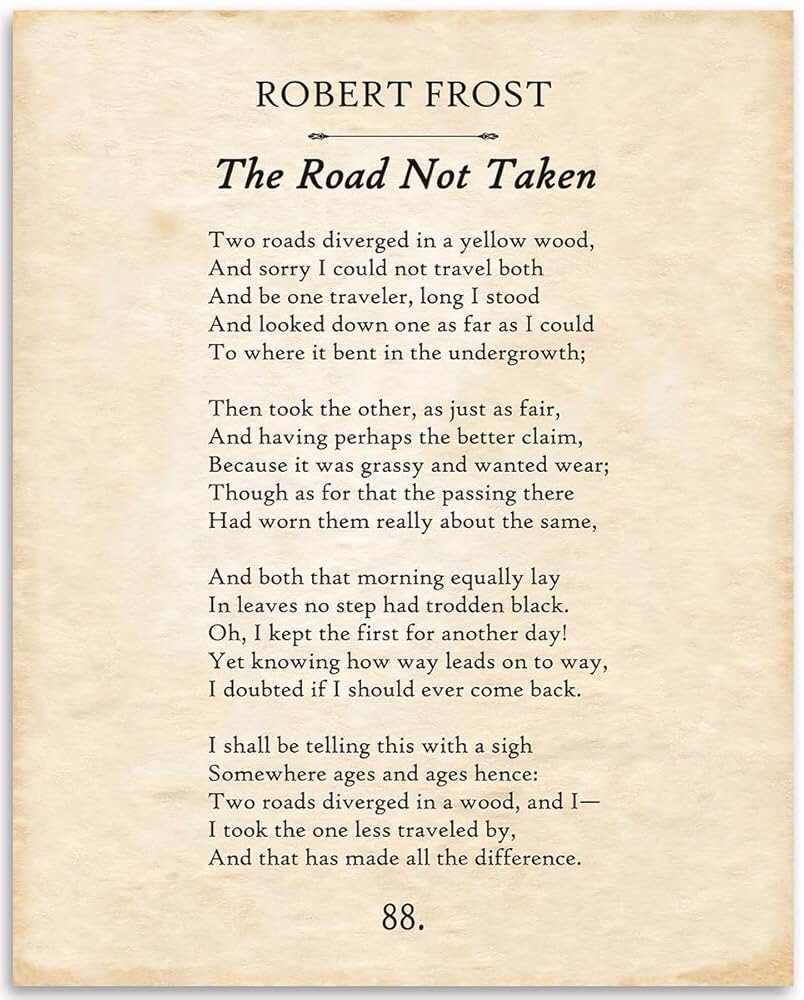
While taking a leisurely stroll — or scroll — through Facebook the other day, I chanced upon a reproduction of one of my favorite poems: Robert Frost’s “The Road Not Taken.” It was accompanied by this beautifully dream-like picture, and I sat staring at it for a full five minutes as my mind took its own backward saunter through time.

Suddenly, it was 32 years ago, and I was faced with a do-or-die choice that would alter the immediate course of my life . . . with just seconds to make my decision. There were no road signs in those woods. Which way to go?
I remember it all so clearly . . .
*. *. *
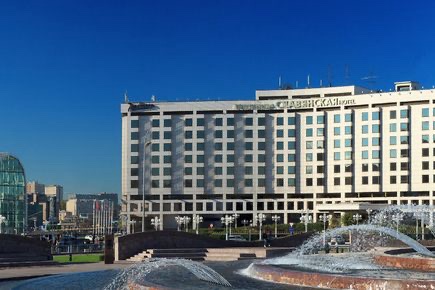
1993: Another bitter cold, snowy February in Moscow — the second in a row for me. But it was warm in the Business Center of the Slavyanskaya Radisson Hotel as I sat waiting for the Russian to arrive and recalled our last meeting, just a year earlier at this same spot. He hadn’t been well then, suffering (he said) from arthritis and preparing to go into the hospital for some form of surgery. And he had seemed at loose ends, having resigned from his government position with the Soviet Foreign Ministry to try to build a new life in the chaotic Russia of the 1990s.
His name was — and I presume still is — Valentin Aksilenko. (I can only presume, because I haven’t seen or spoken to him for 30 years.) I had met him in the course of my work in a Washington, D.C., international law firm in 1979, when he was stationed in the Soviet Embassy in the U.S. He was that rare Soviet official who actually knew how to get business done between his country and ours, and was happy to be able to help. Smart, competent and relatable, he had been a tremendous asset to our firm’s clients in building mutually beneficial commercial relations. So we had stayed in touch from time to time, even after his return to Moscow.
And then he was there . . . bundled against the cold and the snow, striding across the room like his old self, and not the ailing man I had seen the previous year. As I stood to shake his hand and greet him, I was delighted to note the renewed strength of his grip.
We sat on comfortable chairs perpendicular to one another and began — as people do who have not seen each other for some time — talking about events of the past year. And as the conversation turned to the subject of his new position as a consultant to a British firm, I had no inkling of the bombshell that was about to be dropped in my lap.
As though it were the most ordinary of comments, I suddenly heard Valentin say, “I am so glad to finally be out of intelligence work.”
And I thought I felt my heart stop.
Back in the early ‘80s, when he had been serving as First Secretary for Economic Affairs at the embassy in Washington, we had always known that virtually all of the higher-level embassy officers were members of, or at the very least reporting to, the KGB. It was just the way the Soviets operated. But of course, the unwritten rules of the Cold War game dictated that everyone, on both sides, pretend otherwise.
And yet here he was, never before having admitted that he was in intelligence, flat-out telling me how happy he was to be out of it. What was I supposed to do now?
As luck would have it, I didn’t have to do or say anything for the moment. He just kept on speaking about how his life had changed over the years, and I listened . . . waiting for what would come next. Because this was not a man who spoke carelessly.
But then he became quiet, leaning forward to gaze at the carpeted floor, his forearms resting on his legs, hands clasped between his knees. The silence was . . . well, not ominous, exactly, but unsettling. After what felt like hours but was surely less than a minute, he seemed to come to a decision. Raising his head, he sat back with a sigh, and began speaking again.
“I have a friend . . .”
*. *. *
To be continued . . .
*. *. *
Brendochka
1/1/25

