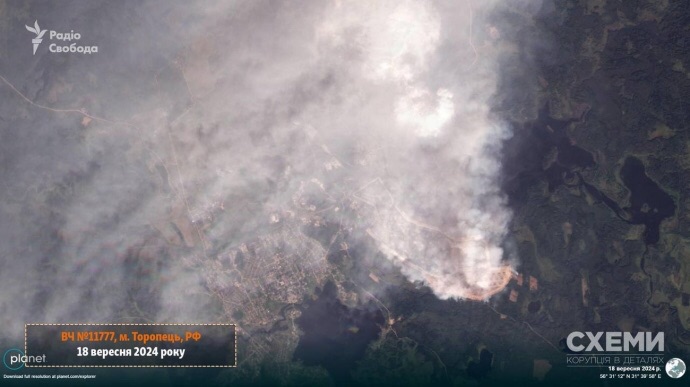
On Wednesday, September 18th, Vladimir Putin’s war against Ukraine came closer to home again, when Ukrainian drones struck an arms depot in the Tver region, some 200 miles north/northwest of Moscow.
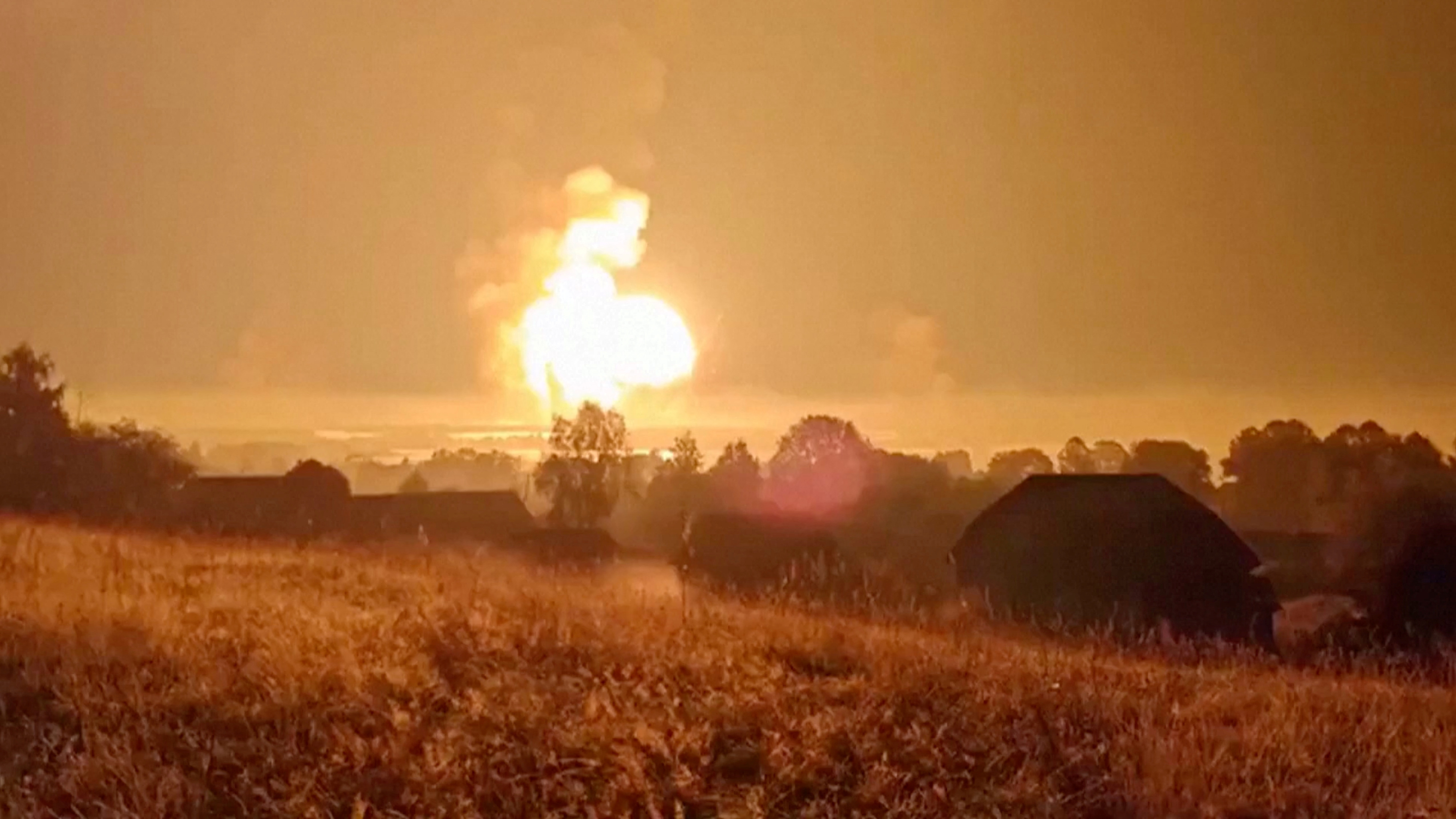
The Kremlin said the area had been hit by falling pieces of drones that had been destroyed by Russia’s defenses. But the evidence says otherwise: the blasts were strong enough to have been detected by earthquake monitors, and NASA satellites sensed intense heat sources from an area of about five square miles at the site. Multiple detonations were heard, and social media videos and photos (as yet unverified) showed the purported result of the strike. An entire nearby town was evacuated. [Lucy Papachristou and Lidia Kelly, Reuters, September 18, 2024.]
According to Russian military blogger Yuri Podolyaka, “The enemy [Ukraine] hit an ammunition depot in the area of Toropets. Everything that can burn is already burning there (and exploding).” [Id.]
A Ukrainian source said the drone attack had destroyed a warehouse storing missiles, guided bombs and artillery ammunition. But the governor of the Tver region, Igor Rudenya, downplayed the damage, saying merely that the drones had been shot down, a fire had broken out, and some residents were being evacuated.
The storage facility had in the past been touted by former Deputy Defense Minister Dmitry Bulgakov as “protect[ing] them [the stored weapons] from air and missile strikes and even from the damaging factors of a nuclear explosion.” [Id.]
But one woman, on one of Russia’s VK chat groups, had this angry response to the attack:
“Why wasn’t the ammunition underground?! What are you doing???? In Kudino, houses were blown away! Why is the forest burning and no one is there… What kind of negligence is this!!!!” [Id.]
Sounds like more than a simple difference of opinion to me.
*. *. *
Russia, of course, calls this aggression; Ukraine and its Western allies know it for what it is: a successful counteroffensive.
And this was accomplished without the use of the controversial long-range U.S. missiles that Ukraine has been seeking permission to use. That decision remains to be made by the U.S. and its NATO allies, and Vladimir Putin continues to threaten retribution if permission is granted.
This week, outgoing NATO chief Jens Stoltenberg dismissed Putin’s warnings, saying:
“There have been many red lines declared by him before, and he has not escalated, meaning also involving NATO allies directly in the conflict. He has not done so, because he realises that NATO is the strongest military alliance in the world. They also realise that nuclear weapons, nuclear war, cannot be won and should not be fought. And we have made that very clear to him several times.” [Dmitry Antonov and Lucy Papachristou, Reuters, September 18, 2024.]

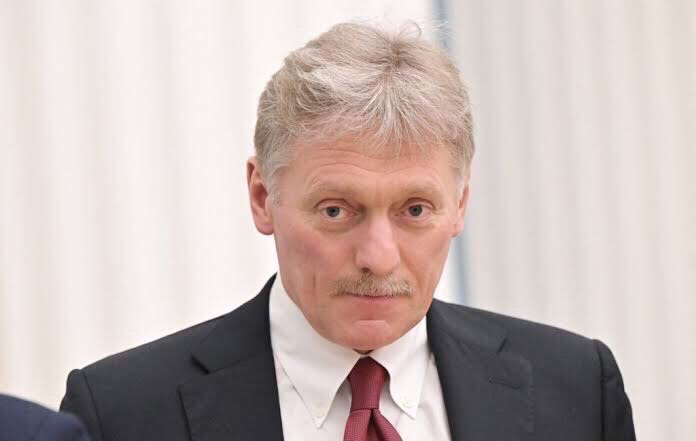
Strong words, indeed. And who should emerge to respond to them but the Russian media’s best friend in the Kremlin . . . drumroll, please . . . Dmitry Peskov. Of course, he was not amused, and offered this:
“This ostentatious desire not to take seriously the Russian president’s statements is a move that is completely short-sighted and unprofessional” . . . adding that Stoltenberg’s position is “extremely provocative and dangerous.” [Id.]
Thank you, Dima . . . it’s always good to hear from you.
And so, as another winter approaches, Vladimir Putin’s “special military operation” in Ukraine drags on; more people die, are wounded, and are displaced; and the world’s two superpowers stand toe-to-toe on that metaphorical red line once more . . .
. . . while I have flashbacks to 1962.**
Just sayin’ . . .
Brendochka
9/20/24
** The Cuban Missile Crisis: October 16-29, 1962.

