Kurt Vonnegut was an American author best known for his satirical and darkly humorous commentaries on American society, arguably the most famous being his sixth novel, “Slaughterhouse-Five.”
Kurt Vonnegut (1922-2007)
In 1965, before the great success of “Slaughterhouse-Five,” Vonnegut had published his fifth novel, “God Bless You, Mr. Rosewater, or Pearls Before Swine” — a satire centered around a multi-millionaire who develops a social conscience and establishes a foundation “where he attempts to dispense unlimited amounts of love and limited sums of money to anyone who will come to his office” . . . leading his family and friends to conclude that he has obviously lost his marbles.
But Vonnegut himself was the furthest thing from crazy. In fact, he may have been something of a prophet, some 60 years ahead of his time, when he wrote this:
“Thus did a handful of rapacious citizens come to control all that was worth controlling in America. Thus was the savage and stupid and entirely inappropriate and unnecessary and humorless American class system created. Honest, industrious, peaceful citizens were classed as bloodsuckers, if they asked to be paid a living wage. And they saw that praise was reserved henceforth for those who devised means of getting paid enormously for committing crimes against which no laws had been passed. Thus the American dream turned belly up, turned green, bobbed to the scummy surface of cupidity unlimited, filled with gas, then went bang in the noonday sun.”
– Kurt Vonnegut, “God Bless You, Mr. Rosewater”
Does that strike a familiar chord for anyone? Yup . . . for me, too. Let’s just hope we don’t all go “bang in the noonday sun.”
I suppose if the Hiltons could do it, the Trumps are entitled to their hotel chain as well. But do they really have to be so ostentatious? And isn’t there — or shouldn’t there be — some moral imperative against doing business with dictators and tyrants? Or using threats and coercion (i.e., sanctions and tariffs) to get the deal you want?
Rendering of Trump Tower Belgrade
Apparently not when there is enough money, and oil, at stake.
Word has it that the Serbian government has — against the wishes of a very vocal segment of the country’s citizens — established a joint venture with a property development company owned by Donald Trump’s son-in-law, Jared Kushner, to demolish an historic building site in Belgrade dating back to the conflict with Kosovo, to be replaced with a glitzy, five-star hotel/apartment/museum complex.
In an effort to gain relief from U.S. sanctions against Serbia’s national oil company due to its majority stake being owned by Russia’s Gazprom and Gazprom Neft, the country’s president, Aleksandar Vucic, has been cozying up to the Trump administration in spite of his friendly relations with Vladimir Putin and his accelerating crackdown on independent media and and civil rights.
Serbian President Aleksandar Vucic
So when Kushner came calling, Vucic pushed through a law removing the cultural designation of the existing complex and permitting demolition work to proceed “in a manner that is satisfactory” to Kushner’s company, Atlantic Incubation Partners LLC. The deal with Kushner includes a free lease of the land for 99 years, with an option for the lease to be converted into full ownership. [Julian Borger, The Guardian, November 13, 2025.]
Serbia is not a member of NATO or the EU, though it has been working toward EU membership. Vucic is another of those world leaders — like Turkiye’s Recep Tayyip Erdogan and Hungary’s Viktor Orban — trying to maintain a balance between East and West, with varying degrees of success. And for a country that is one of the poorest in Europe, a deal like this with Kushner would be a huge windfall for Serbia . . . well, for Vucic, anyway.
And what would it mean to Kushner? If nothing else, it would buy him a lot of brownie points with daddy-in-law, who would benefit politically and — let’s face it — financially as well. Because, while the oddly-named Atlantic Incubation Partners may legally belong to Kushner, where dynasties like the Trumps are concerned . . .
Jamal Ahmad Hamza Khashoggi was a Saudi Arabian author, journalist and dissident who opted for self-imposed exile in 2017 because of his opposition to the policies of the Saudi government and its rulers, King Salman and Crown Prince Mohammed bin Salman (popularly known as MBS). Khashoggi wrote articles critical of the Saudi regime for a number of publications, including the Washington Post.
Jamal Khashoggi, with his fiancee – C. 2018
In October of 2018, he entered the Saudi consulate in Istanbul, Turkiye, to obtain documents required for his upcoming marriage. He was never seen leaving the consulate, and it was later determined that he had been killed and dismembered there. Intelligence reports concluded that the murder — eventually admitted by Saudi Arabia’s attorney general as having occurred — was ordered by Mohammed bin Salman himself.
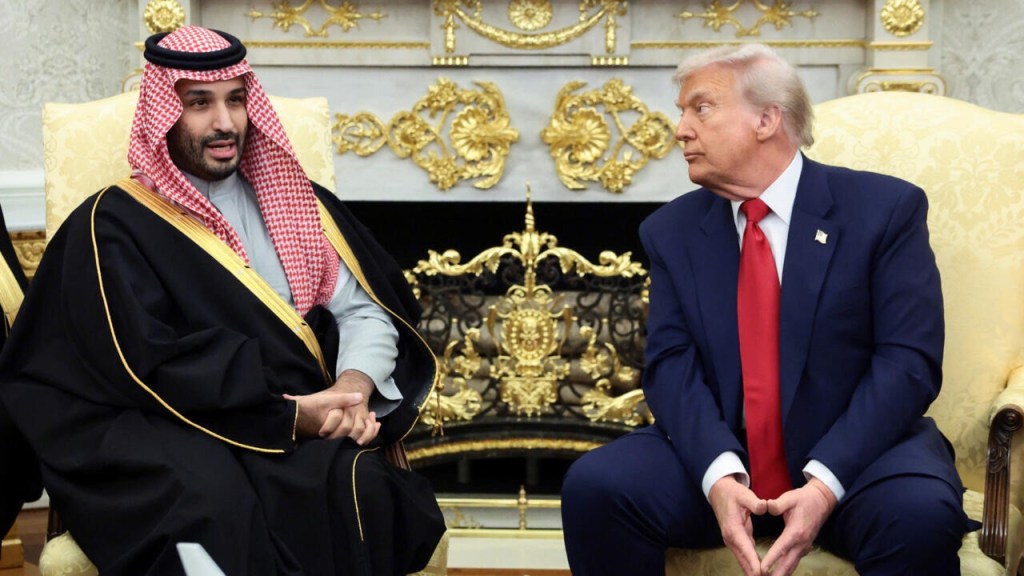
Today, MBS was an honored guest of Donald Trump at the White House, where he was greeted at the South Portico — not merely at the Pennsylvania Avenue front entrance with a presidential handshake and an appropriate welcoming committee — but by U.S. military troops riding horses and carrying the flags of both nations, accompanied by drum rolls and blaring trumpets, and a fly-over of six jet fighters.
Ceremony at the South Portico
Also on the agenda for this evening is a star-studded dinner (too bad the new ballroom isn’t ready yet), followed by a business-focused conference tomorrow at the Kennedy Center. U.S. officials have said they will be discussing a multibillion-dollar investment in America’s AI infrastructure, cooperation on civil nuclear energy, and plans for Riyadh’s investments into the U.S. economy. [Alexander Ward and Michael R. Gordon, Wall Street Journal. November 18, 2025.]
But to me, the highlight of MBS’ arrival was Donald Trump’s statement as he stood next to the Crown Prince and was asked by the press about the Khashoggi killing:
“You’re mentioning somebody that was extremely controversial. A lot of people didn’t like that gentleman that you’re talking about. Whether you like him or didn’t like him, things happen.”
And then, turning to MBS, he added, “But he knew nothing about it.”[Id.]
In the Oval Office
“Things happen.” What things? Just the murder and dismemberment of one annoying journalist? Or maybe we should talk about September 11, 2001, when 19 hijackers — of whom 15 were Saudis — took the lives of nearly 3,000 civilians in New York, Washington, and Pennsylvania.
“Things happen.” That’s been the attitude of every murderous despot the world has ever known: a casual shrug, and, “Oh, well . . . c’est la guerre.”
Or, as Josef Stalin said: “The death of one man is a tragedy; the death of millions is a statistic.”
Young people don’t think much about old age. They see an elderly couple holding hands and they think, “Oh, aren’t they cute!” Or they may hold a door open for an older person, or offer to shovel the snow from their aging neighbors’ front walk.
But the older you get, the more you are forced to think about it — not about dying, necessarily, but about living with your deteriorating self. About things lost: friends, hair, memory, libido; and things found: belly fat, a hiatal hernia, wrinkles.
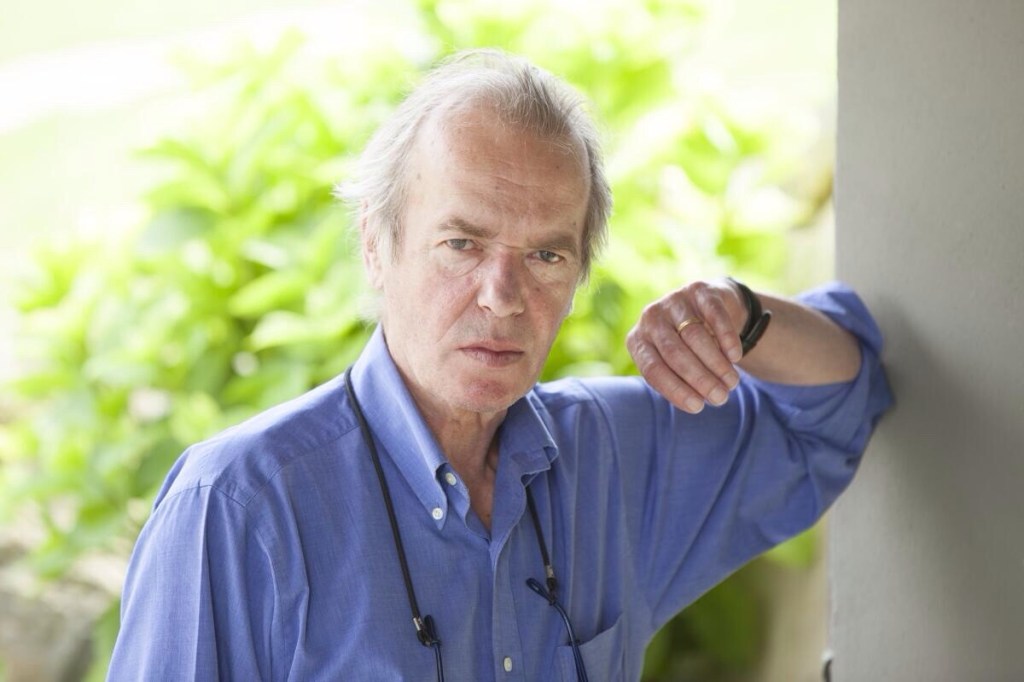
The other day, I stumbled across the perfect comment on the aging process by English author, screenwriter and critic Martin Amis, to share with you today:
“And meanwhile time goes about its immemorial work of making everyone look and feel like shit.”
– Martin Amis, “London Fields”
Martin Amis (1949 – 2023)
And that, my younger readers, is what you have to look forward to.
So there I was, on the first day of school in a new city, a new part of the country, and no clue as to where I was supposed to catch the school bus. There were no websites to instruct us in those days, and my mother’s attempts to reach the school board had failed because they were closed until the actual opening day of classes.
That morning, with my only information being the street corner where the bus stop was supposed to be located, I headed out on my own as my mother and sister left for work. It was just a couple of blocks from our apartment, and as I neared the intersection, I saw two groups of school kids, one decidedly younger than the other.
Approaching the older group, I asked two girls standing together whether I was in the right place. They said yes, and became my two best friends throughout the next three years. It was just dumb luck.
Let me say here that I hated high school. I did well scholastically, but socially, I bombed. In New Hampshire, the two-year age gap hadn’t made any difference. But these teenagers were more sophisticated than my small-town friends had been, and I never did fit in. I wasn’t teased or bullied; I was just the smart, shy, younger-than-everyone-else girl on the sidelines.
And I was in the Commercial/Business course . . . not the Academic/College course with the cool kids.
That may need a bit of explanation. Back then, high school students had to choose among three curricula: College, Business, or Vocational/Technical. We all had to take the basics — English, History, Math, Science — but with specific additional classes geared toward our likely career paths.
Vocational courses at the time were for the benefit of the scholastically-challenged students, and included Shop for the boys and Home Economics for the girls (although there were some girls in Shop and vice-versa, but not much was said about that in those days).
I had made my choice — enrolling in Commercial courses — because of our family situation. My sister Merna had had to leave college and give up her dream of becoming a teacher when our parents separated. We three women were living on their two salaries: my mother’s as a bookkeeper, and Merna’s as a secretary. And I had reasoned that I was going to have to join the wage-earners after high school, so I made the decision — ultimately both good and bad — to prepare for a job. I needed to learn to type and take shorthand.
High School Typing Class – C. 1950s
I know . . . I know. In today’s cyber world, where three-year-olds are computer literate as if by magic, that sounds strange. But back then, those were highly marketable abilities. And it turned out that I was good at both, winning awards in my senior year.
But after three years of honing my skills, I was still just 16 years old, and looked all of 14. Who was going to hire me? So I made a deal with my mother.
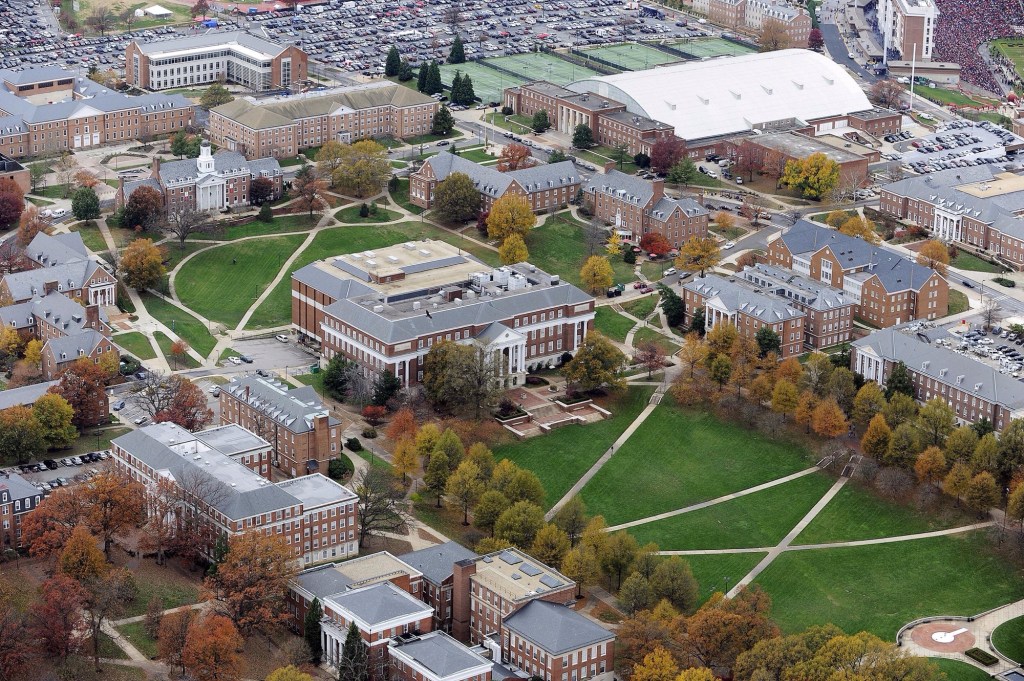
We were doing all right financially, thanks to her ability to squeeze six cents out of every nickel, and she offered to send me to our state school — the University of Maryland — but with some conditions. First, she could only afford tuition, but not board, so I would have to live at home and find a way to commute, as we didn’t have a car. Second, I was still somewhat shy, and UMD was a huge, rather overwhelming campus, where I felt I would have been lost in the crowd.
University of Maryland College Park Campus
And third — and most important — was the fact that I would still be living, and going to college, partially off of my sister’s wages . . . the sister who had sacrificed her own education to help support us. I couldn’t do it.
So the deal was that I would look for a job, and if I didn’t find one within a few weeks, I would apply to UMD.
I would have considered going to work for the government, but I was still too young to take the Civil Service exam. So a friend of my mother’s referred me to a lady who ran an employment agency in D.C., and she sent me out on my very first job interview with one caution: She had told them I was 17, not 16.
Lying was so much easier in the days before computerization of all our personal data.
Unbelievably, three days after graduation I was hired as secretary to a junior partner in a small but prominent Washington, D.C., law firm. They were desperate for qualified help, so they took a chance on me. I stayed there for seven years. And after three years, on my 19th birthday, I finally told them the truth and we all had a good laugh.
And that was my next step in the lifelong process of character-building. That job — working with professionals, learning to love the law, learning to curse, learning to drink — and most importantly, learning to love learning for its own sake — turned a shy 16-year-old into a gutsy, self-confident, outspoken adult.
But was the decision to forego the four-year college experience a mistake?
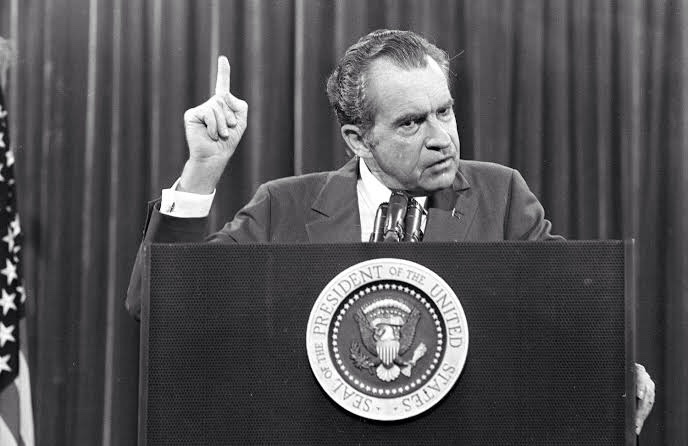
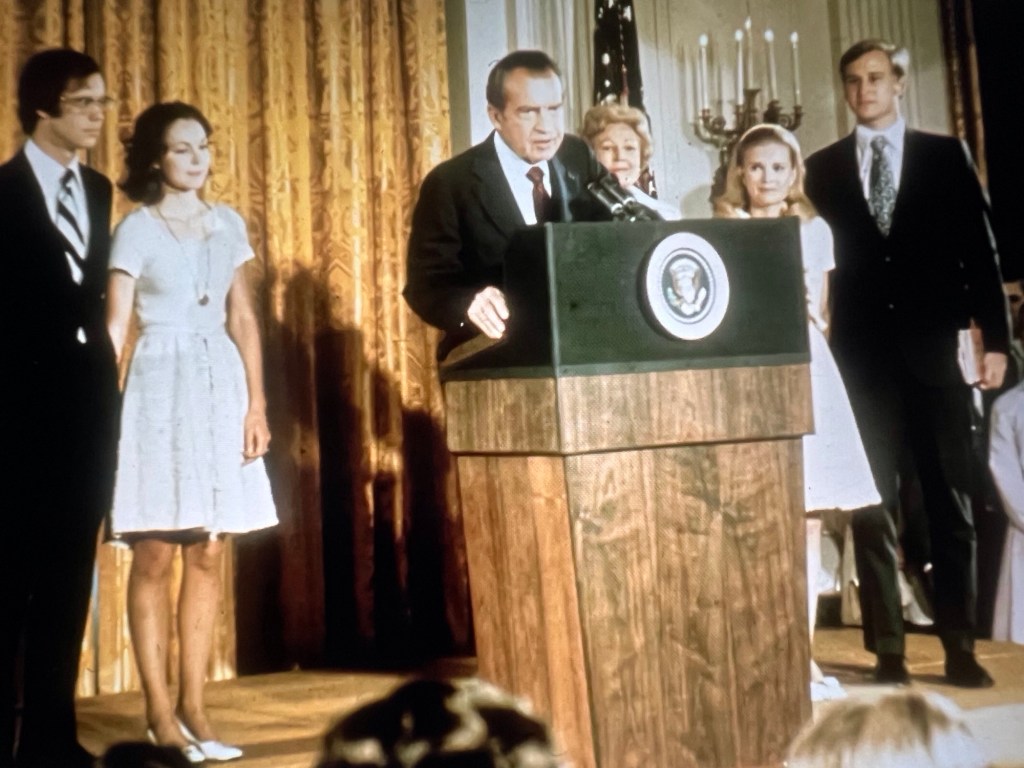
On this date 52 years ago — November 17, 1973 — in the midst of the biggest political scandal of the 20th century, a group of Associated Press editors asked then-President Richard Nixon about his role in the Watergate burglary and cover-up. He replied that:
“ . . . people have got to know whether or not their President is a crook. Well, I’m not a crook. I’ve earned everything I’ve got.” [“Today In History,” History.com, November 17, 2025.]
“I am not a crook!”
Less than a year later, on August 8, 1974, Nixon resigned the presidency to avoid impeachment for his crimes. He had earned that, too.
Farewell Address
The riddle, “What is the sound of one hand clapping?” originated from a Zen Buddhist koan: a paradoxical question meant to provoke insight and transcend logical thought. It might represent the idea of the sound of silence, the emptiness of the ego, or the nature of existence beyond dualistic thinking.
Such was the effect of Nixon’s disingenuous disclaimer half a century ago. And the echoes of that silent clapping resound today, drowning out the noise of the denials of yet another occupant of the Oval Office as to his administration’s “high crimes and misdemeanors.” *
* Article II, Section 4, U.S. Constitution.
Will the fallout be similar? History does tend to repeat itself; but times change, attitudes change, and reactions are not easily predicted. So, as always, time will tell.
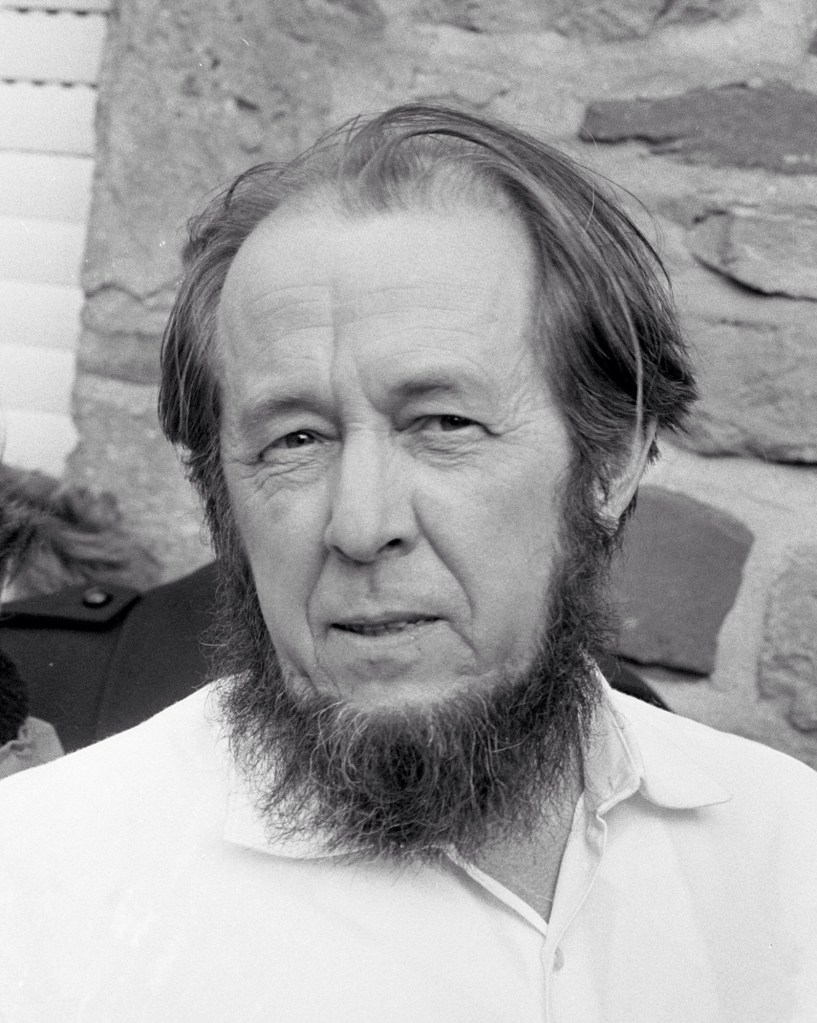
Aleksandr Isayevich Solzhenitsyn understood evil. Born in Russia just a year after the Bolshevik Revolution, he became an author and dissident who wrote about, and raised global awareness of, political repression in his country. For his efforts, he spent eight years in the Soviet GULAG prison system, followed by years of internal exile before being “rehabilitated” by Nikita Khrushchev. In 1970, he was awarded the Nobel Prize in Literature.
Aleksandr I. Solzhenitsyn (1918-2008)
Solzhenitsyn’s most famous work was The Gulag Archipelago — an expose of the brutal penal colony system of Stalinist times and beyond — in which he wrote:
“In keeping silent about evil, in burying it so deep within us that no sign of it appears on the surface, we are implanting it, and it will rise up a thousand fold in the future. When we neither punish nor reproach evildoers, we are not simply protecting their trivial old age, we are thereby ripping the foundations of justice from beneath new generations.”
– Aleksandr Solzhenitsyn, “The Gulag Archipelago 1918-1956”
*. *. *
Solzhenitsyn was of course writing about the evils of the Soviet system of his time; but his body of work was also a cautionary tale for future generations . . . and for other nations.
Obviously, no one can accurately foretell the future. But we can think ahead to the most likely possibilities . . . and in the case of young Wesley (“Wes”) Feenstra — the 16-year-old Canadian living with his parents and seven siblings on their farm in the Nizhny Novgorod region of Russia — there are some big “ifs” to be considered.
Wes Feenstra in Nizhny Novgorod – November 2025
Because on November 5th, Vladimir Putin signed into law Decree No. 821: “Executive Order On the Temporary Procedure for Granting Citizenship of the Russian Federation and Issuing Residence Permits in the Russian Federation.”
And no one seems sure exactly what it means, to whom it applies, what is meant by “temporary,” or whether it was intentionally left ambiguous or was the result of hasty, sloppy drafting. But one thing is clear: It involves military service as a prerequisite to obtaining Russian citizenship or permanent residency.
And Wesley’s dad, Arend Feenstra, is understandably concerned, both for himself and his sons.
The Feenstras — Arend, Anneesa, and eight of their nine children — moved from Saskatchewan, Canada, to the Nizhny Novgorod region of Russia nearly two years ago, to build a farm and a new life away from the perceived “wokeness” of their native country in a place they thought would be better suited to their conservative beliefs. After a rough start, things began to fall into place for them, and they have been doing surprisingly well, with a great deal of hard work and an abundance of social media promotion for Putin’s immigration drive.
The Feenstras Receiving Their Temporary Residency Visas in 2024
About a year ago, they obtained temporary residence status, meaning that in another three years’ time, they would be eligible to apply for permanent residency. With two years still to go, that would bring young Wes to his 18th birthday — the age of eligibility for military service.
And the new Decree No. 821 states that :
“ . . . [in order] to obtain Russian citizenship and a residence permit in Russia, certain categories of capable men aged 18 to 65 must now provide one of two documents:
– A discharge certificate from military service in the Russian Armed Forces or the Russian Ministry of Emergency Situations.
– A certificate confirming unfitness for military service.
[Eng.confidencegroup.ru, November 10, 2025.]
Without either of those, they would be required to serve at least a year in the military.
A clear exception is made for citizens of the Republic of Belarus. Not clear, however, is what other exceptions or requirements may exist under 821.
Nor does the decree specify what is meant by a “Temporary Procedure for Granting Citizenship.” Is it intended to be effective only for the duration of the “special military operation” in Ukraine? Or is it open-ended?
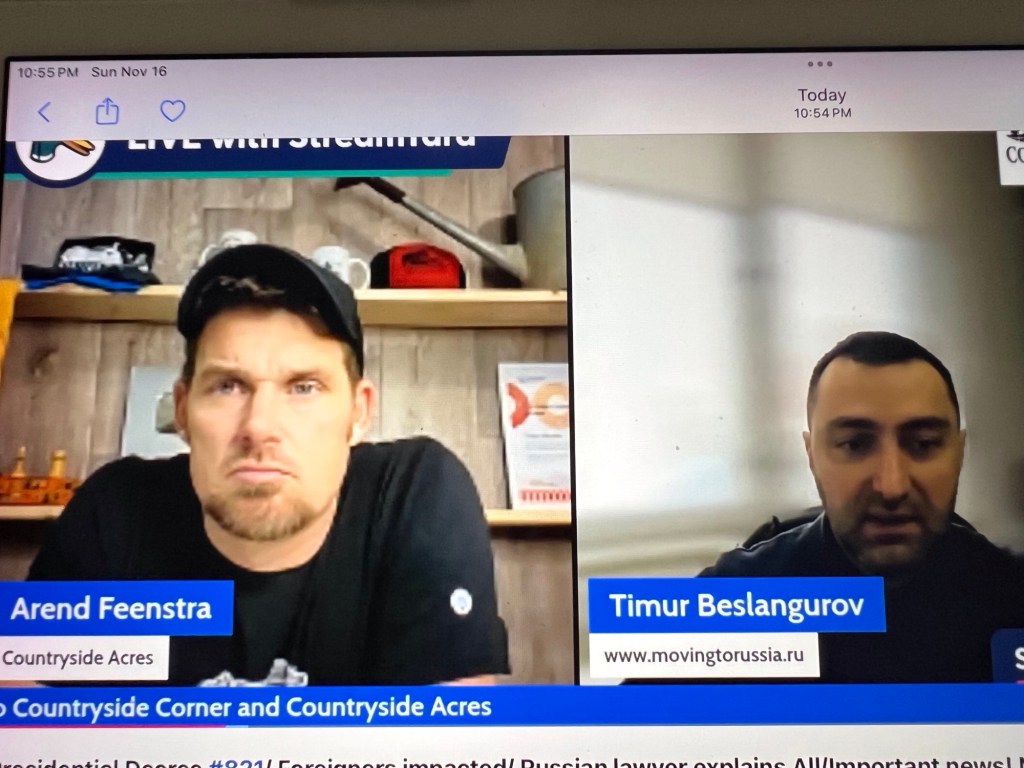
Certainly, Arend Feenstra needed answers. So he called upon Timur Beslangurov, a leading Russian expert on immigration law, who appeared with Feenstra on social media. And after watching the broadcast twice, all I was able to discern were a lot of “ifs” and “maybes” and an occasional “probably.”
For example: Beslangurov “hopes” the unclear portions of the decree will be amended; said that “supposedly” they won’t take anyone who doesn’t speak Russian; and “believes” the decree is intended to apply primarily to citizens of the Central Asian “Stans,” of whom there are millions in Russia.
He also spoke of a pending decree on immigrants who came to Russia because of “shared values” — as did the Feenstras — and said that, in any event, their family was “probably” all right for at least the next two years, when their temporary residency permits expire.
Screen Shot From YouTube
*. *. *
Throughout Beslangurov’s attempt to allay everyone’s fears, Arend Feenstra appeared uncharacteristically serious and increasingly concerned . . . as well he might. But he managed to close the broadcast with his customary promotion of life in Russia, saying it’s still a “really good place” with a “pile of opportunities.” He said he continues to feel that immigrants are welcome there, that it is a safe place to be, and that a “traditional value” visa is the best way to go.
But his customary enthusiasm was missing, and it was obvious to me, after observing this family for nearly two years, that Arend Feenstra has suddenly been hit with one of the realities of life in Putin’s Russia: the unpredictability and capriciousness of the government.
So he now faces the possibility of military conscription for himself and/or his eldest son . . . or alternatively, losing all of the money and hard work they have invested in their thriving new farm and having to start over again, back in Canada or elsewhere.
Is it a fishing boat? A vessel carrying suspected drug dealers or smuggling in illegal immigrants? A pleasure craft belonging to a billionaire friend of the White House?
No, it’s none of those; it’s potentially much more threatening. It’s the KARELIYA: a Russian spy ship, spotted and identified by U.S. Coast Guard personnel about 15 miles south of the Hawaiian island of Oahu — outside U.S. territorial waters, but just barely — in late October.
Russian Navy General Intelligence Ship KARELIYA
It’s not the KARELIYA’s first visit to Hawaii. Part of Russia’s fleet of six active intelligence-gathering Vishnya-class ships in its Pacific Fleet, it was previously seen near the island of Kauai in 2021, and again near the Hawaiian island chain in 2022. [The Moscow Times, November 14, 2025.]
And now it’s back, uninvited, and reportedly retrofitted to current standards. The U.S. Coast Guard said that its personnel had conducted “a safe and professional overflight and transiting near” the ship on October 29th, and added:
“Acting in accordance with international law, Coast Guard personnel are monitoring the Russian vessel’s activities near U.S. territorial waters to provide maritime security for U.S. vessels operating in the area and to support U.S. homeland defense efforts.” [Id.]
What . . . no Hellfire missiles? Just three miles outside our territorial waters, and we didn’t blow them out of existence? No . . . this time, someone (the U.S. Coast Guard) actually used common sense and restraint.
Thank the powers-that-be for small — actually, rather large — favors!
Thus far, no imminent threat from the KARELIYA has been detected . . . or, at least, none has been publicly reported. But viewed in conjunction with recent Russian drone incursions into the air space of a number of Europe’s NATO and EU countries, it seems to signify an increase in widespread Russian surveillance activities.
But to what purpose? Defensive, offensive, or simply a subtle warning to keep us all off balance?
It could be anything. Maybe someone should ask Vladimir Putin.
My daily quotations are chosen according to my mood of the moment, or a specific topic that’s been on my mind. Today’s subject is Stupidity.
We’re surrounded by it, drowning in it; and it is becoming so normalized, I’m beginning to think I’ve wandered into the Cuckoo’s Nest and my medication will be served tonight by Nurse Ratched.
But sometimes a particularly stupid item makes the news that seems almost hilariously funny — until you realize it’s coming from the people we’re supposed to be able to trust to look after us and our country. Today’s case in point:
Laurel and Hardy . . . or Bonnie and Clyde?
In 1969, I read a wonderful book titled The Peter Principle, by Laurence J. Peter, the basic premise of which was that individuals tend to advance throughout life until they reach the level of their incompetence. And one of the most relatable lines from that book to today’s world is this:
“Sometimes I wonder whether the world is being run by smart people who are putting us on or by imbeciles who really mean it.”
So why did this resonate with me today?
You’re probably aware of the surprising rift between Donald Trump and Marjorie Taylor Greene — one of his most vociferous supporters until recently — because she dared to cast a vote against his wishes. This led to some below-the-belt exchanges between the two, one of the least of which was Greene’s complaint that Trump was not taking or returning her calls.
To which Trump, after first rescinding his endorsement of her upcoming reelection bid, had this to say on social media:
“She has told many people that she is upset that I don’t return her phone calls anymore, but with 219 Congressmen/women, 53 U.S. Senators, 24 Cabinet Members, almost 200 Countries, and an otherwise normal life to lead, I can’t take a ranting Lunatic’s call every day.” [Betsy Klein, CNN, November 15, 2025.]
Never mind the “ranting Lunatic” remark; that’s typical for him. And I can’t speak to the “otherwise normal life” assertion.
But what is amusing, in a somewhat disturbing way, is that he doesn’t seem to know that there are 100 U.S. Senators (not 53), 435 members of the House of Representatives (not 219), and 26 members of his own Cabinet (I wonder which two he forgot).
Oh, wait! I see it now. He was counting RepublicanSenators and Congressmen — which tells us that he doesn’t speak to the Democrats at all. As though they don’t represent American citizens, who don’t count because they’re stupid, lying, fake traitors. That’s half the country he took an oath to serve and defend — completely written off. And he just admitted it.
That’s not only stupid . . . it’s criminal.
*. *. *
Napoleon Bonaparte once said:
“In politics, stupidity is not a handicap.”
He seems to have been right . . . except, of course, for that whole invading-Russia-without-considering-the-early-winter debacle.


























 The Blog About Everything … and Sometimes Nothing