Young people don’t think much about old age. They see an elderly couple holding hands and they think, “Oh, aren’t they cute!” Or they may hold a door open for an older person, or offer to shovel the snow from their aging neighbors’ front walk.
But the older you get, the more you are forced to think about it — not about dying, necessarily, but about living with your deteriorating self. About things lost: friends, hair, memory, libido; and things found: belly fat, a hiatal hernia, wrinkles.
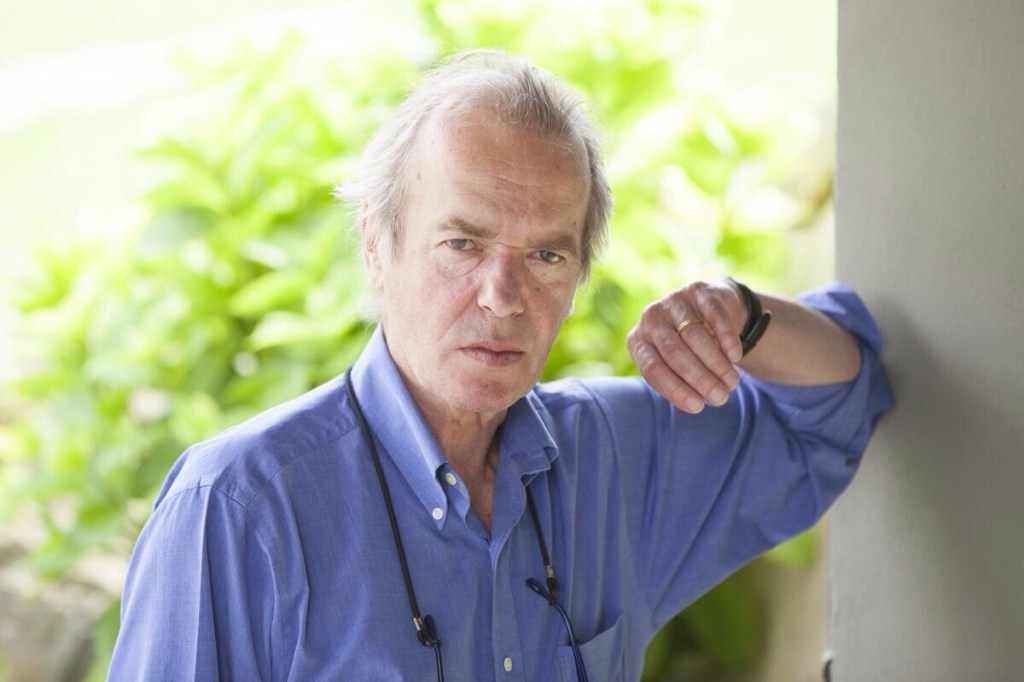
The other day, I stumbled across the perfect comment on the aging process by English author, screenwriter and critic Martin Amis, to share with you today:
“And meanwhile time goes about its immemorial work of making everyone look and feel like shit.”
– Martin Amis, “London Fields”
Martin Amis (1949 – 2023)
And that, my younger readers, is what you have to look forward to.
So there I was, on the first day of school in a new city, a new part of the country, and no clue as to where I was supposed to catch the school bus. There were no websites to instruct us in those days, and my mother’s attempts to reach the school board had failed because they were closed until the actual opening day of classes.
That morning, with my only information being the street corner where the bus stop was supposed to be located, I headed out on my own as my mother and sister left for work. It was just a couple of blocks from our apartment, and as I neared the intersection, I saw two groups of school kids, one decidedly younger than the other.
Approaching the older group, I asked two girls standing together whether I was in the right place. They said yes, and became my two best friends throughout the next three years. It was just dumb luck.
Let me say here that I hated high school. I did well scholastically, but socially, I bombed. In New Hampshire, the two-year age gap hadn’t made any difference. But these teenagers were more sophisticated than my small-town friends had been, and I never did fit in. I wasn’t teased or bullied; I was just the smart, shy, younger-than-everyone-else girl on the sidelines.
And I was in the Commercial/Business course . . . not the Academic/College course with the cool kids.
That may need a bit of explanation. Back then, high school students had to choose among three curricula: College, Business, or Vocational/Technical. We all had to take the basics — English, History, Math, Science — but with specific additional classes geared toward our likely career paths.
Vocational courses at the time were for the benefit of the scholastically-challenged students, and included Shop for the boys and Home Economics for the girls (although there were some girls in Shop and vice-versa, but not much was said about that in those days).
I had made my choice — enrolling in Commercial courses — because of our family situation. My sister Merna had had to leave college and give up her dream of becoming a teacher when our parents separated. We three women were living on their two salaries: my mother’s as a bookkeeper, and Merna’s as a secretary. And I had reasoned that I was going to have to join the wage-earners after high school, so I made the decision — ultimately both good and bad — to prepare for a job. I needed to learn to type and take shorthand.
High School Typing Class – C. 1950s
I know . . . I know. In today’s cyber world, where three-year-olds are computer literate as if by magic, that sounds strange. But back then, those were highly marketable abilities. And it turned out that I was good at both, winning awards in my senior year.
But after three years of honing my skills, I was still just 16 years old, and looked all of 14. Who was going to hire me? So I made a deal with my mother.
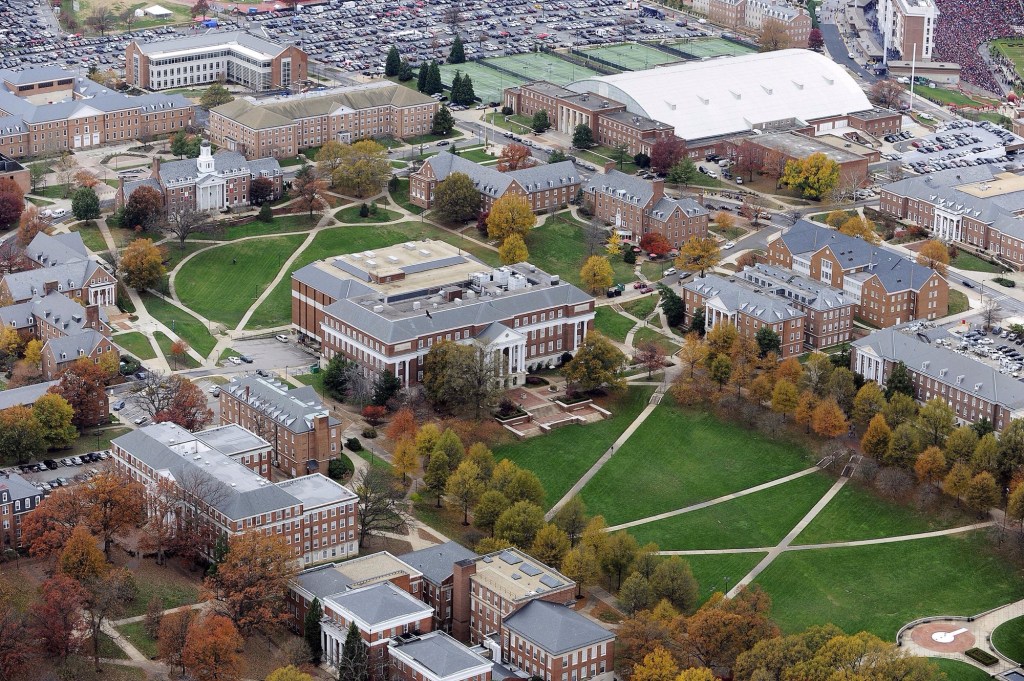
We were doing all right financially, thanks to her ability to squeeze six cents out of every nickel, and she offered to send me to our state school — the University of Maryland — but with some conditions. First, she could only afford tuition, but not board, so I would have to live at home and find a way to commute, as we didn’t have a car. Second, I was still somewhat shy, and UMD was a huge, rather overwhelming campus, where I felt I would have been lost in the crowd.
University of Maryland College Park Campus
And third — and most important — was the fact that I would still be living, and going to college, partially off of my sister’s wages . . . the sister who had sacrificed her own education to help support us. I couldn’t do it.
So the deal was that I would look for a job, and if I didn’t find one within a few weeks, I would apply to UMD.
I would have considered going to work for the government, but I was still too young to take the Civil Service exam. So a friend of my mother’s referred me to a lady who ran an employment agency in D.C., and she sent me out on my very first job interview with one caution: She had told them I was 17, not 16.
Lying was so much easier in the days before computerization of all our personal data.
Unbelievably, three days after graduation I was hired as secretary to a junior partner in a small but prominent Washington, D.C., law firm. They were desperate for qualified help, so they took a chance on me. I stayed there for seven years. And after three years, on my 19th birthday, I finally told them the truth and we all had a good laugh.
And that was my next step in the lifelong process of character-building. That job — working with professionals, learning to love the law, learning to curse, learning to drink — and most importantly, learning to love learning for its own sake — turned a shy 16-year-old into a gutsy, self-confident, outspoken adult.
But was the decision to forego the four-year college experience a mistake?
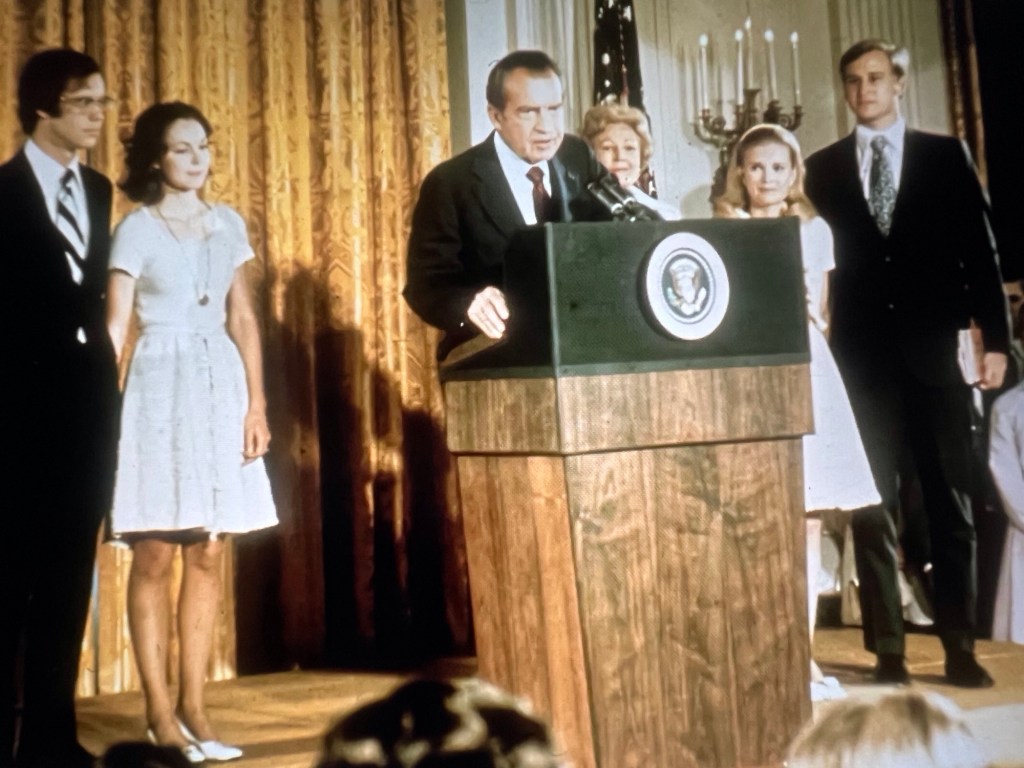
On this date 52 years ago — November 17, 1973 — in the midst of the biggest political scandal of the 20th century, a group of Associated Press editors asked then-President Richard Nixon about his role in the Watergate burglary and cover-up. He replied that:
“ . . . people have got to know whether or not their President is a crook. Well, I’m not a crook. I’ve earned everything I’ve got.” [“Today In History,” History.com, November 17, 2025.]
“I am not a crook!”
Less than a year later, on August 8, 1974, Nixon resigned the presidency to avoid impeachment for his crimes. He had earned that, too.
Farewell Address
The riddle, “What is the sound of one hand clapping?” originated from a Zen Buddhist koan: a paradoxical question meant to provoke insight and transcend logical thought. It might represent the idea of the sound of silence, the emptiness of the ego, or the nature of existence beyond dualistic thinking.
Such was the effect of Nixon’s disingenuous disclaimer half a century ago. And the echoes of that silent clapping resound today, drowning out the noise of the denials of yet another occupant of the Oval Office as to his administration’s “high crimes and misdemeanors.” *
* Article II, Section 4, U.S. Constitution.
Will the fallout be similar? History does tend to repeat itself; but times change, attitudes change, and reactions are not easily predicted. So, as always, time will tell.
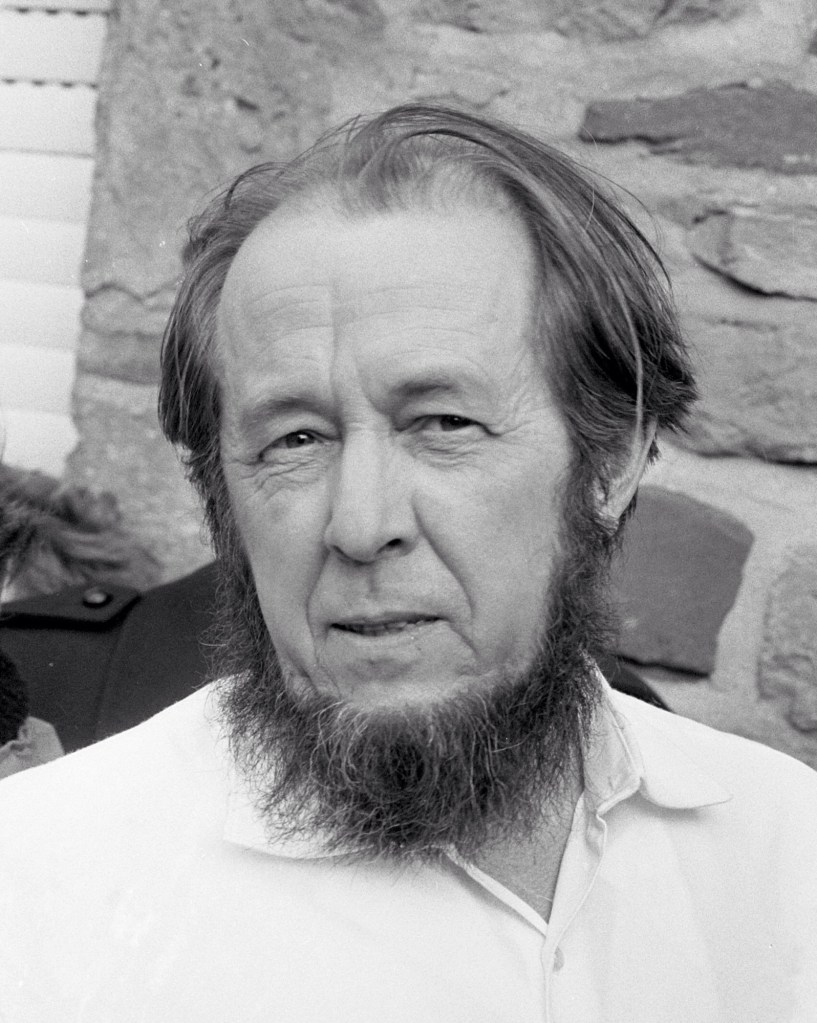
Aleksandr Isayevich Solzhenitsyn understood evil. Born in Russia just a year after the Bolshevik Revolution, he became an author and dissident who wrote about, and raised global awareness of, political repression in his country. For his efforts, he spent eight years in the Soviet GULAG prison system, followed by years of internal exile before being “rehabilitated” by Nikita Khrushchev. In 1970, he was awarded the Nobel Prize in Literature.
Aleksandr I. Solzhenitsyn (1918-2008)
Solzhenitsyn’s most famous work was The Gulag Archipelago — an expose of the brutal penal colony system of Stalinist times and beyond — in which he wrote:
“In keeping silent about evil, in burying it so deep within us that no sign of it appears on the surface, we are implanting it, and it will rise up a thousand fold in the future. When we neither punish nor reproach evildoers, we are not simply protecting their trivial old age, we are thereby ripping the foundations of justice from beneath new generations.”
– Aleksandr Solzhenitsyn, “The Gulag Archipelago 1918-1956”
*. *. *
Solzhenitsyn was of course writing about the evils of the Soviet system of his time; but his body of work was also a cautionary tale for future generations . . . and for other nations.
Obviously, no one can accurately foretell the future. But we can think ahead to the most likely possibilities . . . and in the case of young Wesley (“Wes”) Feenstra — the 16-year-old Canadian living with his parents and seven siblings on their farm in the Nizhny Novgorod region of Russia — there are some big “ifs” to be considered.
Wes Feenstra in Nizhny Novgorod – November 2025
Because on November 5th, Vladimir Putin signed into law Decree No. 821: “Executive Order On the Temporary Procedure for Granting Citizenship of the Russian Federation and Issuing Residence Permits in the Russian Federation.”
And no one seems sure exactly what it means, to whom it applies, what is meant by “temporary,” or whether it was intentionally left ambiguous or was the result of hasty, sloppy drafting. But one thing is clear: It involves military service as a prerequisite to obtaining Russian citizenship or permanent residency.
And Wesley’s dad, Arend Feenstra, is understandably concerned, both for himself and his sons.
The Feenstras — Arend, Anneesa, and eight of their nine children — moved from Saskatchewan, Canada, to the Nizhny Novgorod region of Russia nearly two years ago, to build a farm and a new life away from the perceived “wokeness” of their native country in a place they thought would be better suited to their conservative beliefs. After a rough start, things began to fall into place for them, and they have been doing surprisingly well, with a great deal of hard work and an abundance of social media promotion for Putin’s immigration drive.
The Feenstras Receiving Their Temporary Residency Visas in 2024
About a year ago, they obtained temporary residence status, meaning that in another three years’ time, they would be eligible to apply for permanent residency. With two years still to go, that would bring young Wes to his 18th birthday — the age of eligibility for military service.
And the new Decree No. 821 states that :
“ . . . [in order] to obtain Russian citizenship and a residence permit in Russia, certain categories of capable men aged 18 to 65 must now provide one of two documents:
– A discharge certificate from military service in the Russian Armed Forces or the Russian Ministry of Emergency Situations.
– A certificate confirming unfitness for military service.
[Eng.confidencegroup.ru, November 10, 2025.]
Without either of those, they would be required to serve at least a year in the military.
A clear exception is made for citizens of the Republic of Belarus. Not clear, however, is what other exceptions or requirements may exist under 821.
Nor does the decree specify what is meant by a “Temporary Procedure for Granting Citizenship.” Is it intended to be effective only for the duration of the “special military operation” in Ukraine? Or is it open-ended?
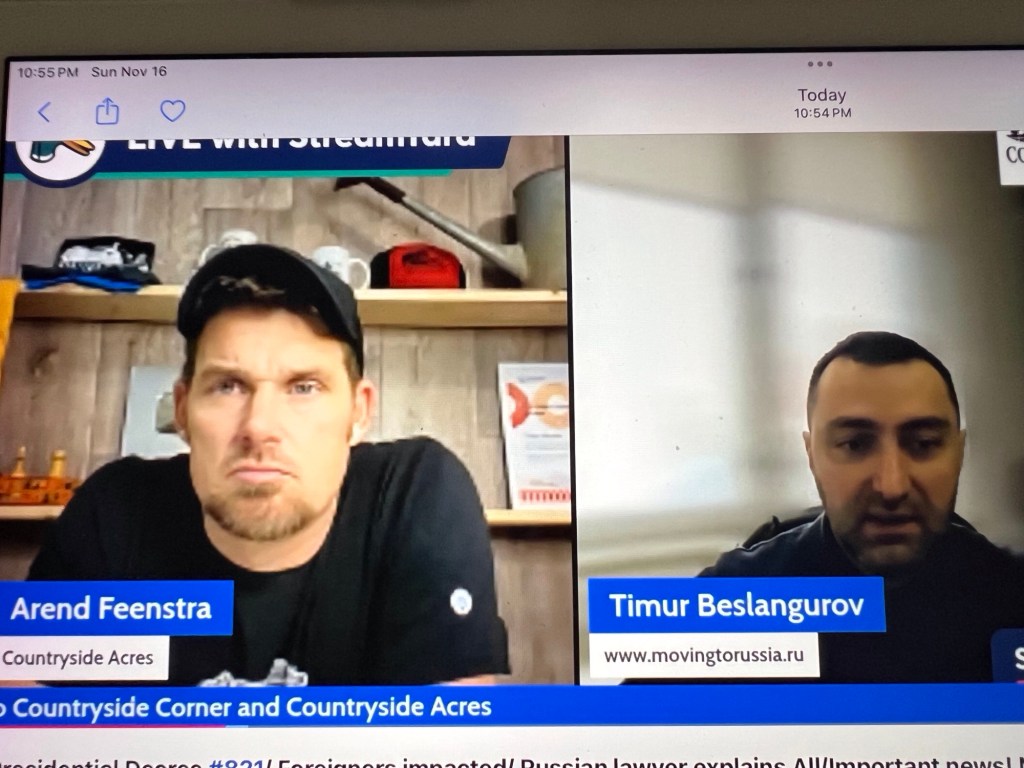
Certainly, Arend Feenstra needed answers. So he called upon Timur Beslangurov, a leading Russian expert on immigration law, who appeared with Feenstra on social media. And after watching the broadcast twice, all I was able to discern were a lot of “ifs” and “maybes” and an occasional “probably.”
For example: Beslangurov “hopes” the unclear portions of the decree will be amended; said that “supposedly” they won’t take anyone who doesn’t speak Russian; and “believes” the decree is intended to apply primarily to citizens of the Central Asian “Stans,” of whom there are millions in Russia.
He also spoke of a pending decree on immigrants who came to Russia because of “shared values” — as did the Feenstras — and said that, in any event, their family was “probably” all right for at least the next two years, when their temporary residency permits expire.
Screen Shot From YouTube
*. *. *
Throughout Beslangurov’s attempt to allay everyone’s fears, Arend Feenstra appeared uncharacteristically serious and increasingly concerned . . . as well he might. But he managed to close the broadcast with his customary promotion of life in Russia, saying it’s still a “really good place” with a “pile of opportunities.” He said he continues to feel that immigrants are welcome there, that it is a safe place to be, and that a “traditional value” visa is the best way to go.
But his customary enthusiasm was missing, and it was obvious to me, after observing this family for nearly two years, that Arend Feenstra has suddenly been hit with one of the realities of life in Putin’s Russia: the unpredictability and capriciousness of the government.
So he now faces the possibility of military conscription for himself and/or his eldest son . . . or alternatively, losing all of the money and hard work they have invested in their thriving new farm and having to start over again, back in Canada or elsewhere.
Is it a fishing boat? A vessel carrying suspected drug dealers or smuggling in illegal immigrants? A pleasure craft belonging to a billionaire friend of the White House?
No, it’s none of those; it’s potentially much more threatening. It’s the KARELIYA: a Russian spy ship, spotted and identified by U.S. Coast Guard personnel about 15 miles south of the Hawaiian island of Oahu — outside U.S. territorial waters, but just barely — in late October.
Russian Navy General Intelligence Ship KARELIYA
It’s not the KARELIYA’s first visit to Hawaii. Part of Russia’s fleet of six active intelligence-gathering Vishnya-class ships in its Pacific Fleet, it was previously seen near the island of Kauai in 2021, and again near the Hawaiian island chain in 2022. [The Moscow Times, November 14, 2025.]
And now it’s back, uninvited, and reportedly retrofitted to current standards. The U.S. Coast Guard said that its personnel had conducted “a safe and professional overflight and transiting near” the ship on October 29th, and added:
“Acting in accordance with international law, Coast Guard personnel are monitoring the Russian vessel’s activities near U.S. territorial waters to provide maritime security for U.S. vessels operating in the area and to support U.S. homeland defense efforts.” [Id.]
What . . . no Hellfire missiles? Just three miles outside our territorial waters, and we didn’t blow them out of existence? No . . . this time, someone (the U.S. Coast Guard) actually used common sense and restraint.
Thank the powers-that-be for small — actually, rather large — favors!
Thus far, no imminent threat from the KARELIYA has been detected . . . or, at least, none has been publicly reported. But viewed in conjunction with recent Russian drone incursions into the air space of a number of Europe’s NATO and EU countries, it seems to signify an increase in widespread Russian surveillance activities.
But to what purpose? Defensive, offensive, or simply a subtle warning to keep us all off balance?
It could be anything. Maybe someone should ask Vladimir Putin.
My daily quotations are chosen according to my mood of the moment, or a specific topic that’s been on my mind. Today’s subject is Stupidity.
We’re surrounded by it, drowning in it; and it is becoming so normalized, I’m beginning to think I’ve wandered into the Cuckoo’s Nest and my medication will be served tonight by Nurse Ratched.
But sometimes a particularly stupid item makes the news that seems almost hilariously funny — until you realize it’s coming from the people we’re supposed to be able to trust to look after us and our country. Today’s case in point:
Laurel and Hardy . . . or Bonnie and Clyde?
In 1969, I read a wonderful book titled The Peter Principle, by Laurence J. Peter, the basic premise of which was that individuals tend to advance throughout life until they reach the level of their incompetence. And one of the most relatable lines from that book to today’s world is this:
“Sometimes I wonder whether the world is being run by smart people who are putting us on or by imbeciles who really mean it.”
So why did this resonate with me today?
You’re probably aware of the surprising rift between Donald Trump and Marjorie Taylor Greene — one of his most vociferous supporters until recently — because she dared to cast a vote against his wishes. This led to some below-the-belt exchanges between the two, one of the least of which was Greene’s complaint that Trump was not taking or returning her calls.
To which Trump, after first rescinding his endorsement of her upcoming reelection bid, had this to say on social media:
“She has told many people that she is upset that I don’t return her phone calls anymore, but with 219 Congressmen/women, 53 U.S. Senators, 24 Cabinet Members, almost 200 Countries, and an otherwise normal life to lead, I can’t take a ranting Lunatic’s call every day.” [Betsy Klein, CNN, November 15, 2025.]
Never mind the “ranting Lunatic” remark; that’s typical for him. And I can’t speak to the “otherwise normal life” assertion.
But what is amusing, in a somewhat disturbing way, is that he doesn’t seem to know that there are 100 U.S. Senators (not 53), 435 members of the House of Representatives (not 219), and 26 members of his own Cabinet (I wonder which two he forgot).
Oh, wait! I see it now. He was counting RepublicanSenators and Congressmen — which tells us that he doesn’t speak to the Democrats at all. As though they don’t represent American citizens, who don’t count because they’re stupid, lying, fake traitors. That’s half the country he took an oath to serve and defend — completely written off. And he just admitted it.
That’s not only stupid . . . it’s criminal.
*. *. *
Napoleon Bonaparte once said:
“In politics, stupidity is not a handicap.”
He seems to have been right . . . except, of course, for that whole invading-Russia-without-considering-the-early-winter debacle.
On August 1, 2024, at an airport in Ankara, Turkey, a multi-national swap took place involving 26 political and other prisoners from several countries, including Russia and the United States. One of those freed from the Russian GULAG was Russian-British journalist and critic of the Putin government, Vladimir Kara-Murza.
Vladimir Kara-Murza – August 2024
Since his release, Kara-Murza has continued his efforts, in coordination with others including Mikhail Khodorkovsky and Yulia Navalnaya, the widow of the late dissident Aleksei Navalny, to free the remaining political prisoners in Russia — currently estimated at between 1,500 and 2,000 — and to bring about democratic reforms in a post-Putin Russia.
In a recent interview on Times Radio London’s Frontline on November 14th, he told, from first-hand experience, of the prisoners’ worst nightmare being the possibility that they might be forgotten. He said that the Russian government’s intent in locking them away in isolation for multiple-year sentences is to demoralize them and instill in them the fear that with the passage of time they would be overlooked.
Which is precisely why I continue to write this column each week. My little effort certainly does not reach an audience as wide as those of Kara-Murza, Khodorkovsky, or Navalnaya; but my hope is that words, like drops of water in a bucket, are cumulative. So I keep talking.
*. *. *
And on that note, here they are once again: the political prisoners of the Putin regime and those of his allied states — all those known to me, and the thousands I don’t know about:
Prisoners of War:
The 19,500 Kidnapped Ukrainian Children The People of Ukraine
Immigrant Detainees in Russia:
Migrants from the Central Asian nations of Kazakhstan, Kyrgyzstan, Tajikistan, Turkmenistan and Uzbekistan
Endangered Exiles:
Mikita Losik Yulia Navalnaya Countless Journalists and Other Dissidents
Ales Bialiatski Andrei Chapiuk Marya Kalesnikava Uladzimir Labkovich Andrzej Poczobut Marfa Rabkova Valiantsin Stafanovic Yuras Zyankovich
In Georgia:
Mzia Amaglobeli
In China:
Chenyue Mao (American)
In Russia:
David Barnes (American) Gordon Black (American) Antonina Favorskaya Konstantin Gabov Robert Gilman (American) Stephen James Hubbard (American) Sergey Karelin Timur Kishukov Vadim Kobzev Darya Kozyreva Artyom Kriger Michael Travis Leake (American) Aleksei Liptser Grigory Melkonyants Nika Novak Leonid Pshenychnov(in Russian-occupied Crimea) Nadezhda Rossinskaya (a.k.a. Nadin Geisler) Sofiane Sehili (French) Igor Sergunin Dmitry Shatresov Robert Shonov Grigory Skvortsov Eugene Spector (American) Laurent Vinatier Robert Romanov Woodland (American)
There’s no need to name names here . . . you know who I mean. He’s the stable genius who, in a previous incarnation, described himself as the “number one developer in New York.”
Dreaming in Shades of Gold, Gold, and More Gold
Well, Mr. No. 1 Developer: Let’s start with the construction permits — or the lack thereof.
It all began with an orgasmic dream about a ballroom that would rival Versailles Palace in size, but on the tacky side. To find room for it, an entire wing of an existing historic building — the People’s House — had to be eliminated. And so it was summarily razed and hauled away . . . without the legally required demolition, construction and environmental tests and permits, or (in this special case because it is a very special building) the required permission from the folks in the federal government charged with the care and maintenance of the People’s House.
So what part of “tests” and “permits” — or, for that matter, “historic preservation” — did the real estate expert not understand? Apparently, he slept through those classes in college . . . just as he sleeps through meetings in the Oval Office these days.
*. *. *
Next: Somehow this genius realtor — who graduated from the University of Pennsylvania with a B.S. (how appropriate!) (okay, so it’s a Bachelor of Science degree) in Economics — got it into his head that it might help his phony “affordability” campaign if homeowners were able to obtain mortgages for as long as 50 years instead of the standard 30, thus saving roughly $119 per month that they could use to buy actual meat and vegetables for their families.
That might sound good to a young couple investing in their first home, or to a family struggling to make ends meet in the current “it’s-all-about-the-tariffs” economy. But what the brilliant realtor/economist failed to consider were three factors:
> First, extending the mortgage by 20 years could roughly double the dollar amount of interest paid over the life of the loan;
> Second, since most of the payments during the early years of a mortgage are applied to interest, it would take years longer to accumulate any sizable equity in the property; and
> Third, for most home buyers, it would mean their mortgages wouldn’t be paid off until they were in their 70s or 80s — well past the retirement age for many, and possibly never for some not lucky enough to live that long.
Brilliant!
*. *. *
And finally, on the economics side, is his oh-so-generous idea of sending each and every taxpayer — excluding, for once, his upper-income-bracket friends, who would sneer at such a trifle in any event — a $2,000 “tariff dividend” check out of the trillions of dollars he claims the country has collected since January 20th.
But I wouldn’t go crazy on the holiday shopping just yet, because those checks haven’t been written and may never be.
As of this date, livemint.com reports:
“The IRS has confirmed there will be no new federal stimulus checks for November despite Trump’s tariff dividend proposal. Speculation on social media arose, but officials warn against potential phishing scams related to these announcements.” [Riya R. Alex, livemint.com, November 15, 2025.]
Earlier in the week, Trump had posted on Truth Social:
“We are taking in Trillions of Dollars and will soon begin paying down our ENORMOUS DEBT, $37 trillion. Record investment in the USA, plants and factories going up all over the place. A dividend of at least $2000 a person (not including high income people!) will be paid to everyone.” [Id.]
But wait! Don’t try taking that loaf of baloney to the bank, because, according to a fact check by KTVU:
“No new federal stimulus checks are authorised … Congress has not passed new legislation, and the IRS has made no confirmation.” [Id.]
And according to tax experts — who, by the way, apparently stayed awake during math class, unlike the White House’s resident real estate expert — the numbers do not add up. Erica York, vice president of federal tax policy for the Tax Foundation, wrote on X:
“If the cutoff [for qualified recipients’ income] is $100,000, 150M adults would qualify, for a cost near $300 billion. If kids qualify, that grows. Only problem, new tariffs have raised $120 billion so far.” [D’Angelo Gore, FactCheck.org, November 14, 2025.]
York did note that estimates for 2026 net revenue from tariffs would likely equal about $216 billion. But you can’t cut checks today on next year’s projected income. Banks don’t like that.
*. *. *
So there you have it: the real Wizard of Oz behind the curtain, who claims to be a real estate genius with a “very high IQ,” but doesn’t understand the legal requirements for demolition and construction, or how mortgages work, or what tariffs really are.
As I was lying in bed trying to fall asleep last night (it must have been the caffeine in the coffee Haagen-Dazs), I found myself reminiscing about my younger days, mostly the happy times, and about old friends. And I realized — not for the first time — how few of them I have left. Old friends, that is . . . not memories.
A Perfect Caricature of My “Golden Girls”: Front: Me, Diane and Marilyn Rear: Simin, Amelia and Merna
Since I retired and moved some 600 miles away from my long-time home, I’ve met some lovely people. But they’re new friends. And while it’s fun to learn new things about new people, there’s no history, no jokes about “remember when.” And I miss that.
It’s all part of aging, of course; someone has to be the “last bottle of beer on the wall,” and in my case, I seem to be the designated survivor. So I went searching for some stories of other people’s experiences, looking for humor . . . and what I found was understanding and empathy from a Pulitzer Prize-winning journalist and author. It’s long, but it is so perfectly descriptive of my own thoughts, I’d like to share it:
“The thing about old friends is not that they love you, but that they know you. They remember that disastrous New Year’s Eve when you mixed White Russians and champagne, and how you wore that red maternity dress until everyone was sick of seeing the blaze of it in the office, and the uncomfortable couch in your first apartment and the smoky stove in your beach rental. They look at you and don’t really think you look older because they’ve grown old along with you, and like the faded paint in a beloved room, they’re used to the look. And then one of them is gone, and you’ve lost a chunk of yourself. The stories of the terrorist attacks of 2001, the tsunami, the Japanese earthquake always used numbers, the deaths of thousands a measure of how great the disaster. Catastrophe is numerical. Loss is singular, one beloved at a time.”
– Anna Quindlen, “Lots of Candles, Plenty of Cake”
Anna Quindlen
*. *. *
They’re all gone now — first Simin (we told her to quit smoking!), then Amelia, Marilyn, Diane, and finally, my sister Merna. There are a few others left, many miles away, but still dear and in touch. The numbers are shrinking, though (as am I, dammit!), and reminiscing alone isn’t much fun. My family members, while great, don’t share all of the same memories as the friends I worked and traveled and partied with.
But that’s life, and we either roll with it or go bonkers. And since I’d rather my family didn’t get the idea that I’ve grown senile or descended into some horrible clinical depression so that they need to have me put away, I’d like to close with yet another quote — a much briefer and happier one — this time by a politically controversial but undeniably talented Irish playwright:
“You don’t stop laughing when you grow old, you grow old when you stop laughing.”
– George Bernard Shaw
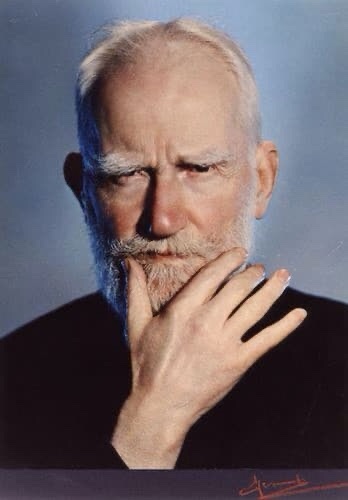
George Bernard Shaw (1856-1950)
*. *. *
And now I shall exit stage right, chuckling merrily.