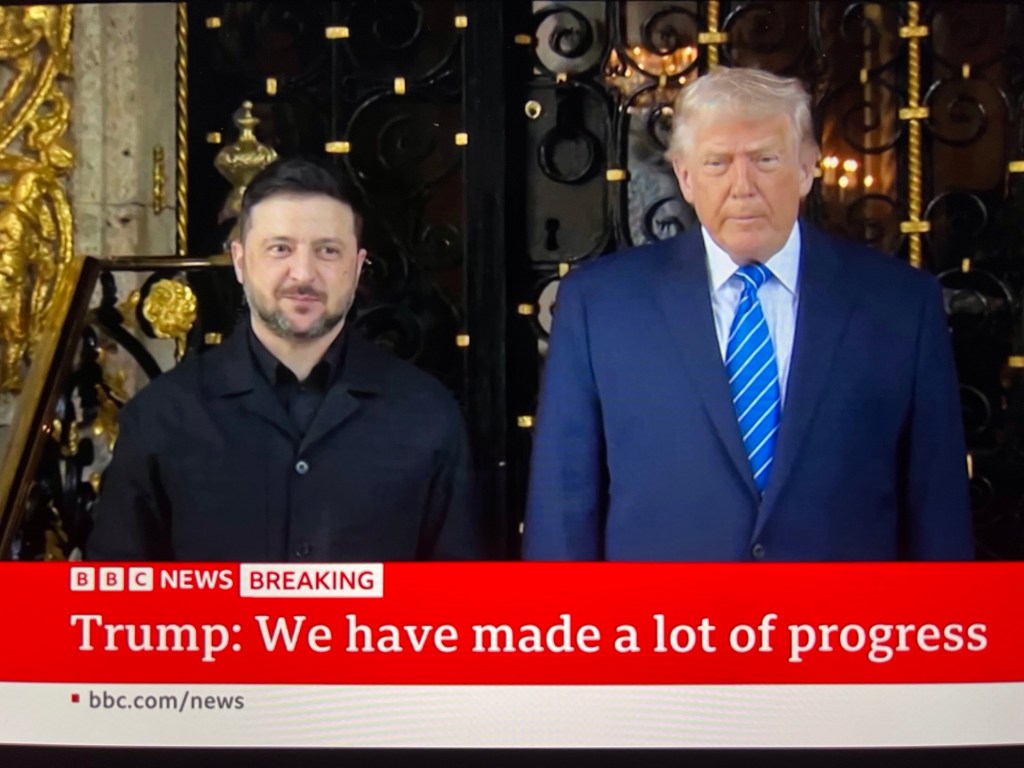
Well, at least my worst fears were not realized: Volodymyr Zelensky left Mar-a-Lago visibly unscathed, and on a somewhat hopeful note.
Meeting at Mar-a-Lago – December 28, 2025
According to Ukrainian journalist Vitaly Shevchenko, speaking to BBC News, Zelensky indicated that his latest 20-point proposal has been 90% guaranteed . . . though he didn’t say which 10% remained at issue. Presumably, that would involve Russia’s territorial claims on the Donbas and Zaporizhzhia regions, and the possibility of establishing a demilitarized zone (DMZ) or special economic zone along the Ukraine-Russia border.
University of Southern California Professor Robert English told the BBC that he felt the parties were trying hard to be optimistic in the face of the major sticking points not yet agreed to, but that there remained a good deal of work to be done.
And speaking alongside Zelensky on CNN, Donald Trump — well, he was just being Trump. He said they had made “a lot of progress,” and “had discussions on just about every subject,” including in his pre-meeting phone call with Vladimir Putin. He then added — taking on his real identity as a hotelier — that they had had a nice lunch, and hoped Zelensky had enjoyed the food.
To which the Ukrainian President — in Florida for the sole purpose of saving what is left of his country and not for the food — sidestepped that little non sequitur, instead reiterating that Ukraine is ready for peace. And he wisely remembered to thank Trump again for all of his efforts . . . but stopped short of genuflecting.
After the Meeting: Still Smiling
So there we are, without sufficient details on which to base a forecast, or even a guess, as to what we might expect from all of this year-end effort. There is, of course, still the post-meeting call to be held between Trump and Putin, which I doubt will hold many surprises in view of Putin’s immovable demands and his refusal even to agree on a ceasefire during negotiations.
And as we await the results of that upcoming talk, I can’t help visualizing that conversation taking place between a Russian Dr. Strangelove, with his finger on the nuclear button, and an American version of an innkeeper named Thenardier (from Les Miserables), “relieving” his guests of whatever he could get his grubby little hands on.
Such is the world we now inhabit. But how on earth did we allow it to get to this point?
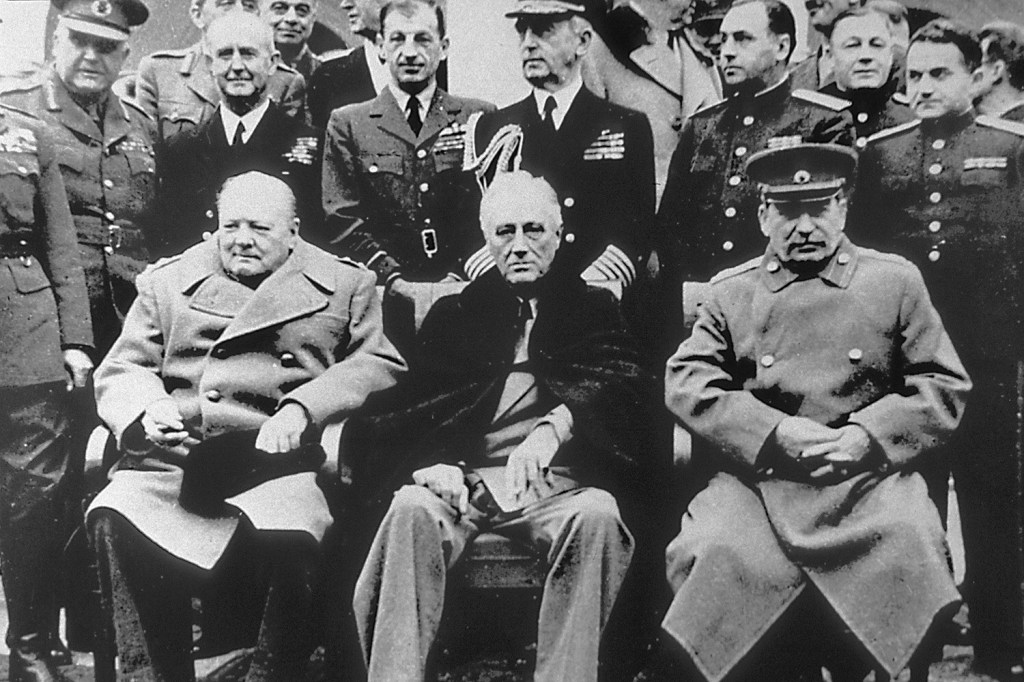
In February of 1945, the leaders of Great Britain, the United States and the Soviet Union — Sir Winston Churchill, Franklin Delano Roosevelt and Josef Stalin — met at Yalta on the Black Sea coast of the Crimean Peninsula to discuss the final stages of World War II and the postwar reorganization of Europe. By May 8th, the war in Europe was over.
Church, Roosevelt and Stalin at Yalta – February 1945
Today, Ukrainian President Volodymyr Zelensky has arrived in Palm Beach, Florida, for yet another meeting with Donald Trump. And once again, Trump chose to precede the meeting with a one-on-one, hour-long phone call to Vladimir Putin — presumably to gauge whether there has been any modification of Putin’s position regarding settlement of his so-called “special military operation” in Ukraine, but more likely to solidify their own agreement on how to convince Zelensky to accede to Putin’s principal territorial and security demands.
And — in sharp contrast to the gathering of equals at Yalta — this is what Zelensky has walked into:
The American Inquisition
Instead of the tripartite meeting he has been requesting — which Putin has steadfastly refused — Zelensky has once more been led into a viper’s nest of eight venomous reptiles hell-bent to claim credit for ending an unjust war, regardless of the ultimate cost to the victims or the future security of Europe.
Aligned against Zelensky, in addition to Trump (fourth from left, with his chin characteristically stuck up in the air), were Secretary of State Marco Rubio; Secretary of Defense Pete Hegseth; special envoy (and real estate mogul) Steve Witkoff; Trump son-in-law (and fellow real-estate guru) Jared Kushner; Chairman of the Joint Chiefs of Staff Dan Caine; General Services Administration’s federal acquisitions service commissioner Josh Gruenbaum (for whatever reason); and — most poisonous of all — White House deputy chief of staff for policy Stephen Miller (second from right, glaring menacingly at the photographer).
That is what passes for diplomacy at Mar-a-Lago.
The day is far from over, and anything could happen. I will, of course, be following events closely; but at the moment, I don’t have a good feeling about this.
In the spirit of the approaching New Year, and as promised yesterday, I’ve decided to focus on the positive and have been searching for quotes that are optimistic, uplifting, and perhaps even humorous.
Benjamin Franklin
Today, my eye landed on the words of Benjamin Franklin: a man well-known, not only for his statesmanship, but for his mischievous sense of humor as well . . . though in this case, I’m quite sure it is my own, often diabolical and sometimes even twisted, interpretation that sees the funny side of this:
“Be at war with your vices, at peace with your neighbors, and let every new year find you a better man.”
What Ben meant, of course, was that you should become a better person in the new year.
But my immediate reaction was: “Yes, please! I’ve been looking for a better man for years, and haven’t found him yet.”
Either way, I think Ben’s sentiment is a good one for 2026 . . . especially after what we’ve all been through in 2025.
This week, as the calendar moves inexorably toward a new year, mankind once again hopes against all reason that January 1st will somehow, magically, cure all of our ills, heal our wounds from the horrors of the past 12 months, and bring peace and joy to a world reeling from the effects of man’s inhumanity to man.
Admittedly, those hopes are illogical — as naive, perhaps, as the New Year’s resolutions we continue to make each year; but they somehow give us the strength to face another year of uncertainty, for none of us can know what lies ahead. And, while I no longer bother with a list of resolutions I know I won’t keep beyond the second week of January, I do still have my hopes for the world in general.
At the top of that list, as it has been for the past two years, is my prayer that the political hostages being held by Vladimir Putin and his allies will at long last be freed from the prisons and penal colonies and returned to the comfort of their homes and their families; and that the constant threat of war under which the world has been living will be eased, allowing reason and true diplomacy to regain a foothold.
And to that end, here they are again . . . the hostages known to me who are still waiting for their prayers to be answered:
*. *. *
Europeans Under Threat:
The people of NATO and EU member states
Prisoners of War:
The 19,500 Kidnapped Ukrainian Children The People of Ukraine
Immigrant Detainees in Russia:
Migrants from the Central Asian nations of Kazakhstan, Kyrgyzstan, Tajikistan, Turkmenistan and Uzbekistan
Endangered Exiles:
Mikita Losik Yulia Navalnaya Countless Journalists and Other Dissidents
Andrei Chapiuk Uladzimir Labkovich Andrzej Poczobut Marfa Rabkova Valiantsin Stafanovic Yuras Zyankovich
In Georgia:
Mzia Amaglobeli
In China:
Chenyue Mao (American)
In Russia:
The “Crimea 8”: — Oleg Antipov — Artyom Azatyan — Georgy Azatyan — Aleksandr Bylin — Roman Solomko — Artur Terchanyan — Dmitry Tyazhelykh — Vladimir Zloba
James Scott Rhys Anderson (British) David Barnes (American) Gordon Black (American) Hayden Davies (British) Antonina Favorskaya Konstantin Gabov Robert Gilman (American) Stephen James Hubbard (American) Sergey Karelin Timur Kishukov Vadim Kobzev Darya Kozyreva Artyom Kriger Michael Travis Leake (American) Aleksei Liptser Grigory Melkonyants Nika Novak Leonid Pshenychnov (in Russian-occupied Crimea) Nadezhda Rossinskaya (a.k.a. Nadin Geisler) Sofiane Sehili (French) Igor Sergunin Dmitry Shatresov Robert Shonov Grigory Skvortsov Eugene Spector (American) Laurent Vinatier Robert Romanov Woodland (American)
. . . and, of course, the thousands whose names and locations are unknown to me.
*. *. *
With this, my last Sunday tribute of 2025 to the world’s political hostages, I wish each and every one of you strength, hope, and a joyous end to your travails as you return to the embrace of your families and friends. May you all have a truly Happy New Year.
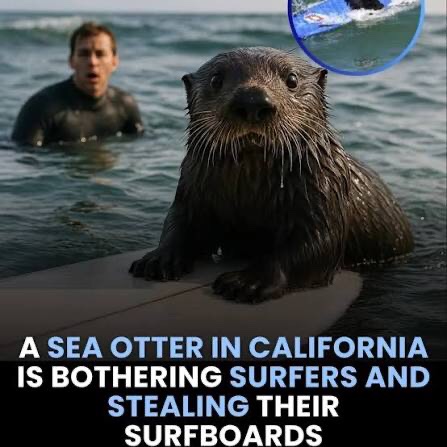
Since I started this blog some three years ago, I have shared 1,916 posts with you (1,917 including this one). It started out as a sort of autobiographical travelog of the more adventurous years of my life, and morphed into a conglomeration of topics from world events, to memories of my childhood, to a mischievous sea otter named Laverna.
The Infamous Laverna
Always on the search for something new, I’ve decided to usher in 2026 with a New Year’s Day retrospective of my posts of the past year — not all of them, certainly, but a couple of the highlights from each month — as a reminder of what we have all experienced, and somehow survived, over the past 52 weeks.
So that’s what I’ll be working on for the next few days, in addition to keeping abreast of the daily news. Wish me luck . . . there’s a lot of material to go through. (Not nearly as much, of course, as the Epstein files; but at least I don’t have to deal with all the redactions.)
“Oh, those funny, funny people at the Justice Department!”
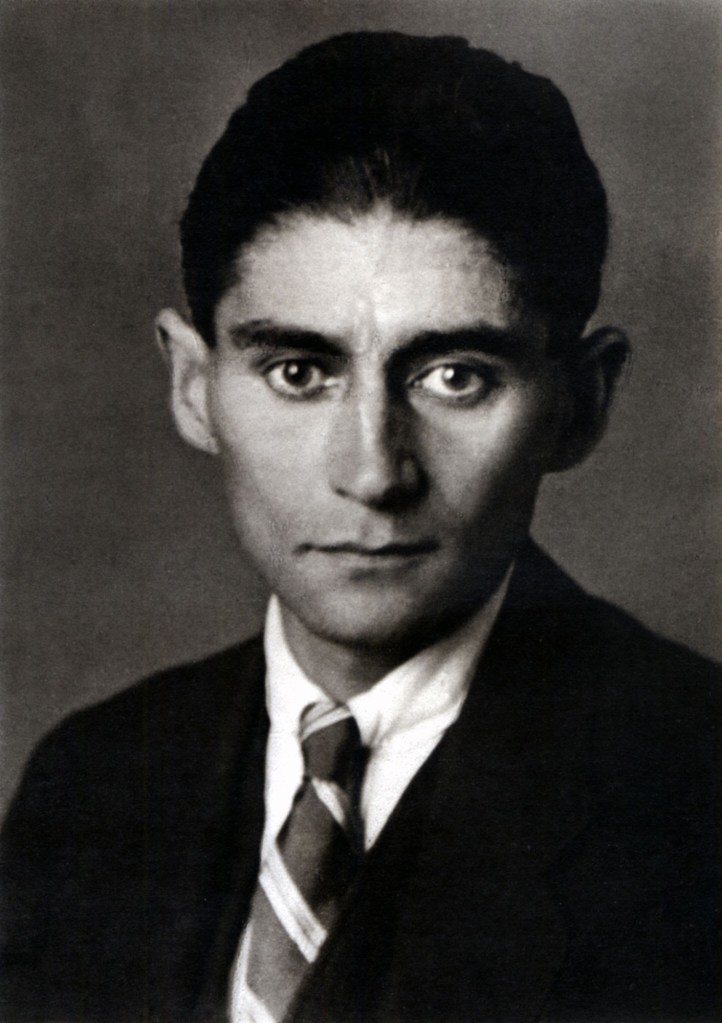
In fact, do not read Kafka even if you’re not depressed . . . because if you’re not, and you do, you soon will be.
Franz Kafka (1883-1924)
I was thinking yesterday about my idyllic summer of 1991 in Prague, which is when — along with the incredible history, architecture, culture, food and beverages of Czechoslovakia (now Czechia, or simply the Czech Republic) — I first became interested in the writings of Franz Kafka, perhaps the most famous of all Czech writers.
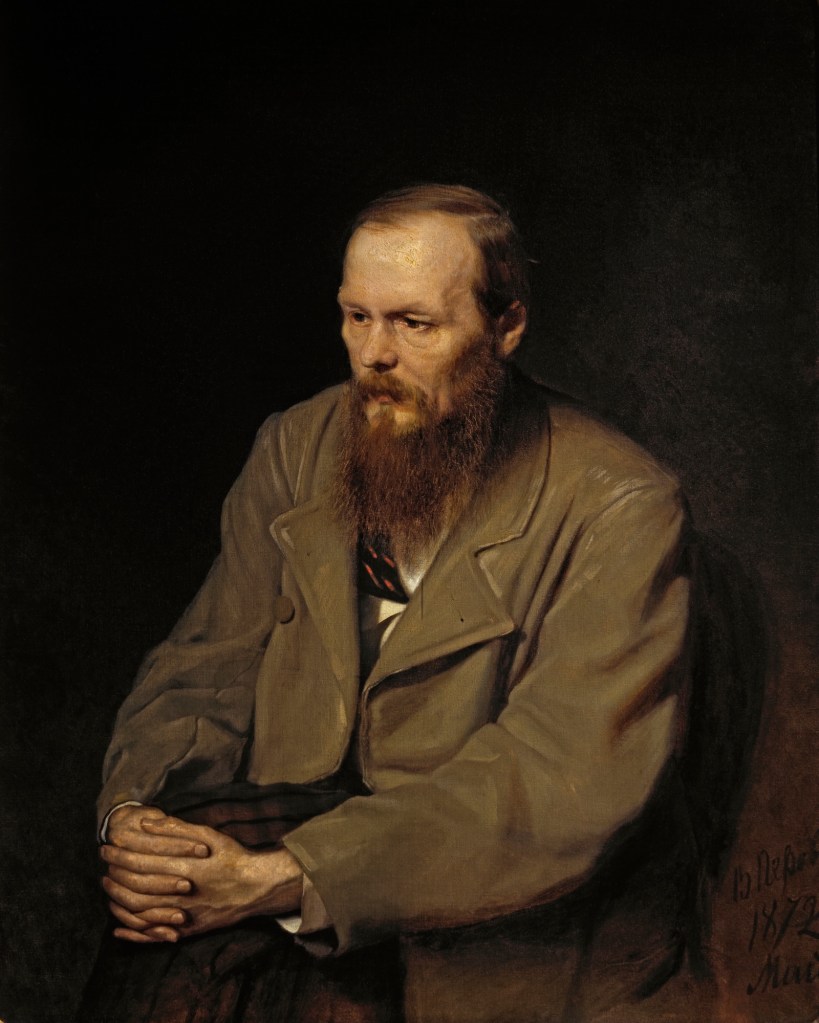
I wondered at the time how anyone who only lived to the age of 40 could have sunk so deeply into despair as to produce such dark, often dystopian works of fiction as “The Metamorphosis” and “The Trial” . . . until I learned that his writing was most heavily influenced by Dostoevsky, Nietschze, and Poe — great writers all, but not exactly uplifting.
Fyodor Dostoevsky
And today of all days — when many people are already suffering from an annual case of post-holiday letdown — I should have known better than to go searching for a quote from Kafka. But, perversely, I did it anyway. What I was looking for was actually something to do with thoughts of the future, in keeping with the approach of a new year. But what I found instead were these:
“I write differently from what I speak, I speak differently from what I think, I think differently from the way I ought to think, and so it all proceeds into deepest darkness.”
“I cannot make you understand. I cannot make anyone understand what is happening inside me. I cannot even explain it to myself.”
“I have spent all my life resisting the desire to end it.”
. . . and, just for kicks, his immortal:
“The Meaning of life is that it stops.”
“Good grief!”
While I hesitate to approach the end of the year on such a demoralizing note, it has, after all, been the shittiest of years; and so it’s probably a suitable choice . . . in a rather dystopian, Kafkaesque way.
Perhaps I’ll have something a little cheerier tomorrow . . . say, from Eleanor Roosevelt, or Erma Bombeck. In the meantime, I’m . . .
Habits of a lifetime can be difficult to break. And for an unrestrained, obsessive-compulsive, avaricious, power-mad narcissist, there wouldn’t be any reason to bother trying, because their ingrained sense of entitlement would never allow them to consider that they might be less than perfect.
Take, for example, a person whose entire life has been spent acquiring things: childhood toys, then cars, houses, businesses, real estate, wives, unlimited amounts of money. It’s easy to understand how, in extreme cases, such an individual might lose the ability to accept the fact that there are limits to what is, or is not, acquirable.
And we are all well acquainted with one such individual, who has clearly lost sight of the fact that even he cannot have everything simply because he wants it.
“That’s a lie, you #*^&%$# loser!”
It could be argued that he already has everything: enormous wealth, position and ultimate power — and that there is nothing left for him to aspire to. But to an acquisitionist (if there is such a word, and if there isn’t, there should be), there must always be something else. Even his name on the Kennedy Center, a $400 million ballroom, and a ridiculous new class of battleships named for him are apparently not enough to slake his thirst for more.
Because now he is going after entire countries. He has periodically set his sights on Panama, Canada and Greenland, but hasn’t taken concrete steps toward achieving those goals . . . until recently. And Greenland turns out to be his first target of choice.
Continuing to insist that the United States absolutely needs — and has some sort of divine right to — possession of their land, their resources, and their people, he reiterated, in conjunction with his announcement of the ludicrous battleship project, that:
“We need it for national protection. We need Greenland for national protection. They have a very small population and I don’t know, they say Denmark but Denmark has spent no money there with military protection. . . . They say Denmark was there 300 years ago with something with a boat but we were there with boats too, I’m sure.” [Alan Herrera, Comicsands.com, December 24, 2025.]
Okay, where do I begin? With the fact that the United States did not exist as a nation 300 years ago? Or is it too much to hope that Trump might, just once, get his history and his math straight?
Actually, yes, that sadly is too much to hope for. So let’s go directly to the 57,000 people of Greenland.
Greenlanders are citizens of Denmark and of the European Union. They don’t want to be part of the United States. Period. They have made that abundantly clear numerous times, including during the diplomatically disastrous visit of J.D. Vance in March of this year, when he was met by anti-US demonstrations.
And then there is something called a legal issue. Greenland, while mostly self-governing since 1979, remains an autonomous territory of Denmark, which has responsibility for the island’s defense and foreign policy. And Denmark isn’t selling.
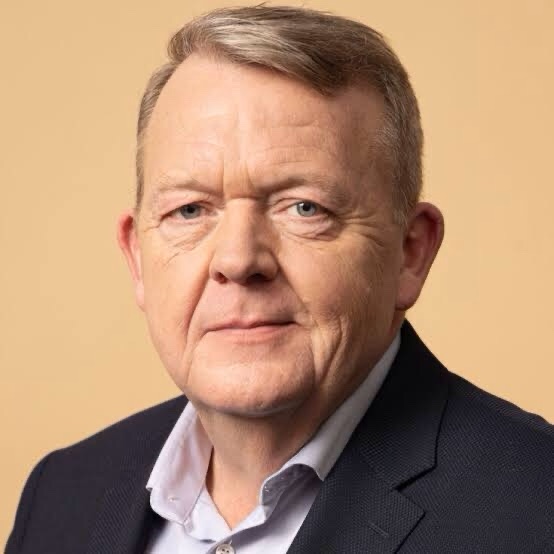
So what does Trump do? He appoints a “special envoy” — Louisiana Governor Jeff Landry — to Greenland, causing Denmark’s foreign minister, Lars Lokke Rasmussen, to summon the U.S. Ambassador to discuss the matter. And on December 22nd, Rasmussen issued a statement saying that Landry’s appointment clearly indicates that Trump is still trying to claim ownership of the island — which, of course, would include its vast natural resources — and adding:
“We insist that everyone including the U.S. must show respect for the territorial integrity of the Kingdom of Denmark.” [Kim Hjelmgaard, USA Today, December 22, 2025.]
Danish Foreign Minister Lars Rasmussen
To which Trump responded on social media:
“Jeff [Landry] understands how essential Greenland is to our National Security, and will strongly advance our Country’s Interests for the Safety, Security, and Survival of our Allies, and indeed, the World.” [Id.]
Not to mention those rare earth elements, numerous minerals, and reserves of oil and gas waiting to be tapped. Let’s not forget those.
But Greenland is not a commodity to be traded on any stock exchange. It is a country — around 836,000 square miles of land (about three times the size of Texas), some 57,000 human souls, and a proud history of its own. Trump may covet it, because it is indeed strategically located and rich with natural resources. But that doesn’t mean he has a right to grab it.
Recently-appointed head of the U.S. Arctic Research Commission Thomas Dans — an investor, professed Russia expert, and MAGA political strategist — wrote about Landry on WhatsApp:
“Governor Landry and Louisianans supply an exceptional base of knowledge and experience across the global stage. Energy, infrastructure, tourism, shipping and trade are all priority areas for our future relationship with Greenland.” [Id.]
Thomas Dans
Well, that’s just great. But can’t all of those priority goals, as well as a military presence, be attained by means of trade agreements and treaties? Do we need to bully our way in?
Unfortunately, when the occupant of the Oval Office is a professional bully, this is what happens. And the US risks losing another close ally . . . and likely any hope of accomplishing our actual security goals in the area by friendly, diplomatic means.
As Foreign Minister Rasmussen said in a broadcast on Denmark’s TV2:
“I am deeply upset by this appointment of a special envoy. And I am particularly upset by his statements, which we find completely unacceptable.” [Billy Stockwell, Betul Tuncer, CNN, December 22, 2025.]
And Greenland’s Prime Minister, Jens-Frederik Nielsen, added that, while the territory was willing to cooperate with the US and other countries on the basis of mutual respect:
“The appointment of a special envoy does not change anything for us. We decide our own future. Greenland belongs to Greenlanders, and territorial integrity must be respected.” [James Landale and Rachel Hagan, BBC, December 22, 2025.]
And that should be the final word . . . but will it be?
Well, here we are. Christmas is behind us once again, except for the tasks of finding space for all of the gifts and disposing of the wrappings.
And as we look forward to the end of a monumentally difficult year and the start of a new (and hopefully better) one, I find the perfect sentiment for today to be one expressed by the late essayist and author Susan Sontag:
“I want to make a New Year’s prayer, not a resolution. I’m praying for courage.”
Susan Sontag – 1933-2004
I suspect we could all use an extra helping of that.
The December holiday season — encompassing Christmas, Chanukah, Kwanzaa, and the countdown to a brand-new year — is a time when we turn our thoughts to giving . . . giving of ourselves to those closest to us, and often donating to those around the world whom we’ve never met but who are in dire need.
And thus I have found it oddly appropriate to share with you this tale of perhaps the ultimate giver: Russian-born, exiled billionaire entrepreneur Pavel Durov . . . and why he made me think of the legendary “Johnny Appleseed.”
John Chapman, a/k/a “Johnny Appleseed” (1774-1845)
Though “legendary,” John Chapman was a real person. Born in 1774 in colonial Massachusetts, he developed an early interest in conservation that led him to a career as a nurseryman, and to the discovery of a means of growing trees from apple seeds rather than the traditional grafting method. He introduced his methods to the far-flung areas of Pennsylvania, Ohio, Indiana, Illinois, West Virginia, and even the Canadian Province of Ontario, becoming a folk hero who earned the nickname of “Johnny Appleseed,” and inspired the creation of numerous poems and songs in his honor.
Pavel Durov, on the other hand, probably doesn’t give a great deal of thought to trees. The creator of the original VKontakte (now simply VK) social networking service in Russia, he fled his native country to escape pressure from the Kremlin to reveal confidential information about his clients. Settling for a time in France, he turned his talents to the new network we now know as Telegram. He holds multiple citizenships and spends most of his time in Dubai; his net worth has been estimated by Forbes at $17 billion.
So, other than inventiveness and perseverance, what do these two men — from different centuries and different lands — have in common?
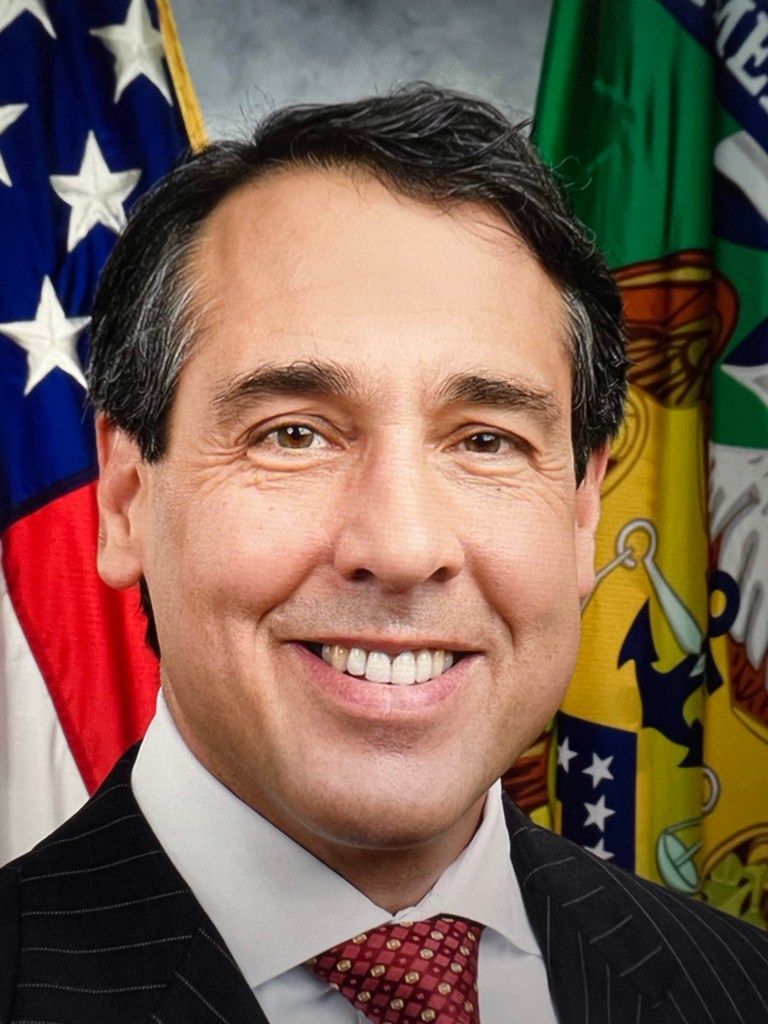
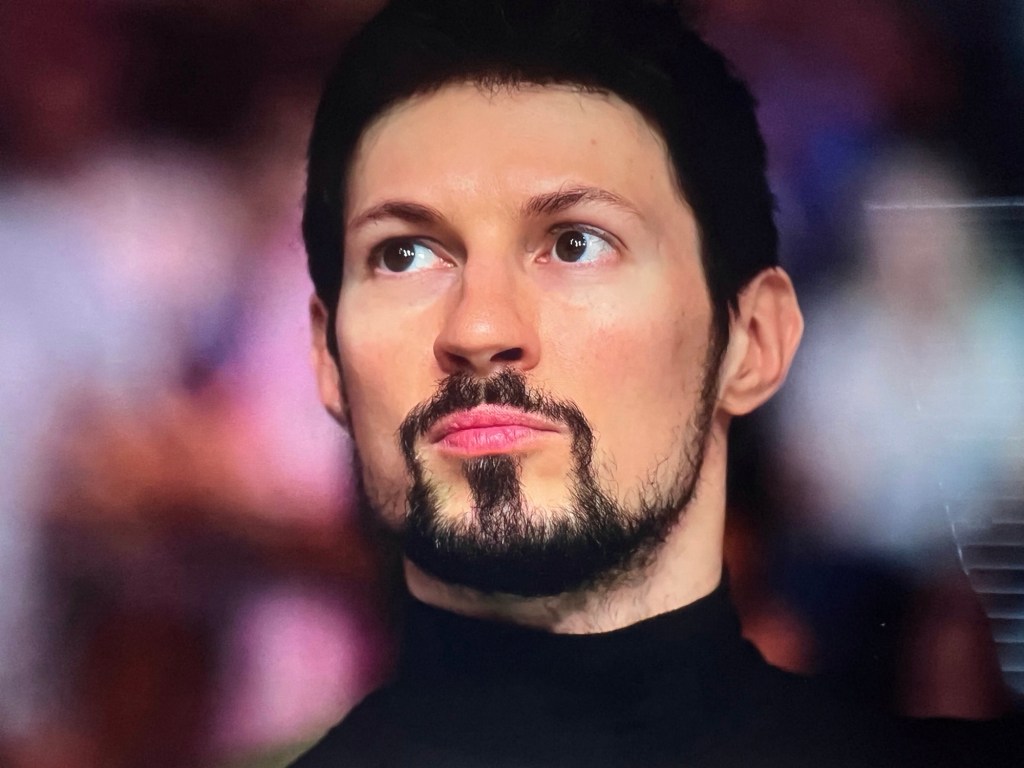
Well first of all . . . look at their pictures.
Pavel Durov (1984 – present)
Now, that’s just eerie!
But setting aside the doppelgänger effect, these two men share another common passion: procreation. Johnny Appleseed grew trees from apple seeds; Pavel Durov grows children from a whole other kind of seed: his endless supply of human sperm.
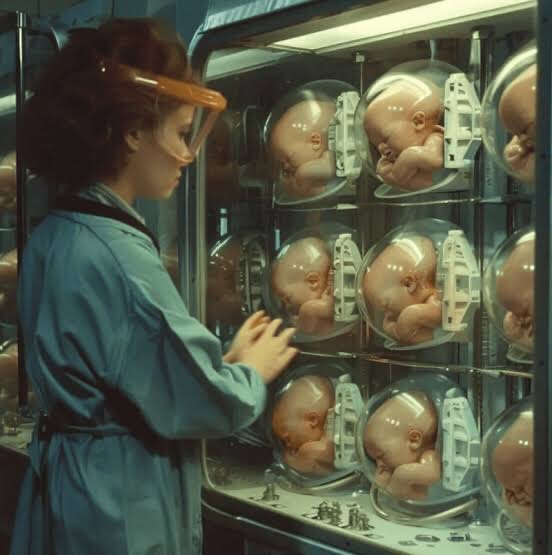
Durov is a passionate advocate of pronatalism: a movement that has been likened to a rebirth of the theory of eugenics (selective breeding). Sometimes dubbed the “Russian Elon Musk,” he is said to have fathered 100 biological children across 12 countries by means of in vitro fertilization (IVF).
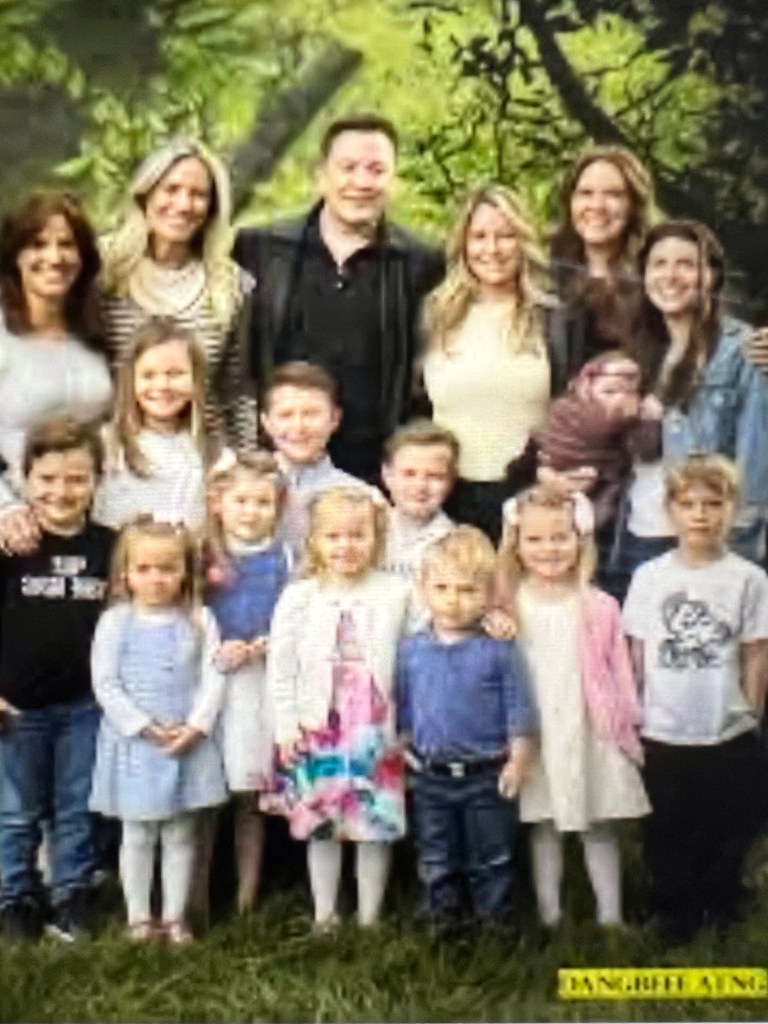
A Gathering of Musks
But unlike Musk — who boasts of having convinced multiple wives and girlfriends to become the “baby mamas” for his estimated 14 offspring, and actually takes an active part in their lives — Durov does not know the recipients of his largesse. His first donation occurred around 2010, when he helped out a friend who was having difficulty conceiving a much-wanted child. He later had the idea of providing his supposedly “high-quality” genetic material to others, in an effort to reverse the trend of a decreasing world population . . . and to help create a race of physically and intellectually superior — and, not incidentally, white — Homo sapiens.
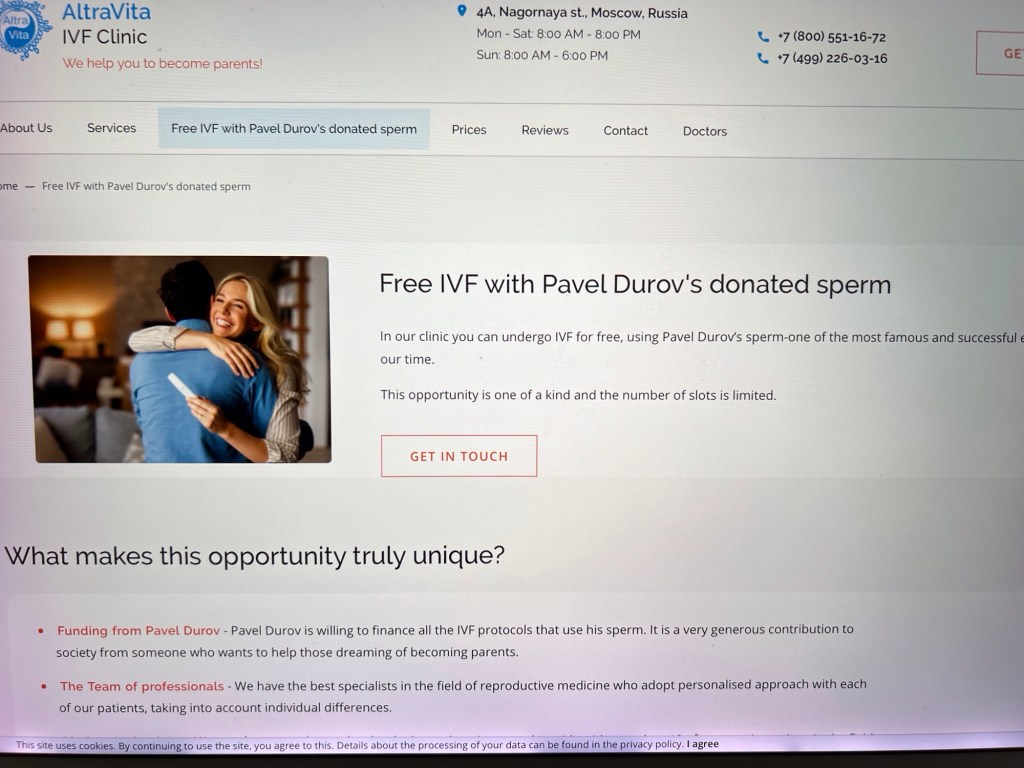
Durov is busy operating his business interests and dealing with his legal problems in France, and apparently no longer has time to spend in that private little room doing you-know-what for the future benefit of mankind. But when he fled Russia, he left behind sufficient sperm, safely frozen, with a Moscow fertility clinic known as AltraVita. The clinic now advertises — on its website, on social media and news sites, and at conferences — that it has Durov’s “biomaterial” available for free IVF treatment of qualified women . . . meaning that they also must be physically and intellectually superior.
A former doctor at the clinic said:
“The patients who came, they all looked great, were well-educated and very healthy. They wanted to have a child from, well, a certain kind of man. They saw that kind of father figure as the right one.” [Sam Schechner, Daria Matviichuk and Thomas Grove, Wall Street Journal, December 22, 2025.]
AltraVita IVF Clinic Website
I’m not sure that “father figure” is the right description of someone the children will never know, but nevertheless . . .
Now Durov has generously offered an added incentive to those women who may be hesitating to undertake an IVF protocol for financial reasons: in addition to covering the cost of the IVF treatments, he announced in a podcast with Lex Fridman in October that his biological children could each receive an equal share of his inheritance:
“As long as they can establish their shared DNA with me, someday maybe in 30 years from now, they will be entitled to a share of my estate after I’m gone.” [Id.]
What a guy! There are others — some of the wealthiest and most influential men in the world — with a similar interest in producing as many little likenesses of themselves as possible . . . even to the extent of using genetic testing and experimental gene splicing. But I haven’t heard of any of the others offering the possibility of future inheritance. (Not that there’s any guarantee of fulfillment of that half-hearted promise from Durov, “someday maybe in 30 years from now.”)
*. *. *
Aside from the ethical questions that have always surrounded the concept of selective breeding in humans, my first reaction to Pavel Durov’s story was:
“WTF??!!!!”
“Selective breeding” is how we pair race horses to produce winners, cows to supply us with high-quality milk and beef, and dogs to take Best of Show at Westminster. Is it also how we want to produce our next generation of children?















 The Blog About Everything … and Sometimes Nothing