Having a wonderful time reminiscing about all my past travel (and other) adventures. Hope you’ll share them with me in my blog, “All Roads Led to Russia.”
When we ask ourselves what has happened to the United States, how the Republican party allowed itself to be hijacked by a right-wing malignant narcissist and his fanatic, lunatic-fringe followers, and how we the people failed to see it coming, we need only look to the late George Orwell for a complete understanding of all of it.
George Orwell (1903-50)
As long ago as 1949, Orwell’s preeminent, dystopian novel “1984” foretold of a country called Oceania, ruled by a single Party whose omnipotent leader was known as Big Brother. And in one long paragraph from that book, everything we are witnessing and experiencing today becomes blindingly clear:
“Now I will tell you the answer to my question. It is this. The Party seeks power entirely for its own sake. We are not interested in the good of others; we are interested solely in power, pure power. What pure power means you will understand presently. We are different from the oligarchies of the past in that we know what we are doing. All the others, even those who resembled ourselves, were cowards and hypocrites. The German Nazis and the Russian Communists came very close to us in their methods, but they never had the courage to recognize their own motives. They pretended, perhaps they even believed, that they had seized power unwillingly and for a limited time, and that just around the corner there lay a paradise where human beings would be free and equal. We are not like that. We know that no one ever seizes power with the intention of relinquishing it. Power is not a means; it is an end. One does not establish a dictatorship in order to safeguard a revolution; one makes the revolution in order to establish the dictatorship. The object of persecution is persecution. The object of torture is torture. The object of power is power. Now you begin to understand me.”
Washington’s worst-kept secret these days — and for some time now — has been the accelerating physical and cognitive decline of Donald Trump. He fights it; he denies it; but it is on full display daily as he struggles to find the words he needs, or even to stay on script. He has been seen dozing off in meetings, and wandering off as though he’s not sure where he is or what he’s supposed to be doing.
That sort of degeneration, not uncommon in an aging population, is sad when it happens to anyone. When it involves the President of the United States, it is more than sad; it is downright dangerous.
But he isn’t always asleep at the switch; he does have his lucid moments. And one of those moments seems to have occurred during a gathering of Congressional Republicans in Washington on January 6th, as they were discussing the upcoming midterm elections.
Unfortunately for him and his supporters, however, that particular flash of insight was not a cheery one. What he said was:
“You gotta win the midterms ‘cause, if we don’t win the midterms, it’s just gonna be — I mean, they’ll find a reason to impeach me. I’ll get impeached.” [Steve Holland, et al., Reuters, January 6, 2026.]
Confusingly, he went on to predict an epic Republican win, but then made reference to the history of sitting presidents doing poorly in midterms:
“They say that when you win the presidency, you lose the midterm. I wish you could explain to me what the hell’s going on with the mind of the public.” [Id.]
Ironically, that is precisely what the public is wondering about him. But one thing is clear from his first comment: he is, at some level, aware of the fact that he has committed impeachable offenses, and that the return of a Democratic majority to Congress would very likely place the balance of his presidential term in serious jeopardy.
Now, if you or I were in that position, we would tend to consider (1) resigning, or (2) cleaning up our act in an attempt to salvage what was left of our career and reputation. But Trump’s mind does not work like most people’s. When cornered, he reacts like a wild beast: defenses on full alert, claws out, salivating for the kill. And that is when he goes off in search of a diversion: a perceived enemy to prosecute, another country to invade, or an ally to alienate.
Several journalists and podcasters have mentioned it this week, so I know I’m not the only one who’s noticed. But what’s going on with the Epstein files?
They were all anyone was talking about . . . the new documents, the redacted documents, the missing documents, the Department of Justice dragging its feet, Pam Bondi lying her ass off. Until, suddenly and inexplicably, Donald Trump went and invaded Venezuela, creating the ultimate red herring.
And now it’s all about the kidnapping, the drugs, the oil, the drugs again, and Cuba, Colombia, Mexico, Greenland, Iran . . . the United States of Trump.
Suddenly that little matter of pedophilia and perjury got pushed onto the back burner, and the angry man in the Oval Office caught a break. Now he was able to direct his fury at the looming midterm elections, throwing things and threatening to fire his entire staff of toadies and sycophants if they didn’t find a way to fix the results.
He seems to believe that if he creates enough mayhem, then the one thing of which he is most terrified — the truth about what is in those files — will finally be revealed.
Whatever that truth is — and I don’t pretend to have the slightest inkling — it must be so shocking, and so potentially damaging, that it has to be buried at all costs.
But we cannot allow that to happen.
It’s not a question of prurient curiosity, or a desire to “get the goods” on anyone . . . although there are plenty of people for whom those are the driving factors. No . . . it’s a question of truth, justice, and — dare I say it? — the American way.
We can’t drop the ball on this, when we’re so close to learning the truth.
I have been following, with great wonder and admiration, the Buddhist Monks engaged in a “Walk for Peace” across America as they spread their messages of love, compassion and unity. Together with their intrepid dog Aloka, they have captured the minds and spirit of people around the world in these times of political turmoil and humanitarian failure.
“Walk for Peace”
And so today I have chosen the words of the Buddha himself, which seem to me the best possible advice for all of us as we struggle to make sense of the daily barrage of information, misinformation and disinformation being hurled at us from all sides:
“Do not believe in anything simply because you have heard it. Do not believe in anything simply because it is spoken and rumored by many. Do not believe in anything simply because it is found written in your religious books. Do not believe in anything merely on the authority of your teachers and elders. Do not believe in traditions because they have been handed down for many generations. But after observation and analysis, when you find that anything agrees with reason and is conducive to the good and benefit of one and all, then accept it and live up to it.”
– Siddhartha Gautama, more famously known as Buddha
The Buddha
And for those authoritarians spreading the lies and half-truths, Buddha had this additional word of caution:
“Three things cannot hide for long: the Moon, the Sun and the Truth.”
That is, unless it’s museum quality like this one, listed on eBay for $49,995:
“Matryoshka” Russian Nesting Doll
But for garden-variety souvenirs like these:
As cute as they are, they’re worthless except perhaps as sentimental memorabilia to the person who bought them or received them as a gift some 30 or more years ago.
And yes . . . that person would be me. I actually have several sets, my two favorites being these political gems:
Gorbachev, Brezhnev, Khrushchev and Stalin
Yeltsin, Gorbachev, Brezhnev, Khrushchev, Stalin and Lenin
Like most people, I have a lot of other treasured items as well, collected over a lifetime of travel, gift-receiving, and impulse buying. For me, each piece has a memory attached, and so I continue to make room for them, dusting and rearranging them as my mood dictates.
But I worry about what will happen to my collection when I’m gone: the metal statuette of the Fiddler on the Roof; the totem pole and Inukshuk from Alaska; the Russian “Babushka” and “Dedushka” figurines from the Hillwood Museum in Washington; the photographs I took in London, and Budapest, and Prague, and Moscow, that I had framed and still proudly display on my walls.
Ukrainian Babushka and Dedushka
I know what my children will do with the more expensive items — the china, crystal, and the few pieces of jewelry and antiques that I’ve bequeathed to them in my Will. They may keep one or two items out of sentiment; but most will not suit their more contemporary tastes, and will be sold.
And that’s okay, because those are not the things that mean the most to me. It’s the little things — like the small drawing of a church, bought in 1988 from the artist in the ancient capital of Mtskheta, Georgia; the blue-and-white Lomonosov porcelain egg from a monastery in St. Petersburg (when it was still Leningrad); or the malachite and ivory sailboat that was a gift from the son of the Zairian Ambassador to the U.S. back in the early ‘80s. Their monetary value is negligible; but they mean the world to me.
Malachite and Ivory Sailboat from Zaire
And now, as I sit here writing about them, I know that I can’t just leave their fate in someone else’s hands. And I can’t have them buried with me, because I have chosen to be cremated. But I can provide for them in a codicil to my Will, instructing that they be donated to the Salvation Army, where hopefully each will find a new home with someone who falls in love with them just because they’re beautiful.
Perhaps the saddest part of growing old is knowing that every trace of the person you have been will soon disappear, and eventually be forgotten by all but a few descendants. I can’t prevent the inevitable; but I can try to keep my little treasures from being tossed onto a trash heap.
Has anyone actually not seen the 1985 classic Back to the Future?
Flux Capacitor
Who could forget that mad genius, professor/inventor Doc Brown, whizzing back through time in his De Lorean automobile with his young friend, Marty McFly, changing history to prevent a personal tragedy?
I didn’t think of it in time for Christmas, but my birthday is coming up again in a couple of months, and I’d like to place my order now. Unfortunately, it doesn’t actually exist yet — not even Amazon has been able to source it — so I’m in search of a brilliant inventor to transport me back to a time before . . . well . . . this:
Ideally, I’d like to go back to around 1960, when I was young, single, and enjoying life to the fullest. But this isn’t about me; so I’ll settle for, say, the 1980s — a time before the angry man began thinking about entering politics; when our country, while not perfect, was the cradle of democracy, when we and our allies were truly friends, and we treated even our enemies with the respect mandated by international law and treaties.
And if I were able to change just one thing on that trip to the past, it would be to transport the angry man to Greenland, where he would be sentenced to spend the rest of his life in a remote fishing village, working for average wages in a fish processing plant, living among honest, strong, hard-working people who wouldn’t tolerate any of his crap.
That is, of course, if Greenland would have him.
Ikerasak, Greenland
*. *. *
Now, I don’t know whether time travel will ever be possible. And, considering the similarity between the logo on the warning sign that came with Doc Brown’s futuristic invention and another, all too real, signage, it might not be the best idea I’ve ever had.
When we read an obituary of someone we once knew, or a famous (or infamous) person who may in some way have been important to us, it’s natural to think about that person’s life, and how they are likely to be remembered.
I believe it’s safe to say that most of us would like to think we’ll be missed, and recalled with fondness for the good we have done in our lives rather than the mistakes we’ve made. But sadly, there are a great many — and let’s not mince words here — truly rotten people in this world, who have, for a wide variety of reasons, knowingly caused nothing but harm and misery to others.
The notice of the death in prison of CIA turncoat Aldrich Ames, 84, on Monday of this week brought to mind one man’s vision of the fate awaiting such people:
“The wretch, concentred all in self, Living, shall forfeit fair renown, And, doubly dying, shall go down To the vile dust, from whence he sprung, Unwept, unhonored, and unsung.”
– Sir Walter Scott, The Lay of the Last Minstrel
Sir Walter Scott (1771-1832)
For those “wretches” of whom Scott wrote, there could be no worse fate than to depart this world “unwept, unhonored, and unsung.”
And for those of us who have fallen victim to their iniquity during their lifetimes, there can be no greater satisfaction.
Just sayin’ . . .
Brendochka 1/7/26
Just sayin’ . . .
Brendochka 1/7/26
NOTE: In case anyone thinks I missed the grammatical error in Sir Walter Scott’s quote — “from whence” — I didn’t. I tried very hard to ignore it, but in the end, I kept hearing my long-ago English teachers saying “Really? From whence?”
If you’re under the age of 45 or 50, or didn’t pay much attention to the U.S.-Russian spy wars of the 1980s and ‘90s, you’re probably wondering, “Who is — or was — Aldrich Ames?”
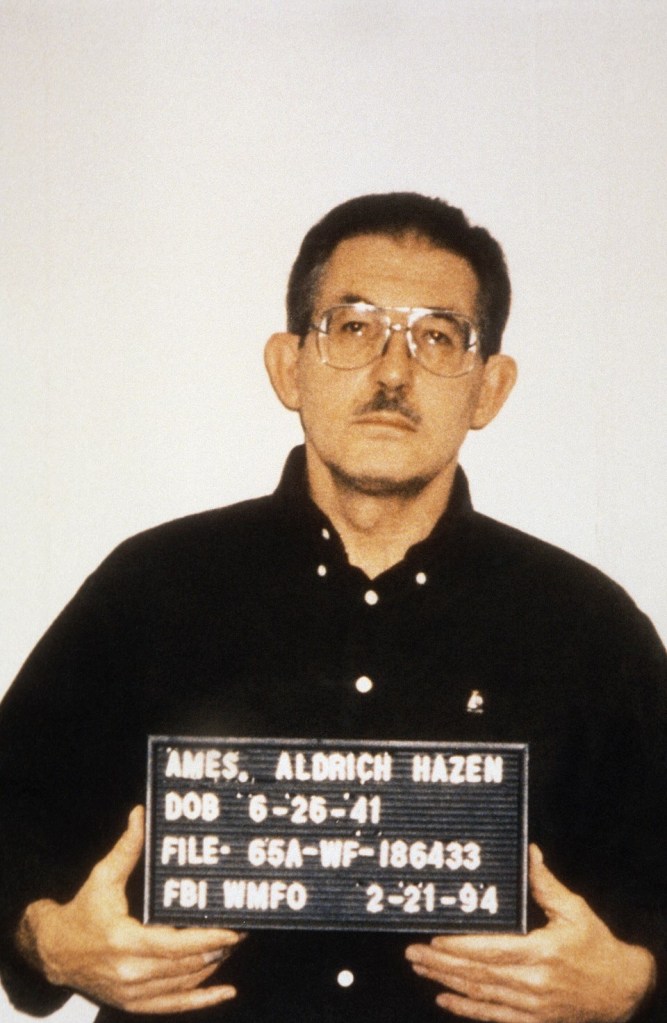
Aldrich Ames – February 1994
Briefly, he was an American CIA counterintelligence officer who spied for the Russians from 1985 to 1994. Described as one of the most damaging spies in U.S. counterintelligence history, he sold the Russians classified information, including the identities of CIA and FBI sources, resulting in the deaths of at least nine valuable agents. Following an extensive internal investigation at the CIA and a joint operation with the FBI, Ames was finally identified . . . with the additional help of information elicited from a Russian KGB defector in 1993.
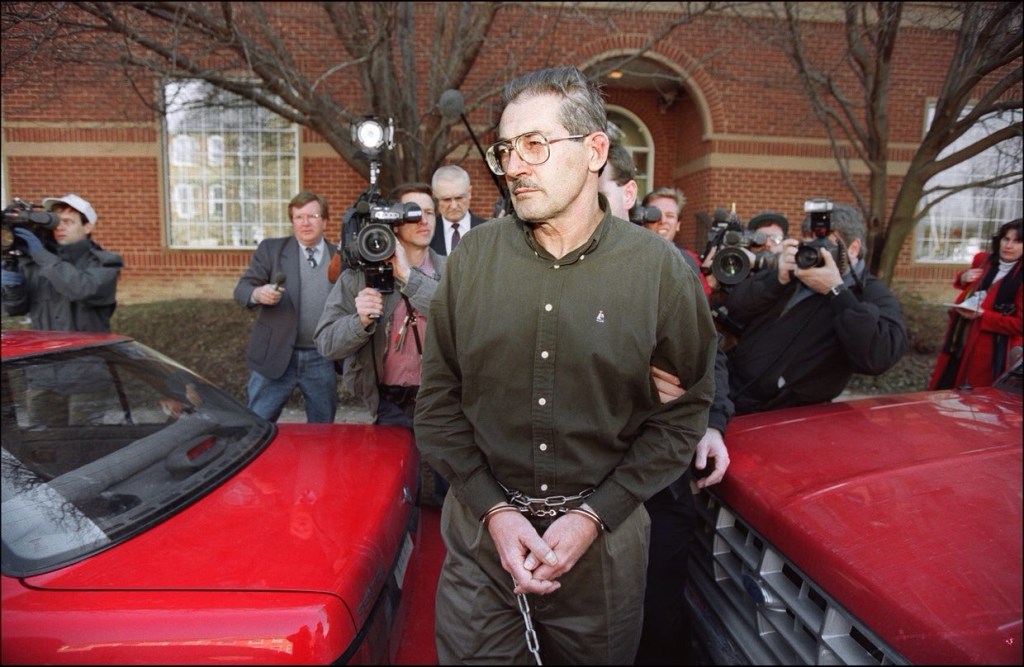
Ames was ultimately arrested outside his home in the Washington, D.C., suburb of Arlington, Virginia, on February 21, 1994. He pled guilty to charges of espionage and tax evasion (shades of Al Capone!), and was sentenced to life in prison without possibility of parole.
Two days ago, after serving nearly 32 years in the federal prison system, Ames died at the age of 84. No cause of death has yet been announced.
And now you’re wondering: “So what?”
From the reader’s point of view, that would be a reasonable reaction. But my interest in the case was more personal, as shared in some of my earlier posts on this blog. And learning of Ames’ death yesterday led me to look back to that earlier time, and to share a small part of my tale with you once again.
So here we go . . .
*. *. *
LOOKING BACK: A 40-YEAR-OLD SPY STORY
“Life’s a pitch, then you spy.” – John Alejandro King
On April 16, 1985, an American man walked into the Soviet Embassy on 16th Street in the northwest quadrant of Washington, D.C., and asked the guard at the glass-protected desk if he might speak with an Embassy diplomat, Sergei Chuvakhin. When the guard called Chuvakhin to the front entry, the American man handed him an envelope addressed to Stanislav Androsov, then the KGB rezident (chief of station) at the Embassy. Unknown to Chuvakhin, the envelope contained a few documents and an offer to procure and provide more of the same in exchange for the sum of $50,000. The American then left the Embassy and returned to his office in suburban Langley, Virginia.
Former Russian Embassy, Washington, D.C.
Upon receiving and opening the envelope and reviewing its contents, Androsov summoned his deputy, Viktor Cherkashin, then the head of counterintelligence at the Embassy, to discuss the significance of the unexpected and unconventional communique.
The American waited nervously until a month later, when he finally received a call inviting him to meet again with Sergei Chuvakhin at the Embassy on May 17th. On the American’s arrival, Mr. Chuvakhin greeted him, showed him into a small fourth-floor meeting room, and withdrew as he had been instructed. In a few moments, a different gentleman entered the room and introduced himself as Viktor Cherkashin. Their meeting was brief but productive, culminating in an agreement by the KGB to the payment of $50,000 in exchange for additional documents from the American.
Cherkashin and the American next met on June 13, 1985, at Chadwick’s Restaurant, a popular watering hole in the historic Georgetown neighborhood of Washington. The American brought with him a larger package of classified CIA files, which he exchanged with Cherkashin for the agreed amount of $50,000.
Thus began the career of Aldrich Ames as a mole for the Soviet KGB inside the CIA — a career that lasted for nine years, until his eventual arrest on February 21, 1994. Nine years, during which a troubling number of U.S. human assets in Russia were lost, engendering the beginning of a years-long mole hunt within the CIA’s ranks.
Nine years, during which Ames evaded detection despite internal CIA investigations, lie detector tests, routine vetting, and his own reckless extravagance and general carelessness.
Nine years, until — with Ames already at or near the top of the CIA’s short list of suspects — a recently-arrived former KGB officer talked to the FBI and revealed, either knowingly or inadvertently, a key bit of information that allowed the FBI to make its airtight case of espionage against Aldrich Ames.
Without the CIA task force’s relentless, top-secret internal search for a mole, Ames might never have become a suspect. But the CIA has no law enforcement authority in the United States, and so they finally had no choice but to enlist the help of the FBI. It was the joint effort of the two agencies — a rather exceptional collaboration at the time — that brought down the man who still, more than thirty years later, is described by many as perhaps the most destructive U.S. traitor of the 20th Century.
Funny … He doesn’t look like a spy.
Much has since been revealed about the extent of the damage done by Aldrich Ames and the lives lost as a result of his betrayal. But still, more than thirty years later — as he continues to live out his life sentence in the Federal Correctional Institution at Terre Haute, Indiana — Ames claims to have additional information yet to be shared with U.S. intelligence authorities.
And still — three decades after the fact — the identity of the Russian defector who provided that last vital piece of the puzzle also continues to be protected, presumably for his own safety. A few names have been posited by various sources and, not surprisingly, vehemently denied or simply not commented upon.
One was an acquaintance of mine.
*. *. *
The Second Part of the Story
“Though this be madness, yet there is method in’t.” – William Shakespeare, Hamlet
On April 25, 1993, two former Soviet KGB officers — we’ll call them Comrade X and Comrade Z — arrived at JFK International Airport in New York and spent the night at the Connecticut home of their new literary agent. The following day, they met with book publishers in New York City, one of whom agreed to purchase and publish an as-yet-unfinished book being written by Comrade Z based on his years in Washington as a spy for the KGB. The two men then traveled to the Washington, D.C., area, where they remained until their return to Moscow at the expiration of their visas on May 5th. During that period, they met and spoke with agents of the FBI.
One week later — on May 12, 1993— the FBI opened its formal investigation of Aldrich Ames, an agent of the Central Intelligence Agency suspected of being a long-time Soviet mole inside the CIA.
I am the person who brought Comrades X and Z to the United States in the spring of 1993 for the purpose of selling that book, thus making it possible for the FBI to interview them at length, and later to pave the way for their defection to the United States.
What followed were two years of madness . . . and two of the more, let’s just say, interesting years of my life. Questions were raised, by journalists and others, as to the identity of the person who provided that final piece of the Ames puzzle needed to form an air-tight case against him. Some suggested it was Comrade X — “my” Comrade X — but that has not, to my knowledge, ever been revealed. It certainly has not been confirmed (or denied) to me.
*. *. *
Over the years, friends have asked why I haven’t tried writing a book about my experiences of those times, and my answer has always been two-fold: First, that I’ve not been sure whether the subject matter, from the U.S. government’s standpoint, might still be sensitive; and second, because it all happened so long ago, it may have ceased to be of much interest during the years of detente between the U.S. and Russia.
But now, after so many years, and with the return of Russia under Putin to the “bad old days” of totalitarian rule . . . not to mention the near-extinction of relations between Russia and the Western allies since Putin’s invasion of Ukraine . . . it seems somehow appropriate to remind people of how long, and how consistently, the spy wars have been going on while we were looking the other way.
“The whole question is: who controls whom.” – Vladimir Ilyich Lenin
That appellation was originally given by President Franklin Delano Roosevelt to the December 7, 1941, attack on Pearl Harbor. But the horrific event that brought the United States into World War II was planned and executed by an enemy force . . . not by our own citizens, aided, encouraged and supported by our own president.
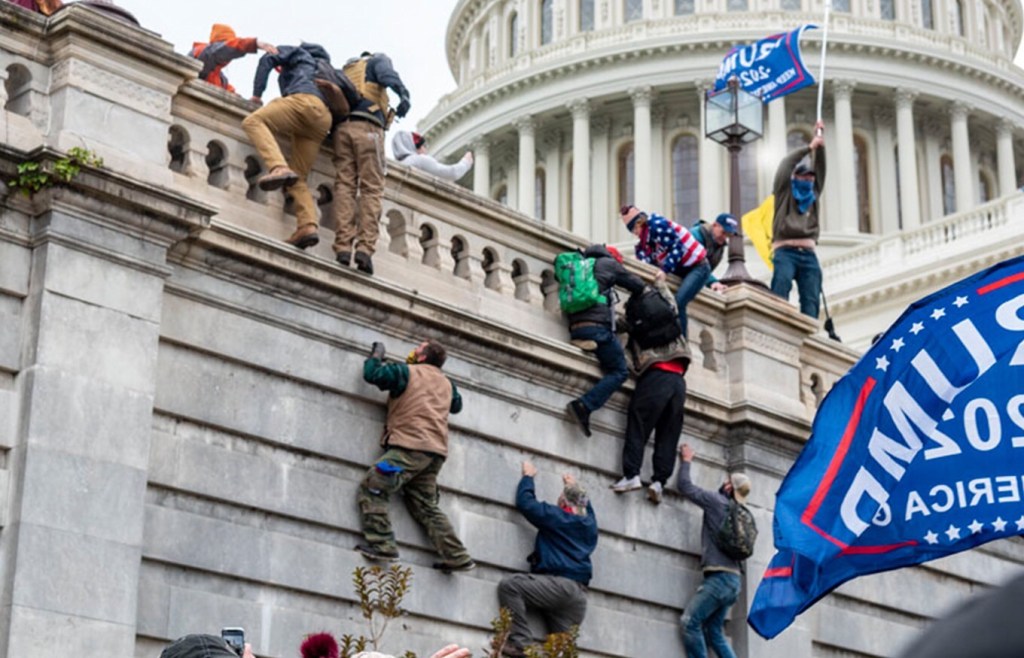
Today is the fifth anniversary of the insurrectionist attack on the United States Capitol by mobs of violent, mindless brutes and thugs seeking to overthrow the 2020 election of Joe Biden to the presidency, in order to continue the authoritarian regime of Donald Trump.
Attack on the U.S. Capitol – January 6, 2021
That attempted coup failed. But Trump never acknowledges defeat. Four years later, he slithered his way back into the White House by a slim plurality of the vote, where he has continued — and accelerated — his coordinated assault on our 250-year-old democracy . . . not to mention his personal attacks against anyone and everyone who has ever dared to criticize him.
It is certainly not necessary to detail, yet again, Trump’s criminal acts of the past year, or his increasingly deranged behavior and obvious physical decline; that is being done on a minute-to-minute basis by the news outlets and social media. And the American people are all too aware of the personal effect his administration’s actions are having on their daily lives.
But beyond our individual problems, what is most concerning is the domino effect of his actions: the weakening of our country’s relations with our traditional allies, the reduction of our status in the eyes of the rest of the world, and, most frightening of all, the opportunities he has provided to the world’s most tyrannical governments — Russia, China, North Korea, Iran, etc. — to step in and fill the void.
In the days since Trump’s shocking invasion of Venezuela, the prevailing attitude among those other authoritarians has been, “If the U.S. can do it, why can’t we?” And they have a point. If Donald Trump can send his troops to kidnap the president of another sovereign nation, doesn’t that justify what Russia is doing to Ukraine? Doesn’t it give tacit permission to Xi Jinping to go after Taiwan? Or Netanyahu to fully occupy Gaza and the West Bank?
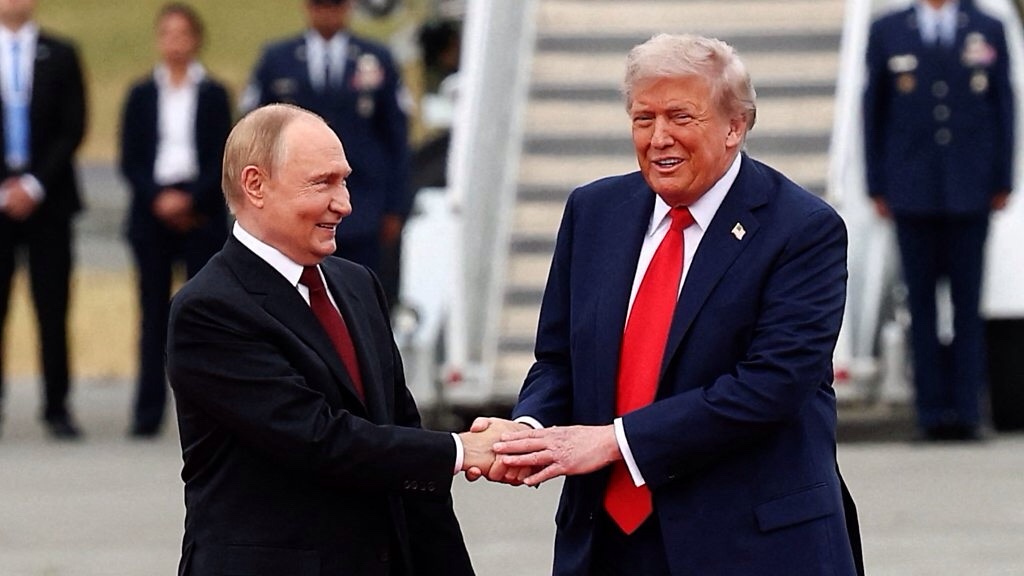
Even before Venezuela, Vladimir Putin had accurately assessed the possibilities presented by Trump’s political stupidity. A week after their meeting in Alaska in August of 2025, which was supposed to have been focused on settling the conflict in Ukraine, this is what Putin had to say in a speech back home in Russia:
“With the arrival of President Trump [in the White House], I think that a light at the end of the tunnel has finally loomed. And now we had a very good, meaningful and frank meeting in Alaska.
“The next steps now depend on the leadership of the United States, but I am confident that the leadership qualities of the current president, President Trump, are a good guarantee that relations will be restored.” [Reuters, August 22, 2025.]
Meeting in Anchorage, Alaska – August 15, 2025
Under this administration, our country has well and truly been sold out in exchange for the personal power of one man and the enrichment of his evil oligarchy. And it began just two weeks before he was due to leave office, when he addressed that rally on the National Mall and encouraged the crowds to march to the Capitol . . .
Rally on the National Mall – January 6, 2021
. . . and when he called the violent attack on that institution a “peaceful” gathering.
And it has continued since then, as he has pardoned the most violent of the convicted criminals who participated in that attack, and repeatedly declared the 2020 election to have been “stolen.”
So yes . . . January 6, 2021, is a day that lives in infamy within the history of the United States. Only this time — unlike that day in December of 1941 — the rest of the free world is not rushing to our aid; and our own people, rather than uniting in defense of our great nation, are divided as they have not been since the end of the Civil War in 1865.
































 The Blog About Everything … and Sometimes Nothing