Having a wonderful time reminiscing about all my past travel (and other) adventures. Hope you’ll share them with me in my blog, “All Roads Led to Russia.”
Unless someone wrote in his name on a ballot, the answer is: No one.
Has he been officially appointed to any office in the upcoming administration? Again, the answer is: No.
Then my next question logically follows: So what the hell is he doing?
Let me explain.
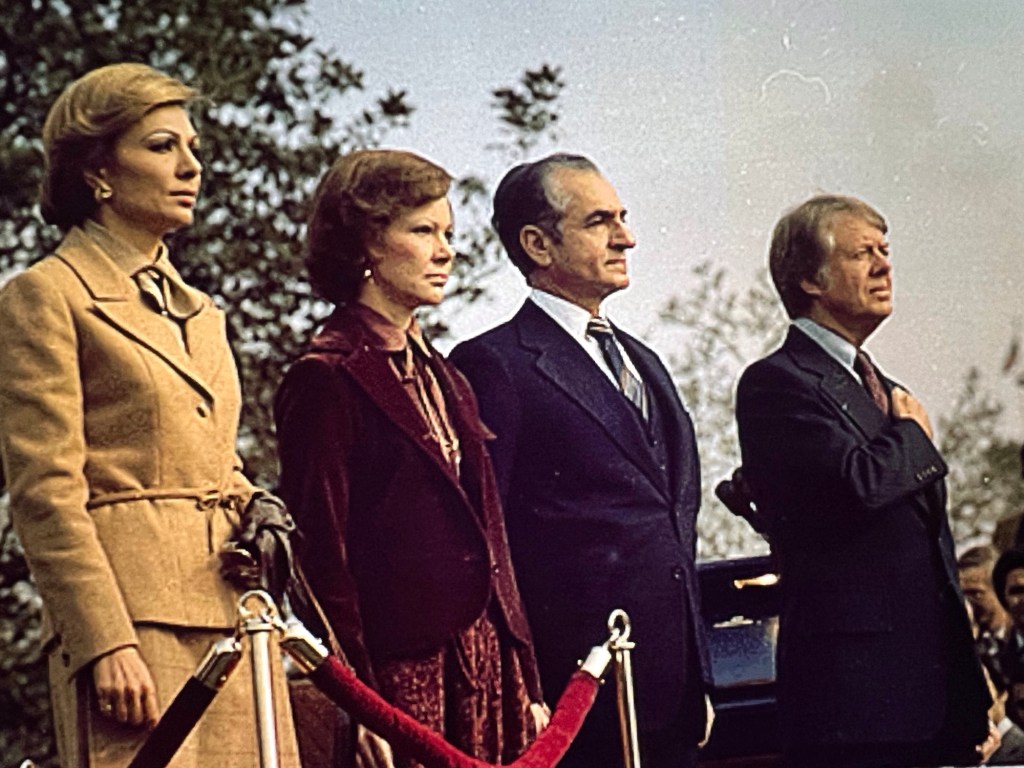
On November 15, 1977, then U.S. President Jimmy Carter publicly welcomed the Shah of Iran and his wife to Washington. Over the next two days, Carter met with the Shah in the White House, where they discussed possible means of further improving already friendly diplomatic relations between their two countries, as well as the Middle East political situation in general.
Empress Farrah Pahlavi, First Lady Rosalynn Carter, Shah Mohammad Reza Pahlavi, President Jimmy Carter – Washington – 1977
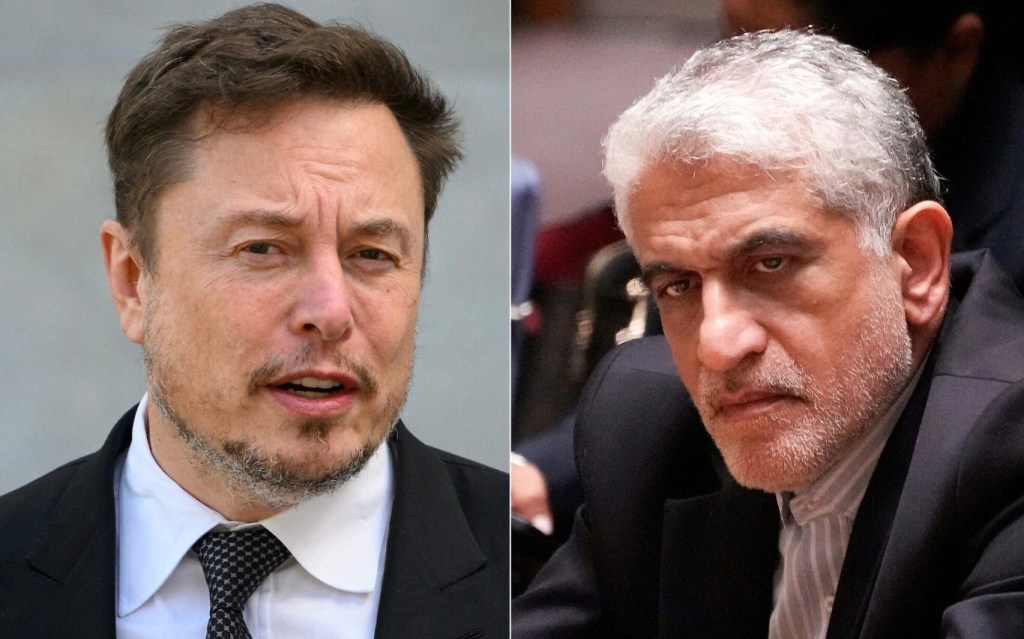
On Monday of this week, almost exactly 47 years later, Elon Musk — an unelected, unappointed friend of President-elect Donald Trump — secretly met with the Iranian ambassador to the United Nations, Amir Saeid Iravani, for more than an hour, according to two Iranian officials cited by the New York Times. [Tara John, CNN, November 14, 2024.]
CNN reports that it has reached out to Trump’s transition team and to Musk for comment, and that Iran’s mission to the UN has declined to comment. A U.S. official did tell CNN that Biden administration officials at the UN were not notified that the meeting was to take place, and still had not received independent confirmation that it ever happened. [Id.]
Musk and Iravani
Again, my question is: What is Musk doing? As far as has been made public, his future role in the Trump administration is to be as co-head (with Vivek Ramaswamy) of an as-yet-nonexistent “Department of Government Efficiency,” with a stated goal of streamlining government operations.
Not Secretary of State. Not Director of National Intelligence. Not White House Chief of Staff. Basically, a bean-counter . . . though, admittedly, of a very large pile of beans.
So why, I ask, is he seemingly everywhere that Trump is, even taking part in telephone conversations with foreign leaders and officials? Is he also to be some sort of foreign policy adviser? Or is it just Musk being his usual pushy, arrogant, take-charge self?
In short, just what is going on in Trump’s back rooms that we, the American people, have a need — and a right — to know?
Just after midnight today I reported on a decrease in medical payments to Russian military troops wounded in the fighting in Ukraine, which officially included a nearly $30,000 supplemental payment to those deemed “unfit for duty.” And I wondered how that determination was to be made, and by whom.
I still don’t have the answer to the “how” or “who” questions. But a brief news flash popped up this morning, giving a clear indication that those details are irrelevant in a military organization that sends its wounded back into battle, fit or not.
Telegram channel “Baza” has reported that more than a dozen wounded contract soldiers — who had traded criminal prosecution for the “opportunity” to be blown to smithereens in Ukraine — fled their military unit near Novosibirsk when they received word that they were being sent back into battle . . . despite their injuries. [RFE/RL, November 14, 2024.]
Way to save $30,000 a head, people!
Thus far, seven of the AWOL soldiers have been captured, with the remainder still at large. No indication has been given as to what their fate will be, though I can’t imagine it could be worse than being sent back into the meat grinder of battle.
The brief report also fails to clarify the extent of the men’s injuries, most likely because that information has not been provided by the Russian military. Presumably, if they were able to “flee,” they’re at least mobile; but that doesn’t necessarily make them fit to fight.
Clearly, more information is needed here. But the whole idea of being given a choice between prison and war — the ultimate “rock” and “hard place” — is beyond my comprehension.
Quite a few years ago, I worked with a young man who went to Australia on a two-week vacation. When he came back, he quit his job, sold his condo, packed his bags, and returned to Australia for good. That’s how completely he fell in love with it. We would hear from him periodically, and he never regretted that move. Since that time, I have wanted to visit Down Under to see what attracted him so quickly and completely.
Unfortunately, that opportunity has eluded me. But I think I now know why Australia has always seemed so appealing to me . . . I mean, aside from its beautiful scenery, friendly people, magnificent Sydney Opera House, and a truly quirky jargon.
It’s the fauna.
Seriously, what could be cuter than . . .
A Marsupial Piggy-back Ride
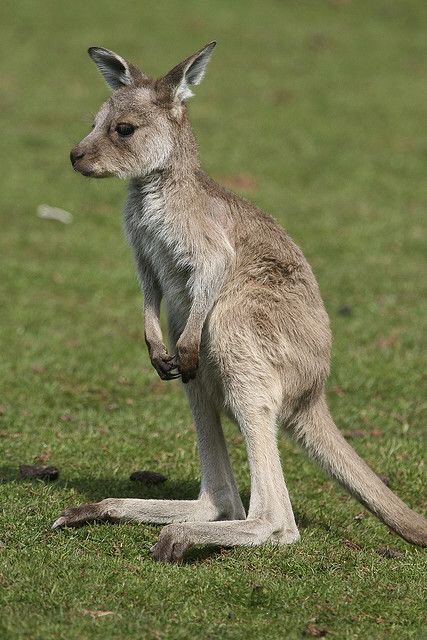
Unless it’s this little fella:
But this one doesn’t cuddle . . . it’s a kick-boxer.
And there are the wombat, the quokka, the platypus, and a whole slew of other oddly-named (and, to be fair, odd-looking) critters.
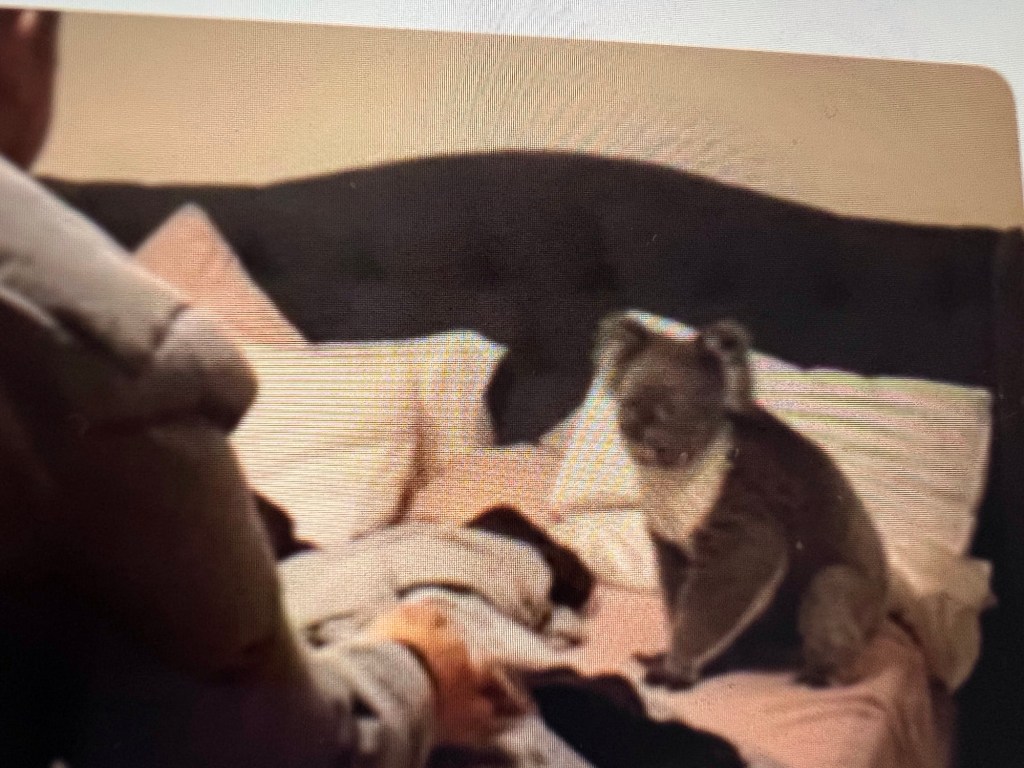
But if I were to come home to find a furry stranger hanging out in my bedroom, I would want it to be a relative of the one encountered by Brunno and Fran Rufino in their home in Adelaide on Wednesday:
The Unexpected Visitor
Mrs. Rufino, who is originally from Brazil, posted about the event on Instagram, saying, “I was scared, happy and excited at the same time. I was so nervous that I forgot my English. Only in Australia.” [Isaac Yee and Chris Lau, CNN, November 14, 2024.]
The couple surmised that the sweet little fur baby had found its way into the house through the pet door, and then couldn’t locate the exit. So Mr. Rufino took a blanket and gently nudged the intruder toward a door, where it happily took off for its natural habitat. That, of course, was exactly the right thing to do . . . but I would have been hard put to let it go without first moving in for a big hug. From the koala, of course.
*. *. *
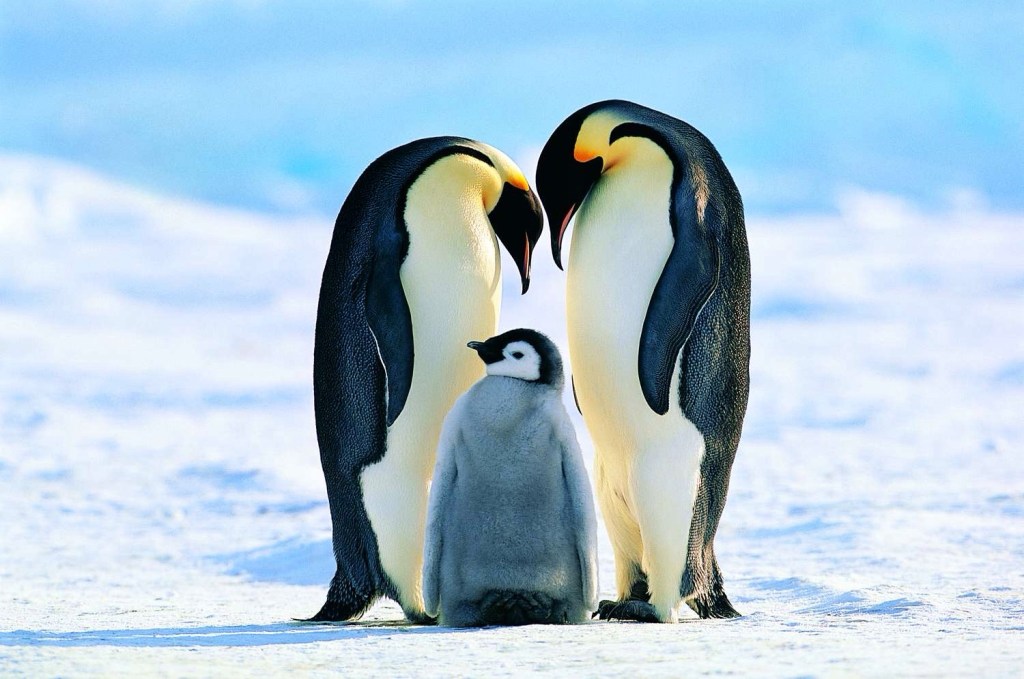
And then there’s the mysterious visitor — not from another planet, but from another continent — who waddled ashore earlier this month at Ocean Beach on Australia’s western coast. Definitely lost, and looking totally bewildered, it was a seriously underweight emperor penguin — the first ever recorded to have made the 2,000-mile swim from its Antarctic home. [Chris Oberholtz, Fox Weather, November 13, 2024.]
Even little Mumble of “Happy Feet” fame never dreamed of doing that!
Show ‘em how, Mumble!
The visitor to Australia was, of course, an adult, weighing only about half his normal weight. Government wildlife officials took charge and removed him to the care of a local seabird rehabilitator, Carol Biddulph, who said:
“Never in my wildest thoughts would I thought I’d ever have an emperor penguin to care for. It’s just amazing. It’s just such a privilege to be part of this bird’s journey.” [Id.]
A Family of Emperors
The bird’s rehabilitation is being aided by veterinarians and wildlife experts from the University of Western Australia, and consideration is being given to the possibility of returning him to Antarctica. In the meantime, since the climate in that part of Australia is significantly warmer than in Antarctica (isn’t that true almost everywhere?), they’re helping him adjust by misting him regularly with chilled water.
The mystery of the emperor’s epic journey will probably never be solved, though it is believed that strong ocean currents most likely swept him off course. [Id.] Since penguins’ yearly rituals are so ingrained, I worry that he will be lonely and befuddled until they do get him home.
But I would so love to have been there to welcome him ashore.
In My Imagination
*. *. *
Though the unscheduled appearance of an emperor penguin is undoubtedly a one-time event, the uniqueness of the occasion — and the odds against it ever happening at all — speak to the character of the continent itself. As Fran Rufino said about her koala adventure:
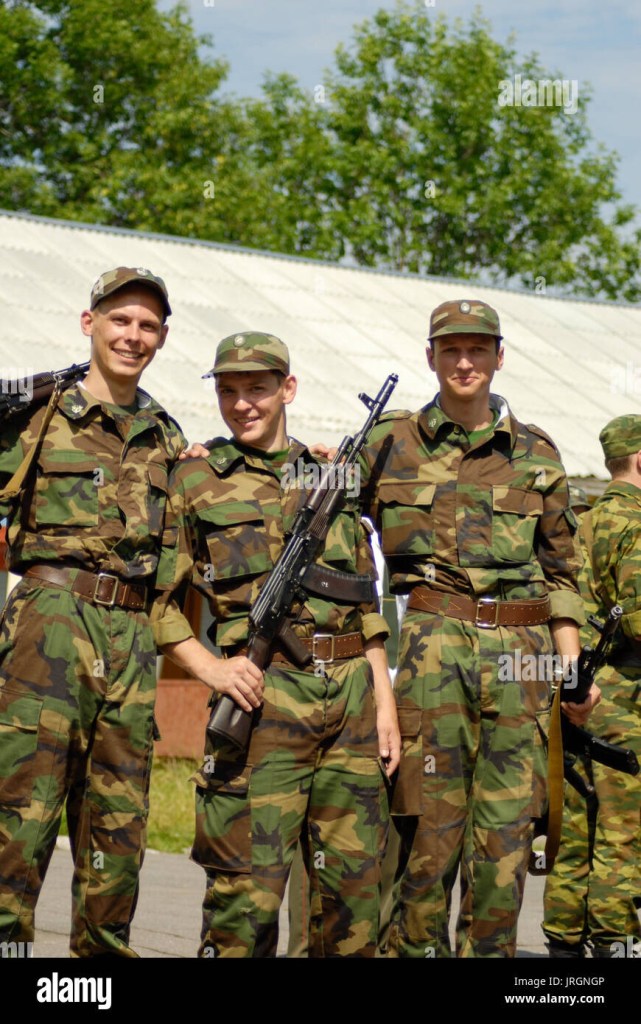
They’re so young, so innocent . . . so poorly trained. They are the newest members of the Russian Army, conscripted to fight a war in Ukraine that most of them don’t understand or support, and to kill other young men they’ve never met who — in a better world — might have become their friends.
Some of these boys — a lot of them — will not come back. Others who do return alive will never be truly whole again. The lucky ones will have only temporary physical injuries. And, until two days ago, each of the damaged returnees would have been entitled to a one-time medical payout of three million rubles, or about $30,000.
But someone in Moscow recently came to the conclusion that it wasn’t fair to pay a seriously, permanently injured soldier the same amount as one who only had, say, a non-life-threatening bullet wound that would heal nicely in a matter of a few weeks or months . . . and that perhaps payouts should be based on the severity of the injury. And I don’t see any way to dispute that logic.
But . . .
Remember, this is Russia, where there is always a “but,” and logic doesn’t always prevail.
But did they then increase the amounts on a scale taking into account the nature of the injury, the amount of pain and disability caused, the length of recovery time, the extent of any permanent disability, loss of future income, and the resulting emotional trauma?
Well . . . no, they didn’t. (And as to the last item, I wonder whether the Russian government even acknowledges the existence of PTSD.)
No . . . what they did was leave the $30,000 payment in place for the very worst cases, and decrease the rest to practically nothing: $10,000 in some cases, and as little as $1,000 for others.
The Disappearing Ruble
The new law sets guidelines for determining the amount of each wounded soldier’s compensation. The problem here is that the definitions are, to state it politely, open to interpretation. Actually, they’re as clear as mud.
For example, “Section I” injuries — those that “endanger their life or health or may cause significant damage to their organs” — include “severe spinal injuries, brain damage, rupturing of genitalia, rib fractures, broken limbs, or damage to organs such as the lungs or kidneys.” [Business Insider, November 14, 2024.]
Worth only $10,000 are less severe “Section II” injuries, deemed to be temporary, such as “minor fractures, concussions, first- and second-degree burns to the eyes, ankle fractures, and gunshot wounds that don’t affect organs.” [Id.]
Those who are wounded and deemed “unfit for duty” are entitled to an additional 2.96 million rubles ($29,600) under an earlier law signed by Putin in March 2022, just after the invasion of Ukraine on February 24th. But how is that determined, and by whom?
To be clear, the foregoing are “medical” payments. The 2022 law also provides for those not fortunate enough to have survived the war. I haven’t seen the law itself, but Business Insider reports that it “entitles those who die in the war to about 7.4 million rubles, or $75,000, as well as 5 million rubles, or $50,000, to their families.” [Id.]
Wait . . . WHAT??!!! Is that $75,000 paid to the corpse? Does it have to be buried with him, while the family is left with just the $50,000? I do hope that was a misprint.
“Oops!”
*. *. *
Now, all of that may sound fairly generous, although $30,000 — or even $75,000 — doesn’t go very far today . . . not even in Russia. And the lesser amounts of $10,000 or the measly $1,000 are a joke.
But what strikes me as most unfair is the amount of money Putin — while short-changing his military — has managed to find for the care, feeding and education of all of those babies he has encouraged . . . no, ordered . . . Russia’s young couples to produce to offset the country’s declining population. How is that even going to work with so many young men apparently coming home with ruptured genitalia?
And to what purpose? So that, in 18 years or so, the next generation too can be sent off to some foreign land to have their brains damaged . . . their lungs and kidneys destroyed . . . or their very lives stolen from them?
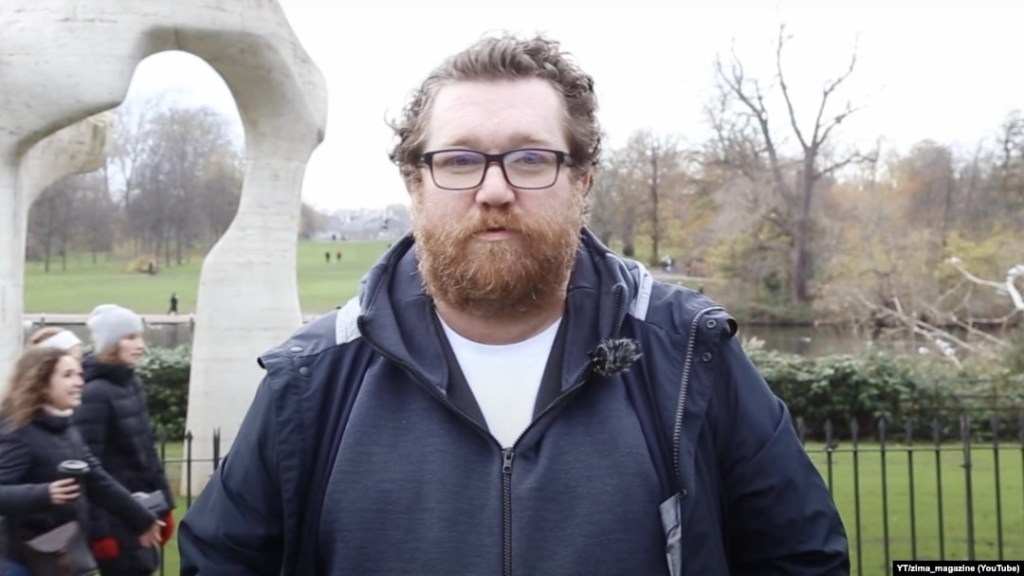
Alexei Zimin: Celebrity chef, author, Russian expatriate, outspoken critic of Vladimir Putin’s war in Ukraine — now dead at age 53.
Alexei Zimin
Born in the Soviet Union in 1971, Zimin’s love of cooking led him to a career as a restaurateur and as host of a popular TV show on Russian TV. But his outspoken opposition to Russia’s invasion and annexation of Crimea in 2014 necessitated his leaving Russia for London, where he opened a Russian restaurant that he named Zima — an establishment that has become popular with the Russian expatriate population of London. He also publishes a magazine by the same name, and has co-authored several books.
He was able to continue broadcasting on Russia’s NTV channel until he posted anti-war messages on social media following the February 2022 invasion of Ukraine, at which time his show was discontinued in Russia. His response, posted on Instagram, was simply:
“There will be no new episodes due to the anti-war position of the host. Do I regret it? No, I regret that we ended up going to war. I don’t take part in the war, the war takes part in me.” [CBS News, November 14, 2024.]
Zima Restaurant, London
Since the Russian invasion of Ukraine, Zimin’s restaurant has been the target of threats and abuse. And on the evening of November 12th, when he hadn’t been heard from in three days, his body was found in the apartment he was renting in Belgrade, Serbia.
His last Instagram post on November 4th had announced that he would be in Belgrade on the 7th to prepare a special dinner in a club there, and to promote his most recently published book: Anglomania, “a personal look at the cultural history of Great Britain.” [RFE/RL, November 14, 2024.] So his whereabouts were no secret.
Belgrade authorities have reported that an autopsy, including a toxicology examination, will be performed, as there were no visible indications as to the cause of death.
Belgrade, Serbia
*. *. *
More than one source has noted that Zimin’s death is just the latest in a string of unsolved, suspicious incidents, both in Russia and in European countries, involving opponents of Vladimir Putin. These have included poisonings, shootings, and “falls” from windows. Matt Olsen, head of the National Security Division of the U.S. Justice Department, has said that he is concerned that this could extend into the United States:
“I don’t think Putin is trying to hide his hand. I think quite the opposite. I think . . . they’re going after their critics: both to eliminate the critics but also to send a stark and chilling message.” [CBS News, op.cit.]
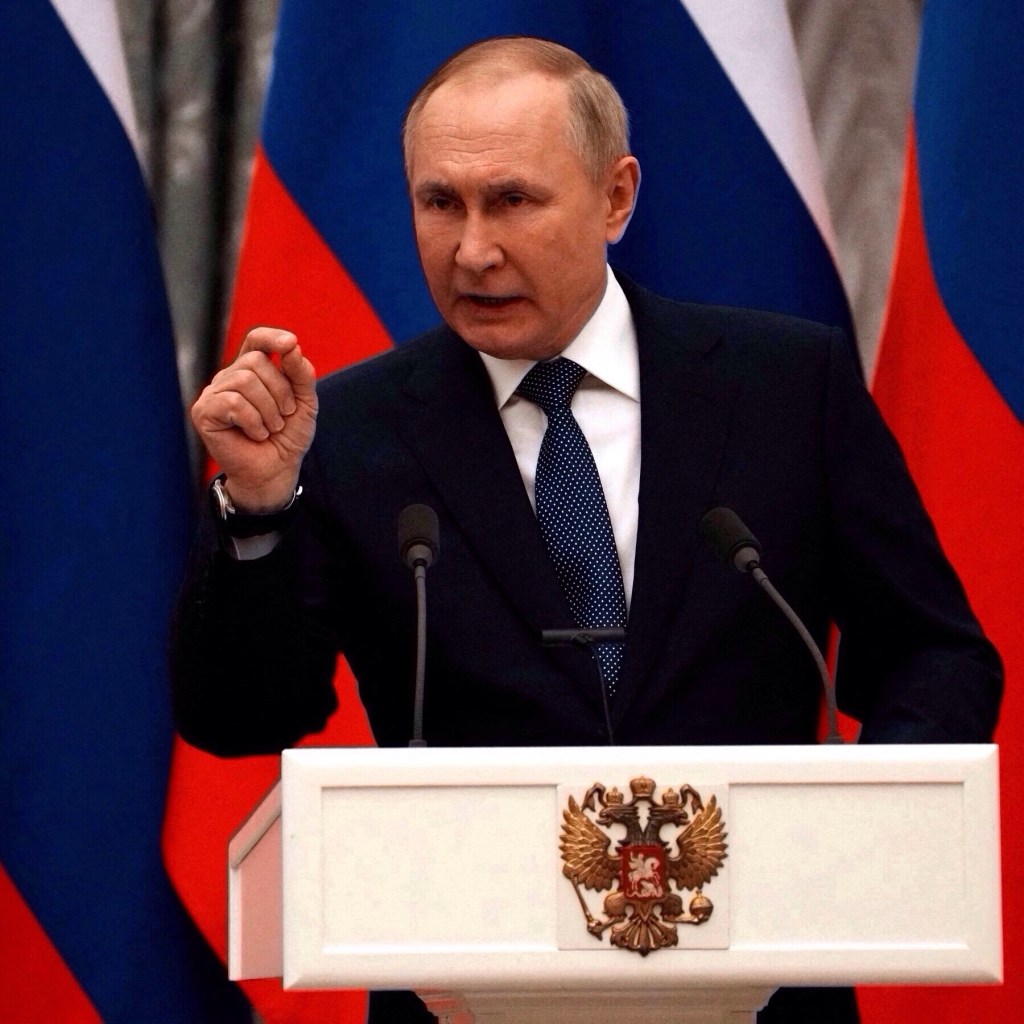
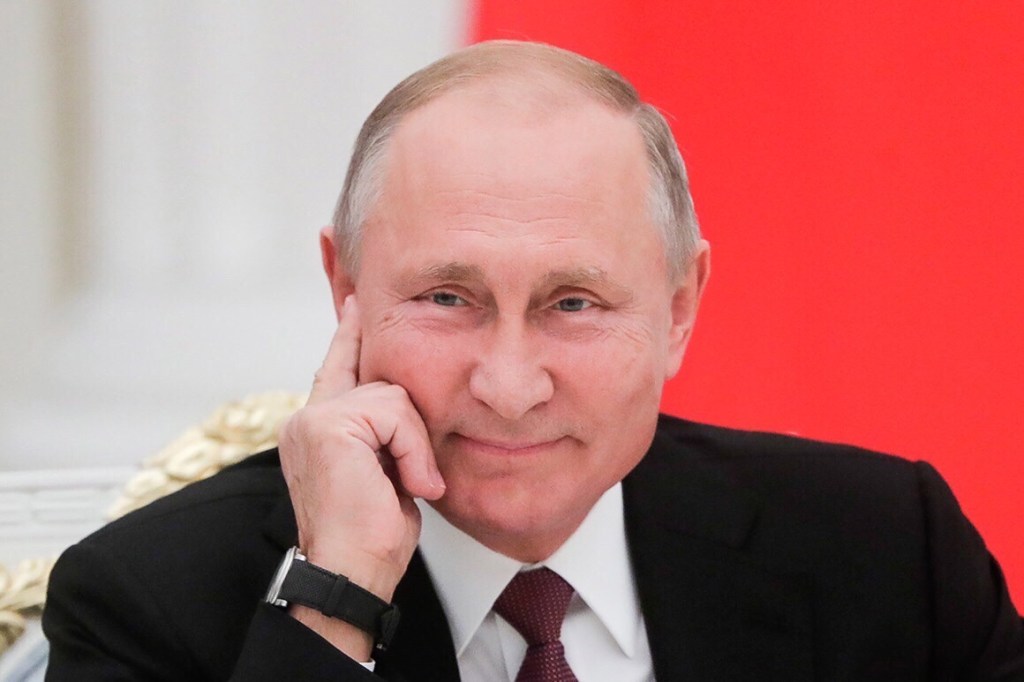
Vladimir Putin
Mr. Olsen, as is his job, is being circumspect. My opinion? I don’t just “think” that’s what’s going on.
By my count, we’re just 42 days away from Christmas. Normally, I’ve gotten a good jump-start on the holiday planning and shopping by now; but somehow, for some indefinable reason, it’s just not coming together this year.
I’ve started working on my gift list (giving, not receiving) several times, and all I’ve accomplished is writing down the names of family and friends. I did manage the other day to think of the perfect gifts for my favorite cousins and one friend before my brain shut down again; but there are seven people left on that list, and I’m stumped.
And then the reason hit me. I’ve developed a disease that is so common to the older generation, and that I always thought I would be able to avoid: “Past-itis.” I have been thinking — even dreaming some nights — about all those wonderful Christmases of the past, when my kids were little, and my family and friends were alive and close by, and I was in the midst of all the festivities.
Times have changed. I miss the days of fighting the crowds to shop in real stores for gifts I can see and touch before I buy them. And I miss the endless parties, the dressing up, the cooking and baking, the homemade eggnog, even the extra five or ten “holiday pounds” to be lost again after New Year’s Day. I miss the trip to the Hallmark store for coordinated gift wrap and ribbon and tags, and the hours of wrapping and bow-making.
Somehow, shopping online and stuffing things into gift bags just isn’t the same. But it’s easier, and these days that’s important.
And oh, how I miss the Christmas season that didn’t begin until the day after Thanksgiving — not in the middle of July, when it’s 95 degrees outside and you haven’t even begun to think about autumn yet. It should be cold at Christmastime.
So I’ve diagnosed my problem, and now all I need to do is figure out the treatment that will cure it. I’m thinking about stocking up on sugar cookies and apple cider; turning on some old-fashioned Christmas music (you know . . . Bing Crosby, Frank Sinatra, Mannheim Steamroller, the Chipmunks); sitting down with the pile of Christmas catalogs that still find their way into my mailbox; and pretending that my little ones are asleep in the next room and my sister is just a phone call away.
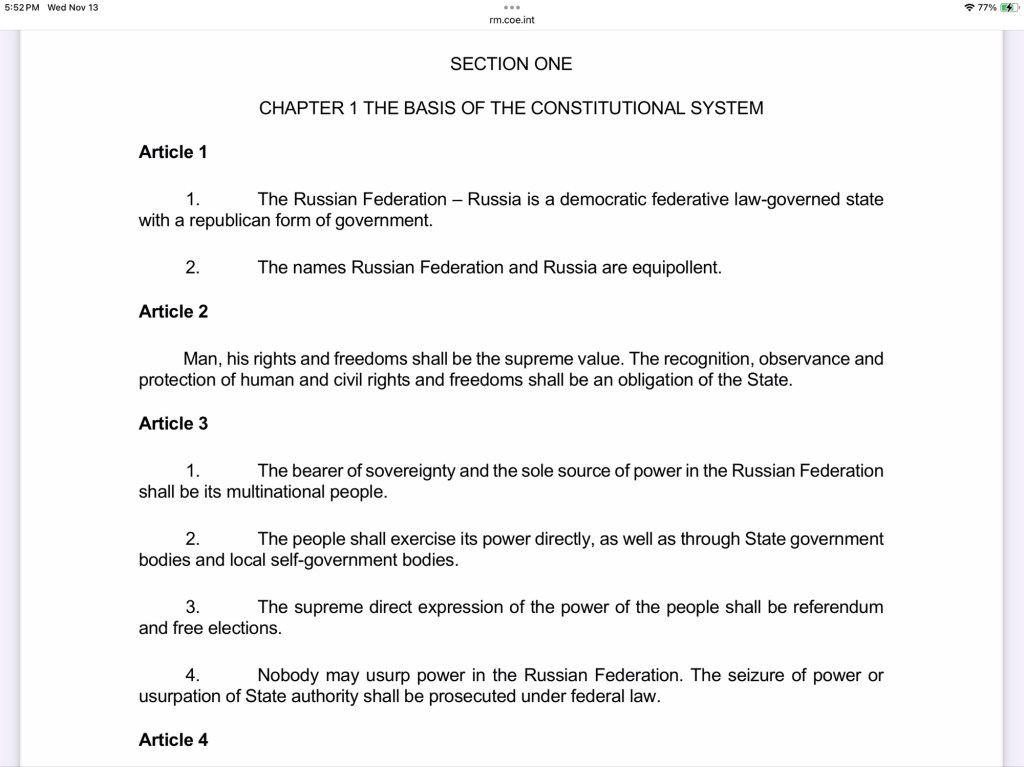
“The Russian Federation – Russia is a democratic federative law-governed state with a republican form of government.” [Section One, Chapter 1, Article 1, Constitution of the Russian Federation.]
“Man, his rights and freedoms shall be the supreme value. The recognition, observance and protection of human and civil rights and freedoms shall be an obligation of the State.” [Id., at Article 2.]
And in case you don’t believe me, here it is:
Excerpt From the Russian Constitution [Copied from Council of Europe, February 4, 2021]
I also like the mention of “free elections” in Article 3, paragraph 3. But that’s a whole different issue.
*. *. *
Languages are funny things. The same word can carry six different nuances in six different languages. And in a language like Russian, where the same word means “floor” or “sex” (as in gender), and where the softening of the final letter of another word can change a “corner” into a lump of “coal” . . . well, you can see how it would be easy to get totally lost. And forget about verbs. A friend with whom I took language lessons from a tutor once excused herself to “drive” to the bathroom.
So I suppose the drafters of the Russian Constitution might be forgiven for not knowing the difference between a democracy and a republic, or the true meanings of “freedom” and “civil rights.” But they did get one thing right: Russia is indeed a “law-governed state.”
The only problem is: who makes the laws?
No, not that jackass — a different one!
Theoretically, it is not a jackass at all, but Parliament that makes the laws. Like the United States and a number of other countries, the Russian legislative body is bicameral, consisting of two houses. In Russia, they are called the Duma, or Federal Assembly (lower house), and the Federation Council (upper house). And, as in the U.S. Congress, new legislation must be approved by both houses before being submitted to the President for signature.
Sounds good, doesn’t it? But in Russia, the reality is that, if the President — who we all know has been Vladimir Putin for the past 24 years — wants a law passed . . . or even a Constitutional amendment . . . he just has it submitted to the Duma, and WHAM! it’s done. Something that can take weeks or months in Washington or London or New Delhi is accomplished in a matter of a few days or less in Moscow, depending on how quickly Putin wants it done.
Efficient, for sure . . . but hardly “democratic.”
*. *. *
So why, I hear you ask, are you receiving this sudden, unsolicited lesson in Russian Civics 101? Well, simply because of my compulsion to share the news of a couple of laws that have been rammed through in Moscow during the past week — laws that are so outrageous, so antithetical to “civil rights,” that one can only . . .
The first, a bill banning “Childfree Propaganda,” zipped through the required three readings in the Duma and was passed on November 12th, to be handed on to the Federation Council for its rubber stamp and delivered to the Kremlin for Putin’s signature. No arguments, no amendments, no vetoes. Nice and neat. [RFE/RL, November 12, 2024.]
But wait . . . what is this “childfree propaganda” about? Well, you may remember the publicity regarding Putin’s “Year of the Family,” and his pronouncements as to the patriotic and spiritual responsibility of Russia’s young couples to procreate — not just once or twice, but over and over and over again, as many as eight or more times, presumably until the mother’s womb collapses. All of this is for the divine cause of rebuilding the depleted population of Mother Russia (largely due to the casualties caused by Putin’s war against Ukraine, though we’re not allowed — by yet another series of laws — to mention that).
And similarly, under the new legislation, you’re not permitted even to express any opposition to, or questioning of, Putin’s new baby factory idea, subject to huge fines. The government is offering financial and child-care assistance to ease some of the burden on the exhausted parents, and they are supposed to be grateful for that and shut the hell up.
A perfect example of Russian “freedom” and “civil rights” in action.
*. *. *
And about those war casualties. For some reason that Putin apparently finds it impossible to comprehend, a lot of young adults are not happy about facing the possibility of conscription into the army to fight a war they don’t even understand, much less approve of. And in the nearly three years since the start of Russia’s “special military operation” — known everywhere outside of Russia as a “war” — a lot of draft-age men have chosen to leave their country rather than face the horrors being described by those who have served and survived. This mass exodus, of course, has contributed further to the population decline.
So now, “temporary measures” have been imposed by means of amendments to Russia’s law on military duty, including potential conscripts being banned from:
leaving the country;
driving and registering a vehicle;
registering and selling real estate;
receiving loans; or
registering as a self-employed individual or entrepreneur. [RFE/RL, November 13, 2024.]
Their only option, then, would be to sneak out of the country, which in itself would be illegal and thus prevent them from ever returning without facing prosecution.
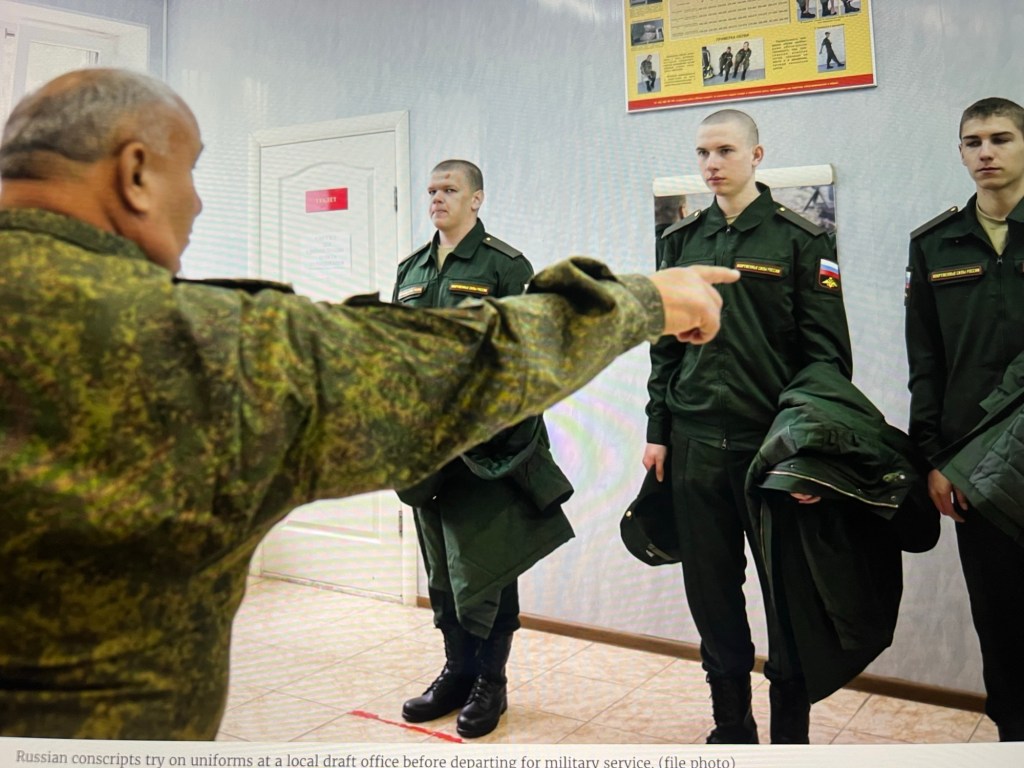
Conscripts Receiving Their Uniforms
*. *. *
So that’s it, folks . . . the first, and hopefully the last, lecture on Russia’s legal system.
And now, having written it and read it over, I turn to glance once again at the day’s late headlines and take note of how my own (U.S.) government is shaping up as we look ahead to the next four years with a new administration.
And I feel the sudden, cold chill of trepidation, seeing how quickly and easily life can change.
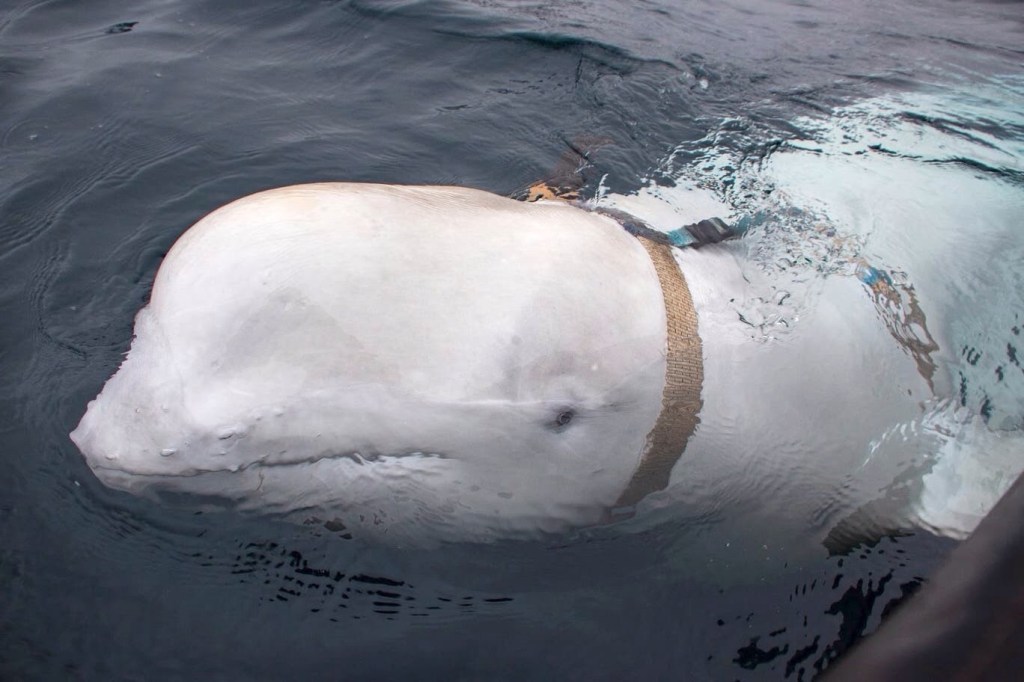
He was a 2,700-pound, 14-foot-long beluga whale, discovered off the northern coast of Norway in April of 2019, wearing a harness with a small camera mount and a buckle reading, in English, “Equipment St. Petersburg.” He was friendly, and he was hungry — apparently accustomed to being fed, and not finding food on his own.
The Arrival of Hvaldimir
So the good folks of Norway decided to adopt him, and they named him Hvaldimir — “hval” being Norwegian for “whale,” and “dimir” from the first name of Russia’s president, Vladimir Putin. They removed his harness, and he swam to the nearby port of Hammerfest to make his home.
Sadly, after five years of living freely and happily in Norwegian waters, he was found dead near the end of summer this year. A necropsy showed that no foul play was involved; he had gotten a stick lodged in his mouth. And Norway mourned the loss of the beautiful, mysterious creature they called Hvaldimir.
But the question remained: Was he, or was he not, a Russian spy? The Russians are known to have worked with marine mammals, training them — I suppose — much as the U.S. trains its … wait for it …Navy Seals.
(All right . . . go ahead and groan. I’ve never been able to resist a pun.)
Anyway, Hvaldimir had a habit of touching people with his nose when he was hungry, so he had obviously been trained to give signals for some purpose. And the collar clearly indicated that he had been held in captivity. But that was all that was known . . . until recently.
Enter Dr. Olga Shpak, an expert in Hvaldimir’s species, who made it her mission to learn more about him. She now believes that he did indeed belong to the Russian military, and that — being something of what the Russians would call a “hooligan” — he managed to escape from a naval base in the Arctic Circle. But she doesn’t think he was trained as a spy; rather, he was most likely a guard for the base. [Jonah Fisher and Oksana Kundirenko, BBC, November 13, 2024.]
Dr. Olga Shpak
Dr. Shpak, a native of Ukraine, spent more than 20 years researching marine mammals in Russia before returning to her homeland in 2022. Her conclusions are based on conversations with knowledgeable friends and former colleagues in Russia, who have unofficially (and anonymously) confirmed that Hvaldimir — whose original name was Andruha — was one of theirs: a beluga missing from a military program in the Russian Arctic.
Andruha had been captured in the Sea of Okhotsk in 2013 and kept in a dolphinarium in St. Petersburg for a year, when he was “drafted” into the military. Dr. Shpak says:
“I believe that when they started to work in open water, trusting this animal [not to swim away], the animal just gave up on them.
”What I’ve heard from the guys at the commercial dolphinarium who used to have him was that Andruha was smart, so a good choice to be trained. But at the same time, he was kind of like a hooligan — an active beluga — so they were not surprised that he gave up on [following] the boat and went where he wanted to.” [Id.]
With all due respect, Dr. Shpak, I don’t believe he “just gave up on them.” I think he’d been planning his escape for a long, long time.
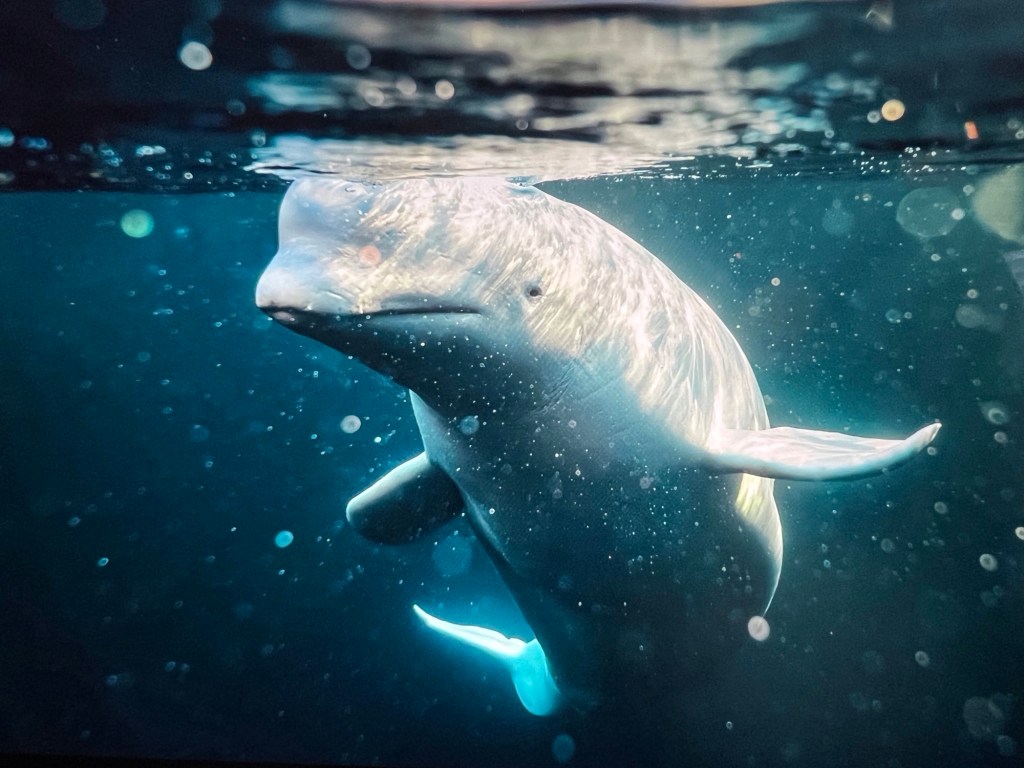
Free At Last
*. *. *
To the surprise of absolutely no one, Russia has never officially responded to the claim that Hvaldimir (a.k.a. Andruha) was trained by its military. In 2019, when first asked if he might be theirs, Reserve Colonel Viktor Baranets said, with an unexpected display of humor:
“If we were using this animal for spying, do you really think we’d attach a mobile phone number with the message ‘Please call this number’?” [Id.]
Maybe not, Polkovnik Baranets. But I can’t stop wondering about that camera mount.
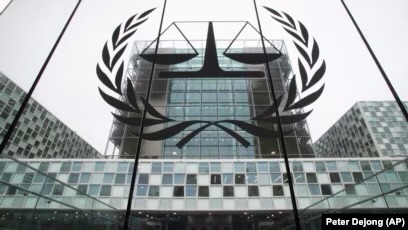
Last year, the International Criminal Court at The Hague (ICC) issued warrants for the arrest of Russian President Vladimir Putin and Russia’s Children’s Commissioner, Maria Lvova-Belova, on charges of having forcibly deported Ukrainian children and “resettled” them in Russia.
And in June of this year, the ICC issued additional warrants against Russia’s then Defense Minister Sergei Shoigu and Armed Forces Chief of Staff Valery Gerasimov, charging both with war crimes and crimes against humanity committed in Ukraine since Russia’s invasion in February of 2022.
The International Criminal Court – The Hague
The ICC does not have enforcement authority, but must wait and hope for the subject of such a warrant to travel to a member country willing to make the arrest on their territory on the ICC’s behalf. Thus far, all three remain at liberty.
But now — in a classic case of “you just can’t make this stuff up” — a Moscow court has issued an arrest warrant for ICC Judge Haykel Ben Mahfoudh on a charge of “illegal incarceration” stemming from the warrants against Shoigu and Gerasimov. Judge Mahfoudh and two ICC colleagues were responsible for having issued the warrants against them in June. [RFE/RL, November 12, 2024.]
Valery Gerasimov and Sergei Shoigu
Looking at this development from as objective a viewpoint as possible, what immediately jumps out at me? Well, aside from the fact that a Russian court is not an international organization and thus has no jurisdiction outside of its own territory . . .
. . . and ignoring the obvious fact that issuing a warrant cannot by any stretch of the imagination be construed as “illegal incarceration,” since they are not in custody but are perfectly free to travel to any non-ICC-member country of their choosing . . .
. . . doesn’t it then seem painfully obvious that . . .
. . . this is just plain childish??!!!
I mean, really childish. Putin is behaving like . . . well, exactly like what he is: the big bully on the playground. “You hit me six months ago, so now I’m going to break your nose, just for spite.”
Don’t they have anything better to do in Moscow? Such as withdraw their troops from Ukraine?
Or rewrite a few of their more outrageous laws, and let some political prisoners out of jail?


























 The Blog About Everything … and Sometimes Nothing