Having a wonderful time reminiscing about all my past travel (and other) adventures. Hope you’ll share them with me in my blog, “All Roads Led to Russia.”
This being a holiday weekend — here in the U.S., at least — when we’re all focused on family and friends and giving thanks, I decided to flip past today’s usual news items of wars and other killings, political infighting and natural disasters, in search of something amusing . . . or at least on the lighter side.
And I found it — at Mar-a-Lago, in Palm Beach, Florida, where the Trump family’s Thanksgiving dinner looked more like a bar mitzvah celebration.
Mazel Tov!
I haven’t seen the guest list, nor do I care who was seated at all those other tables. But at the host’s table, in addition to Melania and Barron Trump — and seated directly next to Donald Trump himself — was the newest member of the clan . . . the guy who seems to be everywhere that Trump is . . . the omnipresent keeper of the presidential-elect secrets . . . the man I call “The Big X”: none other than Mr. Elon Musk.
One of the other guests — a French jewelry designer by the name of Yaakov Safar — took a video of Trump and Musk when they decided to bust a few moves to the Village People’s classic “Y-M-C-A,” while still seated. [Kit Maher, CNN, November 29, 2024.]
I would have paid a lot to see that!
The power couple (Trump and Musk — not Trump and Mrs. Trump, as you might expect) also worked the room together, stopping at each table to speak to the guests. As reported by Safar, “ . . . the rest of the time he spoke with Barron and Elon in great discussions on a lot of subjects, and the joy was enormous.” [Id.]
There’s no hint of what Melania Trump was thinking while the guys were doing their host-and-host duty and conferring between themselves and with 18-year-old Barron . . . though I imagine she was relieved to have been spared that task.
At least she was at the host’s table.
*. *. *
On the day following the election, Trump’s granddaughter Kai had posted a Trump family photo in which Musk also appeared. Along with another picture including Musk, Kai said that he had achieved “uncle status.” [Id.]
Uncle Elon. How sweet!
And at an America First Policy Institute Gala at Mar-a-Lago earlier this month, Trump himself joked about Musk’s constant presence:
“He likes this place. I can’t get him out of here. He just likes this place.”[Id.]
Yeah, I’ll bet he does. What billionaire power junky wouldn’t shell out $118 million to buy his way into the Emperor’s inner circle?
The late Sir Winston Churchill once famously described Russia as “a riddle wrapped in a mystery inside an enigma.”
And he nailed it, all right! Like these matryoshka dolls — nested one inside another inside another — Russia is many-layered, with always another surprise hidden inside.
Russian Matryoshka Nesting Dolls
Which is why I firmly believe — despite their cheery outward appearances on their YouTube broadcasts — that the Feenstra family is in for a rude awakening in the not-too-distant future. And I worry about them.
After a very rocky start on arriving in Russia — during which their bank account was frozen, they were crammed into a one-room Soviet-style apartment with no sign of the farm they had been promised, and they were informed that they might not be allowed to stay because they did not speak Russian — the discouraged matriarch of the family, Anneesa Feenstra, broadcast that she hated it there and wanted to go home.
Then she publicly apologized. And suddenly, and quite miraculously, all of their problems seemed to vanish. Their funds were released to them, and they found themselves on a large, fertile piece of farmland where they have been building a big house and outbuildings, growing vegetables, driving a new van big enough for their family of ten, obtaining all of the assistance and materials they need . . . and even being told that the law had been changed concerning the language requirement!
All doors were suddenly open to them . . . including the “door” to international telecommunications in the form of a YouTube channel, when most independent media have been silenced. So we are now able to hear daily from the Feenstras — primarily Arend — and witness their progress as they build their dream life in the land of endless opportunity: Russia.
With big, toothy smiles plastered on all ten of their faces, they guide us through the days of hard work: hammering, sawing, hauling, painting, ploughing, planting, harvesting . . . They didn’t come to Russia seeking an easy life; they were farmers in Canada, accustomed to hard work. And they seem to thrive on it.
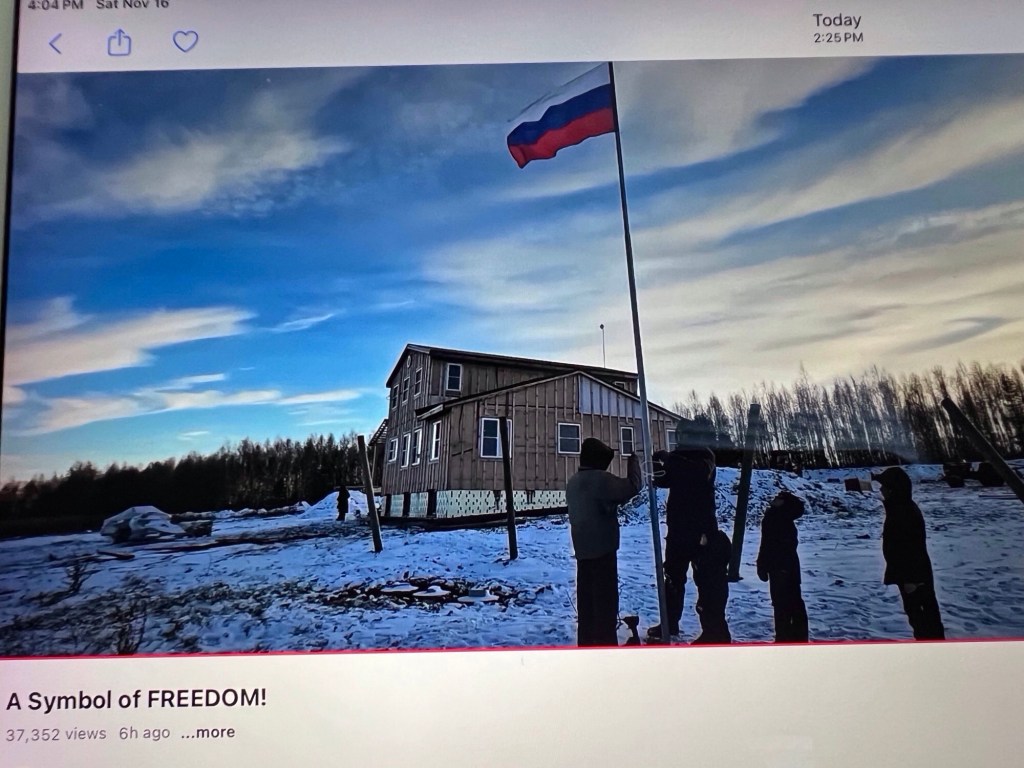
But there’s always time for the daily propaganda . . . er, YouTube broadcast . . . which — while occasionally including a problem or a glitch of some sort — always has a happy ending, and a mention or two of how blessed they are to be living in Vladimir Putin’s Russia. They even managed to hoist a big Russian flag in honor of their new homeland at the entrance to their property.
Flying the Flag of Freedom on the Feenstra Farm
And yesterday Arend Feenstra spoke of the “great day” they had had, first attending a meeting at OKA. I didn’t know what that was, so I looked it up and found that it is an agency in Nizhny Novgorod designated to assist foreigners wishing to move to Russia. There have been earlier reports showing the Feenstras greeting newly-arriving families from Canada and the U.S., as though they may actually be acting as a welcoming committee, perhaps for OKA (though that was not mentioned). In fact, the purpose of yesterday’s “meeting” was not specified at all.
And after that — or perhaps as part of the OKA event — was a talk by one Maria Putina, who, speaking in English, introduced herself as a “lawmaker” with the Ministry of Foreign Relations (described by Arend Feenstra as the “Foreign Relations Committee”) and offered her services to assist with any problems the country’s newest residents might encounter.
Whether these “meetings” are required or voluntary is not clear. What is obvious is that the Russian government is still very much a part of the Feenstras’ lives . . . and likely to remain so.
*. *. *
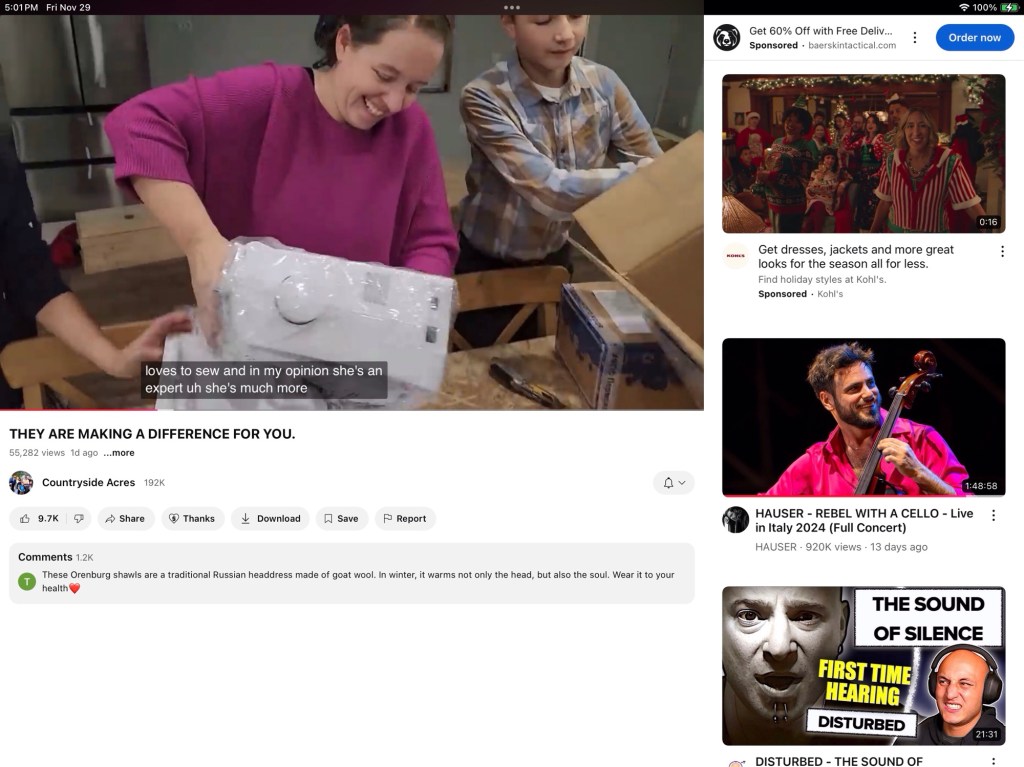
The broadcast then segued to their stop, on the way home from the business part of their day, to pick up a slew of packages that had arrived for them from friends — apparently, some of them being from fans of their YouTube programs. These contained a brand-new sewing machine, a sewing basket filled with accessories, and a lot of clothes — mostly warm wraps, gloves, and lots of socks. It appears these generous donations are a substantial part of what’s been keeping the family supplied with necessities they might otherwise find it difficult to obtain.
The Sewing Machine (screen shot from YouTube video)
*. *. *
There seems to be a big push in Moscow these days to encourage immigration from many parts of the world, unlike so many countries that have been discouraging it for reasons of security or economic concerns. And the Feenstras — with their ready-made family of eight healthy, hard-working children, eager to blend into the conservative lifestyle of their adopted country — are the perfect face of that movement.
They’re very outspoken about their religious and moral beliefs. But what about their political views? Do they even have any? That is never mentioned. How do they feel about the war in Ukraine? That is best not talked about at all. Do they even know anything about Putin’s territorial ambitions? I doubt it.
As long as they continue to live the life they prefer on the farm, and remain the well-behaved, favorite emigre family of their new president, they’ll be fine. But fame fades, and one day a new family from another country will come along to take the torch from them and run with it. Or there will be a change of focus in the administration, or perhaps even a change of leadership.
And then, when the Feenstras are just another large family living on the Russian economy . . . well, then what do those eight children have to look forward to?
Life is always something of a crap shoot. But in Russia, it’s usually a bit heavier on the crap.
We’ve all struggled, from time to time, with a choice of the right people to name as professional and character references on our resumes or for a mortgage loan application: perhaps a former boss, the family physician, or a member of the clergy.
But how many of us can claim to have the backing, the confidence — even the praise — of this individual? Not many.
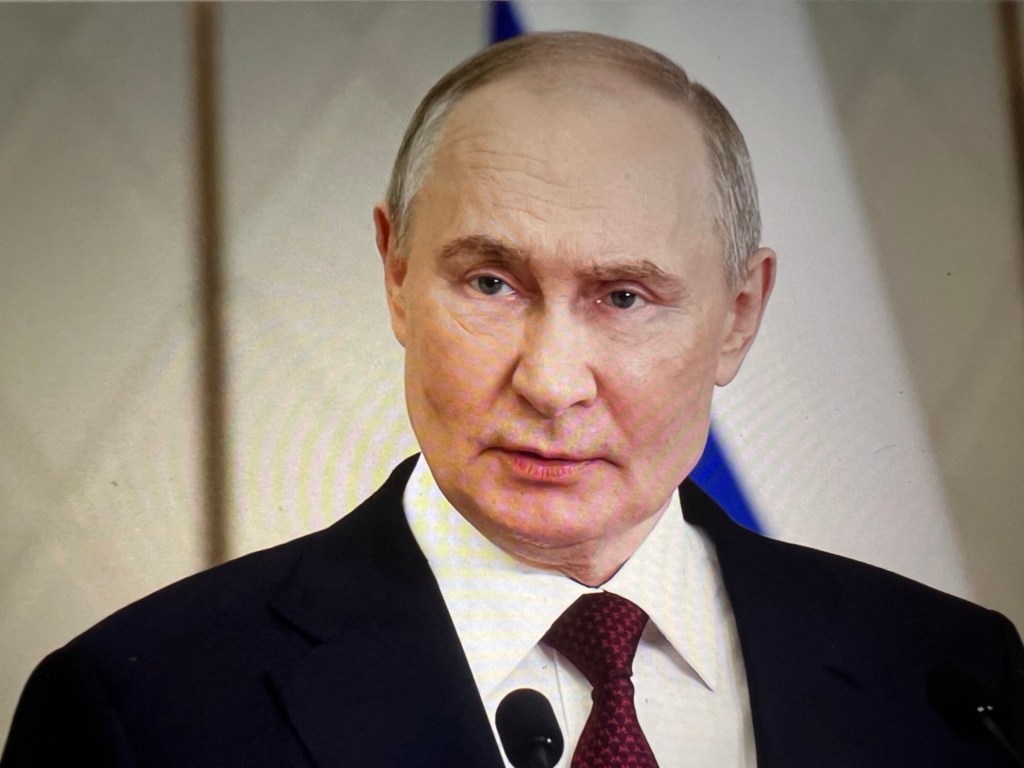
Vladimir Putin, Speaking at Astana, Kazakhstan – November 28, 2024
But Donald Trump can.
Attending a security summit this week in Astana, capital of the former Soviet republic of Kazakhstan, Putin was asked whether U.S. President Biden’s decision to permit Ukraine to use U.S.-supplied long-range missiles to strike deeper into Russian territory would impact future relations between Moscow and Washington. He responded that Biden had created “additional difficulties” for the incoming Trump administration, and again threatened to deploy Russia’s nuclear-capable ballistic missile, the “Oreshnik,” against Ukraine.
Putin further suggested that things might improve after Trump takes office:
“As far as I can imagine, the newly elected president is an intelligent and already quite experienced person. I think he will find a solution.” [Christian Edwards, Darya Tarasova and Lauren Kent, CNN, November 28, 2024.]
Is he talking about the same former president whom he manipulated like a well-behaved marionette for four years from 2016 through 2020?
Apparently so, because he then went on to praise Trump further, specifically with regard to his having overcome a “serious test” — referring to the two failed assassination attempts during recent campaign rallies. He also spoke of the “absolutely uncivilized means of struggle [that] were used against Trump” . . . and expressed his own fear that Donald Trump may not currently be safe. [Id.]
Well, as an expert on the subject of assassinations, he obviously knows what he’s talking about.
He also drew on his many years of experience in the field of political and legal persecution when he chastised the U.S. judicial system for the “humiliating, unfounded judicial procedures [to which Trump had been] subjected” . . . referring, of course, to Trump’s conviction on 34 counts of falsifying business records. [Id.]
What’s that old saying about the pot calling the kettle black? Oh, well . . .
I don’t know whether the next four years will be a whole lot of fun, but I can almost guarantee — with Edgar Bergen and Charlie McCarthy at the helms of their respective countries — they won’t be boring.
*. *. *
Returning to the subject of Russia’s threatening to attack Ukraine’s “decision-making centers,” and whether those might refer to military or political facilities, Putin responded with an old Russian joke:
“You know, in Soviet times there was a joke about weather forecasts? Here’s the forecast: today, during the day, anything is possible.” [Id.]
The CNN report doesn’t mention whether anyone else laughed.
*. *. *
It might impress some people to see the name of a world leader on a resume. But if I ever again need a reference for any purpose, I think I’ll stick with the family doctor or a former boss, or even the nice young man who delivers my prescriptions. Because . . . to paraphrase one more old aphorism . . .
“With friends like Vladimir Putin, who needs enemies?”
I know I said I was taking the day off from writing, but one news item just begs for comment; and since it involves the future of my country — our country — I could not shove it aside.
*. *. *
As we all sit down to dinner today — whether it be turkey, or lasagna, or Peking duck — most of us will have something to be thankful for.
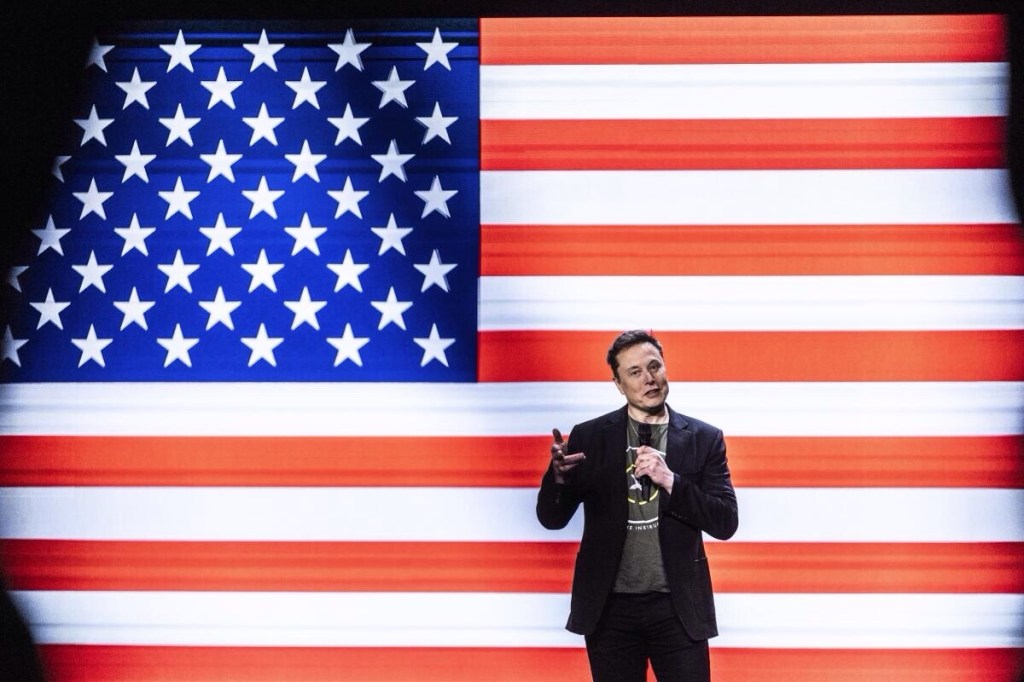
And I’m sure there are numerous people . . . I can think of four in particular . . . who will give thanks to this guy:
. . . for ruining their Thanksgiving, Christmas, Chanukah, New Year’s, and possibly the rest of their lives.
But what does it matter to him? He’s the richest — and arguably the second most powerful — man in the world. His net worth is currently estimated at nearly $350 billion. That’s billion, with nine zeroes after the first comma: $350,000,000,000.
So people (and this is just the beginning) such as the woman employed as Director of Climate Diversification at the U.S. International Development Finance Corporation; a second woman, the chief climate officer in the loan programs office at the Department of Energy; and a third woman, serving as senior advisor on environmental justice and climate change at the Department of Health and Human Services; and yet a fourth, a senior adviser on climate at the Department of Housing and Urban Development . . . all four of these accomplished professionals should give thanks today to Elon Musk for singling them out as candidates for the unemployment line. [Hadas Gold and Rene Marsh, CNN, November 27, 2024.]
His comment on X as to the last of the four was that she “should not be paid $181,648.00 by the US taxpayer to be the ‘Climate advisor’ at HUD. But maybe her advice is amazing.” Followed by two laughing emojis! [Id.]
Very funny . . . not.
So her hard-earned salary is a waste of taxpayer money . . . but the $465 million awarded to Musk’s own Tesla Motors in 2010 by the Department of Energy — the very office employing the second woman he has designated as expendable — was a justifiable taxpayer expense . . . right? It all seems to depend on who is receiving those dollars.
And then to publicly announce their names, so that they have become subject to harassment, and at least one death threat! What was he thinking?!! He doesn’t even have the authority yet. In fact, his so-called Department of Government Efficiency only exists — in his mind and Donald Trump’s — as a future possibility.
*. *. *
As an average taxpayer for sixty years, Elon Musk wouldn’t want to hear what I have to say about him or his ideas for the future of my country. Because he is talking — not only about the lives of numerous individuals, but about the worsening climate crisis that is enveloping the entire world — as though they don’t even exist.
So I will say no more now, because I have learned that it is best that I not speak — or write — when I am turning purple with righteous anger.
I will instead leave it to my readers, who are also intelligent, hard-working, tax-paying individuals, to form their own conclusions as to Musk’s qualifications to be the judge of who is, or is not, entitled to “live long and prosper.” **
While there is much going on throughout the world that is worrisome, upsetting, and even frightening, this is a day to focus on our blessings. On a personal level, I have much to be thankful for: family, friends, a good home, and the mere fact that I have made it to another holiday season.
Not to mention my gratitude for the obvious fact that I am not a turkey on this day when — if they were at all smart — they would be running for their very lives.
So I shall leave my usual snarky writing for another day, and devote this one to loved ones near and far, and memories of those who are no longer with us and are oh-so-sorely missed.
Happy Thanksgiving, everyone. I’ll be back tomorrow.
Given an opportunity to visit a different era, either past or future, I would prefer to go back a few decades, to when I was younger, stronger, and much better-looking, and when life seemed so much simpler — say, the 1950s. But, unlike the fictitious Marty McFly, we’re not given that choice; the irresistible force of time keeps us moving forward, whether we want to or not. There’s no such thing as a “flux capacitor” — although I’ve heard a rumor that Elon Musk may be working on it.
“Back To the Future” – Universal Pictures, 1985
I gave up making New Year’s resolutions a long time ago. I don’t know anyone — myself included — who ever kept theirs. But as we approach the start of another year that promises to be as bad as — if not a thousand times worse than — the last one, I thought I’d give it another shot, in an attempt to keep from making the same mistakes again.
So, here we go . . .
Resolution No. 1: I will eat as much as I want, of whatever I want, whenever I feel like it. I lost my girlish figure years ago; a few extra pounds no longer matter, as long as I don’t outgrow my clothes because at today’s prices I can’t afford a whole new wardrobe.
Resolution No. 2: Screw the whole exercise thing. I hate it; I’ve always hated it. And it gets harder every year. If I feel like taking a walk, or just getting up out of my easy chair to go to the refrigerator again, I will. But I won’t be doing anything requiring exertion on a regular basis.
Yeah . . . not gonna happen.
Resolution No. 3: I will keep Amazon in business again this year, and will make at least one ridiculous, wasteful purchase each month. Economizing is for younger people who can expect to live for many more years, as long as they don’t smoke, drink hard liquor or sodas, eat meat, take really hot baths, get vaccinated, fail to get vaccinated, travel, drive or ride in a motor vehicle, or argue with any big tattooed guys named Bubba or Snake.
Resolution No. 4: I will not suffer fools, lightly or otherwise. If that means breaking an earlier promise to myself not to write about domestic (U.S.) politics . . . well, so be it. Because there are way too many fools out there right now, and the temptation is just too f*cking irresistible.
Candidate for U.S. Cabinet
Resolution No. 5: I was going to resolve to speak my mind — sometimes diplomatically, but always honestly — on all subjects. But I already do that, so let’s just say I’ll keep doing it.
My Idol: Maxine
Resolution No. 6: Our family’s cat is an old girl. I’m going to make her love me before one of us dies.
Resolution No. 7: That pile of “to-be-read” books over there? I pledge to read one of them this year.
Resolution No. 8: And as for the clutter in my closets . . . I will learn to accept it. It’s time to get over my OCD problem.
And finally . . .
Resolution No. 9: I will keep writing my blog each day, for as long as my mind and my fingers keep working in sync. And I resolve to continue, within the parameters of said blog, skewering every government leader, politician, billionaire, obnoxious celebrity, and Kremlin spokesman (yes, that’s you, Dmitry Peskov) who gets his or her name in the news. Because I enjoy it . . . and at my age, I think I’m entitled to a little fun.
So that’s it. If you were expecting an even 10 resolutions . . . well, nobody ever said life was fair.
It only took a day for Russia’s Investigative Committee to report that it had opened a criminal case against British citizen James Scott Rhys Anderson, accusing him of terrorism and mercenary activities.
James Scott Rhys Anderson
On Sunday, I reported on Anderson’s having been taken into custody in the Kursk region of Russia while fighting as a volunteer with Ukraine’s International Legion. Few details were available at that time. But yesterday, the Investigative Committee said that Anderson, along with other members of Ukraine’s military and (allegedly) some foreign mercenaries, had illegally entered Kursk with weapons, military equipment, and drones armed with explosive devices. [RFE/RL, November 26, 2024.]
The group are accused of intending to “intimidate the local population, cause ‘significant’ property damage, and destabilize government operations.” [Id.]
I never cease to be amazed at how the leadership of a society that gave birth to such writers as Tolstoy, Dostoyevsky, Gogol, and numerous other masters of the ironic can fail to recognize the irony in its own behavior.
Fyodr Dostoyevsky
Year after year, decade after decade, century after century . . . the Russian government continues to twist and pervert fact into unrecognizable shapes, blaming the enemy du jour for having manipulated or forced it into committing its unspeakable acts of brutality.
When Ukraine’s allies — most or all of them members of NATO and/or the EU — were restricted from committing to send troops on the ground in Ukraine, President Zelensky put out a call for international recruits . . . and thousands of volunteers responded. Russia has labeled those volunteers as mercenaries — a category not protected under international law — and at times accused them of terrorism . . . making it open season on any volunteers encountered on Russian territory.
But what of the 11,000 or so North Koreans sent by Kim Jong Un to Vladimir Putin’s army for training and deployment to Ukraine? And Russia’s own Wagner Group of mercenaries? Or the Chechen fighters? And now, if Russia’s most recent diplomatic effort succeeds, Yemen’s Huthi rebels may well be added to the mix.
I suppose there’s not a terrorist or a mercenary in that bunch.
That’s not Russian irony . . . that’s an out-and-out lie. And not even a convincing one.
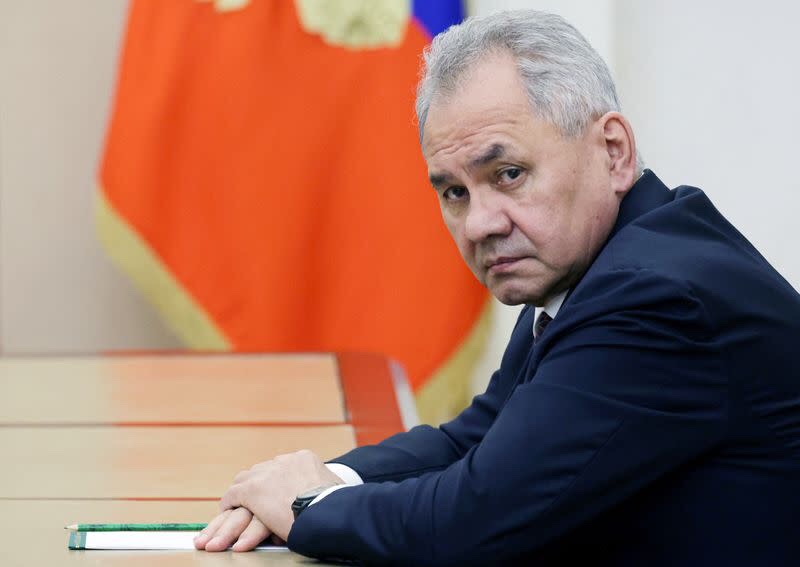
“Sergei Shoigu, the secretary of Russia’s powerful Security Council, told Afghanistan’s Taliban leaders on Monday that Moscow wanted to help achieve a durable peace in the country, Russian news agencies reported.” [Ron Popeski, Reuters, November 25, 2024.]
Sergei Shoigu
Wait — I could not have read that correctly. Russia wants to waltz back into Afghanistan . . . to make peace?
Again??!!!
Have Russia’s historians once more been tasked with erasing history? Have they truly forgotten the years 1979-89, or the degradation of leaving Afghanistan the first time, with their proverbial tails between their legs?
According to Shoigu — the former Russian Minister of Defense who now sits at Putin’s side on the all-powerful Security Council — it was the Taliban leadership who asked for Russia’s help in “. . . [easing] the pressure imposed by U.S. sanctions against the Kabul government . . .” [Id.]
As head of a delegation to Kabul for talks with senior officials there, Shoigu was quoted as saying:
“Let me confirm our readiness to establish a constructive political dialogue between our countries and among the goals would be providing an impulse for the process of a settlement among Afghans.” [Id.]
*. *. *
I have only one comment to this unimaginable development, and that is:
“Well, here we go again!”
Soviet Withdrawal From Afghanistan – 1989
What do I keep saying about history repeating itself? Obviously, no one has been listening.
UFOs have been with us for as long as I can remember. Many people assume they’re from outer space because they have thus far defied identification; but nothing in their name indicates that. We simply don’t know what they are; they’re just objects that vary widely in the descriptions given by alleged witnesses.
Maybe this; maybe not.
And now we have a new class of unfamiliar flying things for UFOlogists to agonize over: UFDs. We know what they are — they’re drones — but they’re unidentified because we don’t know whose they are, what their purpose is, or why they’ve suddenly begun showing up over three air bases in the United Kingdom in which the U.S. military maintains a presence.
Between Wednesday and Saturday of last week, they were seen flying over the Royal Air Force’s (RAF’s) bases at Lakenheath, Mildenhall and Feltwell — all used by the U.S. Air Force (USAF).
A spokesperson for the USAF in Europe offered a brief statement:
“Installation leaders determined that none of the incursions impacted base residents or critical infrastructure.” Rob Picheta and Natasha Bertrand, CNN, November 24, 2024.]
And Britain’s Ministry of Defense said:
“We take threats seriously and maintain robust measures at defence [sic] sites. This includes counter-drone security capabilities.” [Id.]
Well, that’s reassuring, anyway.
“Thanks for that!”
Neither country would comment further. But a source familiar with the matter did say that there were about five or six drones, and they appeared to be acting in coordination. However, the source added that they did not at any time pose a threat to the bases, and that there is no evidence that they may have been able to collect any sensitive intelligence. [Id.]
I’d like to know how that source — or anyone they may have been quoting — came to those conclusions when they haven’t a clue (as far as they’re saying) about whom those uninvited visitors belong to. But what do I know? I’m just another uninformed, somewhat nervous civilian who will probably be dreaming about UFDs tonight . . . if I can close my eyes at all.
Russia’s TASS news agency and pro-Russian Telegram channels have released a video showing a man in military uniform allegedly captured by Russian forces in the Kursk region — an area of western Russia infiltrated and partially held by Ukrainian forces. The man in the video identifies himself as James Scott Rhys Anderson of the United Kingdom. [RadioFreeEurope/RadioLiberty, November 25, 2024.]
James Scott Rhys Anderson – Hostage?
In the video — which RFE/RL says has not yet been independently verified — the man identified as Anderson says that he had served in the British Army until 2023, and thereafter joined Ukraine’s forces to fight against Russia. [Id.]
Unlike the legions of professional military troops enlisted by Russia from other countries such as North Korea, and the mercenaries from Chechnya and Russia’s own Wagner Group (now known as the Africa Corps), the thousands of foreigners fighting on the Ukrainian side of the conflict have been volunteers. No NATO-member forces are on the ground in Ukraine, as that alliance exists for defensive purposes, and has a duty to avoid any action that might escalate the existing situation.
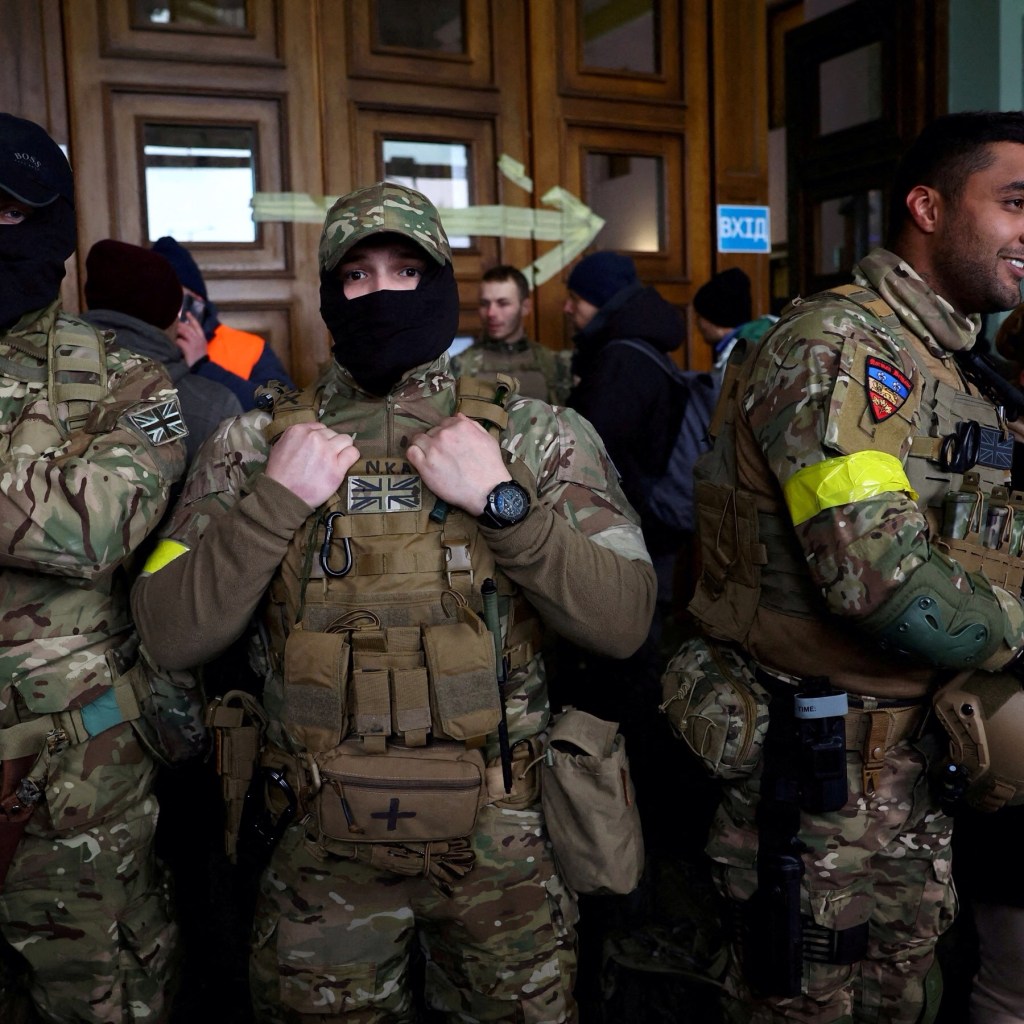
Many of the volunteers have enlisted in Ukraine’s elite International Legion, which has been integrated into their ground forces. In Anderson’s video, he states that he had also joined the International Legion. [Id.]
Ukraine’s International Legion Forces
And now this individual — acting as a volunteer in a fight for the independence of a peaceful nation — is in the hands of a regime known for its inhumane treatment of prisoners, both military and civilian. Though we cannot foresee the future, and must — as always in Russia — wait for further news, I am adding Mr. Anderson’s name to my list of foreigners being held in Russian prisons as hostages for Vladimir Putin’s own nefarious purposes.
My fervent wish is to be proven wrong. But officially approved Kremlin news sources do not broadcast information — particularly about the “special military operation” in Ukraine — without clearance from on high. We should be hearing soon from the Kremlin itself with further details — or, at least, their version of them.



































 The Blog About Everything … and Sometimes Nothing