Having a wonderful time reminiscing about all my past travel (and other) adventures. Hope you’ll share them with me in my blog, “All Roads Led to Russia.”
With everyone screaming for answers, and U.S. officials — including Senate Majority Leader Chuck Schumer — calling for action, you’d think we’d have heard something substantive by now about all of those UAP (Unidentified Aerial Phenomena) sightings that are being tentatively identified as drones flying above U.S. military installations and Donald Trump’s Bedminster golf course. As Senator Schumer said:
“We’ve seen lots of recent sightings in New York, New Jersey, Long Island, Staten Island. So it’s remarkable, with all these sightings over the last while, why do we have more questions than answers? If the technology exists for a drone to make it up into the sky, there certainly is the technology that can track the craft with precision.” [John Bacon and Thao Nguyen, USA Today, December 16, 2024.]
“We come in peace”
On Sunday, Homeland Security Secretary Alejandro Mayorkas tried to reassure us with this announcement:
“There’s no question that people are seeing drones. I want to assure the American public that we in the federal government have deployed additional resources, personnel, technology to assist the New Jersey State Police in addressing the drone sightings. It is our job to be vigilant. If there is any reason for concern, if we identify any foreign involvement or criminal activity we will communicate with the American public accordingly. Right now we are not aware of any.” [Id.]
Sorry, Secretary Mayorkas, but somehow I don’t find that particularly comforting.
However, I was delighted to read this from Connecticut Representative James Himes, who seems to have an inside track to . . . well, he didn’t exactly say where, but certainly somewhere . . . and who shared with us in an interview on Fox News Sunday:
“Now, let me say something that I know with confidence. It is not the Iranians. It is not the Chinese. They aren’t Martians. I know that’s very unsatisfying for people who want a Hollywood movie out of this.” [Id.]
*. *. *
Well, Hollywood movie be damned. I’m just relieved to have it on such good authority that they’re not little green men from Mars. I’ll sleep so much better tonight!
It is becoming an all-too-familiar story in far too many parts of the world.
Iranian-American journalist Reza Valizadeh has been sentenced by an Iranian court to ten years in prison for “collaborating with a hostile government.” [Bita Bakhtiari, RFE/RL, December 14, 2024.]
In addition, following the end of his prison term, Valizadeh will be banned for two years from living in Tehran or adjacent provinces, from leaving Iran, and from belonging to any political or social organizations — in effect, remaining a prisoner within the country. [Id.]
Reza Valizadeh
A journalist for Radio Free Europe / Radio Liberty’s Radio Farda for ten years, he resigned in November 2022, but returned to Iran to visit family in early 2024. He was arrested on September 22nd, although he had been assured by Iranian officials that there was no legal bar to his returning to Iran.
Despite condemnation by the U.S. State Department, as well as calls by multiple organizations advocating freedom of the press, Valizadeh continues to be held in Tehran’s Evin Prison under severe restrictions, with only limited access to legal representation or family. [Id.]
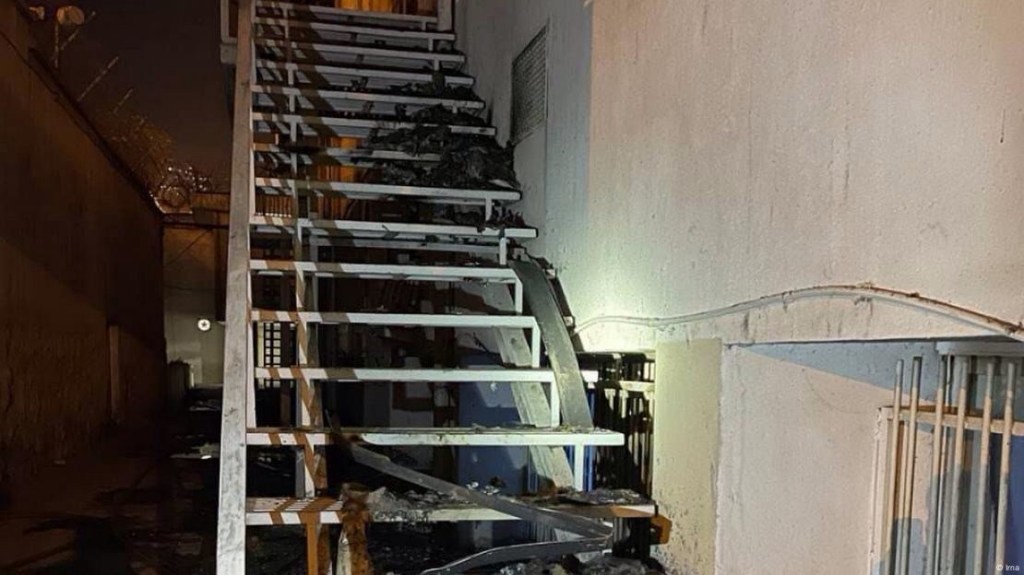
Inside Evin Prison, Tehran, Iran
If all of this sounds too familiar, it’s no wonder. It is a scenario straight from Vladimir Putin’s textbook on how to rid oneself of the voices of opposition. Not that it’s a new tactic to the Iranian government; they are well known to use Westerners and dual citizens as bait for future prisoner swaps. But Valizadeh is the first U.S. citizen known to have been arrested on false charges since a prisoner swap in September of 2023. [Id.]
And it’s happening elsewhere: Andrey Kuznechyk and Ihar Losik in Belarus, Vladislav Yesypenko in Crimea, and Farid Mehralizada in Azerbaijan are just a few examples.
*. *. *
In earlier times, the best way for an oppressor to secure control of a city or state was first to take over its communications and transportation infrastructures. It’s not that easy today: communications are no longer centralized in one or two radio or telegraph stations. So what do you do? You silence the broadcasters: the journalists, the bloggers, the Facebookers and YouTubers. You already control the police and the courts, so you simply charge your adversaries with something — anything — that sounds illegal, and you throw them into prison where they have no access to the outside world.
Which is precisely what is happening, almost on a daily basis, in so many parts of the world today — Russia, Belarus, Georgia, Iran, China and Hong Kong, North Korea. The free press is under attack; and the most frightening thought is how long it will be before no journalist will be willing to take the risks involved in speaking the truth.
And that is precisely what the world’s despots are aiming for.
The good news is: There are no new Russian/Belarusian/Eastern European political arrests in the press this week.
The bad news is: The remaining hostages on our list continue to exist as victims of Putin’s purge of his opponents in prisons in Russia, Belarus and elsewhere, awaiting their Christmas miracle.
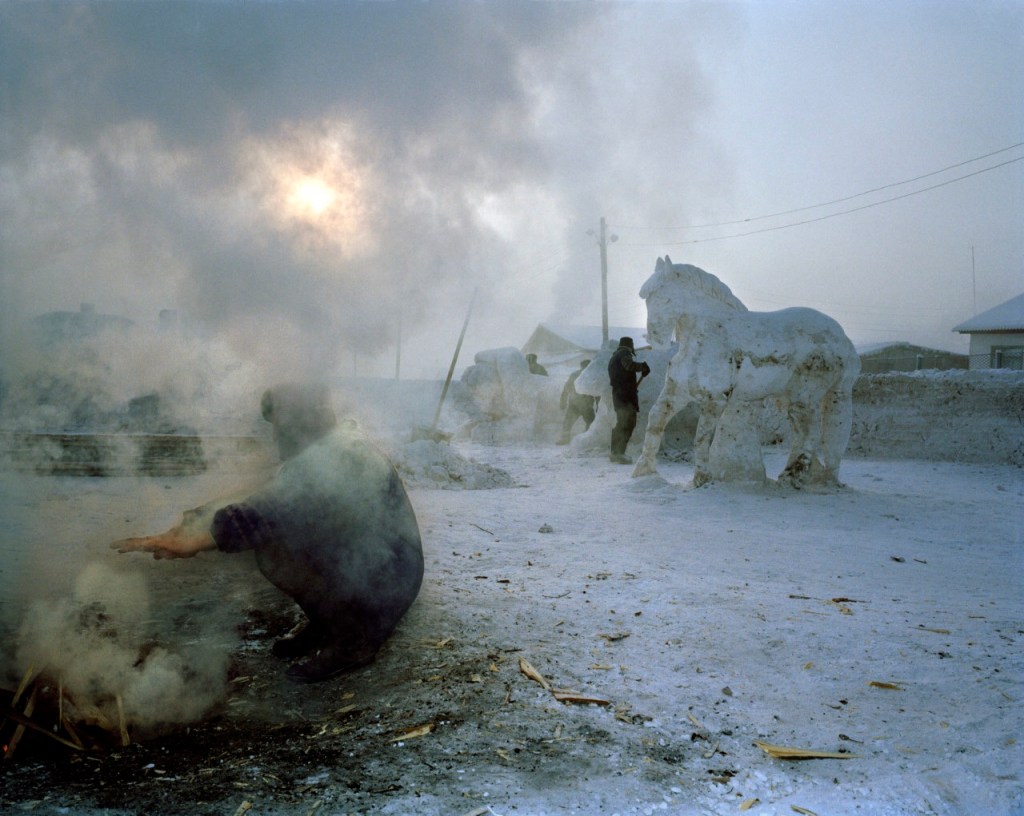
Prison Camp at Krasnoyarsk Region – 2002 (by Carl de Keyzer)
But I have pledged to continue honoring them each week until not one remains locked up. And so, once again, here they are . . . at least, those whose names are known to me:
David Barnes Gordon Black Marc Fogle Robert Gilman Stephen James Hubbard Ksenia Karelina Andrey Kuznechyk (in Belarus) Michael Travis Leake Ihar Losik (in Belarus) Daniel Martindale Farid Mehralizada (in Azerbaijan) Robert Shonov Eugene Spector Laurent Vinatier Robert Romanov Woodland Vladislav Yesypenko (in Crimea)
And once again, to the incoming Trump administration, I respectfully urge you to place the release of these hostages at the top of your immediate to-do list in January. Far more vital than the concern over daylight saving time (though I do agree with you on that) are the lives of these innocent men and women. The negotiations by the Biden administration and several of our allies that were so successful in August must be carried on.
That’s not to say you’ll have any real use for every tidbit of information you pick up from day to day — or, for that matter, retain it for very long — but it can be fun. Like today’s word from worddaily.com.
Now, as every online shopper knows, once you’ve bought something, or transacted any sort of business on the internet, you’re fair game for every online vendor, every huckster, and every whack job out there. When I settled in and opened my email today, I found 133 messages. And by the time I had deleted the junk, I had — by actual count — seven left that I wanted or needed to read. And most of those were my daily news reports.
“133??!!!”
But there was one that caught my eye — from “Word Daily” — that I don’t always bother to check because I think I already have a fairly decent vocabulary. But for some reason, today’s word aroused my curiosity:
“Quidnunc“
I like to try to figure things out for myself whenever possible, so I gave it some thought before reading the definition. “Quid” — besides being another name for the British monetary pound — was first a Latin word meaning “something.” And “nunc” is also Latin, meaning “now.”
Well, that didn’t add up to anything useful, unless you’re the demanding sort who wants something, and wants it NOW. So I took a peek at the definition, and it turns out that a “quidnunc” is . . . or in the 18th Century was . . .
“An inquisitive and gossipy person.”
A Quidnunc (L) and a Quidnunc Enabler (R)
See what you can learn with a minimal expenditure of time and effort? Not that I’ll be likely ever to use it, because there is already a perfect term for that sort of person. I mean, who needs to remember “quidnunc” when we already have:
“Yenta”!
Yente the Matchmaker (“Fiddler On the Roof” – 1971)
Still, it could come in handy in a roomful of, say, English teachers, or literary snobs . . . just to show off a little.
As some of my readers may have noticed, I am hooked on history, and especially those little tidbits of trivia from the past that make great fillers for the inevitable, uncomfortable moments during a social gathering when everyone seems to have run out of conversation. You can always break the silence with something like the one I just learned:
“Did you know that Abraham Lincoln, while President, once pardoned his own sister-in-law?” *
[* This is true. Source: “This Day In History,” HISTORY.com, December 14, 2024.]
(Though I suggest you might want to think twice before opening with that one, as it may well arouse the ire of someone in the crowd who is already pissed off at Joe Biden for pardoning his son. But presumably you know your friends’ political views well enough to judge whether it’s worth the risk.)
At any rate, I came across an item in that same column yesterday that caught my attention because — as my regular readers are too well aware — I am also hooked on Russia — her history, politics, music and literature, food, whatever — the good, the bad, the beautiful, and the ugly. So my eye naturally was drawn to this caption under the “World War II” header:
“1939. USSR expelled from the League of Nations”
“Aha!” said I . . . another wrinkle to be added to my brain, as I was not aware of the details of this incident. And what I learned today was further reinforcement of my belief in the adage I have repeated countless times:
“Those who forget history are doomed to repeat it.”
That also goes for those who intentionally ignore history. And we can all name a number of world leaders who fall into that category!
But I digress . . .
A little, very brief, background: In 1920, the League of Nations was established in the aftermath of World War I to provide a forum for resolving international disputes and to prevent major wars in the future. It was conceived as a result of the Paris Peace Conference of 1919 and the signing of the Treaty of Versailles. But for complex reasons — far too many to detail here — it struggled to find its footing until it was finally displaced by the establishment of the United Nations in 1945.
Among the League’s other problems was the issue of what to do with Russia, which — in the midst of the First World War — had become embroiled in its own civil war and been reinvented by the Bolshevik Revolution of 1917.
And then there was Germany.
Both Germany and Japan voluntarily withdrew from the League in 1933, and Italy left in 1937. As we all know, the rise of the Nazi party in Germany during the 1930s ultimately led to World War II and the Axis alliance. The three nations’ withdrawals from the League should have been an ominous sign of things to come.
Poster of Children of the Axis Powers: Hitler, Hirohito and Mussolini
But it was also around that time that the Soviet Union — by then a fully-established totalitarian state under the iron fist of Josef Stalin — was showing its true imperial aspirations. In September of 1939, Stalin’s troops invaded and occupied eastern Poland — thus earning its expulsion from the League of Nations — and . . . oh, here is where it begins to sound familiar . . .
“ . . . ostensibly with the intention of protecting Russian ‘blood brothers,’ Ukrainians and Byelorussians, who were supposedly menaced by the Poles.” [“This Day In History,” HISTORY.com, December 14, 2024.]
Yes, that was my true “aha moment.” And if it doesn’t ring any recent bells for you, then you haven’t been keeping up with what’s been happening in Ukraine since February 24, 2022, when Vladimir Putin’s Russian military invaded eastern Ukraine . . . on the excuse of having to protect its Russian sympathizers from the allegedly oppressive “Nazi” regime in Kyiv.
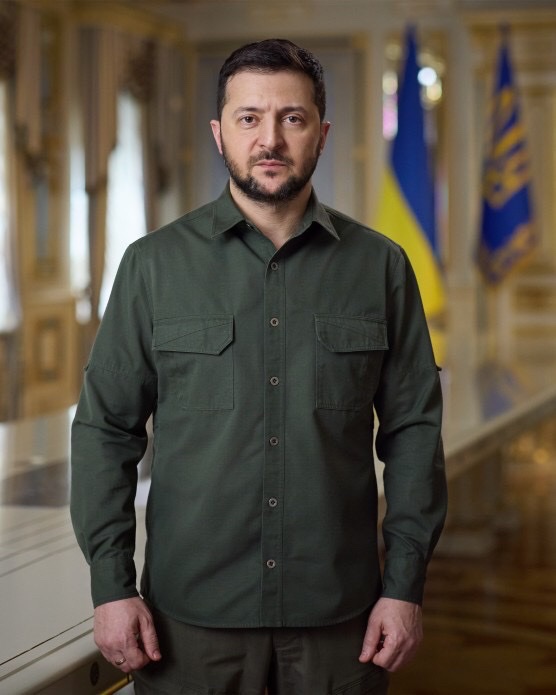
Ukrainian President Volodymyr Zelensky: Jewish, not Nazi
And there it is: history repeating itself by recycling old excuses for new wars. Vladimir Putin has apparently run out of unique catch-phrases.
But he hasn’t run out of expansionist ambitions. Just as Stalin’s success in Poland inspired and enabled him to terrorize “Lithuania, Latvia and Estonia … into signing ‘mutual assistance’ pacts, primarily one-sided agreements that gave the USSR air and naval bases in those countries” [id.], and to invade Finland without justification, so Putin will claim the same authority if he succeeds in bringing Ukraine to its knees — whether militarily or through diplomatic negotiations in his favor.
And that simply cannot be allowed to happen, for the sake of the rest of Europe . . . and of the entire world.
The United Nations, NATO and the EU must succeed where the League of Nations didn’t. In today’s world, failure is not an option.
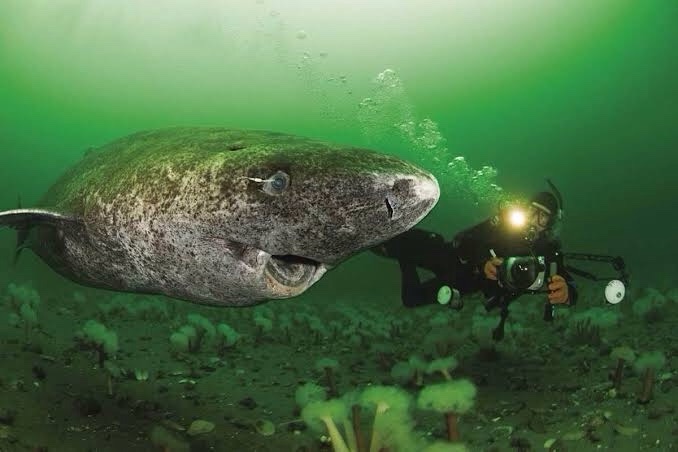
Lurking deep in the frigid waters of the North Atlantic and Arctic Oceans is a family of Somniosidae (“sleeper sharks”) known as the Greenland shark, renowned not only for their size (as long as 21 feet and weighing over 2,200 pounds), but for their longevity as well.
The Greenland Shark: More Than Just a Pretty Face
These monsters have the longest lifespan of any known vertebrate, estimated at anywhere between 250 and 500 years. They reach sexual maturity at around 150 years of age (no comment), and give live birth to pups after an estimated . . . holy crap! . . . eight- to eighteen-year gestation period.
“Years??!!!”
Their flesh is toxic to mammals, so they are obviously considered inedible . . . although a treated form of it is eaten as a delicacy in Iceland. (My advice: be very careful what you order for dinner when visiting Reykjavik.)
The Greenland shark eats anything, including carrion, so it does serve a useful purpose in the undersea ecosystem. But other than that, you may ask what it’s good for. And there is an answer to that.
An international team of scientists has become the first to map the Greenland shark’s genome, sequencing about 92% of its DNA. Dr. Steve Hoffman, senior author of new research on the Greenland shark at Germany’s Leibniz Institute on Aging, has said:
“To this end, this genome is some kind of a tool, if you will, that allows us, and of course also other researchers, to look into these molecular mechanisms of longevity.” [Taylor Nicioli, CNN, December 13, 2024.]
And as a result of these studies, the authors of the report have posited that they could also gain further insight into the means of extending the human lifespan.
Well, isn’t that special!
“Seriously?!!”
Of course, they’re not suggesting we humans might soon be living as long as 250 to 500 years . . . nor, apparently, have they thus far addressed the issue of quality of life over any extended period. But my question is this:
With the world in the shape that it’s in, and the mess we’ve already made of it — politically, socially, and environmentally — who in their right mind would want to live that long?
Especially if you have to wait 150 years to reach sexual maturity, and then be pregnant for a minimum of eight years.
Not I, thank you. Life’s enough of a challenge as it is.
Whether red-faced from anger or from embarrassment — or both — Vladimir Putin is not a happy camper these days. And it’s no wonder.
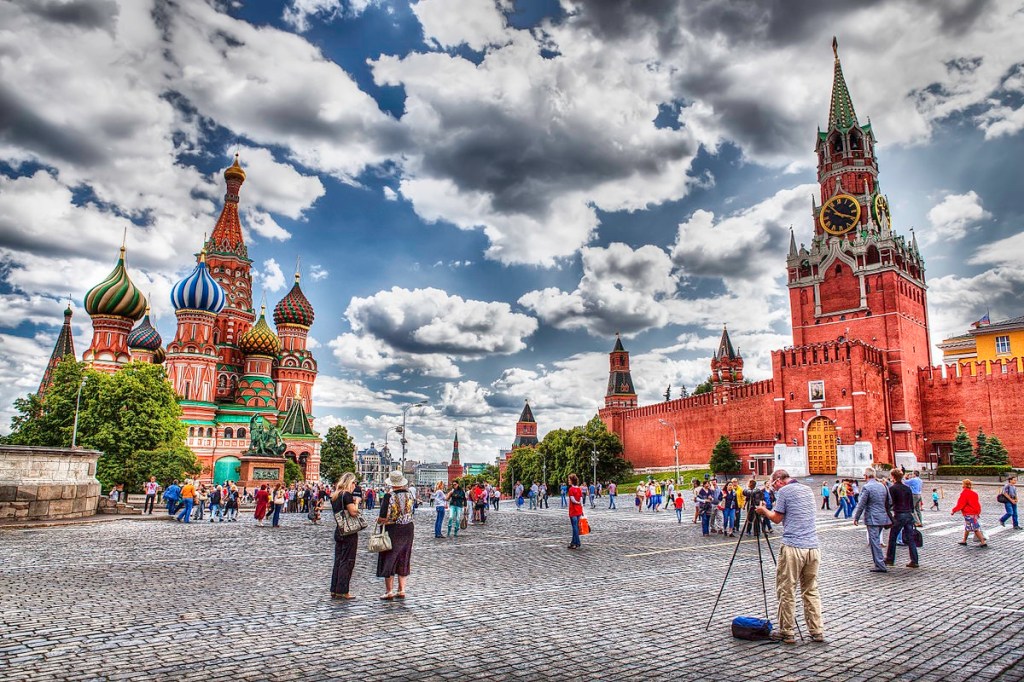
Red Square, Moscow
First, his most significant “client” in the Middle East — Syrian President Bashar al-Assad — is ousted in a coup that has sent him and his immediate family running to Moscow for asylum, leaving Syria in a precipitous political state, and the level of Russia’s influence in the Middle East in question.
Not to mention having to decide what to do with the Assad family in the long term.
Former President and Mrs. Assad
He must also realize that Assad’s fall was at least partially his own fault — enabled by Russia’s preoccupation with the war in Ukraine, drawing precious attention, money and personnel from its long-time assistance to Syria.
And what is he to do with the 6,000-7,000 troops he has stationed in Syria? Pull them out and send them to Ukraine? But then what happens to his airfield at Hmeimim and the naval facility at Tartus? The planes can be flown out; but the ships based at Tartus are unable to leave their Mediterranean port for their home on the Black Sea because of Turkey’s restriction of access through the Bosporus Strait. [Roksolana Bychai and Steve Gutterman, RFE/RL, December 13, 2024.]
Which also brings Turkish President Recep Tayyip Erdogan into the picture as one of the most vital pieces on the chess board of Eurasian/Middle Eastern politics . . . the man who has mastered the art of fence-sitting in his geopolitically strategic position between East and West.
Turkish President Erdogan
Next, Putin must come to grips with the fact that his “special military operation” in Ukraine has cost him far more dearly than he could ever have anticipated, in terms of money, manpower, and popularity in his own country. Tatyana Stanovaya, a senior fellow at the Carnegie Russia Eurasia Center, offered her view on X:
“Assad’s collapse has … shaken Putin, making him less inclined to demonstrate flexibility with Ukraine. The war in Ukraine has, to some extent, cost him Syria, which reinforces his unwillingness to compromise.” [Id.]
But Ruth Deyermond, a senior lecturer in the Department of War Studies at King’s College London, foresees less of an effect on Ukraine:
“Given how tightly Putin’s presidency is tied to the war in Ukraine, how far he’s been willing to reshape Russian economy and society, how many lives he’s been willing to sacrifice for it, and how dependent he’s made Russia on other states (China, Iran, North Korea), it’s hard to imagine that the loss in Syria will make much difference because it’s hard to see how the Kremlin could take victory in Ukraine more seriously than they already do.”
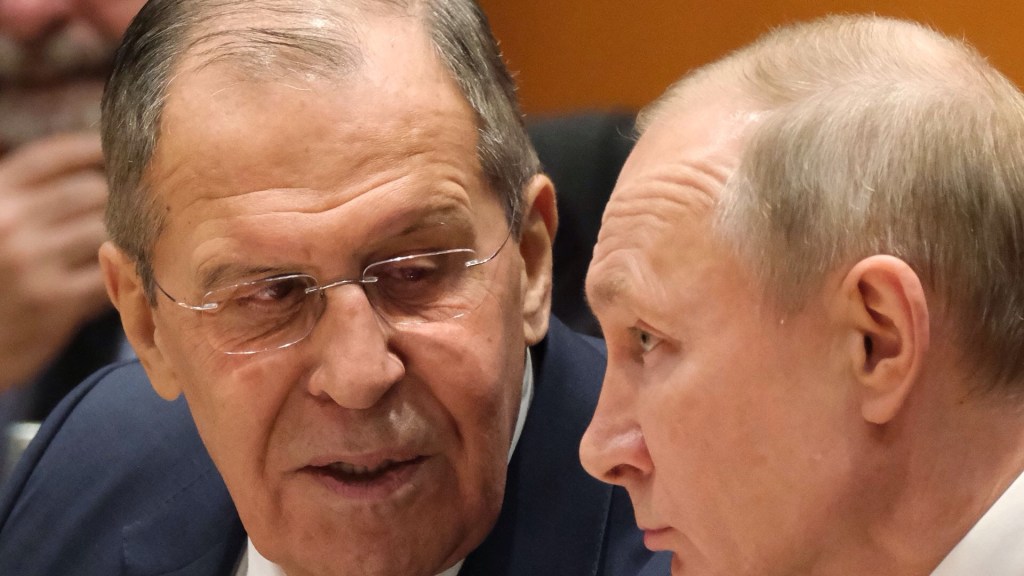
Russian Foreign Minister Sergey Lavrov and President Vladimir Putin: Very Serious Indeed
It’s impossible to foretell the way in which events will ultimately play out. But Volodymyr Ohryzko, former Foreign Minister of Ukraine (2007-09) and presently head of a center for the study of Russia, had this to offer:
The “myth that Russia is great, invincible, and so forth — it’s all just propaganda. And I think this was seen clearly once again in many capitals, and it will influence all subsequent events. For us, I think this is a positive moment in our work with Western partners. And we must take advantage of this moment. . . .
“The Kremlin’s inability to take any serious steps to prevent this geopolitical humiliation [in Syria] shows how overstretched they are in Ukraine. That and the failure of Putin’s recent nuclear threats should encourage NATO members in their support for Ukraine.” [Id.]
*. *. *
If I may take the liberty of once more calling upon the wisdom of my late Ukrainian grandmother:
There’s a bit of an update today on the drone sightings over the U.S. and U.K. — though I’m afraid it’s not great. Not calamitous . . . but not wonderful, either.
No, it’s not Amazon same-day delivery!
Starting with the U.S.:
As reported earlier, after an initial spotting near the Raritan River — which feeds into New Jersey’s largest reservoir — the incursions spread to locations near the Picatinny Arsenal (a military research facility), and the town of Bedminster, where one of Donald Trump’s golf courses is located.
But wait . . . there’s more.
Yesterday, several drones were reportedly seen over the Bronx in New York; the responding officers also saw them, but said they soon disappeared. And in addition to other parts of New York State, police in Groton and New London, Connecticut, have confirmed “suspicious drone activity.” [Bernd Debusmann, Jr., BBC News, December 13, 2024.]
Now former Maryland Governor Larry Hogan reports that he has seen what appeared to be “dozens” of drones over his home in Davidsonville, Maryland, about 25 miles from Washington, D.C. He has written on X:
“Like many who have observed these drones, I do not know if this increasing activity over our skies is a threat to public safety or national security. But the public is growing increasingly concerned and frustrated with the complete lack of transparency and the dismissive attitude of the federal government.” [Id.]
Thank you, Governor Hogan. Your words spoke for me . . . and for a lot of others.
Governor Hogan
And this is not new news. The Wall Street Journal reported back in October that mysterious drones were spotted near U.S. military facilities in Virginia over a period of 17 days.
And in the U.K.:
Contrary to earlier reports from both sides of the Atlantic, the BBC has now been told by U.K. defense sources that a “state actor” is suspected as being responsible for the activity near their military installations. [Id.]
I’m sure they didn’t name the suspect, but it wouldn’t be difficult to come up with a short list of possibilities.
Let’s start with the “Naughty” side, please, Santa.
I generally spend the evening hours preparing my thoughts on the day’s events, to be posted shortly after midnight. And more often than not, there’s a surfeit of subject matters to choose from (or “from which to choose,” for those of us who still refuse to let go of that preposition rule).
Tonight, however, I find myself sleepy, achy, and unmotivated. So bear with me, please, while I try to get some restorative sleep in the hope of waking up refreshed and raring to go in the morning.
Quite illogically — considering the daily headlines — I keep thinking that one day I’ll open my eyes to find a better, brighter world. I guess that’s what comes of having lived through those magical years of the ‘60s. The old anti-war, peace-love-hope songs of the minstrels of that era still resonate with me. I wonder how many of you remember this one:
“Last night I had the strangest dream I ever dreamed before. I dreamed the world had all agreed To put an end to war.
“I dreamed I saw a mighty room And the room was filled with men, And the papers they were signing said They’d never fight again.
“And when the papers all were signed And a million copies made, They all joined hands and bowed their heads, And grateful prayers were prayed.
“And the people in the streets below Were dancing ‘round and ‘round, And guns, and swords, and uniforms Were scattered on the ground.
“Last night I had the strangest dream I ever dreamed before. I dreamed the world had all agreed To put an end to war.”
— Ed McCurdy, 1950
Though written by McCurdy, it was recorded at various times by Pete Seeger, The Weavers, Joan Baez, and possibly others — but most popularly by Simon and Garfunkel in 1964.
A Very Young Paul Simon (R) and Art Garfunkel
Simpler times? You bet! And oh! how I miss them.
And there’s still just enough of the youth of the ‘60s left in me to want to believe.
From England, to Tajikistan, and now to New Jersey . . . they just keep showing up in the oddest places, and mostly near military installations. But we keep hearing that, while they’re as yet “unidentified,” they don’t pose any threat to the public.
Oh, come on now, you guys! Does every single person in the world have “STUPID” written across their foreheads? Really??!!!
At the risk of repeating myself too often, I will say it once more: Either someone in authority knows what they are and where they’re from, or they do pose at least a potential risk of some sort.
Now, I am not saying I’m in agreement with U.S. Congressman Jeff Van Drew (R-NJ), who claims he has heard from “high sources” that the recent objects buzzing his state were from an Iranian “mothership” in the Atlantic:
“That mothership … is off the East Coast of the United States of America. They’ve launched drones into everything that we can see or hear. These are from high sources. I don’t say this lightly.” He added that they should be “shot down.” [Bernd Debusmann Jr., BBC News, December 12, 2024.]
Congressman Jeff Van Drew
Well, at least he didn’t blame the Russians for this one . . . which is too bad, in a way, because we do always love hearing from the inimitable Kremlin spokesman, Dmitry Peskov. Oh, well . . . sorry, Dima. Maybe next time.
But getting back to the “Iranian mothership,” Pentagon press secretary Sabrina Singh said flatly on Wednesday:
“There is no truth to that. There is no Iranian ship off the coast of the United States, and there’s no so-called mothership launching drones towards the United States . . . these are not drones coming from a foreign entity or adversary.” [Id.]
Iranian Warship in the Red Sea
And White House national security spokesman John Kirby added today that there is “no evidence at this time that the reported drone sightings pose a national security or a public safety threat or have a foreign nexus.” [Id.]
In fact, Kirby added, many of the sightings are manned aircraft being operated lawfully, and none have thus far been reported in restricted airspace.
Excuse me . . . did he say “manned”??!!!
But then he also said:
“While there is no known malicious activity occurring, the reported sightings there do, however, highlight a gap. So we urge Congress to pass important legislation that will extend and expand existing counter-drone authorities so that we are better prepared to identify and mitigate any potential threats to airports or other critical infrastructure.” [Id.]
How very reassuring. That should only take Congress . . . what? . . . five or ten years.
There have been dozens of sightings since November 18th — as many as 49 reported on Sunday alone — some over a sensitive military research facility, and others near Donald Trump’s Bedminster golf course. But New Jersey Governor Phil Murphy said they don’t appear to pose a public safety concern. [Id.]
Aha! Over Trump’s golf course, eh? Maybe we can just blame the Democrats!
Assistant Director Robert Wheeler, Jr. of the FBI’s Critical Incident Response Group said at a congressional hearing on Tuesday:
“I don’t have an answer of who’s responsible. But we’re actively investigating.”[Id.]
More comforting news.
*. *. *
On the other hand, however, New Jersey Assemblywoman Dawn Fantasia, who was briefed by Homeland Security yesterday, stated that the Pentagon’s assertion that there is no known or credible threat is “incredibly misleading.” She said the drones appear to avoid detection by traditional methods such as helicopter and radio, travel with lights turned off, and “operate in a co-ordinated manner.” [Id.]
“They’re ba-a-a-ack!”
*. *. *
So let me get this straight. Is there, or isn’t there, anything concerning about these UAPs (Unidentified Aerial Phenomena)? If we’re not “all that well-prepared to identify and mitigate any potential threats,” then how do we know there aren’t any threats? And if “many” of them have allegedly been identified, what about the rest that haven’t?
Now, I most certainly do not subscribe to the UFOlogists’ School of Paranoid Delusions, wherein everything floating above ground level is presumed to be from another dimension. The odds are strongly in favor of these drones being man-made. But again . . . by whom, and for what purpose? If they’re “friendly,” most likely experimental, why not just say so, without revealing any details we wouldn’t want our enemies to know? Or why not simply test them far from sensitive or populated areas, where there would be no one to see them but a few bears and coyotes?
Unless, of course, those “bears” are really extraterrestrials in big fur coats . . .































 The Blog About Everything … and Sometimes Nothing