Having a wonderful time reminiscing about all my past travel (and other) adventures. Hope you’ll share them with me in my blog, “All Roads Led to Russia.”
A semi-submersible vessel was recently seized at sea by Portuguese police and naval authorities, who surrounded the boat, boarded her, arrested the four crew members, and seized 1.7 tons of Class A cocaine.
The narco-sub, which was bound for the Iberian peninsula, was operated by two Ecuadorians, a Venezuelan and a Colombian, who were remanded in pretrial custody following a court appearance in the Azores on Tuesday.
And that — for the benefit of U.S. officials — is how it should be done. Yes, they were in international waters, some 1,000 nautical miles off the coast of Lisbon, Portugal. But it was accomplished on the basis of reliable information received by the Lisbon-based Maritime Analysis and Operations Centre, with the backing of the UK’s National Crime Agency and the U.S. Drug Enforcement Administration. [James Gregory, BBC, November 4, 2025.]
It was not a small boat “suspected” of carrying drugs; it was not blown out of the water by a missile launched from afar; and no one was killed or injured.
The Trump Method of Drug-Fighting
The suspects have received a preliminary hearing, and will be given due process of law . . . though 1.7 tons of coke should be sufficient to guarantee a conviction.
Following seizure of the vessel, it was found that it was incapable of being towed back to shore due to poor weather conditions and the “fragile construction” of the sub, and it sank at sea. Vitor Ananias, head of Portugal’s police anti-drug-trafficking unit, told reporters:
“ . . . between the heat, the vessel’s fumes and high waves, with difficult weather conditions, even one day is tricky [for the four men on board]. By the end of 15 or 20 days all you want is to get out.” [Id.]
It sounds as though being arrested may actually have saved the lives of the four accused criminals — certainly a better option than being blown to bits.
*. *. *
Few people would argue against the dangers of illegal drug-running, or the need to put the multi-national drug cartels out of business. But the existence of the problem is not an excuse for cold-blooded murder.
Nor is the use of remotely-launched weaponry justifiable by saying it was done that way to ensure the safety of the U.S. military involved in the attack.
No Portuguese police or naval officers were injured in the seizure of the much larger vessel in the middle of the Atlantic Ocean. Surely, U.S. military personnel are equally competent. It hardly seems necessary to deploy the world’s largest aircraft carrier, the USS GERALD R. FORD, to troll the waters of the Caribbean in search of more victims. Yet that is what Donald Trump has done.
USS GERALD R. FORD
Thus far, some 66 people have been wiped out in the course of 16 such strikes, with no evidence or substantial details being offered by the administration to justify the actions. But Trump has rationalized the deaths by saying the United States is in “armed conflict” with drug cartels.
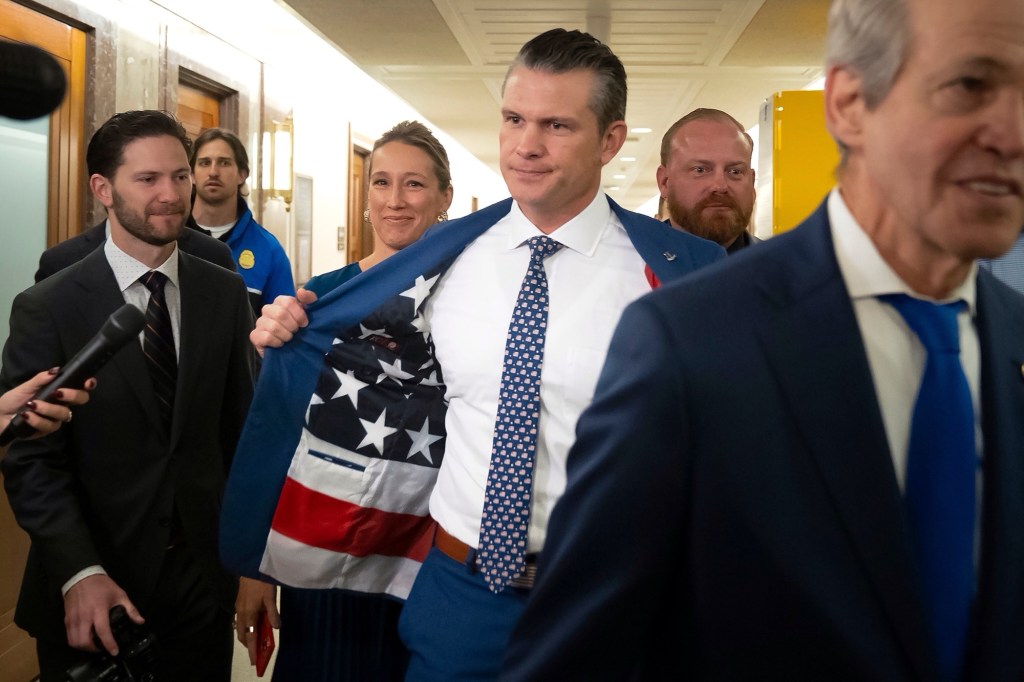
And Secretary of Defense Pete Hegseth, while on a recent trip to Asia, posted:
“We will find and terminate EVERY vessel with the intention of trafficking drugs to America to poison our citizens.” [The Associated Press, November 5, 2025.]
Pete Hegseth
That is what he said: “find and terminate” . . . as though he were talking about a fantasy movie, with himself in the role of Hellboy.
But those 66 people — criminals or not — were human beings, not characters in a film. And they were not given a chance to defend themselves in a court of law.
So would someone please tell me: What ever happened to “truth, justice, and the American way”?
We’re back to the Russian writers today: my personal favorite, Fyodor Dostoevsky (“Crime and Punishment,” “Brothers Karamazov,” etc.).
Fyodor Dostoevsky (1821-81)
No . . . Dostoevsky was not suggesting that we should go around insulting people for the fun of it. A level of empathy and simple good manners — or what we now call “political correctness” — is just a matter of decency and common sense.
But he understood the dangers inherent in being robbed of our political opinions, and our right to express them, in order to avoid offending the imbeciles in high offices: in his time and place, those were the Russian Tsar and his minyons.
And while times change, human nature unfortunately does not.
Between 1901 and 1910, approximately 1.6 million people — including all four of my grandparents, one great-grandmother, and three of my future aunts and uncles — emigrated to the United States from greater Russia. Most were ethnic Jews, Poles and Lithuanians, who left to escape the pogroms against the people of their so-called “races.”
Russian Anti-Semitic Pogrom – Early 1900s
In more recent decades, aside from a surge in the early 1990s following the collapse of the Soviet Union, the numbers have decreased and their demographics have changed: the majority of recent Russian arrivals have been better educated, leaving their homeland for political, professional and economic reasons.
But lately, a converse trend has been seen, with Americans, Canadians, Australians, and others — largely politically-conservative farming and working-class families with children — seeking an escape, not from poverty or political persecution, but from what they describe as the evils of a woke society.
Some 1,500 “ideological immigrants,” including 127 Americans, have applied for temporary residence (a necessary prerequisite to eventual citizenship) in Russia in the last year. [Caroline Radnofsky and Griffin Eckstein, NBC News, November 2, 2025.]
I have followed the adventures of one such Canadian family — the Feenstras from Saskatchewan — who have built a thriving farm from scratch in the Nizhny Novgorod region of Russia over nearly two years. And they recently added a guest house on their property in order to welcome the Pulley family from Australia, who work the farm with them. With the eight Feenstra kids and the three Pulley children, they have had their hands full expanding, not only the farm, but a number of side businesses . . . including their social media broadcasts.
The Feenstra Family
*. *. *
And last July, I reported on an American family — the Huffmans: Derek, a welder and builder, and DeAnna, a teacher and floral designer, who introduced themselves on social media as follows:
“We’re the Huffman family — Americans who moved to Russia 2 months ago! Derek (46) has a background in welding & construction, DeAnna (42) is a former teacher & floral designer, and we’re raising our 3 daughters (12, 11 & 10) while embracing a whole new life, language, and culture.” [Josh Fiallo, Daily Beast, July 18, 2025.]
The Huffman Family in Red Square
Now there has been an update on the Huffmans, and sad to say — though not surprisingly — their experience has not been as positive as that of the Feenstras.
Derek, DeAnna and their three daughters were the first family to move to a community planned for English-speakers some 30 miles west of Moscow, which they had read about online. It is operated by a long-term American expatriate and former host on Kremlin-sponsored RT network, Tim Kirby. [Radnofsky and Eckstein, NBC News, op.cit.]
In March, Derek said in a well-scripted video on his family’s YouTube channel:
“President Putin is an amazing leader and he’s done great things for Russia. It’s nothing like you see on the news. [Social media platform X] is the only place where you get real information [about America’s problems].” [Id.]
It appears that the Huffmans were not as financially well-prepared as the Feenstras for the long settling-in period in Russia. They had made the move with the encouragement of, and donations from, some of their YouTube subscribers. But Derek had a hard time finding work in construction or welding, and instead joined the Russian army, both for the money and to expedite the family’s applications for citizenship. On May 26th, he added on YouTube:
“Above and beyond the citizenship, the money, a big part of it for me is about the respect and earning our place here in Russia.” [Id.]
Yeah . . . right. Clearly, the Huffmans failed to do their due diligence before adopting Russia as their new home. Because those promises from Vladimir Putin’s government have notoriously gone unfulfilled, even to native Russians . . . let alone recent immigrants.
Russian Soldiers in Ukraine – Not As Glamorous As It Sounded
Instead of being placed in a unit that would utilize his specific skills as promised, he was sent to the front lines, where even the limited amount of training was useless to him, as it was all conducted in Russian, which he did not speak or understand.
During his six months’ deployment, he was erroneously reported as having been killed in action, but later resurfaced in videos on the family’s YouTube channel in October. In one such film, he said:
“I’m happy that I’m still alive and doing what I can to survive, and be of service to Russia. I’m so thankful to all the Russian people who have reached out and helped my family while I’ve been gone.” [Id.]
It was not clear whether he would be redeployed, or what the future might hold for the family. But they’re alive . . . and possibly wondering whether they should have given more thought to their decision before accepting Putin’s invitation to escape the “destructive neoliberal ideological attitudes” of America. [Id.]
Would you buy a used car from this man?
*. *. *
NBC News has also spoken with another Texas family: Leo and Chantelle Hare — a middle-aged couple with three sons, ages 17, 15 and 12 — who followed their ultra-conservative dream to what sounds more like a nightmare. Leo explained their reason for the move in a video call:
“It was the promise of a country that would not promote the LGBT agenda. We liked the fact that LGBT is basically outlawed here in official ways.” [Id.]
Well, that’s putting it mildly. Russian law strictly prohibits the “promotion of nontraditional sexual relationships,” and the public display of LGBTQ identity, including wearing or posting the rainbow flag on social media.
The Hares said that they relied on far-right commentators and conspiracy theorists Alex Jones and Mike Adams for their news in the U.S., and were disillusioned with American politics after the 2020 election . . . likely meaning that they bought into Donald Trump’s claims that he had actually won. Yet they don’t believe that even his return to power will change the country enough for them to want to return. [Id.]
The Hare Family
But their introduction to life in Russia was fraught with problems. As they were en route to Moscow, their initial plan to rent an apartment there fell through, and they were forced to spend the winter on a farm 70 miles outside the city, caring for the animals in exchange for free room and board.
Then their landlord’s son offered them a generous (a big red flag right there!) interest rate if they would invest their $50,000 bankroll in what he described as a car import business. But they received just one interest payment, and then . . . nothing. When the man refused to return their money, they went to the police and filed complaints with the local court, but received no help from regional officials.
To make matters worse, their sons are unhappy with life in Russia, and the two older boys have said they want to return home. They are prohibited from attending school until they are able to pass a language test and are presently being home-schooled, further increasing their sense of isolation.
On the up-side, both parents are now working as English tutors. They have found an apartment in Ivanovo, northeast of Moscow, and say they “are living really comfortably now.” And Leo has admitted it probably “would have been a dealbreaker” if they had known in advance about the school restrictions. [Id.]
“Well . . . duh!”
One more example of uninformed, inexperienced people failing to do their homework and instead placing their trust in the promises of strangers.
Luckily, Leo says that at least he never considered joining the army in Russia because of his age and safety concerns; and hearing Derek Huffman’s story, he says that Huffman may have “assumed a little too much” about life in the Russian military.
“We assumed a lot, too,” he said. “But we do have a faith in Christ and He is leading us, even though we’ve made mistakes.” [Id.]
Maybe so. But I wonder whether the Christ in whom he so fervently believes would have advised him to move halfway around the world simply to escape people with differing views of sexuality.
Just a thought . . .
“Hmmm . . .”
*. *. *
The experiences of the Huffmans, the Hares, and even the Feenstras — who, though certainly doing better than the others, have had their share of difficulties — should provide a cautionary tale for anyone thinking about following in their footsteps. Russia is a dictatorship, led by a vicious, murderous autocrat and his team of corrupt oligarchs. It is a place where the rules change at the whim of one man, and people disappear into the penal system (or the quagmire in Ukraine) for no apparent reason, and often without a trace.
In all honesty, there are also a lot of things going on in the U.S. these days that give me similar cause for concern (for the record, “wokeness” is not one of them); and if I were younger, I might have considered relocating. But rest assured that, if I were to give it serious thought, my list of potential destinations would not include Russia.
Not all memorable quotes can be attributed to the great classical writers, or to the world’s leading statesmen . . . or, for that matter, to men.
If I could resurrect just one woman from history, it would be Eleanor Roosevelt, wife of U.S. President Franklin D. Roosevelt. What she lacked in traditional physical beauty, she more than made up for with her intelligence, wisdom (not the same thing), and empathy.
Eleanor Roosevelt (1884-1962)
Today, I choose just one of the multitude of pithy comments drawn from her lifetime of study and public service:
“Anyone who knows history, particularly the history of Europe, will, I think, recognize that the domination of education or of government by any one particular religious faith is never a happy arrangement for the people.”
Sad to say, Mrs. Roosevelt, that the self-described “Christians” in charge of our government today are either ignorant of history, or choose to emulate rather than learn from it.
But we the people have not given up the cause for which you and your husband fought so valiantly for so long: the preservation of our democracy.
I had spent the first nine years of my life in Rhode Island, surrounded by my parents, sister, maternal grandparents, aunts and uncles, cousins, and a plethora of neighbors who felt free to drop by at any time and never bothered to knock because the back door was always open.
It was a warm, secure, loving, if someone noisy environment. Until one day, when my sister Merna and I were told that we would be moving to New Hampshire in the summer, to be closer to my father’s even larger family. In truth, the job opportunities were better there; but we children didn’t need to know that.
Moving to New Hampshire
At age nine, it seemed like a grand adventure. And indeed, it worked out well. Merna was in high school by then, and had hated her school in Rhode Island; she found her niche in Manchester, making friends and ultimately graduating with honors.
I was entering the sixth grade, still two years younger than my classmates and a bit small for my age. When my mother brought me to school to register, the principal immediately said there was no way a tiny nine-year-old could be expected to fit in with eleven- and twelve-year-olds. But my mother — never one to accept criticism of her precious children — showed her my fifth-grade report card (all A’s, of course, as nothing less was acceptable in our family) and a document certifying my passage to sixth grade, and it was agreed that they would “give it a try.”
In brief, the next four years were the best of my school years. I had lots of friends and continued to ace all of my subjects. I couldn’t have been happier . . . except for the times when my father would disappear for weeks on end.
It wasn’t another woman, as far as my mother knew. It was even more stupid than that: in his 40s — considered middle-aged in those days — he had decided to become a jazz groupie. He had always loved jazz music, but had no musical talent of his own; so he latched on to a friend’s band and occasionally traveled around the country with them, finding temporary jobs in the various cities and sometimes sending money home to the family who had taken second place in his life.
1950s Jazz Band
My mother rolled up her sleeves and went back to work, as did Merna, who had to drop out of college. And when he next came home, my mother told him that if he ever left again, he would return to an empty house. He didn’t believe her.
But that’s exactly what happened. He took off, she took the money she had been secretly squirreling away, put the furniture into storage, and moved us to Washington, D.C., where she had a brother who helped us get settled.
When dear old dad returned to New Hampshire, he found an empty house, with only a bed, a dresser, a chair, and a snarky farewell note.
Surprise!
So, at the age of 13, my future character was once again molded by an event over which I had had no control. We stayed with my aunt and uncle for a month, my mother and Merna found good jobs, and we moved into an apartment where I suddenly found myself on my own all day, five days a week.
Until school started in September, I explored the neighborhood, made friends with the neighbors and several local shopkeepers, taught myself to cook and do the family laundry . . . and decided I liked being self-sufficient.
I also had a lot of time to read. On one of my strolls to the nearby shopping center, my eye was caught by a small book entitled “Over Sexteen” — a compendium of suggestive cartoons and jokes that would be considered ridiculously mild by today’s standards, but were a little racy for those times. I bought it and was curled up on the sofa, reading and laughing out loud, when my mother returned home from work that evening and asked me what I was reading that was so funny.
I didn’t try to hide it . . . instead, I just nonchalantly held the book out to her and watched her eyes double in size as she began leafing through the pages. I know I heard her snicker a couple of times, though she made a valiant effort not to. Finally she asked if I understood the jokes; and when I said of course I did, she handed it back to me, shrugged, sighed, and said, “Well, then, I guess you’re old enough to read it.”
And that was pretty much the extent of my advanced sex education, other than having earlier been handed a book designed for pre-teens on the subject of menstruation, which I found instructive but totally icky.
As it happened, Mother actually did enjoy a good joke; but serious talk of S-E-X was too much for her to handle.
Fortunately, my generation outgrew that.
*. *. *
Well, that takes us through the second phase of my personality development, and on to the final three years of high school in suburban Prince George’s County, Maryland (a suburb of Washington, D.C.), where I began to make serious life decisions on my own.
Please note that I didn’t say they were all good decisions — just serious ones. So stay tuned.
Reading a Shakespearean play is, to me, much the same as listening to a complete opera: his soliloquies, like an operatic aria, are magnificent and memorable; but I sometimes lose my way in the maze of all the in-between language. Methinks the Bard doth discourse too much.
William Shakespeare (1564-1616)
Still, many of my favorite quotes come from the works of old Will, such as this immortal advice from “Hamlet”:
“This above all: to thine own self be true, And it must follow, as the night the day, Thou canst not then be false to any man.”
In the dark days in which we are now living, it seems especially important for each of us to take heed of Shakespeare’s words of wisdom — which were offered by the character Polonius to his son Laertes as the young man was leaving to study at university — and to avoid being swayed by those who would lead us down the wrong path.
Advice that is as important — if not more so — for the 21st century as it was for the 17th.
For nearly 250 years — since long before these words were written — their significance has formed the foundation of this new, young country:
“Give me your tired, your poor, Your huddled masses yearning to breathe free . . .”
America was built by generations of honest, decent, hard-working people from every corner of the world who dreamt of making a new life for themselves and their children in America, free of the poverty and oppression of their less fortunate native lands.
But now that dream has been killed. Instead of the annual limit of 125,000 refugees as established by former President Joe Biden, Donald Trump has decreed that no more than 7,500 will be admitted over the next year . . . slashed by 94%, with priority being given to White South Africans.
The same White South Africans whose parents and grandparents were responsible for the horrors of apartheid practiced against their Black neighbors. The same White South Africans, known as Afrikaners, who are descended mostly from the early Dutch and French settlers who, while modernizing and growing the industry, agriculture and economy of their new home, at the same time took control of its government and relegated its native population to a life of poverty and servitude.
Nelson Mandela: The Man Who Ended Apartheid
And now these White South Africans are claiming to be victims of illegal or unjust discrimination because of the imposition of a new law allowing seizure of portions of the country’s agricultural land by the government without compensation. As it happens, Whites — who comprise just 7.2 percent of the country’s population — own an estimated 72-73 percent of the agricultural land.
The post-apartheid South African government says that its purpose is to return some of the previously confiscated land to its rightful Black owners; the present White owners, of course, say they are being robbed. It is a complex, contentious issue, rightly to be decided by the people of South Africa.
But Donald Trump — in line with his ongoing campaign to turn the United States into his ideal of a White, male, Christian oligarchy — has taken up the cause of the White South African farmers who, whether rightly or wrongly, feel the need to flee. And he is offering them an open door and a fast path to citizenship, while simultaneously barring entry to people of color, and deporting masses of those already here.
Immigration Raid in Los Angeles, California
*. *. *
All I can think of is this other man’s one-time dream of an “Aryan” nation, populated by a “master race” of people of Northern and Western European descent . . . excluding Jews and Romany people, of course:
We all remember or have learned about what horrors that led to. And I’d like to know what, if any, difference there is between his dream and Trump’s.
Today we turn to another, very different Russian for not just one, but a pair of quotes applicable to today’s world.
These are not from a literary giant or noted philosopher, but from the infamous Vladimir Ilyich Ulyanov — better known as Vladimir Lenin — who saw the opportunity for his moment in history and grabbed it by the b . . . well, grabbed it for all it was worth. From that day forward, the world was irrevocably changed . . . and not for the better.
Vladimir Ilyich Ulyanov (a.k.a. “Lenin”)
And here are two examples of the secrets of Lenin’s success in becoming one of history’s most ruthless dictators:
“A lie told often enough becomes the truth.”
– and –
“The whole question is: who controls whom.”
I wonder: Is it just me, or does that remind you of anyone in a position of power today?
Leonid Pshenychnov is an internationally-renowned Ukrainian Marine Biologist who has worked for decades on the conservation of biological resources of the Southern Ocean, including Antarctic krill and fish biodiversity. Since 1996, he has represented Ukraine at the Commission for the Conservation of Antarctic Marine Living Resources (CCAMLR), and was scheduled to do so again last month at Hobart, Australia.
Leonid Pshenychnov
Before traveling to Hobart, Dr. Pshenychnov was visiting family in Russian-occupied Crimea in September, when he “was forced to take up a Russian passport . . . and has been arbitrarily charged with ‘threatening the security of the Russian Federation,’” according to Vasyl Myroshnychenko, Ukraine’s Ambassador to Australia. [Jano Gibson, abc.net.au, October 20, 2025.]
A translated version of a document issued by Russian authorities to Dr. Pshenychnov’s attorneys following his arrest describes him as a “Russian citizen . . . [who] defected to the enemy” by participating in CCAMLR’s meetings in recent years, and accuses him of using his research to undermine Russia’s krill fishing operations near the Antarctic Peninsula by encouraging tighter catch limits — despite the fact that the movement to enforce the new limits was unsuccessful. [Id.]
2023 Ukrainian Delegation to CCAMLR: Dr. Pshenychnov Standing Center, Ambassador Myroshnychenko Seated Right
And if that isn’t a setup, I’ve never seen one. Forcing a Russian passport upon a Ukrainian citizen, and then declaring him a “defector” to the “enemy” is the height of chutzpah . . . not to mention being blatantly illegal.
Yet Dr. Pshenychnov, age 70, has been imprisoned, despite protests from both the Ukrainian and Australian governments. In the words of Ambassador Myroshnychenko:
“Dr. Pshenichnov’s [sic] arrest and imprisonment without any evidence is a blatant human rights abuse.” [Id.]
Thus, our list of Russia’s hostages grows once more, as we await the outcome of his case.
*. *. *
So, with a deep sigh of regret, here we go again this week:
Immigrant Detainees in Russia:
Migrants from the Central Asian nations of Kazakhstan, Kyrgyzstan, Tajikistan, Turkmenistan and Uzbekistan
Prisoners of War:
The 19,500 Kidnapped Ukrainian Children The People of Ukraine
Endangered Exiles:
Mikita Losik Yulia Navalnaya Countless Journalists and Other Dissidents
Ales Bialiatski Andrei Chapiuk Marya Kalesnikava Uladzimir Labkovich Andrzej Poczobut Marfa Rabkova Valiantsin Stafanovic Yuras Zyankovich
In Georgia:
Mzia Amaglobeli
In China:
Chenyue Mao (American)
In Russia:
David Barnes (American) Gordon Black (American) Antonina Favorskaya Konstantin Gabov Robert Gilman (American) Stephen James Hubbard (American) Sergey Karelin Timur Kishukov Vadim Kobzev Darya Kozyreva Artyom Kriger Michael Travis Leake (American) Aleksei Liptser Grigory Melkonyants Nika Novak Leonid Pshenychnov (in Russian-occupied Crimea) Nadezhda Rossinskaya (a.k.a. Nadin Geisler) Sofiane Sehili (French) Igor Sergunin Dmitry Shatresov Robert Shonov Grigory Skvortsov Eugene Spector (American) Laurent Vinatier Robert Romanov Woodland (American)
Let me say from the outset that I am not one of those people who think they remember their own birth. I may have a few delusions of my own, but luckily, the belief that I remember fighting my way out of the womb and through the birth canal is not one of them.
I do, however, recall my mother’s story of that fateful day when I — all eight pounds and nine ounces of me — made my debut appearance . . . and in rather dramatic fashion.
Apparently, I was born with an extra impatience gene, if there is such a thing. Because my mother — a petite woman who never weighed more than 99 pounds soaking wet, except when pregnant — barely made it to the hospital in time. No labor pains, no time for prep; just a lot of amniotic fluid, a slight backache, five minutes in the delivery room, and there I was: screaming mad, arms and legs flailing, and probably wondering when they were going to bring my dinner.
I have some old family pictures in which I appear, around age two or three, as a rather cute, blonde, serious-looking toddler being posed for photo ops on special occasions. Other than that, any history from those earliest years is strictly anecdotal, passed down by various relatives and undoubtedly edited along the way. But my own memory kicks in around age three, when my older sister Merna decided it was time for me to begin my education.
Specifically, she taught me to read, write, and do simple arithmetic, so that I became my mother’s favorite parlor trick. Whenever we had guests, she would drag out the daily newspaper or a magazine, have someone choose a random article, and make me read it to them. Luckily, Barnum & Bailey never brought their circus to our small town, or I’m sure she would have tried to sign me up as one of their sideshow “freak” acts.
Circus Folk (a long time ago)
I remember skipping a couple of grades in school because of the head start my sister had given me, so that I was all of six years old when I started third grade. By that time, Merna was in junior high school, and no longer available to walk with me to and from my elementary school. So of course, my mother was ready to assume the task — but I was having none of it. I knew the way from the previous school year; I was a big third-grader; and I was quite capable of looking after myself, thank you very much.
So at the ripe old age of six, I took off that first morning in September: up Rathbun Street past St. Louis Catholic Church and School, across both streets at the intersection of Rathbun and Privilege Streets, along Privilege to Social Street, then left another half block to Pothier Elementary School, Woonsocket, Rhode Island . . . a substantial distance for a wee lass such as myself. And in the afternoon, when I reversed course, I could see my mother — who had doubtless been frantic for the entire day — waiting outside our house, watching for me to pop into sight.
(Full disclosure: We had no cell phones or GPS trackers in those days; but the principal of my school was one of my mother’s best friends, and I’m quite sure there was at least one phone call to let her know I had arrived safely in the morning.)
Today, allowing a six-year-old to do that on her own would be cause for Social Services to launch an investigation. But those really were kinder, gentler times. And it wasn’t New York City or Detroit; it was small-town New England in the 1940s. I was — in my own mind, at least — independent, smart, and quite certain that I was invulnerable. I’m convinced now that it was that experience, all those decades ago, that prepared me for my world travels in later years.
*. *. *
Most often it’s the major events that we think of as life-altering: our choices of study and career, marriage (or not), being in the right place at the right time . . . like Forrest Gump discovering that he was one hell of a ping-pong player.
But in reality, it’s frequently the smaller things that shape our character and influence the decisions we make later in life . . . little things like striking out on my own at six years of age, and learning to read at three so that I skipped a couple of grades and graduated early.
And I will get into more of those little things later, as soon as I dredge them up from memory.