Author Archives: brendochka39

Unknown's avatar

About brendochka39

Having a wonderful time reminiscing about all my past travel (and other) adventures. Hope you’ll share them with me in my blog, “All Roads Led to Russia.”

11/19/24: A Velvet Revolution, and a Golden Summer – Part II


Here is the rest of that summer of ‘91 in Prague, a year and a half after the expulsion of the communist regime. I had arrived just as the last of the Soviet military occupiers were leaving, and the city was in full celebration mode. It was truly a magical time, and one that I feel blessed to have shared with the Czech citizens who made it happen. When my time there was over, I was sad to leave them . . . though, as Dorothy said to Toto, there really is no place like home.

*. *. *

Now, where did we leave off last time? Right — Valerie had been rescued from the elevator and made good her escape from Prague. It was her loss; she missed out on a lot of good times.

On the way to work one day, I noticed printed signs posted on utility poles and trees all along the main streets, but couldn’t make out what they said. When I asked someone at work, I was told they were an announcement of the regular five-year cleaning of the pipes. All water was to be shut down throughout the city — except in the central, Old Town district — for the upcoming weekend. That explained the rusty water in my shower.

Astronomical Clock, Tyn Church – Old Town Prague

But what does one do without water for an entire weekend? Well, if you’re an American on an expense account, you either leave town or check into a hotel where there is water. But being tourist season, all the major hotels were already full, and I could only find space in a lovely little boutique hotel, the Ungelt, just off the Old Town Square. It was perfectly located, and for $200 I had — not just a room — but a beautiful two-bedroom, two-bath suite with a huge living room and a full kitchen. Good thing, too, since it turned out I was going to have to share it with a partner coming in from the Cleveland office.

The partner’s secretary called one day just before the water shutdown to ask whether we could help out with a hotel issue. Her boss would be arriving in Prague a day earlier than originally planned, but when she had tried to add a day at the start of his hotel reservation, she had been told that all rooms in the city were booked, due both to the usual tourist crush and the upcoming water issue. I explained the situation to her, which she of course found incredible, being from Cleveland where tourist invasions were not really a problem and the water system wasn’t 500 years old. But I had a brilliant idea. I said I had just reserved a two-bedroom suite for myself, and I would be happy to have company for the one night. Her reaction was hilarious! She simply could not believe that I — a woman — would agree to share living space with a man — and a married man at that — whom I had never even met. Ah, these moral midwesterners! She just didn’t understand, first, that in most of the western world this would not be considered shocking; second, that he was a partner in the firm and if he tried anything objectionable, I would know exactly where to find his wife; and third, that this was Prague, where practically nothing was considered unusual. So she checked with her boss, and he said “yes please” — which must have sent her into spasms.

Hotel Ungelt, Prague

As it turned out, though, the water was restored before he arrived and I was able to move back into my apartment after only one night in the hotel. He was already on a plane by that time, so I left a note and the key for him at the hotel desk, and said I’d see him at the office on Monday. When we did finally meet, he said he and his wife had had a good laugh over the situation, and yes, his secretary was a bit on the puritanical side. No kidding!

Anyway, while I was staying at the hotel, I was able to do some wandering around the Old Town, where I encountered a family of three from Germany: a young couple and a middle-aged woman, who were driving around Europe on the cheap. The young man spoke English, and told me they had lost their bearings in the city’s twisted streets. He asked if I could direct them back to the student hostel where they had stayed the night before. He showed me a piece of paper with the supposed address on it, but what they had written down was the word “Ulitsa,” which they had copied from a street sign, and which I had to explain means “Street” — not the name of the street as they had thought. They didn’t realize that the street names were shown in reverse, as for example, “Street Main.” Dismayed, they asked where else they might stay, and I told them about the water situation and the packed hotels, and that I had even had to move out of my apartment to an expensive hotel for two days. The young man suddenly became very excited. Could they stay in my apartment, since I wasn’t using it?

Old Town Square, Prague

Now, I’ve heard of chutzpah, but this was beyond belief. Did I have “STUPID” written across my forehead? Was I really going to let three total strangers — and wayfaring tourists at that — move into my apartment, where all my belongings were, and where they couldn’t bathe or flush the toilet for two days??? Really? So I quickly made up a story about a landlord who wouldn’t allow tenants to sublet, wished them well, and got away from them as quickly as I could. They had a car, and I assume they slept in it that night. If they could even remember on which ulitsa they’d parked it!

*. *. *

As wonderfully friendly and generally safe as Prague was, it was not without its problems. The Romany people — commonly referred to as Gypsies — live in many parts of Europe, and were considered a huge problem in Prague at that time. Sadly, they were blamed for every crime that occurred anywhere in the city, whether they were guilty or not. One day, Rudy had picked me up at my apartment, and as we drove down the hill and around the corner, I noticed a man lying on the ground near the rear of a parked car, and saw blood on the ground near his head. I shouted at Rudy to stop, but instead he merely slowed down, took one look at the man, and kept going, saying it was not safe to stop. That was not like Rudy at all, and I kept asking him what was wrong with him. His answer shocked me. He said the man was a Gypsy, and if he was alive, regained consciousness and became frightened, he could very easily pull a knife and kill us both.

A Romany (Gypsy) Family

Now, I’m a city girl, and I’m no stranger to the dangers posed by all sorts of unsavory people. But I’ve also seen the results of hatred and bigotry, and I just could not allow a man to lie there and possibly die simply because we were afraid. So I told Rudy to find the nearest police or fire station. As luck would have it, just up the street we encountered a police car with two officers, stopped them, and led them back to the injured man, who was by then sitting up and holding the back of his head. The officers took charge, and we were able to go on our way. Sadly, that too was Prague. It’s the one truly negative memory I have of that summer, and it will never go away.

But, as with any ethnic group, there are Gypsies . . . and there are Gypsies.

Of all of the wonderful restaurants in Prague that year, my favorite was located outside the city center in a big, rustic log cabin set back from the road in a thinly wooded area. I never would have found it on my own, but my co-workers seemed to know every eating spot in town. The dining room was huge and beautifully rustic, and in the center was an enormous open fire pit with a dozen or more chickens turning continuously on a long spit. And there was entertainment: a group of Gypsy musicians, who — along with the owners of the restaurant — were delighted to meet the friendly American woman who spoke to them in Russian. As a result, I was always given the best table near the rotisserie, and serenaded to the soulful strains of Gypsy violins whenever I visited. (And yes, you can get sick and tired of hearing Zigeunerweisen.) Of course, as an American, I was by Eastern European standards a good tipper, so those guys weren’t stupid. But I had grown very fond of them, and hated saying goodbye to them at the end of the summer. If they went out and committed crimes after work, I never knew about it, and didn’t want to know. They were my Gypsies.

Gypsy Love

*. *. *

Then there was U Fleku — a brewpub that had been in continuous operation since the year 1499, even through the much more recent Nazi and Communist occupations. My friends Joe and Mary Saba — you may remember them from the London episode — came to Prague to work for a couple of weeks, during which time Joe had a big birthday to celebrate. So we —about a half dozen of us — took him to U Fleku and surprised him with a birthday cake. However, the only candles we had been able to find were the size of Chanukah candles, and when they were all lit, we were sure the blaze was going to burn down the 500-year-old wooden building. But it didn’t. And as we sang “Happy Birthday,” we were surprised and delighted to hear everyone in the room join in, singing in Czech. We had clearly chosen the perfect place for Joe’s birthday party — even though I still didn’t like beer.

U Fleku: More Than Just Beer

Oh, and about that cake. I had stopped that morning at my favorite bakery to order it. It was to be freshly baked and ready for pick-up that afternoon. I couldn’t decide which of several flavors to choose, so I said — or thought I said — “either that one or that one,” pointing to two of the samples. The cost was an incredible $7.00, which would have been the price of just a couple of slices back home. But when Rudy went to pick up the cake in the afternoon, he returned to the office with, not one, but both cakes, and for the same $7.00 — an unbelievable $3.50 apiece! I guess I must have gotten my conjunctions mixed up; clearly, I didn’t know my “or” from my “and.” The second cake did not go to waste, though — my Czech friends knew how to eat as well as drink. I could never quite understand how they stayed so slender; must have been all the walking.

*. *. *

One more restaurant story. Well, actually a priest story. Or both. Anyway, I received a call one day from Michael Silverman in the Washington office (also from my London and Budapest adventures), telling me that a client and friend from Rutgers University, Dan Matuszewski, was coming to Prague and would be calling me to touch base. Dan was a delightful guy, and I was looking forward to hearing from him. When he called a few days later, to my surprise and delight he invited me to join him for dinner, and said that there would be a third person with us: Father Theodore Hesburgh, then President of Notre Dame University. I had heard of but never met “Father Ted,” as he was affectionately called, and was honored to have the opportunity. However, not being Catholic, I wasn’t quite sure what to expect, and decided I had better be on my best behavior.

To begin with, I couldn’t find the restaurant. I had the name (the Beograd — Belgrade, in English), as well as the address, and I knew where the street was, just off of the lower end of the famous Wenceslas Square. But I couldn’t find a building with the right street number, nor was there a visible sign with the name of the restaurant. So I approached a man walking by, who didn’t speak English, and asked him for the “Restaurace Beograd” — the Czech words for Belgrade Restaurant. Again, though, my pronunciation must have been less than perfect, because the poor man kept saying, “Ne Beograd. Praha. Praha.” (“Not Belgrade. Prague. Prague.”) He obviously thought I was suffering from some form of dementia and believed I was in Yugoslavia! As he walked away, shaking his head slowly from side to side in apparent sympathy, I was thinking about how to find a Czech language tutor, and soon. But first I had to find the restaurant.

Belgrade Restaurant: Can you see the name? I couldn’t.

I did locate it a few minutes later, with the help of another passerby, just around the corner from where I had been looking. It seemed that the street, which appeared to end at a cross street, actually made a 90-degree right turn and continued under the same name. Oh, well . . . that’s Prague.

When I finally arrived, Dan and Father Ted were already finishing their first round of drinks, and I soon discovered to my everlasting delight that Father Ted was one of the funniest, most interesting, and most down-to-earth priests one could imagine. I can’t think of a topic we didn’t cover during that dinner, most of it with a distinct overtone of irreverence and accompanied by a good bit of raucous laughter. I’m not sure how much any of us managed to eat that night, but it was a great time and one of my fondest memories of Prague. I do regret, though, that I never did make it to Yugoslavia.

*. *. *

My very first chapter of this blog began with the sentence, “I once climbed a mountain in Czechoslovakia.” I did not lie, although “mountain” may have been a slight exaggeration. It sure felt like a mountain, though. Google Maps tells me that the tallest mountain in the Czech Republic is Snezka, at 1,603.3 meters, or 5,260 feet — just twenty feet short of a mile high. On the other hand, my mountain, Hluboka, is described as “a hill.” But from personal experience, I can tell you that even the hills of San Francisco can’t hold a candle to the one leading up to Hluboka Castle. To me, it was a mountain. And you can’t drive right up to the castle, whether by car or tour bus; parking is at the bottom, and then you walk. Straight up. It probably only took about 10-15 minutes, but it felt like hours. All of my walking around Prague had not prepared my body for that experience, and my legs were sore for a week (a good excuse for more of that marvelous, medicinal Becherovka!). But the magnificent castle at the top was well worth the trek. And that was just one part of a lovely weekend spent at Jana’s parents’ home in the nearby town of Pisek.

Hluboka Castle – Czech Republic

Before I go on with that weekend, let me tell you about all of those Janas I keep mentioning. In order of seniority, they were: Jana Pilatova (the one from Pisek and the smartest), Jana Stefakova (the hottie with the equally hot boyfriend), and Jana Jungmannova (the youngest, prettiest, and sweetest). If you noticed the “ova” ending on all their family names, that’s the feminine designation. The Czechs — in 1991, at least — had no problem with the centuries-old system of gender-specific identification.

So Jana P. had invited me to meet her family and get out of the city for a couple of days. It was about a two-hour bus ride through the beautiful countryside of Bohemia. Her parents had a very nice, comfortable, older home on a substantial piece of land with a huge vegetable garden in the rear. Her father was a farmer who worked for a large produce grower, and everything they ate was freshly picked or killed, skillfully prepared, and incredibly delicious. But they couldn’t understand why I had such a small appetite — which, I promise you, was not the case at all. They could not have been more hospitable, and I found them to be well-educated and politically well-informed, as was their daughter Jana. The dinner conversation was lively, mostly about their joy at finally being rid of the [expletive deleted] Russians. It is a truism that you don’t really get to know a country until you have spent time with the “ordinary” people, away from the tourist areas; and I felt privileged to have had that opportunity.

Pisek, South Bohemia, Czech Republic

*. *. *

But all good things must come to an end. I was scheduled to return home during the last week of August, having already extended my stay for a couple of weeks at the firm’s request. As much as I loved being there, it was the longest I had ever been away from home, and I was feeling a bit homesick. I had a tape of Simon & Garfunkel’s concert in Central Park, and kept playing “Homeward Bound,” over and over and over again. So when I was asked to extend once more until after Labor Day, some little voice in the back of my head told me I had to decline. When I announced to the gang from the office that I was going, they planned a farewell barbecue at Rudy’s house, and I felt as though I had truly found a second family — a diverse and somewhat quirky family — in Prague, and it was not easy to leave them. But that voice kept telling me to get on home, and so I left as scheduled, with my six pieces of overweight luggage, some beautiful Czech crystal, the strains of Mozart and Gypsy melodies lingering in my mind and heart, and a wealth of incredible memories.

Unforgettable Prague

*. *. *

A week or so later, just before Labor Day, my mother became ill and entered the hospital. She passed away on September 18th, of congestive heart failure. I had come home just in time. Always, always listen to that little voice.

But even in the aftermath of a tragedy, good things can happen. The loss of someone close to you can bring with it the realization of how precarious life really is, and how important it is to make the most of the time we’re allotted. And as I prepared to do exactly that, it became more and more clear that, for me, all roads did indeed lead to Russia.

Signing off until next time,
Brendochka
3/2/23 (re-posted 11/22/23 and 11/19/24)

11/19/24: Newton’s Third Law of Motion Says . . .

. . . that for every action there is an equal and opposite reaction.

Vladimir Putin played dirty. He had his North Korean friend, Kim Jong Un, send 11,000 troops to fight with the Russians in Ukraine. According to Putin’s own philosophy, that calls for a response. But Ukraine doesn’t have the option of calling on outsiders to do their work for them.

So why is the aggressor surprised when his victims fight back with the only means available to them? Has Putin seen the devastation his weapons have caused in Ukraine? The civilians he has slaughtered? The hell he has created for a peaceable nation that was no threat to him?

Ukraine’s missile struck an ammunition warehouse — a legitimate military target — not a school, or an apartment building, or a maternity hospital.

Paybacks are hell, Mr. Putin. You started this. And Ukraine isn’t anywhere near to being even yet — nor do they want to be. It’s time for you to stop whining, admit the monstrous crimes you have committed, and call an end to it.

You want to be a hero? It’s simple: First be a mensch.

Just sayin’ . . .

Brendochka

11/19/24

11/19/24: Riding the Kremlin Escalator


Not surprisingly, the Kremlin’s reaction to yesterday’s White House announcement — that permission had been granted to Ukraine for the use of U.S. long-range missiles to defend against Russia’s continuing attacks — was immediate, vicious, and escalatory.

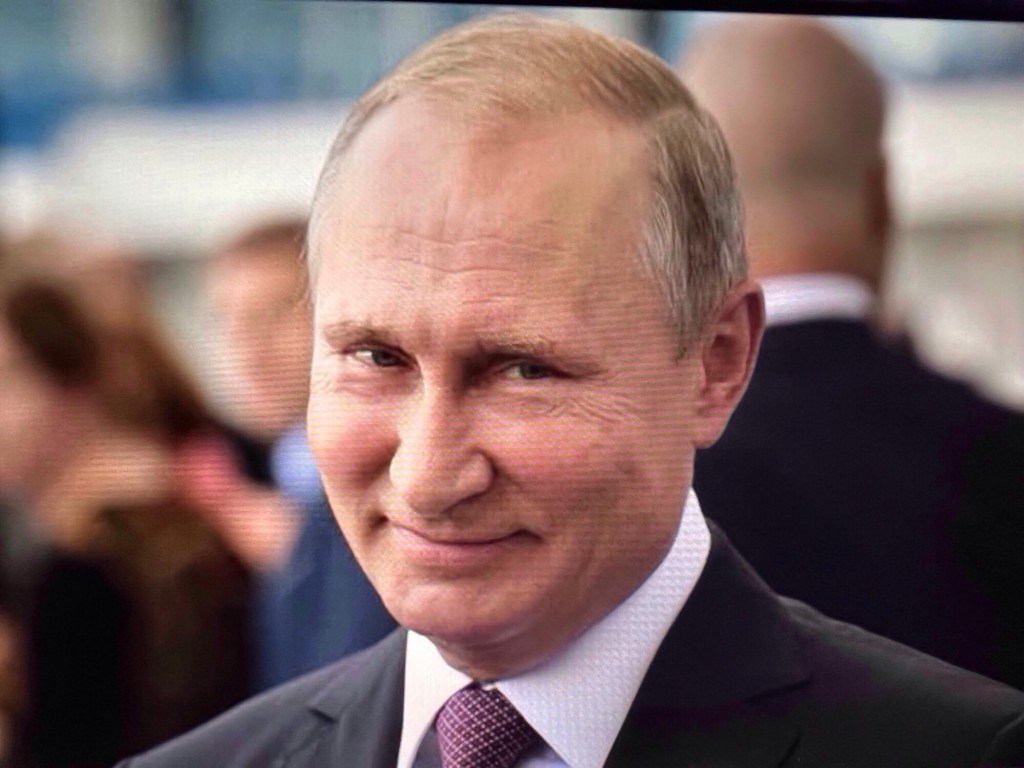
Vladimir Putin: The “Escalator”

The Russian government’s Rossiyskaya Gazeta newspaper said on its website on Monday morning that “Departing US president Joe Biden … has taken one of the most provocative, uncalculated decisions of his administration, which risks catastrophic consequences.” [Steve Rosenberg, BBC News, November 18, 2024.]

Member of the Russian Parliament Leonid Slutsky said that the U.S. decision would “inevitably lead to a serious escalation, threatening serious consequences.” [Id.]

And, taking it a step further, Russian Senator Vladimir Dzhabarov called it “an unprecedented step towards World War Three.” [Id.]

On a less threatening note, the pro-Kremlin Komsomolskaya Pravda labeled it a “predictable escalation.” [Id.]

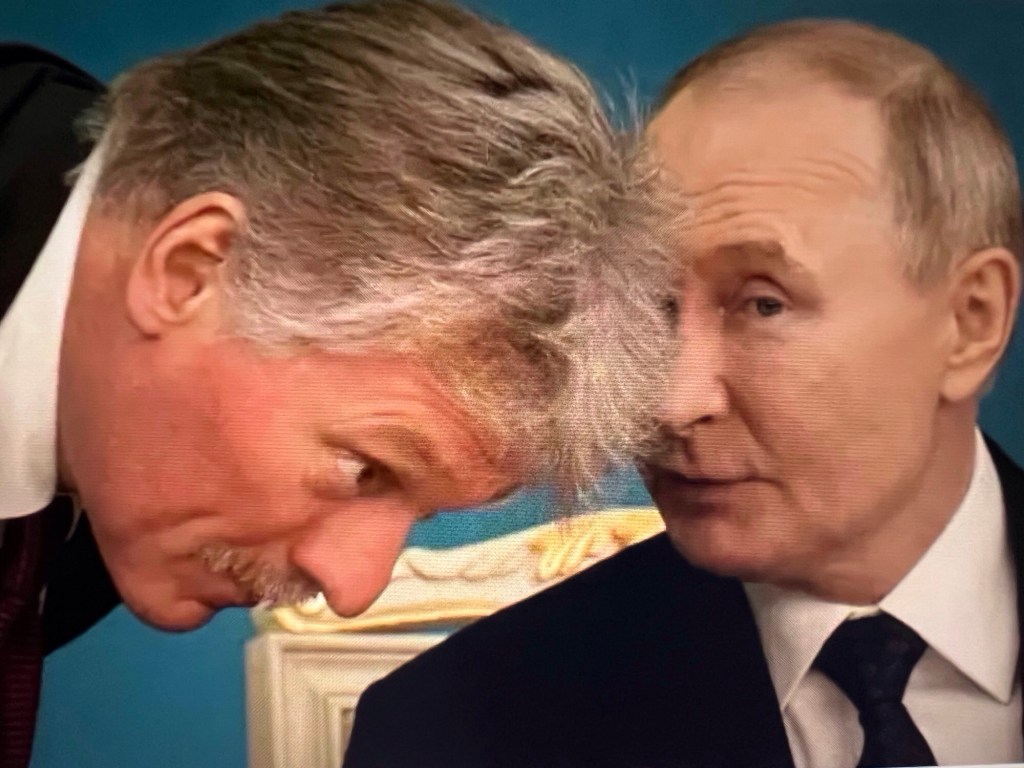
And then we heard from Kremlin spokesman Dmitry Peskov, who told journalists:

“. . . if such a decision has been taken it means a whole new spiral of tension and a whole new situation with regard to US involvement in this conflict,” and accused the current U.S. administration of “adding fuel to the fire and continuing to stoke tension around this conflict.” [Id.]

Dmitry Peskov, with Vladimir Putin

As always, Mr. Peskov manages to overlook a few facts, such as:

  • Who started the war (a.k.a. “Special Military Operation”) in 2022? — That would be Vladimir Putin.
  • Who, for nearly three years, has systematically targeted the infrastructure and civilian areas of a sovereign nation that was not bothering anyone, causing hundreds of thousands of combined civilian and military casualties? — That, again, would be Putin.
  • Who has brought in foreign military troops to support its own, as well as mercenaries and former prisoners convicted of the most violent crimes? — You’ve got it: Putin.
  • But who screams bloody murder when Ukraine receives support from its allies? — That wouldn’t be Putin, would it? Well . . . yes, it would.
  • And who cries like a baby when their victim, Ukraine, dares to strike back on Russian territory? — Oh, please! Do I really have to answer this one?


But never mind the war of words. What might Russia actually do as a result of this new development? Reading Vladimir Putin’s mind is a guessing-game at best. But back in June, when asked by journalists what he might do if Ukraine were given the ability to hit targets on Russian soil with weapons supplied by Europe, this is what he replied:

“First, we will, of course, improve our air defence systems. We will be destroying their missiles. Second, we believe that if someone is thinking it is possible to supply such weapons to a war zone to strike our territory and create problems for us, why can’t we supply our weapons of the same class to those regions around the world where they will target sensitive facilities of the countries that are doing this to Russia?” [Id.]

That’s fairly straightforward, wouldn’t you say?

And more recently, Putin’s ally, Belarusian President Aleksandr Lukashenko, had this to say to BBC’s Steve Rosenberg:

“I warned them [Western officials]. ‘Guys, be careful with those long-range missiles.’

“The Houthi [rebels] might come to Putin and ask for coastal weapons systems that can carry out terrifying strikes on ships. And if he gets his revenge on you for supplying long-range weapons to [President] Zelensky by supplying the Houthis with the Bastion missile system? What happens if an aircraft carrier is hit? A British or American one. What then?”

[Id.]

Aleksandr Lukashenko

Chilling words. Is it any wonder, then, that Poland has established a NATO-integrated missile defense base in its northern regions? Or that Sweden and Finland are giving their citizens instructions on “how to survive a war”?

*. *. *

But there is another factor to consider in attempting to assess Vladimir Putin’s state of mind: the Trump Factor.

Joe Biden has just another two months to serve as President of the United States. He has been stalwart in his support of Ukraine; and Vladimir Putin knows — in fact, the whole world knows — that Donald Trump is far less . . . shall we say . . . enthusiastic about continuing that support.

BFFs at Helsinki, 2018: We still don’t know what was privately discussed.

My money is on Putin simply waiting out the next two months, relying on his ability — whether real or perceived — to manipulate Trump in ways that he has been unable to do with President Biden.

If I’m right, it wouldn’t be the best-case scenario for Ukraine — though it’s certainly not as terrifying as the prospect of World War III.

But then, nothing is. And Vladimir Putin knows it.

Just sayin’ . . .

Brendochka
11/19/24

11/18/24: A Velvet Revolution, and a Golden Summer – Part I

I missed commemorating the anniversary by a day; but 35 years ago yesterday — November 17, 1989 — a revolution began in Czechoslovakia that was so non-violent it was later dubbed the “Velvet Revolution.” It began with a gathering of people in Prague’s Wenceslas Square. The crowd size on the 19th was estimated at 200,000, and by the next day had grown to a massive assembly of around half a million people.

Vaclav Namesti (Wenceslas Square), Prague – November 1989

By November 24th, the entire top party leadership had resigned; on the 27th, a two-hour general strike by all of the citizens of Czechoslovakia was held.

And when it was over, on November 28th, the people of Czechoslovakia had overthrown the 41-year, Moscow-backed Communist Party rule, and the march toward democracy had begun.

Eighteen months later, I was given the golden opportunity to live and work in Prague for a few months, in the newly opened office of the American law firm in which I was working. Being reasonably intelligent, and up for a little adventure, I hesitated for about three seconds. That night, I started packing.

This is the story (in two parts) of that idyllic summer of 1991 in one of the most beautiful, historic, quirky cities in all of Europe: of the people (and dogs) I met, the things I learned, the laughs I had, and the sheer joy of stretching the boundaries of my life. If you’ve read my original posting, you’re certainly welcome to skip the rest; but if you haven’t, then I invite you to read on and spend a little magical time with me in Zlata Praha: Golden Prague.

*. *. *

In 1991, I was working in the Washington office of the Squire Sanders law firm, and feeling bored with my life in general, when a bit of manna from Heaven fell into my lap. Two of the partners — one from the home office in Cleveland — were discussing the firm’s foreign offices. I said, half jokingly, that if there was any thought being given to opening an office in Moscow, I’d like to volunteer. The Cleveland partner said there was not, but that they had a new branch in Prague in need of someone who could organize the office and help to train the Czech staff. He asked if I would be interested, and — assuming he was also kidding — I laughingly replied that I could be packed and ready in an hour.

Never assume anything.

A few short weeks later, I found myself, and my six pieces of seriously overweight luggage, on a plane to the historic capital of Czechoslovakia, where I knew absolutely no one. I also did not know the Czech language, but I had studied Russian, and since they’re both Slavic languages, I figured it couldn’t be that hard, right? This was going to be great!

Old Town Square, Prague

When my overnight flight landed at Prague, I found a very pleasant-looking young man named Rudy holding a sign with my name, and I met my first friend in my new home. On the ride from the airport, I discovered why Prague is called the Golden City: the name refers to the golden spires of its abundance of churches, the estimated number ranging anywhere from 100 to 1,000, depending on which travel guide you’re reading. Rudy drove me first to the apartment the firm had rented for me, about a kilometer from the office; dropped off my luggage; and then headed straight for the office along a very direct route that would clearly be an easy walk for me the next morning, and every day after that for the next three months.

I could not have arrived in Prague at a better time. It was May of yet another “Prague Spring.” But this time it was not about an anti-communist revolt as it had been when the Soviet Union invaded in 1968; it was, conversely, all about celebrating the departure of the last of the occupying Soviet troops that very week. Independence had at last returned to Czechoslovakia, and to the rest of Eastern Europe, after the fall of the Berlin Wall a year and a half earlier; and Prague had not stopped partying since.

My apartment was on the second floor of a generic Soviet-style building near the foot of a ridiculously steep hill. The hallway light operated on a timer and had to be switched on each time I entered the building or left my apartment, if I didn’t want to be groping around in the dark. The apartment itself had a fairly large bedroom, and a small living room, where there was a wardrobe with a man’s clothes still hanging in it. (I never did find out who they belonged to, and no one ever came to claim them.) There was also a tiny bathroom where the hot water ran reddish-brown for several minutes before clearing enough for a quick shower. A sit-down bath was out of the question. The kitchen contained a working refrigerator, stovetop and sink; but I never learned to use the oven, which showed temperatures in centigrade, or the Russian-made microwave, which I was sure would zap me with some sort of deadly rays if I dared try.

My Old Neighborhood in Prague

But none of that mattered, as I only slept, showered and changed clothes there. The rest of my time was spent at the office, followed by dinner every evening with one or more of my co-workers at any of the many outstanding restaurants the city had to offer, and sightseeing all weekend, every weekend. I quickly got into the habit of stopping on my way to work in the morning at a bakery near my apartment for fresh bread and pastries to share with all of my new colleagues, and Rudy brought in our daily supply of deli meats and cheeses for lunch.

On my first walk to work, I also discovered that I had seemingly been transported to Dorothy’s Emerald City. At the top of my hill was a store with a large sign that appeared from a distance to read “OZ.” Of course, my curiosity led me directly to it, and as I came closer, I found that those letters were — not the end of the yellow brick road — but the initials of the words “ovoshchi” and “zelenina.” Optimistically thinking that there must be a measure of similarity between the two Slavic languages, I tried to use my limited Russian skills to translate. In Russian, “ovoshchi” means vegetables, so that one was easy — or so I thought. But “zelenina” was a bit of a puzzle. I reasoned that it had to come from the root word for “green,” which in Russian is “zelyoni.” So, OZ seemed to stand for vegetables and . . . what? green things? — which obviously made no sense whatsoever. OZ was a produce store, all right, but it turned out that a Russian vegetable translated to a Czech fruit, and the “green things” were the veggies. My first foray into this new language was a complete bust, and it never did get much better. But I arrived at work that morning with a bag full of delicious fruit and green things.

The next day I got to the office to find that there was great excitement among all the employees, who included the aforementioned Rudy (our driver and jack-of-all-trades); another young man named Roman (our second driver and office courier); three very attractive, blonde young ladies all named Jana; Beata, who was a multi-lingual American paralegal of Czech birth; and a Czech-American attorney named Milan. It seemed that Rudy — a man of many talents, as it turned out — had scored a handful of tickets for a concert coming up the following weekend at the local football — soccer, to us Americans — stadium to celebrate the Russian exodus. The performer was none other than Paul Simon, of Simon & Garfunkel fame; and there was a ticket for me. And I’d only had to travel 4,300 miles to get there!

“Like a bridge over troubled water . . .”

As if that weren’t enough, when we arrived at the packed stadium on Saturday evening, we discovered that an even greater star was in attendance: President Vaclav Havel, the hero of the newly freed, democratic Czechoslovakia. We were able to see him from our seats, and the excitement was palpable throughout the crowd. Welcome to Prague, Brenda. This was just the first week, and I had spent it with an American music icon, the President of Czechoslovakia, and a whole bunch of welcoming strangers, most of whose females seemed to be named Jana.

Vaclav Havel, Hero of the Velvet Revolution

But Paul Simon wasn’t the only act in town. It happened that 1991 also marked the bicentennial anniversary of the death of one Wolfgang Amadeus Mozart, and throughout Europe his genius was being celebrated ad nauseum, all summer long. And I couldn’t get enough of it. Dragging various people along with me, I must have gone to a half dozen concerts. My favorites were held in a small theater on the banks of the Vltava River, and were called — if I remember correctly — “Mostly Mozart.” To the beautifully performed melodies and lyrics of the operatic arias (in the originally written languages), satirical plays were presented by the singers onstage that were absolutely hilarious; and somehow, the interplay of comedy and Mozart’s masterpieces just worked. “Wolfie” may have been turning over in his grave, but I loved it . . . and so, apparently, did the rest of Prague.

*. *. *

As for any spoken language barrier, I soon learned that everyone in the country had been required to study Russian during the Soviet occupation, but that most Czechs refused to speak it any longer, for obvious reasons. Along with their other freedoms, they were thrilled to have their native language back. But when I rode in a taxi or shopped in a local store, the conversation would usually go something like this:

Me (in Czech): “Dobry den” (“Good day”). Then, in English: “Do you speak English?”

Them (in German): “No. Do you speak German?” (It seemed they’d forgiven the Germans for the long-ago Nazi occupation, but the Russians . . . not so much.)

Me: “Nein.” (One of the dozen or so words I know in German, two of the others being Schweinehund and Dummkopf. You see how my mind works?)

Me (continuing, this time in Russian): “Maybe you speak Russian?”

Them (in Czech, and suddenly stiffening as though someone had shoved a pole up their butt): “No! No Russian!”

Me (still in Russian, and very apologetically): “Sorry. I’m American, and I only speak English and a little Russian. Can you understand me?”

Them (still in Czech, but now visibly relaxing): “Oh, American! Good! Welcome! Yes, I understand a little Russian.”

Problem solved. They would continue to speak in Czech, very slowly and with a lot of gestures; and I would respond in Russian, the same way. And somehow, we managed to communicate. Through the weeks, as I picked up some words and phrases in Czech, I would use a mixture of the two languages. Every cab driver in Prague came to know me and where I lived and worked — there weren’t a lot of American expats in Prague at the time, and a redheaded American woman who spoke to them in Russian was memorable. Being a good tipper didn’t hurt either.

*. *. *

Personal note: I hate beer. In my opinion, it’s bitter, it’s bloating, it smells bad, and it leaves a bad aftertaste. (I feel the same way about coffee, except for the bloating part). If that makes me weird, so be it. But the folks in Prague weren’t ready to accept that, and kept trying to convince me that their renowned Czech beer, Pilsner, was different and so much better. So one evening, when we were all out partying after work (not an unusual occurrence), I agreed to take a sip from Jana’s (it doesn’t matter which Jana’s) glass — and almost did a vaudeville-style spit-take. I’m sorry, but beer is beer, and I can’t tell a good brewski from a bad one. And I said so, as gently as possible. But I don’t think they ever forgave me for that.

“Sorry, it’s . . . beer.”

I did, however, discover a local drink that I loved, and still keep in my freezer to this day, right next to the Stolichnaya vodka. It’s called Becherovka, and is a clear, herbal, after-dinner liqueur, to which I was introduced one evening at dinner when I happened to mention that my feet were killing me from all the sight-seeing along the cobblestoned streets of Prague. On their promise that it would relieve my pain, I tried a shot before dinner. And a second. It was uniquely refreshing, and couldn’t possibly do any harm — after all, it was herbal, wasn’t it? Well, after those two shots, and another one after dinner, absolutely nothing hurt. In fact, although I swore I was not the least bit lightheaded, I couldn’t feel my feet at all. Luckily, I wasn’t doing the driving. So who needs opioids — or even ibuprofen — when you’ve got Becherovka? I do limit myself these days to one or two small shots, but it’s still my pain-killer of choice. (BTW, it can be ordered online, if you’re interested, and over 21.)

Herbal Pain Killer

Then there was the night I met the Dobermans. No, not the nice Jewish couple next door; these two were from upstairs. When I got out of the taxi in front of my building after dinner one evening, there was a small group of men standing nearby, just talking and enjoying the mild summer air. One of them called out to me, but he was speaking Czech and I couldn’t understand him. Thinking they were just being neighborly, I gave them a friendly wave as I opened the door to my building . . . and was confronted in the dark hallway by two humongous, solid black, barking, drooling, straining-at-the-leash Doberman Pinschers, ears up and tails down, obviously looking for someone to kill. Someone like me. Startled out of my wits, I let loose with a primal scream . . . the dogs’ owner screamed in response . . . the dogs barked louder . . . and all the while the men on the street were roaring with laughter. That was what they had been trying to tell me: look out for the dogs, who had just come back from their evening walkies. And when my neighbor and I finally stopped screaming, we joined the others in laughing at ourselves. The dogs — who lived directly above me — turned out to be sweethearts, once they got to know me, and their owner was also quite friendly; though I would have preferred to meet them some other way — any other way.

The Dobermans

Dogs are treasured as pets in Europe, just as they are here. And that included the dog belonging to the Czech Foreign Minister.

We had an American attorney working with us — a bright but spoiled young woman from a well-to-do family, who never quite adapted to the easy-breezy way of life in Prague. Our law firm had been retained by the new Czech government to advise and assist in formulating a new constitution and legal framework, and she — we’ll call her Valerie — had been assigned a desk at the Foreign Ministry where she worked pretty much full-time. As a convenience, she brought her lunch to work every day and kept it in the Ministry’s refrigerator, as did many others.

Now, I have to insert here that Valerie was, shall we say, less than popular with the Ministry staff. She had way too much Attitude. On the day in question, the Foreign Minister was leaving town on government business, and had brought along his beloved dog — a terrier, I believe — to hand over to a friend who was going to care for the pooch during his master’s absence. The Minister parked in his usual spot in front of the building, opened the driver’s-side car door, and before he could turn around, his dog ran out into the street — and directly into the path of an oncoming vehicle. The poor baby was killed instantly as his owner watched, helpless.

Needless to say, the Minister was devastated, but was unable to cancel or postpone his official trip at the last moment. So he had to make some hasty arrangement for his dog until a funeral could be planned for the following week. And this being Prague, the solution turned out to be . . . well . . . unique.

When Valerie arrived for work a little later that morning, no one took the trouble to warn her that anything was amiss. She went directly to the kitchen to put her lunch into the refrigerator, and had one item that needed to be kept frozen. So she opened the freezer door . . . and let out a SHRIEK that must have been heard in Belgium. Because in the freezer — staring sightlessly out at her, arms and legs akimbo, a silvery frost already forming on his fur and his little black nose and protruding pink tongue — was the Minister’s dog. The Minister’s dead dog. Sad . . . stiff . . . broken . . . bloody . . . undeniably, irretrievably dead doggie . . . without so much as a blanket or a newspaper to cover his sorrowful condition. And the shrieking continued, while all around her, Valerie’s co-workers were laughing their asses off. Not at the dog, of course, but at her. They really didn’t like her.

NOT the Minister’s Dog, Just a Cool Facsimile

You will be relieved to know, incidentally, that that unfortunate, cryogenically-preserved canine received what was reportedly a lovely burial the following week in the Minister’s home town, alongside all of his previous pets. I assume he was thawed first. The dog, not the Minister. Requiescat in pace — R.I.P., little pup.

Prague seemed intent on getting back at Valerie for not being happy there. Sometime during the summer, we suffered a city-wide power failure for nearly an entire day. As the locals were fond of saying, “Oh, well . . . that’s Prague.” While the rest of us enjoyed a lunch at a nearby restaurant, consisting of cold cuts and fresh vegetables, with potatoes cooked slowly over a huge collection of candles (Czech ingenuity at its finest), Valerie was stuck in the elevator at the Ministry. Stranded alone in the car, she again displayed her usual aplomb in times of crisis: she screamed, pounded the elevator door, screamed some more, repeatedly pushed the buttons to all the floors . . . and continued to scream for someone to get her the %#*#& out of there. When stressed, it seemed her upper-class upbringing went directly down the drain. She was, of course, ultimately rescued. But no one was in the least surprised — or in the least saddened — when she finally was granted a transfer back to the States.

*. *. *

Valerie may have considered Prague to be a living theatre of the absurd; but to me it was an endless tapestry of humanity at its best, and life as it is meant to be lived: freely, joyously, and always hopefully.

There is so much more to tell about that summer in Prague — water shut-offs, Gypsies, German tourists, rotisserie chickens, a Catholic priest, Chanukah candles, and more — so I’ll have to make this a two-part chapter. See you next time for the rest of the story.

TTFN,
Brendochka
2/23/23 (re-posted 11/21/23 and 11/18/24)

1/18/24: You Gotta Love This Lady


Meet Margret Chola, a fun-loving grandmother in her mid-80s from rural Zambia, whose granddaughter, Diana Kaumba, happens to be a stylist based in New York City.

Margret Chola, Fashionista
Classy Lady

In a spirited moment one day when Diana was in Zambia visiting her “Mbuya” (“grandmother,” in the local Bemba language), the two women began playing dress-up with some of Diana’s fashion creations. Seeing how fabulous Mbuya looked in the stylish outfits, Diana thought it would be fun to photograph her, on her farm outside of the capital city of Lusaka, and to post some of the pictures online.

Diana Kaumba and “Mbuya” Margret Chola

The first ten minutes after posting brought 1,000 or so likes, and today Margret Chola is known to the world as “Legendary Glamma,” with 225,000 Instagram followers. Of her new role, she says:

“I feel different, I feel new and alive in these clothes, in a way that I’ve never felt before. I feel like I can conquer the world!” [Penny Dale, BBC, November 15, 2024.]

With a Pearl-Loving Friend

Diana says she hopes their Granny Series will highlight that older people still have a lot to offer:

“Do not write them off, love them just the same till the end because remember we will be just like them one day.” [Id.]

A Girl Can’t Have Too Much Bling

Mbuya’s life has been a difficult one. But she urges people to “live their lives and not worry about being judged by society.” She says you can “always forgive yourself for whatever mistakes you made. You can never change your past — but you can change your future. . . . I’m now able to wake up with a purpose knowing that people around the world love to see me.” [Id.]

Wearing the Zambian National Colors

This beautiful, vibrant, spunky lady is my new role model. Keep it going, Mbuya.

Just sayin’ . . .

Brendochka
11/18/24

[Photos from CNN, 11/15/24]

11/18/24: Instead of Negotiation . . . Escalation


A Rough Chronology of Events:

February 24, 2022: Vladimir Putin’s Russian military forces invade Ukraine. Putin predicts total surrender within days, or weeks at the most. He seriously underestimates Ukraine’s strength and the response of the international community.


Today: The war in Ukraine is still raging. Estimated casualties on both sides thus far: somewhere in the neighborhood of half a million, though exact figures are impossible to obtain due to Russia’s refusal to release accurate statistics.

In the Interim: Crippling sanctions have been placed on Russia and many of its top officials and oligarchs. The International Criminal Court has issued a worldwide warrant for the arrest of Vladimir Putin for war crimes involving the forcible removal of Ukrainian children from their homeland, thus isolating him and making it impossible for him to travel to all but a few countries throughout the world.

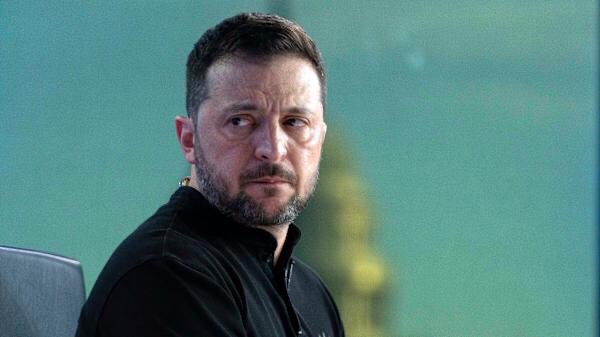
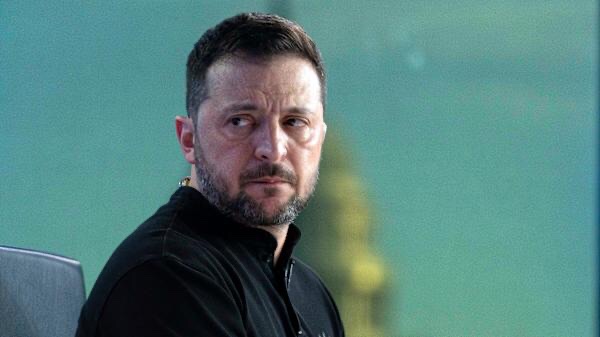
Putin has repeatedly said that he wishes to negotiate an end to the hostilities . . . though, of course, only on his terms, which include his keeping all Ukrainian territory he has thus far managed to occupy, as well as guarantees that Ukraine will never be allowed to join NATO. Ukrainian President Volodymyr Zelensky says, in effect, “When hell freezes over.”

Ukrainian President Volodymyr Zelensky

November 13, 2024: Poland and the U.S. inaugurate a NATO missile defense base in Northern Poland, integrating it into NATO’s defenses. As expected, Russia’s Kremlin spokesman, Dmitry Peskov, responds:

“. . . And, of course, this leads to the adoption of appropriate measures to ensure parity.”

November 15, 2024: Putin reaches out to German Chancellor Olaf Scholz, expressing Russia’s readiness to look at energy deals if Berlin is also interested. This is widely viewed as a desire on Putin’s part to begin wriggling out of the aforementioned sanctions.

German Chancellor Olaf Scholz

November 17, 2024 (Ukraine time): Russia launches one of its largest air strikes on Ukraine, principally on its energy infrastructure and other civilian sites in cities throughout the country. Is this blatant escalation of hostilities what the Kremlin deems to be “appropriate measures”?

In an understandable display of defensive readiness, neighboring Poland scrambles its fighter jets.

Polish F-16s

November 17, 2024 (U.S. Eastern time): American President Joe Biden gives the go-ahead for Ukraine to use long-range missiles supplied by the U.S. to strike farther inside Russia — permission long sought by Ukraine but heretofore held back for fear of escalation.

A Very Grateful President Zelensky, With President Biden

*. *. *

It is now just past midnight on November 18th. This started two years and nearly nine months ago. It’s not likely to end overnight tonight, so I presume there will be follow-up later today. I can hardly wait.

Just sayin’ . . .

Brendochka
11/18/24

11/17/24: Putin’s Hostages: Bring Them Home, Week 45: A Different Message


This week’s tribute to the hostages takes us to Berlin, Germany, where Yulia Navalnaya, the widow of Alexei Navalny, along with former hostages Vladimir Kara-Murza and Ilya Yashin, and about 2,000 Russian exiles and sympathizers marched to the Russian Embassy to protest the war against Ukraine, to demand the release of Russia’s political prisoners, and to urge the ouster of Vladimir Putin and his trial as a war criminal. [RFE/RL, November 17, 2024.]

(L-R) Vladimir Kara-Murza, Yulia Navalnaya, Ilya Yashin

Shouting “Russia without Putin” and “No to war,” the crowd marched peacefully behind the three opposition leaders from Potsdamer Platz to the Brandenburg Gate in central Berlin. Addressing the crowd, Yashin said, “Putin is not Russia. Russia is us. And we are against the war.”

In a statement released prior to the march, the organizers told the world:

“The march aims to unite everyone who stands against Vladimir Putin’s aggressive war in Ukraine and political repressions in Russia.” [Id.]

Yet the protest had its detractors, including the Ukrainian Ambassador to Germany, Oleksiy Makeev, who said it was a “walk without dignity and without consequences,” and that it merely displayed the opposition group’s “weakness.” In the Zeit newspaper, he had also written that the three — Navalnaya, Kara-Murza and Yashin — were not doing enough to support Ukraine, and that they should be urging their fellow Russian citizens to protest in Russia.

Perhaps Ambassador Makeev has a point. But has he considered the futility and the dangers of staging even the smallest, most peaceful protest in Russia? It’s easy for him to speak from the safety of Berlin, but he should first recall the fate of Alexei Navalny and others who fought against the odds . . . and lost their lives.

Alexei Navalny

I see today’s march as a tribute to those who have made that effort and are still paying for it. And to those non-Russians who sit beside them in prison as political pawns of Vladimir Putin, waiting for their turn to be traded and sent home.

Sometimes the fight against tyranny has to begin outside the palace walls . . . or, in this case, outside the country’s borders.

Just sayin’ . . .

Brendochka
11/17/24

11/17/24: Teasing Dmitry . . . No More

For anyone who reads me with any amount of regularity, it should be obvious that the Dmitry of whom I speak is none other than Dmitry Sergeevich Peskov, Press Secretary / spokesman for the Moscow Kremlin, and thus also for Russian President Vladimir Putin.

And for those of you who don’t know, here he is:

Dmitry “Dima” Peskov

He is a man with an obviously stressful job, which he has held for the past sixteen years. And that means he must be damned good at what he does — and he’d better be.

An East German government representative misspoke once in 1989; and in doing so, he unintentionally brought down — not only the Berlin Wall — but, as a domino-effect consequence, also the entire Soviet occupation of Eastern Europe and, just two years later, the Soviet Union itself.

So the person speaking for the Kremlin today would, at all costs, want to avoid making that sort of faux pas.

It is Dmitry’s unimaginable responsibility to know everything that is going on everywhere in the world at all times, how it affects Russia’s interests, what his boss (Putin) thinks about it, and how best to spin it to Russia’s advantage. Unfortunately, that often requires him to prevaricate, obfuscate, dissemble, equivocate . . . well, let’s face it: outright lie . . . with a perfectly straight face.

But let’s look at that face. It’s pleasant, intelligent, attractive, charming — evocative of a loving father or grandfather. His smile looks genuine, and there’s even a hint of a twinkle in the eyes. If you met him at a social gathering, you’d probably like him.

So it has for some time bothered me to think that he really, truly, honestly believes the bullshit he is required to spew at the world on a daily basis on behalf of the evil man he calls “boss.”

The Boss: Vladimir Putin

And because, in my mind, Dima — I have taken the liberty of addressing him by his nickname — Peskov does not appear to fit his professional image, I have tried to think of him as a normal person, and one with the sort of quirky sense of humor that invites teasing in return. And I’ve had fun with that.

Until today, when I Googled his name to check his patronymic (middle name) for this post, and stumbled across an item on the website of the U.S. Department of State (DOS) titled, “Faces of Kremlin Propaganda: Dmitri Peskov.”

Of course, I have always known, and not all that deep down inside, that Dima — the real Dima — could not have been faking it all these years and gotten away with it; and that he couldn’t have risen to his present position without sincerely believing in the guy who signs his paycheck. But seeing it in print, from an official source . . . well, it’s taken all the fun out of the teasing.

For example, the State Department says:

“In this capacity [as Putin’s spokesperson since 2008], he has played a key role in propaganda and disinformation campaigns to cover up the Kremlin’s links to the 2006 polonium poisoning of former Russian intelligence officer Alexander Litvinenko, the 2018 Novichok poisoning of former Russian military intelligence officer Sergei Skirpal [sic] and his daughter Yulia, and the 2020 Novichok poisoning of Russian opposition leader Alexei Navalny. In all these cases, official and independent sources have debunked the Kremlin’s disinformation and established the Kremlin’s direct responsibility. Serving Putin has been lucrative for Peskov, and despite being a civil servant for his entire career, he and his family are now multimillionaires.” [state.gov]

Well, it didn’t say he personally poisoned them; he was just an accessory after the fact. But still . . . Dima . . . how could you?

As for the “multimillionaires” reference, I followed the State Department’s link and learned that Dima, his wife and two adult children have been living the high life, far above his salary range, for many years, and are now among those sanctioned by the United States since the invasion of Ukraine by Russia in 2022. Under the circumstances, I think that’s fair; but I do hope they have enough left for rent, groceries, and a clothing allowance, because the little woman looks pretty high-maintenance to me.

Date Night With the Missus

*. *. *

And speaking of Ukraine . . . Oh, my God! This is what DOS has to say:

“Before Putin launched his unprovoked and brutal war of choice against Ukraine, Peskov repeatedly denied Russia had any intentions to invade its neighbor. He falsely asserted that Russia did not pose a threat to Ukraine, that Russia had never attacked any other nation, and that Russia would be the ‘last country in Europe’ to think about starting a war. Attempting to discredit Western media reports that exposed the Kremlin’s invasion preparations, Peskov called them ‘provocations,’ and ‘unfounded fomenting of tension,’ ‘Western hysteria,’ ‘irresponsible fakes,’ and ‘maniacal information insanity.’ Russia’s war in Ukraine validated the media reports and undermined Peskov’s credibility.” [state.gov]

Do you see what I mean about his sense of humor? “The last country in Europe to think about starting a war”??!!! Does he write his own material?

But reading on:

About the reports of atrocities committed by the Russian forces in Ukraine, Peskov repeated the Russian Defense Ministry’s statement that “not a single local resident suffered from any violent actions” under Russian occupation; said the accusations were ”groundless”; called the descriptions of the mass killings a “well-staged tragic show” and “a forgery in order to try to denigrate the Russian army”; and insisted that the killings were the “result of a staged falsification.” [state.gov]

By which time, I was no longer laughing, but was feeling pretty much like this:


*. *. *

Well, as you can imagine, Dmitry Sergeevich Peskov doesn’t seem so normal, or so likable, or so tease-able, any longer. He’s just another one of Putin’s henchmen, fully invested in the dictator’s mad ambition to take over the world by any means available. I’ve known it all along, of course — just not in such agonizing detail.

What’s really upsetting, though, is that now I have to find someone new and amusing to pick on . . . and in Putin’s inner circle, that’s not easy.


Sorry, Dima . . . I have to honor my country’s sanctions. But it’s been fun while it lasted.

See you in the news, kiddo.

До свидания,

Brendochka
11/17/24

(Footnote: I wonder what kind of sense of humor Foreign Minister Sergey Lavrov (right rear, above) has. But wait . . . he’s been sanctioned too. Damn! Can’t have any fun with these freakin’ Russians anymore.)

11/17/24: What Do I Want For Christmas?

Other than world peace, a clean environment, and cures for all sorts of terrible diseases, you mean?

The awful truth is . . . I haven’t the foggiest notion.

This is what happens when you get older, you no longer go to work every day, and your social life slows down to approximately the speed of one of those ancient Galapagos tortoises. You have more jewelry than you will ever again wear; those beautiful leather handbags you used to covet are now too heavy to lift, even empty; and your stack of “to-be-read” books has already toppled over onto the cat twice.

(She’s all right, but she still runs screaming from the room every time I pick up a book.)

I’ve been collecting art glass and Native American pieces for so many years, there is no bare space for any more. And I’m sick to death of dusting them anyway. Actually thinking of having a yard sale one of these days.

The same goes for kitchen stuff and small appliances. Besides, who cooks?

And if you’re thinking a nice fluffy robe or throw would be just the ticket for those cold winter nights, everybody else is way ahead of you — I’ve got so many, I’ll have to donate some to the local shelter.

Though some nice red wine (Merlot is perfect) would help me stay good and warm.

That fruit-of-the-month thing you sent a couple of years ago was lovely, but that was before my digestive system went all kerflooey, so probably not a good idea now. IBS is really a bitch.

And I still have enough of last birthday’s body lotion gift set left to de-wrinkle an elephant.

I am running out of toenail fungus cream, though.

And speaking of animals . . . no, I don’t need a puppy for company, thank you. You know I love them, but they have to be walked at all hours, and I can barely get myself to the bathroom on time these days.

I did used to love the day spa with the massage. But I caught a look at myself in the bathroom mirror the other day. Nobody sees me naked anymore. Understand? Nobody!

Anyway, I guess you’ve gotten the picture by now. There are a few basic necessities you might consider — not very sexy, but it would save the Amazon delivery people a couple of trips, and me a good bit of money. Things like toilet paper, vitamins, and laundry detergent (those cute little pods because the jugs of liquid are also too fuckin’ heavy to lift anymore).

Of course, there’s always a gift certificate from my therapist’s office. Medicare doesn’t cover everything, you know.

Well, I do hope this has been helpful. And thanks ever so much for thinking of me.

Brendochka

11/17/24

11/17/24: Denunciations Я Us


I’m sure it’s of little consolation to Nadezhda Buyanova, but she is not alone.

Dr. Nadezhda Buyanova

Dr. Buyanova is the 68-year-old Russian pediatrician who has been sentenced to 5-1/2 years in a penal colony for allegedly “publicly spreading deliberately false information” about the Russian armed forces . . . based only on the testimony of an angry woman and supported solely by the word of the woman’s seven-year-old son, whom defense counsel was not permitted to question.

Defense attorney Oskar Cherdzhiyev believes the accuser, Anastasia Akinshina — whose husband was killed fighting in Ukraine — acted out of malice due to Dr. Buyanova’s Ukrainian heritage. In a video, Akinshina expresses her anger thus:

“So the question is: where can I complain about this bitch now, so that she’ll be kicked out of the fucking country or sent to the devil in jail?” [Mark Trevelyan, Reuters, November 15, 2024.]

Nice.

“Oh, my goodness!”

*. *. *

Whether or not Dr. Buyanova made the comments of which Akinshina accuses her — comments alleged to be opposed to Russia’s war against Ukraine — there is an even greater issue involved than the single case against this one citizen and the destruction of her 40-year medical career and the remainder of her life.

And that issue is the fact that this is not just a single case. It is one of a growing number of denunciations being made by neighbor against neighbor, friend against friend . . . and even family member against family member. And these denunciations — so terrifyingly reminiscent of the Stalin-era purges of more than half a century ago — are resulting in criminal prosecutions that are strictly politically motivated. And all have arisen since the beginning of Russia’s invasion of Ukraine in February of 2022.

*. *. *

Since that time, according to Russian rights group OVD-Info, 21 such criminal cases have been brought based on unproven accusations by individuals. Eva Levenberg, a lawyer with OVD-Info residing in Germany, said that they knew of an additional 175 people facing lesser administrative charges for “discrediting” the Russian army — all based on the word of individual informants — 79 of which cases have resulted in substantial fines. [Id.]

(Note: Reuters reports that it has been unable to confirm the precise number of cases.)

The Russian Ministry of Justice has not responded to Reuters’ request for comment; and good old reliable Kremlin spokesman Dmitry Peskov said merely that “the Kremlin does not comment on court rulings.” [Id.]

But Russian President Vladimir Putin has had much to say, since the 2022 start of his “special military operation” in Ukraine, to encourage the Russian people to speak up against one another.

Stalin’s Ghost?

Declaring that Russia is in a “proxy war” with the West, he said that citizens need to help “root out internal enemies.” Just weeks after the invasion of Ukraine, he said that the Russian people:

“. . . will always be able to distinguish the true patriots from the scum and the traitors, and just spit them out like a gnat that accidentally flew into their mouths.” [Id.]

Well, there you are. If that isn’t an invitation to get busy snooping and accusing, then I don’t know what it is. It certainly is colorful.

And according to OVD-Info, since February of 2022 more than 20,000 people have been detained for making various anti-war statements or protests, with criminal cases filed against 1,094 of them. [Id.] Cases have even been noted of churchgoers denouncing priests, and students turning in their teachers.

It makes me wonder what has happened to the spirit of Putin’s “Year Of the Family,” and his declarations of the importance of “home, happiness and mutual support.”

Putin at the launch of the Year of the Family

Obviously, they were nothing but words. Empty, meaningless words.

As usual.

Just sayin’ . . .

Brendochka
11/17/24