Having a wonderful time reminiscing about all my past travel (and other) adventures. Hope you’ll share them with me in my blog, “All Roads Led to Russia.”
One, allegedly in charge of overseeing the entirety of our national intelligence; the other, supposedly listening to the person he himself chose for the position; and neither of them knowing what the hell they’re doing.
Tulsi Gabbard — after testifying that, according to her information and analysis, Iran was not building nuclear weapons despite having a stockpile of materials — suddenly has an epiphany and declares that Iran could indeed have a nuclear weapon after all . . . and “within months.” She attributes the turn-around to her earlier statement having been taken out of context by “dishonest media.” [Sofia Ferreira Santos, BBC News, June 21, 2025.]
Right. When caught in a lie, blame the media. Classic Trump.
Who, not coincidentally, had just said publicly that Gabbard’s initial statement was “wrong.” [Id.]
Well, of course she had to be wrong. Because if she had been right originally, then he wouldn’t have an excuse now to attack Iran for failing to accede to his demands . . . would he?
So there she is, looking like a deer caught in the headlights of an 18-wheeler, with the boss making faces at her from just a few feet away. What’s she supposed to do . . . tell the truth?
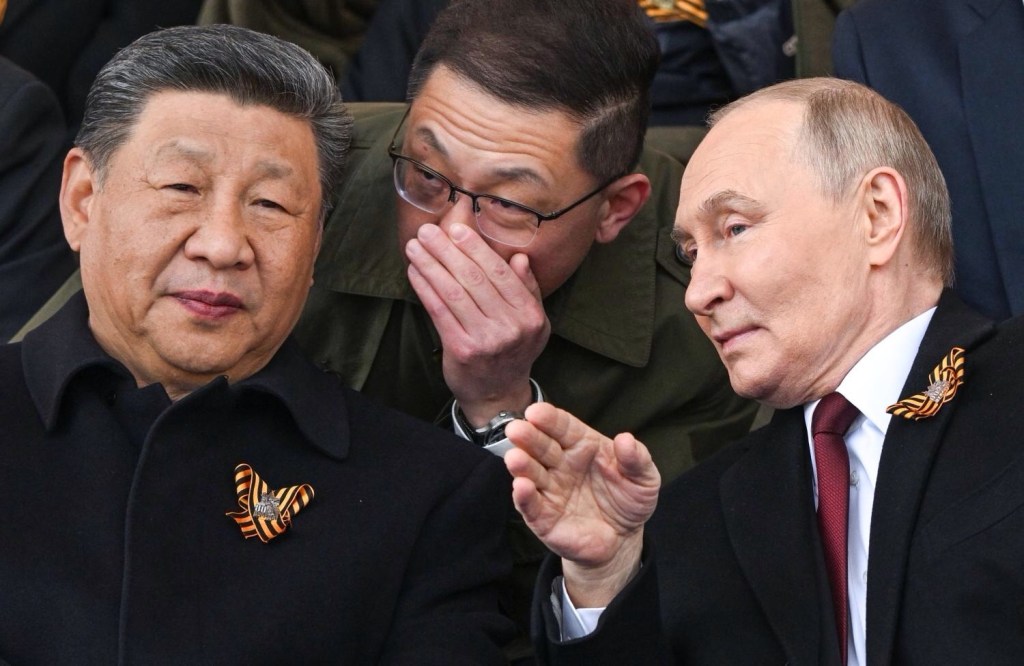
No, I’m not talking about Donald Trump and Elon Musk; that’s yesterday’s news. This is another on-again-off-again alliance, one that has been bouncing back and forth for decades. I’m talking about the USSR/Russia and China . . . or, in more current and personal terms, Vladimir Putin and Xi Jinping.
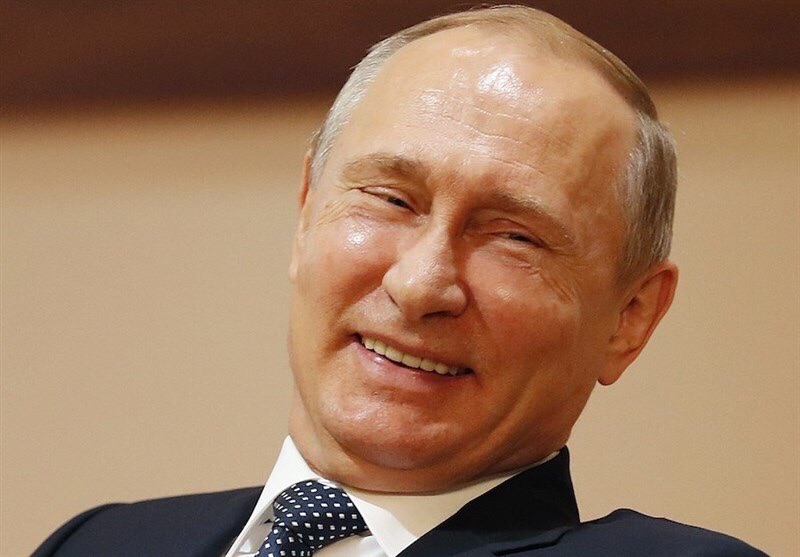
Sharing a Moment: Xi Jinping (L), Vladimir Putin (R), and an obviously amused interpreter
Formal diplomatic relations between the Soviet Union and China were established as far back as 1949. But in the early 1980s, relations between the two countries were at a low point. The United States had been working toward improved trade relations with China since Richard Nixon and Henry Kissinger’s historic visit to Beijing in 1972, making Moscow unhappy; the Soviet Union was continuing its support for Vietnam, and had amassed troops along the Sino-Soviet border, seriously irritating Beijing. The two countries’ leaders were virulently distrustful of one another.
And the joke going around my office was that I had just prevented World War III.
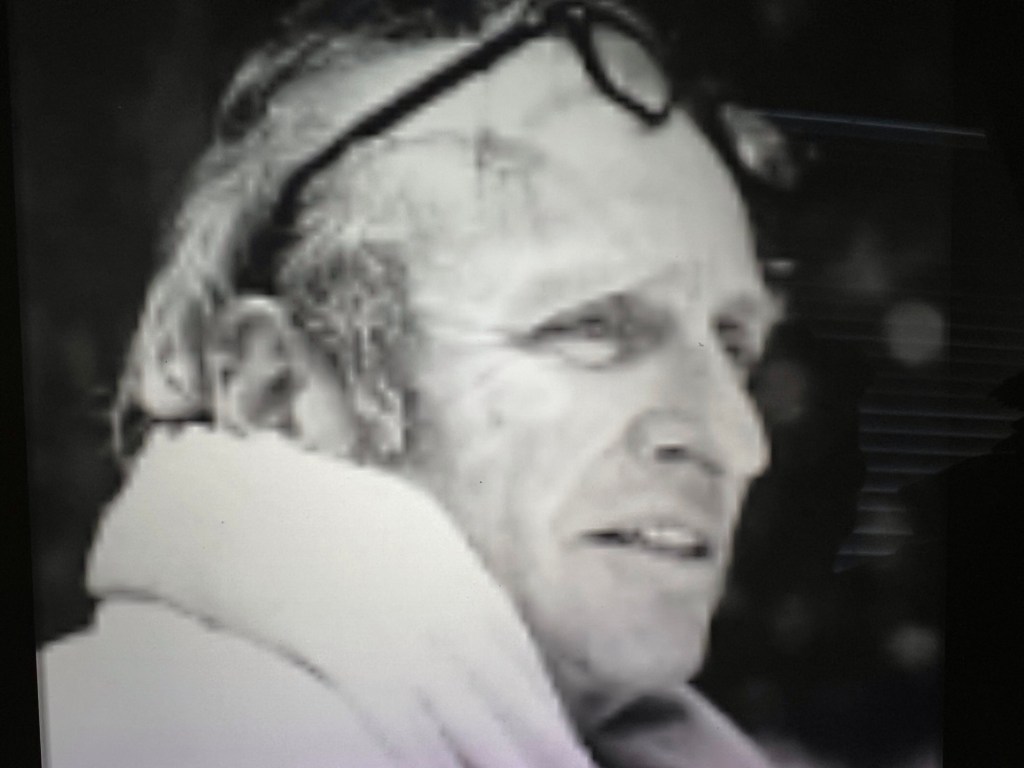
My boss at the time was Walter Sterling Surrey, a Washington attorney whose international practice involved corporate clients doing business throughout the world, including China and the Soviet Union. He was, in the earlier part of his career with the U.S. Department of State, the chief legal draftsman of both the Marshall Plan and the NATO Treaty. He had also later worked with Nixon and Kissinger in reestablishing relations with China. He was well connected.
Walter Sterling Surrey (1915-89)
So it was natural that we would have contacts in numerous embassies to facilitate negotiations of commercial transactions on behalf of our clients. And one day, it happened that back-to-back meetings were scheduled in our office, the first with an economic officer from the Soviet Embassy, and the second with a delegation from China. And we had timed them so that they wouldn’t overlap.
But then Murphy’s Law took over . . . you know, the one that says if anything can go wrong, it will. The Russian visitor, who was meeting with Walter in his office, stayed longer than we had anticipated, and the Chinese group arrived early. I knew we couldn’t let them see each other, but there was no way the Russian could leave without passing through the lobby where the Chinese visitors were waiting.
That was when I went into my Keystone Kops routine. First I rang Walter’s phone and whispered to him that his next appointment had arrived early, and that he should keep the Russian gentleman talking until I gave him the all-clear signal.
Keystone Kops
Next, I called one of the firm’s partners who also worked with Walter on matters involving China, told him of the predicament, and asked him to greet the Chinese, take them into a conference room, and keep them behind closed doors until I could scoot the Russian out of the building.
When he had done that, I knocked on Walter’s door, stuck my head inside, and said, “I’m sorry to interrupt, but you’re needed in the conference room.” The Russian diplomat took the hint, and I escorted him past the conference room, through the reception area, and into the elevator, while Walter went on to meet with the blissfully unsuspecting group waiting for him.
Crisis averted. Had their paths crossed, there would have been more than a little discomfort and embarrassment involved; it could have destroyed the trust our firm had built up over years with the embassies of both countries, and cost our clients millions of dollars in lost business opportunities . . . not to mention the possible loss of some of our firm’s biggest clients. Not literally World War III, of course; but to us and our clients, it would have felt like it.
*. *. *
Such was the state of Sino-Soviet relations in the early ‘80s. Since then, their governments have run hot-and-cold toward each other numerous times. And right now, in 2025, they’re mostly comfortably warm.
Together, Putin and Xi have aligned in an attempt to de-escalate the Israel-Iran conflict, and are calling for Trump to back off and not become involved on the side of Israel. In so doing, they are setting themselves out as the world’s foremost peacemakers, and as power brokers ready to step in where the U.S. has failed.
Ironically, the Kremlin has condemned Israel’s actions as a breach of the United Nations Charter and other standards of international law — typically ignoring Russia’s own ongoing invasion of Ukraine, which China steadfastly refuses to condemn. [Nectar Gan, CNN, June 20, 2025.]
Xi, on his part, has not specifically condemned Israel, but urged both Iran and Israel — “especially Israel” — to call a ceasefire as soon as possible. [Id.]
And in a message to Trump, Xi stressed that “major powers” having a special influence on the parties to the conflict should work to “cool the situation, not the opposite.” [Id.]
So they’re now on the same side of this issue, as well as being allied through their respective memberships in Russian-led BRICS and Russia’s participation in China’s Belt-and-Road Initiative (BRI). They have declared that their friendship has “no limits.” The two totalitarian leaders are, for all intents and purposes, best buddies.
But if that’s the case, then why — according to a New York Times report — has China been increasingly busy hacking Russian government agencies and companies since the start of Russia’s war in Ukraine? [Firstpost.com, June 20, 2025.]
Last year, for example, a Taiwan-based cybersecurity research firm, TeamT5, established that a China-backed group was behind a cyberattack on a major Russian engineering firm, searching for information on nuclear submarines. [Id.]
Spying is said to be the world’s second oldest profession. (If you’re too young to know what the oldest one is, you should probably ask a parent.) And in today’s world, that means cyber-spying, as well as HUMINT (human intelligence). It’s business as usual.
We civilians, in our happy ignorance, tend to think of spying as existing between enemies — not allies. But nothing could be further from the truth.
In 1984, National Security Agency intelligence analyst Jonathan Pollard was arrested for selling classified defense information to America’s staunchest ally in the Middle East: Israel. He was convicted, spent the next 30 years in prison, and finally moved to Israel in 2020. Friend or no friend, Israel had no right to our classified information; but that didn’t stop them from wanting it, or finding a way to get their hands on it.
And so it goes. Since Moses sent his spies into Canaan, the world’s nations have been peering through one another’s curtains.
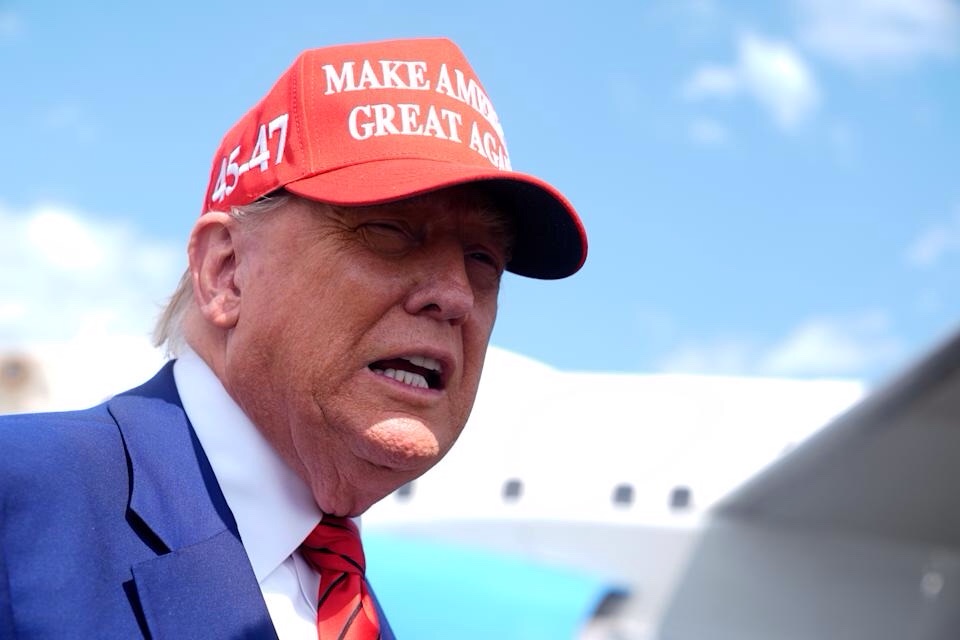
Donald Trump has been called a lot of things. “Forgiving” is not one of them.
But to carry a grudge for nearly five years, and to continue trying to prove a point that has already been disproved by numerous federal courts and by his own first-term attorney general when there is nothing to be gained . . . well, that defies reason, even for an angry, embittered, supremely sore loser.
Or might there, after all, be something to gain by calling for a special prosecutor to open yet another investigation into former President Joe Biden’s actions during his term in office, as well as Trump’s never-ending insistence that the 2020 election was fraudulent? What purpose could be served by dragging an ill, elderly man through the muck of Trump’s delusions, and submitting the country to yet another ignominious travesty?
Trump would have us believe that he is taking his time and attention away from the country’s very real problems to regurgitate his five-year-old bile for the sole purpose of saving our nation. In his own words:
“Biden was grossly incompetent, and the 2020 election was a total FRAUD! The evidence is MASSIVE and OVERWHELMING. A Special Prosecutor must be appointed. This cannot be allowed to happen again in the United States of America! Let the work begin!” [Eric Tucker, AP, June 20, 2025.]
Even if he were right — which he isn’t — what would it matter now?
Well, consider this: We’ve all heard his disingenuous comments about a possible third term . . . and even a sly suggestion that there might be a simple way to circumvent the Constitutional two-term limitation.
If the 2020 election were, as he so fervently desires, somehow to be declared null and void, wouldn’t Trump then retroactively declare himself the actual winner? And is it a stretch of the imagination to think he would then proclaim himself entitled to serve out that four-year term, in addition to the one he is currently serving?
In such a cataclysmic event, who would decide these questions . . . The Republican-majority Congress? The conservative-weighted Supreme Court? And what would happen to all of the actions that were taken during Biden’s four-year term?
Any way you look at it, it is a Constitutional nightmare waiting to happen . . . one that would make the Watergate scandal of the ‘70s look like a day at Disney World. And the decision as to the appointment of a special prosecutor rests in the hands of Trump appointee, Attorney General Pam Bondi.
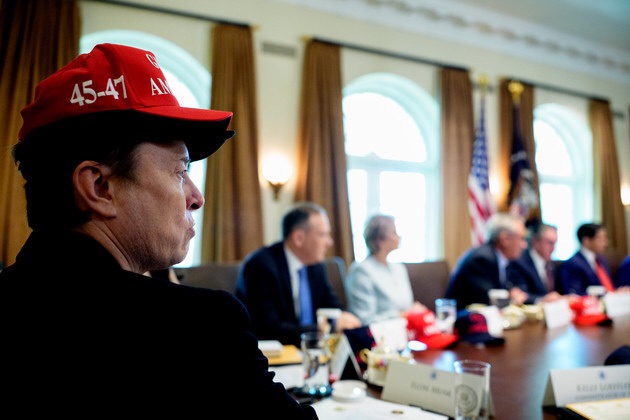
If he’s not blowing up rockets, or decimating government agencies, or fathering another little mini-me, it seems that Elon Musk’s favorite pastime these days is fighting with White House personnel.
Being Musk, of course he started at the top of the pyramid, engaging in a little name-calling with Donald Trump before finally apologizing (sort of), when he admitted he had probably gone “too far.”
But he now blames that falling-out on Sergio Gor, head of the White House Presidential Personnel Office, whom he has called a “snake,” and accused of failing to submit the required form for his permanent security clearance. He also has called Gor out for nixing Musk’s recommended choice to head NASA out of spite aimed, not at the nominee, but at Musk himself.
It seems as though everyone in the White House wants to be daddy’s favorite. But, unlike an actual family feud, these internecine scuffles at 1600 Pennsylvania Avenue make international headlines. And they usually spread faster than the latest strain of COVID.
A Bad Day in the White House
Today Musk said that Gor committed a federal crime when “He deliberately lied about where he was born on Federal forms. That’s a serious crime.” [Farrah Tomazin, Daily Beast, June 20, 2025.]
It’s also a serious accusation. I don’t know where Musk got his information, but his isn’t the only mention of Gor’s questionable origins. It has been said that his real name is Sergey Goryachov (or possibly Gorokhovsky) of Saratov, Russia — though these allegations do not appear to be from the most reliable sources.
Without verification, of course, these rumors remain just that: rumors. But in light of the access and authority granted Gor by his position in the White House, perhaps they bear further investigation to determine whether he has indeed lied about his background.
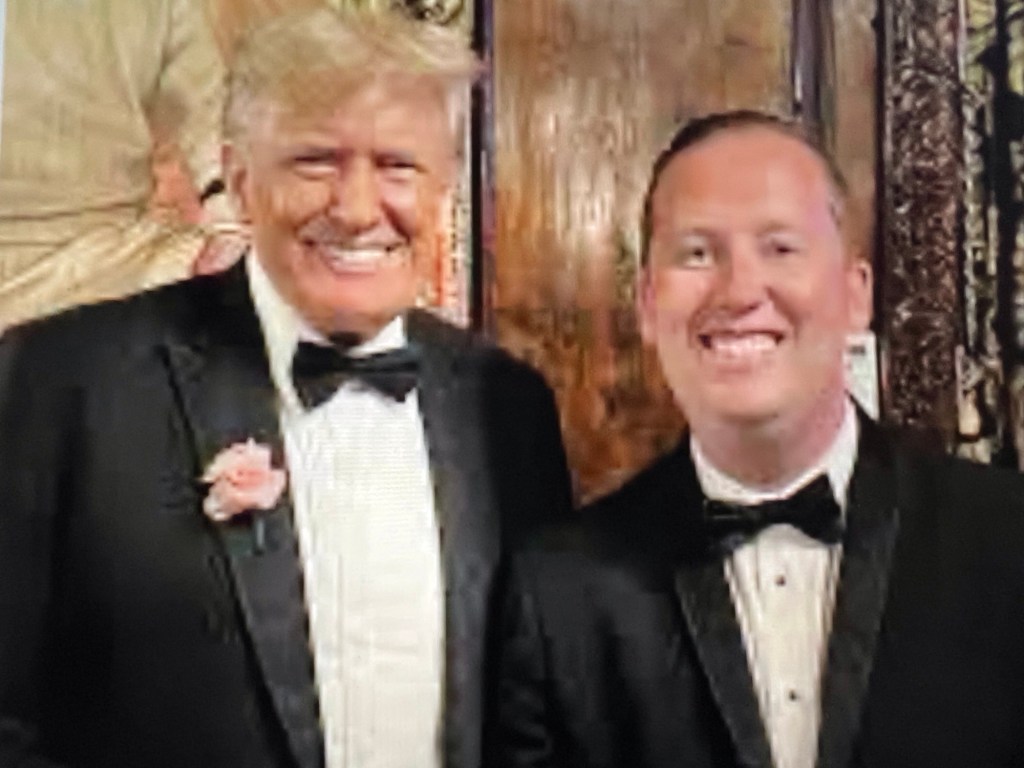
Donald Trump and Sergio Gor
After all, people are being deported for far less.
If he can’t get his story straight about something as simple as a holiday, how can he be trusted to take control of the Middle East situation?
“He,” of course, is Donald Trump. And never mind his whiplash-inducing u-turns on the plethora of natural and manmade disasters currently overtaking the planet . . . those are enough to drive anyone mad. But how can we expect any individual to take charge of our futures when he can’t even remember that, during his first term in 2020, he took credit for making Juneteenth “very famous,” when “nobody had ever heard of it.” Or that one of his campaign pledges that year was to make it a federal holiday . . . but that it was actually done by President Joe Biden in 2021.
(But of course, Trump still doesn’t recall that he lost that election, so why would he remember such a little detail?)
Now, however, he wants to eliminate the holiday he once promoted — one that celebrates the end of slavery in the United States — on the specious grounds that we have too many paid holidays as it is . . . not because it recognizes diversity, which we all know is his real reason.
So the man who spends virtually every weekend on the golf course — costing the taxpayers millions of dollars for travel, salaries of his Secret Service entourage, etc. — has this to say to the people who put him into the White House:
“Too many non-working holidays in America. It is costing our Country $BILLIONS OF DOLLARS to keep all of these businesses closed. The workers don’t want it either! Soon we’ll end up havinng a holiday for every once [sic] working day of the year. It must change if we are going to, MAKE AMERICA GREAT AGAIN!” [Alejandra Jaramillo, CNN, June 19, 2025.]
A Paid, Non-Working Day Off – Presidential Style
Right. We Americans — who already have the second-lowest number of paid vacation days and the fewest paid leave days of any nation in the world [Business Insider, December 6, 2022] — want nothing more than to work ourselves to death for the glorification of the Draft-Dodger-in-Chief.
I’ll sign up for that . . . just as soon as he sells his golf clubs.
In a world spinning out of control, it’s necessary now and then to yell “STOP!” . . . and focus instead on those occasional moments that make us smile, whether in appreciation of an act of human kindness, the sight of a child playing with a puppy, or someone doing something so incredibly crazy you just have to laugh.
And I found one of those hilarious moments in a short news item yesterday about an 81-year-old man who tried to drive his car down the famous Spanish Steps in Rome.
On the way down . . .
Luckily, no one was injured, but his car did get hung up on the lower end of the steep staircase.
Getting stuck . . .
The report didn’t say whether he was charged with a traffic violation, but his car had to be removed with the help of a crane. The elderly gentleman, who tested negative for alcohol, told officers that he was on his way to work . . . as though no further explanation was needed. Maybe that’s the way it is in Rome.
La fine(The End)
There’s no indication of why he chose to travel down the historic, pedestrian-only steps; maybe he was late for work and this was his idea of a shortcut. I have to give him props for still having a job and driving a car at his age, though his apparent lack of judgment makes me wonder whether he shouldn’t consider retiring soon.
In any event, I’m glad he’s okay.
[Story and screen shots from BBC.com, June 19, 2025.]
*. *. *
Then there’s the “weird but kinda cute” category of news story, about something called a “Labubu” — an elf-like little doll from China with a vinyl face and plush body, pointy ears, big eyes, and “a mischievous grin showing exactly nine teeth.” The name doesn’t mean anything, but refers to one of the characters in “The Monsters” toy series created by Hong Kong-born artist Kasing Lung. [BBC.com, June 19, 2025.]
A Litter of Labubus
For some reason, they seem to be all the rage now — and not just with children. Celebrities including Rihanna, Kim Kardashian, and some others I’ve never heard of are said to be collecting them.
I was going to say something snarky here about there being no accounting for taste; but then I remembered when I collected Beanie Babies . . . not for my children, but for myself. (I wish I’d saved them; they’d probably be worth a fortune now.)
A Bunch o’ Beanie Babies
And how many of you are old enough to recall those bright blue Smurfs, the incredibly ugly Cabbage Patch Dolls, and the spooky little Gremlins?
Smurf-o-Rama
Cabbage Patch KidsOne of the cuter Gremlins
Every generation has its silly obsessions, whether it be Hula Hoops, Barbie dolls, or Hot Wheels. They may seem like nothing but expensive clutter; but if they bring us or our kids a little joy, then doesn’t that make them worth something?
Remembering them certainly brought a smile to my face today. And we can all use a lot more of that.
According to his Wikipedia bio, Sergio Gor is Director of the White House Presidential Personnel Office. Reportedly born in 1986 in the Mediterranean island nation of Malta (though the Maltese government “cannot confirm” his birthplace), he emigrated with his family to the United States in 1999, attended high school in Los Angeles and George Washington University in Washington, DC.
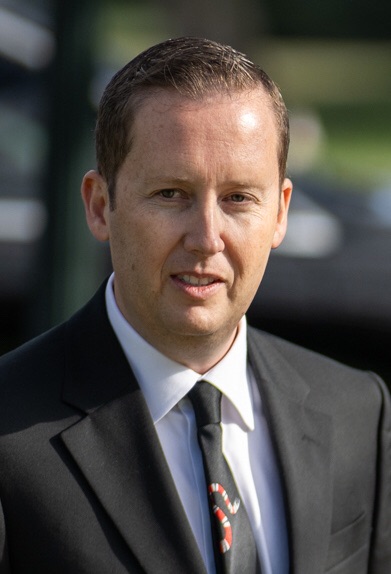
Sergio Gor
Since college, he has worked for the Republican National Committee; served as a staff member for Congressional Representatives Randy Forbes, Michele Bachmann and Steve King; worked as an associate producer for Fox News, and as Deputy Chief of Staff for Senator Rand Paul. He was a top fundraising official for Donald Trump’s 2020 reelection campaign, and founded the pro-Trump super-PAC known as Right for America, which spent nearly $72 million during Trump’s 2024 campaign.
And now, as head of the White House Personnel Office, he holds enormous power. His position charges him with the vetting and hiring of around 4,000 Executive-branch staff members . . . which he accomplishes, in part, by “poring over old tweets, political donations and remarks to ensure loyalty to the president.” [Steven Nelson and Diana Glebova, New York Post, June 17, 2025.]
But doubt has arisen as to whether Gor himself has been properly vetted for his own security clearance. According to the New York Post, three administration insiders have said that Gor has not submitted his Standard Form 86, a document containing more than 100 pages of questions required for clearance. Among the bits of information to be provided are statements of where the applicant was born and whether they have any foreign connections. [Id.]
An inquiry to the Maltese government as to Gor’s birth date was responded to as follows:
“No acts are registered with the provided details.” [Id.]
White House counsel David Warrington of course claims that “Mr. Gor is fully compliant with all applicable ethical and legal obligations. His security clearance is active, any insinuation he doesn’t maintain a clearance is false.” [Giselle Ruhiyyih Ewing, Politico, June 19, 2025.]
Perhaps so. But where there are questions, there should be answers — answers supported by evidence. A copy of his completed application would suffice nicely, along with a copy of his birth certificate or U.S. naturalization documentation. That would certainly put the rumors to rest.
Sample SF-86
What is most intriguing, though, is that no one outside the White House seems to know who Mr. Gor really is . . . other than the inestimable Elon Musk, who knows him all too well. In fact, it appears that Mr. Gor may have been largely responsible for Musk’s sudden and hasty departure from the Washington political scene.
Musk reportedly refused to work with Gor after a Cabinet meeting in March, where Musk’s criticism of some Cabinet members’ agency cuts prompted Donald Trump to remind Musk that the agency heads — and not Musk or his DOGE cutthroats — had authority over their own departments. [Id.]
And the final blow for Musk may have come when Trump — at Gor’s urging — terminated the nomination of Musk’s pick of Jared Isaacman to head NASA. It was around that time that Musk packed up and left town, and the now-infamous name-calling marathon between Trump and Musk began.
That is a clear indication of the level of influence Gor has with Trump, and all the more reason that his legitimacy should be verified.
Now — while the former BFFs have called a truce of sorts — Musk has turned his attention (and his venom) to Gor, calling him a “snake” in a post on X, and raising the question of whether Gor has indeed been properly vetted for security clearance purposes.
So, are we in for another round of “boys will be boys” insults? Are Musk’s accusations of security breaches in the White House true, or merely guesswork fueled by spite? And does any of it really matter?
Well, yes, unfortunately it does matter . . . and especially if the absence of a proper security clearance turns out to be true. Because then a slew of other questions would arise, such as where Sergio Gor was actually born. If not Malta, then where? (Russia has been suggested by some, but without adequate substantiation.) Is that his real name? Is he actually a U.S. citizen? And if it turns out that he has been improperly acting in his position in the White House, then what about all of those persons he has been responsible for hiring? Are they all to be re-investigated, or even fired?
This could turn out to be a tempest in a teapot . . . or it could be a major headache for the Trump administration. Either way, let’s hope it gets cleared up, and not swept under an expensive White House oriental carpet.
War is hell. There doesn’t seem to be much doubt about that.
In today’s more “civilized” societies, however, even war has its rules, such as the humane treatment of civilians and prisoners of war.
But as we all know, there are those nations’ leaders who refuse to be bound by any constraints, or who simply deny that they are guilty of any infractions and continue on their merry way . . . intentionally targeting hospitals, schools, homes, and places of business; raping, torturing and killing civilians; and kidnapping children for “rehoming” and “reeducation.”
And just when we think humanity has sunk as low as it can possibly go, Vladimir Putin has come up with yet another horror to inflict on the victims of his war against Ukraine. In the course of an agreed-upon exchange of the remains of Russian and Ukrainian casualties, he has been sending back to Ukraine the mutilated and mixed-up body parts of their loved ones . . . and some that don’t even belong to them.
Bringing Them Home
Two peace talks in Istanbul on May 16 and June 2 failed to result in the hoped-for ceasefire or a path to peace. But one positive outcome was an agreement on repatriations and prisoner exchanges, which have been underway since then. The last stage of a deal to return the remains of more than 6,000 Ukrainian soldiers was completed on June 16th, when Russia sent the final 1,245 bodies (or 1,248, according to Moscow’s figures) back to their homeland.
But Ukrainian Interior Minister Ihor Klymenko has reported in a post on Telegram that it was discovered during the complex process of identifying the remains —which involves autopsies, DNA testing, and other procedures — that:
“. . . Russia is also deliberately making the identification process difficult for us. Bodies are returned in an extremely mutilated state, parts of [the same] bodies in different bags. There are cases when the remains of one person are returned even during different stages of repatriation. In addition, during the latest repatriations, the bodies of Russian soldiers were also transferred to us — mixed with the bodies of Ukrainians.” [RFE/RL, June 16, 2025.]
A request by RadioFreeEurope/RadioLiberty for comment from Russian officials has gone unanswered. [Id.]
Klymenko added that Ukrainian specialists “are working at the limit of what is possible” to identify the remains, and that “the biggest challenge is time. We understand the pain and the expectations of families. We are accelerating the identification process as much as possible. But with each large repatriation, it becomes more difficult to do this, and perhaps this is precisely Russia’s goal.” [Id.]
Searching for Answers
Imagine, if you dare, that you are a Ukrainian parent, spouse, sibling, or lifelong friend of a missing soldier, and that you have just learned that your loved one may have been returned home in pieces, lost in a jumble of mixed-up body parts. Or that you are a Russian citizen, also awaiting the identification of a family member, and you think there is a possibility that his remains may have been sent to Ukraine by your own government.
One would hope that, at best, this new horror is the result of overwork, inefficiency, and stupidity on the part of the Russian officials in charge of their side of the repatriation operation. But, as Minister Klymenko suggested, it might just as easily have been intentional.
If it was, it is unforgivably cruel, malicious, and ghoulish. It may also be a violation of the Geneva Conventions . . . although for Putin, that would be just one more war crime on his record.
“What . . . me worry?”
And to a person with no conscience, that’s not even worth thinking about.
A friend told me the other day that she is becoming physically ill from the stress and depression caused by the deluge of cataclysmic world events . . . a deluge that seems to go on, and on, and on, with no end in sight.
And a family member said yesterday that her way of dealing with it is to push it to the back of her mind and — even though she sees the headlines and is aware of what’s happening — she tries not to dwell on it by immersing herself in other things: her work, her children, her community.
Lying in bed last night, thinking about both of those women, I realized that I fall somewhere between the two: I feel the stress and the emotional debilitation, but I can’t turn away. In fact, I am that person who, when confronted with the most horrific sight — a train falling off the track, or a loved one breathing their last breath — cannot look away. I am unable to evade the truth, or to choose ignorance.
But neither will I allow reality, no matter how terrible, to get the better of me. I may be unable to change the situation; but neither will I let it destroy me. And since I no longer have the distractions of a job or small children to occupy me, I have found my own way of dealing with the ill effects of the world’s events: I write about them.
And it helps. That is why you see me here, endlessly expounding on subjects ranging from wars in foreign lands, to the disastrous excesses of the current U.S. administration, to natural disasters, to personal reminiscences, and sometimes even detouring into the odd bit of humor or whimsy. And each time another person reads one of my articles, I feel a little less alone in a world I can’t control.
So thank you, dear reader, for being there. You are my unseen support system.
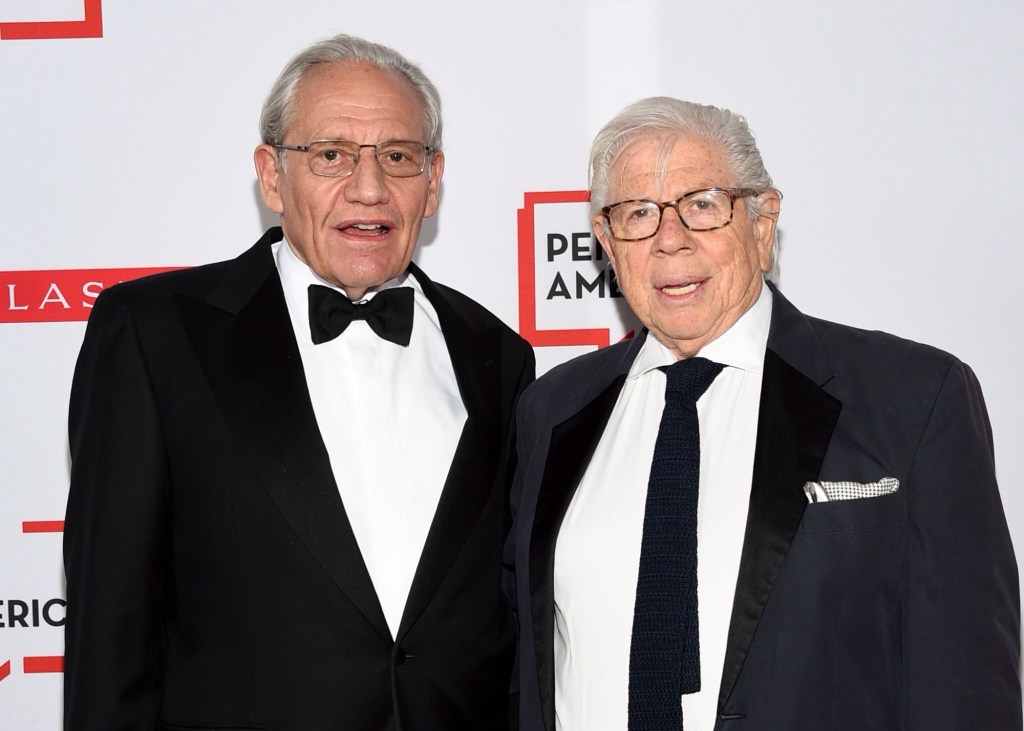
Happily, Bob Woodward and Carl Bernstein are still around. But they’re older now, as we all are . . . no longer the two young, eager, junior investigative journalists who worked for the Washington Post in the 1970s.
And more’s the pity.
Woodward and Bernstein: Then . . .. . . and Now
Because this country has never been more desperately in need of the sort of fearless investigation and reporting we saw from the likes of that pair when they exposed the break-in at Democratic National Committee (DNC) headquarters in the Watergate complex on June 17, 1972 — 53 years ago yesterday.
Their subsequent reporting, followed by their 1974 book titled “All the President’s Men”, broke open a web of corruption, lies and cover-ups that led to the downfall of the Nixon administration . . . proving to the world that in the United States, no one — not even the President himself — was above the law.
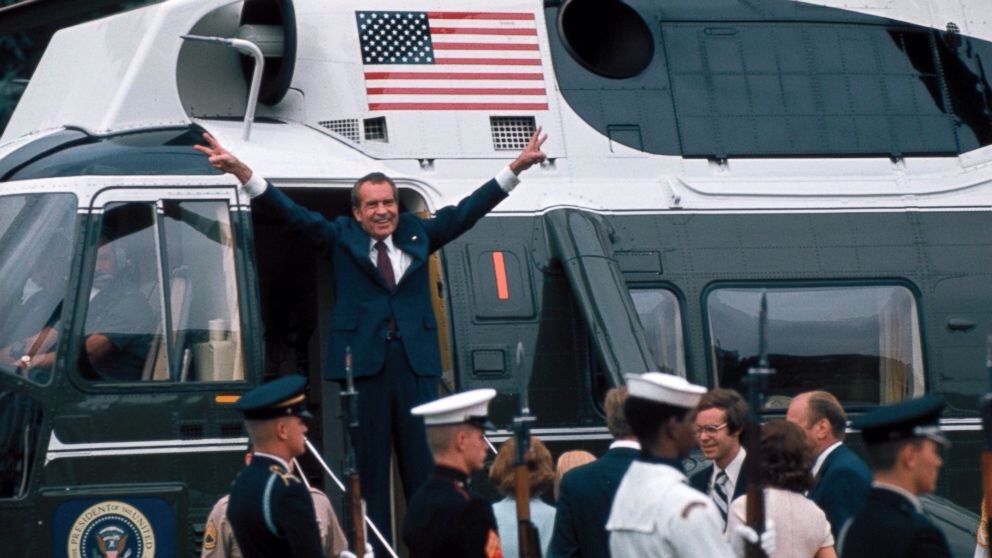
Former President Richard M. Nixon, leaving Washington for the final time
But that was then, when the media, the courts and Congress were free to do their jobs without fear of intervention, threats, or retribution.

































 The Blog About Everything … and Sometimes Nothing