Having a wonderful time reminiscing about all my past travel (and other) adventures. Hope you’ll share them with me in my blog, “All Roads Led to Russia.”
That would be Dmitry Medvedev, Deputy Chairman of the Russian Security Council, and Putin’s tough-talking, threat-issuing, ultra-hawkish proponent of the war in Ukraine . . . and, apparently, World War III.
Dmitry Medvedev
Donald Trump’s magnanimous extension of a 50-day period for Moscow to respond to a demand for a ceasefire or face further sanctions has been brushed off by the Kremlin as a mere nuisance. But taken more seriously is Washington’s simultaneous decision to expedite further shipments of missiles and other weaponry to Ukraine.
Ignoring the facts as usual, Foreign Ministry spokeswoman Maria Zakharova told a news briefing in Moscow:
“It is obvious that the Kyiv regime consistently perceives such decisions by the collective West as a signal to continue the slaughter and abandon the peace process. . . . The language of ultimatums, blackmail, and threats is unacceptable to us. We will take all necessary steps to ensure the security and protect the interests of our country.” [Guy Faulconbridge, Andrew Osborn and Dmitry Antonov, Reuters, July 17, 2025.]
Someone might want to remind Zakharova just who invaded whom on February 24, 2022, and who is being slaughtered by whom . . . but that might be inconvenient.
Maria Zakharova
Apparently, however, Zakharova’s comments weren’t forceful enough for Dmitry Medvedev. While assuring the West that Russia had no plans to attack NATO or Europe, Medvedev said on Thursday that — if it believed the West was escalating what he described as its full-scale war against Russia — “We need to act accordingly. To respond in full. And if necessary, launch preemptive strikes.” [Id.]
If they believe the West is escalating . . . respond in full . . . preemptive strikes: That is the stuff of nuclear nightmares.
How much of what Medvedev says is a reflection of the actual amount of weight he carries in the Kremlin, and how much is bluff and bluster, we can’t be sure. We can only hope and pray that he’s not the guy with his finger on the button.
As my readers know by now, the Feenstras are a large family — Dad Arend, Mom Anneesa, and eight children ranging from teenagers to toddler — who sold their farm in Saskatchewan to begin a new life on a farm they are building from scratch in the Nizhny Novgorod region of Russia.
Their purpose was to get away from the “wokeness” of their native Canada in order to raise their children in a more conservative environment, free from the perceived “dangers” of LGBTQ+ liberalism. After a year and a half, they seem to be making great progress . . . but only with the help of the Russian government in exchange for their never-ending participation in propaganda programs and videos being disseminated worldwide via social media.
I can’t say I agree with what they are doing; but their personal choices are theirs to make, and I do admit to a certain admiration for their tenacity and their unstinting faith that they have made the right decision for their children.
*. *. *
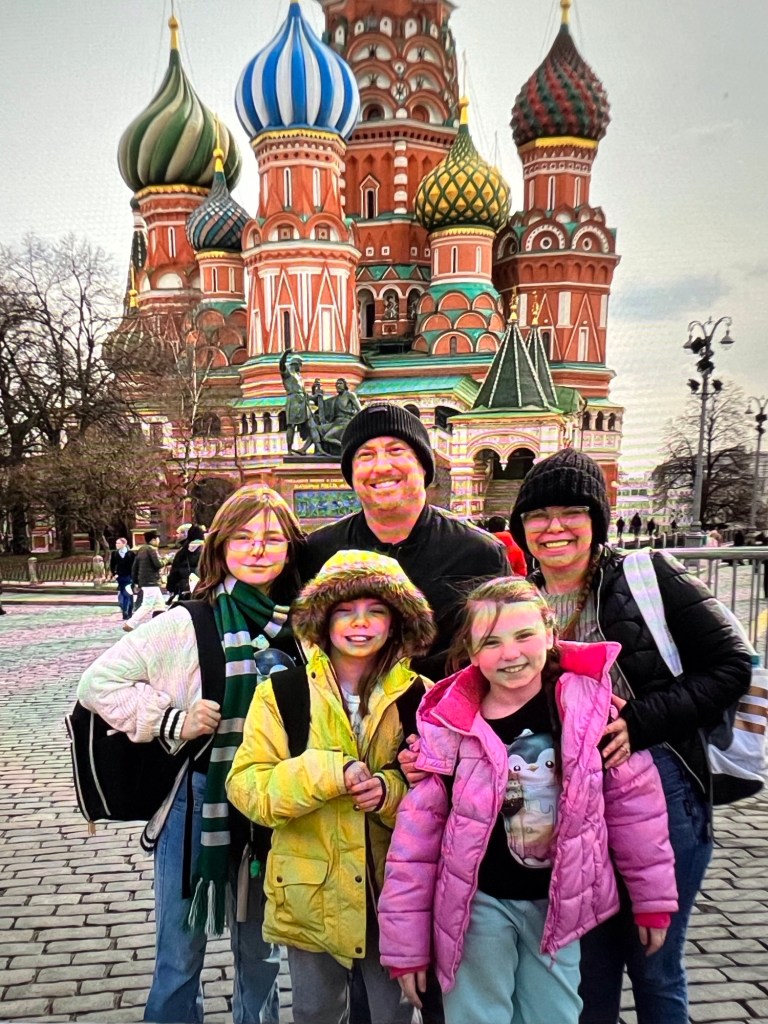
Yesterday, though, I came across a story about an American family — Derek and DeAnna Huffman and their three daughters — who moved to the Moscow region a few months ago, for pretty much the same reasons as the Feenstras.
The Huffmans in Red Square
Their May 21st post on @HuffmanTime read: “We’re the Huffman family — Americans who moved to Russia 2 months ago! Derek (46) has a background in welding & construction, DeAnna (42) is a former teacher & floral designer, and we’re raising our 3 daughters (12, 11 & 10) while embracing a whole new life, language, and culture.” [Josh Fiallo, Daily Beast, July 18, 2025.]
But things are not working out so well for the Huffmans. In an effort to gain expedited Russian citizenship for his family, and in hopes of being able to “earn” the respect of their new Russian neighbors, Derek Huffman — naively believing the government’s recruiting propaganda — enlisted in the military on the promise that he would not be sent to the front lines in Ukraine, but would be working as a correspondent (albeit with no knowledge of the Russian language) or as a welder.
He also believed the recruitment promises of financial benefits. But after a month of training, the Huffmans have yet to receive the first payment.
I’m sure you know what to expect next: Derek is being sent to the front lines after all, with no military background and only minimal training — and that training being conducted in Russian, which he does not understand.
His wife DeAnna said, “Unfortunately, when you’re taught in a different language, and you don’t understand the language, how are you really getting taught? You’re not. So, unfortunately, he feels like he’s being thrown to the wolves right now, and he’s kind of having to lean on faith, and that’s what we’re all doing.” [Id.]
Last month, Derek had told Russian state media:
“The point of this act [joining the military] for me is to earn a place here in Russia. If I risk myself for our new country, no one will say that I am not a part of it.” [Id.]
And now he is being used as cannon fodder, along with thousands of Putin’s conscripts being recruited from jails, prisons and homeless shelters to fill the empty spaces left by the dead and wounded.
Last year, Russian lawmaker Aleksandr Borodai — who heads a group called the Union of Donbas Volunteers — was recorded telling officers that the military brass considers volunteer soldiers “second-rate infantry [needed to] exhaust the enemy’s manpower” as much as possible before a full attack can be launched by regular army units. In the same conversation, he referred to volunteers as “expendable manpower.” [Daniil Belovodyev and Systema, RFE/RL, July 17, 2025.]
And that is what the well-meaning but seriously misguided Derek Huffman has signed up for.
*. *. *
Aside from the obvious concerns about Derek’s chances of survival, my thoughts naturally go to DeAnna and the three children. What will they do, and how will they survive, while he is fighting in Ukraine? And what will become of them if, in the worst-case scenario, he doesn’t return?
These are the possibilities that people need to consider before deciding that the grass is going to be greener somewhere else. Is it really worth all of this, just to shelter your children from some of the realities of life that don’t happen to conform to your beliefs?
I, for one, don’t think so. But that’s only my opinion.
Karl Marx and Friedrich Engels wrote The Communist Manifesto . . . the beginning of the whole ugly mess.
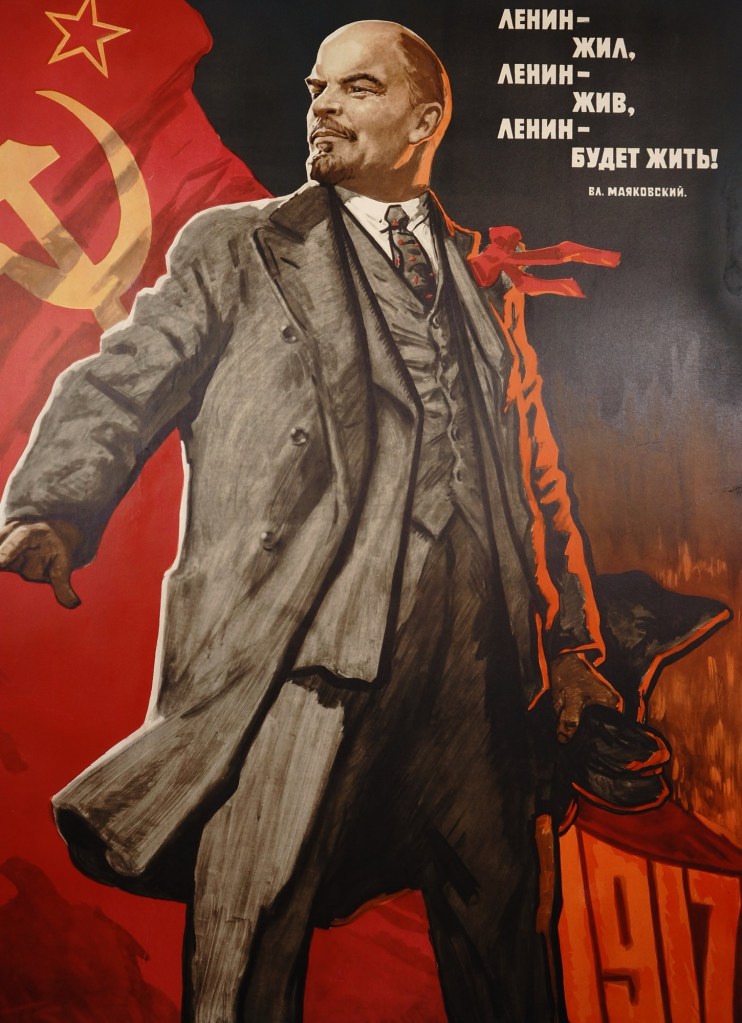
Vladimir Lenin wrote Shto Dyelat? (What Is To Be Done?) . . . He stole the title from a Nikolai Chernyshevsky novel, and the seed of an idea from Marx and Engels; but then he took it to a whole new level.
Adolf Hitler wrote Mein Kampf . . . the political dreams of a madman, begun while in prison in 1923 and brought to fulfillment as World War II and the Holocaust — the firs volume published 100 years ago today, on July 18, 1925.
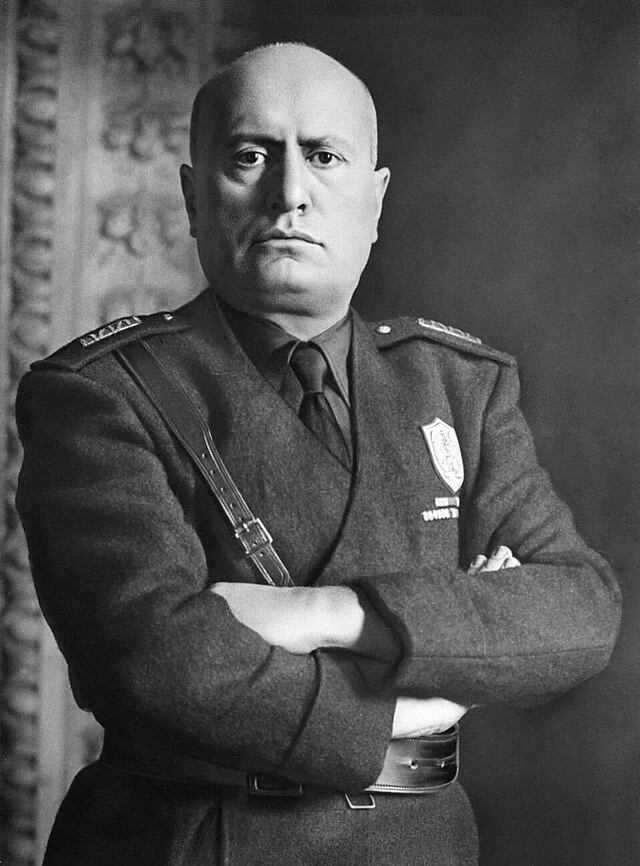
Benito Mussolini wrote My Life. . . the autobiography of a fascist dictator who didn’t die soon enough.
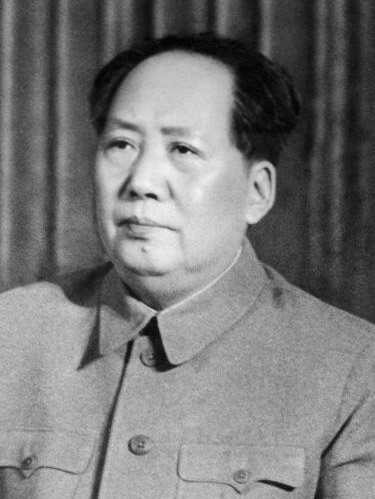
Mao Zedong wrote The Little Red Book . . . a compilation of quotations from the Chinese communist strongman who launched the Cultural Revolution, and whose legacy, unfortunately, lives on.
Vladimir Putin wrote On the Historical Unity of Russians and Ukrainians . . . an essay, published in July 2021, that should have forewarned the world of what was to come just seven months later.
And Donald Trump wrote The Art of the Deal. . . oh, wait. No, he didn’t; Tony Schwartz did.
But Trump has written — mostly in misspelled, ungrammatical, incorrectly punctuated, and often unintelligible tweets — such gems as:
“The concept of global warming was created by and for the Chinese in order to make U.S. manufacturing non-competitive.” [From @realDonaldTrump, November 6, 2012.]
“I am much better looking than Kamala Harris.” [August 17, 2024.]
About Whoopi Goldberg: “She was so filthy, dirty, disgusting. She was so dirty. Every word was filthy, dirty. What a loser she is.” [October 29, 2024.]
About Rosie O’Donnell: “If I were running ‘The View,’ I’d fire Rosie O’Donnell. I mean, I’d look at her right in that fat, ugly face of hers, I’d say, ‘Rosie, you’re fired.’ [2006]
About the January 6, 2021, storming of the U.S. Capitol: “Nothing done wrong at all. There were no guns down there. We didn’t have guns. The others had guns, but we didn’t have guns. And when I say we, these are people that walked down — this was a tiny percentage of the overall which nobody sees and nobody, nobody shows. But that was a day of love.”
About immigration: “Why are we having all these people from shithole countries come here?” [January 2018]
*. *. *
Eight world leaders, past and present, without whom the world might have been a much safer place.
In 1990, the United States and other Western countries were heavily involved in assisting Eastern European nations that had just been freed from the yoke of Soviet control and were slowly finding their way to the establishment of new, democratic government structures.
Hungarian Parliament Building, Budapest
Along with financial and technical aid, those countries needed political, legal and economic reeducation. And in September of that year, I was privileged to assist my law firm’s team sponsoring a seminar in beautiful Budapest, Hungary, on doing business in Eastern Europe and the Soviet Union.*
* Note: Though Hungary, among others, had regained their independence after the fall of the Berlin Wall in 1989, the Soviet Union itself did not collapse until December 26, 1991.)
Those were heady times, full of energy and optimism for a brighter, freer future. And for the most part, those plans and dreams have been fulfilled, at least to a large extent. But there has been backsliding in some places over the years, including in Hungary since the rise to power of its Prime Minister, Viktor Orban.
I have written several times about Orban’s autocratic leadership, including the fact that it now appears — for the first time since 2010 — that he may finally be in jeopardy of losing power to a more moderate opponent in the next election.
And one of Orban’s critics in Parliament, Katalin Cseh, has spoken out — not to her own people, but to the American public — about the lesson to be learned by Donald Trump’s opposition from her own country’s experiences.
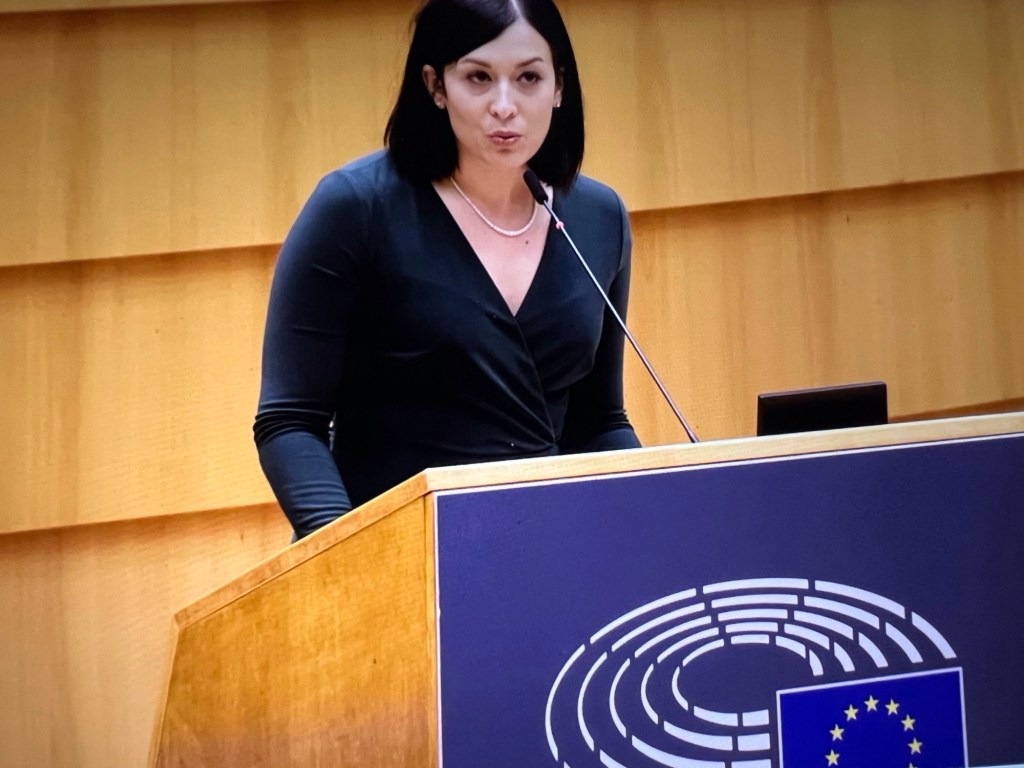
Katalin Cseh, Member of Hungarian Parliament
Ms. Cseh’s comments — delivered at a recent webinar forum on authoritarianism organized by the Washington-based think-tank, Center for American Progress — speak for themselves; so I will simply quote excerpts here:
“I invite everybody to study the processes that happened [in Hungary] and elsewhere, because autocratic learning is real. Backsliding just went by us like a train, without anybody realizing how far it had gotten. So it’s very important to pay attention from the very beginning … [and] to mobilize.” . . .
“I do believe that many Americans think this [authoritarianism] is something that also only happens to others, and I think that mindset has to be fought.” . . .
“Start preparing for the midterms like yesterday. Go to every protest, go to every march, stand right beside everybody who is being attacked, no matter if it is a group you belong to, or something that you do not share personally. You have to stand side by side [with] each other and help and support those who might feel isolated and alone.” . . .
She then urged Democrats and activists to form a widely inclusive “movement” and find “candidates for the midterms or any election that is coming your way who can get people excited — not necessarily the same old faces they have been seeing all the time that they don’t really trust that much, but visionary leaders … who are part of a community, who are being persecuted.” . . .
She said that leaders such as Trump and Orban can only be effectively opposed by ditching a “legalistic, technical, technocratic approach [in favor of] something for the electorate to be excited about. Autocrats are not always good in governing. So cost of living, crisis of healthcare, education — if the focus is shifted to these areas, and not oly technical descriptions of what’s going on in the courts, this is something that people can relate to more.” [Robert Tait, The Guardian, July 16, 2025.]
“Outstanding!”
*. *. *
There were comments by other panelists, most notably by Szabolcs Panyi, a journalist with the Hungarian website Direkt36, who drew a parallel between Trump’s approach to the media and the methods used by Orban to attack journalists. These included banishing established outlets from briefings in favor of friendly journalists and so-called “propagandists”:
“What particularly rings out is how certain large media outlets or owners or large conglomerates try to appease Donald Trump by settling lawsuits or by firing journalists [or] editors. It really resembles what happened in Hungary in the 2010s.” [Id.]
*. *. *
Anything I might add here would be superfluous. But I would like to thank Ms. Cseh, Mr. Panyi, and the other panelists for their honest and insightful conclusions.
I only hope their words reach the right people on this side of the Atlantic. Maybe my sharing them will help a little.
It’s not entirely new. The original White House Office of Faith-Based and Community Initiatives (OFBCI) was created during the administration of George W. Bush, and was continued by both Barack Obama and Joe Biden. But I don’t recall ever hearing about it back then.
Former Location of OFBCI on Jackson Place, near the White House
During Donald Trump’s first administration, the office remained vacant until 2018, when he launched a White House Faith and Opportunity Initiative, and appointed Pastor Paula White as its head.
But again, not much was heard about it. This time around, however, Trump seems more determined to enlist God’s help in accomplishing his mission to rule the world, and has created the new White House Faith Office, under the Domestic Policy Council, to “assist faith-based entities, community organizations, and houses of worship in their efforts to strengthen American families, promote work and self-sufficiency, and protect religious liberty.” [“Presidential Actions – Executive Order: Establishment of the White House Faith Office,” WhiteHouse.gov, February 7, 2025.]
And again, it is headed by Paula White: a “televangelist, nationally known evangelical leader in the Charismatic movement, and longtime spiritual advisor to President Donald J. Trump.” [Wikipedia.org.]
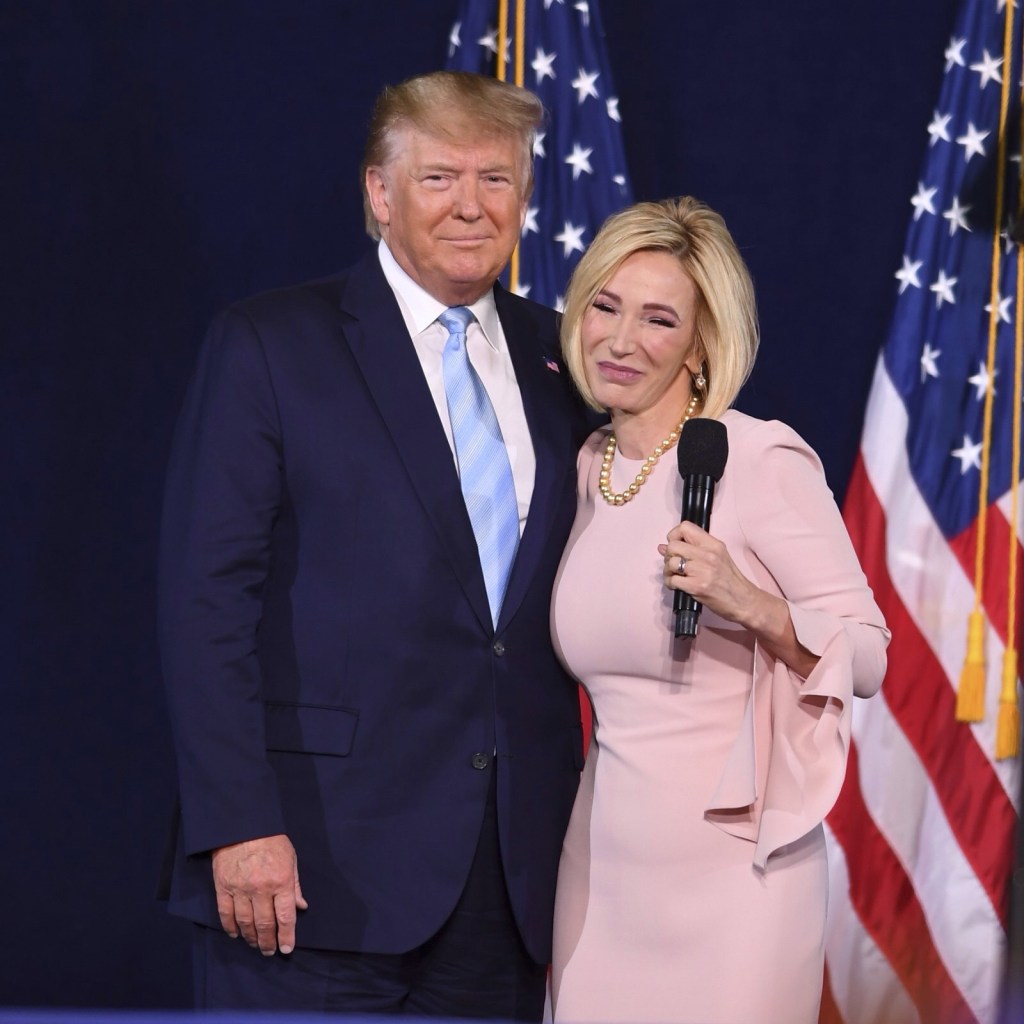
Donald Trump with Spiritual Advisor Paula White
As written, that doesn’t sound like a terrible thing . . . but how is faith the business of government? And what faith, or faiths, are we talking about?
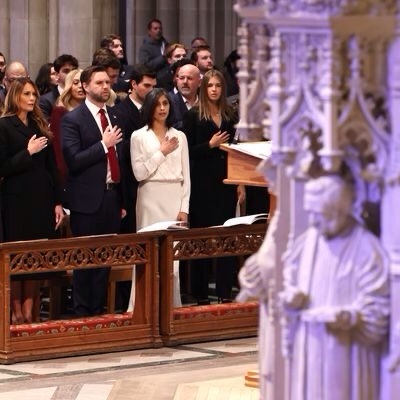
If you dig a little deeper, you will also find references to Pete Hegseth’s Christian prayer services at the Pentagon, and JD Vance’s membership in a church that is associated with the Communion of Reformed Evangelical Churches (CREC) — a movement “committed to maintaining its Reformed faith, avoiding the pitfalls of cultural relevance and political compromise that destroys our doctrinal integrity.” The CREC churches adhere to a strictly patriarchal and conservative interpretation of Scripture, advocating, for example, that in a sexual relationship, “A woman receives, surrenders, accepts.” [Samuel Perry, Baylor University, The Conversation, June 20, 2025.]
As stated in my post of June 25, 2025 — “The Crusades, Part Deux?” — CREC churches also contend that the government, and everyone serving in it, should be Christian. In an interview with the Nashville Tennessean, researcher Matthew Taylorsaid:
“They believe the church is supposed to be militant in the world, is supposed to be reforming the world, and in some ways conquering the world.” There are also CREC schools, known as Logos Schools, whose curriculum is designed to help parents “raise faithful, dangerous Christian kids who impact the world for Christ and leave craters in the world of secularism.” [Id.]
In other words: White, Christian, misogynistic nationalists.
JD Vance in Church
I also looked into Paula White’s Charismatic movement, which, I’m sorry to say, did nothing to ease my mind. Also a movement of Christian churches, it “emphasizes the active presence and work of the Holy Spirit, often through spiritual gifts like speaking in tongues, healing, and prophecy . . . [and] is often characterized by expressive and emotionally charged expressions of faith, such as raised hands, dancing, and speaking in tongues. . . Some critics argue that the emphasis on spiritual gifts can be exploited by manipulative leaders or individuals. . . . The emphasis on subjective experience can lead to a lack of discernment and a susceptibility to false teachings or practices. . . . Some Charismatic churches have been associated with the prosperity gospel, which teaches that God blesses believers with material wealth.” [AI Overview, Google.com.]
Well, he certainly has blessed Donald Trump and his inner circle of friends and sycophants.
Charismatic Church Service
One of the most precious freedoms granted by our Constitution is freedom of religion, and that freedom applies not only to Donald Trump, JD Vance and Paula White, but to every single American. Required participation in a prayer sessiion at the Pentagon or at the start of a Cabinet meeting is completely out of place, and most especially when it favors one faith — in this case, Christianity — over others.
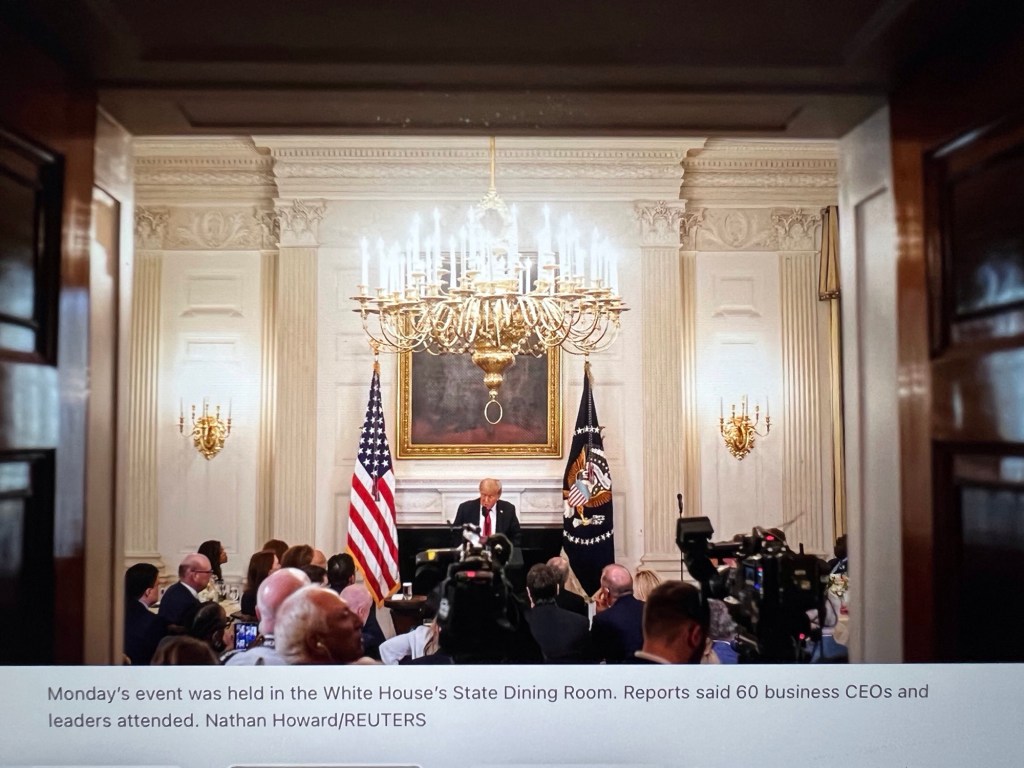
And on that subject, I call the reader’s attention to the White House Faith Office dinner held on Monday to honor more than 60 business leaders and CEOs who donate to faith-based charities, and to “encourage them to continue investing with the White House Faith Office.” [Brooke Singman, Fox News, July 14, 2025.]
Perhaps I’m missing something, but I’d like to know what sort of “investments” the White House is soliciting, and to what purpose.
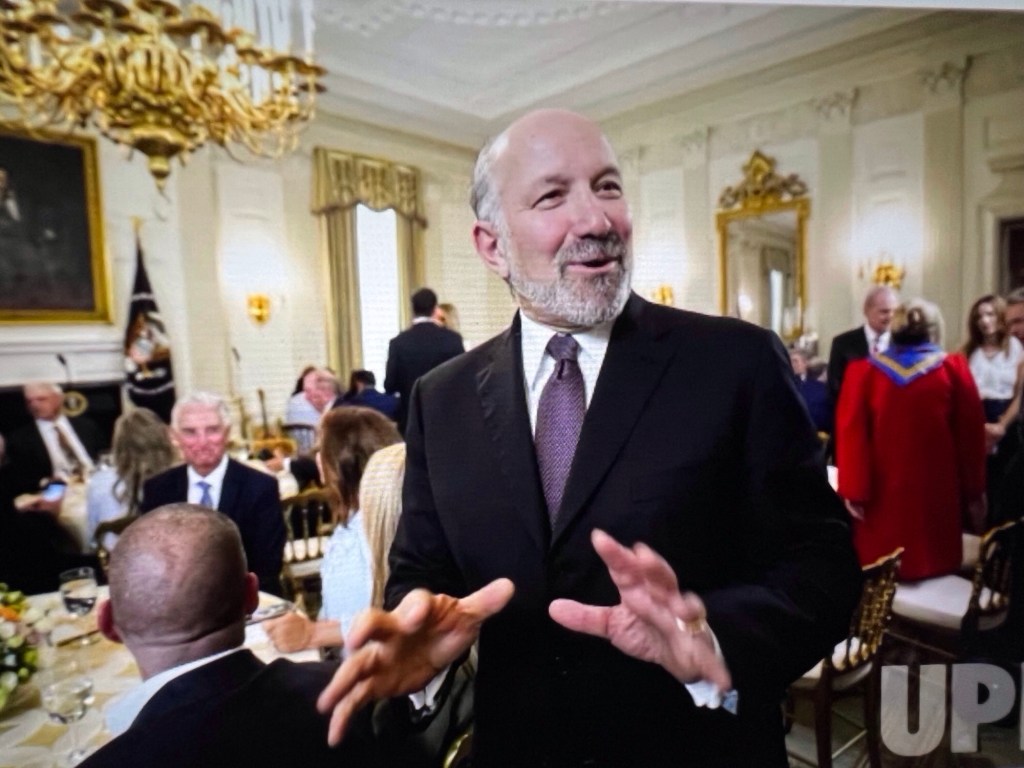
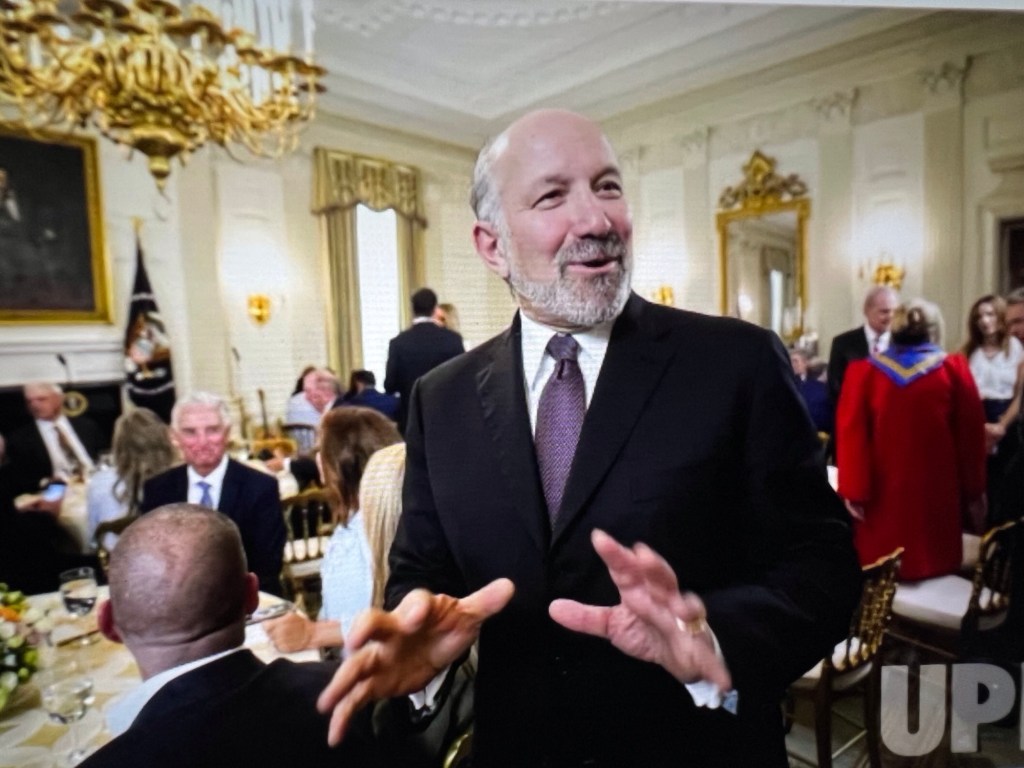
Secretary of Commerce Howard Lutnick at the Faith Dinner
In addition to the 60+ business leaders and CEOs, also in attendance were Treasury and Commerce Secretaries Scott Bessent and Howard Lutnick, Small Business Administrator Kelly Loeffler, National Economic Council Director Kevin Hassett, and — apparently the sole non-business-related guests — Pastor Paula White and Faith Director Jenny Korn.
But this was supposed to have been about faith . . . right?
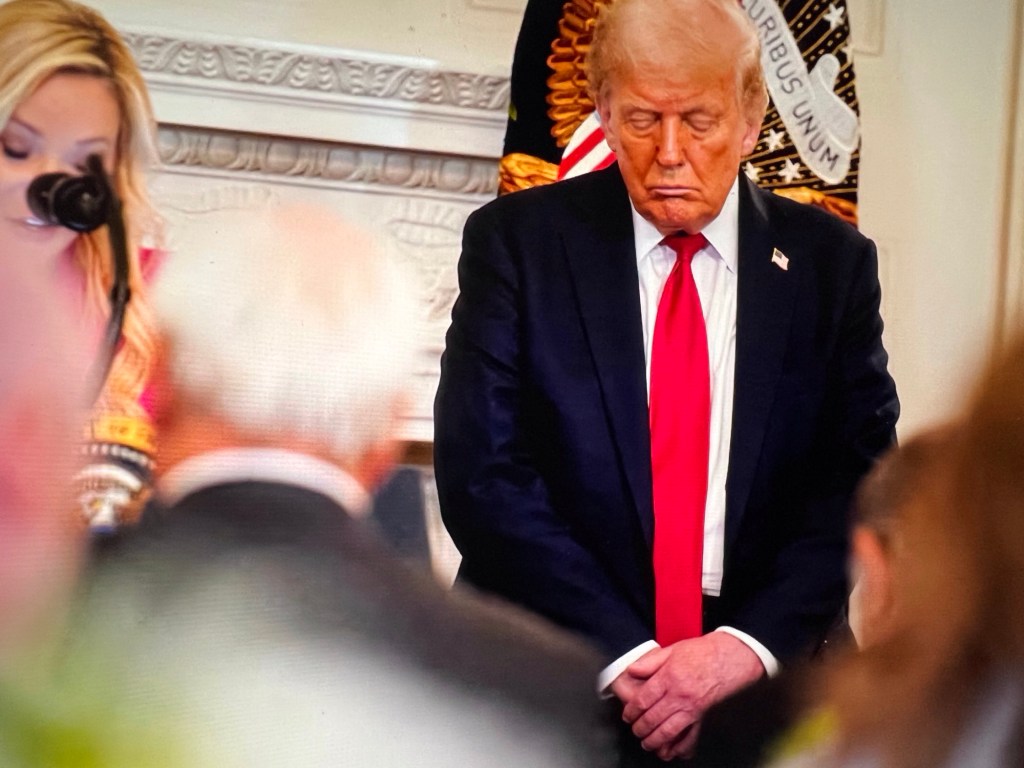
Apparently, there was an actual moment of prayer — led by Paula White, of course — during which Trump assumed the position and put on his pious face:
And then came the speeches. As part of his prepared notes, Trump said:
“I’ve ended the radical left war on faith, and we’re once again protecting religious freedom instead of destroying it, and God is once again welcomed back into our public square.” [Josh Fiallo, Daily Beast, July 14, 2025.]
Then — as he usually does, and never should do because he always ends up making a fool of himself — he veered off-script. According to first-hand reports, he talked about the “bullshit” Biden-era indictments against him, and compared himself to Al Capone:
“I was under investigation. more than the late, great, Alphonse Capone. Think of it. Al Capone would kill people for dinner. If he left the room and he didn’t like him, he’d have him shot, killed, buried under a building someplace, as part of the foundation of a building. They’re all over the place, and I said I had more time under investigation than the legendary Alphonse Capone, or probably anybody else. The one thing I did that was very helpful, I was indicted five times. Indicted, that wasn’t a word that was in — my father’s looking down, my mother’s looking down, that my son’s not supposed to be indicted. I think I got indicted five times, impeached two times. All bullshit, right? Terrible stuff.” [Id.]
White House Faith Office Dinner – July 14, 2025
Then he went off on another incoherent tangent, this time about gas prices:
“Gas prices have reached the lowest level in five decades. Actually, it’s going to be, we’re going to see some really good numbers where, you know, drill, baby drill, drill, baby drill. I’ve got to make sure that people can afford to produce the gas. . . .
“But the gas has gotten to the lowest level in decades, and you’re seeing $1.99, $1.98. I saw $1.95 at certain states, not California, because every time it goes down, they add taxes onto it. All they do is they keep adding taxes. Terrible governor, doesn’t know what he’s doing. He may be, he may be a candidate, but if you, if you go by success, you can’t have him be a candidate.” [Id.]
“Drill, baby, drill.” The Gospel according to Saint Trump.
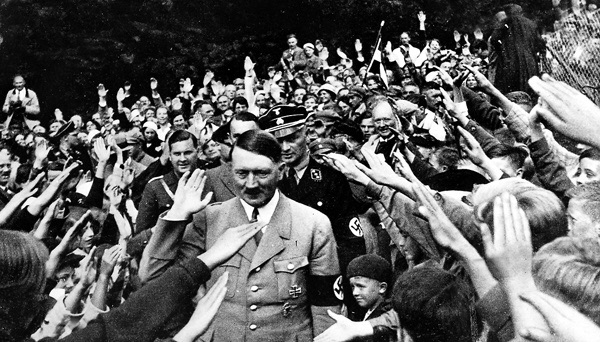
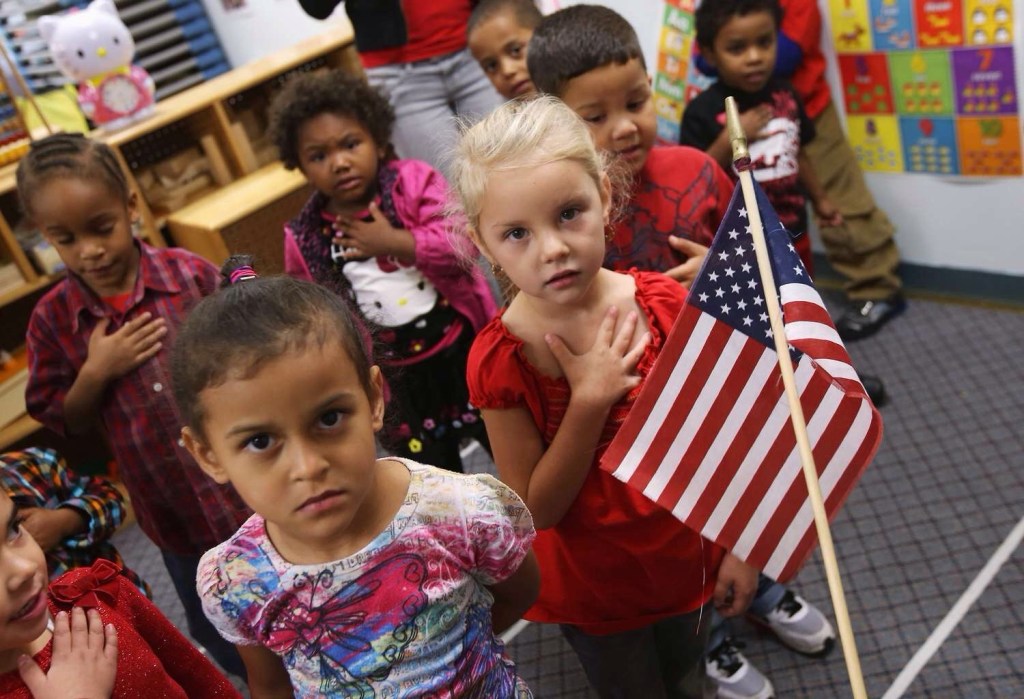
And the luncheon crowd of CEOs and business leaders reportedly clapped and cheered at all the right moments . . . immediately bringing to my mind this scene from George Orwell’s 1984:
And this, from 1930s Germany:
And one more, from 2022:
Announcing the Invasion of Ukraine: “Together Forever”
*. *. *
Am I overreacting? Possibly, but I don’t think so . . . not in light of everything that’s been taking place in this country since the beginning of this year. The warning signs are there: signs of a steady decline into dictatorship. We’ve seen it happen too many times before, in other countries.
Do you suppose Joe Schmo, out there in one of those “red” states — say, Arkansas or Wyoming — woke up one morning recently, turned on Fox News, and thought, “What the fu*k?!! That ain’t what he told us!” . . . ?
“What the . . . ?”
That’s what appears to be happening to a number of Donald Trump’s loyal MAGA base, as well as some Republican members of Congress who may have suddenly grown consciences (guilty or otherwise). And it all has to do — not with the war in Ukraine, or immigration policy, or even the economy — but with the late, licentious, lawless Jeffrey Epstein.
Personally, I don’t give a rat’s ass about Epstein. I am one of the fortunate millions of people who never met him, and who was never in any way impacted by his degeneracy. Following his conviction, I had hoped he would live a great many more years in prison, where — in a shining example of the ultimate payback — he would become the boy toy of an inmate named Hulk. But not for my personal satisfaction . . . rather, for all of those innocent people he actually harmed.
Hulk
You see, what I do care about is justice. And whether Epstein committed suicide or was murdered in prison is important, because — no matter how evil the victim may have been — no murder should go unsolved, and no killer unpunished.
And the fallout from the notorious “list” — and whether it ever even existed — matters because there may be others out there guilty of heinous crimes who should be held accountable, but whose names might otherwise never be known.
And that’s the crux of the matter: Who are the people who are so frightened that their names might be on such a list? They are not likely to be the local pharmacist or your child’s elementary school teacher. Epstein only associated with the high and the mighty in business and industry, the arts, and government. And those people have everything to lose.
The sudden frantic scrambling in the White House and the Justice Department to recant their earlier allegations that such a list existed and was, in fact, sitting at one point on the desk of the Trump-appointed U.S. Attorney General, Pam Bondi . . . well, how can one not raise an eyebrow, and a whole lot of questions?
So yes, it matters. Just as it mattered when Richard Nixon tried to deny the Watergate break-in, and Bill Clinton denied having sexual relations with Monica Lewinsky.
It matters because such things are not strictly personal; there are major legal issues involved. And when you are in a position of power and trust — whether in government or private industry — there are also possible issues of national security to worry about.
Not to mention — dare I say it? — the issue of a standard of morality to which our leaders should be held . . . and to which I’m sure the good Christian members of the White House Faith Office would be the first to agree.
So, though Jeffrey Epstein is dead and gone, the detritus of his abominable lifestyle continues to float downstream. And those MAGA loyalists have every right — indeed, a responsibility — to question the motives of their leaders in hiding the truth.
On November 2, 2024, I shared the story of an American citizen, identified as Daniel Martindale, who had been “removed . . . from territory controlled by the Ukrainian armed forces.” He had allegedly been in Ukraine for two years, “transmitting coordinates of Ukrainian military” for the Russian forces. [RFE/RL, November 2, 2024.]
Daniel Martindale – Moscow Press Conference – November 2024
Martindale next appeared at a press conference in Moscow, saying that he was there voluntarily and wished to obtain Russian citizenship. Displaying his U.S. passport and a birth certificate, he told the press:
“My name is Daniel Martindale. Here is my passport. It went through the war with me, you can see in what condition it is. . . . I’ve wanted to go to Russia for a long time, I realized that this is the moment I’ve been waiting for.” [Id.]
At that time, there was insufficient information to determine whether Martindale was indeed a voluntary defector, or perhaps had been captured by Russian forces and taken to Moscow against his will. Pending proof to the contrary, I added his name to our list of political hostages, where he has remained . . . until yesterday.
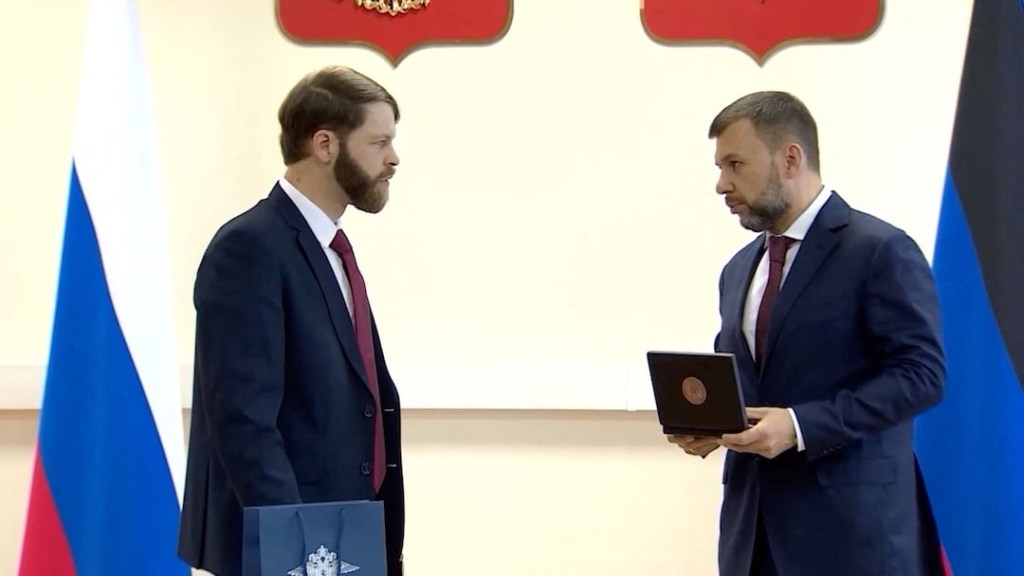
Finally, after some eight months of silence, out of the blue came an announcement on Telegram from the head of the Russian-occupied sector of Ukraine’s Donetsk region, Denis Pushilin, telling the world:
“By decree of our President Vladimir Putin, a passport of a citizen of the Russian Federation was awarded to Daniel Martindale.” [CBS News, July 15, 2025.]
Pushilin went on to say that Martindale had “long since proven with his loyalty and actions that he is one of us. He spent more than two years in the territory under enemy [Ukrainian] control. And not only did he survive — he helped. He supported our guys, passed on important information to our special services, risked his life.” [Id.]
Martindale (L) Receiving His Russian Citizenship – Moscow, July 15, 2025
Well, that solves that mystery . . . though not with the best possible answers. While it’s certainly a relief to know that Martindale is not rotting in one of Putin’s Arctic penal colonies, it is sorely disappointing to learn that he is, after all, a traitor to his own country. He never deserved a place on our list of hostages, and his name has been removed.
One interesting point: The Feenstras — the Canadian family who emigrated more than a year ago to the Nizhny Novgorod region, whose journey I have been following in this blog — have spoken about their path to citizenship. In February, after 13 months of living in Russia, they were granted temporary residency status, which will remain valid for three years. The next step at that time will be permanent residency, followed by full citizenship, for a total of six years’ waiting time.
Daniel Martindale seems to have skipped the preliminaries and gone directly to the final step in a little over half a year. Even taking into account his two years in Ukraine, that’s still a fast track to citizenship.
But I guess that’s the difference in the perceived value to the Russian state of legal, hard-working immigrants as opposed to soulless traitors.
I’ll tell you what the problem is — it’s 50 more days of bombs, missiles, drones, and ground assaults . . .
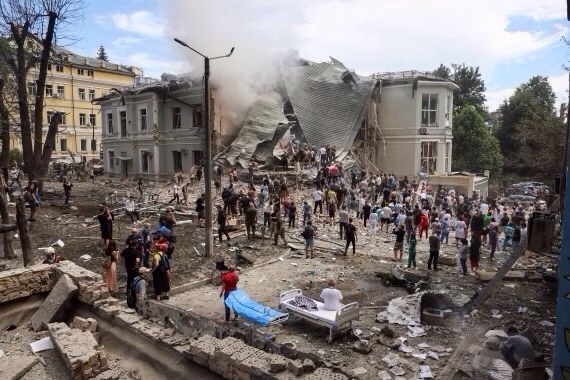
. . . 50 more days of civilians — women, children, the elderly and infirm — being killed or wounded in their homes, in schools and hospitals, or on the street . . .
. . . 50 more days of Vladimir Putin sitting in the Kremlin, strategizing with his military leaders about the best way to take control of a country in seven weeks . . .
. . . and 50 more days for Donald Trump to turn his attention to more “important” matters, like herding immigrants into concentration camps, taking revenge on people who have dared to disagree with him, and causing maximum disruption to the essential services of the very government he swore to protect.
It’s also 50 more days of Vladimir Putin and his flunkies laughing at the United States in general — and Trump in particular — for having handed him yet another gift: the gift of time.
And make no mistake . . . they are laughing.
Publicly, Kremlin spokesman Dmitry Peskov tried to make the West think that they consider Trump’s threatened 100% tariffs a “very serious” matter, telling journalists yesterday:
“We certainly need time to analyze what was said in Washington.” [Matthew Chance and Benjamin Brown, CNN, July 15, 2025.]
Sure, take your time, Dima — you’ve got another couple of months.
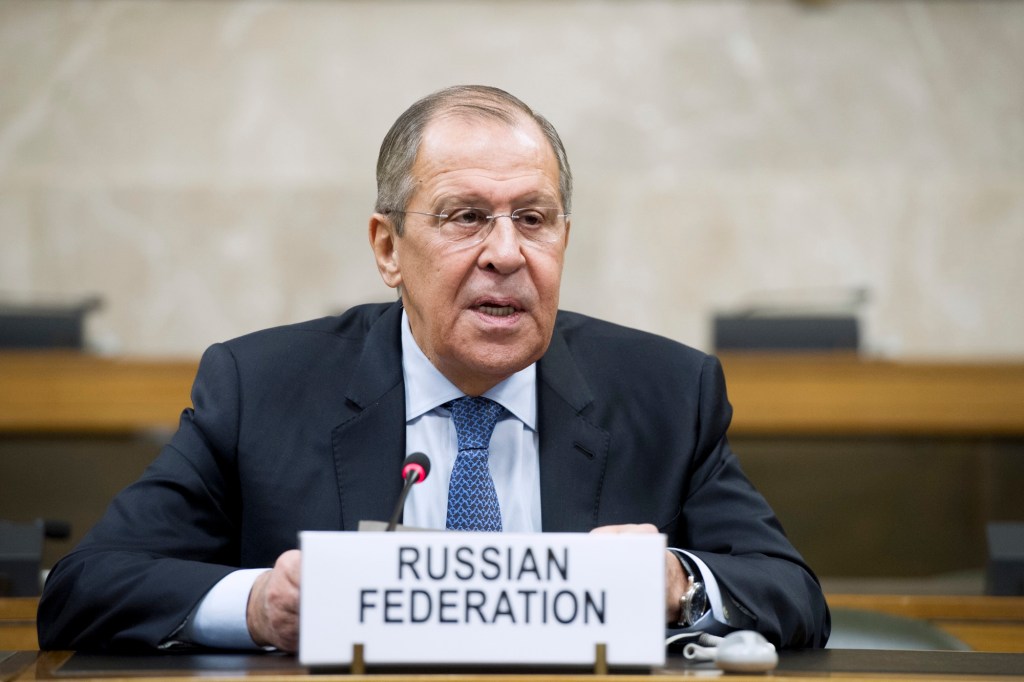
Foreign Minister Sergey Lavrov, on the other hand, was more direct, saying that further sanctions are not that much of a problem:
“We already have an unprecedented number of sanctions against us. We are coping and I have no doubt that we will cope.” [Id.]
And other Kremlin insiders are confident that 50 days will be enough time for their ever-increasing assaults on Ukraine to finish the job . . . or for Trump to completely reverse his Russia “strategy” (such as it is) yet again. One Russian legislator, Konstantin Kosachev, posted on social media:
“In 50 days, oh, how much can change, both on the battlefield and in the mood of those in power in the US and NATO. But our mood will not be affected.” [Id.]
Russian Foreign Minister Sergey Lavrov
And that sums up the problem. I’ve said it before — just yesterday, in fact — but it bears repeating: Donald Trump does not have the slightest inkling of what Vladimir Putin is really about. Trump is mercurial, reactive, and impetuous; whereas Putin, in typical Russian fashion, is proactive, plays a long game, studies his opponents to find their weaknesses, and plans his strategies in minute detail. But he is also cunning, and able to adapt to changes in circumstances when necessary.
Trump expresses frustration and “disappointment” in Putin; yet he continues to enable his adversary’s manipulations, because his self-interest is more important to him than the lives of the people of Ukraine. He wants desperately to be able to claim success in brokering an international peace agreement — perhaps to offset his massive failures at home — and thinks that he will eventually wear Putin down with sanctions.
But the odds are stacked against him; and until he recognizes and admits it, the people of Ukraine will not know a moment’s peace.
When I came down south to live with family five years ago, I was looking forward to meeting Dixie the dog . . . and we quickly became good friends. The fact that she would also befriend Attila the Hun if he offered her snacks is irrelevant; all that matters is that she likes me.
I was not, however, prepared for the Cat. That’s “Cat,” with a capital “C.”
We are a family of animal lovers, so a resident feline wasn’t really going to be a problem . . . or so I thought. But I’m more of a dog person, and had never lived with a cat before, so there were bound to be some surprises. I just never anticipated having to deal with the Queen of Sheba.
To begin with, she doesn’t have a name. That’s because, when she was rescued from the local shelter years ago, my son decided there was no sense in naming someone who wouldn’t respond to being called under any circumstances — and he was right: she doesn’t. I call her “Miss Kitty,” but that’s more for my own sake than hers.
She’s an older cat, and mostly just lies around, or wanders about the house checking things out, having a little snack or a drink, and looking for her next resting spot. Trying to play with her is futile — she’s simply not interested, or too tired, or perhaps considers herself above such nonsense.
Not Miss Kitty, But a Good Impersonator
So when toys didn’t work, I began gently approaching her from time to time, ignoring her haughty expression, and letting her sniff my hand to become acquainted. And one glorious day, she allowed me to stroke her for just a few seconds before standing up and slinking away.
Whereas Dixie can never get enough love from her humans, I’ve learned that cats are much more protective of their personal space. And they make the rules as to when they may be approached. So when Miss Kitty signals that it’s all right, I am now allowed to give her a nice, gentle petting. And sometimes — when she’s in an extremely generous mood — I’ll even be honored with a tiny kitty kiss.
But she still won’t approach me. Sometimes she’ll wander into my den while I’m sitting here, but not to see me — merely to sniff around, checking things out, only to stroll out again without so much as a nod of acknowledgment.
And occasionally, I’ll spot her walking by and into my bedroom, where she either does a routine check and walks out again, or finds a cozy corner in which to hide from Dixie for a while.
So when I caught her in my peripheral vision heading for the bedroom yesterday, I looked up from my reading in time to see her pause and look directly at me with an expression that clearly said, “I’m going in there, so don’t try to stop me.” As though I would have dared.
After about 15 minutes, I got up to go to the kitchen, and thought I’d look in on Miss Kitty, as I hadn’t seen her leave the bedroom. And when I turned toward the open door, there she was — sitting up in all her regal beauty in the middle of my bed, surveying her kingdom and giving me that look that said, “I know it’s your room, but it’s my house, so everything in it belongs to me. And this is a great bed.”
Also Not Miss Kitty
And that was that. She had staked her claim, and I felt that in doing so, she had bestowed upon me a great honor: the honor of acceptance.
It can’t be easy — especially if you’re a self-styled “stable genius” with an ego the size of Cassiopeia — to suddenly find out that your wife is not just a pretty face, but is also smarter than you.
And that perhaps if you’d listened to her in the first place, you might actually have been able to put an end to the war in Ukraine as promised.
After all, she did grow up in Slovenia, once a part of communist Yugoslavia. If anyone would be expected to understand the workings of a totalitarian regime and its leader, she would.
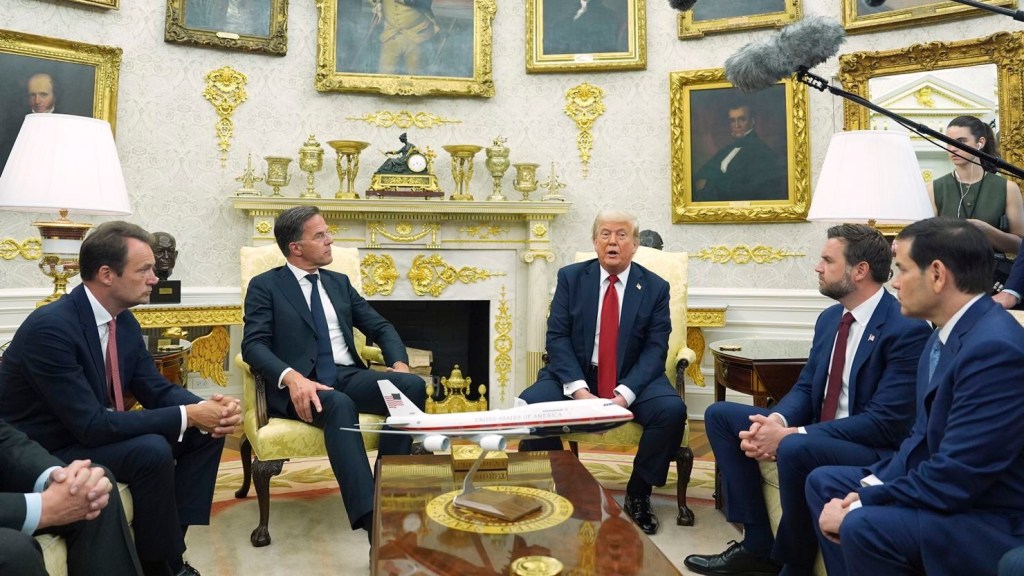
You probably know by now that I’m talking about first lady Melania Trump, who keeps a very low public profile and rarely comments on political matters. But it seems that, at least now and then, she does speak to her husband . . . who, of course, is none other than Donald Trump. And one thing she told him made its way back to NATO Secretary General Mark Rutte at a meeting in the Oval Office yesterday morning.
While discussing issues regarding a hoped-for ceasefire between Russia and Ukraine, Trump tossed in a personal anecdote:
“I go home, I tell the first lady, ‘You know, I spoke to Vladimir today. We had a wonderful conversation.’ And she said, ‘Oh really? Another city was just hit.” [Joey Garrison, USA Today, July 14, 2025.]
In the Oval Office – July 14, 2025
And — apparently finding the whole embarrassing exchange somehow worth repeating — he enlarged upon the same story at a luncheon later that day with his newly-established Faith Office gang in the White House State Dining Room:
“I’d get home, I’d say, ‘First lady [I’m sure he really calls her that, aren’t you?], I had the most wonderful talk with Vladimir. I think we’re finished.’ And then I’ll turn on the television, or she’ll say to me one time, ‘Wow, that’s strange because they just bombed a nursing home.’” [Id.]
According to first-hand reports, there was laughter from the crowd, so maybe it was funny after all . . . if you have a warped, sadistic sense of humor.
(Note: More about the White House Faith Office coming up in a separate article.)
Secretary of Commerce Howard Lutnik at the Faith Office Luncheon
The real tragedy is that he still doesn’t get it. Despite his recent blustering threats of going full monty on Putin, and his protestations that he’s had it with the Russian leader’s lies and the rising death toll in Ukraine, Trump has now given him another 50 days — just short of two months — to agree to a “deal” or face crippling tariffs.
And in a late phone call with the BBC, he still maintained that he is “disappointed but not done with Vladimir Putin.” When pressed by the interviewer as to whether he trusts Putin, he replied, “I trust almost no-one.” [Gary O’Donoghue, BBC, July 15, 2025.]
Which doesn’t exactly answer the question, does it?
*. *. *
In May and June of this year, an estimated 415 Ukrainian civilians were killed by Putin’s barrages, and another 2,179 injured. [Google AI-Overview.] And Trump — who repeatedly expresses horror at the unnecessary casualties of the ongoing war — has just given Putin enough time to take aim at that many additional civilians . . . or more.




































 The Blog About Everything … and Sometimes Nothing