Having a wonderful time reminiscing about all my past travel (and other) adventures. Hope you’ll share them with me in my blog, “All Roads Led to Russia.”
Late last night, when the news broke of Poland’s defensive interception of Russian drones in Polish airspace, I posited three likely excuses we might expect to hear from Russian authorities: 1) denial; 2) purported overreaction by Polish military forces; or 3) an accusation of provocation on the part of Poland itself.
Today, it appears they’ve chosen all three.
A Russian Shahed Drone
In a statement on its website, the Russian Foreign Ministry said:
“. . . no targets on the territory of Poland were planned for destruction . . . [and that these] specific facts completely debunk the myths repeatedly spread by Poland in order to escalate the Ukrainian crisis further.” [Brad Lendon, Isaac Yee, Nina Subkhanberdina and Ivana Kottasova, CNN, September 10, 2025.]
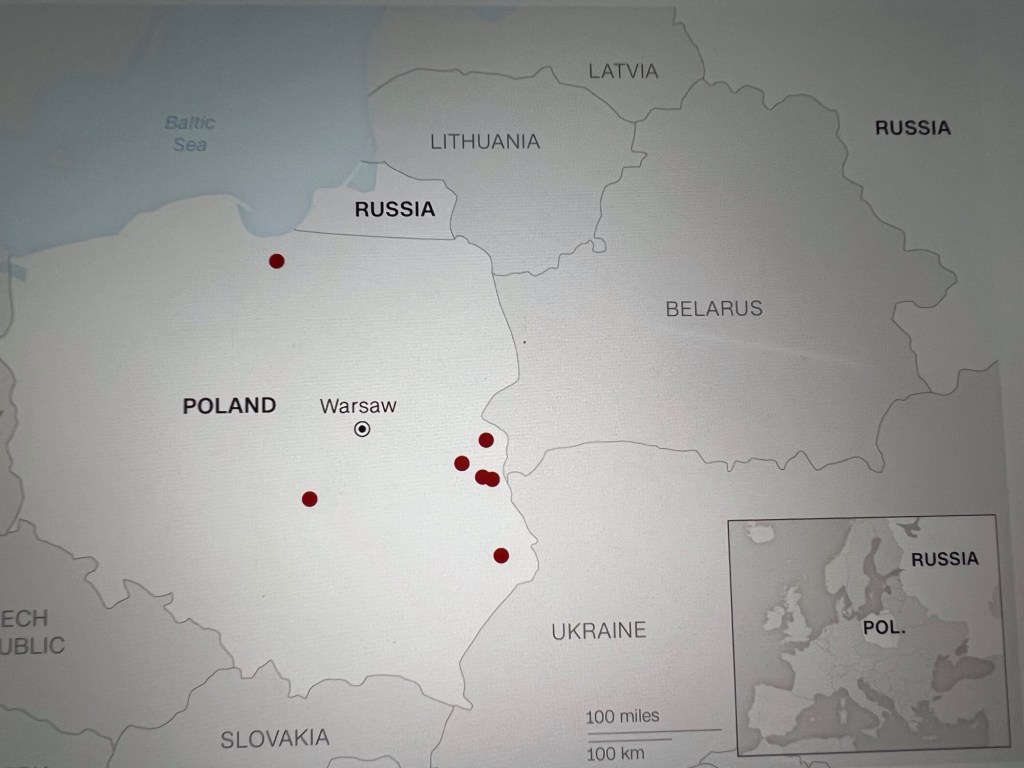
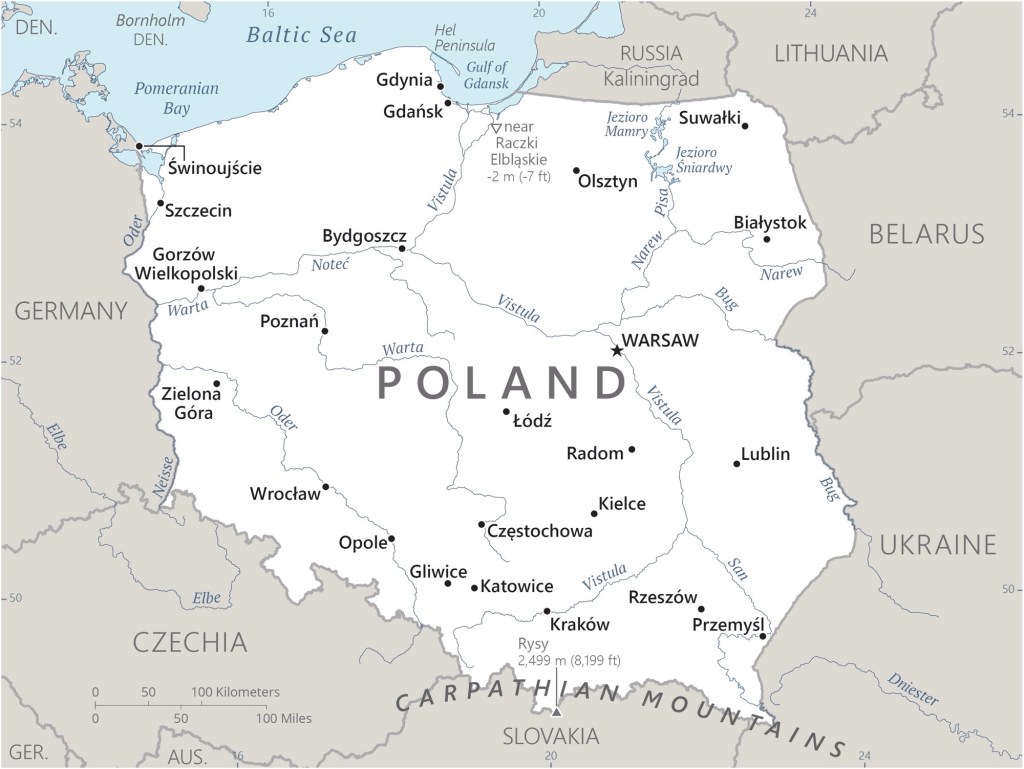
But this was not an isolated incident; nor was it a single drone that accidentally overshot its intended Ukrainian target. There were 19 known drone attacks, the majority originating in Belarus, with some reaching into the center and far north of Poland.
Map of Drone Strikes in Poland – September 10, 2025
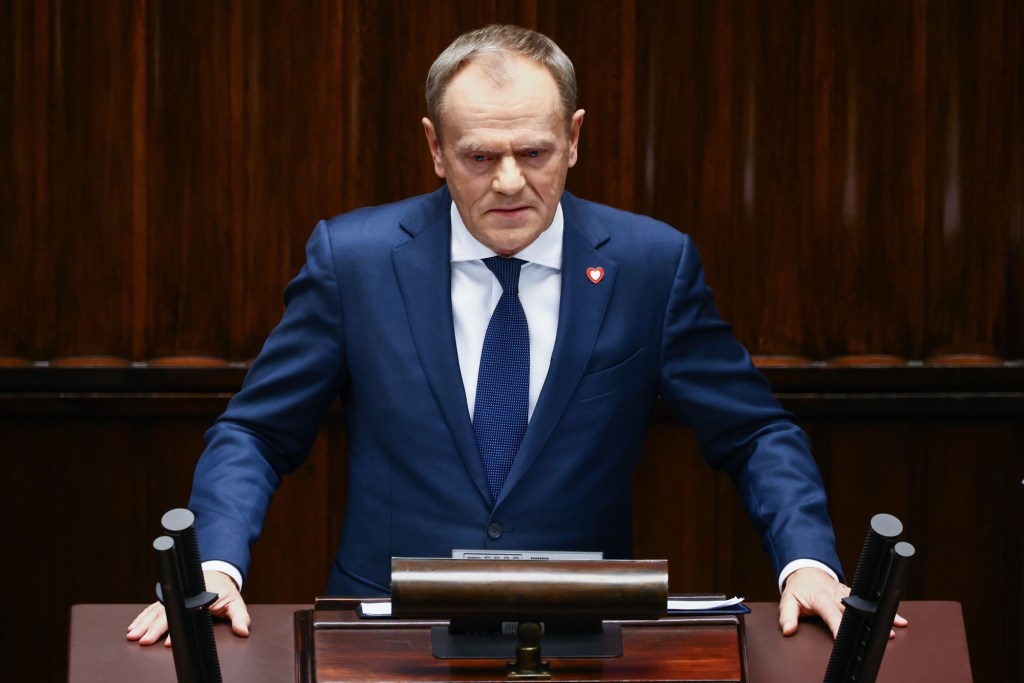
Polish Prime Minister Donald Tusk said that, while there was no reason to say that Poland is at war, it is now closer than at any time since World War II . . . adding that his country is facing an “enemy that does not hide its hostile intentions.”
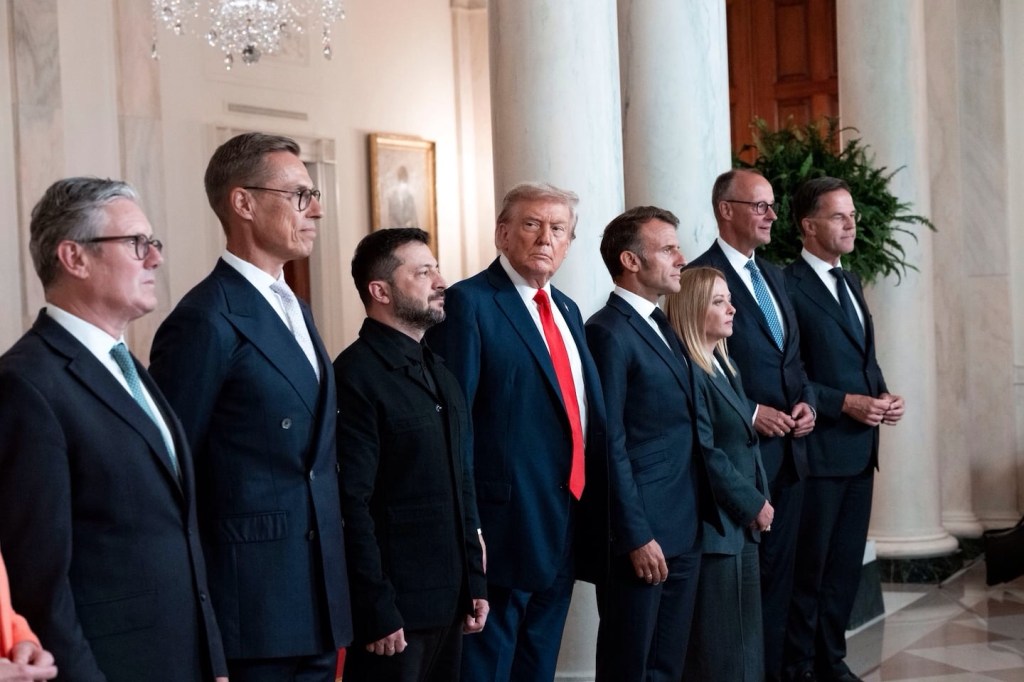
Strong messages have also been issued by European and other allies:
> German Defense Minister Boris Pistorius said this was a “deliberate and targeted provocation.”
> Canadian Prime Minister Mark Carney said that “Russia’s actions — following a week of brutal attacks on Ukrainian civilians — underscore the importance of our steadfast support for Ukraine.”
> And Kaja Kallas, the EU’s foreign policy chief, called it “the most serious European airspace violation by Russia since the war began, [and that] indications suggest it was intentional, not accidental. Russia’s war is escalating, not ending.” [Id.]
*. *. *
And what was Donald Trump’s initial reaction this morning? He wrote this on his social media platform:
“What’s with Russia violating Poland’s airspace with drones? Here we go!”[Michelle Stoddart, Morgan Winsor and Tomek Rolski, ABC News, September 10, 2025.] [Bold emphasis is mine.]
“Say what?!!”
And there you have it: the supposed leader of the free world has spoken. Only, as usual, he has said absolutely nothing.
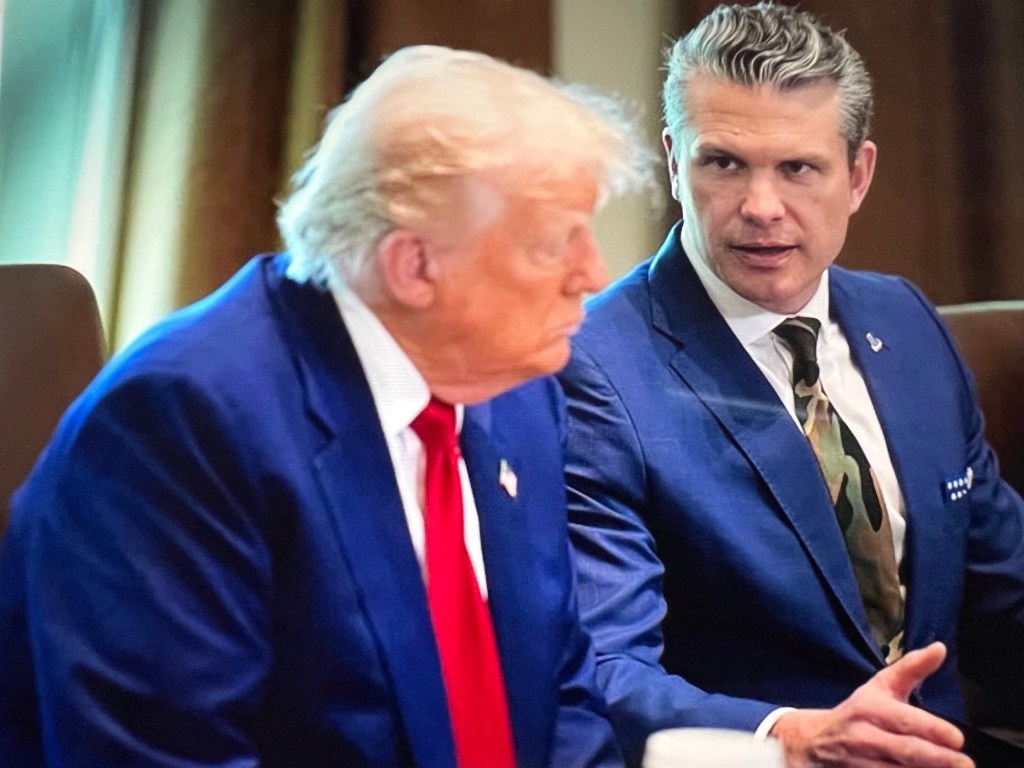
Perhaps he and his newly titled Secretary of WAR, Pete Hegseth, are busy poring over a world map, trying to locate Poland.
NOTE: This report was written last night, before the news flashed across my screen of Poland’s military defenses having shot down Russian drones that had penetrated Polish airspace. In the context of that event, this article may seem less significant. But in fact, all actions ordered by Vladimir Putin, and all statements issued by him and members of his inner circle, should be viewed cumulatively. He does nothing, and says nothing, without a reason.
*. *. *
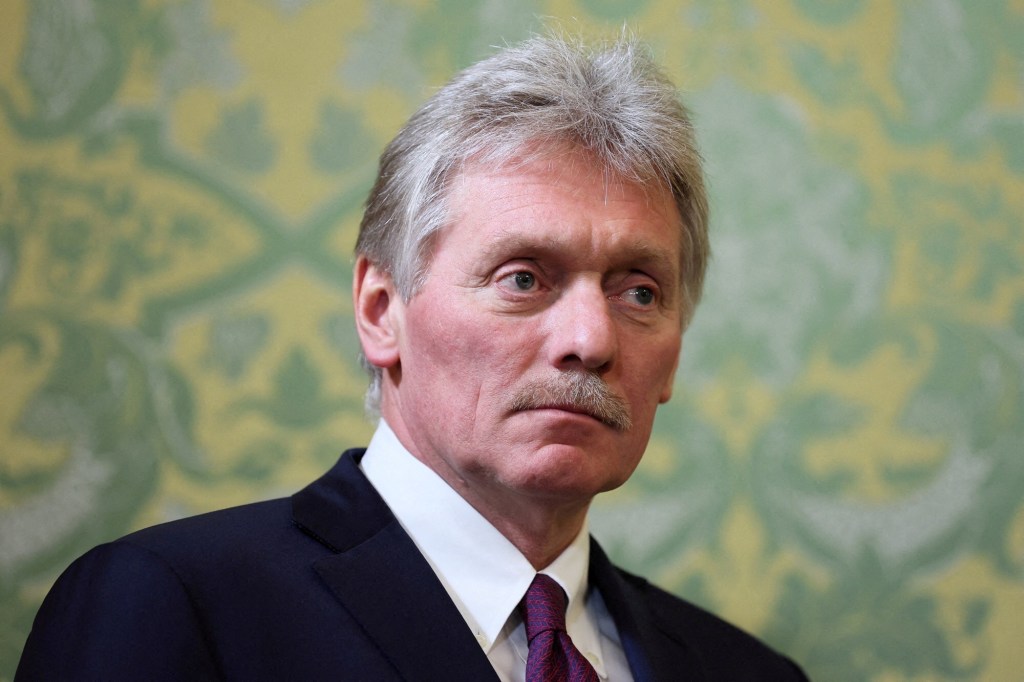
The “horse” in this case is none other than everyone’s favorite press secretary, Kremlin spokesman Dmitry Peskov. And the most recent proclamation from his lips could not have been clearer:
He said that sanctions are not working . . . and they never will.
Dmitry Peskov
On Friday, September 5th, Donald Trump issued another of his empty threats, saying that he would get the war settled “or there’ll be hell to pay.” [Guy Faulconbridge and Anastasia Teterevleva, Reuters, September 8, 2025.]
On Monday, September 8th, the United States and the European Union announced that they were considering additional economic restrictions against Russia in the ongoing effort to force Vladimir Putin to the negotiating table and bring an end to his war against Ukraine.
But on the same day, Peskov told a Kremlin reporter:
“No sanctions will be able to force the Russian Federation to change the consistent position that our president has repeatedly spoken about.” And he added that sanctions had “turned out to be absolutely useless in terms of exerting pressure on Russia.” [Id.]
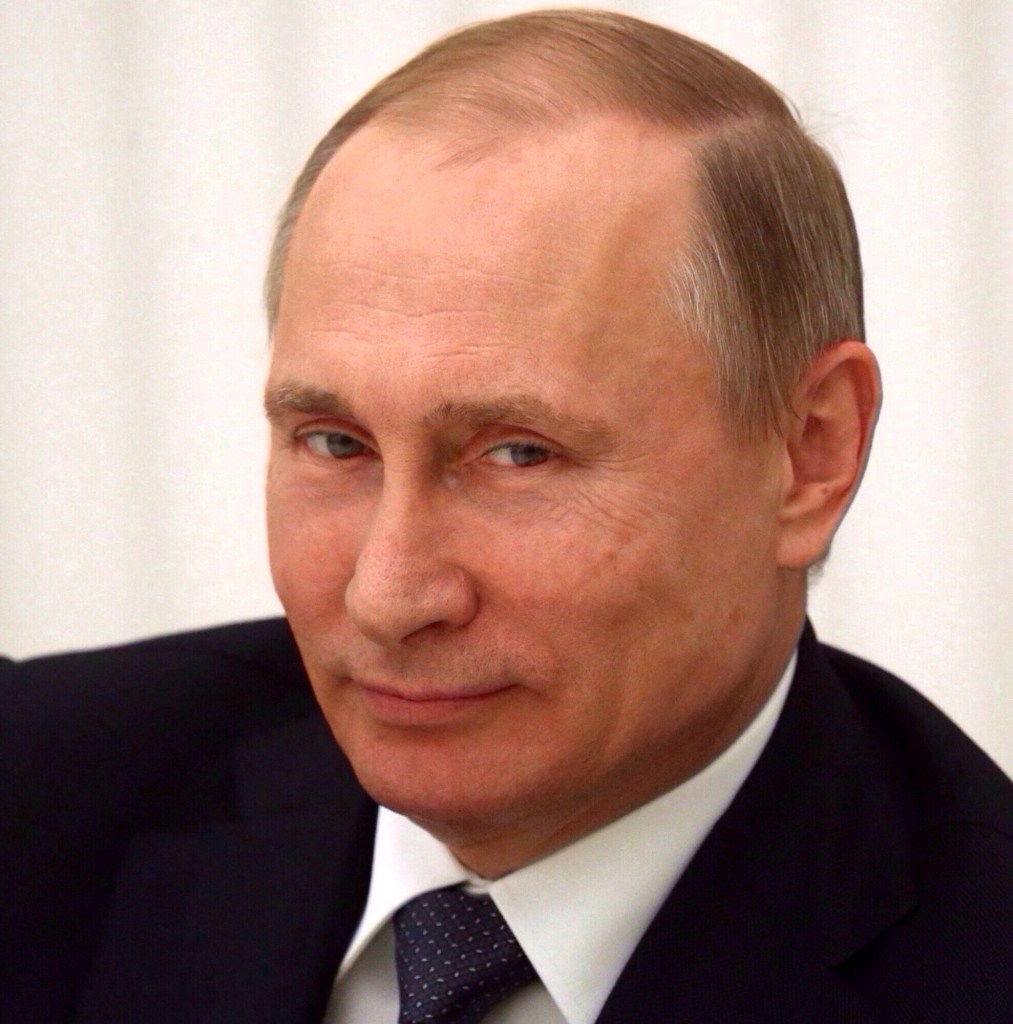
Putin himself has said that the Russian economy has endured well, growing faster than those of G7 countries. He has ordered businesses and officials to defy the sanctions in every way possible. [Id.]
Laughing All the Way To the Bank
Meanwhile, Ukraine and its European allies continue to say they do not think Putin is serious about peace. [Id.]
Well . . . no sh*t, Sherlock!!
What do you suppose their first clue was? The strike on the main government building in Kyiv?
Or the 24 civilians killed, and as many more injured, by a Russian glide bomb attack on the village of Yarova in the eastern region of Donetsk on Tuesday night?
Short of declaring war on Russia, the U.S. and EU countries are doing everything in their power to put a stop to the madness. But as long as Russia’s allies — China, North Korea, Iran, India, and even a few right-leaning European countries — continue to support his war effort by refusing to cut off trade relations, Putin is determined to carry on his march through Ukraine, keeping his country running on a wartime economy.
And what are our options?
Seriously . . . I’m asking: What are our options? Does anyone know?
21:38 EDT: The operational command of the Polish armed forces posted that “Polish and allied aircraft are operating in our airspace, while ground-based air defence and radar reconnaissance systems have been brought to the highest state of readiness.” [BBC, September 9, 2025.]
21:57 EDT: The Polish army has stated that a military operation is “ongoing,” and urged everyone to stay at home. [Id.]
22:03 EDT: The Polish Armed Forces confirmed that the country’s airspace was “repeatedly violated by drone-type objects” during Russian strikes in Ukraine, and that an operation is underway to “identify and neutralise the targets.” [Id.]
22:15 EDT: Poland’s Deputy Defense Minister, Cezary Tomczyk, said: “Over Poland, an operation to neutralise objects that have violated and exceeded the border of the Republic of Poland is underway. All services are in action. We ask you to follow the announcements of the Polish army and the police.” [Id.]
22:26 EDT: The Polish Armed Forces said on X: “Weapons have been used, and operations are underway to locate the downed objects.” [Id.]
22:30 EDT: Polish Prime Minister Donald Tusk confirmed that an operation is underway “related to multiple violations of Polish airspace,” and that he has been in “constant contact” with the Ministry of Defense and has received a direct report from the operational commander. Id.]
Polish Prime Minister Donald Tusk
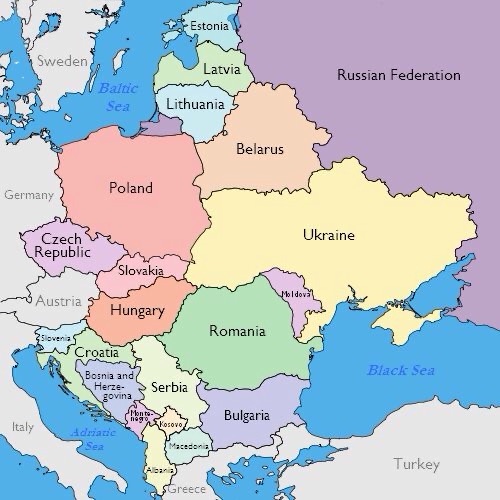
With Russia’s missile and drone attacks on Ukraine intensifying and reaching to the far western regions of the country, the bordering nations of Poland, Hungary, Slovakia, Romania and Moldova have long been alert to the possibility of an invasion — even if accidental — of their airspace. And now, for the first time, it has happened: Poland — a NATO member — has been forced to deploy aircraft to intercept and shoot down what appear to be Russian drones.
22:51 EDT: Three regions in the eastern part of Poland close to the borders of Ukraine and Russia-friendly Belarus have been identified as the most vulnerable at this time, one of which — the Mazowieckie region — includes the nation’s capital of Warsaw. The Armed Forces have stated that they are monitoring the situation and “remain fully prepared for immediate response.” [Id.]
How do you suppose Putin will characterize this? A figment of everyone’s imagination? An overreaction on the part of the Polish military? Or perhaps even a provocation created by Poland itself, as an excuse to attack Russia?
Maybe he’ll say Poland just shouldn’t have been in the way when those drones overshot their intended targets in Ukraine!
*. *. *
Separately, an earlier report (22:29 EDT) stated that drones had been detected heading west toward the city of Zamosc, Poland, and that Warsaw’s Chopin Airport, along with at least two other airports in the country, had been shut down “due to unplanned military activity related to ensuring state security.” [Brad Lendon, Isaac Yee and Nina Subkhanberdina, CNN, September 9, 2025.]
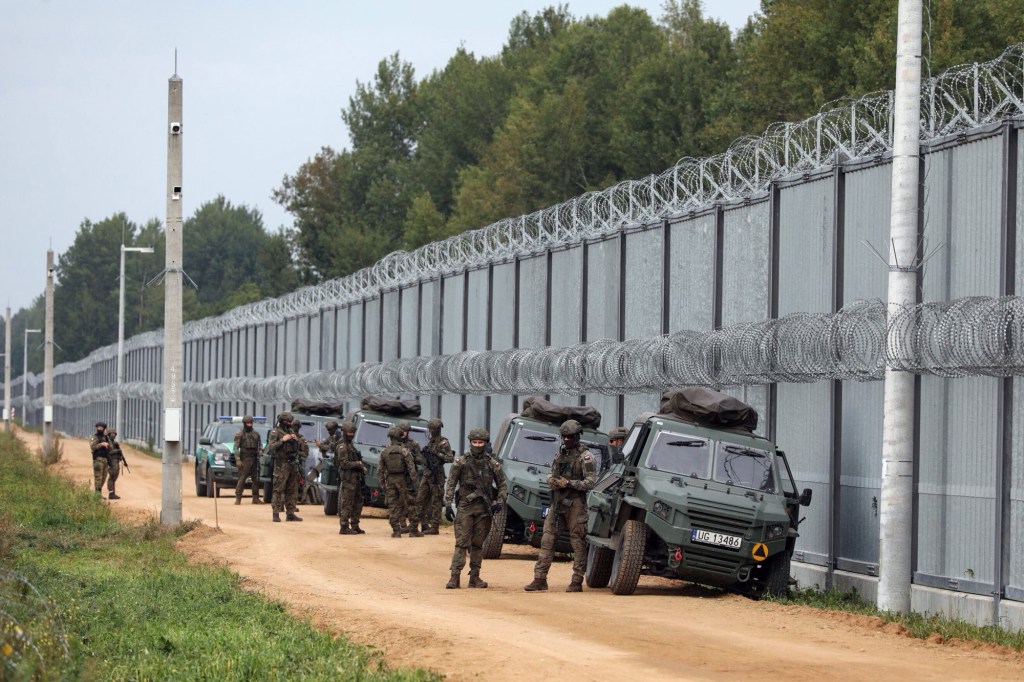
It was also announced that Poland was closing its eastern border with Belarus due to large-scale joint Russian-Belarusian military exercises beginning on Friday. Known as the Zapad 25 exercises, they have caused serious concern in neighboring NATO countries Lithuania and Latvia as well. As stated by Prime Minister Tusk at a government meeting:
“On Friday, Russian-Belarusian maneuvers, very aggressive from a military doctrine perspective, begin in Belarus, very close to the Polish border. Therefore, for national security reasons, we will close the border with Belarus, including railway crossings, in connection with the Zapad maneuvers on Thursday at midnight.” [Id.]
At the Polish Border With Belarus
*. *. *
It is impossible tonight not to think back to those last days of February 2022, when Russian troops amassed near the border of Ukraine in what Vladimir Putin called, and still calls, a “special military operation” . . . a supposedly routine exercise that has lasted more than three and a half years.
Whatever is going on — whether yesterday’s two situations are connected or coincidental — this does not bode well. I assume the lights will be on in the Washington White House all night tonight.
Farming is hard work. And building a farm from scratch, in a strange country where you don’t know the customs, the laws, or even the language, seems to me to be an impossible task.
Yet the Feenstras have been doing it for nearly two years now, and with a surprising level of success. It hasn’t been easy; but with a family of eight children (though a couple are still too young to help with the work), a bottomless supply of faith, and a good bit of outside help, Arend and Anneesa Feenstra are making it happen.
The Feenstra Clan
And somehow — amidst all of the vegetable growing, animal tending, construction, equipment maintenance, canning, cooking, sewing, scrubbing, and the daily recording and broadcasting of every joyous facet of Russian farm life for Putin’s propaganda machine — they occasionally manage to squeeze in a bit of rest and relaxation.
Recently, they were invited to participate in a “fair” at nearby Nizhny Novgorod — bigger and more extensive than the local markets they’ve attended closer to home. Arend Feenstra did a good bit of filming as he strolled through the grounds, but held back on his usual narration this time, so I’ll have to let the screen shots do the talking for him.
As you can see, the fair was primarily another market opportunity for the local farmers and crafters. The fairgrounds did not appear to have permanent stands; the vendors came well prepared for what turned out to be a somewhat rainy day, and set up their own weather-protected venues.
While not a momentous occasion for the Feenstras, the video did offer a first-hand view of life off the farm in rural Russia: simple, family-oriented, somewhat primitive from a 21st-century viewpoint, and focused on the basic necessities of life. But it was an opportunity to socialize, and to rest from the daily grind of farm work.
*. *. *
In another video back at home, we were given a glimpse of a gathering of friends in the big Feenstra kitchen, which included their new tenant farmers, Justin and Anita Pulley and their four children; another emigre family; and some Russian friends.
With musical entertainment provided by Justin and Anita, this might have been a get-together in any country in the world . . . a confirmation of my belief that people are basically the same everywhere: decent, honest, hard-working, caring individuals who bear no ill will toward anyone.
It’s the governments that are the problem.
And why the decent, honest, hard-working, caring Feenstras chose to live under Putin’s repressive, autocratic government — simply to escape the “wokeness” of their native Canada — is something I have yet to understand.
It seems to me they’ve traded one perceived “evil” for a proven one. And it is their children who will have to live with that choice.
I confess: I like sweets. No . . . actually, I love sweets. And I am of the opinion that, as we age and find ourselves losing one after another of our favorite things, we’re entitled to hang on to a guilty pleasure or two. Mine happens to be my sweet tooth.
Now scientists are saying that more and more people are indulging in increasing amounts of sugary stuff . . . and there is a surprising reason for it. Apparently, summer’s hot, humid weather increases our desire for cold, sweet treats and beverages, like ice cream, frozen desserts, and icy drinks. But now that phenomenon has become more widespread, and a team of researchers has been trying since 2004 to figure out why.
According to Pan He, a study author and lecturer in environmental science and sustainability at Cardiff University, it can be blamed on climate change.
The data collected between 2004 and 2019 showed that, for every 1.8 degrees Fahrenheit of warming, added sugar consumption in U.S. households increased by 0.77 grams per person per day, with the greatest escalation noted at temperatures between 68 and 86 degrees. [Laura Paddison, CNN, September 8, 2025.]
Without going into excruciating detail here, the study says that hotter weather causes the body to lose more water, thus increasing the craving for hydration and cooling. That makes sense: when you sweat, you need to replace the fluid you’ve lost. And it seems that, when that happens, Americans tend to reach for cold, sweet products. [Id.]
I’m a firm believer in the efficacy of scientific research, and I do not in any way dispute the conclusions of this 15-year study. And I also give full credence to the advice of the American Heart Association that we need to limit our sugar intake in order to avoid such devastating illnesses as diabetes, obesity and heart disease.
But, as an emancipated adult American woman, I also claim the right to ignore that advice if I so choose. I’m not endangering anyone but myself.
As far as I’m concerned, my sweet tooth and I have been together for more years than I care to admit, and we are inseparable. Having gotten this far with only a couple of manageable health issues to complain about, I figure I’ve been doing something right. And that includes my compulsion to end every meal with something sweet . . . and to supplement those desserts with an occasional between-meals treat.
It has nothing to do with hot weather, either. I have bought ice cream from an outdoor vendor in Moscow in the middle of February (and had to stand in line behind half a dozen other idiots to get it). And although I now live in the steamy southern U.S., our house is air-conditioned. The outdoor heat is not the cause of my sugar craving.
I just love sweets, sweetie; and nobody . . . do you hear me? I said NOBODY . . . is going to get between me and my Haagen-Dazs.
When we think of the Great Depression of 1929-39, we think of the causes — the stock market crash, the run on banks, the gold standard, and the retaliatory tariffs engendered by the U.S. Smoot-Hawley Act. And we think of the effects on the general population — massive unemployment, lost investments and savings, bread lines, an epidemic of suicides.
Depression-Era Bread Line
But how often do we think of what finally brought us out of that decade of decline and despair? It started with President Franklin Delano Roosevelt’s “New Deal,” of course: a jobs program that got Americans back to work building a bigger and stronger infrastructure for the country, stabilizing the economy, and benefiting everyone individually and collectively. But it wasn’t enough by itself.
What ultimately brought an end to one calamity was the start of yet another one: World War II.
America’s entry into the war after the Japanese attack on Pearl Harbor on December 7, 1941, created an urgent, immediate need for increased production of war materials. Existing factories were retooled and new factories built to produce tanks, airplanes and rifles instead of cars, refrigerators and bicycles — thus creating countless new jobs.
Military conscription was enacted and volunteerism escalated, putting millions of draft-age men to work fighting for freedom. The vacuum thus created in the civilian work force was filled by women and by men who were too old or physically ineligible to go to war.
The country was operating on a wartime economy, which not only ended the depression, but brought about the great economic boom of the late 1940s and forward into the ‘50s and beyond.
*. *. *
Is it surprising, then, that Russia — despite the punishing sanctions that have been levied against it by the U.S. and numerous other countries — has managed to survive the last three and a half years since its invasion of Ukraine?
The circumstances are different, of course. Before the invasion, Russia was not in an economic depression. It didn’t need to be dragged out of a slump; it simply needed to keep from plunging into one. So it seemed that the best way to punish Vladimir Putin’s actions against Ukraine would be to strike at his country’s economy, first by hitting it with disabling sanctions, and then by imposing tariffs against countries that continued to trade with it.
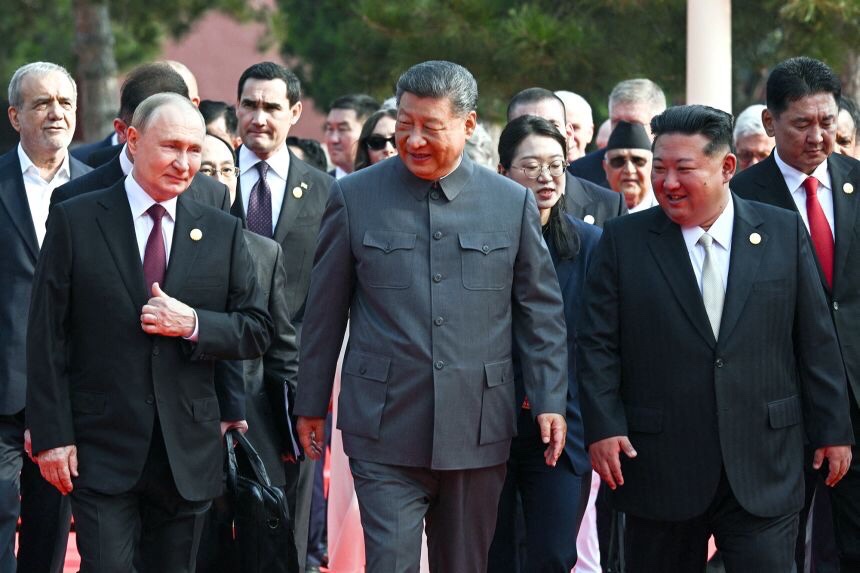
Thus far, that hasn’t turned out to be as crippling to Russia’s economy as intended. Countries like China, North Korea, India and Iran continue to purchase Russia’s seemingly endless supply of oil and gas, and to offer military assistance . . . weaponry as well as personnel.
Friends and Business Partners
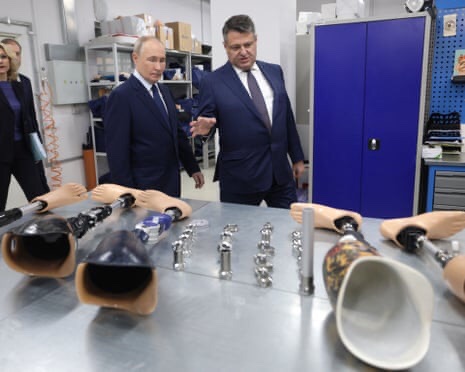
And — like the U.S. during World War II — Russia has been operating on a wartime economy, giving birth to new industries out of necessity. Case in point: prosthetics.
State Secretary for the Ministry of Defense Anna Tsivlyova, in a rare discussion of the casualties caused by the “special military operation” in Ukraine, told the Eastern Economic Forum in Vladivostok that Russia has achieved “huge breakthroughs” in prosthetic development because of the war:
“The participants of the special military operation have become, so to speak, the drivers of the development in this sphere, and we’re accumulating experience on a global scale.” [Matthew Loh, Business Insider, September 5, 2025.]
Tsivlyova added:
“Today, the participants of the special military operation allowed us to reach a priority, flagship level. Because what our state does is much higher than the standards adopted elsewhere. We are leaders here. It’s not China, it’s not anywhere in Europe. There is huge investment, huge amounts of money, huge opportunities that opened.” [Id.]
Vladimir Putin Inspecting Prosthetics Facility
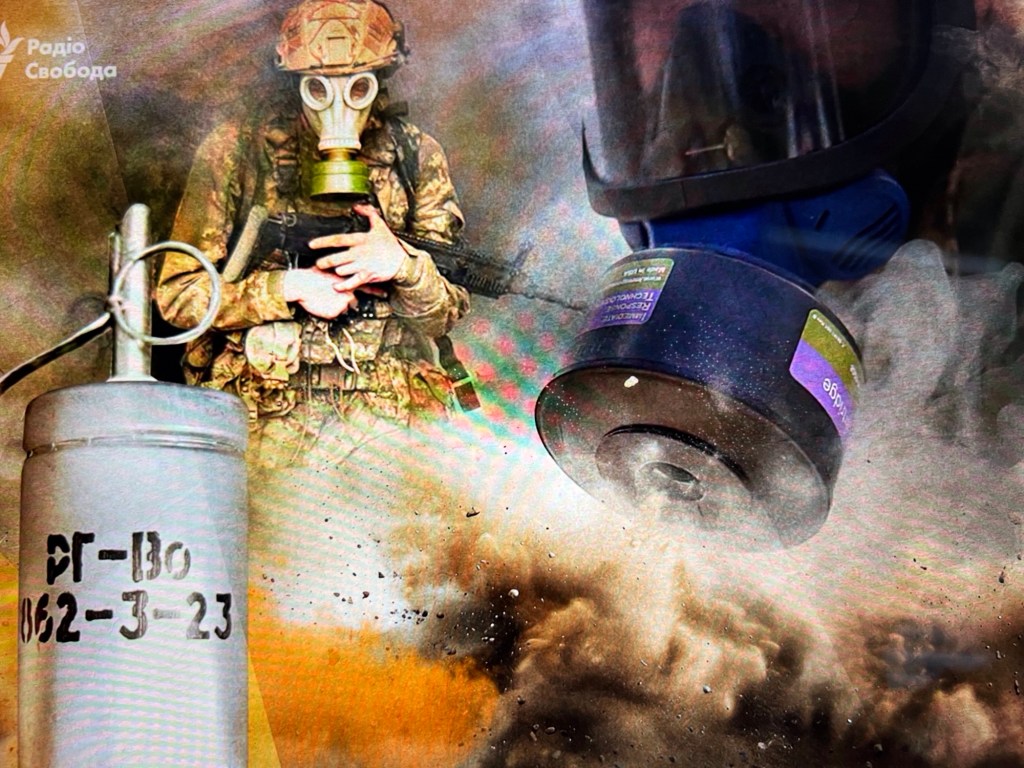
Another example can be found in a monastery town outside of Moscow at the Scientific Research Institute for Applied Chemistry (NIIPH). Though its website advertises such products as fireworks and sparklers, it has been mass-producing RG-Vo grenades — a toxic gas grenade — for use in Ukraine.
While prohibited from use in warfare under the Chemical Weapons Convention — to which Russia is a party — they have been circumventing sanctions against the Institute by manufacturing the banned weapons with raw materials from unsanctioned companies, and ingredients such as red phosphorus — which can be converted into deadly white phosphorus — from Chinese companies. [Kyrylo Ovsyaniy, et al., RFE/RL, September 6, 2025.]
RFE/RL Photo: The Canister Reads, in Cyrillic Lettering, “RG-Vo.”
Thus, Russia has taken the lessons of history and turned them to its advantage, creating and expanding industries to maintain its war against Ukraine . . . the war that it has no intention of bringing to an early end.
No matter how hard the U.S. and its European allies try.
Although Russia’s invasion of Ukraine has brought the U.S. into what some are calling another Cold War with the “Evil Empire,” it’s not (so far) an actual war. Let’s pray it never becomes one.
And diplomatic relations with China and North Korea seem to be holding thus far.
That’s the good news.
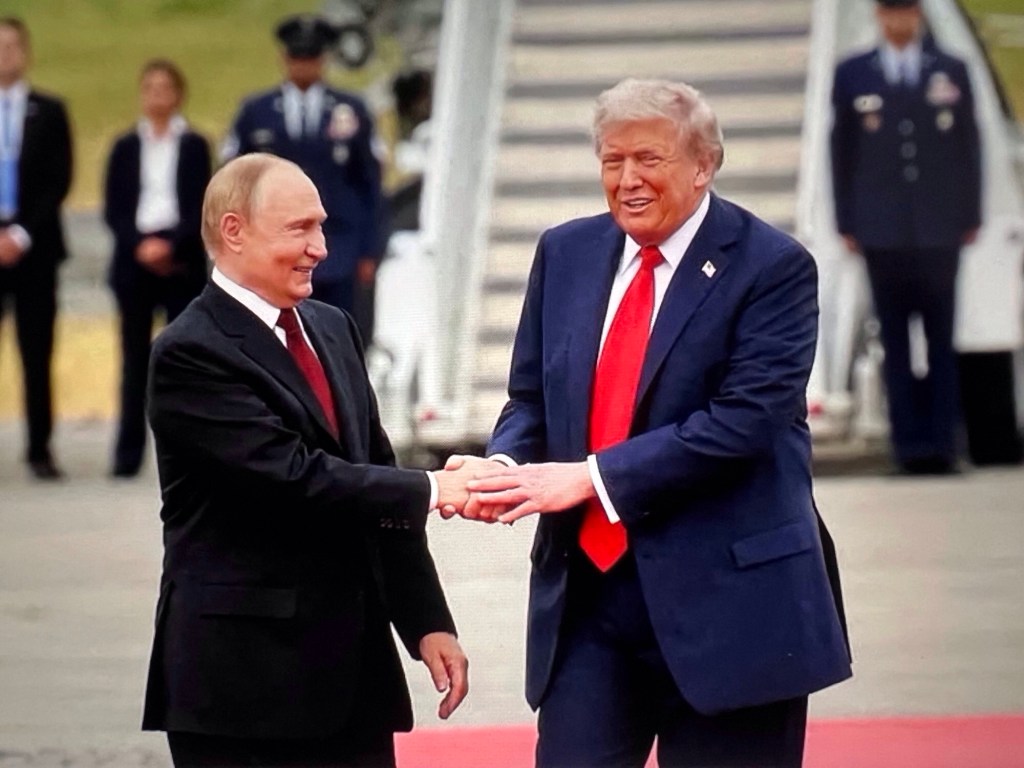
The Two-Fisted Hand Shake in Alaska
But what’s going on in Venezuela? First, Donald Trump orders a strike against a “drug-carrying vessel from Venezuela,” — not an interception and arrest, but a deadly attack that killed 11 people. It was not a defensive action; it was a first strike by the United States government. [Danai Nesta Kupemba, BBC News, September 5, 2025.]
Then Venezuela twice flew its military aircraft near a U.S. vessel off the coast of South America, causing Trump to warn that, if Venezuelan jets continue to fly over U.S. naval ships and “put us in a dangerous position, they’ll be shot down.” [Id.]
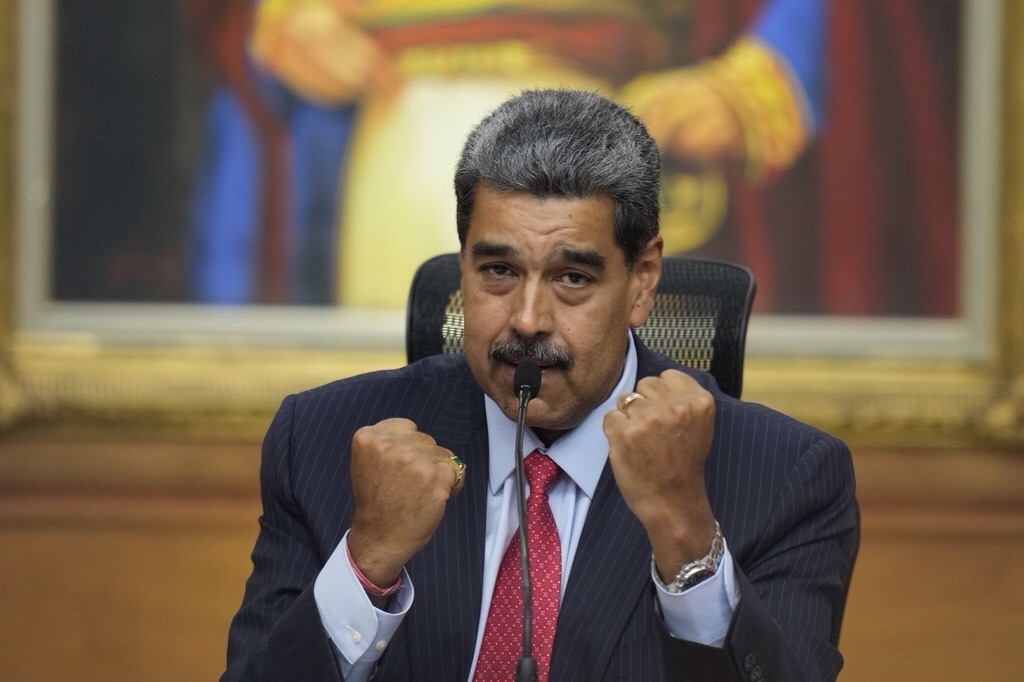
Venezuelan President Nicolas Maduro has denied Trump’s allegations and accused him of seeking “regime change through military threat” . . . while still emphasizing that “Venezuela has always been willing to talk, to engage in dialogue, but we demand respect.” [Id.]
Venezuelan President Nicolas Maduro
But is Trump’s war on drugs — while arguably a good thing in and of itself — a legitimate excuse to use force against foreign suspected traffickers outside of U.S. territory, in clear violation of international law? Isn’t that, in reality, fighting one crime with another?
And could it not be construed as an act of war?
That doesn’t seem to matter to U.S. Secretary of State Marco Rubio, who said during a visit to Ecuador that the U.S. will “blow up” foreign crime groups if necessary, possibly in collaboration with other countries:
“Now they’re gonna help us find these people and blow them up, if that’s what it takes.” [Ione Wells, BBC, September 4, 2025.]
*. *. *
Setting aside the multiple ongoing international headaches, Trump seems also to have declared war on his own country.
When he sent the National Guard into Los Angeles, he alleged that it was to support local law enforcement in defending against massive riots — which turned out to be scattered confrontations that the local and state authorities said were spotty flare-ups that were well under control.
And in D.C., when Trump rode past a homeless encampment in McPherson Square, he decided that Washington was in the throes of a devastating crime wave that needed to be cleaned up — not by increasing the resources of the D.C. Police Department, but again by sending in the military. Over 2,000 National Guard “reinforcements” have found themselves in the nation’s capital with so much time on their hands, they’ve been kept busy cleaning up trash and tending the many city parks. And why?
Because there is no devastating crime wave in D.C. In fact, violent crime in the city has been down by about 20% over the same period last year.
Our Military In Action – Washington, D.C.
*. *. *
Still, not to be discouraged by court rulings and massive civilian protests against his unconstitutional misuse of the military, Trump has now turned his attention to — and declared war on — Chicago.
Having already announced plans to begin a major immigration enforcement operation in the nation’s third-largest city, Trump issued this unhinged statement in a social media post:
“I love the smell of deportations in the morning … Chicago about [sic] to find out why it’s called the Department of WAR.” [Samantha Waldenberg, CNN, September 6, 2025.]
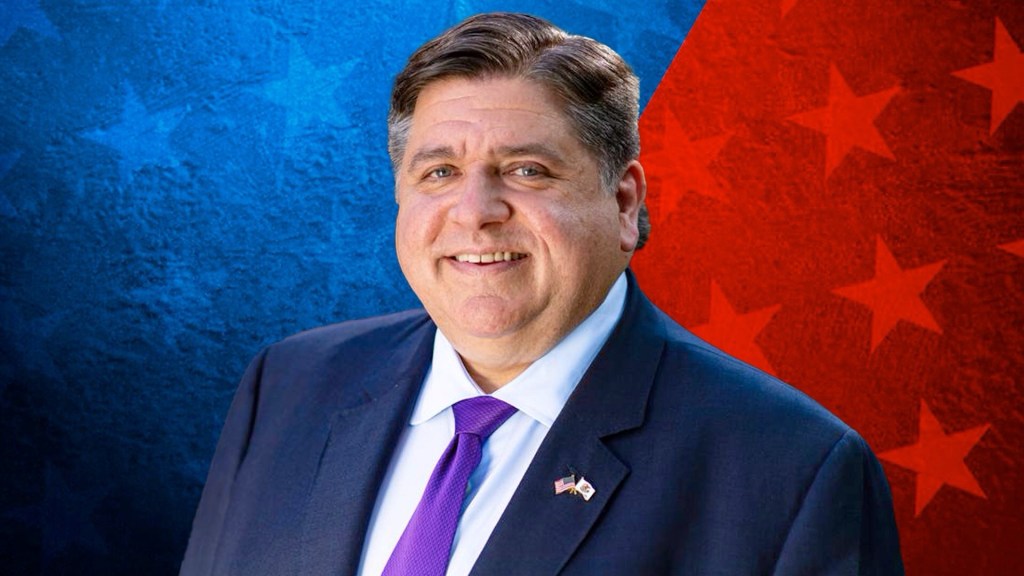
To which Illinois’ Governor J.B. Pritzker replied in a post on X:
“The President of the United States is threatening to go to war with an American city. This is not a joke. This is not normal. Donald Trump isn’t a strongman, he’s a scared man. Illinois won’t be intimidated by a wannabe dictator.” [Id.]
Illinois Governor J.B. Pritzker
Yes, folks . . . he’s declared war on his own country.
*. *. *
But hold on — what was that about a “Department of War”? When did that happen?
Actually, it’s not official; that can only be codified by an Act of Congress, as was done in 1949 when the earlier wartime “Department of War” was renamed the “Department of Defense.” But current Secretary of Defense Pete Hegseth has been authorized — by one of Trump’s multitude of executive orders * — to style himself as Secretary of War. And he wasted no time in changing the name plate on his office door at the Pentagon.
* Executive Order: “Restoring the United States Department of War,” September 5, 2025, whitehouse.gov.
The Executive Order goes to great lengths to justify itself, in essence declaring that what was right for George Washington in the 18th century is good enough for Donald Trump some 236 years later:
“The Founders chose this name to signal our strength and resolve to the world. The name ‘Department of War,’ more than the current ‘Department of Defense,’ ensures peace through strength, as it demonstrates our ability and willingness to fight and win wars on behalf of our Nation at a moment’s notice, not just to defend. This name sharpens the Department’s focus on our own national interest and our adversaries’ focus on our willingness and availability to wage war to secure what is ours. I have therefore determined that this Department should once again be known as the Department of War and the Secretary should be known as the Secretary of War.”
*. *. *
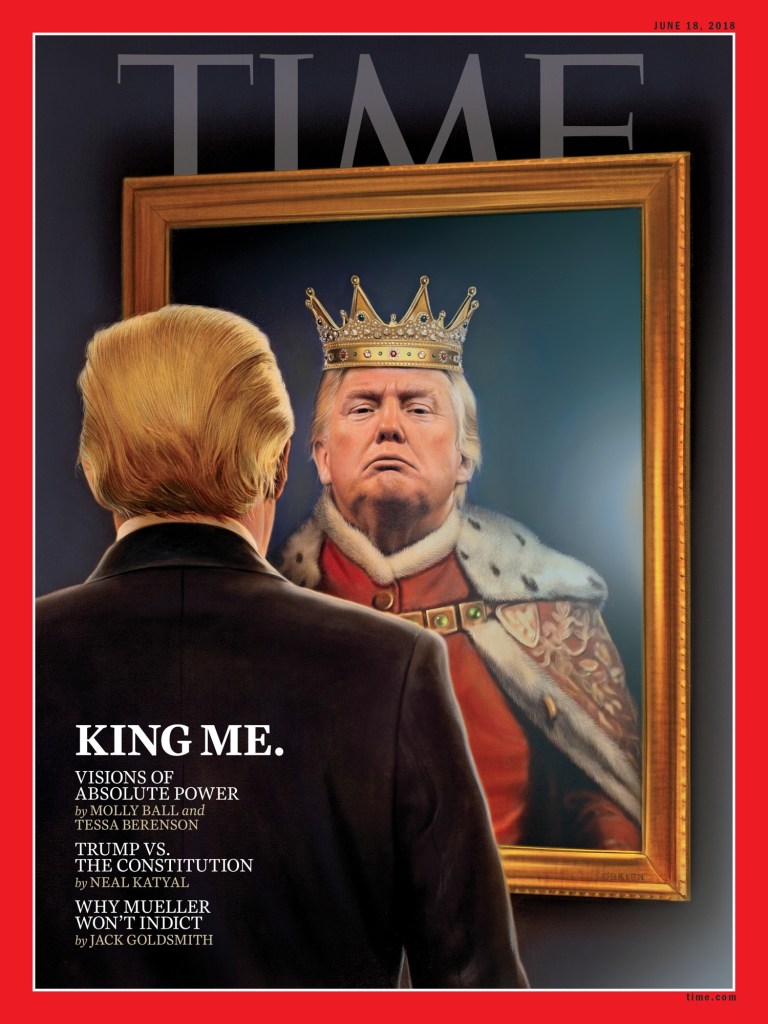
Thus does Donald Trump “render unto Caesar” — i.e., himself — “that which is Caesar’s.”
Or what he, as America’s dictator, declares to be his.
Well, so much for being the family member with the strongest resistance to whatever bug happens to be going around. Two others have just gotten over it, and now it appears to be my turn.
I’m not deathly ill, but just sufficiently fuzzy-brained to be incapable of putting words together in any sort of intelligible order. So I’m setting aside the iPad now, and hanging around today in my P.J.s and robe, with a nice big mug of hot herbal tea, a fuzzy blanket, and whatever looks good on BritBox.
The world will just have to continue along its current self-destruct orbit without my two cents’ worth of sarcasm for a day or so. But I’ll be checking in to let you know I’m still alive.
‘Til then, be good to each other . . . and stay away from these guys:
She’s not a new hostage — just new to this list. In fact, it was five years ago today, on September 7, 2020, that Belarusian musician and political activist Marya Kalesnikava was kidnapped in Belarus, forcefully transported into Ukrainian territory, managed to escape, tore her passport to pieces, and walked back to Belarus.
Once there, she was immediately arrested, as was her attorney, Maksim Zak.
Marya Kalesnikava
Kalesnikava, a professional flautist, had done nothing more than work with political groups in opposition to Belarus’ dictatorial leader, Aleksandr Lukashenko.
On September 11, 2020, Amnesty International recognized Kalesnikava as a prisoner of conscience. A year later, on September 6, 2021, she was sentenced to 11 years in a penal colony for her political activity.
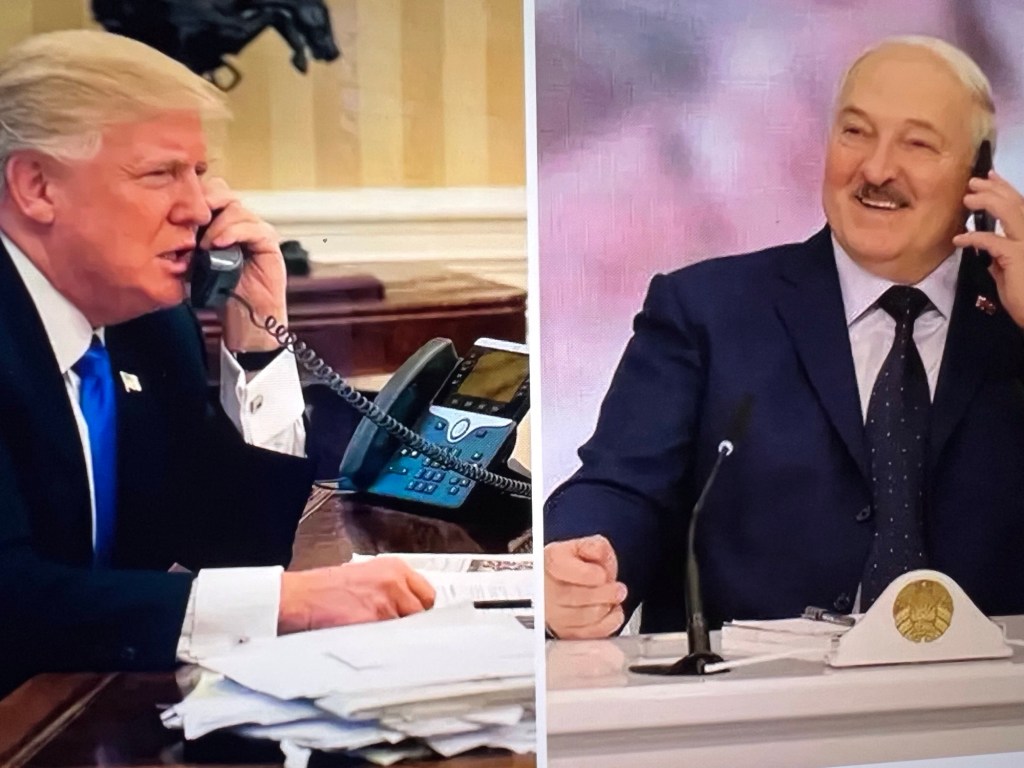
Now her sister, Tatsiana Homich, has spoken about her hope that Kalesnikava may soon be released as part of an agreement being negotiated between Lukashenko and Donald Trump, who has optimistically forecast:
“I believe they’re going to be releasing a lot of those 1,400 [presently held in Belarus] . . . in the pretty near future.” [Ray Furlong, RFE/RL, September 7, 2025.]
Composite Photo of Donald Trump and Aleksandr Lukashenko
If Trump is not exaggerating, and if Lukashenko proves to be true to his word, it could mean the end of Marya Kalesnikava’s long nightmare. Let’s hope so. In the meantime, she joins our list of those for whom the fight continues.
*. *. *
Immigrant Detainees in Russia:
Migrants from the Central Asian nations of Kazakhstan, Kyrgyzstan, Tajikistan, Turkmenistan and Uzbekistan
Prisoners of War:
The People of Ukraine The Azov 12
Endangered Exiles:
Mikita Losik Yulia Navalnaya Countless Journalists and Other Dissidents
Ales Bialiatski Andrei Chapiuk Marya Kalesnikava Uladzimir Labkovich Ihar Losik Marfa Rabkova Valiantsin Stafanovic Yuras Zyankovich
In Russia:
David Barnes Gordon Black Antonina Favorskaya Konstantin Gabov Robert Gilman Stephen James Hubbard Sergey Karelin Timur Kishukov Vadim Kobzev Darya Kozyreva Artyom Kriger Michael Travis Leake Aleksei Liptser Grigory Melkonyants Nika Novak Nadezhda Rossinskaya (a.k.a. Nadin Geisler) Igor Sergunin Dmitry Shatresov Robert Shonov Grigory Skvortsov Eugene Spector Laurent Vinatier Robert Romanov Woodland
According to Worldometers.info, out of a total of 195 countries in the world, only 19 are reported as having a gross domestic product (GDP) of $1 trillion or more. The vast majority of the world’s nations get by on a great deal less than that.
So why, I ask myself, would any one person — even a serial baby daddy with a flock of children to support — need, or even want, to be a trillionaire? What would you do with it? Start your own country?
Well, if you were this person . . .
You recognize him … Donald Trump’s former BFF, Elon Musk
Now, if you were, say, Bill Gates, Warren Buffett, or MacKenzie Scott, you would find no end of philanthropic causes that desperately need and deserve help . . . just as you’d already been doing, though on a much larger scale.
But the person closest to reaching that goal is already the richest person in the world. And, while theoretically possible, the reality of his actually attaining a net worth of $1 trillion is dependent on a number of factors. It would come in the form of a proposed new pay package from his Tesla company, which would grant him an additional 423.7 million shares of its stock, worth $143.5 billion at today’s value.
But he would only receive the shares if the value of Tesla stock increased significantly, reaching an overall value of $8.5 trillion, thus making Tesla the most valuable company ever. So it’s complicated, and it’s all very iffy. But, like everything Musk has ever dreamt of doing, what seems impossible to us mere mortals could conceivably come true for him.
Sweet dreams, Elon
But again . . . why? Well, there are the bragging rights, of course. But more importantly, there is the sheer personal POWERthat accompanies that kind of wealth. And that’s what people like Musk thrive on.
But then there is the age-old ethical question of whether anyone deserves to have so much more than they could ever use, when there is such an overabundance of suffering and devastation in the world.
I am a firm believer that anyone who earns their money honestly, through their own effort and skill, has an absolute right to do whatever they choose with it: invest it, spend it on luxuries, hoard it, or give it away. And no one has the right to force them to share it with others.
But I would hope that, having been fortunate enough to have achieved great wealth, one might want to experience the joy of using a portion of it to make the world, in some way, a better place. What a glorious feeling that would be!
But then, I’ve always been something of an idealist, unlike the Musks of this world. So, while I don’t wish him any bad luck, forgive me if I do hope he never achieves this specific goal. Because I think he already has more than he deserves.
Maybe the Tesla Board of Directors could instead redirect some of that extra cash and give their hard-working employees a big fat raise, or a really nice Christmas bonus . . . or both. You know who I mean: the people who keep the company operating, and who live from paycheck to paycheck and can’t afford a new TV because one of the kids needs braces.
The people without whom Musk would be out of business.