It’s not easy for people with disabilities to get around, regardless of where they live. Even here in the United States, where we have the benefit of the Americans with Disabilities Act (ADA) requiring easy access in public buildings, wheelchair ramps built into sidewalk curbs, and the like, there are many places that are just not navigable to people using wheelchairs or walkers.
And in northern climates throughout the world, when winter adds to the difficulties, disabled and elderly people are pretty much confined indoors for the duration, unless they have help.
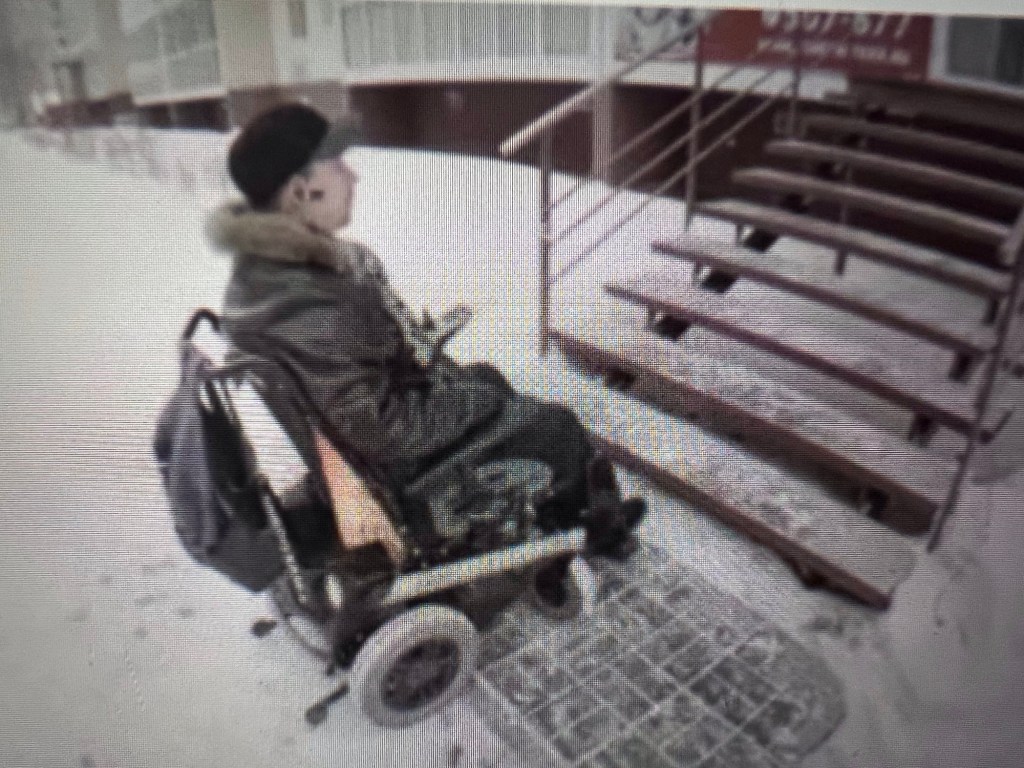
Then there are the financial burdens to be contended with. How does a person who can’t work afford a scooter, a wheelchair, or transportation to and from their medical and physical therapy appointments? Aids — and aides — cost money. The fortunate ones may have family members to help; but the burden on them can quickly become onerous as well.
Luckily for many, there are disability benefits available to ease the pain somewhat. But if you live in Russia and have the misfortune of being disabled — even if you are a war veteran who lost a limb, your eyesight, or your general health in Ukraine — you are royally screwed.
Because the rules governing qualification for disability status have been tightened since Vladimir Putin’s invasion of Ukraine four years ago. As the federal budget began allocating more and more money into military spending, and hundreds of thousands of severely wounded troops started returning home in need of care, the government began crunching the numbers and found that they could save an estimated 120 billion rubles ($1.6 billion) a year by simply reducing the rolls of the officially-designated disabled.

According to a former medical and social assessment specialist, who declined to be identified for fear of repercussions:
“The authorities understood that the war would increase the number of people with disabilities. So they decided to make the statistics look better — and save money.” [Valery Panyushkin and Systema, RFE/RL, January 26, 2026.}
Changes had already been made several times since the 2014 invasion of Crimea. But the decree issued in April of 2022 has taken matters to an even more draconian level. That decree lists three conditions for recognizing a person as disabled: the persistent impairment of bodily functions; the “complete or partial loss of a citizen’s ability or capacity to care for themselves, move independently, orient oneself, communicate, control their behavior, study, or engage in work activities”; and the need for rehabilitation. [Id.]
Any one of those conditions should be enough for an individual to have to live with. But the decree also stipulates that one condition alone is not sufficient grounds for a disability classification; a combination of conditions is required, which means that authorities are able to deny disability status to nearly everyone.

And even the most severely disabled (classified as Group One) must regularly collect documents, undergo repeated examinations, and pass medical and social assessments every two years. Those with less severe conditions are required to confirm their status every year.
There is — theoretically, at least — such a thing as permanent disability status; but again, the wording is so vague as to make it virtually impossible to attain. One 70-year-old woman said that she was advised to hire a private consultant to help her gain permanent disability status, at a cost of 100,000 rubles ($1,310). She has heart stents, but still must undergo an annual exam to confirm her condition. As she said:
“As if the stents will just disappear. If I undergo coronary angiography every year, I’ll die from the tests sooner than from a heart attack.” [Id.]
*. *. *
Life is hard enough. And it becomes harder as we grow older, or become handicapped due to injury or illness. We lose abilities we took for granted; we lose our accustomed source of income; and if we live long enough, we lose our friends because we simply outlasted them. But when governments make it exponentially more difficult for us to go on . . . well, I can only compare it to culling a herd of wild animals that has become too populous for the land to sustain.

What was it Ebenezer Scrooge said about the poor?
“If [they] would rather die . . . they had better do it, and decrease the surplus population.” – Charles Dickens, A Christmas Carol.

You’d better hurry, tovarishchi. Because that seems to be what Comrade Putin is thinking about the old and infirm.
Just sayin’ . . .
Brendochka
1/28/26
 The Blog About Everything … and Sometimes Nothing