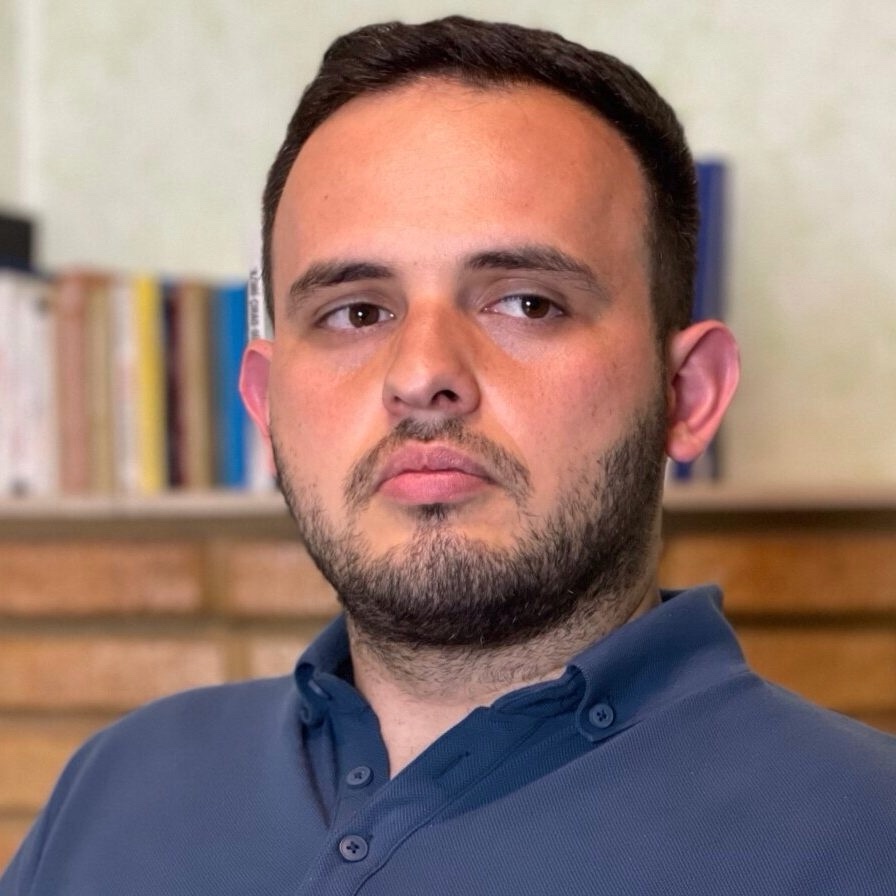
Farid Mehralizada — an Azerbaijani journalist recently released from prison after being falsely charged with “smuggling” — told of the real reason for his arrest in May of 2024. While the security agents jumped him and placed a hood over his head, one of them whispered into his ear: “You talk too much.” [RFE/RL, September 9, 2025.]
Such arrests and imprisonments have become commonplace in today’s Russia, Belarus, Azerbaijan, and other countries where it is illegal to speak out against the government, or even to discuss or read about subjects that are contrary to government policy. And detaining and imprisoning foreigners on such spurious charges has become de rigueur in those countries, where they are held for ransom to be paid by their governments, usually in the form of prisoner exchanges or return favors.
But in the 1980s, such incidents involving foreigners were unusual in the Soviet Union. In 1986, when American journalist Nicholas Daniloff was detained in retaliation for the arrest of Soviet spy Gennadi Zakharov in New York, the international outcry was unprecedented, and led to a rapid exchange of the two after less than two weeks of diplomatic negotiations.
For the most part, however, Americans were considered to be safe in the Soviet Union, as long as they didn’t do anything stupid. But in 1988, when a friend and I signed up with an organized tour group for a trip to the USSR, my mother — a lifelong champion worrier — was sure I would be kidnapped and held hostage. I never understood why she thought I would be of any value to the Russians; but I’m convinced she neither slept, ate, nor exhaled during the two weeks I was away.
I’m happy to report that she was wrong, and I returned home safely.

Then in 1993, I went to live and work in Moscow for several months — an experience about which I have written at some length. My mother had already passed away by then, so I didn’t have to worry about her worrying about me.
By that time, however, there was much for us Americans and other foreigners to be concerned about. It was the time of what they called “the Great Mafia Wars” in Russia, and people — foreigners included — frequently turned up dead, or disappeared completely.
I was in charge of the Moscow office of a U.S. humanitarian aid program, which was legally registered to operate in Russia and thus was on the radar of both the local Militia and the KGB. And both organizations had introduced themselves to me, making sure I knew they were always around. I tried not to dwell on it, but I was obviously easy prey if they had decided they needed another pawn for their political chess match.
But again, I was lucky. Maybe I had a guardian angel — probably my worry-wart mother — but whatever the reason, and despite taking a few risks (the details of which are best left unexplained), I survived and made it back home in one piece . . . one very exhausted, but exhilarated, piece.
I wouldn’t trade that experience for anything. But when I think back to those months in the context of the recent proliferation of kidnappings and hostage-takings, I realize how easily I might have become one of the victims of a regime that knows no restrictions and places no value on human life.
And that realization, more than anything, has forged my emotional tie to the desperate people languishing in prisons and penal colonies throughout Russia, Belarus, and elsewhere, fighting to survive until the wheels of international diplomacy turn far enough to bring them home.
So, for those of you who may have wondered why I continue to post a weekly tribute to those hostages, it is both from my desire to keep the world focused on their plight, and an immense feeling of gratitude that I was lucky enough to escape the same fate.
Some may call it survivor’s guilt; I call it empathy. Whatever its name, and for what it’s worth, it’s the reason I have kept — and will continue to keep for as long as I am able — my weekly vigil on behalf of those less fortunate.

Just sayin’ . . .
Brendochka
9/15/25
 The Blog About Everything … and Sometimes Nothing