I hadn’t really thought about it before, but I suppose the United States first became a disposable society once the shortages and rationing of World War II were behind us, and we had plunged headlong into the peace, prosperity and technological advances of the 1950s and ‘60s.
Weary of having to repair and mend everything from automobiles to underwear in order to make them last so that our troops overseas could have tanks and parachutes, we just began throwing things away and replacing them with the latest and greatest innovations.

Refrigerator making a funny noise? Don’t call a repairman; just order a new one . . . with a self-defrosting freezer. Car need a few new parts? Forget the mechanic and check out the latest model Chevy with the extra-long tail fins. Husband getting on your nerves? You might even turn him for a newer model. (Just kidding about that last one.)
And that mindset has taken such firm root in our society, that people now are beginning to think about doing the same thing to our planet: turning it in for a new, fresh, unspoiled land to . . . well . . . spoil.
Two of the world’s richest men — Elon Musk and Jeff Bezos — each with his own commercial space company, and a combined net worth of more than $630 billion, have seemingly never outgrown their adolescent “Flash Gordon” dreams of conquering outer space. And now they have the means to try to make those dreams a reality. Their visions differ only in the details.
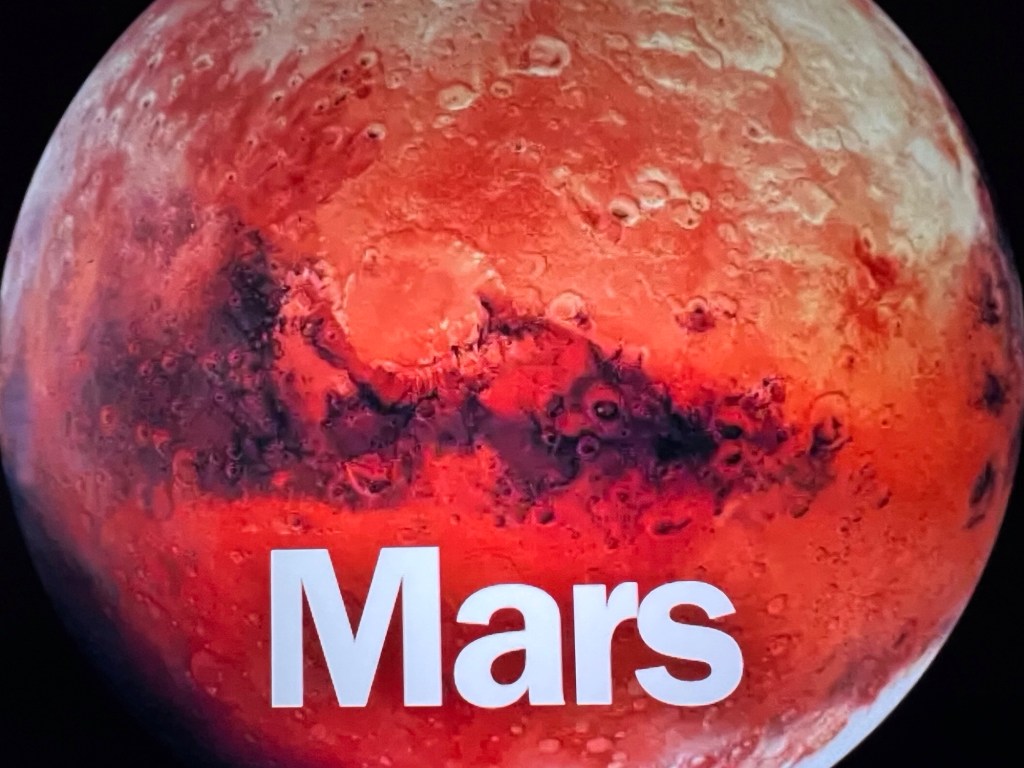
Musk, as we know, is focused on Mars, where his mind’s eye sees actual settlements of people: Earthlings, relocating to become Martians. Actually living on the “Red Planet.” Starting from scratch, in an environment without buildings, or trees, or (as far as we know) potable water sources.
Bezos, on the other hand, has a somewhat more credible idea. He envisions moving “heavy industry and polluting industry off Earth,” possibly onto spinning spaceborne laboratories where colonies of humans live and work full-time, reserving Earth for living and vacationing in one big, pollution-free national park. [Jackie Wattles, CNN, September 12, 2025.]

Presumably, we would all have two homes — one near our workplace in space and one for relaxation on Earth — and commute, perhaps on weekends, in our Jetson-style spacemobiles to and from our spinning offices, shops, or factories.
I’m getting dizzy just thinking about it.

I realize these concepts are far from being realized, and that I most likely will not live long enough to see them take shape. But while I’m still among the living (here on Earth), I have a question for Messrs. Musk and Bezos:
What is stopping you from using your phenomenal wealth and technical resources to fix what’s wrong with the beautiful planet we already have?

Before it’s too late, why not work to save our natural resources, our animal life, our air and water and soil? Get rid of the world’s so-called leaders who are destroying everything that is good about this Earth, and elect people who love and respect our planet.
Take some lessons from the Inuit, the Maori, and other indigenous peoples who have retained their innate connections to the land.
Utilize more solar and wind energies, and less of the finite fossil fuels.
Stop manufacturing junk that no one needs, that only ends up in the trash heap of non-biodegradable remains.
Stop worrying about who’s liberal and who’s conservative, or whether your neighbor is gay or straight or trans. Start thinking instead about imposing huge fines against people who pollute our air and litter or damage our parks and beaches and rivers.
Start a new movement — one that inspires love and unity, instead of hate and division. You could call it MELA: Make Earth Livable Again.
Forget about Mars and rotating satellite workplaces. Come back down to Earth, and — like the patriots of the World War II era — fix the good things we already have.
I, for one, have no desire to move.

Just sayin’ . . .
Brendochka
9/14/25
 The Blog About Everything … and Sometimes Nothing