In April of this year, there were just two. By June, the number had risen to 653. And last month, in August, there were a total of 1,968.
That’s how many internet cut-offs there have been across Russia this year. In the wake of his invasion of Ukraine in February of 2022, Facebook, Instagram and X have already been blocked by Vladimir Putin’s government and are accessible only through VPNs. Now WhatsApp and Telegram — the two most widely-used messaging apps in the country — are headed in the same direction.
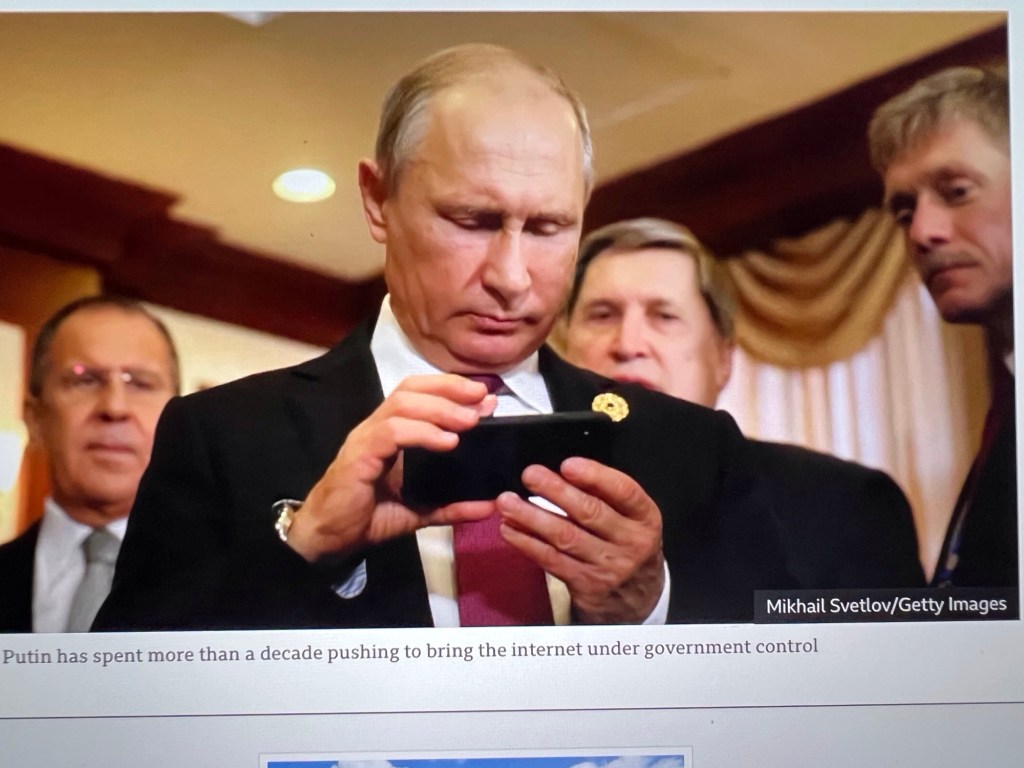
When I lived and worked in Moscow for several months in 1993, just getting a telephone landline required a Herculean effort. Since that time, cell phones have found their way into the hands of nearly every Russian citizen, and the internet is as heavily relied upon for business and personal use as it is everywhere else in the world.
But new restrictions were imposed in August by Roskomnadzor — Russia’s media regulator — on calls made through WhatsApp and Telegram, and service on both has become unreliable and sometimes completely unavailable. Meta — the owner of WhatsApp — has even been designated an extremist organization in Russia. [Sergey Goryashko, BBC News, September 5, 2025.]
Not coincidentally, both WhatsApp and Telegram offer end-to-end encryption, thus stymying the government’s ability to eavesdrop or to access stored data. And as one person from the city of Tula — speaking anonymously for fear of retribution — told the BBC:
“The authorities don’t want us, ordinary people, to maintain any kind of relationships, connections, friendships or mutual support. They want everyone to sit quietly in their own corner.” [Id.]
So the government has come up with an alternative for its internet-dependent citizens: Max.
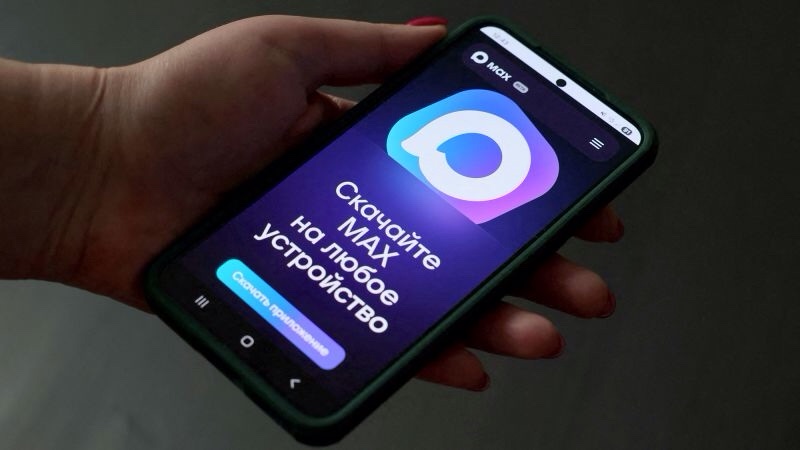
Max was launched by VK, the nation’s largest social network. The platform is controlled by majority state-owned Gazprom — the largest oil and gas producer in Russia — and by one of Putin’s closest confidantes, billionaire Yuri Kovalchuk, who is reputed to be Putin’s “personal banker.”
Max is the focus of a massive advertising campaign featuring Russian pop stars and bloggers, and is now required to be pre-installed on all devices sold in the country. It is being touted as a “super-app,” offering multiple functions, including government digital services and banking.
But it is also a super-tool by which the government can surveille and censor its users. Max’s privacy policy states that it may pass information to third parties and government bodies, thus potentially subjecting users to prosecution for accessing prohibited information, or expressing an opinion contrary to government policy.
By law, it is already required that individuals show their national ID in order to purchase a sim card; and the security services have access to the telecom operators’ infrastructure, making it possible for them to read your messages, find out whom you call, and track your location. [Id.]
And soon it may be the only available option. Schools are now being ordered to move parent chats to Max. In Rostov, near the Ukraine border, Max is being used as an alert system. In St. Petersburg, it is being utilized by emergency services. [Id.]
Additional restrictions are constantly being added. There are now fines for “deliberately searching” online for “extremist materials” — of which there is a blacklist of more than 5,000 resources. It is also illegal to advertise on platforms connected to “extremist” organizations, of which Instagram is one. And ads for VPNs are banned. [Id.]
*. *. *
During the past 34 years since the breakup of the Soviet Union, the Russian people have become accustomed to the accessibility and convenience of 21st-century communications. Cell phones and the internet have made the lives of ordinary citizens easier in countless ways, and those in rural areas have become particularly dependent on them for obtaining otherwise unavailable goods and services.
Losing that convenience — or, alternatively, knowing that using it will mean the loss of privacy and freedoms they have come to take for granted — will be devastating to the Russian populace.
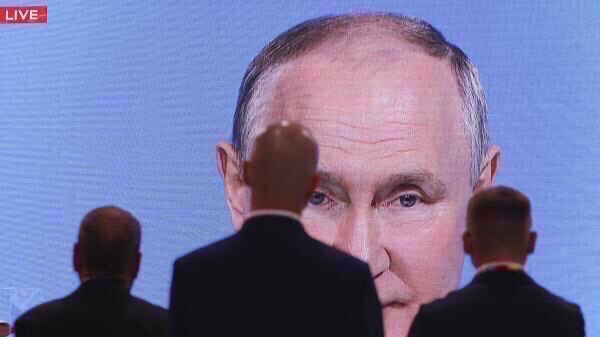
Which is exactly the way Big Brother Putin wants it.
Just sayin’ . . .
Brendochka
9/11/25
 The Blog About Everything … and Sometimes Nothing