In 1990, the United States and other Western countries were heavily involved in assisting Eastern European nations that had just been freed from the yoke of Soviet control and were slowly finding their way to the establishment of new, democratic government structures.

Along with financial and technical aid, those countries needed political, legal and economic reeducation. And in September of that year, I was privileged to assist my law firm’s team sponsoring a seminar in beautiful Budapest, Hungary, on doing business in Eastern Europe and the Soviet Union.*
* Note: Though Hungary, among others, had regained their independence after the fall of the Berlin Wall in 1989, the Soviet Union itself did not collapse until December 26, 1991.)
Those were heady times, full of energy and optimism for a brighter, freer future. And for the most part, those plans and dreams have been fulfilled, at least to a large extent. But there has been backsliding in some places over the years, including in Hungary since the rise to power of its Prime Minister, Viktor Orban.
I have written several times about Orban’s autocratic leadership, including the fact that it now appears — for the first time since 2010 — that he may finally be in jeopardy of losing power to a more moderate opponent in the next election.
And one of Orban’s critics in Parliament, Katalin Cseh, has spoken out — not to her own people, but to the American public — about the lesson to be learned by Donald Trump’s opposition from her own country’s experiences.
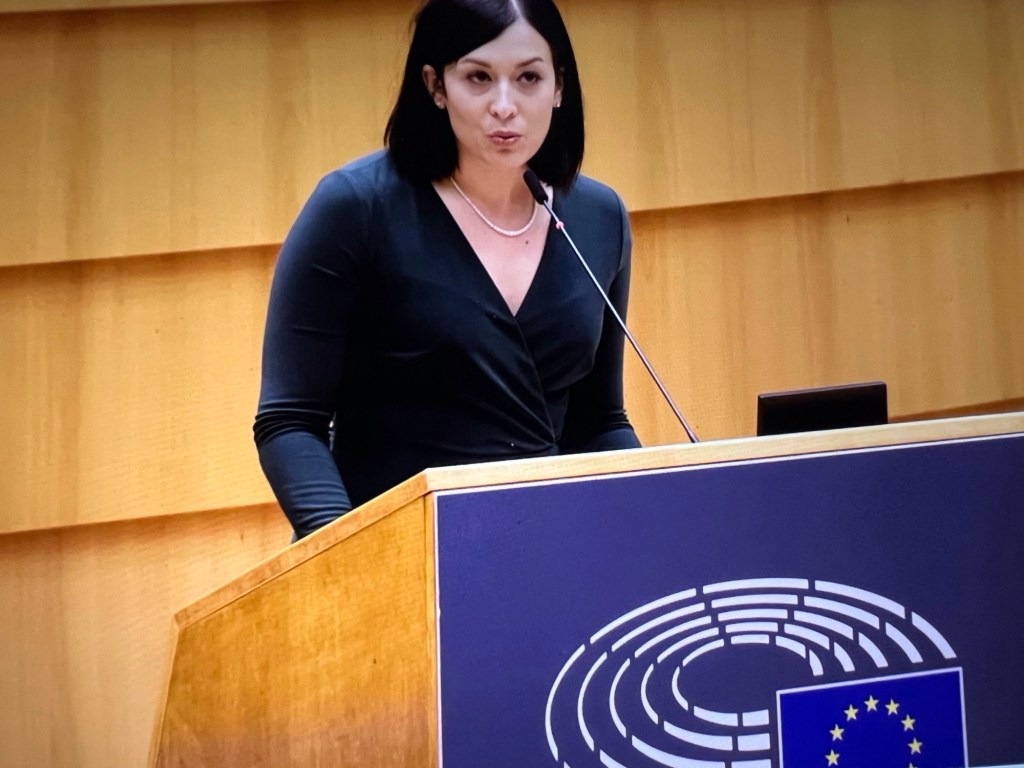
Ms. Cseh’s comments — delivered at a recent webinar forum on authoritarianism organized by the Washington-based think-tank, Center for American Progress — speak for themselves; so I will simply quote excerpts here:
“I invite everybody to study the processes that happened [in Hungary] and elsewhere, because autocratic learning is real. Backsliding just went by us like a train, without anybody realizing how far it had gotten. So it’s very important to pay attention from the very beginning … [and] to mobilize.”
. . .
“I do believe that many Americans think this [authoritarianism] is something that also only happens to others, and I think that mindset has to be fought.”
. . .
“Start preparing for the midterms like yesterday. Go to every protest, go to every march, stand right beside everybody who is being attacked, no matter if it is a group you belong to, or something that you do not share personally. You have to stand side by side [with] each other and help and support those who might feel isolated and alone.”
. . .
She then urged Democrats and activists to form a widely inclusive “movement” and find “candidates for the midterms or any election that is coming your way who can get people excited — not necessarily the same old faces they have been seeing all the time that they don’t really trust that much, but visionary leaders … who are part of a community, who are being persecuted.”
. . .
She said that leaders such as Trump and Orban can only be effectively opposed by ditching a “legalistic, technical, technocratic approach [in favor of] something for the electorate to be excited about. Autocrats are not always good in governing. So cost of living, crisis of healthcare, education — if the focus is shifted to these areas, and not oly technical descriptions of what’s going on in the courts, this is something that people can relate to more.” [Robert Tait, The Guardian, July 16, 2025.]

*. *. *
There were comments by other panelists, most notably by Szabolcs Panyi, a journalist with the Hungarian website Direkt36, who drew a parallel between Trump’s approach to the media and the methods used by Orban to attack journalists. These included banishing established outlets from briefings in favor of friendly journalists and so-called “propagandists”:
“What particularly rings out is how certain large media outlets or owners or large conglomerates try to appease Donald Trump by settling lawsuits or by firing journalists [or] editors. It really resembles what happened in Hungary in the 2010s.” [Id.]
*. *. *
Anything I might add here would be superfluous. But I would like to thank Ms. Cseh, Mr. Panyi, and the other panelists for their honest and insightful conclusions.
I only hope their words reach the right people on this side of the Atlantic. Maybe my sharing them will help a little.

Just sayin’ . . .
Brendochka
7/18/25
 The Blog About Everything … and Sometimes Nothing