When Mikhail Baryshnikov leapt across the stage of the Kennedy Center’s Opera House, there was a moment — just a few seconds, really, though it seemed an eternity — when he hung suspended in mid-air, his forward trajectory halted, gravity inexplicably defied.

Even above the strains of Tchaikovsky’s majestic music, the collective gasp of the audience was clearly audible. Then, as time stopped, no one breathed. And finally, the dancer’s momentum propelled him forward once more, his feet silently touched the stage floor, and we — the fortunate witnesses to this miracle — exhaled as one.
That night in the early 1980s — seeing Baryshnikov dance Tchaikovsky’s immortal Swan Lake — was without question the most memorable of my many years of memorable and varied theater experiences. And it would not have been possible had he not been permitted, some eight or ten years earlier in 1974, to perform with the Bolshoi Ballet in Toronto, Canada . . . where he defected from the Soviet Union, seeking political asylum and eventually gaining citizenship in the United States.
It was the era of the Cold War, when U.S.-Soviet relations were at a treacherously low level. Yet cultural exchanges were still taking place, with Russia’s famous ballet companies, concert orchestras, and folk dancers appearing throughout the world . . . always accompanied, of course, by an easily-recognizable contingent of KGB minders.
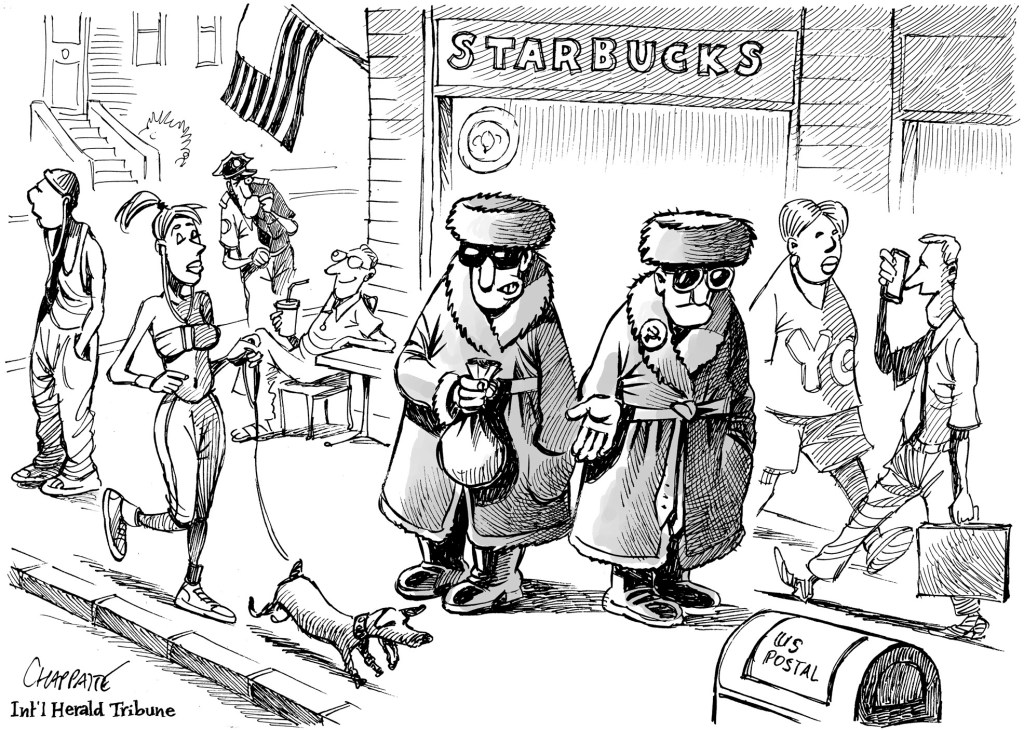
Of course, we sent our American stars over there as well. Jazz and rock musicians were particular favorites, and Russian audiences were thrilled to see and hear the likes of Elton John, Billy Joel, Bon Jovi, Ozzy Osbourne, Motley Crue, and others.
The exchanges were meant to bridge cultural divides and foster goodwill. How well they worked is debatable; but one thing is certain: everyone who was privileged to attend the performances, on both sides of the Iron Curtain, had a hell of a good time; and — for a few hours at least — Americans and Russians forgot that they were supposed to hate each other.
*. *. *
But that was then. The Cold War — in theory, at least — ended with the collapse of the Soviet Union in 1991 (although we’re still spying the daylights out of each other, but that’s a whole different story). Until recently, thanks to the reforms of Mikhail Gorbachev and Boris Yeltsin, business transactions, sporting competitions, cultural and educational exchanges, and personal travel between Russia and the countries of the West have thrived.
And then, on February 24, 2022, Vladimir Putin invaded Ukraine, and in place of a cold war, there was a real war taking place in Europe of a magnitude not seen since World War II. Russia has once again become a pariah in the free world, and sanctions imposed by the U.S. and Europe have affected every facet of Russian society, including individuals generally considered non-political.
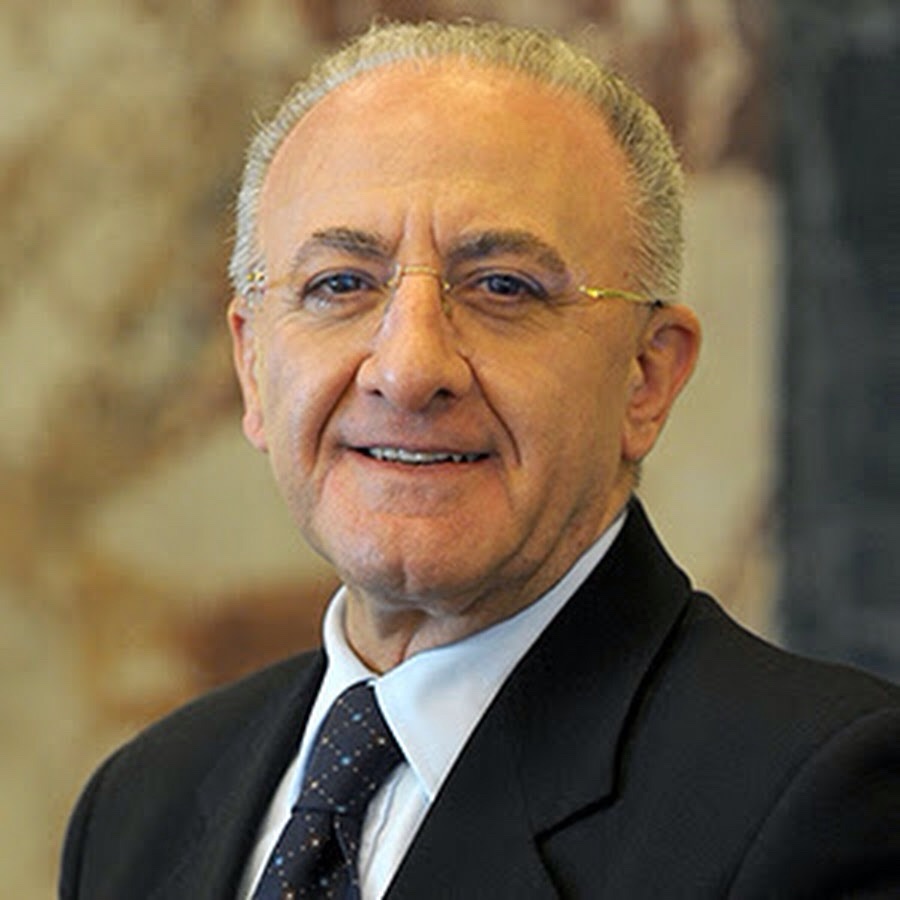
So when Vincenzo de Luca, President of the Campania region of Italy, recently invited Russian conductor Valery Gergiev — director of the Bolshoi and Mariinsky Theaters and a close ally of Vladimir Putin — to perform at a concert festival later this month, he ran into some serious opposition.
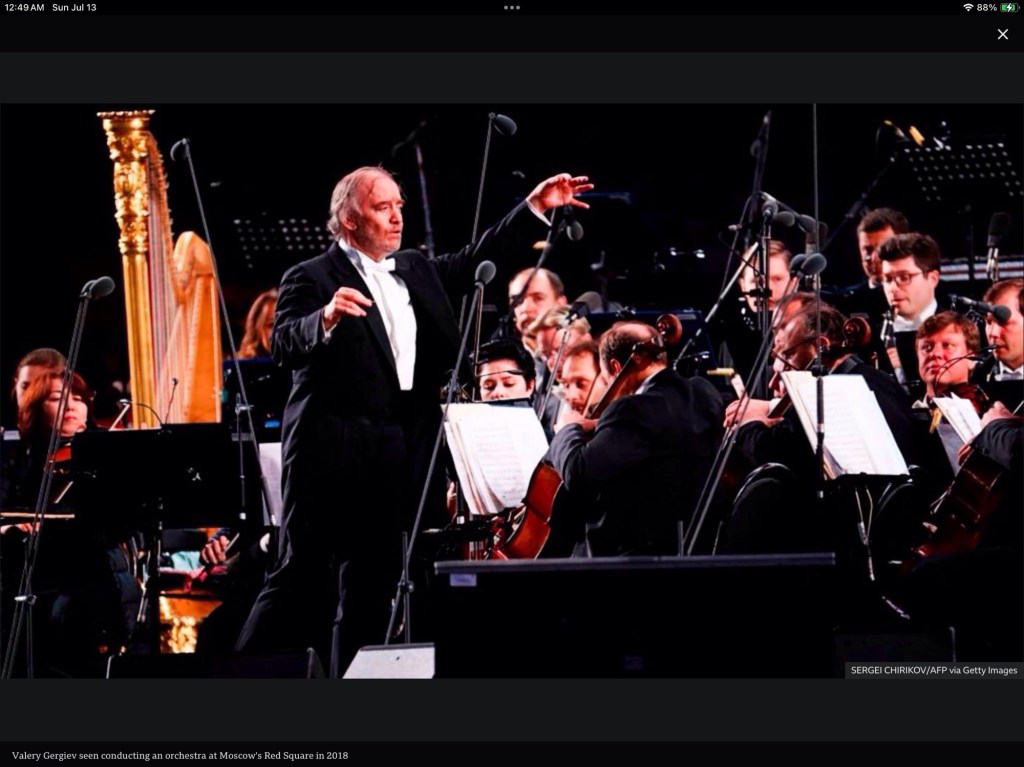
De Luca’s position is that “Culture … must not be influenced by politics and political logic. We do not ask these men to answer for the choices made by politicians.” He had previously called Europe’s ban on pro-Putin artists “a moment of stupidity — a moment of madness” at the start of the war, and now says he is proud to welcome Gergiev to the festival. [Sarah Rainsford, BBC, July 12, 2025.]
On the opposite side of the debate is Pina Picierno, a vice-president of the European Parliament, who has said that Gergiev’s return would be “absolutely unacceptable,” and called the conductor a “cultural mouthpiece for Putin and his crimes.” [Id.]
Needless to say, that is also the position being taken by people like Ukrainian human rights activist Oleksandra Matviichuk, who said that inviting Gergiev was “hypocrisy,” not neutrality. And the exiled members of the late Alexei Navalny’s Anti-Corruption Foundation want the concert cancelled, and have called upon Italy’s interior ministry to ban Gergiev from entering the country. [Id.]
*. *. *
So what’s the solution?
I sorely miss the old days, when it was “sexy” and exciting to attend a performance of the Bolshoi, the Kirov, or the Moiseyev Folk Dancers at the Kennedy Center. I even recall seeing the incredible Leningrad Dixieland Jazz Band at the Smithsonian Institution in the ‘70s, with the then Soviet Ambassador in the audience.
But those were different times, when we still innocently believed — or at least hoped — that peaceful coexistence was possible. Today, in the world of Vladimir Putin and Donald Trump . . . well, not so much.
So, as much as I’d like to take Mr. de Luca’s side, realistically I don’t see how I can. Because sanctions can’t work if we make exceptions.
How I miss the good old days!

Just sayin’ . . .
Brendochka
7/13/25
 The Blog About Everything … and Sometimes Nothing