There’s always someone willing and able to make a small fortune out of someone else’s tragedy. In Victor Hugo’s Les Miserables, it was the innkeeper / grave robber, M. Thenardier, who descended into the sewers below Paris to rob the dead of their jewels and gold fillings following the unsuccessful students’ uprising. After all, they were dead; they didn’t need their valuables any longer . . . or so he rationalized.

That was in 19th century France. In today’s Russia, it’s the funeral industry that is capitalizing on the government’s “special military operation” against Ukraine. While official Russian combat casualty statistics are kept secret, estimated deaths are in the hundreds of thousands. And as the bodies of the dead are returned home, the demand for caskets, burial sites and funeral services has skyrocketed.
And so has the cost of all of those necessities — by an estimated 12.7% in the first four months of 2025 over the same period last year, according to the Russian newspaper Kommersant. [RFE/RL, June 26, 2025.]
Allegedly, families of the war dead are reimbursed by the government for funeral expenses up to a limit of about $650 in most regions, and around $880 in Moscow, St. Petersburg and Sevastopol (in Russian-occupied Crimea). The current average cost, nationwide, was $750 in 2024, and would obviously be higher now. Anything above the reimbursable amount would be the responsibility of the deceased’s family. [Id.]
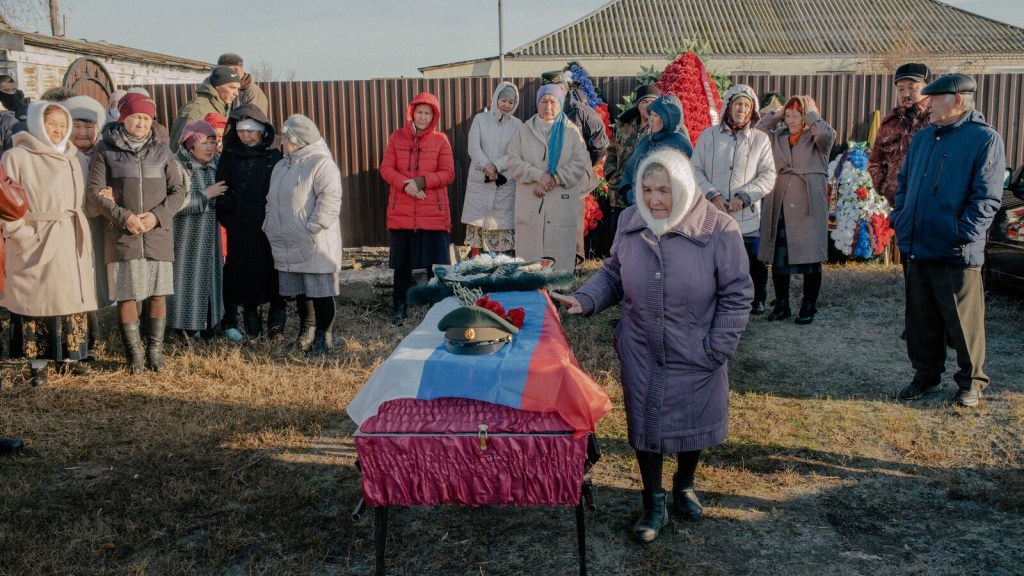
That is, if there were actually funds disbursed to the families. Some have complained that the government’s promises are being ignored. One woman, whose father was killed in combat near Pokrovsk, Ukraine, said on social media:
“I paid for everything myself. There was no burial service, no death benefits. No one came, not even a representative from the military commissariat or the brigade where he served.” [Id.]
Russia’s average income per capita in December of 2024 was about $8,100 [ceicdata.com], with inflation running rampant. Many of the soldiers fighting in Ukraine enlisted only because they were offered substantial bonuses — money that was desperately needed to support their families. Under the circumstances, $750 is an astronomical amount of money to most of the country’s average citizens.
But the funeral industry is thriving. Nearly 200 new funeral-related businesses have opened this year alone, with the greatest number reported in Tatarstan, the Moscow region, and St. Petersburg. [RFE/RL, op.cit.]
While the funeral parlors and casket-makers themselves have doubtless seen their costs rise, the increased demand brought about by the devastating war in Ukraine has also provided an opportunity for a sizable amount of profiteering by a bunch of “entrepreneurs” . . . at the expense of their grieving friends and neighbors.
It may be business as usual . . . but it also seems a bit Ebenezer Scrooge-ish to me. Or maybe I’m just too much of an idealist.

C’est la guerre.
Just sayin’ . . .
Brendochka
6/27/25
 The Blog About Everything … and Sometimes Nothing