The “big, beautiful parade” in Washington on Saturday was sufficiently horrifying to remind me of my one and only encounter with a military deployment in that city, more than five decades ago. (I realize I’m giving away my age here, but what the hell . . . there’s no denying it any longer.)
It was early April, 1968. Martin Luther King, Jr., had been assassinated in Memphis, Tennessee, on April 4th, sparking race riots and other civil disturbances in more than 100 cities across the United States. The most violent of these occurred in Chicago, Baltimore . . . and Washington.
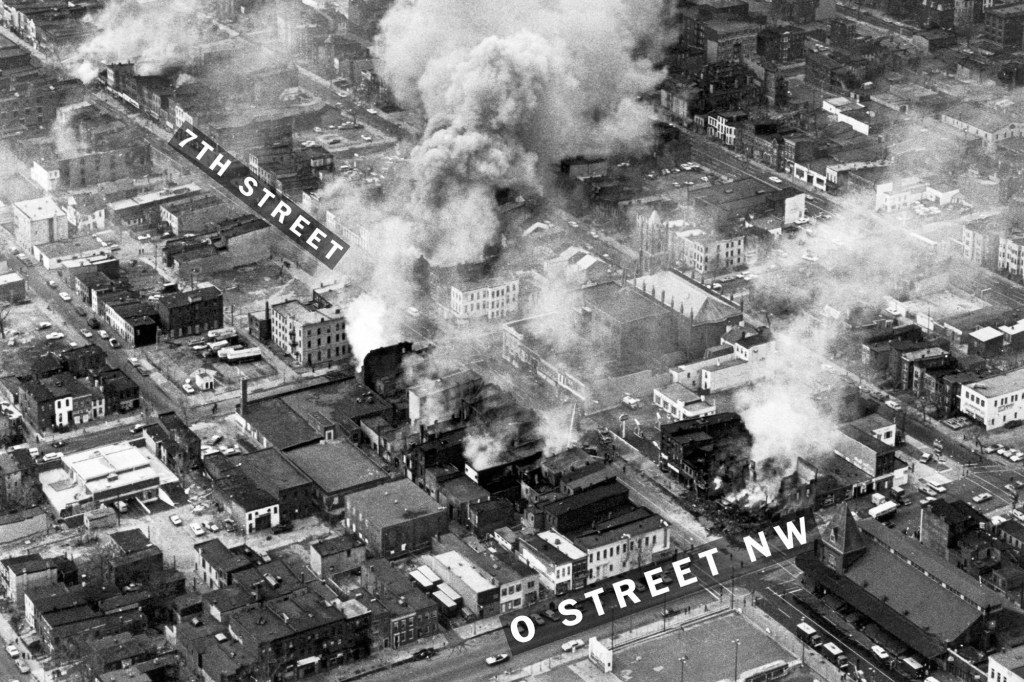
For four days, predominantly Black neighborhoods in the city were subjected to rampages of arson, looting, and general destruction — far too widespread for the D.C. police to handle on their own. President Lyndon Johnson had no choice but to call in the National Guard to assist in the defense of the federal jurisdiction. When it was over, 13 people were dead, around 1,000 more injured, and over 6,000 had been arrested.
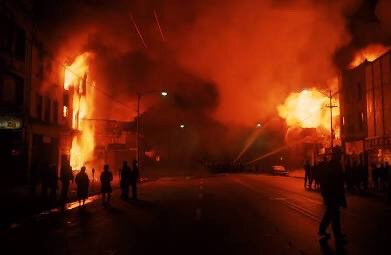
On that Friday evening, April 5th, I sat in the top-floor apartment of friends across the Potomac River in Arlington, Virginia, with the most morose group of people I had ever encountered outside a funeral parlor. For hours, we sat, barely speaking . . . just getting quietly drunk as we watched the glow of the burning areas of the capital city on the other side of the river.
I lived in a Virginia suburb, and was safely removed from the danger as long as I didn’t go back to work in D.C. But it was the weekend, and we were all certain the worst would be over by Monday. I just hadn’t counted on my sister’s problem.
She was living in an apartment in D.C., in a “safe” neighborhood. But there was one part of her routine that she was adamant about not breaking, and that was her regular Saturday appointment with her hairdresser . . . whose shop was in Alexandria, Virginia. She didn’t own a car — in fact, she didn’t drive at all — so she regularly rode the bus back and forth. But a curfew had been instituted, as I recall, for 5:00 p.m., so she expected to be home in plenty of time, and off she went. Then, at nearly 2:00 p.m., the D.C. authorities moved the curfew back to 3:00 p.m., and the buses stopped running into the city.
And now you’re thinking: No problem. She could just stay with me . . . right? Ordinarily, that is exactly what we would have done. But, on that weekend of all weekends, she had a friend from California staying with her, who was now alone in the apartment in D.C. My sister had to get home.
So of course, she called the one person she knew who was crazy enough to say yes. At 2:00 p.m., I jumped into my Chevy Corvair — a cute little car that got great mileage but wasn’t built for speed — and headed for the Capital Beltway, the fastest way to get from one part of suburban Virginia to another without worrying about stop lights. As I drove, I was listening to the news on the radio, thinking only of how long it would take for each segment of the trip, and calculating how much time I would need to get back over one of the bridges into Virginia before curfew.
You see, I had left my two children, then ages 4 and 2, with my mother, and couldn’t get stuck in D.C.
When I noticed that all the other cars on the highway seemed to be standing still, I took my eyes off the road for a second to glance at the speedometer and saw that — holy crap! — I was doing 90 m.p.h. In a little Corvair. On a 60-m.p.h. road. What a great little car she turned out to be.

I slowed down a little, but not much, until I reached my exit from the highway. When I got to the beauty salon in Old Town Alexandria, my sister was waiting. But there was another problem: I was low on gas. There was also a curfew in place on the sale of gas, presumably to prevent the rioters from stocking up for their Molotov cocktails, so I had to find a station on the Virginia side. That done, we headed for town.
Traffic going into the city was understandably light, so I got her home safely, watched while she went inside, and looked at my watch. It was 2:35 p.m., so I had 25 minutes to make it to the closest river crossing, which was the Memorial Bridge. No problem.
I headed south on New Hampshire Avenue, which would take me to Washington Circle, where I would then pick up 23rd Street directly to the Lincoln Memorial and Memorial Bridge. So far, so good. And then, suddenly, there they were.
Headed north on New Hampshire Avenue, coming toward me, was something I had never seen before: a convoy of military vehicles — no tanks, but a half dozen or so heavy-duty trucks and jeeps. It was like a scene from an old war movie . . . something that would have seemed in place in a European city, but not here. And as I continued to move slowly forward, the lead jeep suddenly made a sharp left turn directly into my path . . . and stopped dead, blocking my southbound lane.
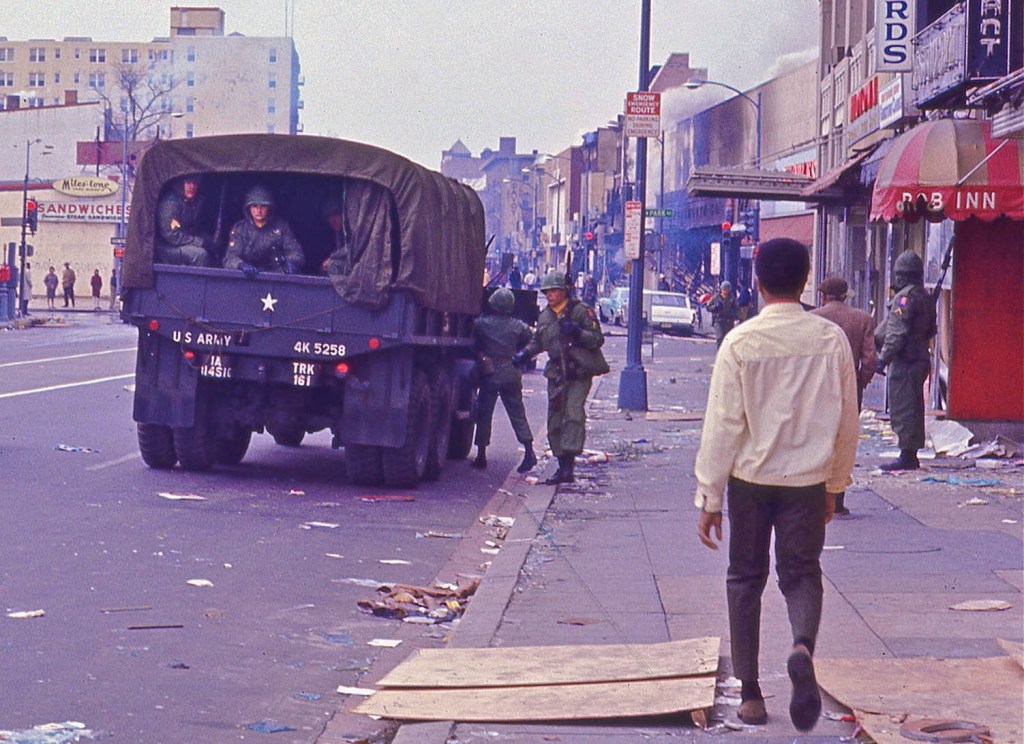
What the hell? It was now 2:40 p.m., and I was immobilized. I saw a young soldier, carrying a rifle with fixed bayonet, leave the jeep and begin walking toward my car. He couldn’t have been more than 19 or 20 years old, and he looked scared to death. But he followed orders, walked over to my car as I rolled down my window, and said, “Excuse me, ma’am. Do you know there’s a 3:00 curfew?”
“Ma’am”? Did he just call me “Ma’am”??!!! I wasn’t much older than he was.

Putting aside the fact that this boy had just aged me ten years, I looked at him and saw that he had absolutely no idea what he was supposed to do. So I took mercy on him, and answered as gently as possible: “Yes, I know that. That’s why I’m trying to get back to Virginia before then. That’s where I’m headed now.”
Silence. He didn’t know what to do next, and the clock was ticking. Then I noticed movement to my left, and saw a D.C. police officer walking toward the car. He appeared to be around 40 years old, experienced, and calm. He asked what the problem was, and since the young soldier had obviously been struck dumb at some point, I answered, explaining that I had just driven my sister home and was headed back to Virginia before curfew.
The nice officer turned to the soldier — who, of course, was still clinging to his rifle, apparently for support — and said, “Son, you’re supposed to stop people coming into the city, not leaving it. Now, why don’t you move that jeep and let her get home.”
And that seemed to snap the younger man back into consciousness. The jeep was inched back just far enough for me to squeeze through, I thanked the police officer (my guardian angel) profusely, and made a beeline for the border. It was now 2:45 p.m.
Bottom line: I was not only out of D.C., but all the way home, by 3:00 p.m. I didn’t bother to check the speedometer along the way.

*. *. *
That was a time of legitimate need for National Guard reinforcements: massive, violent riots in the federal city of Washington, D.C., the nation’s capital. Not localized, contained demonstrations in Los Angeles; and not the wholesale roundup of peaceful foreigners from their homes, schools, and workplaces around the country.
And not a Red Square-style display of military might tearing up the surface of Pennsylvania Avenue for a little boy who always wanted a parade for his birthday.
Comparing the situations does rather put things into perspective, doesn’t it?

Just sayin’ . . .
Brendochka
6/17/25
 The Blog About Everything … and Sometimes Nothing