As I hinted yesterday, I’ve been busy for the last couple of days working on a mental re-set. While not totally avoiding the doom-and-gloom of the daily news (total ignorance is never a good thing), I’m trying to focus less on it, and more on things that make me — and hopefully, you as well — smile. Because in today’s world, that’s what we all need, isn’t it?
And so I’ve dredged up a couple of my early blog posts from 2023, when some of my current readers were still unaware that I was around . . . in fact, possibly even before I joined the 21st century and signed onto Facebook. (Yes, I know . . . I’m a late bloomer.)

And away we go. Hope you enjoy my reminiscences.
*. *. *
Reflections #1: “It’s In Your Blood”
Welcome back. For those of you who have been following me for the past six months through my long-ago travels around the western hemisphere, and especially my Russian adventures, this new series will prove quite a departure. And for those who are brand new to my blog: welcome to my wonderfully weird world of wit, wisdom and winsomeness — or at least, that’s what I’m aiming for as we start out along this new road.
But as I sat down at my keyboard to begin this chapter, I realized that I was showing clear signs of withdrawal, and that I’m one of those people who probably needs to taper off gradually, like when I tried to give up sugar. So, rather than attempting to make too clean a break from all that Russian stuff at once, I thought I’d start things rolling with a little bit of Russian-related nostalgia. Just a touch — you know, so I don’t crash and burn.
*. *. *
Ekaterina Alekseyevna (Katya, for short) was a delightful little lady from Moscow, who was teaching Russian at Northern Virginia Community College in 1985, when I decided that studying an impossible language might be a relaxing way to spend my evenings and weekends after working 40-plus hours a week at a super-stressful job in a high-powered Washington law firm. So now you know something about me: I am a glutton for punishment.

Our Russian 101 class started off with, as I recall, 27 students, only one of whom had ever studied the language before but needed a refresher course because he had met a Russian woman on one of his trips there and wanted to marry her. (Talk about gluttons for punishment? Sad to say, that did not work out well for him.) The rest of us were total neophytes; I, for example, knew how to say exactly three words in Russian: “yes,” “no,” and “goodbye,” which actually placed me well ahead of the rest of the class. As for the Cyrillic alphabet . . . well, judge that for yourselves:

But I am as stubborn as I am masochistic, so I dug right in, and at the end of the first semester, I was one of the 12 remaining students in our class. The high attrition rate was no surprise — just look at the freakin’ alphabet! And don’t even get me started on the grammar, or how to pronounce a word that begins with four consecutive consonants. As it turned out, though, I had something of a knack for the language, even though other, simpler languages had always eluded me.
In fact, after one of our evening classes, as several of us were walking together toward the parking lot, Katya asked me if I had ever studied Russian before. I said I had not, and she asked, “Well, why do you suppose you’re so good at it?” I told her I thought it might be genetic, because all four of my grandparents had come from Russia — the part that is now Ukraine. She stopped in her tracks, pointed a finger at me (no, not that finger, silly!) and declared, “Aha! It’s in your blood.” And thus, I swear, she put a curse on me. I’ve had this Russian obsession ever since — the language, the history, the culture, even (God help me) the politics — and that was almost 40 years ago. Let me tell you, that’s a long time to be obsessed with anything!

*. *. *
Relax . . . I don’t really believe in curses. But the part about the Russian grandparents was real, and particularly my maternal grandmother, to whom I was most attached. My Bubbe was an amazing lady: sweet, warm, loving, hard-working, nurturing . . . and tough as nails when she needed to be. She came here in 1905 from the old country — a town called Zhitomir, not far from Kyiv — as a young wife with one baby. She and my Zayde (grandfather) spoke no English when they arrived in America; but they were multi-lingual, speaking Russian, Polish and Yiddish, and quickly learned to speak English without ever being able to read or write it.
They settled in Woonsocket, Rhode Island — God knows why! — and had four more children, all five finishing high school with top grades, which was quite an accomplishment in those days. By the time their first grandchildren — my sister and I — came along, my grandfather had a thriving bakery business; they owned a multi-unit house, fully paid-for, where we and two of my aunts and uncles lived and paid rent; and they were the darlings of the surrounding, predominantly French-Canadian-Catholic neighborhood.
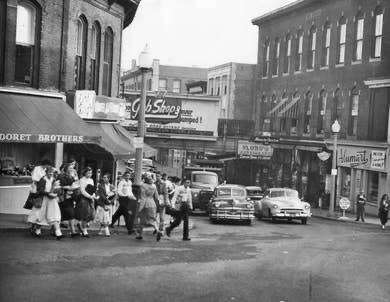
But back then I wasn’t really interested in my heritage, though now I wish I had been. They were just my loving grandparents, and were as much of an influence on my childhood as my own parents were. So what was it like, growing up with an ever-present Russian-Ukrainian-Jewish grandmother hanging over you — watching, listening, feeding, touching, hovering, feeding, scrubbing, scolding, feeding, hugging, fussing, and — did I mention? — feeding you every hour of every day for the first nine years of your life? Sound awful? Well, you’re wrong. It was wonderful, and not only because of the food. We were cared for, looked after, taught right from wrong (and almost everything was wrong . . . right?). We were loved, and we were safe.
And we grew up good.
And God help us when we misbehaved! If a grandparent or an aunt or uncle caught us doing something we shouldn’t, they didn’t conspire with us to hide it from our parents — they ratted us out, big time. And, depending on the severity of the crime, either we were sent to our room without supper, or . . . for the worst offenses, like lying, or killing the neighbor’s cat by sitting on it (my sister actually did that)* . . . we were spanked. Bare-bottom spanked. Usually with a strap. Did anybody report our parents to Social Services? Ha! What Social Services? — they didn’t exist. Did we hate our parents? Well, yeah . . . at the moment, we did. But not for long, because then we’d get supper in bed and a big hug along with the inevitable lecture, which usually ended with the best lesson of all . . .

And we grew up good.
* Note: I was too little to remember the dead cat episode, but I’ve been told she didn’t mean to kill it; she just wanted to go for a ride. You know: “Gidyap, Kitty!” I guess it was a really big cat. I’m thinking maybe Maine Coon size.
There were dozens of pearls of wisdom that my Bubbe had brought with her from the old country, mostly cautionary, like “Stay away from that girl; she’s a kurva.” (You can probably figure that one out.) Or, “Don’t sit on the stone steps; you’ll get piles.” (I think that meant hemorrhoids). Or, “Don’t touch that frog! You’ll get warts.” And my personal favorite: “If you keep frowning, your face will freeze like that.” Well, between the “piles” and the warts, how could I not be frowning?!!
But there were no warnings about playing in the dirt; or about stuffing ourselves with huge meals made with solid Crisco or schmaltz (chicken fat) and unlimited amounts of salt; drinking from each other’s soda bottles; climbing trees; roller skating without a helmet (who had helmets?); or reading comic books filled with bad guys blasting the good guys with their deadly ray guns.

And still we grew up good.
There was one other member of my grandparents’ household: my great-grandmother (Bubbe’s mother), who was called “Baba.” She was ancient — probably not much older than I am now, though I’m not a great-grand yet. She must not have been well, because I remember her spending most of her time in her room. Or maybe it was because we were all speaking English and she had never learned how and felt left out. But there were times when she was up and about, shuffling around in a housedress, an apron, and floppy bed slippers. She always had hard candies in her apron pockets along with — for whatever reason — mothballs. (Don’t ask me why; I really don’t know.) The candies weren’t individually wrapped in those days, so when she would sneak some to my sister and me, they tasted a little like . . . what else? . . . mothballs. There was also usually a little pocket lint stuck to the candy, but we didn’t care; candy was candy. Unless it was a mothball.
And we grew up good — though sometimes I wonder how we grew up at all.
It was a household crawling with relatives — parents, aunts, uncles, cousins, second and third cousins from out of town, and of course, the ever-present old folks — all talking at once, arguing (they called it “discussing”) about anything and everything, and sharing each and every minuscule detail of their lives. It would probably drive me crazy today, but at the time it was normal, and I loved each and every one of those people — my people — with all my heart.
My Zayde and Baba both passed away when I was just eight, and my Bubbe lived another thirteen years after that. I miss them still, and when I finally get to that great shtetl in the sky, they’re the first people I want to see. Because of them, I got sucked into what my sister later dubbed “that whole Russian thing.”
And because of them, I think I grew up pretty good.
Just sayin’ . . .
Brendochka
6/5/23 (re-posted 4/24/25)
 The Blog About Everything … and Sometimes Nothing