I believe my readers (all eight or ten of you) will be excited to know that I am just about to eat my first Spotted Dick.

All right, children . . . that’s enough snickering. You know perfectly well, from the tales of my recent obsession with all things British, that this is what I mean:
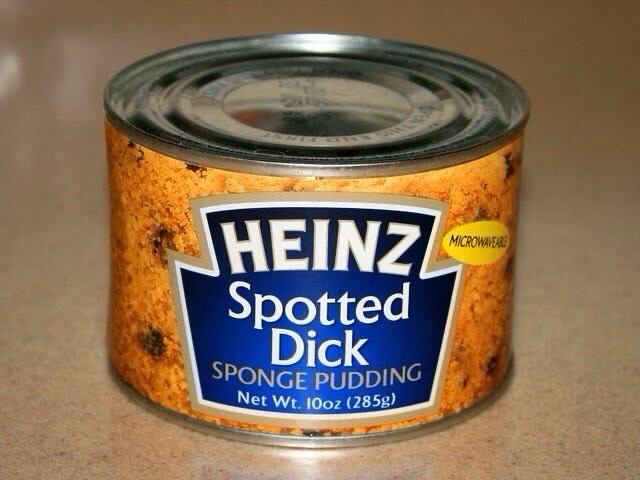
I had long ago spotted this item in my local supermarket in suburban Washington, D.C., but was frankly too embarrassed to pick it up, walk around with it in plain sight in my cart, and then have to face the cashier at the front of the store.
I’ve tried ordering it from the market where I now shop, having moved to another part of the country, but apparently the good people of the southern U.S. are not into Spotted Dick. I consider that to be their loss.
When I did an online search of one upscale local market, they didn’t know what I was talking about either; however, this is what came up as possible acceptable substitutes:
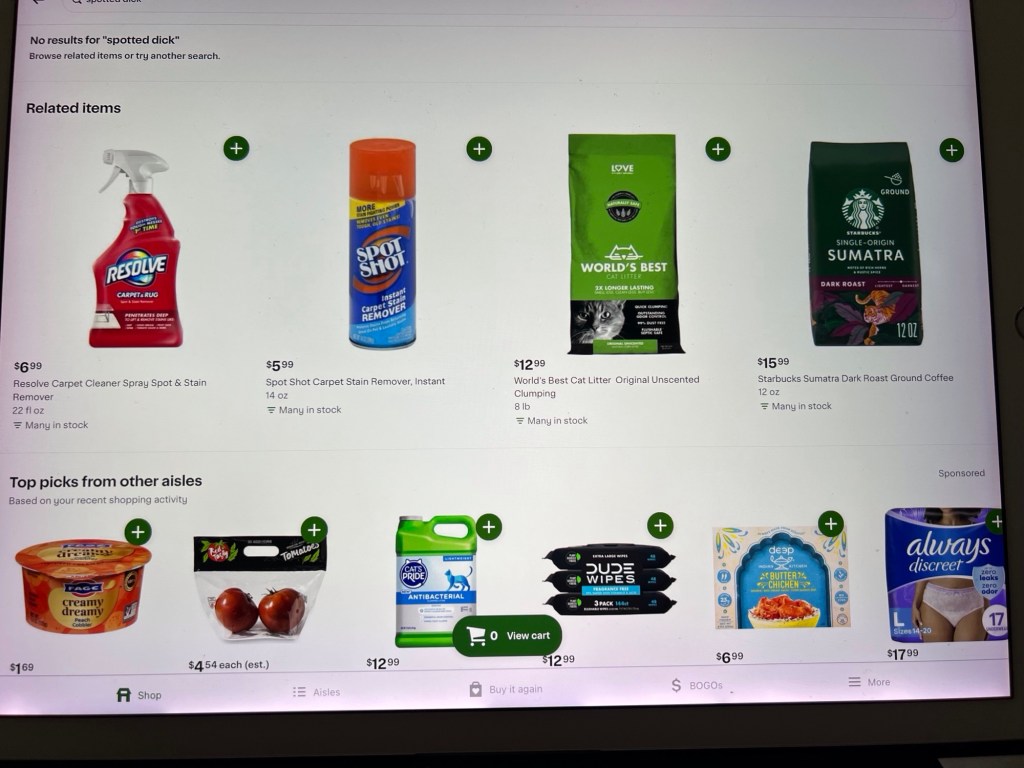
I thought about trying the “Creamy Dreamy” just for fun, but got hung up on wondering what twisted artificial intelligence thought the Spot Shot stain remover, Cat’s Pride kitty litter, extra-large Dude Wipes (use your imagination), and Always Discreet incontinence panties might be in the same category as a sponge pudding. (“Sponge,” by the way, being Britain’s name for a light, airy cake, which actually does make sense.)
But recently, I discovered that Amazon — yes, good old “Whatever it is we’ve got it and if we haven’t got it we’ll get it for you” Amazon — carries a different brand of it:
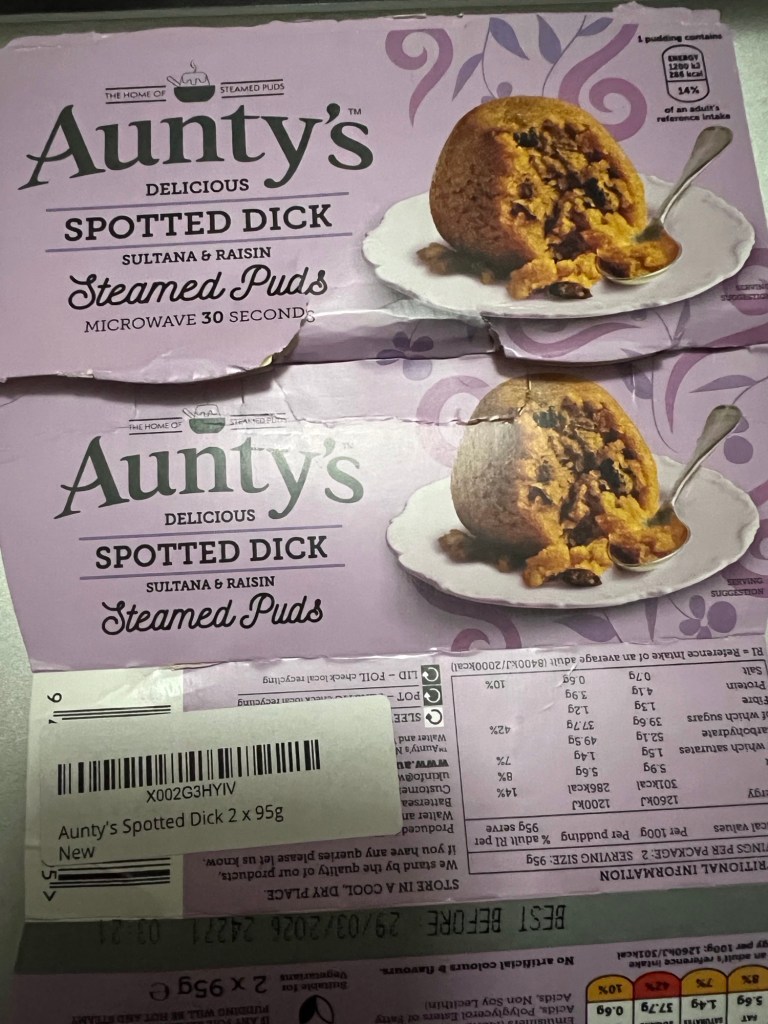
Now we know that Spotted Dick is a “steamed pud.” I’m sure you’ve figured out that a “pud” is short for “pudding” . . . but did you also know that, to the British, the term “pudding” covers a wide range of desserts, whereas in America a pudding is a thick, gloppy, viscous, milk-based dessert, and other desserts have their own specific names, like “pie,” “cake,” or “cookie.” (Actually, I believe a British cookie is called a “biscuit,” but that’s a whole other issue.)
Do you see why I’m so intrigued by the British? They speak an entirely different language!
Anyway, I was delighted to find that Aunty has a Spotted Dick (restrain yourselves, please), and I hastened to order just a single two-pack to satisfy my curiosity. When it arrived the very next day, I read the package, which turned out to be an education in itself.
The instructions were simple enough: remove the foil top from one cup of S.D., nuke on high (1,100-watt microwave) for 30 seconds, invert cup into bowl, squeeze and lift the little cup off the pudding, and enjoy. Okay . . . got it.

It was the list of ingredients that left me gobsmacked (there I go again!). You see, in the U.S., our laws require all ingredients in prepared foods to be listed in a specific way; but it is assumed that we don’t necessarily need — or want — to know what each ingredient is, or what it is likely to do to our bodies. Not the natural stuff, like flour, sugar, or milk . . . but those mysterious last items, like “xanthan gum.”
And I don’t know whether it’s also required by British law, or perhaps Aunty just decided to do it on her own, but the package from my Spotted Dick contained far more detail than I had ever expected (or hoped) to see. Allow me to elucidate:
After all of the recognizable ingredients, which are real food, we have Sodium Bicarbonate and Disodium Diphosphate. These are identified as “raising agents.” The first one I know as “baking soda”; the second one was, until today, a complete mystery. Actually, I think they should be called “rising” agents, not “raising,” because they obviously are responsible for making the batter “rise” when heated. “Raise,” I believe, is a transitive verb, which means it must take an object, so what are they supposed to be raising . . . the dead? I think not.

Anyway, on to that Xanthan Gum, which turns out to be a “stabilizer.” That’s good . . . because there’s nothing worse than an unstable Spotted Dick.
Next came Calcium Chloride, which is identified as a “firming agent.” Actually, I would have thought that was some sort of fitness trainer, or perhaps a miracle face cream, but what do I know?
For preservatives, we have Sorbic Acid and Alcohol. Aha! Now we’re getting somewhere. I know several people who are well preserved with alcohol, but they don’t usually bother adding it to food; there are much quicker ways . . .

At this point, it gets even more confusing, so I’ll copy it for you, verbatim, from the package:
“Acidity Regulator (Lactic Acid), Natural Flavouring, Emulsifiers (Mono- and Diglycerides of Fatty Acids, Polyglycerol Esters of Fatty Acids, Non Soy Lecithin.”
Discounting the natural flavoring (don’t even get me started on the differences in spelling of that word), the rest of the list seems to indicate that the manufacturers add fatty acids and esters of fatty acids, but first they make sure they’ve included an “acidity regulator” to . . . well . . . presumably to regulate all those fatty acids, including Ester’s (whoever she is).
And if that Lecithin is “non soy,” then why won’t they tell us where it does come from? Don’t we need to know that as well? It could be from eggs, and if you’re vegan, that would be a problem.
After completing this tutorial in nutritional chemistry (if there is such a thing, because it actually sounds like an oxymoron to me), I then noticed a section in all capital letters, beginning with “CAUTION.” Well, I’m not stupid, so of course I went on reading because my life might be in danger here:
“CAUTION: REMOVE ALL THE FOIL LID BEFORE HEATING IN THE MICROWAVE. IF ANY FOIL REMAINS [there should be a comma at this point, but there isn’t – ed. note] DECANT INTO A BOWL. PUDDING WILL BE HOT AND STEAMY.”
That is, if the piece of foil hasn’t caused your microwave to explode, in which case you’ve got bigger problems than a steamy hot pudding.

God, I love the British!
Just sayin’ . . .
Brendochka
4/8/25
P.S. Just ate my first Spotted Dick, and the verdict is . . .

 The Blog About Everything … and Sometimes Nothing