No one actually speaks Shakespeare; in fact, only a small percentage of people truly understand it. Perhaps, in Elizabethan England, people went around rhapsodizing in sentences such as, “But soft, what light through yonder window breaks?” (“Romeo and Juliet”). But I doubt that line would get you many dates today . . . unless you’re looking for a quick trip to the funny farm.
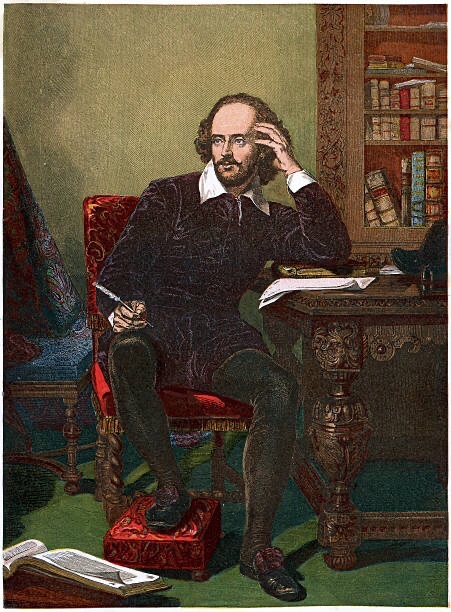
However, if you know me at all, you’ve probably noticed that I have a tendency to quote other, far more eloquent personages than myself. And one of my favorites is old Will Shakespeare, who has provided us with such bits of wisdom as “This above all: to thine own self be true,” and “It [life] is a tale told by an idiot, full of sound and fury, signifying nothing.” I particularly like that last one.
So when I happened upon an article referencing other of the Bard’s original phrases — most of which I had heard, but had no idea of their origins — I immediately clicked on the link (shakespeare.org.uk) and was fascinated to learn just how much of today’s conversational English dates back to the late 16th and early 17th centuries, and to Mr. Shakespeare himself.
For example, how many times have you cleaned out a closet and discarded something that has “seen better days”? That one is from “As You Like It.”
And in the same play, we learn that there can be “too much of a good thing.” (Although, in the case of my favorite guilty pleasure — Haagen Dazs ice cream — I’m not sure that’s true.)

Have you ever thought there was “neither rhyme nor reason” (“The Comedy of Errors,”) why you “have not slept one wink” (“Cymbeline”). I certainly have — although there usually is a reason, like too much of that Haagen Dazs late at night.
“Hamlet” is just loaded with pearls of wisdom. In Act 3, Scene 4, Shakespeare talks about something we now call tough love . . . but he calls it being “cruel to be kind.” Perhaps he was criticizing someone’s apparel, because earlier, in Act 1, Scene 3, he commented that “People are judged by the way they dress.” I used to believe that; though seeing the way most people dress these days, “in my heart of hearts” (Act 3, Scene 2), I’m not so sure. I even wonder whether “my own flesh and blood” (Act 1, Scene 5) would agree with me.
Shakespeare was really on a roll when he gave birth to Hamlet!

*. *. *
Now we come to “Henry IV,” which I confess I’ve never even tried to read. It introduces characters with names like Falstaff, Hotspur, Mistress Quickly (the less said about that, the better), Nym, Bardolph, Pistol, and someone called Doll Tearsheet . . . which makes me wonder what Shakespeare had been smoking during that period of his life. But he did come up with one lasting phrase when one of his characters complained that someone “hath eaten me out of house and home.”
To me, the highlight of “Julius Ceasar” is Marc Antony’s soliloquy at Caesar’s funeral, which is just dripping with sarcasm worthy of the harshest of today’s political commentators. But there are a few others that have stood the test of time, such as “a dish fit for the Gods,” “It’s Greek to me,” and being made of “sterner stuff.”
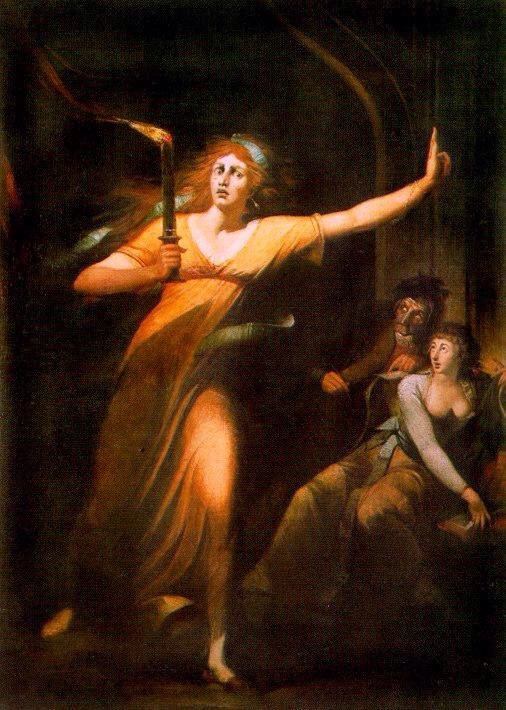
And my personal favorite — “Macbeth” — brings us such immortal phrases as “the be-all and the end-all,” and “What’s done cannot be undone” (when Lady Macbeth goes completely off her trolley).
“Othello” is certainly worth reading, as it talks of “Jealousy is the green-eyed monster,” “[a] foregone conclusion,” and someone who “wear[s] my heart upon my sleeve.” And in “The Merchant of Venice,” we learn that “All that glitters isn’t gold,” and how to recognize “a blinking idiot” (by the blinking, I should think).
The list goes on and on, so I’ll just close with a few more and leave it to the more curious of you to check out others for yourselves:
“The world is my oyster” (“The Merry Wives of Windsor”)
”Short shrift” (“Richard III”)
“A tower of strength” (“Richard III”)
”Star-crossed lovers” (“Romeo and Juliet”)
”Wild-goose chase” (“Romeo and Juliet”)
”Break the ice” (“Taming of the Shrew”)
”Brave new world” (“The Tempest”)
”Melted into thin air” (“The Tempest”)

*. *. *
Whew! I’m exhausted just from reading all of this; I can’t imagine how much effort must have gone into coming up with that much original thought and wisdom.
And I am gobsmacked (British slang, mid-20th century) at how many of our most common colloquialisms date back 400 years — and all to one man with ink-stained fingers, who really knew how to turn a phrase.
And so, with that, “I shall say good night till it be morrow.”

(“Romeo and Juliet,” of course.)
Just sayin’ . . .
Brendochka
3/17/25
 The Blog About Everything … and Sometimes Nothing