Gather ‘round, boys and girls, for a class in sex education that I guarantee will leave you feeling thrilled that you are Homo sapiens, and not octopi (or octopuses — it’s optional).
And for all of you equal rights enthusiasts out there, this lesson should also open up some interesting debates about the whole male-female dominance thing. So let’s get at it, and peek in on some octopi . . . well . . . getting at it.
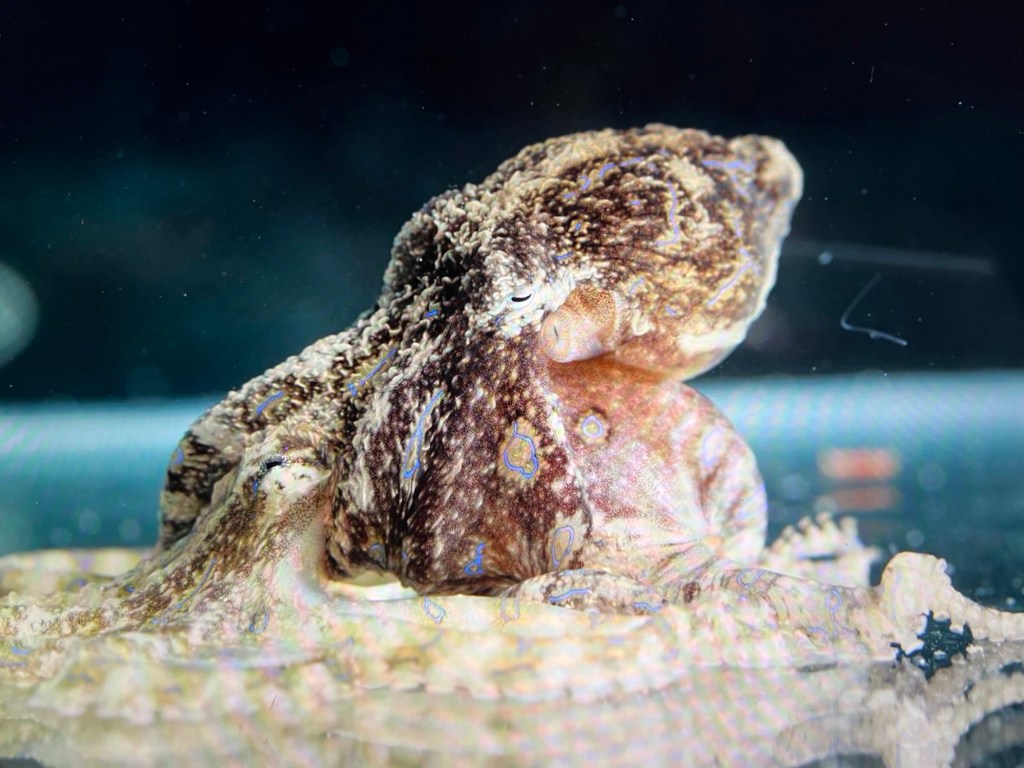
Please do not ask me whether this is a picture of a male or female octopus, or which end is which. Or, for that matter, whether there even is an end, or if it’s just a big blob. I don’t know, and — not being a member of its species — I frankly don’t care. It is, however, important to other octopi.
What I have learned is that — like the praying mantis and some spiders — the female octopus, after mating, devours the male, thus getting even with him for disturbing her sleep, and putting an end to his further philandering.
Score one for the female of the species.

But it turns out that, over however-many years or centuries, Mother Nature stepped in and helped the hapless males of some species of octopi by giving them longer mating arms, so as to keep a safer distance from the females while still being close enough to . . . well, you know.
Now, for reasons unknown, the male blue-lined octopi (BLOs) have not been included in that lucky group, and still have to live with shorter mating arms. They do, however, have another, even more diabolical, built-in weapon: an extremely powerful venom known as tetrodotoxin (TTX), which — while dangerous, and sometimes even deadly, to humans — merely knocks out another BLO for a sufficiently long period of time to allow . . . well, you know.
Sort of an undersea Rohypnol.
So — being male and therefore inclined at times to think more with their reproductive organs than their brains — at some point one of them discovered that, if he first snuck up behind the lady of his choice and bit her in a specific area, thus injecting her heart with some of that venom, she would be temporarily immobilized . . . allowing him to have his way with her and escape without becoming her next meal.
And the word spread among his male colleagues, giving new meaning — at least in the world of blue-lined octopi — to the term “date rape.”
Score one for the guys.

*. *. *
How do I know all of this? Quite simply, through someone else’s hard work. An animal neurobiologist at the University of Queensland, Australia, Wen-Sung Chung, wrote of his team’s study of the mating ritual of the blue-lined octopus, during which they found — for the first time ever — evidence of a neurotoxin being used in mating, rather than for hunting or defense. [Jack Guy, CNN, March 13, 2025.]
I’m not sure how scientists decide that it’s important enough to raise a great deal of money to study some of the things they do, but I have confidence that somehow this golfball-sized mollusk is vital to the world’s ecosystem. In any event, Chung’s report made far more enjoyable reading than any of the political horror stories of the day.
And as for his conclusions, allow me to quote Chung himself:
“They have very strange mating behavior.” He further described the process as “an arms race between the sexes,” and added that “It’s a kind of survival skill.” [Id.]
Well, yeah . . . it would be, wouldn’t it?

*. *. *
All of which left me wondering which member of the copulating couple I should side with: the cannibalistic female, or the predatory male. And my conclusion is that they pretty much deserve each other.
If science has taught us nothing else, it is that Mother Nature usually knows what she’s doing . . . with the possible exception of us humans.

Just sayin’ . . .
Brendochka
3/14/25
 The Blog About Everything … and Sometimes Nothing