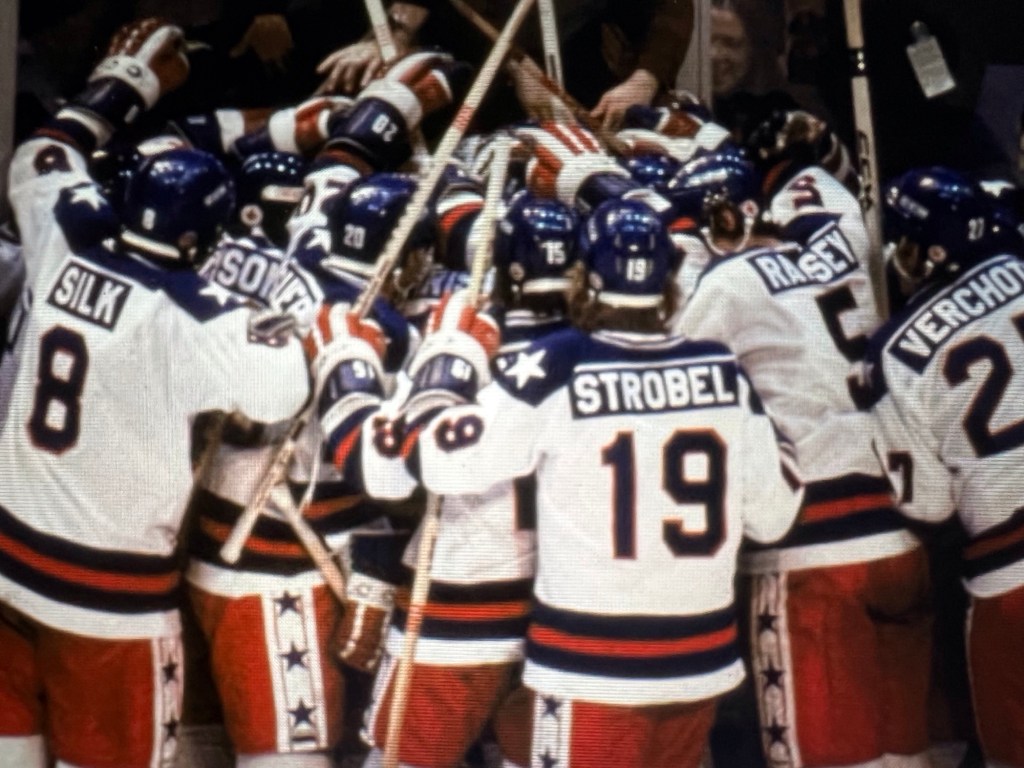
Yes, I’ve been digging back through the history files again, and I see that it was on this date in 1980 that the U.S. Olympic hockey team — comprised of college players and considered the obvious underdogs in the match against the four-time gold-medalist Soviet team — performed the now-famous “Miracle On Ice” at Lake Placid, New York.
Against all odds, the Americans beat the pants off the Russians in a nail-biting game that ended 4-3 for the Yanks. And the world went nuts.
In the interest of full disclosure, as always, I admit that I am not a hockey fan. In fact, I’m not much of a sports fan at all, though I do enjoy watching some of the individual sports — particularly gymnastics, skating, swimming and diving. But all in all, I’d rather see a good play or musical.
So why does this event bring back such a clear memory? Actually, it’s because of what happened the following Monday, February 25th, when I was back at work in the law offices of Surrey, Karasik & Morse in Washington.
For those of you who haven’t been following me regularly, allow me to explain, as briefly as possible, that I was working as assistant to the senior partner of the firm, Walter Sterling Surrey, a man of exceptional accomplishments, incredible mental acuity, an unpredictable temper, unflagging loyalty . . . and a sense of humor that knew no bounds and gave no quarter to anyone.

The firm’s practice consisted in large part of the representation of major corporations in connection with international commercial transactions throughout the world’s six inhabited continents. (For some reason, the penguins on Antarctica never saw the need to retain our services.) And a number of Walter’s clients had business dealings in both China and the Soviet Union, which necessitated maintaining contacts with the commercial attaches in both of their embassies.
On the day in question — Monday, February 25th — it happened that “our man” in the Soviet Embassy, Valentin, was scheduled to meet with Walter in our offices to discuss a possible transaction between one of the firm’s clients and the relevant Soviet Ministry (all business was conducted with the Soviet government in those days).
Valentin was the first “real” Russian I had ever met, and he was nothing like the blustering, threatening image I had previously had of Soviet officials. Instead, he was quiet, well-spoken, obviously intelligent, pleasant, and always helpful to Walter in navigating the Soviet bureaucracy. We knew we couldn’t trust him; but we liked him.
That Monday, the chatter in the office — as in much of the rest of the country — was all about the big hockey win the previous Friday. And when Valentin arrived, and I went to escort him from the reception area to Walter’s office, Beelzebub suddenly took control of my brain and my tongue, as he so often did.
As we shook hands and said good morning, I asked Valentin — as I did with all visitors:
“May I offer you something: Coffee? Tea? Hockey puck?”
Holy Mother of God! What had I done?!!
One would think that, at the very least, I had just lost the best job I’d ever had . . . or, at worst, started World War III. But, though the devil may have been in charge of my tongue that day, an angel was obviously sitting on my shoulder. Because Valentin laughed. And I laughed. And we kept laughing, all the way down the hall to Walter’s office.
Later, when the meeting was over and Valentin had left the office, Walter of course had to know what had been so funny. And when I told him, he too roared with laughter. It was just the sort of thing he would have said . . . which is what saved my skin, and my job, that day.

*. *. *
Recalling this small incident today has brought on a sudden wave of nostalgia for what I call my “Walter years.” The ten years that we worked together were, for me, years of learning, of growing, and of being an integral part of the excitement of the ‘80s. Walter was my boss, my mentor, my friend . . . and a father figure, not only to me, but to all of “his people.”
He was, in his earlier years at the State Department, the chief legal draftsman of both the Marshall Plan and the NATO Treaty. He worked, mostly behind the scenes, with Richard Nixon and Henry Kissinger to reopen commercial relations with China in the ‘70s. And he never met anyone he couldn’t converse with, from heads of state to taxi drivers. But he never bragged of his accomplishments. He didn’t need to; you just knew, when you met him, that he was someone special.
I could write a book about those ten years. And who knows? . . . maybe I will.

Just sayin’ . . .
Brendochka
2/22/25
 The Blog About Everything … and Sometimes Nothing