He’s a new friend. We’ve never met, and doubtless never will, as I live halfway around the world in America. But we read each other’s blogs, and sometimes comment on them, always with the greatest mutual respect. And I know that if we ever did meet, we would become the best of friends.
Much like myself, he writes on a variety of topics. And what he has written about his country has stirred my interest in a land to which I frankly had not given a lot of thought in the past — probably because it doesn’t make the headlines with tales of war and other horrors that fill the daily news reports from so many parts of the world. So I have ordered a book on the history of New Zealand, which Amazon has promised to deliver by tomorrow, and I can’t wait to dive into it.
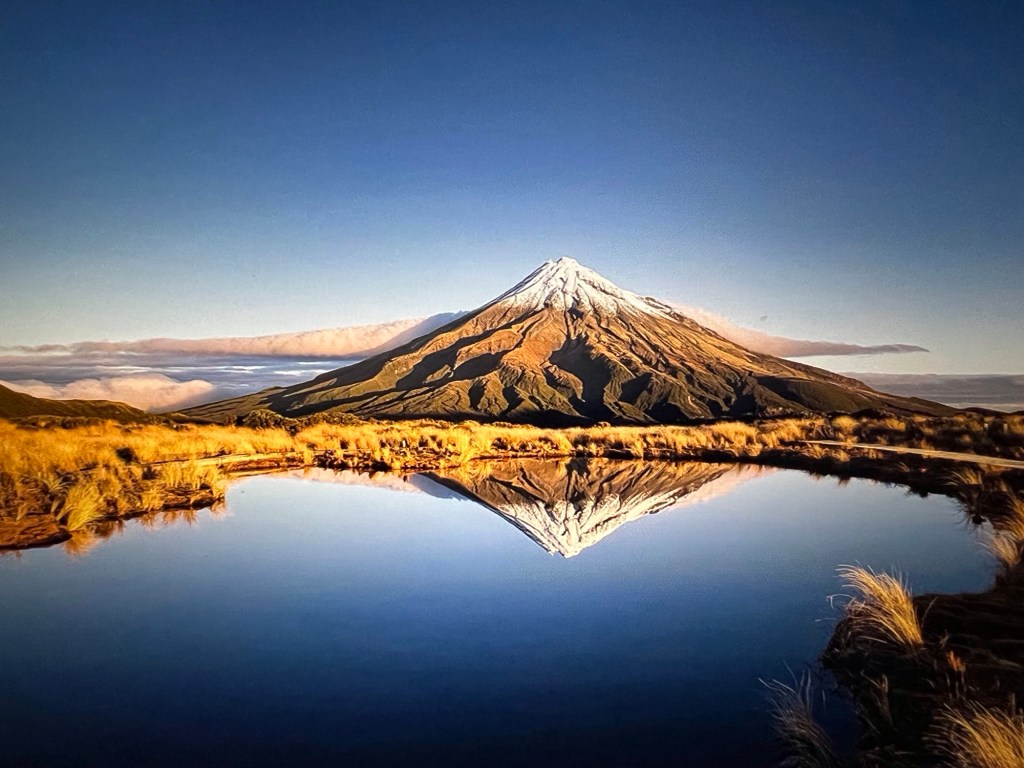
In the meantime, though — and by one of the rare true coincidences in life — I happened upon an online article a few days ago about a mountain in New Zealand — Mount Taranaki — that has been granted personhood.
And I thought: “What on earth . . . ?!!!”
I know that in some languages — French and Russian, to name just two — many inanimate objects are referred to as possessing either masculine or feminine gender. But my native language is English, and to me, an inanimate object is neuter . . . plain and simple. Dogs and cats have genders; birds and fish have genders; dishes and silverware do not.
But on the other hand, who are we to say that a mountain is inanimate? It gives life and shelter to countless flora and fauna. Its winter snows provide springtime moisture to the lands below. The Maori — the indigenous people of New Zealand — consider Taranaki Maunga (the mountain’s Maori name) to be their ancestor. It is a pristine, snow-capped dormant volcano, and a popular spot for hiking and snow sports. And it is not the first natural feature to be granted personhood in New Zealand, that honor also having been awarded to a river and a stretch of sacred land. [Associated Press, January 30, 2025.]
And the recognition of Taranaki Maunga has both spiritual and legal significance for the Maori people, as it is a part of the vast lands that have, since the arrival of the first Europeans on New Zealand, been the subject of conflict between the original Polynesian settlers — now known as the Maori — and the more recent occupants. [Id.]
So, congratulations to Taranaki Maunga, and to all of your people. May you continue to live in peace and harmony with nature, and with one another.
Just sayin’ . . .
Brendochka
2/3/25
P.S. And to my Kiwi friend, I hope I have gotten all my facts straight, and that you will let me know if I haven’t.
 The Blog About Everything … and Sometimes Nothing