They’re still out there, you know — those mysterious drones, flying over the U.S. eastern seaboard, the U.K., and now Germany. We in the U.S. and U.K. are still waiting for some official word as to what they are — or at least an indication that some action is being taken to identify and eliminate them.
Germany, on the other hand, isn’t messing around; the German Cabinet has authorized the army to shoot down suspicious drones seen near military sites or other critical infrastructure.

A statement was issued by German Interior Minister Nancy Faesar, saying that “. . . especially since [Russian President Vladimir] Putin’s war of aggression against Ukraine, we have seen that drones are being used more and more frequently, which poses an increasing challenge for the police and their current technology.” [Paulin Kola, BBC News, January 14, 2025.]
Way to go, Germany! No hesitation, no secretiveness, no pussy-footing around. Bring those trespassers down and find out just what is going on in your air space. Because this is not just one random event; it’s a major security issue. And it’s no longer limited to drones.
*. *. *
Two days ago, Polish Prime Minister Donald Tusk told a news conference in Warsaw:
“I will not go into details, I can only confirm the validity of fears that Russia was planning acts of air terror, not only against Poland but against airlines around the world.” [Mike Eckel, RFE/RL, January 15, 2025.]

He was referring, among other things, to a series of incidents that took place last July in three different parts of Europe, all involving cargo carriers or storage facilities:
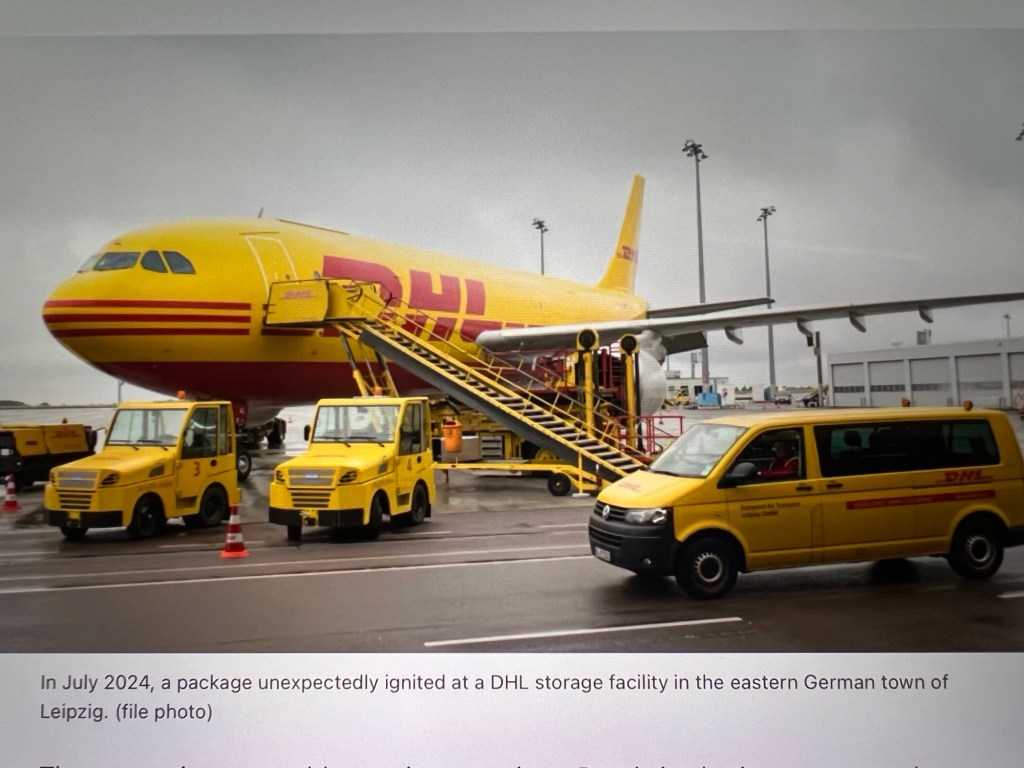
— In the eastern German town of Leipzig, a package shipped from Lithuania suddenly ignited at a DHL storage facility. The fire was quickly extinguished, and damage was minimal.
— Around the same time, a similar incendiary device ignited — again at a DHL warehouse — this time in Birmingham, England. It had arrived on a DHL plane.
— And, still within the same time frame, a device exploded and caught fire at a transport company facility in Jablonow, near Warsaw, Poland. That one took firefighters two hours to put out. [Id.]
*. *. *
Throughout Europe, there is a growing fear of a “shadow war” being conducted against the West by Russia. Taken together, there have been too many recent incidents to be considered coincidental.
In early 2024, an assassination plot was uncovered and averted. The target was Armin Papperger, CEO of Germany’s Rheinmetall — one of the world’s largest producers of artillery and tank shells, which had been producing shells for Ukraine since Russia’s invasion in 2022.
There have also been a number of maritime incidents, mainly on the Baltic Sea, in which undersea power or telecommunications cables have been broken or damaged. In December, the EAGLE S, a Russian-operated oil tanker — though flying a “flag of convenience” from another country — was detained by Finnish authorities en route from St. Petersburg, Russia, to Port Said, Egypt. It was determined to have dragged its anchor and damaged a cable in the Gulf of Finland. [Id.]

Czech Foreign Minister Jan Lipavsky, speaking before a meeting of NATO ministers, said last month that “This year [in 2024] there were 500 suspicious incidents in Europe. Up to 100 of them can be attributed to Russian hybrid attacks, espionage, influence operations.” [Id.]
Intelligence reports from the United States, the U.K., Germany, Poland and others all indicate a Russian connection. U.S. intelligence agencies have obtained intercepts of conversations of Russia’s GRU — its military intelligence agency — describing how the ignited packages were actually a test run for further activities. [Id.]
*. *. *
There is little doubt among Western officials that Europe and North America are the targets of a Russian “shadow” campaign — including sabotage, espionage and disinformation — to destabilize the West and undermine its support for Ukraine.
Russia, of course, vehemently denies any and all such suggestions. Our old friend, Kremlin spokesman Dmitry Peskov, called the accusations of an airline sabotage plot a “vague fabrication.” Well, of course he did.
In the meantime, Europe is increasingly on the alert for whatever may be coming next from its eastern neighbor. North Korea drops garbage-filled balloons on South Korea. Russia, it seems, has a far more fertile imagination, greater technological capabilities . . . and a willingness to go the extra distance.
And that is frightening.

Just sayin’ . . .
Brendochka
1/18/25
 The Blog About Everything … and Sometimes Nothing