
The book had been bought by Simon & Schuster in record time, and Valentin Aksilenko and Yuri Shvets still had eight days remaining before the expiration of their visas. Having lived in the Washington, D.C. area in the 1980s, they knew their way around, and said they wanted to spend some time on their own, revisiting old haunts, and possibly a few old friends. And I knew — though I couldn’t be sure whether they knew I knew — that a good bit of their time would be taken up by the FBI.
But that didn’t let me off the hook entirely. I became less of a business consultant and more of a chauffeur / personal shopper as they made the rounds of the area, which had changed somewhat since they had last been here. And, of course, the feds were never far away from my door, either.
This was totally unfamiliar territory for me: having to watch every word I said to the two men, while trying to remember what they discussed in case I might hear something significant. From the beginning, I had had a strong sense that their mission was about more than the sale of a yet-unwritten memoir. There were too many nagging questions — the main one, in my mind, being the ease with which they had been able to leave Russia for the United States.
As it turned out, the doubts in my head at that time were nothing in comparison to the ones that would arise later in the year, when . . .
But wait, I’m getting ahead of myself. Suffice it to say for now that my stress level didn’t drop until they finally boarded their return flight home on May 5th.

But then I had to prepare to follow them to Moscow for several months; and I had only five days left to get ready.
I had lived overseas once before — in Prague, two years earlier — so I knew what had to be done. But knowing, and doing, are two separate and distinct things . . . and especially when you’re going to live in a place like Russia, where life is so different from anything you’re used to, and not all of your accustomed creature comforts are going to be available.
So, aside from cleaning out the refrigerator, stopping the mail and newspaper deliveries, arranging for someone to start my car every few days to keep the battery from dying, and notifying the building management of my absence, I also had to figure out what to pack and what to leave behind.
And what I packed, besides clothes, peanut butter and a few cans of tuna, was a complete pharmacy: something for headaches, something for a cold, something for diarrhea, something else for constipation, toothpaste, deodorant, Bandaids and antibiotic cream, soaps, lotions, feminine products, makeup . . . enough for at least three months, when I would be coming home on a break before returning for another three months (or so I had been promised). I’ll never forget the expression on the face of the cashier at the drug store when I wheeled the overflowing cart up to her register.
Then I was informed by the head of the foundation I was representing that it would be helpful if I could take with me a few office supplies. By “a few,” I soon learned that he meant a desktop printer, toner cartridges, heavy reams of printer paper, curtain rods and curtains, and the all-important stapler and staple remover . . . among other things that I have long since chosen to push out of my mind.
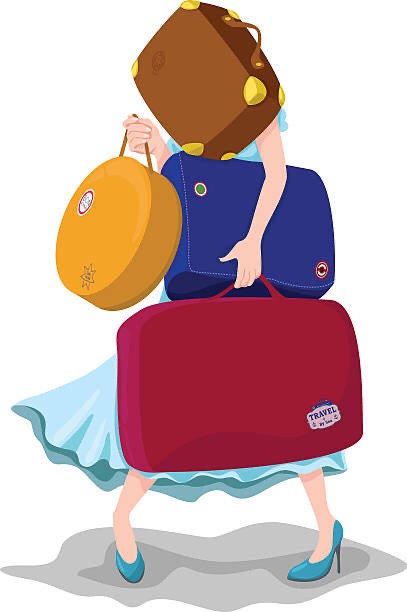
In all, I had 14 pieces of baggage: six large suitcases of my own, and the rest belonging to the foundation. And with that, I set off for Dulles Airport on May 10th, having been told that I would be met at Moscow’s Sheremetyevo Airport by a man named Vitold.
*. *. *
Keep in mind that it was 1993, and flying was much simpler then. Baggage limits and weight restrictions were far less stringent — but even so, 14 pieces for a single passenger was a bit unusual. I had been booked on Air France, and as I approached the counter, I could see the airline agent eyeing my driver and me with our carts filled to capacity with suitcases and boxes. His first question, of course, was, “What is all of that?”
I explained to him that we were from a humanitarian aid organization furnishing healthy food to Russian children in orphanages and hospitals for the chronically ill, and his businesslike demeanor immediately turned to bouillie (mush). He loved what we were doing.

When I said that I was going there to live and work for a while, and that all the boxes were office and apartment necessities, he agreed to let it all pass — but at a cost, as I recall, of something close to $800. However, he asked us to wait a minute while he talked to his supervisor; and when he returned, smiling, he said he had been authorized to cut the overweight charges in half. It was still a hefty $400, but I had the foundation’s corporate American Express card for just such an emergency.
And off I went, with a very warm feeling in my heart for the lovely people of Air France, and a sense of unreality at what I was doing: heading out by myself to live with the “main enemy,” where the only people I knew were a couple of ex-KGB officers, and where I could only try to imagine what lay ahead.

As I was soon to find out, my imagination didn’t even come close to the reality of the next three months and beyond . . .
*. *. *
To be continued . . .
*. *. *
“There are more things in heaven and earth, Horatio,
than are dreamt of in your philosophy.”
– William Shakespeare, Hamlet, Act I, Scene 5
Brendochka
1/9/25
 The Blog About Everything … and Sometimes Nothing