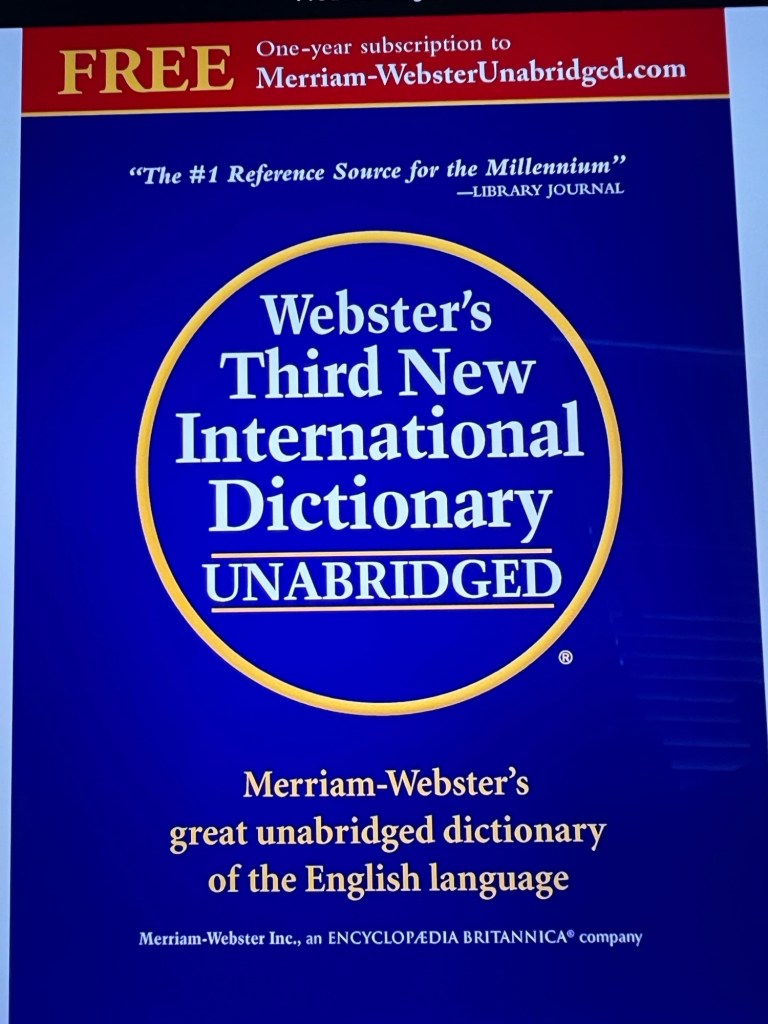
Not only does this edition of the eminent Webster’s Unabridged International Dictionary list for $129 ($82.93 at Amazon) . . . it boasts of 2,662 pages of mostly unused words.
Example: Words like “hypocoristic” — my online Word of the Day yesterday — which is defined as “a pet name or diminutive form of a name.”
I can see it now. A new baby is born, and the happy parents have named her Elizabeth. Friends and family come to meet the newest member of the clan, and someone asks:
“Have you decided on a hypocoristic for her, or will she be called Elizabeth?”
See what I mean? What’s wrong with “nickname”? Or “pet name”? Or even, if you prefer multi-syllabic words, “diminutive”? No one is going to ask you what her “hypocoristic” is, because no one will ever have heard the word.
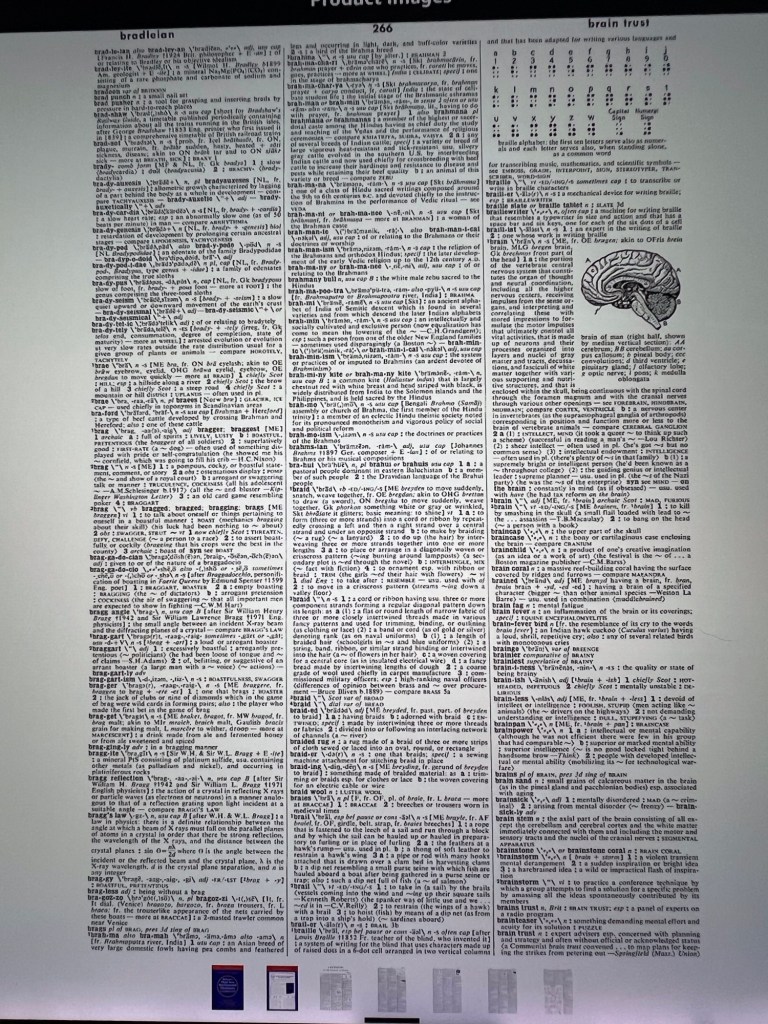
But we have 2,662 pages of words — pages filled with microscopically small print — that could be reduced to fit into a volume a normal human being could actually lift, and possibly even read without a magnifying glass, if we eliminated all the superfluous ones.
Now, I love languages — the melodic, mellifluous sounds of the words; the regional idioms; the little nuances that distinguish the native speaker from the student; the similarities and the differences among the various language groups. Language is an integral part of our national identity. And I’m not suggesting we slash away at a language until it is unrecognizable. I would never do that.
But, in the English language at least, I think we have far more ways of saying the same thing than we really need. No, we wouldn’t want to use the same adjective to describe everything. (Actually, some people already do that — they can’t seem to think beyond “amazing.”)
Surely, though, there must be a point at which a sufficient number of synonyms become too many. And where words seem to exist for no good reason at all, because no one ever uses them. I’m not talking about terminology related to specific fields of study — just everyday conversational vocabulary.
Take the National Spelling Bee. At age ten, I was my elementary school’s champion, runner-up for the city . . . never mind how long ago. And we had some fairly difficult words to learn. The one that sticks in my mind is “conscientious.” But those were words that people knew and used — though not everyone knew how to spell them.

Today’s list of words includes — along with some of the more common ones, of course — the likes of “vivisepulture,” “Beauceron,” “logorrhea” (which sounds like a tree disease to me), “ctenoid,” “glaucescence,” “luftmensch” (could that be German?), “mitrailleuse,” “nuque,” “paduasoy” . . . and so on.
In order to satisfy my insatiable curiosity, I looked up the definitions of these words, and this is what I found:
Vivisepulture: Not listed in my online dictionary; but by combining the prefix “vivi” (“of the living”) and “sepulture” (“a catacomb”), I decided it must refer to a catacomb of the living. Now, that’s just creepy!
Ctenoid: Rough-edged. Okay, that might be useful if you’re a veterinarian specializing in the treatment of cats’ tongues. (And the “c” is silent, by the way — which is also puzzling, and mildly irritating.)
Glaucescence: The state of being bluish-green . . . or greenish-blue. Or it can also refer to a whitish coating on a plum. Don’t ask me; I haven’t a clue as to how the same word can mean two totally different things — which, as we all know, is a far too common occurrence in the English language.
Luftmensch: Also not in my online dictionary. But from my very limited knowledge of German, I’d guess that it refers to a very smart air force pilot. The Red Baron, perhaps?

Mitrailleuse: Another foreign word, French this time. It’s a machine gun. Very useful in everyday American conversation, I should think.
Nuque: The back of the neck — not a quick way to prepare food, or wipe out an entire city in one blow.
Paduasoy: A strong silk fabric. We should probably keep this one for all the folks in the garment industry.
Beauceron: Also French, one of man’s best friends.

Logorrhea: Not a tree disease after all. Rather, it refers to a form of pathologically incoherent, repetitious speech; or an insistent or compulsive talkativeness. I always just called it diarrhea of the mouth. Actually, “logorrhea” does sound better.
*. *. *
You know, after this little foray into linguistic obscurity, I’m having second thoughts about scrapping some of these words. They’re rather fun, actually . . . though I doubt I’ll remember any of them tomorrow. And I do think they should be eliminated from the National Spelling Bee competition, as the only thing the students learn from them is memorization through repetition — not really how to spell.
All of this mental exercise has made me hungry, so I think I’ll go now, put on my glaucescent paduasoy dress, invite my favorite luftmensch to join me for dinner, and nuque something in the miquerowave. Perhaps tomorrow I’ll try to find that vivisepulture everyone has been talking about.

Just sayin’ . . .
Brendochka
1/8/25
 The Blog About Everything … and Sometimes Nothing