
February 20, 1993: Saturday evening, back at home in Virginia.
In the two days between my meeting with Valentin Aksilenko and my departure from Moscow, I had had little sleep. And since that trip had included a second person — an American business colleague — there wasn’t much time to think, either. Our entire week had been taken up with business meetings, dinners, and other discussions; and I couldn’t very well talk to her about my predicament in any event.
By the time I walked into my apartment, I was too tired to do much of anything. Without even unpacking, I called a couple of people to let them know I was back, took a quick shower and flopped into bed, anticipating another restless night. Surprisingly, though, I slept soundly for the first time in days, and woke up around noon the next day.
Feeling much better, I immediately fell into my usual Sunday routine of opening the front door to retrieve the Washington Post, dropping the paper on the kitchen counter, and reaching for the orange juice in the refrigerator. But a headline had caught my eye, and I turned back for a second look. What I had seen were the letters “KGB.”
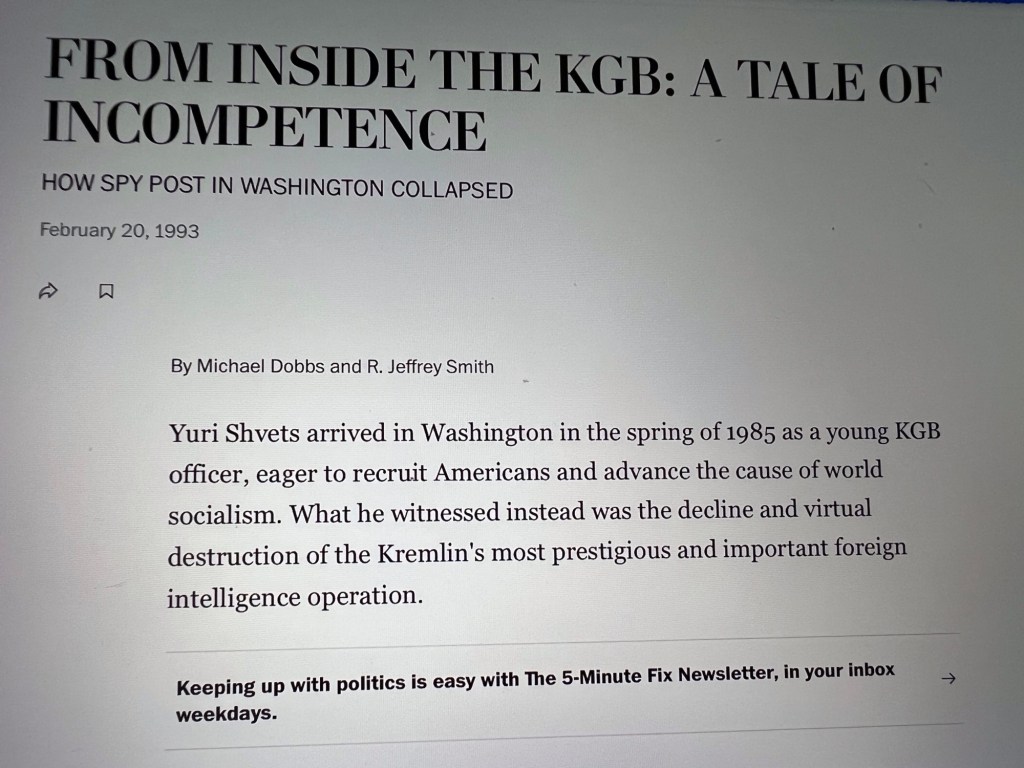
The article was about a former KGB officer who had walked into the Moscow office of the Post to give an interview about a book he was writing concerning his years as a spy in Washington in the 1980s. His name was Yuri Shvets, and I knew immediately that he was Aksilenko’s “friend.” But he was no longer anonymous.
And I lost it. For a solid ten minutes, I stormed around the apartment, cursing everyone and everything that came to mind.
What had all the cloak-and-dagger secrecy been about in Moscow? If it was too risky to publish the book in Russia, why was this idiot shouting about it to the press? Was he suicidal, or just plain stupid?
It was just after 8:00 p.m. in Moscow as I dialed Aksilenko’s home number. When he answered, I got straight to the point.
“Valentin, what in hell is going on??!!!” I practically shouted into the phone.
And he laughed. He actually laughed. Then he said simply, “I guess you’ve seen the Washington Post.”
So I was right — this Shvets person was indeed Valentin’s unnamed friend. And at the same time, I realized that the phone at the other end of my call was likely not a secure line. Calming myself, I listened as Valentin assured me that everything was “under control,” that the business we had discussed was to proceed as planned, and that they still wanted me to help out at my end . . . even offering to draft a contract between us for my finder’s fee. He didn’t seem concerned about the possibility of anyone listening in on his calls — much less about any repercussions from the Russian authorities.
As I sat down to read the article once more, I could not imagine how he could have said that everything was under control. I began thinking about what to do next in light of this new development. I could always just wait a few days and tell him I hadn’t had any luck in finding anyone with contacts in publishing. But something . . . some niggling little thought in the back of my mind . . . kept telling me there was more to this than just a book. Common sense was saying to drop it; but for whatever reason, my conscience was arguing to keep my options open.

And of course, there was also the possibility of earning some honest money if the book were to be published. So, first things first, I decided to call a friend in the Justice Department on Monday morning, to be sure there was no legal prohibition against entering into a commercial arrangement with a couple of ex-KGB spies.
If, indeed, they were “ex.”
*. *. *
To be continued . . .
*. *. *
Brendochka
1/4/25
 The Blog About Everything … and Sometimes Nothing