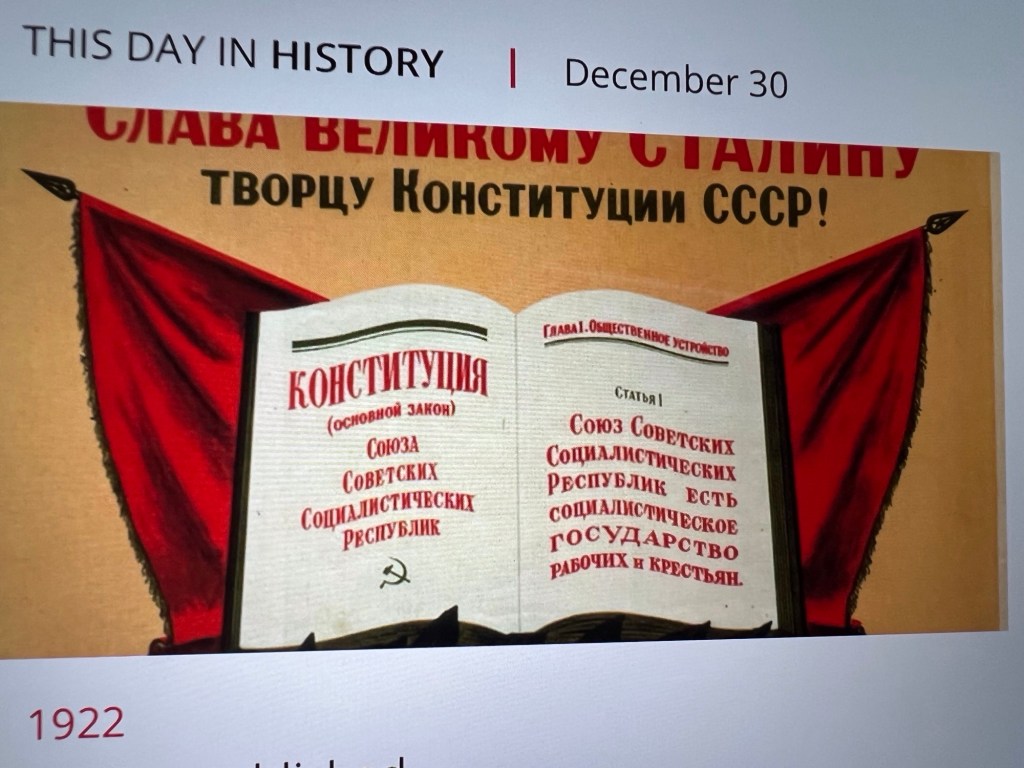
Or so it was said on this date in 1922, five years after the Bolshevik Revolution of 1917, when a confederation of Russia, Belorussia, Ukraine and the Transcaucasian Federation* entered into a treaty officially establishing the Union of Soviet Socialist Republics — or the more easily pronounceable Soviet Union — and rendered the Russian Empire extinct.
[* Later, in 1936, to be divided into the three Soviet Republics of Georgia, Armenia and Azerbaijan.]

During those five post-revolutionary years, Vladimir Lenin’s Bolshevik Party had fought (and won) a civil war and established a tightly-controlled, socialist form of government, making Russia the first country in the world to be based on Marxist socialism. The country was ruled by the Communist Party and its Politburo; all industry was owned and operated by the state; and all agricultural land was divided into state-run collective farms.
Over the following years, the USSR expanded to include Moldavia (now Moldova), the three Baltic states of Latvia, Lithuania and Estonia, and the five Central Asian republics of Kazakhstan, Uzbekistan, Kyrgyzstan, Tajikistan and Turkmenistan: a total of 15 Soviet Socialist Republics controlled by the government located in Russia.
And the rest, as they say . . .
*. *. *
And just 69 years later, on Christmas day of 1991, it all fell apart, when Boris Yeltsin took the reins of power from Mikhail Gorbachev, and the Soviet “hammer-and-sickle” flag was lowered and the tri-color flag of the Russian Federation raised over the Moscow Kremlin.
What celebrations there were then! What joy! What optimism! What a decade of wild, unbridled galloping toward democracy, capitalism, Western-style freedom was to follow.
What a pipe dream!

Because you can’t tear down one structure and expect another to immediately pop up in its place. You have to have a plan, and the tools and materials for a new structure. And none of those things existed in Yeltsin’s Russia. So what they did have, for eight crazy years, was chaos.
Then along came Vladimir Putin to “fix” things.
And the rest . . . well, you know.
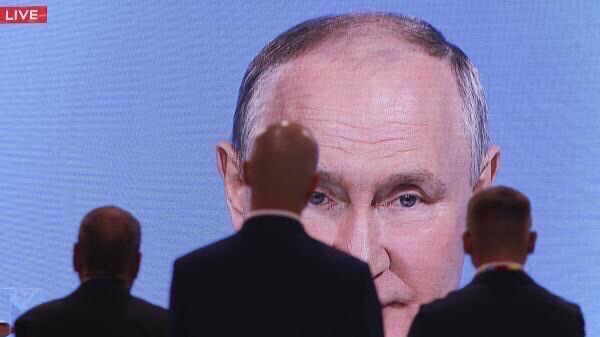
Today, after a quarter of a century in power, Putin has indeed “fixed” things. He has stabilized Russia’s economic, industrial, military, agricultural, and social structures . . . if, by “stabilized,” you mean “taken total control of.” Today’s Russia has become a carbon copy of Lenin’s USSR: an expansionist, militaristic, oppressive, closed society with a government ruled by one evil, shifty-eyed, megalomaniacal little tyrant determined to rule the world.
He is, in effect, the 21st Century’s Lenin . . . history repeating itself, but with technology and weaponry never imagined 100 years ago.

The world moves much more quickly now than it did a century ago. What lies ahead for Russia in the next decade — or, for that matter, in the next days — cannot possibly be predicted. We can only hope for something better than what it has today.
Just sayin’ . . .
Brendochka
12/30/24
 The Blog About Everything … and Sometimes Nothing